
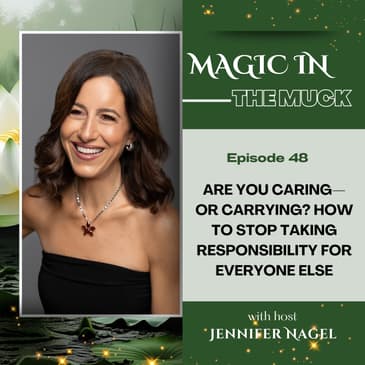
Do you find yourself noticing what everyone else needs — and then feeling responsible for making things better? In this solo episode, Jennifer explores the subtle shift from caring to carrying, and how trusting in another person’s capacity can help us stay deeply connected to others without losing connection with ourselves.
Through a personal story about learning to step back as a parent, Jennifer explores what can become possible when we stop clearing the path for others and leave enough space for their own resources to emerge.
What You’ll Hear:
- How being highly attuned to others can quietly become feeling responsible for their experience.
- The subtle but powerful difference between caring for someone and carrying what belongs to them.
- Why trust may be one of the missing ingredients when we’re trying to help someone we love.
- How stepping back can give others room to discover their own capacity — and give us the opportunity to see it too.
- Why therapists and helpers can care deeply about someone’s healing without becoming responsible for the outcome.
- A gentle experiential reflection to explore: What belongs to me, what belongs to them, and can I stay connected without leaving myself?
Resources Mentioned
Meet the Host: Jennifer Nagel
Jennifer Nagel is a soul-centered counsellor, international facilitator, and best-selling author who has spent over two decades helping people navigate chaos, reconnect with their inner wisdom, and create meaningful, authentic lives. Deeply rooted in the Satir Model and experiential approaches to transformation, Jennifer brings a grounded presence, sharp insight, and a deep trust in the resources of the human spirit.
Her work spans continents and cultures — she has led programs and trainings in Canada, China, Kenya, Thailand, and Mexico, and currently serves as Director of Trainer Development with the Satir Institute of the Pacific. She is also senior faculty with the Banmen Satir China Management Centre.
Jennifer is the author of Magic in the Muck: Finding Grace in Chaos, co-author of Virginia Satir’s Evolving Legacy, and founder and co-author of the collaborative books Therapists Are Human Too and The Healing Journey to Authenticity, created through book-writing retreats she co-facilitated in Mexico.
Connect with the Host:
Website: www.jennifernagelcounselling.com
https://www.congruentpractice.com/
Instagram: https://www.instagram.com/jennifernagel1/
Facebook: https://www.facebook.com/jennifer.nagel.566
LinkedIn: https://www.linkedin.com/in/jennifernagelcounselling/
Costa Rica Retreat: Coming Home to Congruence: https://www.congruentpractice.com/costa-rica-retreat
If you’re longing for a place to connect with others on a soul-aligned journey of healing, growth, and transformation — come join us in the Magic in the Muck: A Soul’s Compass Community, our private Facebook group. It’s a welcoming space to explore the themes from the podcast, share your own magic-in-the-mess moments, and receive inspiration to navigate life’s changes with grace and soul.
💫 Click here to join the community https://www.facebook.com/groups/magicinthemuck
And if you’d like to receive occasional updates about new podcast episodes, upcoming retreats, and other soulful offerings, you can sign up for the Magic in the Muck email list here:
📬 Sign up to stay connected (subscribepage.io/REMTuN)
Magic in the Muck: A Soul’s Compass for Change is proud to be on the High Vibe Podcast Network. Check out Jennifer’s Gift in the Vault https://highvibepodcastnetwork.com/gifts
Share the Love
✨ If this episode lit something up in you… tag us on Instagram @HighVibeLeaders and let us know your biggest takeaway!
🦋 Don’t forget to rate & review — it helps us reach more conscious rebels like you.
Listen & Subscribe
🎧 Spotify
Hello, and welcome back to Magic in the Muck, a soul's compass for change. I'm your host, Jennifer Nagel, and I'm so glad that you're here today. I want to bring up last week's episode, because there was something that Joanna Lynn said that really stayed with me. She said, We lean in to notice the temperature of the room before we even notice our own temperature. And I remember thinking, Wow, yes. How many of us do exactly that, where we walk into a room, and almost immediately we can sense who's comfortable, who isn't, or noticing tension in the room, or tension between two people, or we hear something in someone's voice, and we think, Something's not quite right. We notice. And especially for those of us who are therapists, helpers, parents, caregivers, or maybe maybe just people who are naturally really attuned to others, this can be such a beautiful quality. But I've been thinking about what happens when that attunement becomes something else. When does, I can see that something's happening for you, become, I need to do something about this? And maybe the question underneath all of that is, can I stay connected to you without leaving myself? How do I stay with me while I'm also with you? So, that's some of what I've been sitting with since my conversation with Joanna, and what I thought we could explore together today.
Jennifer Nagel:So, where does this attunement come from? I was thinking of myself as a child. I was definitely someone who would observe from the sidelines at first. I was that person standing at the side really taking in the environment, kind of feeling things out. What's going on here? or Who's here? And what are the rules? What's safe? And how are people interacting with each other? Only once I felt comfortable, once I felt like I had a sense of what was going on, and once I understood the rules of engagement, then I was all in. I could just jump in and participate and have fun. But I needed to feel the environment first. And I was also really sensitive to conflict. If someone was upset with me, I wanted to make it okay. And then even when conflict had absolutely nothing to do with me, it was outside and happening outside of me, somehow I could still feel responsible for helping to make it okay, jumping in and being the mediator. I remember doing this between friends at school, and it carried over into my university years, as well. When I look back now, I can appreciate some of these beautiful qualities in that little girl. She was perceptive, she cared about people, and she was relational. And she noticed things. These are qualities that have served me very well in my life, and certainly in my work as a therapist. But I think somewhere along the way there was also this subtle connection that got made: If I notice what's happening, maybe I need to do something about it. Those are actually two very different things. This is where I think it gets interesting, because for many of us, that movement happens so quickly that we don't even know we've done it. Someone I love is unhappy, I notice, and before I know it, I'm figuring out what I can do to make it better. Or someone's disappointed with me, I notice, and maybe I'm explaining or smoothing things over, or trying to make sure that we're okay again. Someone's struggling, I can see a solution, so of course I
Jennifer Nagel:want to help, and there's nothing wrong with helping. I'm certainly not suggesting that we all stop caring about each other and say, Well, that's yours. Good luck with that. That's not what I'm talking about. I'm talking about that really subtle place where caring turns into carrying, where, I see you're struggling, becomes, I need to fix your struggle, or where, I know you're disappointed, when that becomes, I need to make sure you're not disappointed. And where we sometimes can see a way through something becomes, I need to show you the way, I need to pull you along. Maybe part of the work is not becoming less attuned. Maybe it's simply learning just because I notice something doesn't mean that it's mine to carry.
Jennifer Nagel:I think that's really important, that we can notice things, we can be really attuned to things, it doesn't mean that we're responsible for carrying it. So I've really been playing with those two words: caring and carrying. Because they can look really similar from the outside, and carrying often comes from a very loving place, a very caring place. Of course we want to help. We don't want someone we love to struggle. We know we can make something easier, so why wouldn't we? But I'm beginning to wonder whether there's something else that needs to be part of caring, and that's trust. Like who are we to say that, I know the solution and just follow me or let me help you? Can I care about you and trust you at the same time? Can I trust that you have resources and can I trust that you can struggle and find your way through something? Can I trust that you can have your disappointment? And can I even trust you to make a mistake? If you need something from me, you can ask. So that one can be hard for those of us who are really good at anticipating what everyone else needs before they even figure it out themselves to be able to ask for what they need. I've had such a great opportunity to practice this in real time, real life recently. Last weekend, my daughter moved away to go back to university. When she first told us that this was what she wanted to do, I'll admit that I had doubts.
Jennifer Nagel:There were reasons for my concern that belong to her and aren't mine to share here. But as her mom, I wondered whether she was ready, and then she came to us with a plan. She was really excited about it and really wanted this, and so we agreed to support her. And I've had to pay attention to myself through this whole process because I can be pretty resourceful. I can figure out what's needed, where to get it, how we're going to get it there. I can be super helpful, and and I made a conscious effort to stay out of the things that were hers to navigate. She and her friend found the apartment. She found an incredible amount of furniture on Facebook Marketplace. She figured things out, and now that she's there, I keep noticing these little moments when something pops into my head. Oh, I should remind her about or I should tell her about, and then I stop myself because does she actually need me to remind her about that? Do I really need to micromanage these things? I'm really working at letting it go, and that does not mean withdrawing. I mean, we helped her move. I took her grocery shopping, and I'm interested in how she's doing. I'm here when she needs me. I'm her mom, but I'm practicing being alongside her rather than out in front of her clearing the path, and what's surprised me is what's happened because I've held back. She's done this beautiful job of setting up and decorating her apartment. When we went grocery shopping together, she made great choices about what she needed. I wasn't telling her, Oh, you should get this or What about this? She did this on her own, and with every one of these little experiences, I noticed something happening for me. My hope is growing. My faith in her is growing. My trust is growing, and I realized had I stepped in and managed all of this for her, I might have missed the opportunity to see what she's capable of. That's been really profound for me, because if I'm worried that someone can't manage, and I step in and
Jennifer Nagel:manage things for them, then they have less opportunity to show me that they can, which means I get less evidence that they can, and then of course I continue to worry, and I continue to step in. So somebody has to interrupt the cycle, and well, that somebody in this case is me. So sometimes I need to tolerate my own anxiety long enough to allow someone else to discover what they're capable of, and to allow myself to discover what they're capable of, too. So this has made me think of something that I've learned over many years as a therapist. I care deeply about my clients.
Jennifer Nagel:I can hold hope for somebody's healing, even at times when they may not quite be able to hold that hope themselves. I bring my training, my experience, my intuition, and my compassion. I do everything I can to cultivate a space where somebody can feel safe enough to explore and heal and grow. But I cannot make another human being heal. I know this. I am not omnipotent. And that's actually quite freeing, really, because my responsibility is not to produce somebody else's healing. My responsibility is to how I show up, how I'm present, to be compassionate, to bring my expertise and my humanness. My responsibility is to help create the conditions where healing and change can happen. And underneath all that is something that I believe very deeply, and that is that people have internal wisdom and resources for healing and growth. Sometimes we lose touch with those resources. They're buried under years of hurt, or coping, or messages about who we're supposed to be. We've actually been using our resources for survival as well, but sometimes we just feel disconnected from them and aren't in touch with them. Sometimes we need another human being alongside us to help us reconnect with them. But I don't put those resources inside my clients. They're already there. And maybe that's part of what I'm learning again as a parent. I don't have to create my daughter's capacity. She already has the resources within her. I can support her while she discovers and strengthens her own. And perhaps that applies in so many of our relationships. Can I be alongside you without taking over your journey? If you are in a place where you can just gently close your eyes, or just go inward for a moment, bring to mind someone in your life whose emotional temperature you tend to monitor, someone that you love, and someone you care about, maybe somebody you feel particularly responsible for. And just notice what happens inside you when you imagine them struggling. What
Jennifer Nagel:is it that you immediately want to do? Do you start problem solving, or do you want to make something better? What do you notice happening inside your body? Without judging any of it, just get curious what your tendency is when you see someone you care about struggling. And ask yourself, what am I afraid might happen if I don't step in? And then maybe ask yourself, what actually belongs to me here? What belongs to me, and what belongs to them? And what belongs to the relationship between us?
Jennifer Nagel:And one last question: Can I stay connected to you without leaving myself? Can I care deeply about what you're experiencing and still trust that you have resources of your own? And just take another breath, connecting with your own resources, trusting that you have resources of your own, while they also have resources of their own. And when you're ready, come back. Maybe write down anything that you notice. I think maybe this is what I'm learning. Becoming less responsible for everyone else's experience doesn't require us to become less caring. Maybe it actually invites us into a different kind of caring, one that includes trust, trust in the people we love, trust in our clients, trust in our team, our coworkers, trust in our children, and trust in ourselves that we can tolerate someone else's discomfort without immediately having to make it go away. I'm still practicing this, and I imagine I probably always will. The resources of that little girl, who learned to feel the temperature of the room, who are still are still very much a part of me, perceptive, compassionate, sensitive, observant. I just don't need to feel responsible for carrying everything I notice. I can care without carrying, and maybe that's part of coming home to ourselves, not getting rid of the ways we learned to navigate the world, but having more choice about when we use these resources, to be able to say to another, I see you, I care about you, I'm here, and I trust that your journey belongs to you. And sometimes, maybe one of the most loving things we can do is leave enough space for someone we care about to show us who they can become. Thank you for being here with me today. And until next time, may you continue to discover the magic hidden in the everyday moments of your own journey. Take care.