
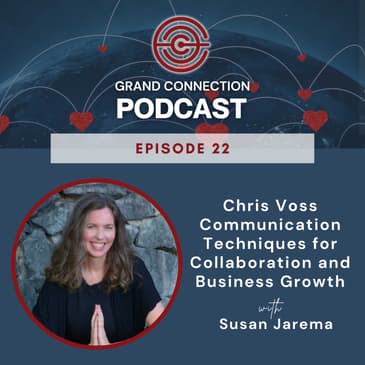
What changes when conversations stop becoming about control and start becoming about connection? Susan Jarema explores the communication principles behind trust, collaboration, and emotionally intelligent leadership through the lens of Chris Voss’ negotiation framework from Never Split the Difference.
Drawing from an earlier conversation about kindness in leadership, Susan reflects on how better questions, deeper listening, and calm presence can transform difficult conversations in business, partnerships, and everyday relationships. The conversation highlights how tactical empathy, emotional awareness, and thoughtful communication create stronger partnerships, healthier collaboration, and more sustainable growth.
What You’ll Hear:
- Trust grows faster when people feel fully heard instead of quickly responded to.
- Better questions create more meaningful and collaborative conversations.
- Tactical empathy helps people feel safe, understood, and open to connection.
- Win-win thinking strengthens long-term business relationships and partnerships.
- Calm, grounded presence changes the quality of every conversation.
Resources Mentioned on this Episode
- Never Split the Difference by Chris Voss
- Episode 18: Kindness in Leadership with Michael Neece
- The Neuroscience of Connection series with Ray McCauley
Meet the Host: Susan Jarema
Susan Jarema is a marketing strategist, internetologist, and co-founder of The Grand Connection. She helps entrepreneurs grow through collaboration, smart strategy, and high-impact digital presence. Susan is also president of New Earth Marketing, where she builds brands, websites, and ecosystems designed for real growth.
Connect with Susan and the Grand Connection Community:
Website: https://grandconnection.ca/
Facebook Group: https://www.facebook.com/groups/grand.connection
Facebook: https://www.facebook.com/GrandConnectionCommunity
Instagram: https://www.instagram.com/grandconnection.ca/
LinkedIn: linkedin.com/company/66749100
Youtube: https://www.youtube.com/channel/UCxq03yde7nb57HKV1hhztYA
Access your Grand Growth Bundle and Free Guest Pass: https://grandconnection.ca/gifts
Learn more about our Neuroscience of Communication Self Mastery Program
We are proud to have Grand Connection Podcast on the High Vibe Podcast Network. Grab your free gift from Susan in our Our High Vibe Gift Vault.
Love this show? Check out the other shows on the High Vibe Podcast Network.
Share the Love
✨ If this episode lit something up in you… tag us on Instagram @HighVibeLeaders and let us know your biggest takeaway!
🦋 Don’t forget to rate & review — it helps us reach more conscious rebels like you.
🔊 Listen & Subscribe
🎧 Spotify
Welcome to The Grand Connection podcast. I'm your host, Susan, and at the Grand connection we believe business grows best when people come together to connect, create and collaborate. In an earlier episode number 18, kindness in leadership, with Michael Neese, I had a really meaningful conversation about kindness, trust and collaboration. We talked about how kindness builds trust, how trust creates psychological safety, and how that becomes the foundation for strong collaboration. But there was one moment in that conversation that really stood out with me. I asked Michael how to handle tough situations, those moments where something isn't working or communication is breaking down. And instead of giving a script or a strategy or telling us exactly what to say, he talked about asking better questions, questions like, how do you think this is going? What do you think is getting in the way, and then just listening, giving space and letting the other person think? And I remember myself thinking, this is such a simple shift, and it's surprisingly easy to do, but it changes everything, because in that moment, you're not correcting someone, you're not pushing your agenda, you're creating space, and that builds trust.
Susan Jarema:And if you haven't listened to that episode yet, I highly recommend going back to Episode 18. Michael brought up the work of Chris Voss, the author of never split the difference, and this is a wonderful place to learn about communication in difficult situations. And he shared that he learned this approach of asking thoughtful, how and what questions and allowing that space from Chris. And he shared also that this is by far one of the most effective ways to handle difficult conversations. And, of course, I smiled when he said that, because I read that book, and maybe you have too, and I loved it. And I've actually, I've got the audio too, so I've listened to that because, you know, I love audiobooks, and I've used those techniques, and I've seen just how powerful they are, and I really want to share them with you here today, because things aren't always perfect in business or in relationships. Sometimes we need to have those tougher conversations, and it's so easy to put them off, to avoid them, maybe to do them in a way you wish you could repeat the conversation, or to hope they just resolve on their own. But what I found in this is when you have a simple process that you can trust, those conversations become a lot easier to step into, and you can handle them in a way that actually builds trust instead of breaking it, and you don't spend days ruminating on how to handle it. Now, if you're not familiar with Chris Voss, he's a former FBI hostage negotiator, so these techniques didn't come only from theory. They came from real life, very high pressure situations where emotions were tough, trust was low and the outcome really mattered. His job wasn't to win an argument. It was to build trust quickly, understand people deeply and guide conversations towards better outcomes, and what he discovered is something incredibly relevant for all of us. People make decisions emotionally first and justify them logically later. So instead of pushing or persuading,
Susan Jarema:he focused on listening deeply, asking thoughtful questions, labeling emotions and creating a sense of safety. And when you think about it, that's exactly what we need in client conversations, referral relationships, partnerships and collaborations, and honestly, even with our kids, because sometimes the toughest negotiations aren't in business, they're at home. I remember thinking at one point I might need to bring in an FBI negotiator just to get my son to clean his room. And what actually works, not pushing, not reacting, but listening, asking better questions and staying calm. And this is really helpful in business and life, because those same skills work everywhere, and I've experienced this myself many times. One example comes to mind recently where I've gone into a conversation thinking, I know how I can help here, or have the solution I. And I'm ready to jump in, share ideas, offer solutions, but when I pause and ask, what's the biggest challenge you're facing right now and then really listen, the conversation shifts, because what they share is often not what I expected. And now we're not in a pitch, we're in a real conversation. That's where connection deepens and collaboration begins. And you can use this when meeting someone to partner with, and also when meeting someone who may be a potential client, or it can be your son who leaves the kitchen a mess. So today I want to walk you through six simple principles I learned from never split the difference, written by Chris Voss, that you can start using right away. I'll list them off first and then give some examples. Number one is listen deeply. Number two, use tactical empathy. Number three, ask better questions. Number four, label emotions and concerns. Number five, seek Win Win, not quick wins. And number six, stay calm and centered. And I'll connect each of these back to our framework, the Connect, Create, Collaborate framework, because this is where it becomes real, not just ideas,
Susan Jarema:but habits you can use every day. And by habits I mean small things you consistently practice in conversations, pausing instead of reacting, asking a better question, instead of giving advice right away, listening all the way through, instead of thinking about what you'll say next. These are simple, but when you practice them consistently, they completely change how you connect with people, and this is exactly what we explore in our neuroscience of connection series with Ray McCauley. And if you haven't listened yet, I invite you to go back to episodes four, five and six, and we take this even further in our Self Mastery program, where we practice these habits in real conversations so they become natural. Because when you combine that self awareness with these communication tools, that's when real transformation happens. So let's start with principle number one, listen deeply. The first principle is to listen deeply. Most people listen so they can respond. I remember doing this so much when I was younger, strong communicators listen to understand. When someone feels heard, trust rises quickly. For example, at a one on one connection call, instead of starting with what do you do, you might ask, what type of clients are ideal for you right now, if a member says business is slow, instead of jumping in with your advice, you could ask, What do you think is the biggest reason? Or if a speaker says they want more bookings, you might ask, what kind of stages feel most aligned for you? This is how we truly connect. The second principle is tactical empathy. Empathy is not fixing things. It's showing someone that you understand their reality. For example, if a potential collaboration partner says they are overwhelmed, you might say, it sounds like you have a lot on your plate right now. If a client is delaying a decision. You could say, it seems like you want to feel fully confident before moving ahead. If someone is quiet in a breakout room, you might gently say,
Susan Jarema:I'm curious what's coming up for you right now. This helps people feel seen. And when people feel seen, they are more open to connection. This strengthens how we connect. The third principle is to ask better questions. Better questions create better conversations. And better conversations create better opportunities. Instead of pitching invite clarity. You might ask, how could we support each other's communities? What could make this collaboration exciting for you. What kind of introductions are most valuable for you? How would you know this partnership is working? And here's a simple shift. Instead of saying, I can help you with marketing, ask, what is the biggest frustration with your marketing right now? Instead of saying, Do you want to collaborate? Ask what kind of collaboration would feel most natural for you. This is where we create clarity ideas and momentum. And I want to bring back to what Michael shared earlier, when he was talking about how to manage difficult conversations, Michael suggested asking questions like, how do you think this is going, or what do you think is getting in the way? And then just listen, give space, let the other person think
Susan Jarema:the.
Susan Jarema:Fourth principle is to label emotions and concerns. Often people don't say the real issue directly, but when you respectfully name what may be happening, trust can increase, and an important part of this is not just labeling, but checking in, giving the other person space to confirm or clarify. For example, it sounds like budget might be a concern. Is that right? Or it seems like timing may not feel right right now? Is that accurate? It sounds like trust matters before taking the next step. Am I hearing that correctly? That last part is the key, because now you're not assuming you're being the bridge, not the billboard. You're not telling someone what's true for them. You're inviting them to share what's really going on. And often that's when they'll open up and say, no, it's actually this and that's when the real conversation begins. If someone says, I need to think about it, you might respond. It sounds like you want to be sure this is the right fit. Is that right? If a referral partner keeps hesitating, you might say, it seems like clarity around roles would help. Here am I hearing that correctly, and again, you're not assuming. You're giving them the space to say, Yes, that's it, or no, it's actually something else. And that's where the real conversation opens up. This creates honest conversations, and honest conversations help us create together. The fifth principle is to seek Win Win outcomes, not quick wins. And this is so big at the Grand connection. We're all about collaboration, and it's always win, win, win, win, win. And this one is so important in our community, because it's easy in business to think short term. How do I get the client? How do I close the deal? How do I get that referral? But when we focus only on quick wins, we can unintentionally damage long term relationships. What we want instead is to think in terms of shared success. Win. Win means both people benefit. Both people grow. Both people feel good about the
Susan Jarema:outcome. So instead of asking, What can I get from this, we shift to, how can we both grow from this? Let me give you a real example. When I'm in a one on one with someone who's been introduced into the Grand connection, I'm very intentional. I don't lead with talking about membership, even though, of course, that could be relevant. Instead, I focus on them. I ask questions, I listen, I understand what they're building, what they need, what kind of connections would support them. And I will often hold back sharing details about the membership until they ask, because when they ask, it means the interest is real. It means the conversation is aligned, and now we're not in a pitch, we're in a collaborative conversation that's a very different energy, and it builds trust, because they feel seen, not sold to. And what I found is those conversations lead to much stronger relationships and much better long term outcomes. This is not about holding back value. It's about sharing at the right time in the right way, for the right reason and in the grand connection. This is where things really come to life. This is where conversations turn into partnerships. Introductions turn into referrals, and relationships turn into real opportunities. You're not just building a business, you're building a network of trusted collaborators, and this is the heart of collaborate. The sixth principle is to stay calm and centered. And this one is more important than we often realize, because your energy speaks before your words do. People don't just hear what you say. They feel how you show up. And I learned this in very, very real ways. I remember one time getting on a call, very frazzled. I'd been rushing from one thing to another. I was late, and I didn't give myself any space in between. The person I was meeting was a healer. We've got a lot of healers in our community, and right away, she sensed that my energy was not aligned. Before we even got into the conversation, she
Susan Jarema:actually said, let's stop and pause for a moment. And she guided us to take a breath and get centered, and she went through a short meditation. I remember that moment very clearly because everything shifted. The pace slowed down. I became present, and the conversation that. Followed was completely different than it would have gone otherwise. Now not all of us are getting onto calls with an NLP coach or meditation teacher, but that experience really stayed with me, and it made me realize I need to create that space for myself. I need to avoid stacking too many back to back meetings and take a moment to ground myself my own way before I show up. And this is why I really love the mindful minute practice that Ray McCauley has taught our community. It gives you a simple way to do this on your own, before a call, before a meeting, before any important conversation, before a talk you're doing in front of a big group, you pause, you breathe, you center, you focus on a value, and you bring yourself fully into the moment. Because when you're centered, you show up differently. You listen better, you respond more thoughtfully, you create a space where others feel safe to open up, and that strengthens your ability to connect, create and collaborate. When you look at all of this together, it's not just about having perfect words, it's about how you show up, listening builds connection, just like we talked about earlier, empathy builds trust, and questions create clarity, and that's what opens the door to collaboration. If you'd like to experience this kind of conversation in real time, we invite you to join us at the Grand connection. Come connect with heart centered entrepreneurs from around the world, build meaningful relationships and discover collaboration opportunities that can truly grow your business. You can grab your free guest pass and your grand growth bundle at Grand connection.ca. Forward, slash gifts, and before you end your day
Susan Jarema:to day, ask one better question to someone you care about, and just listen see what opens up until next time, let's connect, create and collaborate.