
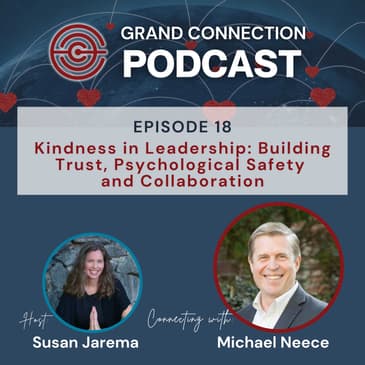
What happens when kindness becomes a consistent leadership practice rather than an occasional gesture? Susan Jarema and Michael Neece explore how kindness strengthens trust, builds psychological safety, and supports meaningful collaboration. Through shared insights, they highlight how small, intentional actions shape stronger relationships and more resilient teams.
The conversation connects naturally to the Connect, Create, Collaborate framework and the GRAND Growth Model, emphasizing that sustainable growth begins with self-awareness, empathy, and reliability. By focusing on what is within reach and approaching others with generosity, leaders create environments where ideas are shared openly and collaboration becomes both effective and deeply human.
What You’ll Hear:
- Kindness begins to reveal its role as the underlying force that shapes trust, collaboration, and leadership effectiveness.
- Psychological safety emerges as the quiet factor that determines whether teams thrive or struggle.
- The idea of the three-foot radius shifts how focus, responsibility, and personal leadership are understood.
- Gratitude and reframing experiences begin to soften ego-driven reactions and open space for better teamwork.
- Small, intentional meeting practices start to change how people feel seen, valued, and willing to contribute.
- Kind leadership is redefined through the willingness to address tension with honesty while still honoring the human behind it.
Featured Guest: Michael Neece
As President of Our Future is Kind, Michael teaches people how to use the power of kindness to create innovative, productive, and efficient teams.
His wide-ranging experience includes leadership and educational roles in traditional corporate settings as well as planetariums. He has delivered more than 750 sessions about team building, kindness, the wonders of the universe, and the curiosity invoked by space exploration. Michael has developed a unique approach to helping teams thrive by talking about kindness through a cosmic lens.
Michael is the author of "In Kind: Consciously Craft a Meaningful Life and Career" and “Joy Unleashed: The Ultimate Guide to Living Your Best Life.” He hosts the podcast, “Our Future is Kind,” where he interviews executives, futurists, politicians, artists, writers, and community leaders to help his audience ponder, “What should the future be like? Who will be there? How can we craft it carefully into what we want and deserve?”
Connect with Michael:
Website: https://OurFutureIsKind.com
Instagram: https://www.instagram.com/michaelgneece
LinkedIn: https://www.linkedin.com/in/yournextkeynotespeaker
YouTube: https://www.youtube.com/@YourNextKeynoteSpeaker
Meet the Host: Susan Jarema
Susan Jarema is a marketing strategist, internetologist, and co-founder of The Grand Connection. She helps entrepreneurs grow through collaboration, smart strategy, and high-impact digital presence. Susan is also president of New Earth Marketing, where she builds brands, websites, and ecosystems designed for real growth.
Connect with Susan and the Grand Connection Community:
Website: https://grandconnection.ca/
Facebook Group: https://www.facebook.com/groups/grand.connection
Facebook: https://www.facebook.com/GrandConnectionCommunity
Instagram: https://www.instagram.com/grandconnection.ca/
LinkedIn: linkedin.com/company/66749100
Youtube: https://www.youtube.com/channel/UCxq03yde7nb57HKV1hhztYA
Access your Grand Growth Bundle and Free Guest Pass: https://grandconnection.ca/gifts
We are proud to have Grand Connection Podcast on the High Vibe Podcast Network. Grab your free gift from Susan in our Our High Vibe Gift Vault.
Love this show? Check out the other shows on the High Vibe Podcast Network.
Share the Love
✨ If this episode lit something up in you… tag us on Instagram @HighVibeLeaders and let us know your biggest takeaway!
🦋 Don’t forget to rate & review — it helps us reach more conscious rebels like you.
🔊 Listen & Subscribe
🎧 Spotify
Welcome to the Grand Connection podcast. I'm your host. Susan Jarema, at the Grand Connection we believe business grows best when people come together to connect, create and collaborate. Today, we are going to explore how kindness strengthens collaboration, leadership and the way we work together. Joining us today is Michael Neese, president of our future is kind. Michael teaches leaders how kindness can build stronger teams, create psychological safety and helps organizations thrive. He is the host of the podcast, our future is kind of which I just had an interview on, so excited about that, where he explores how kindness can shape the future of leadership, organizations and community. Michael is also a member of the grand connection community, and has spoken on our stages many times. We have had the opportunity to collaborate in several ways, including our upcoming book project, podcast guest swapping, as we've done today, and sharing many introductions across our networks. Michael, welcome. I'm really looking forward to this conversation. Thanks so much for having me. Susan, so your podcast and the upcoming book is called our future is kind. What led you to this focus,
Michael Neese:I've been in five different industries leading up to this current role as president of our future is kind. And let me just tell you that having purpose driven work is really important to me, knowing that every day I'm waking up, I'm doing something that I genuinely believe in. But equally important, maybe even a little bit more important, is the people, always the people. It's the customers that we serve. It's our supervisors, it's the people that we are leading, it's the people who are helping us or whom we are helping. I love people, and so when I decided I was going to jump out into the land of being a solopreneur, I said, well, I need the right name for the company. And I said, our future is kind that's the best possible name, because I'm thinking about building that future that I want to live in that we all deserve to live in, and it's got to be centered on kindness. So what other name fits? That's the one.
Susan Jarema:Oh, well, it's a perfect name. And I love the idea of visioning a better future. You know, there's so many movies that are like apocalyptic, negative ones. We got to have more kind ones that have this, this like, because they're creating the visions, right? Absolutely, absolutely.
Michael Neese:That's why I always turn to Star Trek as my my beacon of what the future could be like, where people are are honored, if they're showing up in good faith, if they're smart, if they're caring, if they are innovative, if they have a sense of adventure, and if they listen to each other and value each other?
Susan Jarema:Yeah, no. Well, we kind of have to do a list swap of good shows that are positive, because I have certain times where I just, I just want to watch something really, really positive, right? Let's get that together at the grad connection and share a whole list for everybody. So how does kindness influence the way people collaborate? Because we talk about connect, Create, Collaborate all the time here on this podcast, and at the Grand connection, we connect together. We connect we create so we're creating trust, we're creating ideas, we're creating opportunities, and then we collaborate well.
Michael Neese:Amazon does big data really well, and they did this project Aristotle a few years back in which they created teams, and in some cases they did hand chosen teams, where there were lots of rock stars and PhD holders and people with these amazing track records, and they just, they put them onto teams, and then otherwise, they just kind of let the teams blossom as they were going to. And what they found was that the determining factor for success was whether or not the team had psychological safety. That was it. That was the one big thing. Because if you have a lot of rock stars on the team, but they don't communicate, well, they don't hear each other. They want to be the one in the spotlight, their idea has to be the most important and best idea. Well, those teams collapse on themselves very fast. It's the teams where you have psychological safety, where you have success. And where does psychological safety come from? There's no other place it can come from than trust, because if you don't trust everybody else on your team, you're not going to say the semi dumb, goofy idea that eventually turns out to be the right idea. You won't say it out loud, or you won't say out loud the idea that you are afraid somebody else is going to steal that idea and pretend that it's theirs. So you have to have trust to be able to say the thing and whatever the thing is. And so that's your psychological safety foundation. Is trust. And then where does trust come from? It comes from kind acts. If people aren't kind to each other, it's hard to rely on each other, you know, if people are silent or if they're stoic and standoffish. Now you it's hard to build that layer of trust. So I always think that kindness is the root of everything.
Susan Jarema:Okay, so, okay, let's talk about trust. Like, because we talk about this in my in my framework, and I have a whole, I have a whole big section on trust, but let's talk about it here today. Like, I trust you. You showed up many a times. You even did a talk from the hotel member when your plane was late and you showed up anyways. You did it. You did it from your mobile phone. Like the best talk ever from a mobile phone, I'd say you were and and you had bad internet. The people walking behind you, I don't even but, but you showed up, right? And you let me know you were very consistent, and like you're you're very reliable. You let me know before I getting on this plane. The plane's been delayed. I don't know this might happen. I'm going to try to make it so I had enough time to prepare back a plan that I was going to do if you didn't show up. So I would have done a talk of my own, and you'd have been we didn't done that, but you showed up and you did it, and it was awesome, and everybody appreciated like, what you did.
Michael Neese:I remember that talk, and it was so much fun. You, you bring in the best members, because they had these great questions and and I really enjoyed the conversation that came from that.
Susan Jarema:So we build trust there. And you, you spoke another time earlier, I think. And then when you had the opportunity, came up for your book, your new book coming out, which is a collaborative book called, what's it called?
Michael Neese:It's called, our future is kind the ultimate guide to making a difference. Okay, so
Susan Jarema:same as your podcast, company, that's very good brand recognition, everybody. And it's, it's a wonderful topic. And when I saw that, like, I get opportunities like this coming across my my desk, or slash email, many, you know, many times in a week, even. And this one, I thought, You know what? I trust Michael, he is going this project is going to turn out really well. You also, like you have a lot of speaker experience, and you've done a collaborative book before, and I've seen you marketing that book, so you really followed through on your commitments
Michael Neese:Right? Absolutely. Yeah. Well, if we're not all the way in it, I don't know why we're in it. So that's a good thing.
Susan Jarema:So what are other things that you do in a company, like a company sitting would, if you go into a company and you're talking to them about how to build trust, like, let's say there's no trust. What are you going to do? Your first steps, you come in and join the
Michael Neese:Well, I mean, the first thing is you need to be at the leadership level, because the leaders are the ones who send the signals to everybody else. If you're going to middle management first, you don't have the buy in, and you have to really gage if the leaders are going to be really invested. But one of the first things you talk about is you have to focus on self, right? If you are not regulated well enough, if you are not you know, in your body, if you're not in your space, then you are not projecting out to everybody else. The right ethos, right? The right culture. And so what I try to teach people, you know, one of the very first things I teach them is the three foot radius idea is very simple. Navy SEALs here in the United States, it's this elite strike team. They rescue people, they carry out these covert operations. And the Navy SEALs talk about living in your three foot world, or owning your three foot radius, right? So if you are in charge of your three foot radius, that means the things that are within reach. That means that if you're in a huge situation where you're hearing yelling from this, you know, over here, and you're hearing gunfire from over that direction, and you're hearing explosions over there, you can get distracted, right? And so you have to be able to focus on what's in your three foot radius, because otherwise you're distracted. And what's in your three foot radius is a child who needs rescuing, or there's an attack and you're not ready for it because you were too distracted by the other thing. And this is the perfect metaphor for everybody in the modern world, because you turn on the news, it's nothing but distractions. It's things that are far away, that you can't necessarily make a dent in, and what you've got under your control is your three foot radius. So it's within your three foot radius, maybe your monitor and your keyboard and your mouse. Maybe it's the person who's near you who really needs that
Michael Neese:coaching, who needs help, right? But you can affect a lot of change if you own your priorities, and your priorities are always within reach. If it's out of reach, it means, yeah, you'll get there eventually, but right now, you focus on, what can I control in your three foot radius? And so that's that is the first place to start. And here's the trick. It's not just kindness to yourself to know what you should be focusing on. It's kindness to anybody who relies on you. Because if I know what my priority is and I do the thing I say I was going to do, now, people who are relying on me to do things know I'm reliable. They know they can come to me. They know they can give me. That hard task, and if I say I can't do it right now, they know that's real. And if I say I can do that right now, they know that's real. And so they know how to rely on me and when to rely on me, and that's all the time, because I'm always going to give a straight answer. So knowing about your three foot radius is a kindness to self, and it's a kindness to anybody else around you,
Susan Jarema:And it keeps you sane?
Michael Neese:Oh, absolutely, yeah, if you're if you're not always distracted, you're not dysregulated in your nervous system.
Susan Jarema:Well, we have our self mastery of connection program. So it's neuroscience of connection, and it's, it's really creating habits around self regulation, like understanding yourself first so that you can communicate and have mindful conversations. We do mindful minutes. We understand our brain networks and and what's going on inside so that we can, you know, this stuff is all going around, but we're really focusing on our mind. What's happening right here in our head nowadays? Yeah, that's a very good strategy. Do you have any others that you you work with clients on? So you do that. And I guess you have some activities that you would be sharing with people on, you know, you tell them about this, but they got to think about how it applies to them, right?
Michael Neese:They have to the they have to list out, you know, what are the top 10 things that they are concerned about right now at their company, or the top 10 Things they are concerned about in their community. Once they list those things, then you ask them to circle the things that they can actually do something about right now. Like, if I, if I said we're going to ask you to, you know, turn to your keyboard right at the moment and look at whatever it is and try to fix it out of this top 10 List, what are those things you can actually do something about? And usually it's one or two or three things. Two or three things. It's almost never as many as five. And so what you find is, oh my gosh, I'm spending a lot of my time, you know, spinning in the background of my brain, worrying about these extra seven or eight things that I can't do a darn thing about. So if you're able to put those to bed for a while and get to them later. Now you have an uncluttered mind as you're focusing on one thing that you pick. Another great strategy is thinking about your silver linings. A lot of us think in terms of like Susan, when you are plugged into something, you're thinking, well, Susan thinks this, and Susan's feeling that. And it makes sense, because you're a human and you've got one perspective that you can grab easily, and that's your perspective. But what we find is that we go through the day and our egos can get in the way of so many things, right? So if something doesn't go well, let's say that you're in a big corporate setting, and somebody gets a promotion and you didn't get it, is so easy to get caught up in the ego of I didn't get it. Why am I not enough? They don't like me. This other person doesn't work as hard as I am. You start getting getting into this rabbit hole of thinking in terms of you. And in fact, there are some silver linings to the fact that they got that. Do you remember how they only got a bump that was like 1% pay bump to get that? And
Michael Neese:do you remember how they're going to have to work evenings and weekends now? And that's terrible. You weren't looking forward to that. Also, this other person might be somebody that you really trust. You know that they have good judgment. It's a good thing that they're moving up in the organization. So thinking about those silver linings, the things that you can be grateful for, in the things that initially felt terrible, think of those things that you're grateful for. Those are the silver linings, and then that's what helps diffuse your ego and gets you now on board with Okay, right? What's the mission that we're all working on? Thank goodness Todd got that great promotion because I trust him, and now I can help support him and tell everybody else how great he is.
Susan Jarema:Well, and also, if you were the person that you know, it was noticeable that you were unhappy, and you know people, people are going to start to notice that, and you won't be getting another promotion. You're not very kind, right, right?
Michael Neese:Celebrating the success of anybody else is always the right thing to do, even if they're in your arch nemesis. Celebrate that other person because it means that their family is now benefiting from the fact that they're pulling in more, you know, money, or they are now in a higher profile where they can make changes in the organization that hopefully they all believe in. Otherwise they wouldn't be working there. So, yeah, having sour grapes, you know, putting on that sour face when you see somebody else get ahead that serves nobody. And it's, it's all ego.
Susan Jarema:You know what I found, too, is when, when people have, you know, something's happened, where someone else got something that I didn't get to put ever in my life, like they get all the way back to university days, but it motivated me. So if you can take that energy and use it in a positive way, it motivated me to do it go into a different direction, where I did more of what I was aligned with, and things went well afterwards for myself, you know. But it gets you going. It fuels you a little bit. But take that fuel instead of making it negative, make it a positive.
Michael Neese:Right, right? And then you're also giving back into the other person. And now you have that energy, so now you're contributing on two fronts in two ways. So that's a huge, huge bonus. And all you had to do was be kind to the other person, and remember that actually, this is kind of a good deal for you too. So you're being kind to yourself. You're seeing that that brighter light
Susan Jarema:Well, and that person could become a client for you later on. And like, it's the you know, don't burn your bridges up, right?
Michael Neese:People remember if you're not kind, and people remember if you are kind. And so how do you want to be remembered?
Susan Jarema:Yeah, so let's move over to collaboration, because that's what we do here at the Grand connection. And I can see the kindness really is going to fit in well with this. So what key ingredients do you find in your work that you've done that has made collaboration work well for you? Of course, the trust. I'm suing
Michael Neese:Absolutely, and you're only building trust if you're having people see each other as human beings, right? And so that's a big piece of it is at the beginnings of meetings. If you have a round robin, it's really helpful to just say, Okay, we're going to start off this meeting. We're going to go ahead and take there are 12 people at the table. We're each going to take one minute to talk about what's good in your life. Just one minute tell us everything that you want to share about what's good in your life. And it could be that your kid just got into university, or, man, I just, I just got a great health checkup with my doctor, and they said that all of my cholesterol levels are lower and I'm doing great. It could be anything, but it reminds people that, oh, right, you're not just somebody. I'm expecting a report from you're you're a person that you have a garden. You grow things. I have a garden. I grow things. We should chat after this. We see those connections. We get excited about each other. We want to cheer each other on. If you're a boss and you say, Hey, we're just going to run this meeting, we don't have time for the, you know, hand holding and singing Kumbaya around the campfire. We don't have time for that. Well, what you find out is that it actually it trashes your collaboration. It trashes the trust in your team, because nobody sees each other as valuable, as as as human, as somebody that you want to cheer on and so that that's just terrible for your collaboration. So, so even something as simple as a round robin is very, very good strategy.
Susan Jarema:We do that at the Grand connection we all we share wins. That's one of the breakouts that we do often. And, you know, allow each other to celebrate with each other. You know, what's gone on in their in their world? I'm seeing that, you know that I'm just imagining being in a company, because you work more corporate. I'm a solopreneur, and I've been, I'm always but I work with teams like I have my VA team. Anyone listening, you'll have episode. I think it was 13 and 14. Was with Jessica Koch, where we talked all about creating a collaborative atmosphere in your in your support team around you. And she loved connecting. She wanted to understand what's going on in their world so that what matters to them, so that she can, she can create a culture where people are supportive around each other, and they they know that they're helping each other out in both ways, like it goes reciprocally, and that if a person feels that in your corporate culture or the culture in your smaller business or your collaboration parvers, that we're all you know, we all care about each other, we're all going to do more to support each other, and it's just leveling up, right? And I bet you like the guys that know each other, that did the gardening together, well, that boss, you know, has to some emergency happens. He probably can get a hold of Jim during the weekend and he'd fix that computer problem, right? Because, you know, they've chatted about the garden, maybe they shared some, some plant seedling with each other. They're friends now, right? And they're going to support each other and care about the other person's problems.
Michael Neese:Yeah, it's, it's an awful lot of listening and caring. And I think that comes from a place of a generous spirit, and from the belief that every person you ever meet is a treasure. Every every person you meet is unique and marvelous, because in all of the vastness of the cosmos and space time we're on the planet at the same time as each other. How lucky is that? What are the odds against that? So Susan, I mean the fact that you and I know each other. Every interaction that you and I have, I'm always smiling. Every time I get on the phone with you, I get into a podcast with you. I see you in one of these big events and grand connection, I am always smiling, because I just get this great, cozy feeling about who you are and what you represent, and I know that I'm going to learn something from you, and I'm always hopeful that I can contribute something back.
Susan Jarema:Well, I see you smiling back on the screen too, and it makes me smile more. So, you know, it felt reinforcing, isn't it?
Michael Neese:That's right, that's right. We lift each other
Susan Jarema:Well, and I tend to hang around a lot of really kind people. Our grand connection community is centered on the foundations of grand giving. So we all are of service to each other. We're very generous in spirit, and we support each other. And we find that over time, those relationships build into. Into into relationships that help us create more abundance in our business and in our lives. So it is a win, win win thing for all of us. So we know it works. Yeah, what happens when you're in a place where you know somebody isn't as kind and like maybe you have to work with this person and they're not kind to you? What do you do?
Michael Neese:Well, it depends on how egregious it is, if it's just, you know, they they say a scathing comment about some joke that you tried to tell, and, you know, it just, it wasn't terribly generous of spirit. Well, okay, maybe they're just having a hard day, and so just asking him, Hey, how are you doing? What's going on? You know, that's, that's, that's an incredibly empathic and kind way of approaching the other person is to see them as human, to remember that maybe they're having a hard time right now, if it's more they're going through a hard season, and you find out, Oh my gosh, their mom is in the hospital, and they've been so worried about her for weeks now, and they're not getting enough sleep, and they're, you know, all of that. Well, now it's now it's a bigger issue. And you're able to talk to them and say, Gosh, what kind of support can we help get you? Because I care about you. I want to make sure that you're all right, and you're my friend. I want to see you successful. We're on the same team. So I think responding in a human way is always very helpful. If it's something that's different, if somebody is condescending to you because of your gender, your gender preference, your race, your religion, something like that, that that's a whole different thing. And in that case, I think there shouldn't be a lot of tolerance of that. I think whatever you tolerate is what you ultimately cultivate. And so if, as a leader, you see that there are these interactions that are going on that are disrespectful, do not tolerate it, because otherwise you're going to be sending the signal that, Oh, it's okay, and you're going to overlook it because you're being nice, which is totally the opposite of kind, right? Nice is, I'm trying to avoid all the hard conversations. Kind is, I'm going to I'm going to do some truth telling. You know, hey, you know when Todd came in and he said this thing to you, are you okay? And then going to Todd and saying, Todd,
Michael Neese:you can't say these kinds of things, that's an HR violation. But also, maybe you didn't realize you were coming across in this way, but it came across as incredibly racist. Can you tell me what's going on that you would have said something like this in a public setting and get to the root of it. So, yeah, it's really important to understand what's the delineation in here. And then a kind reaction is to be human and be empathic. And sometimes the kind reaction is to say, hey, we don't talk about other people like that here in the office. Let's talk offline later, because it's really important that we get to the root of that comment.
Susan Jarema:Yeah, and sometimes people don't know that they said a comment that somebody else was unhappy with. So it's it's education, and, you know, the language is changing over time too, so you need that cultural sensitivity training in companies. And I think we need to have one another, a speaker, come in on that too, in the grand connection, because a lot of our entrepreneurs, they we grew up in different grew up in different times, and my kids have said to me, you can't say that, Mom, I didn't even know, like I did that the words were not received well anymore. So education too. So working in a company and and as entrepreneurs too, like, if you have some of your clients or companies and you're going there, you need to take care and how you're communicating?
Michael Neese:Absolutely, yeah. I was, yeah. At my last big corporate position, I was an employee resource group for Hispanic and Latino folk. And one of the really interesting discussions while I was there as the co chair for my local site, one of the discussions that I heard was that Latin x versus Latino or Latina. Like, some people really like one of those turns of phrase, and some really, really don't like it. And so you almost just have to step into the room and listen first, and then you can start speaking with whatever, with whatever labels they already have in that group, asking what, what label you would prefer. Right?
Susan Jarema:Absolutely, I would like me to address you.
Michael Neese:And it can seem mysterious at first, but I think you know, educate yourself the best way you can, before you get in the room, and then after that, it's a lot of listening and asking,
Susan Jarema:Yeah, definitely, this world is changing very fast for all of us. Sure, yeah. So, so share with me some collaborations that have been successful for you. I know that you were in a collaborative book before
Michael Neese:That was so much fun. Yeah, I was one of the co authors in joy unleashed, and it was an incredible book project with Sherry Elise as the lead author, and a couple of my friends, and now lots and lots of new friends came from that collaboration, what I found was that by being part of this big, you know, organized project, I was suddenly finding people who were in my tribe. I didn't know that they were in my tribe, and I didn't know they existed. Now suddenly these are, these are my people, and so now these are my 24 new best friends. And so leading my. You project where you're one of the co authors. I'm so so so excited in that, because it means that you and I get to collaborate more deeply than we have before, and I get to find out what's important to you. You get to find out what's important to me, and we get to mutually support as we're trying to tell people about this great book that's going to help change the world. So yeah, that that collaborative book project, the sherry Elise was just it was so much fun. And I have to say, just meeting all these people in a book that's talking about joy and finding joy, even in dark moments, what a great way to lift your Spirit every day.
Susan Jarema:Well, I had heard like rumors that, you know, the collaborative books aren't as successful as they were 510, years ago. But I think that when they're niche books, they have a lot of value. Still, it's still, it's still a win, win, opportunity to be part of something like that, because they you're coming together around a value like with yours. It's around kindness. So all the other authors, I assume, will have the same values as you and I'm going to meet a whole group of people that will learn about the grand connection as well. They might become speakers for my community. It's just tapping into a new circle of influence that is a strong one, because we're all going to work together. And I know you've got meetings lined up where people get together. We're going to get to know each other. Of course, we're going to read each other's books. We're going to promote the full book together. My little idea would be to try to interview all of the people in the book too. So that would be kind of a fun thing we should do. And it's those kind of creative ideas that come together in a collaboration. And I guess you got the idea to do your own after doing the first one, absolutely.
Michael Neese:And the person who introduced me to Sherry is going to be an hour book. He's great. Brian Biro, he's writing our foreword for the book. So yeah, it is an awful lot of fun to be able to grab these new connections, these new friends, and collaborate with them further and in different new ways. So yeah, I love it, and I think I'll probably lead more books in the future that are this same kind of book. I just have to keep finding themes that really, really matter to me. And obviously I named this one after my company. I named this one after my podcast. So I obviously believe in this one as deeply as I can.
Susan Jarema:Well, my podcast is the same name as the company, too, grand connection. Grand connection podcast. The book is gonna have great connection in it. Just to let you know,
Michael Neese:Great, that's wonderful. Yeah, tell everybody. This is fabulous group now.
Susan Jarema:Now your book, also having a book. So those of you who are listening who don't yet have a book, we have a grand authors group here at the Grand connection, which is a really great group to come to when you're thinking of starting a book, or if you have a book that's kind of gone, gone haven't done anything with and you want to reinvigorate it. It's a great one too. And you find a lot of collaborations in that. Now, I seen you participate in Robbie Samuel's collaboration book marketing campaign. Tell him,
Michael Neese:Yeah, it's wonderful. Robbie knows what he's been doing for so many years. I mean, he's just really and and he is just one of the sweetest people that I've ever met. Yeah, what he has done for me is I wrote a book that came out at the beginning of 2024 called in kind. And so when he said, Hey, we're doing this E Kindle, you know, marketing, you know, cross campaign. Oh, it was so much fun to do that, because now I got to be in this group of maybe 20 other authors, and we were promoting and cross promoting each other's books, which meant I got to start reading some books that would not necessarily have ever been put in front of me. They're really good. And so I got to meet the authors, I got to learn more about their books, and I got to promote their books while they reached out to me and said, Oh, in kind What's that all about, and how does it help people? And so that was, that was the great cross promotion there. And let me just back up half a step and say, the the book that you and I are writing, I don't have all of the authors lined up yet. I have quite a few, but I still have a few slots left. So if somebody is in your author's group in Grand connection, or is just listening in today, and you've always wanted to write a book. You've always wanted to have your own author page on Amazon, and you really like the idea of building a kinder future. Reach out to Susan. Reach out to me. We can tell you about the book, and I would love to chat more with you about it.
Susan Jarema:Yeah, no. And, and if you're listening to this after the book's done, which many podcasts are there, Evergreen, they're there for a long time. Michael's doing other books, so, you know, and we'll probably do some collab books too, because that's kind of my next step after see if there's a there's a journey we go through, right? You know, we get started. I, I'm going to be in your book. I'm in one other collab book. So I've got two collab books. I'm working on my own book. I did my podcast last year that took me a long time to get up the nerve to do, because I don't like my voice.
Michael Neese:I think you're delightful, so I will
Susan Jarema:Listen place in your head for like, okay, 50 plus years. Sure, sure, you know, but you're used to that voice. Then you hear it recorded playing back to you, like, that's not what I sound
Michael Neese:It's a different kind of gorgeous than what you thought it was. That's really
Susan Jarema:I'm getting used to it, and it's okay. And it's what I've loved about podcasts. And you do a podcast too, but it gives me great content for
Michael Neese:my book, right? Oh, absolutely. And great connections with people that you might want to derive some ideas from or partner with on other books.
Susan Jarema:Oh, yeah. Like, this is all our grand connection. Podcast is all about collaboration. The whole podcast is a collaboration. We've got members interviewing members on here. We've had the one of our members made the music for the podcast, or our little soundtrack that goes on. It's customized for us. And of course, a member, Michelle Abraham from amplify you, is the Podcast Producer, and I'm part of her high vibe network, as with the podcast and meeting other podcasters. So just get a sense that the grand connection is all about collaboration. If you're feeling a little bit alone in your business, this is a great place to get started. You just come start meeting people, the ideas percolate, and you just start on your journey, and you're going to look back in one year, two years, five years, wow, I've come a long way. It's just exciting, and I see it all the time. And like the AI tools that we all now know how to use, that we didn't at the beginning, and members have demoed it to each other and supported each other. It's very powerful. So I I could talk to you like all day on all of this. I love this topic of kindness because I know that it's so important to collaboration. We've talked a little bit about some collaborations that have worked well for you. You've mentioned that, you know, trust is an important part of collaboration, and that psychological safety that you have to have, right? So we've got kind of that place what's going on when collaborations aren't working? How do we like? How do we deal
Michael Neese:You have to have great leadership. They have to recognize it, and they have to radically accept that what's going on is what's going on. They have to be able to look at it and say, okay, these two people are not speaking well to each other. We haven't really mapped out our process terribly well, and that's why we're a little confused and muddled at the moment. They have to be able to assess well, and if they don't feel like they are in a position where they can do that, what they need to do is grab one or two members of the collaborative and have them come speak to them in a private setting so they can honestly say here are the things that are broken. Once you've identified what is broken and what's not going well, then you can start looking at, what are the cures, what are the ways that you can you can fix things, but a huge amount of it is okay. Maybe the two people who are arguing, maybe they're arguing over who has more authority to make a particular decision. Well, maybe it was unclear as who's who is given that authority to have that decision making power, and maybe that's a problem with the leadership, or maybe that's a problem with how the project was set up, and not so much a an issue of one of them is is arrogant, or one of them has a bigger ego than the other, right? So, so you really have to have good leaders who are able to radically accept this is the way things are right now and then. They have to be willing to have honest conversations about how to correct it, not easy, not easy. And the best way to give feedback that I've ever heard in my whole life comes from a book by Chris Voss. Never split the difference. Chris Voss was an FBI chief kidnapping negotiator, so good. And his method, like I don't know that he's very ever explicitly said this is how you give feedback. But I have taken his teachings and used in my practice where you simply go to somebody and say, How do you think this is going? And then you sit silently
Michael Neese:and let them talk. And then you have to encourage them and say, Look, this is a make it or break it situation. I need you to be super honest. How do you think things are going? And you ask the question several times, and then you let them talk. You don't have to go in there and say, well, you're being arrogant, or you're not hearing this other person, or you broke this thing, or you missed the timeline. All you have to do is go to the person and say, How do you think that went? What do you think is getting in the way of our success right now? Now, suddenly you're a partner to this person. Now, suddenly you're on the same team trying to solve the problem. You're not pointing to the other person saying you are the problem. And I think way too often we try to do the feedback sandwich, which is tell them a nice thing that you don't really necessarily mean and that you just made up in the moment so that you could tell them the mean thing in the middle that they really need to hear, followed by another nice thing that they're not going to hear because they are so discombobulated now, right? The feedback sandwich is terrible. It is never the way to go, right? There's the FBI method. There's the Yeah, well, this is the Chris Voss method, which I think is the best, which is ask how and what questions over and over again, and then tackle the problem together as a team.
Susan Jarema:Yeah. I recommend that book highly. He is great, yeah, yeah. And Master clients are really good in the book too. Like, yeah,
Michael Neese:Masterclass is yes, this big thing where master teachers come in and teach you something in multiple episodes, and Chris Voss does one. So, oh,
Susan Jarema:Okay, well, I'll have to check that out too. Well, this relates to we're going to wind this up, because we've been here for a while. You talk, you mentioned ego in the example of the people that were getting along, and that's often a problem, and you can see it right when you when you're the outsider, you could see, oh, this is ego. That's that's generating this conflict. Now, I've heard you speak about taking a cosmic view. Yes, okay, tell me about this, because this is, I love this one.
Michael Neese:So if you envision a desktop globe that is one foot across, right of roughly 30 centimeters across, we are a one 600,000th of an inch tall. We are specks of dust. Larger specks of dust are six story buildings on this scale. And so when you just think about the size of the Earth, you're not even thinking about the size of the universe. The size of the universe is incomprehensible. It's 95 billion light years across. We're maybe two meters tall, for really tall people, maybe two meters. So we are these tiny, tiny creatures in the vastness of space. And if you think 13 point 8, billion years have already come and gone in history, and we get to be around for maybe 80 or 100 years, we're here for the snap of the fingers. And so when you think of things in those terms, the universe doesn't care about us. We are tiny, we are insignificant, we don't matter. But the better interpretation of all of this is that in the vastness of all of the cosmos, of all of space time, you're the only you who will ever be. That means that you're infinitely precious. You're a treasure. You're a marvelous wonder of this universe, because you are the only you, and we only get you for a short time. Well, so are you like, really, really insignificant, and nobody cares about you and you don't matter? Or are you like, infinitely precious? Let's set both of those things to one side for a moment and recognize the fact that if you are infinitely precious and you are a marvelous wonder, so is every other person you've ever met in your whole life, and that means you need to be treating everybody as somebody worth knowing, as somebody worth supporting, as somebody worth understanding. And so for me, I can get my ego out of the way very quickly when I remember that the traffic that I'm stuck in and the person who just cut me off on the highway, they don't even know me. This isn't about me. It has nothing to do with me. And in the blink of an eye, it's all going to be over
Michael Neese:anyway. I'll be home. I'll have my little glass of wine and my healthy bean and lentil soup, whatever it is that I need to do to kind of wind down from the day. But I don't have to get wrapped up and try to cut in front of that person to prove something they don't even know who I am. Maybe they're and maybe they're in a hurry to get to the hospital to take care of a loved one. So So I love getting the ego out of the way by thinking how we are dwarfed by the size of the universe and how we are so infinitely lucky to have each other. So why don't we treat each other that way?
Susan Jarema:Oh, what a great perspective on dealing with this. I do a little it's kind of the opposite. Well, I look at other people that you know, and somebody might be doing something because, you know, we live in our own world. We are the center of our own little universe, right? But so is everybody else. And I just remind myself that person has their own universe too, right? And then you got to go, Okay, I wonder what they're thinking in their universe. And then it starts getting you having that little bit of empathy that goes on with that so very good idea to look at, look at yourself and the cosmic view. And also, you know, think about what universe they're in so you can understand them a little bit more as we end this, I always kind of lead people with some takeaways for someone listening today who wants to add more kindness into their connection so that they have greater success. What are three habits they should develop? And I love talking about habits, because you can know something, but a habit is something you implement. So I don't know something that we can do on a regular basis.
Michael Neese:Okay, the first one that I'm going to name is going to name is going to get a lot of eye rolls from everybody, until you hear how I say to do it. So practice gratitudes every single day, three different gratitudes every day. You can't repeat for 30 days or 60 days or 90 days. Well, yeah, the way that most people do it is they end up with a big long list at the end. And then they're like a sunset, the taste of raspberries, my hug from my kid who almost never hugs me, right? They go through and they have this list. Well, the list is an incomplete way of doing it. What you need to do is when you think of something you're grateful for, like the hug from that kid who doesn't usually hug you, close your eyes. Envision that kid stepping to you, putting their arms around you. Imagine how they smell and how it feels to be in their arms and to remember that this kid really loves you and you really love them, and re experience that moment. That's how you do gratitudes, right? You don't just write it down on a list and say, Yep, I got my list. Re experience it. It only takes a minute for each of the three things you do. You've got three minutes every day everybody does, and it sets your entire body to a very good sense of calm and warmth and love. So that's, that's the number one thing. The next thing is, envision your favorite person in the world. Close your eyes right now, everybody who's with us, close your eyes. Think of that person. Envision what their smile looks like. Think about their voice, whatever it is about them that you adore. Think about that. Now open your eyes, and the next time you have a terrible interaction with somebody who cuts you off on the highway or who sends off a really mean email, or who doesn't show up for an appointment, or whatever it is, envision your favorite person as that person. It was your favorite person who sent you that email. It was the favorite person who didn't show up for an appointment.
Michael Neese:Gosh, now you're curious, you're not mad, you're not ready, right? You're not Yeah, you're not ready to fight fire with fire. You're now curious, and you're worried about that person. You're hoping that they're okay. You've now found the humanity in the other person. Because guess what, that person who didn't show up for the appointment, they're someone's favorite person, so treat them like they're your favorite person. So I love those two. I guess the third one is, think about your three foot radius and make that list. Make that list of things that you know you're worried about and anything that you can't do a darn thing about today. Cross out those are not in your three foot radius right now. Focus only on the one or two that are left on that list.
Susan Jarema:Get a big red marker and cross mode. So it's lots of fun.
Michael Neese:That's right, that's right, so you're not thinking about it later.
Susan Jarema:Yeah. Oh, thank you so much, Michael. I'm just inspired by what you're up to in the world. You know, I guess everybody that's listening here, one of the things we often say at the Grand connection is that collaboration creates opportunities none of us could build alone. And collaboration does not happen automatically. It grows through trust, generosity, reliability, and I'm going to add on to your kindness. So what we've learned from Michael today is kindness builds trust. Trust builds psychological safety, and together they create grand success. Is that correct? Michael? Am I saying it right? You nailed it. That's exactly it. Yeah. And I will add in this leads to better collaboration, which is what we're all about here at the Grand connection. Kindness helps people feel safe contributing ideas. When people feel safe contributing ideas, collaborations become stronger. And when collaboration is strong, communities and businesses grow in powerful ways. Michael, before we wrap up, how can our listeners learn about your work and subscribe to your very kind our future is kind podcast.
Michael Neese:Well, there are a lot of ways to find me, but if you go to our future is kind.com that's one easy to find. I think that's easy to find, easy to find. And then also, if you can find me on LinkedIn, I'm it's pretty obvious which Michael niece I am.
Susan Jarema:That's me spelt N, E, E, C, E, just so you know, yeah, so got the spelling right. And if you'd like to experience this kind of community, we invite you to join us at a grand connection event. You can meet Michael there, and you can grab your free guest pass. Simply visit grand connection.ca and click on the guest pass button the bottom right corner. And while you're there, be sure to grab the grand growth bundle to start your journey towards successful collaborations. You can find that at Grand connection.ca, forward slash gifts. And this bundle includes your grand growth accelerator lab, the grand growth AI assistant to help you build your plan, a grand introduction workbook to craft your networking introductions and a worksheet to map out your next steps, so everything you need to create your personalized grand plan for success through meaningful connections can be found in our bundle. Thanks for listening to the grand connection podcast. And before you go, we invite you to do one small thing today, extend an act of kindness to someone you know, because kindness. Is where great collaborations begin, until next time, connect, create, collaborate, you.