
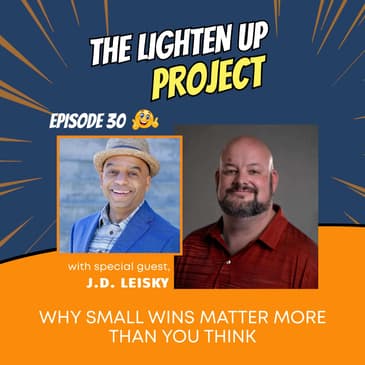
What do you do when life completely changes the rules on you? In this powerful and deeply human episode, J.D. Leske shares how he rebuilt his life through resilience, laughter, community, and purpose after incarceration, major health battles, loss, and overwhelming setbacks.
What You’ll Hear:
- Why healing isn’t about ignoring pain—it’s about learning how to move through it
- How laughter and humor became survival tools during J.D.’s darkest moments
- The mindset shift that helped him go from “Why me?” to “Game on.”
- Why even the smallest steps forward still count as victories
- The power of community, play, and connection in emotional healing
- J.D.’s inspiring journey from prison and heart failure to purpose-driven leadership
Resources Mentioned on this Episode
- Connect with J.D. Leske on Facebook
- Free 2026 Goal Planner + Game On Health REBOUND Community resources Email: gameonhrc@gmail.com
- Learn more about GPS to Life Success and J.D.’s resilience coaching work
- Malcolm’s improv + laughter experiences
Feature Guest: J.D. Leisky
J.D. Leisky is a motivational speaker, entrepreneur, and founder of the Game On Health Rebound Community. After overcoming incarceration, serious health challenges, and multiple life setbacks, he now helps people rebuild their lives with purpose, resilience, and momentum. Known for his raw honesty, humor, and compassion, J.D. creates spaces where people feel seen, encouraged, and reminded that even small steps forward still matter.
Connect with J.D:
Website: https://gps2ls.com/game-on-sign-up
Meet the Host: Malcolm Grissom
Malcolm Grissom, affectionately known as "The Stand-up C.E.O.," is a team-building and employee engagement expert. Malcolm, an award-winning actor, comedian, International speaker, and best-selling author, masterfully blends humor, improv, and business acumen to enhance team dynamics and profitability. As a certified laughter leader, he leverages the power of positive psychology and his social work background to create engaging, results-driven experiences. Whether inspiring executives, strengthening teams, or energizing audiences, Malcolm’s unique approach fosters connection, creativity, and success. His ability to transform corporate culture with humor and insight makes him a sought-after speaker and consultant.
Follow Malcolm:
Website: malcolmgrissom.com
Facebook: facebook.com/malcolmgrissom
LinkedIn: linkedin.com/in/malcolmgrissom
Stressed, stuck, or leading on autopilot? It’s not a motivation problem—it’s a connection problem. Malcolm’s weekly virtual improv classes boost engagement, collaboration, and retention—all while having fun. Register now for a complimentary month: https://malcolmgrissom.thrivecart.com/everyday-encores/
We are proud to have The Lighten Up Project on the *High Vibe Podcast Network .* Grab your free gift from Malcolm in our Our High Vibe Gift Vault.
Love this show, check out the other shows on the High Vibe Podcast Network.
Share the Love
✨ If this episode lit something up in you… tag us on Instagram @HighVibeLeaders and let us know your biggest takeaway!
🦋 Don’t forget to rate & review — it helps us reach more conscious rebels like you.
🔊 Listen & Subscribe
🎧 Spotify
[00:00:03] Welcome to The Lighten Up Project, the show that reminds us that healing doesn't have to be heavy. I'm Malcolm Grissom, the stand-up CEO and founder of the World Laughter Organization. Let's explore how humor, heart, and play save the day and create spaces for healing and connection.
[00:00:33] So let's get ready to laugh, learn, and lighten up. So my peeps, how are you and thank you so much for joining me once again at The Lighten Up Project.
[00:00:55] My name is Malcolm Grissom, I am the stand-up CEO and founder of the World Laughter Organization and you're not. But today I have another very special guest. This man, I should say, he is an inspiration to me. He's been a very, very dear friend ever since I met him.
[00:01:24] We're going to be talking about his story and comeback stories in general and the kind that don't skip the hard parts. We're not going to skip the hard parts today. My guest today is J.D. Ledsky. Wait, I'm pronouncing things wrong. Did I say Ledsky? It's J.D. Ledsky. That's quite all right.
[00:01:54] It's Ledsky. I've been called much worse. You're all right. Yeah, J.D. Ledsky. He's a motivational speaker. Now he's an entrepreneur. He is the founder of the Game On Health Rebound community. After navigating his incarceration and serious health challenges.
[00:02:19] More plot twist than a daytime drama, let me tell you. J.D. bounces back. He always bounces back. But not only does he bounce back. He rebuilt forward. He bounces back forward. He bounces back forward. With a purpose. With resilience.
[00:02:46] With a great sense of joy. A great sense of humor. A great sense of play. J.D. is known for creating spaces where people can feel seen and encouraged and heard. And reminded that progress doesn't have to be loud to be real.
[00:03:11] Because even the small steps forward still count. Especially on the days when getting out of bed feels like a win. That's the only win you can do. It's a win. Our conversation we're gonna speak about momentum. We're gonna speak about second chances.
[00:03:37] We're gonna speak about why your next step. No matter how small it is. Still matters. Let's lighten up and dig in. And welcome J.D. Lesky. Thank you very much Malcolm. Yeah. Thanks. It's a pleasure to be here. I know we've been wanting to do this for a while. And I've been in and out of the hospital. Unfortunately. Which has held me back on things. Well.
[00:04:07] I wouldn't say it held me back. Because they didn't stop me. They didn't hold me back. But you know. They slowed me down just a little bit. But here we are. Like you said. Still getting back up. Moving forward. And I am just grateful to be here. Talking to you. And your peach man. This is an honor. Yeah. So grateful that you were here. So. We play a game. Called Two Truths and a Lie.
[00:04:38] And J.D. has given me three things about himself. I'm going to read them to you. And then ask you. To put on your little detective masks. There are hats. There we go. The mask thingy. The mask. That's the technical term right there by the way. For anyone who wants to know. Is that the mask? Yes.
[00:05:08] Yes. But. This is why we get wrong. You're quite. Figure out. By listening carefully. See if you can figure out which one is not true. Because. At the end J.D. Is going to reveal that to us. All right. So. First of all. He is. A skydiver. Every chance he gets. He goes skydiving.
[00:05:37] Every chance he gets. He goes skydiving. He has made. A lot of money. He has made. A lot of money. And because of that. He is. Been very helpful. In donating. To charity. Not all of it. But. He donates. To charity. So. A lot of money. Donating to charity. And skydiving. Figure out which one. Is not. True.
[00:06:07] All right. My friend. All right. Will you join me in 20 seconds of spontaneous laughter? Spontaneous laughter. Absolutely. I look forward to diving into that. I know you are. You always. Always up for a quick laugh. I know. Let's go. Absolutely. Let's see.
[00:06:54] Oh. I tell you that was fun because, you know, when you first started to force laugh, but then this is chaos. I just started laughing because you were laughing and I'm laughing and it's just, I love it, man. That's awesome. That's a fun little exercise. I love it.
[00:07:16] Yeah. Yeah. Yeah. So I know your connection to, to laughter and joy for our audience though, can you share what is your connection with laughter and joy? You know, I have faced a lot of different trials and tribulations in life, you know, anywhere from
[00:07:40] growing up in the abusive household to spending all my twenties in prison to, you know, building companies, losing everything, having money, being homeless, losing everybody I've loved in life, losing my health and having to battle with that. It's a lot and it can be very overwhelming, but you have to find in those situations, something that brings you joy, brings you laughter. And you know, it's, it's amazing. Even when I was in the hospital, the last, last year, really bad,
[00:08:09] I had this huge mask over my face. And I, even with that over my face, I still had nurses. They were cracking up when they were coming in and making jokes with them. I mean, they were coming in with an attitude of like this poor guy, he's in this bad situation fighting for his life. And they would come in, you know, when they first meet with the somber expression, and then they would just leave smiling and happy. And next thing you know, they would come in on their breaks just to talk
[00:08:36] with me and spend time. And that's just what I do. I love to see people laughing. I love to see people smiling. And I, you know, in the world where we have so much stuff going on, bringing that little bit of joy and happiness into this world means a great deal. Like you said, sometimes what we perceive as a small step, you never know. Little thing like laughter can change a new life. I've seen it happen
[00:09:01] where people are on that edge, where they're ready to just end it all. Next thing you know, they're in a conversation, how laughing you can and going, man, I haven't laughed like this in a long time. And it reminds them. And it's just something about that. Even when we did the force laugh, brings something to the forefront and makes your mind stimulated and just okay, you start perceiving things differently. So I've learned to do that through life. And I am one of those guys, a little bit of a warning. I'm one of those guys that will make a joke at a funeral. I'm sorry, might be,
[00:09:32] might do it. I've even teased with people saying I might be that guy that has a recorder that's in my coffin, you know, and when they go to shut it screaming, Hey, let me out, let me out. Just so, you know, sometimes I have that dark humor, but you know, in any bad situation, people know I'll just come in and bring that laughter. And they're just like, how do you do it? And it's, that's been my survival mechanism. It really has. And it's helped me through so,
[00:10:00] so much. So that's why, you know, when you're doing what you're doing, I'm going, this is really important. It's something that people write off as not a big deal most of the time. And it's huge. Uh-huh. It is, it is, it is most definitely. Later on, and for our audience, tune in to, there is an episode that I, it was, it was at the end of National Humor Month that I shared how
[00:10:28] laughter, I shared the story of how laughter saved my life, quite literally. So yes, it does, it does. And JD is definitely a test to that. Thank you so much. What do you say, JD, about
[00:10:49] to people who say that laughter isn't appropriate or that, let's say, because you brought up making a joke in a funeral? Absolutely. Perfect example. What do you say to those people that say, well, that's not appropriate to make a joke? You know, well, first off, there is times and places
[00:11:18] to make a joke. You know, when I say funeral, I am not the tasteless person completely. Well, okay. I said, I'd put the tape in saying, let me out. That's a little tasteless, but we're going to forget that I said that one. And I can't backtrack now. No, but it's, it's really, it's finding that right time and place. And, and to be honest, you're always going to have people in life that come with
[00:11:44] negative attitude towards things. Now, if you're coming with positivity and joking and laughter is positivity, and somebody's coming at you with a response like that, there's something going on with that individual most of the time. And it's not really what you're doing. It's that person is just got more inside. And to be honest, sometimes people don't want to do laughter. They're sitting there going, I want to stay in this mode of anger, negativity, frustration. And then when somebody
[00:12:14] is bringing that humor, there's that side of them that's like, I want to hold on to this. So the question is, is it really, is it appropriate? It's going, why do you want to hold on to this? It's going, okay, you know, there's something there. So that's really a tell for some people that there's stuff going on in their lives. And honestly, a lot of times it's a great way to open a segue and talk with people because it's like, oh, well, you know, I don't sit there and
[00:12:41] go, I'm going to do what I want to do. I go, okay, I hear your concern. I apologize that that offended you. What about it did that? And when you start opening a dialogue, usually it shifts to what's going on in their life pretty quick. And it's just that opening to be able to go in and go, okay, this is what's happening and work with people. And again, I've seen so many lives change just with that, like we were just talking about and people have come and they have that attitude. And next thing you know, I came with the approach I'm talking about. And within minutes, I've had
[00:13:10] people that I'm folding up that are breaking down in my arms because they just hold on to so much stuff. And so, you know, when you bring that laughter, you start creating an environment where they can feel safe to let go of some of that stuff. So hopefully that kind of answers your question there. Yeah, it does. It does.
[00:13:30] And also, I think it's super appropriate just to put this out there to our audience members who may have thought that maybe I was or you were or we were saying it's not appropriate to laugh at a funeral. I think it's super appropriate to tell a joke or a tasteful joke at a funeral.
[00:14:00] And to... Just finding that fine line. Yeah, it is a fine line. It is a fine line. But I think it's super, super important. And that's one of the times where you have people like you are talking about, JD, who are stuck in that moment. Maybe they want to be in that moment.
[00:14:25] And maybe they want to enjoy that moment too, but they don't know how. So, you know, you have a lot of confusion sometimes at a funeral. So, hurt and confusion, a lot of emotions. And I think when you have a lot of emotions, that's a place where play, maybe not humor, maybe not jokes.
[00:14:54] See, that's another thing. If you go way back and you listen to episode two of my first season, I give a definition of humor that's not just jokes. And a lot of people think humor, they think jokes. But no, humor is also play. And so, when you get into a really emotional time like a funeral,
[00:15:19] I think that's the best time maybe to introduce some play. And it might be offensive to some, but you get out of that. But that's no reason, just because it may be offensive to somebody, that's no reason to hold back from introducing it. That's my point. Absolutely. Yeah. We can't go around. I mean, again, there is respect, of course.
[00:15:48] You've got to follow respect. That's the one thing that you've got to do at all times. When I make a joke, I'm very respectful to people when I'm making a joke. Different things like that. And yeah, it's just, like you said, it's tasteful. It's just figuring that out. And sometimes it's not just a punchline. It's your whole demeanor when you come in, when you're, you know, energy and you're uplifted and everything. I'm going to tell you, it's hard for other people to not get caught up in that same energy.
[00:16:17] Sometimes you don't even have to say a word. And next thing you know, people just get caught up and they're like, why did it, when I got around you, I just felt lightened up. I felt energy. And you didn't even say anything. There's so many nuances to that. And that's why it's like, man, I feel blessed that I've been gifted with that ability in life. And some people aren't and some people are. And sometimes it's harder for other people.
[00:16:45] And then the other thing for me is, like you said, people would get offended. I am in this world of like, I'm going to live life my way. And if somebody gets offended, I'm sorry, but I'm going to keep living life my way. Now, again, I'm not doing things to try and disrespect that person. And I'm not trying to walk all over them. It's just going, okay, you're always going to have naysayers in life with whatever you do. You just got to tune them out. And I'm cool.
[00:17:12] So before we get too much into your story, because I really, really would love to hear a lot more of your story. Before we dig a little deeper into that, if laughter was treated as essential and not optional, how do you think our world would be different? Oh, gosh. I think our world would be drastically improved. Drastically.
[00:17:42] You know, we have a lot of people that just want to see the world burn. And it's just reality. They really have so much anger and trauma. And we don't know what happened in their life. And to take that and they hold on to that, like we were talking about earlier, holding on to these negative emotions and keeping them bottled up or expressing them in other ways. When you have to do that laughter, just like we did that 20 seconds earlier.
[00:18:08] And I hope everybody that's watching this did that and not go back in the beginning and do it with us. Because I'm going to tell you, it just, you can't help but feel something inside after. Now, you might feel silly, but you'll feel something. But, yeah, I'm kind of getting out of such a, but it's just coming into those dark spots. It's like a light. It breaks through. It's just laughter and joy. Just like I said, when they have those walls up, it starts cracking through that.
[00:18:36] So, if it were mandatory and everybody were doing that every day, they would find their mindset completely shift. And when that starts shifting and going towards other things, their actions follow. And next thing you know, it's a cascade of effects that go on. So, yeah, the whole world would be a much better place if it was mandatory that everybody lack. I don't know what. Lack. I think we need to start working on those laws. Yeah. Malcolm for president. Here we go.
[00:19:05] That's right. That's right. I'll change the World Laughter Organization. That's true. Yeah. That will be my campaign. World Laughter Organization. Yes. I love it. I love it. We're going for it. We're going to make it happen. Yes. Yes. My campaign manager, buddy, J.D. Litsky. Yep. And if they don't follow through, like, you know, anyway. What's your gonna?
[00:19:35] How do you personally define healing? Healing to me is when you have something in your life that has been hurtful in one way or another. But I'm gonna go with emotional more than anything. When you have something like that, healing to me isn't ignoring what's going on.
[00:19:59] Healing to me is taking a look at it and figuring out how to overcome that and actually work that into your life to be a better person and utilize that so that you can use it towards other things. Like, they always say, the more you go through, the stronger you become. And my gosh, it's absolutely true when it comes to that. But a lot of the trauma that I've had in my life, I'm gonna talk about my father real quick if that's okay.
[00:20:25] You know, he said and did a lot of hurtful things to me as I was growing up as a child. And I held on to stuff and I thought that I had gotten past it. And then later in life, I'm in my 30s and my dad and I are in a room together and it was right back to where we were. And the hurt and the pain were there. Before my dad died, we were, we didn't care much for each other. But before he passed away, I spent a year taking care of my dad.
[00:20:55] And towards the end of his life, we became friends. And there was a lot of things that we were able to finally work through and a lot of anger that I had that I didn't know that was unresolved. I was able to finally let go and heal from. And so, it's really something that, like I said, it's not ignoring what's there. It's taking it. It's facing it. It's understanding how it works in your life and then find a way to overcome that.
[00:21:25] And then I hope that gives a decent definition of healing there for you when it comes to emotion. Yeah. Yeah, definitely. Definitely. Okay. So, well, actually, you've talked about it a little bit in your healing and what you do.
[00:21:51] But if there's someone out there that is healing, that's going through this healing process, how do you think or what do you think they could do to add a little play to it? And do you think that, well, you obviously think that it is essential and it's needed. You've already told us that.
[00:22:18] So, how could they add a little play or laughter to that to enhance that process? Well, first thing I would tell people is if you haven't seen it, look up who's on first. All right? You can't keep a straight face during that bit. I've been Costello way back when. That one really gets me. And every time, all of a sudden I go back and it's just going, it lights me up and I
[00:22:48] have fun. But the big thing that I tell people all the time and it's become essential. And now I was that lone wolf person in life and pushed a lot of people away. It wasn't until I started surrounding myself with people that I wanted to be like, had the mindset and all these other things that I really saw a big change in my life. And I wanted more joy in my life. So what did I do? I started surrounding myself with people that have that joy. Now, I know this is a little different than finding it within yourself and bringing it out.
[00:23:18] But this is really an essential step that a lot of people forget about. And they go, well, I can just do it for myself. I'll watch something funny like who's on first or anything to make me laugh. That's great. But that's only temporary. It's like putting that quick little bandaid on a giant wolf. It's not really taking care of it. But when you have those people that are surrounded with you, ones you can feel comfortable with, joking and laughing a little bit and they feel comfortable with you. You're going to see that start coming out more and more.
[00:23:47] And the more comfortable you are doing that with people you're familiar with, you'll start doing it with people that you're not familiar with too. And it'll just start happening in your life. So find that group that really will help you lift up, that brings that joy and definitely get tied in with them. And you're going to see some major things change. So you've gone through a lot.
[00:24:10] You've gone through, as you said earlier, you had just last year, you've had a lot of health issues, been in and out of the hospital. You've done a lot of growing, a lot of things that have happened throughout your life that you've described to us.
[00:24:32] So you've had to overcome what I'm getting at in my usual awkward way because I'm Malcolm. Well, I love you, Malcolm. You're an awesome guy, man. I would tell you, for those guys, man, you have been with me for at least four years. You've seen a lot of the struggles that I've gone through. I've seen a lot of the struggles you've gone through.
[00:24:56] And yeah, I just have to throw that in real quick for people and get back to your fear thing that you were talking about. Sorry. Thank you. You can go for it. I give you permission. Thank you. Thank you. Thank you. So you've had to overcome a lot of fears, a lot of different fears along the way. At least, I don't know if I'd use the word overcome.
[00:25:25] You've at least had to face a lot of fears along the way. Okay. What fear are you currently facing in learning how to get courageous with? Yeah. You know, so, and I love this one because this really strikes a lot of things. Malcolm, a lot of people see me and they see the guy that's always laughing. They see the guy that's always smiling. When I'm on camera and I bring the JD Entertainment Man.
[00:25:55] I mean, it's just, well, me in a room, I will have the room laughing, doing all these other things. It's just what I do naturally. When those cameras go off, you see a lot of times I will just sit here and I will regress back into something. And one of the fears that I have, that I'm dealing with is, like I said earlier, I lost everybody in my life that I love. I've lost relationships, family, animals, every single person that I really love, I've lost.
[00:26:23] And so, I've had this fear that I will be this old person that nobody cares about that's sitting in a nursing home by themselves. And what I have to realize is, that is a choice that I have. I can choose to go down that road to where I'll be there when nobody's going to be around their fault. Or I can go down that road where I make my life a thing of joy and bring joy to others.
[00:26:52] And it's not because I want people to be there when I die. It's that when you care and you bring that laughter and you bring that presence and people lift it up, they want to be there for you. And I've had people that at times where I felt like I was completely alone and there's times where you can do that and you're going, I have no family left. I'm not in a relationship. I'm all alone. Next thing you know, I have friends that just come out of the woodwork that are just there and they lift me up and they're in my corner and I realize and I'm like, family isn't just people that raised you.
[00:27:21] Family are people that really care about you. And I have let more people into my life and now play up and very guarded because of that. And it's something that I still work on and it's something that I go through all the time, but I have to remind myself, it's my choice on how I'm acting towards myself and other people that will end in that result that I was talking about earlier. So it's really something that keeps things in perspective for me too. Yeah. Yeah.
[00:27:51] So I want to hear more about the Game on Health Rebound community because I love that. So could you tell all of us more about that? Absolutely. And for just a small fee of $999.99, you get the rest of this video to find the answer for that.
[00:28:20] So yeah, the Game on, it was, I have a organization I call GPS to Life Success. And that's an app that I developed that brought different coaches together to help people that are overcome, to overcome different struggles in life and adversities. So I have different kinds of coaches that are on there with different personalities, but I didn't have my own coaching program. It was like, I created this platform, got these coaches, and then everybody was like,
[00:28:48] hey, it's you that people really want to see, things like that. And I struggled with a lot of stuff. And I didn't want to be that person that people relied on. I was a coach. I don't want to tell anybody the wrong information set out the wrong way. Who will lie to be a coach? These are guys that, you know, all these other things. And you go through that imposter syndrome. Oh, give me one second. Yeah. You go through the imposter syndrome, all of that other different stuff. And it really messes you up.
[00:29:15] And so, you know, again, when I did that, I was going, okay, where am I? Where am I at? And I was trying different things to make money. But the last time when I went in the hospital, before I went in, I started using basketball to rehabilitate myself. So I have 13 stents in my heart. I have congestive heart failure. I've had strokes. I have gone through, I have a blood disorder that attacks my immune system. So I sometimes just getting a cold turns into something that I'll be in a hospital for a
[00:29:45] month and a half, two months for fighting with things. I mean, it's just going through that. And so last time when I was in the hospital, the first thing I thought in my mind is I'm going to be back on that basketball court taking that shot. Now, to be honest, I am not a basketball person. I know I'm using basketball to rehabilitate myself. I can't say all the teams. Heck, the only reason I don't know a basketball player came up to me and started talking to me is because they're taller than me. I'm 6'2". When I'm looking up somebody, first thought is you're a basketball player, okay?
[00:30:13] That's the only way I would really know. I mean, you know, and so it's amazing that I did that, but I just found fun in it because I can go and just take a couple shots. And my heart starts acting up. I just sit down on the bench. Then I get up, just take a couple more shots. And it was something I was doing and it was rehabilitating myself. And so last time when I was in the hospital, again, the first thing that was in my mind, I'm going to get out and shoot basketball.
[00:30:38] And so when I was in there, I focused on that and it was going, okay, that was my goal. So all the other stuff that was happening in between that was trying to bring me down, oh, this result's not looking good. This result, I'm going to be out there shooting this basketball. So you're going to have to get those results to match where my mind is at. And even in the hospital, I have a video that I put together. And in the hospital, I had a nurse that set up a trash can on the table for me. And I had a pile of napkins next to me and it would ball them up.
[00:31:05] And I was sitting there in the hospital bed shooting them to a trash can and preparing for that shot. And then when I finally got to rehab, they had me, they were propping me up and I was able to shoot with this little poop. And it was like a little Nerf basketball things. Those things go everywhere. So it was a lot of fun actually because it's like, and then finally got out to make that shot. But when I was in there, when you're dealing with a lot of health issues as an entrepreneur in life or just with anybody in life,
[00:31:33] you get to a point sometimes when you have chronic stuff to where you feel like you can't do things in life anymore. You watch life go by and you go, I wish I could be a part of life, but at least I'm here to watch it. You know, and we start getting complacent with that that we can't. So what shooting and doing that revitalized me and I'm going, I can do this again. I can get back out. And so when I was in that hospital, I'm sitting there going, I need to build something that will help people find some joy,
[00:32:01] find a community for spirit-filled entrepreneurs that are struggling with different chronic illnesses that are really trying to get that footing and move forward in life. And so it's through community. It's through finding something that's fun that people can do to start rehabilitating themselves. They were building each other up. So we're doing it spiritually. We're doing it physically. And we're doing it mentally where we're coming together.
[00:32:27] And we're not a group that's sitting here, you know, ragging on anybody or putting somebody down if they didn't hit a goal. We're even there if you don't hit a goal, but you hit a small step that's leading to that goal. That's a celebration. Like you were talking about earlier, those small steps. Especially when you have chronic health issues, you look at it and you're used to doing big steps all the time. Yeah, you're going, okay. Anyway, when I first had my heart issues, I had just got done walking over 400 miles. I carried a cross.
[00:32:57] Now, I'm not some super religious guy. I'm not sitting here whipping myself all the time, any crazy stuff like that. It was just one of those personal journeys I wanted to do. And so I carried this cross. I walked the length of Illinois, went through New York City, Long Island, some of Ohio, and thought I was in some great shape. I was Superman. I could go into a gym and I could throw weights on like there were nothing. People would watch me and be like, my gosh, this guy's a monster. I really felt like Superman, like I was untouchable.
[00:33:23] To go from one day feeling like Superman to the next, you're in a hospital and they're like, your arteries look like the arteries of a 75-year-old. I had over 90% blockage. The whole time I did the walk, I had 90% blockage in my coronary artery. I had a widow maker the entire time. Doctors were just amazed. I had five stents in. I had a stroke. My whole world flipped on me in one day. I went from Superman to weak as a kitten.
[00:33:49] Went from doing anything and everything by myself to now I need to help people to pour a glass of milk. I need somebody to do it for me. I can't do all these other things. And so it's a very difficult road. And I wanted to create that community that helps people navigate through that road and get back on their feet. Get into this game of life because this is a tremendous game. And keep that mindset going to where we can achieve our dreams and our goals, even with the setbacks that life throws in our way.
[00:34:20] So that's what made me create the group. And I have a 2026 goal planner that's absolutely free. I gave you the link and everything like that. You can go and you can get the goal planner. And it tells you a little bit more about the organization that I put together. So if that's something you're interested in, you've got that. If not, at least having that goal planner is awesome because it's for the whole year. It breaks it down yearly, quarterly, weekly, and daily. And it's very simple and it makes a huge difference. Uh-huh. Great. Great. All right.
[00:34:49] Now, all of that information is in our show notes. But I'd also like to give you an opportunity to actually verbalize how people can reach you and work with you and find out more about you. You know, here is the thing. I don't have a whole bunch of pages set up. I don't have all of that together at the moment. Okay. It's just something that I put together, you know, mostly for people I know.
[00:35:17] But anybody can get a hold of me on Facebook with JD Lesky. Absolutely. Absolutely. Or you can go to Game on HRC. So, Game on Health Rebound Community. That's why it's HRC at gmail.com and I'll get it there. So, those are about the best two ways to get a hold of me. And I will be glad to talk with you about any information you need. Find out where you are in life and see what we can do to help each other grow. Awesome.
[00:35:47] Awesome. Well, my friend, what is the one thing or what... Not the one thing. What is one thing that you'd like the audience to remember after the episode ends? You are a shining star that is meant to change the world. A lot of times we look at ourselves, we see somebody, let's say Tony Robbins, for instance, and we go, I can't do that. That's not one. I can't do all that other stuff.
[00:36:16] The question I have is, why not? And not necessarily like Tony Robbins is doing, but using what you know and who you are to change lives. Everybody's going through something in life. And especially, you know, a lot of times people don't look at their lives and story. I've had people all the time that look at my life and they go, oh my gosh, mine's nothing compared to yours. And then I look at other lives. I look at somebody who's battled cancer and stuff and I go, God, I would never want to battle through that.
[00:36:46] I couldn't imagine going through these things. We all have something we're going through, but when you go through something in life and you come ahead, you are now somebody who can teach. You can set that example and you can help guide other people to go through those same kinds of trials and tribulations. Each and every one of you out there has a purpose. You weren't here just to take up space and breathe air. You are a magnificent energy that is meant to change the world.
[00:37:15] And you can go out and do it, but you've got to understand that you have that power within yourself. And it'll start happening. I promise you. So, that is my one thing that I would tell people. Well, thank you very much. Thank you very, very much. Full of gems. Full of gems. Game on. Game on. This is game on. Game on. Absolutely. That's right. Well, that's how I look at things now.
[00:37:44] Honestly, when something comes up that's like, looks like it's going to overwhelm me and I start getting in that panic mode. You know what I'm talking about. When things are overwhelming, you know, oh my gosh, what am I going to do? And then I stop myself and I say two words. Game on. Game on. Bam. And it's just like that switch just hits me. Okay. I have faced all this in life. This is something else. I got it. Let's do it. And it just changes. Mm-hmm. Yeah. Yeah.
[00:38:15] Powerful words. Powerful words. Well, thank you very much for sharing your soul with us in this episode. Thank you, audience, for tuning in once again to the Lighten Up Project. Please keep coming back. And whether it's YouTube, whether you're watching us, whether you're listening to our podcast
[00:38:44] on one of the major platforms, please continue doing that. Every Thursday, I will be here with another very fascinating guest and fascinating topic. And come back next week because, yes, we will have someone different. But until then, please remember that every smile can open a door.
[00:39:12] Every laugh can open a heart. And just like JD says, every step, even the smallest of steps, every step can be your next victory. Absolutely. Thank you so much. Until next week.
[00:39:38] You've been listening to the Lighten Up Project with Malcolm Grissom. Stressed out, stuck, or leaving on autopilot? It's not a motivational problem. It's a connection problem. My weekly virtual improv classes boost engagement, collaboration, and retention all while having fun. Register now for a complimentary month.
[00:40:07] Details are in the show notes. Healing doesn't have to be heavy. And Facebook doesn't have to be boring. Find out about upcoming episodes, suggest future guests, and join in on the conversation. Like our Facebook page, Lighten Up Project Podcast.
[00:40:33] If you've enjoyed today's episode, share it. If not, share it anyway. Please subscribe to our YouTube channel at Lighten Up Project Podcast. And rate us on the podcast platform of your choice. Remember, laughter isn't just a reaction. It's a revolution against the heaviness of the world.
[00:41:04] So keep shining. Keep showing up. And when life gets heavy, don't tough it out. Lighten up.