
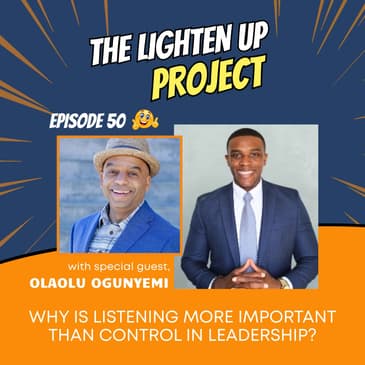
US Marine officer, award-winning author, and founder of Parent-Child Connect, Olaolu Ogunyemi knows leadership isn't tested in keynotes — it's tested when you're tired, triggered, and pulled in five directions at once. He joins Malcolm to unpack what it really means to lead from the core, at work and at home.
What You'll Hear
- Why Olaolu had to relearn how to embrace his own laughter after the Marine Corps taught him to be stoic
- The emotional bank account concept — how leaders build trust through deposits, not just standards
- A real story of finding the balance between holding a standard and leading with empathy
- How to tell if you're leading too strict or too soft, and the honest reset it takes to correct course
- Why Parent-Child Connect exists: creating teachable, memorable moments between parents and kids
- His one-word finish to "leadership isn't about control, it's about ___": listening
Resources Mentioned on this Episode
- Book: Lead Last by Olaolu Ogunyemi
- Free resources & journals — available at parent-child-connect.com/free-resources
- Parent-Child Connect — parent-child-connect.com
- Learn more about Malcolm's work at the World Laughter Organization™
Featured Guest:
Olaolu Ogunyemi is a U.S. Marine Officer, award-winning author, and leadership strategist dedicated to developing resilient, purpose-driven leaders at work and home. As the Founder of Parent-Child-Connect, Olaolu bridges the gap between high-stakes military discipline and the intentionality required for modern mentorship. Olaolu is the author of the Amazon best-selling Crow From the Shadow and a recipient of the Marine Corps University Foundation’s Command and Control Writing Award. His work—ranging from tactical IT strategy in the Marine Corps Gazette to faith-based resilience on the YouVersion Bible App—is unified by a single mission: equipping influencers to lead with contagious energy and practical frameworks. Whether he is speaking to corporate executives or classrooms, Olaolu delivers a message of "Marine Corps discipline meets fatherly heart" that transforms how we lead the next generation.
Connect with Olaolu:
Website: www.parent-child-connect.com
Amazon Author: https://www.amazon.com/author/olaolu_ogunyemi
Pinterest: https://pin.it/3heBVMv
Facebook: https://www.facebook.com/olaolu.ogunyemi
Facebook Group: https://www.facebook.com/groups/561759971924937/
X: https://x.com/Olaolu_Ogunyemi
Instagram: https://www.instagram.com/olaolu.ogunyemi/
LinkedIn: https://www.linkedin.com/in/olaolu-ogunyemi-465ba453
YouTube: https://youtube.com/@olaoluogunyemi?si=zL0_VWAq81g2B5hK
Meet the Host: Malcolm Grissom
Malcolm Grissom, affectionately known as "The Stand-up C.E.O.," is a team-building and employee engagement expert. Malcolm, an award-winning actor, comedian, International speaker, and best-selling author, masterfully blends humor, improv, and business acumen to enhance team dynamics and profitability. As a certified laughter leader, he leverages the power of positive psychology and his social work background to create engaging, results-driven experiences. Whether inspiring executives, strengthening teams, or energizing audiences, Malcolm’s unique approach fosters connection, creativity, and success. His ability to transform corporate culture with humor and insight makes him a sought-after speaker and consultant.
Follow Malcolm:
Website: malcolmgrissom.com
Facebook: facebook.com/malcolmgrissom
LinkedIn: linkedin.com/in/malcolmgrissom
Stressed, stuck, or leading on autopilot? It’s not a motivation problem—it’s a connection problem. Malcolm’s weekly virtual improv classes boost engagement, collaboration, and retention—all while having fun. Register now for a complimentary month: https://malcolmgrissom.thrivecart.com/everyday-encores/
We are proud to have The Lighten Up Project on the *High Vibe Podcast Network .* Grab your free gift from Malcolm in our Our High Vibe Gift Vault.
Love this show, check out the other shows on the High Vibe Podcast Network.
Share the Love
✨ If this episode lit something up in you… tag us on Instagram @HighVibeLeaders and let us know your biggest takeaway!
🦋 Don’t forget to rate & review — it helps us reach more conscious rebels like you.
🔊 Listen & Subscribe
🎧 Spotify
[00:00:03] Welcome to The Lighten Up Project, the show that reminds us that healing doesn't have to be heavy. I'm Malcolm Grissom, the stand-up CEO and founder of the World Laughter Organization. Let's explore how humor, heart, and play save the day and create spaces for healing and connection.
[00:00:33] So let's get ready to laugh, learn, and lighten up. Welcome all my fellow light makers. I am Malcolm Grissom, the stand-up CEO and founder of the World Laughter Organization. And you're not.
[00:01:02] Sorry, you're just not. There's one Malcolm Grissom. I mean, there's other Malcolms and other Grissoms out there, but only one Malcolm Grissom, who's the stand-up CEO and founder of the World Laughter Organization. Okay, I'll stop. All right.
[00:01:22] So this is The Lighten Up Project, and I'm so pleased that you're joining us again for another stimulating conversation. And today, we are going to be talking about leadership. Today, we are going to be talking about leadership.
[00:01:46] But I don't mean the type of leadership that you might read in books or you share in keynotes. No, today we're going to be talking about the kind that gets tested over and over and over again. And when you're tired and when you're triggered, when, you know, things are,
[00:02:10] when you have children pulling this way and that way and things, and you have to go get the dry cleaning and your husband or partner wants you to do that and this, and co-workers are pulling you this way and that way and this way, we're talking about that kind of leadership. The leadership that when you get triggered, when people are leading,
[00:02:37] you are your own family. You can settle down and you can lead from the core. So my guest today is Olalu Ogunyemi. He is a U.S. Marine officer. She is award-winning author and founder of Parent-Child Connect.
[00:03:02] Olalu brings a rare perspective where the Marine Corps discipline meets everyday mentorship. He helps people lead with intuition and not just intensity. From corporate spaces to classrooms to home, his mission is clear.
[00:03:27] He is one to help build resiliency. Our purpose-driven leaders who influence the next generation by how they show up, not just what they say, but who they are, which is exactly what the World Laughter Organization is about.
[00:03:52] So if you've ever wondered, hmm, am I leading or just managing? This conversation is for you. So let's lighten up, lead differently, and let's welcome Olalu Ogunyemi. Man, Malcolm, thank you so much for that warm introduction. I'm so excited to be here. I've been looking forward to this conversation for a while now. So I'm so excited.
[00:04:21] Thank you so much. Great. Well, I'm excited to have you on here. I really am. Let's start our conversation with 20 seconds of spontaneous laughter. Yeah, for that. I'm always up for some laughter. Okay. Yeah. All right. Well, one, two, three, laugh.
[00:05:11] I love laughing. The more you laugh, the more you get into it. Sometimes 20 seconds turns out to be 30 seconds, which is a minute. And when you laugh with someone, you're really feeding off their energy as well. And so I love it. What do you think about laughter?
[00:05:40] What's your relationship with laughter? Well, first of all, that's one of the things I had to learn to accept for myself because I'm naturally a goofy guy. That's who I am. I love smiling. I love laughing. I love being energetic and bringing that kind of positive energy to people. But, you know, when I joined the Marine Corps, I almost wanted to switch that person. I wanted to appear to be more stoic. And so my relationship with laughter is simply that I've learned to embrace it and be the person who is going to laugh.
[00:06:10] Be the person who's going to enjoy life because I've been told numerous times that, man, I'm so happy to see that smile on your face. And I'm so happy that you're laughing, man. I never met anybody who's going to laugh in this circumstance. And you would be surprised that in some of the most dark situations, that laugh is what brought light to everybody. So I love your project and what you're talking about. That's one of the reasons we immediately clicked.
[00:06:33] And I've noticed what you're doing because I was like, man, that is a wonderful thing that you're bringing, not just to just the mission itself. Generally talking about bringing that to the workplace. That's so important. So, yeah, I really believe in laughing. And I believe that it truly is medicine, as the old folks used to say, laughter is medicine. Well, yes. And so there's a couple of points that you brought up that I'd actually like to touch on.
[00:06:58] But the first is I want to go ahead and explain to you because I don't know if I've explained this to you and to our audience or new listeners. So the Lighten Up Project is the podcast. It's the voice of the movement. The movement is in the form of the nonprofit called the World Laughter Organization.
[00:07:27] And the mission behind that is first and foremost to bring the power of laughter and play and improv to youth leaders, especially youth leaders, to spread that with our youth, to help them really get ingrained with using laughter and play throughout education.
[00:07:56] Especially I'm doing this to help with a lot of the heavy mental health issues like bullying prevention, suicide prevention, conflict resolution. It's great for that. And then, like you said, to the workplace. So what I do now, my other business is called Laugh, Play, Thrive.
[00:08:21] And that is specifically geared towards businesses and entrepreneurs and using laughter and implied improv. With entrepreneurs, it's especially headed towards selling.
[00:08:38] And with businesses, it's all about team building and employee retention and just creating that workforce, the workplace culture. And then that will become part of the World Laughter Organization because we want to teach the next generation to not to, like you said,
[00:09:09] there's still this stigma of a leader having to be, okay, I'm stoic, you know, I'm a leader, listen to me, I know what I'm talking about. And I think that leaders and adults in general have forgotten to play. They've forgotten how to play. They've had a lot of fear.
[00:09:39] And there's, the world just gives a lot of fear, you know, everywhere. The news, everything is fear-based. And in order to play, you have to fear less. And so I think because of that fear, a lot of people have forgotten how to play.
[00:10:03] And so if we ingrain this in our next generation, then they'll take this play with them, hopefully, into the workforce and everything. And they won't have this problem that a lot of us have right now. That's right. Anyway.
[00:10:27] No, I love what you're saying there because one of the things I realized is that, you know, one of the things, when you break down laughter, you start looking at how people laugh. And I'm guilty of it myself. One of the biggest things that people do when they laugh is they cover their face. And the reason I bring that up, when you cover your face, cover your mouth, is because laughter in some ways feels shameful. It feels like, well, I don't want people to see me laughing. I don't want to see my mouth, my teeth. Whatever it may be that just causes you to cover your mouth, that's what people feel like when they laugh.
[00:10:55] And when I talk about that, when you're talking about that with leadership, I truly believe that that's just another form of vulnerability. And to your point, we hide behind the layers of fear and other expectations that we have allowed to stack on top of our laughter. It's a lot of times we forget that laughter is truly being vulnerable and sharing ourselves with other people. So not only that, but it's reminding us that, you know, we were children once at one time.
[00:11:20] So as those of us who are leading in the youth industry, whether it be in your church or whether it be in your community as a coach, whatever you're doing, a lot of times we forget that we were once children. So when children are doing things that children do all the way through teenage years, sometimes we don't connect with them because we forget how that is. And laughter is like one of the most basic and the basic forms of connection that you can have and basic forms of communicating your true feelings on the inside without really having to say anything.
[00:11:49] That's what laughter does for people. And so I love what you're doing. And I like I have to commend you for that because I believe that the mission and the direction that you're taking your organization is definitely needed. And I definitely appreciate it. I think it's awesome. Yes. Thank you. Thank you. I appreciate that. So we talked about you mentioned vulnerability, that word vulnerability, which I think is very, very important to leadership.
[00:12:16] What else or what does it mean to be a resilient, purpose driven leader today? Oh, absolutely. So resilient, in my opinion, means that you're just not allowing any and everything to sway you. And when I say that, I mean, it doesn't stop you from achieving the mission in line with your values and the organization values. And it's really important that I say both of those because ideally, both of those values match the organization's values and yours.
[00:12:45] But in some cases, I think there's a mismatch, in which case you see usually the organization individual separate. But in this case, that's really what resilience is about. It's about understanding that there's a lot of outside noise. There's noise. There's a lot of internal friction. There's a lot of things that exist within an organization. So that resilience is finding a way to continue to push towards those values. And how do you do that? Well, you find you become purpose driven. You understand that you are a part of a bigger mission.
[00:13:11] You're a part of something way bigger than just you as an individual manager or even a team leader, whatever you may be doing in your organization. You're bigger than just that. You are a part of a larger mission. And that's what it means to be purpose driven. I think both of those go hand in hand. So I appreciate the question because in order for you to be resilient, I truly believe that you have to have your eyes set on something that's well beyond the day to day activities.
[00:13:35] Because anytime you look at a company or an organization, no matter what that company is, no matter the industry, no matter the family, no matter what it is, there's always going to be friction. And if you were to pop up in any organization or family today, you may find a lot of friction and it's going to seem dysfunctional. And so that's where you have to understand that your purpose is going to be bigger than those dysfunctional moments or those moments of friction. And you have to find a way to continue to push through it. And that's how you become resilient. So that's really what I believe resilience and purpose driven leadership is all about.
[00:14:06] I love that. I love that. My main cynic, you know, he came out with that book. I love it. Find your why or I don't. That's right. Yeah. Yeah. Start with your why. I love that. So and that is so important, not just for not just for businesses, you know, not just for business leaders.
[00:14:32] But that's so important for parents to for any type leaders. Whenever you are overwhelmed when with the chaos, there's going to be chaos because this life, whenever you're overwhelmed, just go back to your why, go back to your purpose. I love that. Thanks so much.
[00:14:55] You know, something I something else I really loved about your bio is you said that you bring a brain core discipline meets fatherly heart. So how did those two worlds come together for you? Yeah. So for one, I was always a rebellious teen. That was me. I wanted to find myself by my identity.
[00:15:22] And one of the things that I did as a part of that whole journey is I joined the Marine Corps. And to be honest with you, it was one of the best decisions I've ever made in my life because it was something I truly wanted to do. And it was just my way of saying, you know what? Nobody can tell me that I can do otherwise, because I actually at that point I was in college. So I probably was more like a 20 year old. So just out of my teen years. But I wanted to show that I can take control of my own life and continue to move forward.
[00:15:50] And what the Marine Corps has provided me is it's provided me a way to achieve success over and over again. It's that regimented approach, that systematic way of thinking to make sure that I can actually achieve results. And that's one of the biggest things that I've been able to do as a Marine and then learn how to transition some of that to being a father. Now, one of the things that I always laugh at is the movie Major Pain. If you've seen that movie, it is by far one of my favorite movies. Quite honestly, it was the only Marine I knew between him and the Gunny Irmy from Full Metal Jacket.
[00:16:20] Those are the only two Marines I really knew before I joined. And so that that was the version of leadership I thought was important. And quite honestly, I tried to bring that not only in the workplace, but to my home and in both places, both at home and at work. I learned a hard lesson that you have to be yourself. And that's really what it that's how those two really those worlds collided is my expectation of what it meant to be a Marine. They started colliding with what I thought it meant to be a dad, which is to be nurturing, to be a protector, to be all these things.
[00:16:49] And then I turn around and say, well, you know, I don't understand how I can do this. You know, I lead my daughter, who I had at a very young age. How can I lead my daughter and and be available to my wife and be very intimate with both of them and be really that same Marine and almost it almost made it two split worlds. And so that's why I put that in my bio and really with help my marketing team, of course, put that in my bio to really express that there was a lot of learning that happened in both sides.
[00:17:17] And those two worlds collided at some points. But then they became more of a collision that I liken to more of the collision that caused something beautiful to happen. It's the world of that extreme discipline, that regimented approach and the world of that nurturing father and finding some kind of middle ground in between.
[00:17:35] So you'll see sometimes that when I talk to my children, they'll meet the very, you know, stern, hey, we need to do this, this, this, this and that, which I believe is helping them learn how to review a situation and develop a plan to achieve success. But then on the other side, you'll see me talking to some of my Marines, whereas in the past I would have tried to say, well, I don't care. And, you know, the Marine Corps didn't issue that family or whatever the problem is. And I'll sit down and talk to them and say, man, I understand what you're going through. So let's just have a moment. Let's just sit together.
[00:18:03] You know, we don't have to talk about anything when I talk about work. We just sit together and play some cards, maybe just hang out. And that's really what I've started to learn. Those two worlds between a Marine and father have began feeding upon each other. And I've been able to grow in both areas, really giving credit to both of those organizations and the people, my family and the Marines that I encounter. So you help me grow. So that's really what I can't even say it's all me. It's nowhere close to being all me. It's all about the people who surround me and tell me when I'm doing well and more likely when I need to improve.
[00:18:32] Hmm. Yes. Yes. So it's some village. They say there's that. I think it's an African proverb. A lot of things are African. They usually come back to Africa and the African proverb, even though they're misquoted, you know, to other places.
[00:18:56] But I think it's an African proverb that says it takes a village to lead. And we're talking about raising children, but leading. But leading as well. One of I, as a leader, am a lead from behind or lead from beside rather than lead from in front of.
[00:19:24] So, again, it's like it's a village. It's all the people around you that help you and help leading, which is great. Now, one of the reasons why I really like that, why that really stands out is the balance that it takes.
[00:19:48] So how can leaders balance and how can they find that balance between the high standards and the empathy and the care? Yeah, that's a hard one. And it takes daily intentionality, because one of the things that I realized is that a lot of times if we just viewed it as trying to like balance and usually call it work life balance.
[00:20:13] Trying to balance those two usually ends in somebody failing or somebody really not getting what they need. And so I like to borrow from both Dr. Stephen Covey and Donnie Smith. And I put this in my book, actually called Lead Last. And Donnie Smith talked about the emotional bank account and the importance of that as a leader, especially when you're trying to balance empathy and all those things. And the way that you look at it is that you understand that you have to make deposits into people and you have to make withdrawals.
[00:20:41] And ideally, just like in a bank, you make more deposits than you do withdrawals. And the things that we consider withdrawals. And this is really talking about those moments of connection. Anytime you have to disconnect from a person in some ways, and the way that may appear to them is when you hold them accountable. And that's one of the things that you have to realize.
[00:21:00] If you were holding somebody accountable more than you were able to build them up or you're able to really encourage them and coach them through and hopefully help them get into a better position, then perhaps they're not aligned with your organization. And maybe that's time to have another hard conversation. But in many cases, I think what happens as leaders is we get so focused on either or.
[00:21:22] We get focused on establishing a standard or we get focused on trying to really work through our soft skills like empathy and trying to listen first to others. That sometimes we never realize how to blend the two and how to work in those two things. And I like to argue that it's not two things that are mutually exclusive. I think they support each other. I think that you should use empathy when you're holding the standard.
[00:21:47] And I say that as a Marine, there's times when, for example, there's one of the rules that we have in the Marine Corps. And I really think this is not just the Marine Corps, but the Department of Defense in general, is that you shouldn't go into one of the places like let's call it like the store or the post exchange or whatever have you in like normal workout clothes. Especially if you're sweating and all that kind of stuff. That's just not we always tell them to put on full clothes, whether it be uniform or whether you dress up, whatever it may be. You have there's a standard that you have to uphold.
[00:22:16] Now, there's times when you walk in and you just see people who are in there doing their thing. You know they're wrong. It's just a real quick, hey, you need to get out. But then there's other times where you can obviously tell that there's a situation that's happening. And this is where you can argue that is it time to make a balance and say, well, I'm going to choose to be empathetic and understand this Marine is probably going through some things. He had to wake up in the middle of the night and go run and get diapers. He didn't think to throw on clothes. Probably drove a long way. Or do I hold the standard and say, don't care, get out?
[00:22:45] I think that there is a way that you could blend the two in this scenario. I mean, something as simple as tell them, hey, man, just go to your car. You know, give me the cash for it. I'll buy the stuff and bring it to your car. You see how you can still hold the standard? You still told him that he can't be in the store in the way he was, that he's presenting himself. But you found a solution that helped him. You understood him. And you found helped him find a solution to get to yes.
[00:23:07] And I really think that's if we looked at it that way and found a way to both make deposits within people and know what and be intentional about when we make withdrawals and understand that those two really coincide and they go hand in hand together. I think we'll be able to make a better. I'll use the word balance. We'll be able to balance it a little bit better than if we just look at them as as two mutually exclusive things. Yes. Yes. Yes. I hear you.
[00:23:32] And I think just this is a great place because not that it's about me, all about me. I don't want to make it all about me. But this is a great place to point out a lot of people, especially when I get into corporate, you know, in front of corporations and CEOs and, you know, HR professionals, they wonder about improv.
[00:24:01] And how so how can improv really help us and how can it beyond the culture? How can it help us be better leaders? Well, you're pointing out something that improv can help you do improv improv can improv develops that emotional IQ or EQ.
[00:24:27] I'm sorry, EQ, not IQ, the emotional EQ, which helps with that balance. It helps establish that balance. And so that's just something I wanted to mention about improv and what I do, because that seemed like a wonderful place to do it.
[00:24:50] But I want to further ask you, so how do you see leaders often leaning too far, whether it's either too strict or too soft? Which one? And then how can they correct it? Yeah, so that's that's great. And first of all, I have to acknowledge that improv, again, that was something I saw on your website when I was reading about you.
[00:25:20] Now, I love that idea of improv, especially when you relate it to emotional EQ. That that's that's cool. That's really cool. And if you haven't seen me looking down, I'm writing. That's what I'm doing. I'm taking notes because I truly believe every leader should be continuing to develop themselves, which goes into your question. How do you find yourself or what happens if you're on either end of the spectrum? And what I truly believe is that if you find yourself, let's talk about on the soft skills, the empathetic spectrum.
[00:25:46] Many times that the biggest symptom that you see is that you start missing the mission. You start missing the opportunity to truly achieve your your project goals or whatever those goals are for you. For example, as I'll use parent because I know it's easy to look in a workplace and you set clear goals. You have, you know, the project timeline is and everything like that. But parenting is maybe not as as clear at times.
[00:26:10] And so in parenting, you know, if you have a standard at home, for example, we tell our children to do their best in school and I know what their best is. And I know if they're missing assignments, that's not their best. And so we encourage them to do their best at all times. So if they're missing assignments, it's easy for me to go into their rooms and talk to them and say, you know what? I understand you're missing assignments. You got a lot going on. So I'll just give you a break. The more I do that, the more I establish a new standard. And that new standard is that whatever they give is OK.
[00:26:39] And so I have to make a habit of and I sometimes find myself at fault with this. I have to make a habit of reinforcing the things that I say. If you're going to, I'm going to say that you must get grades or I'm going to, you're going to have to stay at school to do extra time, whether it be tutoring classes or whether it be, you know, we're going to restrict your electronic time. Whatever it may be, you have to make sure that you're upholding that. Now, let's look at the other side.
[00:27:04] If you're too strict, you find yourself no matter what, then no matter what the circumstance is, I'm going to enforce this rule. There's no, there's nothing that you can say. It's black and white. Now, one of the things that you'll have is that you actually will be on time and on target with your projects. You most likely will be one of the most from a company perspective.
[00:27:23] Overall, you're probably one of the most efficient people there, which, quite frankly, that makes you it's almost like reassuring to know that I'm doing very well because I'm really leading with a strict way. I'm upholding the standard. I'm making sure that the company is achieving its goals and so on and so forth. One of the things that you may see, though, is a high turnover rate. And you're starting to lose some of that creativity that you may have had because now you're trying to retrain somebody else.
[00:27:47] And what the organization may see is that they're starting to see that they're starting to funnel, push more funds to your team. So that way they can try to retrain somebody else. And they also are starting to see more complaints and things of that nature. And so those are the two things, the symptoms that you may see. And if you find yourself on either side, one of the things that you can do in both cases is going back to your basis. Go back to the drawing board. What kind of leader are you and who do you think the people see you as?
[00:28:13] That's one of the biggest things because what we find, what I found talking to leaders and doing an exercise myself is the kind of leader I thought I was didn't necessarily line up with the kind of leader that people said I was. And once you start getting that peer feedback, it's better to get from your peers because they're the ones who are going to be the most honest. Sometimes if you're talking to people who work on your team or work for you, they may not give you the full story, especially if you're more strict because they may not be comfortable, feel like they're safe enough to bring it to you.
[00:28:41] But if you talk to those peers, they've been watching you and perhaps they've already been talking about things that you can do to improve. So figure out who you are, who you think you are and who you are. And if those things don't align, the first thing you need to do is find a way to align those two people. And then the second thing is you have to start listening to people to understand. Start listening to people, understand like what they're talking about. So that way you can start creating a more safe environment for them to bring you ideas and bring you some ways that you can solve a problem.
[00:29:10] And if you find yourself on the other side, now this was actually a little bit harder to walk backwards from it many times, because if you find yourself that's real empathetic, one of the harder things to do is now reset those boundaries. Because those who are like really using those soft skills all the time, usually what happens is those boundaries are pretty low. And so people are constantly walking in and out. But it's going to take time. You literally just set new boundaries and you start working from there and you continue to set those boundaries up. And again, you're working a little bit. It's almost like swimming upstream.
[00:29:40] Now you're trying to find your way back into your team. You're trying to reassert yourself. But I honestly think that it's important to be transparent in those moments to say, hey guys, I truly believe that this is the leader who I was trying to be. Here's the results of that. And I want to take this organization, this team or this family in a different direction. And so here's the new boundaries that I want to set in place. And we're all going to work together. We're all going to grow together. But we have to do this in order for us to achieve our goals.
[00:30:05] So I believe those are really the two different ends of the spectrum and how you can make yourself sort of fall back in the middle. I love that. You know, as you were saying that, I flashback a couple times to I used to be a career counselor or a counselor. Not career counselor, actually. That's just the title. But that's not really what I did.
[00:30:30] I was more along the lines of a guidance counselor at a job core. I'm not sure if you've heard of that. Basically, it's a program that worked with at-risk youth from 16 to 24. And I was working with this one at-risk youth who had a lot of trauma in her background.
[00:30:59] And the idea was that we were motivating him, trying to motivate him to, you know, to take tests and to attend classes every day. You know, things like that. We're trying to motivate him.
[00:31:18] And I always found that for me, it was very important to always meet the, well, in this case, it was a child. But I think it's true for leadership of any type is to meet them, meet the person that you're leading where they are.
[00:31:43] And I think that, and we're going to make mistakes. Like, I found it hard finding that balance between, you know, too much motivation. Like, I want you to get an A or I want you to reach this stamp, this point, you know, get this outcome.
[00:32:09] And I just want you to do the best that you can. So when you were saying that, if, when you were talking about, you know, just going to a child and say, do the best you can, I was thinking of that. And sometimes, though, that's all they can do.
[00:32:30] Sometimes if you push too hard, then, especially with a fragile child, or in this case, it could be a co-worker, a fragile co-worker, then they will pull back. And so it is really difficult finding that balance between that.
[00:32:56] And I think that your point, too, about being vulnerable is very important, too. If we as leaders make a mistake, you know, hey, okay, we're pushing too hard, right? Like, like, in this case, I said, well, you could go in there and you can, you're smart enough to, you know, get that A or whatnot.
[00:33:23] And he was, well, you're pushing a little too hard. You know, I think it's just fine if I go in there and just do my best. So that was a sign to me that, well, I'm pushing a little too hard for this person at this time. And being vulnerable then, and then saying, okay, you're right.
[00:33:52] You know, I was just trying to motivate you. I was trying to get you to push you to do better. But you're right. You go into this situation, you do the best that you can.
[00:34:06] And I think if we just, you know, and I found that in that situation, when I continued that with this person, and then gradually brought in the, okay, push yourself just a little more, then that's how I found that balance.
[00:34:29] But you brought up some wonderful things about, wonderful ideas about being vulnerable in that situation, which is what I think leaders need to do. So I'd like to know what inspired you to create the parent-child connect? Man, that's a beautiful segue because it's exactly what you're describing.
[00:34:56] It's finding the way to inspire somebody else who may not have the same resources that we have. And so in this case, there's a couple of reasons. Number one, I wanted to develop a close relationship with my children. And so I started putting together this book called Crow from the Shadow, which is my first children's book that was supposed to be for us to sit down and create teachable and memorable experiences with each other. And it was just going to be for this household. But then I realized something. I thought about my upbringing.
[00:35:24] I thought about all the guys who I grew up with who are, that's why I'm very familiar with Job Corps, because a lot of them left high school or left really about junior high, early freshman year of high school. They left to go to Job Corps. And in many cases, they didn't, they never succeeded on the other side. They never achieved what they should have achieved through the program. And in many cases, it's because there was nobody there to help guide them.
[00:35:47] And that's one of the things that I wanted to do through Parent Child Connect is to provide resources to parents, teachers, mentors, caregivers, coaches, whoever you have. I want to provide those resources to them so that way they can sit down and create these teachable and memorable experiences with children. Because that's where it starts. It truly starts with connection. And that's where you're talking about that idea of meeting people where they are. That's what Parent Child Connect is all about. It's about meeting these children where they are.
[00:36:13] And we started to expand that to just meeting people where they are if you're going to lead them. Because it's hard to lead somebody if you don't have a connection. And it's really, really hard to lead them if the first time that you're going to have some kind of interaction with them is going to be something that's adverse or something that may cause frustration or some kind of negative emotion. If that's the first time you're going to connect with them, then your relationship may be tainted.
[00:36:39] And so finding ways to connect with others is really what Parent Child Connect is all about. And that's why I founded it. It started up as a book series, then very quickly spiraled into me blogging and providing resources to others and coaching and all these things that really came from Parent Child Connect. But it really started off with my desire to connect with my children and then see other parents connect with their children in the same way. This is such a wonderful conversation.
[00:37:07] And we're just slightly touching upon the tip of the iceberg that's above the surface. You know, there's so much below the surface. As you mentioned, you have a whole series of children's books and you've written a bunch of books. There's a lot that I'd like to explore with you.
[00:37:32] And perhaps we can have you come back and we can explore a lot of these other directions. But right now, I want to get into you have a free gift for the audience. I'm always giving something away. Yes, sir. All right. So some of the things that I offer, I offer free resources. They're downloadable at my website.
[00:37:56] That's parent-child-connect.com backslash or I guess technically that's forward slash, sorry, free resources. And what you'll see there is there are several journals that you're able to download. One is called the Depeat the Shadow Journal, for example. Another is called the Lifelong Divorce.
[00:38:13] That's really for people who not necessarily have gone through a divorce themselves personally, but have gone through, have been a part of the audience, the crowd, as we call it, that was experienced divorce, whether it be your friend or whether it be your parents or your coworkers, whatever it is. That's another journal that we have. So we have several journals that are available for the audience and I would love for you to download them. And then hit me up. Just shoot me a message and tell me whether or not it helped you. And that's really what I love offering the audience.
[00:38:42] I have an ability to go through and truly work this journey together because I really want us to join hands with everyone who's listening or watching and just join an edge and let's walk this thing together called life because we truly have to find a way to continue to be better and better. So that way we can lead the next generation of inspirational leaders. All right. All right.
[00:39:05] So I have all your information in our show notes, but please tell us how can people out there connect with you and continue the conversation and learn more about you? Sure. Sure. The best way to connect with me is to go to parent-child-connect.com. You can go on there and go to the contact page. That message comes directly to me.
[00:39:30] Of course, I don't have as much time as I used to when I first started Parent Child Connect, but I promise I go through every single message so long as it doesn't end up in spam for some odd reason. I go through every single message. I respond to every single one of them because I love connecting with others. I love having these conversations, especially those who are asking questions about parenting. If you don't feel like contacting her, you can go into any of the social media on the platform. You can see, again, on the website. Go to social media. Send me a DM. Comment on the page. Do whatever you want.
[00:40:00] There's many ways to connect with me. I'm not hard to find. Olalu Ogunyemi. If you just Google that, I promise you my face is going to pop up because there's not many in the world, definitely not in the United States of America. So I'm very excited to really connect with you. And I hope that through these conversations that we're able to truly help other people and really just if there's at least one, that's going to be enough for me because I'm inspired every time there's at least one person that's inspired by my content.
[00:40:27] But again, you go to the website, parent-child-connect.com, and you'll see all the resources and books and things I have available there. All right. Okay. All right, sir. So please finish this sentence. Leadership, whether it's in the boardroom, whether it's at home, whether it's in the classroom, leadership isn't about control. It's about listening.
[00:40:56] Listen so you understand and that way you can help others grow. That's what leadership is all about. It's about understanding others to help them grow. But it starts with listening. Love it. Love it. Yes. So thank you, Alalu, for coming on the Lighten Up Project. Thank you for being a new member of the Lighten Up Nation, which is our community. Thank you, Alalu.
[00:41:25] Thank you, all my listeners who keep coming back every Tuesday and Thursday. We have new episodes and stimulating conversations and interesting topics. So please come back. Please share this with other people. We're building a global movement and we cannot do that without your help. So please help by sharing.
[00:41:52] Please go to our YouTube, our Facebook page, our LinkedIn page. Start a conversation with us. Tell us what you like, what you don't like, what you want to see more of. Because we're here from you and most importantly, most importantly, as you go through your day.
[00:42:18] Remember, every smile can open the door. Every laugh can open a heart. And every step can be your next victory. Until next time, I've been Malcolm Grissom. And you haven't. You just haven't. I'm sorry. Again, only one Malcolm Grissom. And only one Olalu Ogunyemi. Really.
[00:42:48] I mean, there's carbon copies. But, you know, there's only one. Until next time. Talk to you later. Bye. Bye. You've been listening to the Lighten Up Project with Malcolm Grissom. Stressed out? Stuck? Or leaving on autopilot? It's not a motivational problem.
[00:43:18] It's a connection problem. My weekly virtual improv classes boost engagement, collaboration, and retention all while having fun. Register now for a complimentary month. Details are in the show notes. Healing doesn't have to be heavy. And Facebook doesn't have to be boring.
[00:43:42] Find out about upcoming episodes, suggest future guests, and join in on the conversation like our Facebook page, Lighten Up Project Podcast. If you've enjoyed today's episode, share it. If not, share it anyway.
[00:44:07] Please subscribe to our YouTube channel at Lighten Up Project Podcast. And rate us on the podcast platform of your choice. Remember, laughter isn't just a reaction. It's a revolution against the heaviness of the world. So keep shining. Keep showing up. And when life gets heavy, don't tough it out.
[00:44:37] Lighten up.