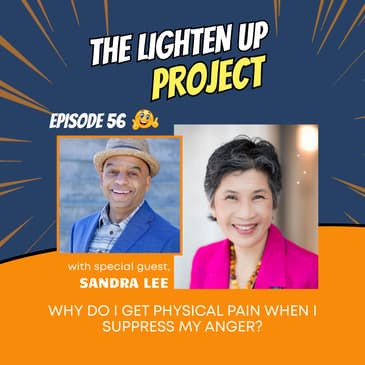
What if the anger you've spent your whole life suppressing is actually the key to your healing? Integrative healing expert and founder of The Anger Spectrum, Sandra Lee has spent over 30 years helping people find freedom from chronic pain — and she believes it starts with finally letting yourself feel what you've been taught to hold in.
What You'll Hear
- Why Sandra believes anger isn't the opposite of laughter — it's a doorway, and laughter is the bridge to walking through it
- The origin of The Anger Spectrum: why suppressed anger (and other "difficult" emotions like sadness, guilt, and worry) so often shows up in the body as physical pain
- How Sandra's own relationship with anger changed the moment she stopped judging herself for feeling it
- A live grounding demonstration using sound and breath, and why being grounded makes it "virtually impossible to be upset"
- The role sound plays in healing at a cellular level, and why singing and music can be so therapeutically powerful
- A real client story: 13 months of daily headaches, and what changed after just one session
- Sandra's simple four-step process for moving through any uncomfortable emotional state: awareness, pause, choice, and laughter
A note to listeners: this episode includes Sandra's personal approach to energy work, sound healing, and pain management. These reflect her own methods and client experiences, not medical advice — please consult a qualified healthcare provider for any questions about your own health or pain.
Resources Mentioned on this Episode
- Free Gift: 9 Pain Management Secrets — Sandra's free email guide, available at shinewithsandra.com/pain
- Learn more about Malcolm's work at the World Laughter Organization™
Featured Guest:
Sandra Lee is an Inner Critic Specialist and Body Interpreter who helps high-functioning women leaders over 50 stop second-guessing themselves and lead with clarity and authority. Creator of the Spectrum of Anger™, she has spent almost 40 years helping women understand what their emotions and body are trying to tell them.
Connect with Sandra Lee:
- Website: https://miracleinspirations.com/
- Email: sandra@miracleinspirations.com
- LinkedIn: https://www.linkedin.com/in/sandra-lee-701662250/
- Facebook: https://www.facebook.com/SandraLeeInspiration/
- YouTube: https://www.youtube.com/@sandralee1miracleinspirations
Free Gift:
Body Symptoms Decoder What is your body trying to tell you? and what is it stopping you from doing? This guide helps you see the connection between suppressed emotions, symptoms in the body, ... and the thoughts that keep you from making progress.
Decode common symptoms:
* Jaw tension
* Headaches
* Digestive upset
* Tight shoulders
* Low back pain
This isn’t diagnosis. It’s awareness. https://shinewithsandra.com/body
Meet the Host: Malcolm Grissom
Malcolm Grissom, affectionately known as "The Stand-up C.E.O.," is a team-building and employee engagement expert. Malcolm, an award-winning actor, comedian, International speaker, and best-selling author, masterfully blends humor, improv, and business acumen to enhance team dynamics and profitability. As a certified laughter leader, he leverages the power of positive psychology and his social work background to create engaging, results-driven experiences. Whether inspiring executives, strengthening teams, or energizing audiences, Malcolm’s unique approach fosters connection, creativity, and success. His ability to transform corporate culture with humor and insight makes him a sought-after speaker and consultant.
Follow Malcolm:
Website: malcolmgrissom.com
Facebook: facebook.com/malcolmgrissom
LinkedIn: linkedin.com/in/malcolmgrissom
Stressed, stuck, or leading on autopilot? It’s not a motivation problem—it’s a connection problem. Malcolm’s weekly virtual improv classes boost engagement, collaboration, and retention—all while having fun. Register now for a complimentary month: https://malcolmgrissom.thrivecart.com/everyday-encores/
We are proud to have The Lighten Up Project on the *High Vibe Podcast Network .* Grab your free gift from Malcolm in our Our High Vibe Gift Vault.
Love this show, check out the other shows on the High Vibe Podcast Network.
Share the Love
✨ If this episode lit something up in you… tag us on Instagram @HighVibeLeaders and let us know your biggest takeaway!
🦋 Don’t forget to rate & review — it helps us reach more conscious rebels like you.
🔊 Listen & Subscribe
🎧 Spotify
Hey, positive people! I am back again, and this time I am talking to another lovely guest, and I have to switch over here to my other computer to to read all about the all about her great, and you'll love this person. She is a integrative healing expert. She's also the founder of the Anger Spectrum. And no, it's not the autism spectrum, it's the Anger Spectrum. I know, they they sound alike, they're both AS, but she's the Anger Spectrum. So, yes, you'll love that. She has a a framework for transforming anger and dealing with pain. Oh, she she blends Well, you know, I'm not going to go ahead and tell you all about her. I'm going to let her tell you about her because she is awesome! Please welcome my newest friend here, Shelly. Hi.
Sandra Lee:Oh, thank you, Malcolm. So, for over 30 years, I have been helping people get out of pain, and lately I've been working most with headaches and migraines, and empowering people to find freedom from pain. So one of the things I know that you love talking about, Malcolm, is joy, and how joy can make a difference in our experience of life and work. There are so many people who I know and have worked with, who they have pain partly because they learned early in life that they had to suppress their joy, that they had to suppress their self-expression, that it was not safe to be able to do that. And that's what leads people, in my opinion, to experiencing pain. When I am not allowing myself to be fully expressed, to feel like I'm loved and seen, and respected, and honored, that's what leads to holding everything in. Does that make sense? It
Malcolm Grissom:does. It does, most definitely. That is also the groundwork of what we've been talking about in past episodes.
Sandra Lee:Let me just talk about the Anger Spectrum, okay? So, the Anger Spectrum is a concept that I created because I am on a mission to reframe our experience of anger.
Malcolm Grissom:Love it. Okay.
Sandra Lee:Because anger is one of those experiences from early in life that have people feel suppressed. They had a parent who was angry, leaves all sorts of distortion about this very important emotion, or, for people like me, where it was not okay to express anger, and so my way of handling that is like swallow all of my self-expression, particularly anything that might be difficult, leading to me feeling like it's not safe to be myself, it's not safe to be seen, it's not safe to be heard. And so, if over the course of my whole life, I put a lid on that, I don't even breathe, and that leads to tension in my shoulders, tension in my neck, tension in my back, tension in my head, holding everything back. So, with the Anger Spectrum, I say, anger is normal, anger is healthy, we need it. it. The issue is if I'm not allowed to express it, and I suppress it, that's when it becomes a problem. But if I am able to express my anger, or whatever emotions I have, as I experience them, then it's not going to pile up. When it piles up, it leads to these pains, it leads to the explosions that are where anger becomes problematic.
Malcolm Grissom:Yeah. Yeah. Oh, Shelly. I
Sandra Lee:I look at anger as being part of a spectrum of emotions:
Malcolm Grissom:Mhmm
Sandra Lee:anger spectrum, all of the challenging, difficult emotions. So, anger, sadness, guilt, worry, are people going to like me? What are people going to think? I think of these as all being challenging emotions. And when I allow myself to be with those and express them, they don't get stuck. And that enables my expression of anger to happen normally.
Malcolm Grissom:Right. Right. I love this. This is This is so much I've I've talked a lot about the inner bully, and this what you're describing about anger and and keeping anger in and locking it in, that is very much in line with exactly what I've been talking about as far as the inner bully. So, what I'd like to do, before we I'd like to go ahead and take a step back because I'd like to hear more about your story. What brought you to talk about anger and to create the anger spectrum?
Sandra Lee:When I was young, it was not okay being angry. But the truth is, I get angry frequently: big things, little things. I used to be angry for weeks at a time. And I used to judge myself horribly because of that, because when I was young, it wasn't okay to be angry. So, I used to, like, really give myself a hard time and beat myself up. Nobody else does this. And then, one of the things I do is Human Design. When I learned Human Design, I realized that I'm supposed to be angry. Anger is normal for me, and that enabled me to become peaceful with it. Instead of judging and criticizing myself, it's like, Oh, there's anger. Is there something I'm supposed to do? Am I supposed to communicate with somebody? Am I supposed to deal with something? Handle that, and then the anger goes away. Changed everything. Instead of judging myself for it, it's like, Oh, is there something I need to do? And then let it go.
Malcolm Grissom:Right. Gotcha. Yeah. Okay. So, what was it that motivated you to want to share this with others? Because right now you're describing something that you've experienced, and it's great. Now, why do you want to share with others?
Sandra Lee:Well, when I work with other people to support them in their healing, whether it's for pain or for them not moving forward with what they want or not believing in themselves, a consistent element for so many people is this history, mostly from family of origin, of anger issues, not being able to be expressive of anger or having a parent who It's such a common thing that people struggle with: It's not okay for me to be angry. And so I decided, after seeing person after person after person after person struggling with this, that I wanted to normalize it. And because I have so much experience with anger myself, like I talked about earlier, I was like, Oh, I'm an expert when it comes to anger. And so I created the anger spectrum. Okay. Yeah, I A
Malcolm Grissom:lot of A lot of people think of anger and laughter, or as two separate things. It's the opposite; they're polar opposites. And laughter I don't think is is the opposite of anger. I think laughter is a doorway to that allows you to experience your laughter in a different way. So, I see laughter as something that people can use to bridge the gap. So if they're really angry and they don't know what to do and how to deal with it, laughter is a way to It's a bridge. It's a doorway to that spectrum that you're talking about, to being, Okay, now we can accept being angry and now, you know, join Sadia Lyssa's spectrum, anger spectrum, right? and experience anger in different ways. So, have you, in dealing with your clients, have you ever used laughter or joy or humor?
Sandra Lee:It's part of like a conscious process that I encourage people to have. Anytime I find myself in experience that I don't want, whether it's anger or upset or judging or criticizing or feeling like somebody else is judging or criticizing me, whatever the state is that I find myself that's uncomfortable, there's multiple steps that I can walk myself through to recover. And the first is being aware. Oh, this is how I feel. So many people aren't aware of how they feel. They're not aware of what they're reacting to; they just react. So the first thing to do is be aware. And it was like, Oh, this is where I am. I want something different. So to have that awareness of where I am, and then choosing to find another place, and then breathe and like pause the situation. So it's like when I'm reacting, if I can move back a little bit and pause, then that gives me some space to be able to choose something different. And then this is where I would put laughter in, because laughter it's it's like it physically changes the frequency. It physically changes my body to make it easier for me to pull myself out of whatever reactive space that I'm in. So certainly, laughter is an incredibly powerful tool that people can use. And it just is getting myself to the point I'm aware of where I am. It's like now would be a good time to laugh, so that I give myself that break. But laughter also like physically massages your organs. It physically massage, you know, it just physically starts to disrupt the stuck place. And this is part of what I call, you know, fake it till you make it. If I were really pissed off at somebody, if I got myself to laugh, it would start evaporating that upset pretty quickly. So laughter is powerful for that reason.
Malcolm Grissom:So could you take us through like and you know, I'm I'm sure you don't want to share details, but could you be could you be as detailed as possible without being detailed? So I I love I love some things that I think about. But could you share with us a sample session, or a way that you work with someone, or that you have worked with someone? If there is a story that you can share without giving out too much details about your whole process and how this works to say bring like you just said, bring someone from, you know, extreme anger, like I'm not, I don't know what to do to at least be able to, well, then we can laugh or we can do something to then experience more of this spectrum.
Sandra Lee:Sure, let's do a little demo,
Unknown:okay? And
Sandra Lee:we'll do a demo like with this example we're using, okay? So imagine being upset, whether it's anger or something else, okay? So part of what happens physically in your body when you do that is like your energy comes up, and you kind of get you know, big like, you you go into fight-or-flight, okay? So fight or flight, fighting, you know, defending myself, or get out of here and flee, okay? So imagine that state is very ungrounded. It's like right? So I'm going to do a grounding process for you. I use sound biofield tuning a tuning fork and hockey puck to help me be energetically aware and also to help people ground. Okay, so I want you to imagine you've got the Earth below your feet and maybe you're sitting in a chair, so you can feel the weight of your body resting on the Earth or on the chair.
Malcolm Grissom:This is great, because you know, I am my feet are on the ground and I am in a chair, so. Yes. Okay,
Sandra Lee:so feel the presence of the Earth below you and draw that energy up, and I'm going to use the sound to help increase that. So drawing energy up from the Earth into your feet, into your seat, through your body, and out the top of your head, and breathe. So, even just with that, you might already notice that you feel more grounded. You feel calmer, more supported. Okay. Now, we're going to connect above to God, Source, the universe, and bring energy down into your head, through your neck, through your back, down through your help pelvis, your legs, your feet, connecting you to the earth. So, feel like you're supported from the earth below and from God and the universe and the heavens and Source, everything above, whatever you believe in. So, feel like you're being suspended between the two, between the earth and between God, Source, and the heavens. So, in this place of being grounded, it's virtually impossible to be upset. Can you feel that? How calm and peaceful it is?
Malcolm Grissom:Mhm.
Sandra Lee:This is being grounded. And this is something I teach people to do, because when you can get to this grounded state on your own, you're so much more powerful. And if you have pain, being in this grounded state helps your body to be able to release the pain.
Malcolm Grissom:Mhm.
Sandra Lee:Sometimes I'm able to, in the course of a very short session, able to have someone go from being in intense pain to not being in intense pain.
Malcolm Grissom:Yep.
Sandra Lee:Just through getting this energy moving, getting the grounding to happen. Right. Somebody who I worked with, she had had a headache every day for 13 months, and the only thing she knew when she woke up in the morning was that she was going to have a headache. First session I did with her, exactly what we're doing now with this tuning fork, her headache went away, and she didn't have a headache for 3 days. Changed so much for her. She realized it was actually possible for her to not have these headaches every day.
Malcolm Grissom:Mhm. Her
Sandra Lee:headaches then came back, and with NLP, we are helping her understand why she has the pain, why she has the headaches, and she's got her life back.
Malcolm Grissom:Wow.
Sandra Lee:She's got more energy. She's more excited now about her work and her dream, and she's actually like engaging in new relationships because she's no longer drained every day by having a headache. That's what's possible in your life. A lot more joy.
Malcolm Grissom:Yeah, definitely, a lot, a lot more joy. So, I've done a lot of I'm very intuitive. I'm very spiritual person myself. I've done a lot of grounding, a lot of grounding work. Just being an actor and improv, you know, we focus a lot on grounding. Mhm. I don't and have not yet really experienced someone who used sound. So, could you explain to us the use of sound and the importance of sound in the grounding process?
Sandra Lee:Not just in the grounding process, but sound is really very healing and therapeutic overall. Mhm. So, sound creates a physical wave. So, when I do this, there's like a wave of sound that travels through space. And in your case, you're going to have sound coming out of the speakers for your computer, landing on you. So when I have a cell in my body and this wave of sound comes through, the wave of sound actually sets up a wave through the wall of the cells. Cells are made of like fats. And cells have like liquid crystal-like walls. So when this sound wave comes and it hits this cell, there's a ripple of a wave that goes through the cell. Every bit of the inside of the gel basically, inside the cell, it all vibrates. And anything that's stuck inside this cell, your cell is able to release those frequencies, the things that are stuck. So sound therapeutically is incredibly healing, because any time you hear sound, it passes in this wave through your cells, releasing what's stuck. This is part of why singing and music are so therapeutic. They're healing. And so this wave of sound has a transformative effect. Hm.
Malcolm Grissom:Very interesting. I love this conversation. It's a great conversation. And we cannot just talk and talk all day. I'd I'd love to just talk and talk all day. You are a wealth of information. I would please share with our audience here how they can work with you and get more information from you, and about you.
Sandra Lee:The easiest way is to get my free gift. I have a gift, Nine Pain Management Sequence, Nine Pain Management Secrets, and it's an email sequence that then after that you will receive my newsletter. And so the address for that is shinewithsandra.com/pain. Shinewithsandra.com/pain. shinewithsandra.com /pain. That's newsletter, right? Okay. Wonderful! Wonderful! All right, well,
Malcolm Grissom:it looks like our time has pretty much come into an end. So, hey, Sandra, I loved having having you on our show. Any last words?
Sandra Lee:It's possible if you have pain to purely energetically be able to release it. I have had neck pain and headaches myself, and in a training that I was in last week, I had a massive healing, massive release, and my pain went away. So it's possible for you, too. A lot of people when they have pain, they feel hopeless, like, Oh, I just have to live with this forever. It's possible that you can find freedom from pain.
Malcolm Grissom:Love it! Love it! Thank you Sandra, for being on our show once again. And thank you, audience, and please keep Stay tuned, there's always fun here at the Lighten Up Project. Thanks for tuning in.