
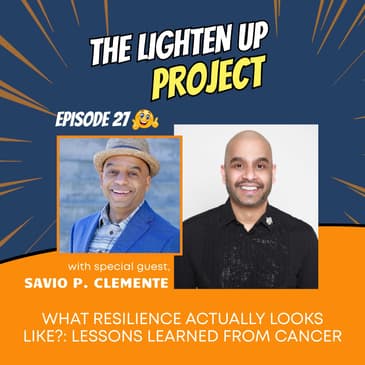
What happens after life completely changes you? In this deeply moving episode, Savio P. Clemente shares how surviving cancer twice reshaped his understanding of resilience, healing, and leadership—and why true strength comes from honesty, surrender, and learning to trust the process.
What You’ll Hear:
- Why resilience isn’t about “bouncing back”—it’s about adapting and evolving
- How laughter and joy help us reconnect with ourselves during hard times
- The powerful difference between controlling life and surrendering to the process
- Why healing is never linear—and how to stop fighting yourself through it
- Savio’s “ALOHA Reboot” framework for navigating uncertainty and emotional overwhelm
- How leaders can reduce pressure, think more clearly, and create healthier cultures
Resources Mentioned on this Episode
- Connect with Savio P. Clemente:https://saviopclemente.com
- Subscribe to Savio’s newsletter: The Human Resolve
- Watch Savio’s TEDx Talk: 7 Minutes to Wellness: How to Love Your Inner Stranger
- Malcolm’s improv + laughter experiences
Featured Guest: Savio P. Clemente
Savio P. Clemente is a keynote & TEDx speaker, journalist, and resilience strategist who has interviewed over 2,000 global leaders and experts. A two-time cancer survivor, he brings a deeply human perspective to navigating pressure, uncertainty, and life’s most defining moments. Through his work with healthcare, corporate, and high-performance leaders, Savio helps people make clear decisions under pressure, build lasting resilience, and lead with greater clarity and confidence. His message blends real-world insight, personal experience, and a grounded sense of perspective that reminds us even in the hardest moments, there is space for growth, connection, and lightness.
Conenct with Savio: https://www.saviopclemente.com
Meet the Host: Malcolm Grissom
Malcolm Grissom, affectionately known as "The Stand-up C.E.O.," is a team-building and employee engagement expert. Malcolm, an award-winning actor, comedian, International speaker, and best-selling author, masterfully blends humor, improv, and business acumen to enhance team dynamics and profitability. As a certified laughter leader, he leverages the power of positive psychology and his social work background to create engaging, results-driven experiences. Whether inspiring executives, strengthening teams, or energizing audiences, Malcolm’s unique approach fosters connection, creativity, and success. His ability to transform corporate culture with humor and insight makes him a sought-after speaker and consultant.
Follow Malcolm:
Website: malcolmgrissom.com
Facebook: facebook.com/malcolmgrissom
LinkedIn: linkedin.com/in/malcolmgrissom
Stressed, stuck, or leading on autopilot? It’s not a motivation problem—it’s a connection problem. Malcolm’s weekly virtual improv classes boost engagement, collaboration, and retention—all while having fun. Register now for a complimentary month: https://malcolmgrissom.thrivecart.com/everyday-encores/
We are proud to have The Lighten Up Project on the *High Vibe Podcast Network .* Grab your free gift from Malcolm in our Our High Vibe Gift Vault.
Love this show, check out the other shows on the High Vibe Podcast Network.
Share the Love
✨ If this episode lit something up in you… tag us on Instagram @HighVibeLeaders and let us know your biggest takeaway!
🦋 Don’t forget to rate & review — it helps us reach more conscious rebels like you.
🔊 Listen & Subscribe
🎧 Spotify
[00:00:03] Welcome to The Lighten Up Project, the show that reminds us that healing doesn't have to be heavy. I'm Malcolm Grissom, the stand-up CEO and founder of the World Laughter Organization. Let's explore how humor, heart, and play save the day and create spaces for healing and connection.
[00:00:33] So let's get ready to laugh, learn, and lighten up! Hello, my fellow light makers! It is I, Malcolm Grissom, the stand-up CEO and founder of the World Laughter Organization.
[00:00:59] And I thank you very much for coming to another episode of The Lighten Up Project. Because we're just lightin' the world up! Lightin' it all up! Lighten up! Well, today on the Lighten Up Project, we are going to be talking about pressure. And how to respond to pressure.
[00:01:26] Because life has a way of testing you. And never do you get a warning email. So, now we're going to be talking about how we can always handle the pressure. And we've got stories about handling pressure. Well, my guest today, Samuel P. Clemente.
[00:01:54] He's a keynote speaker. He's a TEDx speaker. He's a journalist and resilient strategist. Who's interviewed over 2,000 global leaders. And lived through a couple of challenges. And just a couple of challenges that people can only imagine.
[00:02:21] I'll let him tell us about the challenges he's had. He brings a lot of insight due to his past and the past health challenges that he's had. He has not let them slow him down, per se. I mean, they... Well, I should say he has not let these challenges stop him.
[00:02:52] He may have slowed down for a bit. And it's kind of like peaks and valleys. But we'll get into that as well. We'll get into all of that as well. But he brings a lot of perspective on how to think clearly. How to make better decisions when things feel uncertain. And so now, through his work with leaders across many different industries,
[00:03:21] he teaches resilience and that it actually lasts not just in theory, but in real life. So if you've ever wondered how to stay steady when things get hard, this conversation is for you. Let's lighten up. Keep going.
[00:03:47] And welcome Savio P. Clemente. Malcolm, beautiful introduction. Thank you so much. I really appreciate it. I'm excited to be on the show and lighten up your audience. That's right. That's right. And thank you so much for joining the Lighten Up Nation, which is our community.
[00:04:10] So the project is the podcast, but now you're a member of our community, the Lighten Up Nation. And thank you so much because we're all about bringing the power of laughter and humor and play and hope and resilience to global.
[00:04:37] Globally we are to really, especially to our next, to our leaders of our next generation. Because they'll just instill that in the next generation and things will keep growing and improving and improving and improving and growing. So thank you so much for getting done this without you. Thank you, Malcolm. I appreciate it.
[00:05:05] And let's see what we give to your audience. All right. We will. Especially with starting with a 20 seconds of spontaneous laughter. Are you up for that? I am. Of course. All right. Okay. One, two, three.
[00:05:25] Yes, yes, yes.
[00:06:07] Oh, my goodness. I love laughing at that. Sometimes it just goes on and on. I say 20 seconds and it turns into 30 seconds in a minute sometimes and it's lovely. So, hey, what's your relationship with laughter?
[00:06:27] My relationship with laughter is that it always brings me back to balance. No matter how dire things are, and as you alluded to, I have suffered two major medical blows, two cancer diagnoses 10 years apart.
[00:06:44] But laughter has always allowed me to find the other side of that ping. Laughter allows me to really live into my playfulness, my childlike sensibility that I think I've lost along the way.
[00:07:02] And generally, laughter also allows me to appreciate people genius. I think if you can make someone truly laugh and it's a very witty or it's a very inspiring or engaging type of laughter, it really makes you feel more connected to people. Yeah, yeah. Now, you said something that I'd like to touch upon for a second.
[00:07:30] You were talking about how laughter helps you get back in touch with that play that you lost along the way. I think that a lot of adults have forgotten how to play, especially in business.
[00:07:57] Some parents, they forget how to play because they're all about leadership and they forget that being playful is a huge thing. Each part of leadership, as do business leaders, same kind of thing.
[00:08:16] So how do you think that we can remind people, remind adults how to play? Well, as you can imagine, my lane is healthcare leadership. So I talk with CEOs, CMOs.
[00:08:43] I'm dealing with individuals that have high stakes, not only for themselves and for their organizations, but for other people, life or death situations. And they themselves have to be so careful and buttoned up and focused. Especially since what I really speak on, keynote stages is this idea of after the crisis, how do you move forward?
[00:09:09] How do you begin to bring back something that was lost? How do you perform again? And I think the number one key element in facing that or challenging that or even coming up against that is always starts with them figuring out a memory.
[00:09:31] I think if you can get them to speak about a memory, no matter what the memory is, they themselves allow themselves to be at ease. And then from that, you can actually then ferret or have them speak about a time when life seemed joyous. If you speak about joy with someone, they're invariably going to laugh. That's just part of the equation when it comes to joy.
[00:10:01] Interesting. Very interesting. So do you think, are you saying a memory specifically about a play or a joyful moment in their lives or just any type of memory? I think for most people, if you ask them to speak about a memory that has stuck with them or that was profound or that they themselves related to,
[00:10:28] they will invariably talk about a memory. And in that sequence of them retelling that story, they will always find a gem of laughter in there. It's just common. Because laughter and joy, because they are sort of similar or they're related in some degree,
[00:10:51] when you ask about a memory, people want to be thinking about things that made them feel good, made them feel at ease, made them feel accepted, made them feel seen, made them feel loved, made them feel wanted. And when you talk about those qualities, those human elements that we crave, that we want, that we desire, invariably, joy comes into the picture and laughter comes into the picture because we want to then emulate those feelings again.
[00:11:19] And we want to readdress, we want to mirror, we want to capture those moments where life seemed easier, simplistic, less stressful, more in tune with what we thought our lives would be,
[00:11:36] rather than some of the responsibilities and the heavy laden stress that's often put upon us through work, our personal lives, and through the day-to-day responsibilities we have. Mm, yes. Yes, yes. Okay. All right.
[00:11:54] So let's talk about resiliency and the relationship with its relationship with play and joy. So you've interviewed over 2,000 leaders. And so what's the one quality that most resilient people seem to share? So we all know resilience is this idea of bouncing back.
[00:12:24] And with bouncing back, it's often hard because you want to bounce back to where you were in life. And for me, I like to reframe it as adaptive resilience, this idea that when you're in the problem, that you can find strategies. And one strategy is laughter. One strategy is finding the spark, finding the joy, finding the hope in a situation.
[00:12:45] And so I think most of the time when it comes to resiliency in general, people are often focused on what life was like before the tragedy, before the crisis, before the problem. And when they fast forward, they can't always picture themselves seeing themselves past it. It's almost like they're stuck on stop. You know, back in the day, we would have VCRs and it was just stop and it would not go forward.
[00:13:14] And you would have to sometimes take the tape out, put the tape back in. I know I'm dating myself here, Malcolm, but that's what came to mind. And sometimes it's hard to move forward. But joy and laughter gives us the ability when it comes to resilience to see ourselves greater than the problem, to see ourselves above the problem rather than below the problem.
[00:13:36] And so what's important, I think, is to have an element of play, of less seriousness and more of just being in the moment. I think that's really key when it comes to laughter, especially joy, is that we often try to create scenarios that disappoint us, that doesn't live to our expectations. Mm-hmm. Okay.
[00:14:04] Now, you mentioned, I alluded to it and you actually mentioned it. You talked about your two-time cancer survival or being two-time cancer diagnosis 10 years apart.
[00:14:25] Would you please tell us that story so all of our listeners get to really understand what that means and what that meant? So it was 2014. I came back from a trip with a friend in Europe. I started noticing my stomach starting getting distented bigger and bigger. I noticed that I was having drenching, drenching night sweats.
[00:14:51] I actually had it in a couple of locations in Europe when we were there vacationing. And I saw a naturopath. He said to me, something looks really wrong here. You should get a sonogram. I went to go get a sonogram and basically told me I need to have someone pick me up, even though I drove there, to go to the hospital. And within an hour and a half, I was admitted into the fifth floor.
[00:15:15] And then later that night, I was told I'd be transferred to the seventh floor, although I heard the nurses talking that the seventh floor was the cancer floor. So I had an inkling that I had cancer. I didn't know what kind. A day and a half later, after being transferred, I was told I was stage three non-Hodgkin's lymphoma, which was a blood cancer. I was bedridden for a week because inside the distension of the stomach was ascites and inside the ascites was lymphoma.
[00:15:42] And so they distended about, they actually drew about eight liters of fluid from my abdomen. And then I spent an additional eight days. And two days before I left in the hospital, the medical director came and said to me, you have to start your first round of chemo. And I thought literally long and hard about whether I wanted to do that because I knew that chemo can be very harsh and aggressive. But I had no other choice. I was in a hospital. And so I said yes.
[00:16:11] And after I got out, I had an additional five rounds every three weeks. And in about four and a half months, I ended up getting my remission status. And I was in remission for a decade. And then in 2014, June, I'm sorry, in 2024, in June of 2024, I ended up finding out I had a relapse. And we can talk further about that. But at the moment, that's where it was. Hmm.
[00:16:41] Well, so with those experiences, what does resilience in your personal life, what does resilience mean to you today? So to further the story, so I ended up, I would see an oncologist every year, even though after five years, I didn't have to see one. And he told me I was good in 2024.
[00:17:08] I told him I wanted to go see an ENT because I just noticed some nasal congestion and some earfulness from time to time. I came back from another trip to India, and I noticed it before I left on the trip. But I went to my ENT, and he's like, wait a minute. You have a lot of inflammation in the right nostril. He's like, you're a B-cell lymphoma survivor, right? I'm like, yeah. He goes, you know B-cells can live in the nasal cavity? I'm like, what?
[00:17:33] Malcolm, I thought I was going in there for nasal medication because my oncologist said I was good. And he's like, I've been burned as a doctor before. Let's do an MRI. He did an MRI, and he's like, something looks really strange. He's like, let's do a biopsy. And he did a biopsy, and a few days later on a Friday at 3 p.m., I ended up getting a notification. And the notification basically stated that I had a relapse.
[00:18:00] And the next day, believe it or not, I had my 25th college reunion. I was emailing these people weeks ahead of time that I would see them, and I didn't go because I didn't have the courage or the stamina or the strength to deal with something like that, especially when I just found out I just had a relapse. I met with a oncologist that Monday. He explained to me the comprehensive treatment protocol for a relapse for lymphoma. And basically, it was two, three-day stays in the hospital.
[00:18:29] Then they had to put a neck catheter in me in order to harvest stem cells. I had to inject myself for a week or two in order to stimulate those stem cells, then do the stem cell harvesting. 29 days in the hospital. Typically, it's 21, but every time I would stand up, I would have tachycardia. My pulse would go to 160, 170. So much so that one night, they had to transfer me to the ICU to get norepinephrine. I left the hospital.
[00:18:56] I lost about 26 pounds in the hospital after 29 days. Then they did a scan, and I was in complete response to treatment or complete remission to treatment. But then my oncologist was like, there's a clinical trial. If you want to do it, it's an immunotherapy. It's like an insurance policy for you if you want to do it. I thought it over. My sister was like, why would you want to do that after you just got a complete response to treatment? I said, because if it ever came back, then I didn't do everything I needed to do, right?
[00:19:25] And so I did it. It was four and a half months. It was eight rounds of that, and then I did five months of physical therapy. At this point, I left everything on hold. And I tell you this story based upon resilience because even my parents, even when I was doing the immunotherapy, were like, don't you want to go to work? Go to work. Go to work. And I'm like, I don't feel like myself. I can't. What's the point of going back to work when I don't feel like myself again? I can always make money, but I can't get well again.
[00:19:54] I can only get well now. And I tell you this story because that's what resilience really is. It's not this idea of having to bounce back. It's this idea that you can bounce back, but it requires so much more than just medicine, so much more than just a will and a desire. Healing is not linear. Healing is an up and down discovery. It goes round and round.
[00:20:19] It's spiral, and it puts you into different paths and avenues that you yourself never thought that you could find. So what helped me during that time? Obviously, reading, meditating, taking the medications necessary, going for my scans, but watching movies, laughing, allowing myself to visualize and to envision life beyond this to reclaim something that I felt that I lost.
[00:20:48] And so that's what resilience for this process meant to me. So when you say so much more than just will and are you referring to it's really holistic? It took your being able to view your situation holistically, and that's what resilience is.
[00:21:14] I'm just wanting you to unpack this so much more question. It's a great question. So I grew up Catholic, so I had a strong foundation. I was an altar boy for many, many years in elementary school. But in college, I knew that I wanted to explore other belief systems, so I studied everything from Buddhism to Vedic philosophy. So I'm someone who believes truth can be found in many religions. Truth can be found in many belief systems.
[00:21:40] And so for me, the hospital stay, because I was in my own room 29 days, it was quarantine room because when you get a stem cell transplant, they have to make sure they stave off any chance of infections. So yes, people would come and do my vitals, but for the most part, it was pretty much my room. And in there, I latched onto two things, silence and stillness, things that no one could take
[00:22:05] away from me, things that were so profound in that silence and stillness that I could see myself as the one suffering on the table, and I could see myself as that resilient individual who can get through this or who can allow myself to be free of this to some degree. But I also knew that healing is not something that can be fast forwarded. The great Eastern philosophies will teach you that nature doesn't rush.
[00:22:32] The seed underneath the ground doesn't rush. The river, when it flows, it flows in its direction, but it doesn't rush. Even if something's abutting the river like a stone or a rock or a boulder, it goes under, it goes over, it goes around, it goes on the side. And so I knew for me that resilience didn't just mean that I needed to get back to where I am. It meant that I could get back to where I am.
[00:22:59] But the only way to get back to where I am is to allow myself to be free, to surrender to the moment. Because Malcolm, I couldn't control my red blood cells, my white blood cells, my platelets. I can't control any of those vitals that they're looking for. I can only control my mental state, my emotional state to some degree. I can control to some degree my ability to process all this.
[00:23:23] There was one night where my iPhone didn't recognize me because my beard grew, my hair was all messed up. My skin changed four shades darker because of the chemo. And so for me, it was this ability to allow myself to go through the transformation, to go through the exile. And so that's really what resilience is. And like I said, adaptive resilience.
[00:23:49] And for me, this echoes into the work that I do, which is this idea that you just don't survive the crisis. It's what comes after it. People, especially in healthcare leadership, thinks that once they make you through the crisis, they're fine. But no, that's not where you start losing. That's where, especially in healthcare, it's estimated that the US loses about $760 to $935 billion in healthcare waste. Where do you think most of that stems from?
[00:24:19] It's not just the equipment. It's the people leading the charge. It's the leadership that then trickles down to the rest of the staff. And so I say all this just to remind people that healing, especially the healing that I did, I explored everything from traditional medicine to integrative medicine, and also things like internal family systems, where I saw different parts of me expressed through different people. I did ecstatic dance.
[00:24:47] I mean, I did things that most of it would be considered questionable. But I also knew that even in ancient times, they didn't have modern medicine. So how did they get through some of the stuff that they went through? They got through it by discovering and by not being close-minded. And so I allowed that process to unfold. The only thing I didn't do, Malcolm, I didn't do psychedelics. And that's because I truly believe that if you open a door in life,
[00:25:15] you have to be responsible and ready for what the door invites. And so for me, I wanted to make sure that even though my body went through trauma, my mind didn't go through any trauma. Mm-hmm. Yes. Okay. So what advice would you give to the person that's going through, let's say,
[00:25:40] not even something as heavy as a cancer diagnosis, but someone that's going through really hard times, and they just can't seem to find a reason to be resilient. They can't believe in resilience. What advice would you give that person?
[00:26:06] Most people believe that they want to get through the stagnation and make a breakthrough. Most people believe this idea of clarity and getting through and turning that clarity into this idea of strategic advantage. All those things are wonderful. As you can imagine, in healthcare leadership, I talk about industry terms like strategic reversals, where something that was taught to be the standard of care isn't really, or increasing ramp, or increasing return on investment. At the end of the day, those things matter.
[00:26:35] But what really matters is what you honed in on right now, is if someone's going through pain and struggle and discomfort and fear and anxiety, how do they get themselves through it? Well, the first thing they have to do is be really honest with themselves. And so there's a, besides my adaptive resilience framework inside of it, I allude to a mini framework called the Aloha Reboot. I actually echo this in my TEDx talk,
[00:27:02] which is Seven Minutes to Wellness, How to Love Your Inner Stranger. And in the TEDx talk, the words Aloha, it's an acronym. A stands for acknowledge. So acknowledge where you are, what's happening to you. Don't pretend like I was in the hospital. I'm strapped to these machines. I'm hearing the beeps. Yes, it's not pleasant. So just be, just acknowledge where you are. L stands for listening. So listen to yourself.
[00:27:30] So as we all know, Aloha in Hawaiian means hello. And in Hawaiian culture, they have a healing modality called Huna Healing. And in Huna Healing, they believe that the body has messages, has resonance. It can actually talk to you. It has information to glean. And so I say, you might not want to do this in front of other people, but try to listen to see what your body's messages are sending you. So that's the L. O stands for opening. So no matter what your belief system is, even if you don't believe in anything, if you're an atheist,
[00:28:00] just open yourself up to this information. Reject what you don't feel aligns. And accept things that do. H stands for harnessing. So harness what it is that you gleaned and that you gained. And A stands for acting. That's the most important because in the nature of change theory, which is called the trans-theoretical model of change, which is the stages of change, it posits that it's not that people don't want to change. They just don't know how to change.
[00:28:27] They don't know if they're thinking about change, wanting change, being an action of change, or relapsing and not wanting change again. And so that's really what the H, what Aloha really stands for, is acting with courage on those things. Really? Hmm. Okay. So in your story, while you were going through your story,
[00:28:54] especially the second time that you were diagnosed with cancer, what did you learn about yourself in these moments and in your resiliency? Lessons that maybe you couldn't have learned any other way. I learned the idea of truly surrendering, not surrendering to death, but surrendering to the process that there's only so much,
[00:29:21] not only that I could control, but there's only so much that I could do. Control is different than doing. Controlling is wanting to do something, is having the ability to do it. Doing is actually having the physiology. I couldn't do much because I was in the hospital in a quarantine room. Having the ability to, let's say, work again, even though I chose not to because I wanted to focus on healing.
[00:29:48] And I think the third element of all that is really about the fact that, do I have agency anymore? Do I have, not only about the ability to do or the ability to control, but is my circumstance something that's beyond, not only control, but beyond the scope of what I need to establish?
[00:30:11] Maybe, maybe the key is that I need to just let the process unfold the way it needs to unfold. Maybe the fighting of it is what's making it worse rather than making it better. So it really taught me that I can allow things to unfold. I can allow recovery. I can allow integration.
[00:30:38] I can allow the moment to pass the way it needs to, rather than overthinking with cognitive load or cognitive fatigue, which is a huge thing in healthcare leadership because they're so focused on the data. Now, you talked about your background and how you studied a lot of Eastern philosophy and whatnot.
[00:31:06] So what you were talking about being in the moment, letting things unfold, that is a big part of Buddhism and Taoist philosophies. So did you have a sense of this before your cancer diagnoses, I guess?
[00:31:29] Or is that just something that you, especially that this experience led you and opened up for you? I knew these things in theory. You have to remember, I had a first bout with cancer the first time, you know, and I dealt with it. So I wasn't afraid of the enemy. I know this enemy well. I know what it does. I know physically what it can do.
[00:31:57] And even though it's a different treatment protocol and more involved, I know. But there's a difference between knowing something from an intellectual standpoint and even an emotional standpoint, and having to go through the transformation itself, having to actually live through the transformation. So even though you know something, it doesn't become real until it affects you. That's why they often say that doctors don't make good patients because doctors can prescribe.
[00:32:26] They can tell you to adhere to something. They can tell you what the standard of care is. But they themselves, until they have actually experienced it, don't really know what it's like on all levels of their being, not only just mentally, until you experience it. And so at the end of the day, even though these were things that I knew about surrender and letting go, and the universe has its own way of doing things and all that, that's wonderful.
[00:32:54] But when you're faced with a test, and it's a huge test. I mean, this was what I consider like an exile. And even my recovery was an exile. I chose an exile, but it was an exile. Whether you call it spiritual or not doesn't really matter. What really matters is the fact that you're faced up against something really hard, really heavy, and you use all tools and all things available to you. Because like I mentioned previously, healing is not linear.
[00:33:20] If that was the case, everybody who gets the scientific medicines, science of medicine, would be healed. They're not, because the body is complex. Everyone's different. Everyone comes up with a different genetic makeup. And not all the medicines work the way that they're supposed to. But I do know one thing. I've lost eight people since my relapse in June of 2024 to cancer. Some of them, it was just their first bout. So I do not take this lightly.
[00:33:49] I take this as a responsibility. I was able to see from both my professional lens and my personal lens twice now, how our healthcare system, yes, it has, especially in the U.S., has its problems. But it does work. And when it works, it works really well. I'm a living testament to it. So I take responsibility for this. I carry those people that I've lost in both memory and in action.
[00:34:14] And I know that through my work and through laughter as well and through my search for joy, that I can change the hearts and minds of other people and change organizations and allow them to create not only financial success, but to reduce risks. And I mentioned to you a staggering number of healthcare waste. I mean, that's happening rampant.
[00:34:41] So whatever I can do to help alleviate those burdens for organizations and eventually for patients, I'm all for it. I mean, that's a great thing. Now, you mentioned in your story constantly over and over, you repeated this, and I like this, that healing isn't linear. And it's not. Life isn't linear at all.
[00:35:08] There's a bunch of uncertainty. And I think that is one thing. The fear of the uncertainty is, I believe that there are people that struggle with the fear of uncertainty. You know, it starts with fear of being in the dark, you know, because being in the dark is uncertain.
[00:35:38] And, you know, it just grows and grows from there. And I don't mention this lightly. And I certainly don't want to put it on the same level as cancer or any serious illnesses or in what you're talking about, the resilience you're talking about and having to really experience
[00:36:08] something, you know, to understand it. But I have to say, when you were talking, I kept thinking about my classes and what I do. I teach improv. I teach applied improv.
[00:36:27] And there are people ask, what are the benefits of improv in business and in life? If they're not playing games, if they're not, you know, theater people, how does improv help them?
[00:36:48] And one big, big, big way that improv helps is with that feeling of uncomfortableness or the fear that people have of uncertainty. Because part of the improv is yes and. And then it's yes and.
[00:37:15] And that concept of accepting whatever your partner gives you, whatever offer, and building on it. So eventually you become comfortable with uncertainty, comfortable with knowing that, hey, whatever
[00:37:37] happens to me, whatever I'm thrown, whatever offers I'm thrown at, whether it's in business, whether it's an improv game, whether it's in business, whether it's in life, I can handle it. And there's another aspect, too, is the as if.
[00:38:05] That improv gives an as if quality. So in some cases, people don't actually need to experience the tragedies of life. You know, they don't have to experience that to get a better understanding because improv gives
[00:38:33] a, it gives a stage for people to act as if and to, to really empathize with, with the situations that, you know, that they may or may not be in. And, you know, to really empathize with, with your story, for instance, without having to go through it.
[00:39:01] So I just wanted to mention that. Have you had any experience with improv at all? I have actually. I've taken a few improv way, way, way back when, virtually. And in college, I did take a theater class. And so we did a little bit of improv, but that was so long ago. I do know about and yes, you know, yes and, and yes.
[00:39:25] And also, I think what I really gravitated with improv was this idea that everyone comes in complete and whole. It's almost what we in coaching speak with when we say that people are creative and whole when they come into a coaching session, that it's not me trying to fix you. It's me trying to unearth things that are relevant to you and important to you. And it's really echoes what I speak on my keynote stage because I know, especially after
[00:39:54] my relapse, I'm an impromptu improv speaker. I am not a speaker. My TEDx was mostly memorization with memory palace techniques. And that helped me because I embody the word, but my work and my work moving forward is more improv impromptu speaking is that I know what I'm speaking about, but I allow the words to flow. So in other words, I liken it to this idea of being an instrument and letting the breath
[00:40:24] I'm still and silent and letting the breath in that moment to come through to animate what I say and what I do. Well, beautifully put it. Well, beautiful, beautiful. I love that. So what actually happens to our thinking and decision making when we're under pressure? Glad you asked that because my whole goal and what I do in my work is really I help organizations
[00:40:52] fix the hit and drop in decision quality, especially after a crisis when it costs them not only misalignment and delayed execution, but millions of dollars in loss. And I mentioned to you the staggering number. So when it comes to decision quality, the worst thing we could do is to fixate on it. The other thing is the worst thing we could do is to ignore it. And the third worst thing that we could do is pretend it's going to fix itself. That's not possible.
[00:41:21] We as humans under a certain level of leadership have to take the reins and allow ourselves to put down the armor, name what's wrong, be really bold about that and humanize the process. Because leadership, what is it? It's not always in a corporate setting. It trickles down from your team to the community, to your family, to your partner, if you have one.
[00:41:48] And so at the end of the day, the key element there is you are leading, meaning you are reflecting and you are also reverberating and you are also, I'm using a lot of R's, also allowing the ability for people to see you, to see what they can emulate, what they can mirror, what they can take, how to follow.
[00:42:13] And so I think it's really important to allow that transparency to be predominant in your leadership, allow yourself to be empty to new ideas and innovations, and not always having to be the person with the answers. Yes, you have to know how you move forward. Yes, it's vitally important for the organization for you to take on that responsibility.
[00:42:42] But there is a reason why people say that you should surround yourself with smarter people because they themselves can influence your decision making. And so I think the first key element there is to allow the process, just like I allow the process to take shape and take hold. And I'm not trying to minimize, Malcolm, what I went through. It was harrowing. It was hard. It was some days felt really, really, really, really tough. But I also knew that if I didn't face it, if I pretended,
[00:43:11] I didn't really completely allow myself to have an embodied somatic, which is the body, have a somatic response to it, then I was cutting myself short from the experience. And I think anything in life is an experience, whether you think it's a good experience or a bad experience. It's something that I think informs us, whether you think it's a lesson or not a lesson. That doesn't matter. What matters is that you allow the process to take shape.
[00:43:41] Mm-hmm. Yes. A lot of the process. So what really gives you hope now when you look back and you see how different people grow through difficult experiences? Well, it's tough because we live in a very disruptive world socially, politically, technologically with AI. What gives me hope generally is that when I see someone coming across disruption
[00:44:11] or adversity or pain or discomfort, I think we have a lot of access to information. So I don't think information is our problem. I think our problem is quality of integration of that information. And I think it's very important for humans in a world of AI when people can create content and create intelligence very quickly for us to express that through our lived experiences. So in other words, if someone gives you something of truth,
[00:44:40] you have to let it filter and distill into yourself and speak from that. Not speak from only the intelligence aspect, but speak from lived experience. Speak from pain. Speak from sorrow. Speak from joy. Speak from laughter. Speak from those places where it informs the human experience. Because yes, we might be from different countries. Yes, we might look a little different skin color or our cultures or our eating habits. But at the end of the day, we all want the same things, correct?
[00:45:09] We all want those elements that not only make us human, but make us feel alive. That sparks joy in us. And so I think it's very important for us to realize that, to name that, to state that, to want that, to ask for that. To just allow ourselves to be and not feel like we have to create characters. Right. Okay. Love it. Love it.
[00:45:38] Unfortunately, we can't talk forever about this. I have your website and links on how to get in touch with you and everything. I have it all in the show notes. But right now, what I'd like to do is give you an opportunity to tell us,
[00:46:02] how can we talk more about how we can continue the conversation with you? Great. So they can find me on my website, Savio P. Clemente, S-A-V-I-O-P-C-L-E-M-E-N-T-E dot com. On there, they can look at my keynote work. At this moment, I have a few spots left for 2026 for keynotes. They can look at my TEDx talk. Every Wednesday, I have a Substack newsletter called The Human Resolve,
[00:46:30] where I talk about the head, heart, and gut intelligence. And I also talk about the interview series. Right now, I'm running a series with CEOs and CMOs. The Healthcare Leadership Operating System. And so they can find that information out. And then at every social media platform, I'm at The Human Resolve. And I call it The Human Resolve because at the end of the day,
[00:46:52] we humans have the ability to resolve and to find resolution for all that pains us, ails us, and also find commonality in all that brings us joy and laughter. Yeah. What's one tool or habit that someone can use to build their daily resilience?
[00:47:18] I think the number one thing that most people underestimate is their ability to overcome. It's their ability for the arsenals that life has shown them and given them. I think they underestimate their potential. So I think the number one thing to do is to just do a deep dive into what, one, bothers you. Two, a problem that you're trying to overcome.
[00:47:43] Three, solutions in the past that has helped you overcome similar or maybe non-similar things. Four, someone who you aspire or someone who you think is a visionary and how they manage to do, say, be the version that you would like to be. Great. Love it. All right.
[00:48:09] Well, Savio, can you finish this sentence for us? Resilience isn't about being strong. It's about... Resilience is not being strong. It's about being honest. Being honest. All right. Well, thank you very much, Savio P. Clemente, for joining us here on the Lighten Up Project.
[00:48:37] Thank you all the listeners for listening in. We could not do this without you. We are here with new conversations every Tuesday and Thursday. And we're so glad that you are tuning in and supporting us. And please tell your friends about what we do here.
[00:49:04] Because really, it takes a village to do what we are doing, what the Lighten Up Nation is trying to do. Bring this feeling globally around the world and emphasize the power of laughter, joy, happiness, hope, resilience.
[00:49:30] Especially with dealing with these heavy mental health issues like bullying prevention and suicide prevention, conflict resolution, things like that. And we could not do this without you. So please tell your friends. Please send us a review.
[00:49:53] Put a review on one of the platforms, Apple Podcasts, whatever podcast platform that you listen to. Please review our show. Let us know. Tune in to our Facebook page. Subscribe and follow that. And let's have a conversation. Tell us how we can improve.
[00:50:20] Tell us what you like about what we're doing here. We'll do more. We cannot do this without you. So please keep coming back. And please remember that every smile can open a door. Every laugh can open a heart. And every step can be your next victory. So until next time, I've been Malcolm Grissom.
[00:50:50] Thanks so much. You've been listening to the Lighten Up Project with Malcolm Grissom. Dressed out? Stuck? Or leaving on autopilot? It's not a motivational problem. It's a connection problem.
[00:51:11] My weekly virtual improv classes boost engagement, collaboration, and retention all while having fun. Register now for a complimentary month. Details are in the show notes. Healing doesn't have to be heavy. And Facebook doesn't have to be boring.
[00:51:34] Find out about upcoming episodes, suggest future guests, and join in on the conversation like our Facebook page, Lighten Up Project Podcast. If you've enjoyed today's episode, share it. If not, share it anyway.
[00:51:58] Please subscribe to our YouTube channel at Lighten Up Project Podcast and rate us on the podcast platform of your choice. Remember, laughter isn't just a reaction. It's a revolution against the heaviness of the world. So keep shining. Keep showing up. And when life gets heavy, don't tough it out.
[00:52:28] Lighten up.