
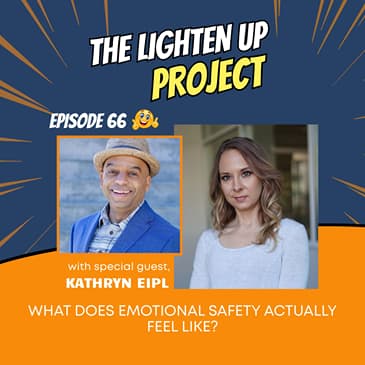
What if you could feel your emotions without being swallowed by them? Emotional strategist, Reiki master, and sound therapist Katherine Eiple joins Malcolm to break down what emotional safety actually feels like, why laughter and tears are often closer than we think, and how her Neural Resonance Method helps the body release the emotional energy the mind can't talk its way through.
What You'll Hear
- Why laughter isn't only tied to happiness — Katherine's honest take on laughing through sadness, stress, and even grief as a way to soften into hard feelings
- What emotional safety really means: feeling grounded enough in your nervous system to actually sit with anger, sadness, or grief instead of avoiding them
- A simple end-of-day practice for processing a heavy emotion on purpose — including where to feel it in the body and how to transition back to neutral
- The story behind her practice's name, Eiple Healing — "Every Individual Person Is Love" — and the belief that everyone is doing their best with what they've been given
- What the Neural Resonance Method actually is: a trauma-informed blend of talk coaching, Reiki, and sound therapy designed to release stored emotional energy from the body, not just the mind
A note to listeners: this episode touches lightly on past personal struggles with burnout and substance use as part of the guest's own healing journey, shared with care as context for her work.
Resources Mentioned
- Katherine Eiple's practice, Eiple Healing — eiplhealing.com (free Neural Resonance strategy session for new email subscribers)
- Find her on Instagram, TikTok, and Facebook: @eiplhealing
- Malcolm Grissom's work at the World Laughter Organization™
Featured Guest: Kathryn Eipl
Kathryn Eipl is an Emotional Strategist, Reiki Master, Sound Therapist, and Yoga and Meditation Guide. She is the founder of E.I.P.L. Healing, Every Individual Person is Love Healing. She created an emotional and nervous system regulation method, the Neuro-Resonance Method™. The Neuro-Resonance Method™ is a trauma-informed, integrative healing approach designed to help shift unhelpful behaviors, release stored emotional energy, and create lasting change through embodied, soulful transformation.
Connect with Kathryn Eipl:
- Website: https://eiplhealing.com/
- Email: info@eiplyoga.com
- Instagram: https://www.instagram.com/eiplhealing/#
- Tiktok: https://www.tiktok.com/@eiplhealing
- Facebook: https://www.facebook.com/eiplhealing
- LinkedIn: https://www.linkedin.com/in/kathryn-eipl/
Schedule your appointment online EIPL Healing: https://bit.ly/4o5Uw5y Complementary Gift = 1 Neuro-Resonance Strategy Session use code WELCOME at checkout.
Meet the Host: Malcolm Grissom
Malcolm Grissom, affectionately known as "The Stand-up C.E.O.," is a team-building and employee engagement expert. Malcolm, an award-winning actor, comedian, International speaker, and best-selling author, masterfully blends humor, improv, and business acumen to enhance team dynamics and profitability. As a certified laughter leader, he leverages the power of positive psychology and his social work background to create engaging, results-driven experiences. Whether inspiring executives, strengthening teams, or energizing audiences, Malcolm’s unique approach fosters connection, creativity, and success. His ability to transform corporate culture with humor and insight makes him a sought-after speaker and consultant.
Follow Malcolm:
Website: malcolmgrissom.com
Facebook: facebook.com/malcolmgrissom
LinkedIn: linkedin.com/in/malcolmgrissom
Stressed, stuck, or leading on autopilot? It’s not a motivation problem—it’s a connection problem. Malcolm’s weekly virtual improv classes boost engagement, collaboration, and retention—all while having fun. Register now for a complimentary month: https://malcolmgrissom.thrivecart.com/everyday-encores/
Share the Love
✨ If this episode lit something up in you… tag us on Instagram @HighVibeLeaders and let us know your biggest takeaway!
🦋 Don’t forget to rate & review — it helps us reach more conscious rebels like you.
🔊 Listen & Subscribe
🎧 Spotify
Thanks to all you people, all you fellow light makers, for joining me once again on the Lighten Up Project. My name is Malcolm Grissom, and I'm the stand-up CEO and founder of the World Laughter Organization, and you're not. So today on the today on the Lighten Up Project, we are going to be discussing emotions, and maybe we'll talk about the Inside Now movies one and two. Who knows? It might come up. I don't know. Yeah, we'll we'll see. We'll see. It's we're gonna have a wonderful conversation today. My guest is Kathleen Eipel. She's an emotional strategist. She's a Reiki master. She's a sound therapist and meditation guide who helps people finally shift through whatever gets them stuck. She's the founder of E I P L Healing. E I P L healing. Every person is love, and she's the creator of the neural reson. Maybe I can can I speak? Maybe I don't know. I'm not sure. Neural resonance method. That's what I'm trying to say. Say that three times quickly. Neural resonance method.
Kathryn Eipl:Neuro method. Neuroresonance method. Yes,
Malcolm Grissom:love it. Neuroresonance method. It's a trauma informed approach. It's designed to help regulate the nervous system, release stored emotion and the energy that it leaves behind, because you know there's all that emotional residue that we leave behind, and it creates real and lasting change. Catherine's work just goes beyond just understanding your patterns, but it helps change them. And so, if you ever said, "I know better, but still I'm doing the same old thing. Well, this episode's feel. So let's lighten up, feel it through, and welcome Kathleen Eitball. Thank you. And I said Kathleen. I'm sorry, it's Catherine Eitball. I said it right the first time, and my brain just went Kathleen the second time. I don't know why. Maybe I'm thinking Kathleen Turner.
Kathryn Eipl:Maybe, but yeah. Thank you for noticing that. I appreciate that.
Malcolm Grissom:Yes, Catherine Eipel.
Kathryn Eipl:Yes.
Malcolm Grissom:So, Catherine, will you join me now that that frog is out of my throat? Will you join me in 20 seconds of spontaneous laughter?
Kathryn Eipl:Yeah.
Malcolm Grissom:All right. Okay. 123, Laugh. My goodness! Oh,
Kathryn Eipl:I love the shift. I appreciate that.
Malcolm Grissom:Yes, sure. And Catherine, what is your relationship with laughter?
Kathryn Eipl:So for me, I think it's something that shows that I'm either really happy, and of course that I, or that I find something very humorous, right? But I enjoy the act of laughing because I feel like it is a great way to easily shift your mood because you do have about 20 seconds to decide if you want to stay in the thought that you're currently experiencing or the feeling that you're currently experiencing. So if you choose to do something different to disrupt that, such as laughing, then laughing. Also triggers some serotonin and dopamine release, then it'll help boost your
Malcolm Grissom:mood. Now, as an expert in emotions, laughter. A lot of people, when they think of laughter, they think happy. They think upbeat. They think lighten up. And I'd like to know, from your standpoint, is that the only emotion laughter evokes?
Kathryn Eipl:No, I think that's the most common emotion that laughter is associated with. But I know that for me at times, and other people as well, that I will laugh when I'm stressed, or even when I'm sad, and I'm experiencing something that is just so heart wrenching, sad that it almost makes me laugh sometimes because it there's this sense of like, well, of course this is what I'm feeling, and like it's beautiful in the fact that I'm able to see it now and move through it, and oh man, this is a lot. So something triggers in me where I'm like, if I laugh, it'll help me ease into this feeling a little bit softer, rather than just like full fledged diving deep into the sadness or the you know dark merchant feeling that's rounding its beautiful face. Good.
Malcolm Grissom:Wow, I like that. Okay, so now let's talk about a little bit about emotions other than laughter. So, what emotion do people often misunderstand about you?
Kathryn Eipl:What emotion do they misunderstand about me? Yeah, that's a that's a great question. I can because I talk so much about emotions. I think some some people have said that it comes across as though I'm almost not conveying emotions. I'm like, well, when I'm working with someone who is going through an emotion, right? I don't want to like I want to be that neutral party, so I'm not going to like if they're in the pit of despair. I'm not going to go deep down into the pit of despair. I'm going to be like, okay, well, tell me about that. How does that feel? Where do you feel it in your body? So me being more neutral and taking like a serious stance, I think, can be understood or can be misunderstood.
Malcolm Grissom:Okay, misunderstood. And now let's, for the sake of this conversation, for the sake of, let's go ahead and follow what you shouldn't do. What we're taught when we're when we study therapy, you know, we're taught to detach to a certain extent. So now let let's go through and follow the opposite of what you just described. So, what if someone went that? What if you were with a client? They were talking about this deep, deep, deep, very emotional thing, and you went along with them. What do you think? How do you think that would affect the relationship or the session or what you do?
Kathryn Eipl:A few different things could happen. So first, it could enhance the feeling that they're already experiencing because you have another person who's validating what they're feeling. So when you have that, it's like it can almost escalate. Where you're like, okay, I shouldn't be feeling these things. Like, and if it is, if it's a heavier emotion, then it can also lead into you know, like some anxiety of okay, well, like this person who is now an expertise in this is validating how I'm feeling. Like, oh, is this bad? Like. Should I like? She's worried too. Should I? Should I try to like pull back and backpedal? So then, if that's what ends up happening, then they're not fully experiencing the motion because now they're worried about another person, or they just are launched on the spiral even further, right, and that can be scary as well. And if they're looking at me as someone who's in a sense of authority here, and then they see that I'm spiraling in their emotions with them, that can also create them to feel unsafe because there isn't someone who's holding them in that emotion because I've just traveled with them, and so the container is a little bit more open, more malleable for for you to go even further into the depths of that emotion, but then it could also, on the other hand, have the opposite effect, right? So it depends on the person, and that might be supportive for them. So if you have someone who views that as support, then that could help them move through the emotion a little bit and feel like they have a buddy in that. However, it is that's a risky tactic to take because you don't know if that person's going to find it supportive until you're in there, and then if they don't find it supported, then you're in the first case where they're spiraling even, even further, going into that anxious behavior.
Malcolm Grissom:Yes, so that's definitely not something that's not something that somebody that hasn't studied therapy or therapeutic ways and techniques and tools, then they don't necessarily want to go in that route because they could actually be doing more harm than good.
Kathryn Eipl:Exactly.
Malcolm Grissom:Okay. Okay. So you mentioned unsafe when so someone feeling unsafe emotionally. What does emotional safety look like in life.
Kathryn Eipl:That's beautiful. It's beautiful question. When emotional safety is when you feel so grounded in your nervous system that you feel comfortable enough to explore the range of emotions. So that's not to say, oh, I'm I have emotional safety. Doesn't mean that you won't experience anger or sadness or grief or depression at points. It means that you feel safe in your emotions, and you feel comfortable enough to allow yourself to experience what those emotions are as they come up. So when you experience sadness, anger, or grief, you're going to be able to sit in that in a healthy way. You might that might look like carving out some time in your day to take some time alone and go to your go to a meditative spot or a comfortable spot that just makes you feel supported. Whether that's your bedroom or your office space, and set a timer for you know five minutes, 10 minutes, whatever you can feasibly give in your day, and just let yourself sit in that emotion. Okay, so you're experiencing sadness. Let's say, where, what triggered that sadness? What happened in your day to invoke that feeling? And is there a spot that you feel it in your body, right? So you're starting to navigate and learn more about this feeling, where it's living, maybe even see if it has a color or a texture associated to it, and just give yourself the space to ponder the things and hold that in your space, and then when the timer goes off. You can just set that off to the side, or I like to pair that exercise with, okay, you just experienced one extreme emotion instead of just ending it there. Give yourself, you know, say six minutes of feeling neutral, feeling a little bit joyful. Like, what are things in your day that made you joyful, right? So, to me, that is what emotionally safe feels like: is that you are going about feeling your emotions in an intentional way and aren't just letting them take hold of you because you want to learn how to use your emotions in a way that
Kathryn Eipl:allows you to respond versus react.
Malcolm Grissom:Respond versus react. Yes, yes, definitely. That that's interesting. I think the the experiences, the tools that you just described are the exact tools they used in order to come up with the movie Inside Now. I think I'm not sure.
Kathryn Eipl:Let's say it is. It
Malcolm Grissom:is because I said it is. Boom.
Kathryn Eipl:Exactly. If someone comments on this saying where what they actually came up with, then we'll know. But you know, maybe that is what they used. You know, it
Malcolm Grissom:is. It is. That's true. Okay, we'll go with that. So, how do you personally recover after a very emotional day?
Kathryn Eipl:So, if I've experienced a lot of emotions in my day, and I just feel, you know, drained or frustrated. I will do some sort of physical activity because that helps one take my mind off of just being locked into those emotions, and it also helps move the the energy around by actually moving the physical body. So I'll go to a hot yoga class. I'll do a good hike. I might do my own yoga practice at home, and then I also will, if I feel more sad, I'm gonna want to be a little bit more reflective. So I'll journal. I will sit by my altar like some incense and just allow myself to get back to my center, doing some nice deep breaths. So those are two exercises that I'll do to help just kind of recover from an emotional day.
Malcolm Grissom:Now, I've heard exercising, moving the body, doing a physical activity-that is something I think that you want to do at the beginning of the day. And I, I like, and definitely after a hard day, it's something that you can recover with as well. Now I've heard that there's been a lot of experts that say, you know, when it comes to working out, it's best to do that in the in the morning hours, you know, when you first wake up. But then, as I just went on, and as you're suggesting, sometimes it's very good to do something like that in the evening. So, just wanted to point that out to our listeners, and really, I think it's it's about it's about Malcolm not being able to find his words. He's going for those of you that don't know that haven't been keeping up with the with our our podcast here. I have a neurological disability, and very often my words and thoughts are just I I go blank, and when that happens, that W T F moment, the wandering. Thought moment, I could break out into dance and movement because just like we're talking, and this is actually a great time for this. I didn't plan this, but we're talking about movement, and I do that because it's often the movement that is stimulating the brain that I can then find that thought again or those words. But even if I can't, hey, it's it's a good it's a good conversation starter.
Kathryn Eipl:Yeah, it is, and you know the physical activity that you do doesn't have to be super rigorous, right? Because maybe that is reserved for your morning workout, but just like going on a walk, being in nature will also help just bring down that like heightened buzz that you can get from experiencing those emotions. And dance is a beautiful thing that you can do as well to move through emotions, or even just let your body kind of breathe flow and see how it wants to move without getting stuck in your head of like, okay, well then I'm gonna do this and then I'm gonna spin and do a pair away and you know, so it's finding that for yourself in the moment, right, or knowing what you already jive with, because some people are like, "Oh, I don't actually like dancing, and it makes me feel uncomfortable. So that's not going to be the thing for you to lean into. But maybe you can take a light jog around your neighborhood, and that is doable. Or putting on a YouTube video to do some stretching too.
Malcolm Grissom:Right? Yeah. Yeah. Okay. So one thing that you said there, I want to touch on, and that's the the idea that we can get in. This is partly why, in my opinion, a lot of adults have forgotten how to play. They've lost that. Is that they're they're so structured? They're now so structured, like Dance routines, okay. Dance routines, you know, pirouette here and now. I'm supposed to step with my left backwards, back step, and the box step, and do all that. And so it's very structured. And at times we we need structure. I'm not saying that we don't need structure at all. And play needs some structure. Even play needs some structure, but a lot of the play, for instance, the play of think of when you are a child. Think of children playing in a sandbox. You know that play was not necessarily structured,
Kathryn Eipl:right?
Malcolm Grissom:And so, where in your life do you give yourself permission, or yeah? Where do you give yourself permission to to play, and where do you still hold back?
Kathryn Eipl:So I give myself permission to play. So one of the things that I do is I'm a sound therapist, sound healer, and I have so many instruments, and I'll give myself permission to just play and experiment with them without thinking like I'm gonna make this thing and it's gonna sound beautiful and amazing. Like I'll sit and play with my crystal harp or play with my tongue drum. And right now I've been working with the flute because I used to be a trained sneak player for four years. I did that pretty steadily, and then I just kind of dropped off with that. And I learned how to play it when I was a lot younger in my youth and early teens. And now I'm in my mid 30s, and I'm coming back to that that flu. And of course, when I'm playing it now, it does not sound like how I used to play. Where, but I don't hold back, right? Because that's also part of the learning process, and I am, in fact, like playing with it, right? I'm finding my flow with that instrument again, and yeah, I don't hold back with it. Like I'll even play, and I'll be like, "Ooh, that sounded funky, and I'll be like, "Okay, just keep keep doing it. Like, and that's there's a lot of fun in that because I get to laugh at myself when I make some really bad sounding note, or I just laugh because I'm like, oh my gosh, that was so bad. Okay, let's keep going. But then some places that I hold back when I play, like I feel like I hold back a lot when I actually do dance because I am one of those people that's little self conscious of it, so I really have to be like fully locked in to the dance or the music that's playing. And a lot of times to get out of that, what I'll do is I'll just close my eyes when I'm at like a a dance party or event where there's a lot of dancing and I'm on the dance floor. I'll just close my eyes and dance. I'm like in my head. I'm great, and I don't want to know how I look with my eyes open. So that's something that I feel like I hold myself back. And then when I'm ready to
Kathryn Eipl:work through holding myself back, I'll just close the eyes and let myself go.
Malcolm Grissom:Yeah, yeah, definitely playing playing with our what are these things? Senses. Playing with our senses sometimes can, especially eyesight, can give us more of a more freedom. I guess you know, just just like putting on headphones, noise counseling headphones when you was sing. Same kind of thing. Same kind of thing. Yeah. So I am curious about what before we get into neural resonance, I'm curious about every individual person is love. That feeling, what what is that?
Kathryn Eipl:So for me, that was something that was a a frequent scene when I was going through my own healing process, or you know, to just share briefly, I used to work in the entertainment industry and as a project manager, and so it was a lot of long hours and doing that repeatedly for years, it felt like it was also a thankless job, and that eventually took a toll on me and my personality, and I started to get depressed, and so I was leaning more into drinking and smoking cannabis to numb out after work because I didn't want to experience the anger that I felt from my career. I didn't want to experience the feeling of feeling like I was a failure if I walked away from that industry because I had spent pretty much my whole life working towards that career path, and so as I was going through my own healing journey, the theme that kept coming up-one of the themes was that we're all trying our best. We all have our own circumstances, our own traumas and experiences that we have gone through in our in our lives, and so you don't understand how someone responds to something because you don't necessarily know their background or what happened to them, and so I would tell myself that you know everybody's doing their best, so we're all just trying to get back to a place of love, whether that is self love or love From others, we're all just striving to be love ourselves. So that's when I created every individual person is love healing because we, I believe that we inherently do embody love. However, all of the situations we face in our life kind of can disrupt that love, right? Because it's testing us when hurtful things or sad things happen to us. It can be really hard to look at that from a place of love or to even feel love yourself. So. we're. Everyone is working towards love, and we're all healing. And a big part of my practice is the fact that we're all different, right? I don't believe that there's one cookie cutter method out there that
Kathryn Eipl:will work for every single person, right? Because different experiences, different childhoods, and upbringings, and socioeconomic status take a part in the person that you become, in the person that you are today, and so that all needs to be factored in in how you work with someone, how you treat someone, you're navigating to.
Malcolm Grissom:Now, how does laughter come into play with that, or does it intersect with that?
Kathryn Eipl:I think it can and does intersect with that, right? Because something that you can do, as I shared earlier, when you're having a dark moment where you're really going into Heavier emotions, sadness, or maybe even frustration and anger, you can laugh your way into getting ready to feel it, or being more open to feel it. There was just to share an example. There was this time I was in ceremony with it was myself and two other friends because we were co-leading a retreat and so we were sitting in ceremony together before the retreat started and we were working with a curandera in the hills of Oaxaca, Oaxaca, Mexico, and the Cordendera said she just helped one of my friends get through a really intense memory from his childhood and processed it, and she assigned me and my other friend roles to play while he was talking through it, and and we were his family in this, and so then we worked through that, and it was quiet for a little bit, and then all of a sudden, she looks at me and goes, "Okay, it's your turn, and she starts asking me questions about my emotions and my and where my energy was at and what she was and she was sharing what she was feeling, and it was very similar to what my friend had gone through because we have similar family histories, and so then I was like, I was crying because I was working through a lot of the emotions. She's having me talk about it, and then all of a sudden, I, I, it wasn't an instinct like I didn't do it purposefully, but I was crying, and then all of a sudden, it started shifting into laughter because my nervous system was like, "All right, let's help level this transition for you a little bit. So instead of just going full on sadness, like we're going to bring in an opposite emotion. You know, laughter helps inspire happiness, and so it was this laugh crying that I was doing, and then my friend joined me in that, and our other friend who was there, she's like, "Are you guys laughing or
Kathryn Eipl:crying? And they're like, "So laughter is a natural part of navigating emotions, right? It's a great transition. It can also be a beautiful, welcoming pattern disruptor.
Malcolm Grissom:Yes, definitely, definitely. Thank you so much for that. Now I am, and I know our listeners are too, interested in finding out about neural resonance method. and how it helps release our stored energy, our stored emotional inert emotional energy specific.
Kathryn Eipl:So the neuro resonance method is something that. It's a multimodality framework. So instead of just having talk therapy or talk coaching, we use Reiki and sound therapy to target the emotional and energetic bodies as well. So when what you don't process, your body stores. So if you're not processing all of the emotions or an experience that happened to you in your past, then that is living somewhere in your body. It is taking up energetic space, and it is taking up physical space within the body, so you can talk your way through it as much as you want. But until you release and clear the physical body and the energetic body, it's still parts of it are still resonating and living with inside you, so that's why I've created this method and paired it with energy work because you want to target the mind, body, and spirit versus just working with the mind only. So by using Reiki is a great way to clear out the residual emotional and physical space that those emotions are holding.
Malcolm Grissom:Thank you. Now, for our guests who don't really know what Reiki is? Could you explain what Reiki is?
Kathryn Eipl:Yes. So Reiki is a form of energy work. The word means universal life force energy in Japanese, and so it is the idea that we are all made of energy. So the process of Reiki is first you're getting just an assessment. The practitioner is assessing where your how your energy is flowing. Maybe there are areas that are functioning a little bit higher or faster than other areas. Maybe there are areas that just feel stuck and really heavy. So once those are identified, the process is smoothing out those lines of communication and opening up all of the energetic pathways, so that your body can function at a more optimal level. I like to describe Reiki as a massage for your energy, so when you think about your physical body, and when you get a massage, typically you have some sort of tightness or tension in the in the physical body. And imagine your energetic body when you're holding an emotion. There is like a tension. There's a density within that energetic body, right? So Reiki is the process of identifying and and helping to work through that.
Malcolm Grissom:Okay, okay, and so we use Reiki to identify and work through those emotions, now can joy and humor then actually help people further the process of those deeper emotions?
Kathryn Eipl:Absolutely, I infuse humor into my coaching sessions pretty regularly Because healing, a lot of people view it as all sunshine, happiness, and rainbows, and it would be great if that's what it was. However, there are highs and lows with healing, and it is a process. So you might feel like a million bucks one day, and then the next day you could not want to get out of bed, right? Because healing isn't linear, and oftentimes you're dealing with a lot of hidden content when you're working through healing, facing things that you haven't been wanting or willing to face until now, so it is important to lighten it up when you can. So making little jokes or finding ways to laugh at at the work, at the process, it does smooth it out and helps lighten the mood of the healing. So you don't want to just keep it all serious, all monotone, all the time. Like I'm very, I'm very humorous and comical in coaching sessions because it's helpful. You're. Allowed to laugh and smile when you're healing. You're allowed to laugh and smile when you're expressing anger. It's okay, right? We're humans, and part of the beauty of that is that we get to experience a vast array of emotions, and some of those we can experience at the same time, and we don't need to solely focus on
Malcolm Grissom:one. Be fair. So, in our show notes, I've put all of the ways to contact you and um all the goodies, all the goodies. But right now, I'd like to give you an opportunity to verbally tell us if someone wants to talk and continue the conversation with you, and or possibly work with you. What could they do? How could they contact you?
Kathryn Eipl:Right. So first, you can reach out to me through my website, ibuldealing.com. That's e-i-p-lhealing.com. I have a contact form on there that you can just fill out, and it gets sent directly to my email. You can also reach out to me on social media platforms like Instagram and TikTok and Facebook under the handle EIPL Healing, and we can start conversations there as well. And also, if you check out my website right now, I have a free gift for anyone who joins my email list. So, if you join through my website, you will get access to have a free narrow resonance strategy session. So that's where we'll look at where you are now, and what your goals are, where you want to go, and we'll plot out a little roadmap, little small step-by-step process of of how to you into that.
Malcolm Grissom:Wonderful, very great. So, what is Is Catherine one thing? Because you've dropped, you know. There's only one thing. There has to be only one thing. It's not like you've shared so many gems here. There has to be one thing. We have to boil it down. What is one thing that you'd like our listeners to remember when the episode ends?
Kathryn Eipl:Change is possible, no matter what point you're at in your life, and even if it doesn't feel like like it is possible, if you desire to change, it 100% is feasible.
Malcolm Grissom:Definitely, definitely. All right, Catherine, can you finish the sentence for us? Healing doesn't have to be heavy Because
Kathryn Eipl:it's allowed to be fun.
Malcolm Grissom:Yes, yes, healing is allowed to be fun, and some people are saying, "But healing? How can that be fun? Try it, try it. Healing can be fun. Catherine has just given it, shown us many ways how healing can be fun. So that is our episode for today. But thank you so much, Catherine, for being a part of this, for now being a part of the Lighten Up Nation, you are the newest member to the Lighten Up Nation. Thank you so much. It is our global community to spread joy and laughter And humor play around this world. So thank you so much for that, audience. Thank you so much, my fellow lightmakers, for coming back because we could not do this without you. We we've now even gone from one show a week to two shows a week, and that's because of you. So thank you so much for your support. Please feel free to go on to one of the major podcast platforms. And leave us a review, or come on to our Facebook page and start a conversation with us. Tell us what you like, what you don't like. Introduce yourself to us. We would love to just make the connection because that's what we're all about, and so until we meet again, remember, every smile can open a door, every laugh can open a heart, and every step can be your next victory. Well, that's good. Thank you, and so everybody else. Thank you, and we'll see you next time.