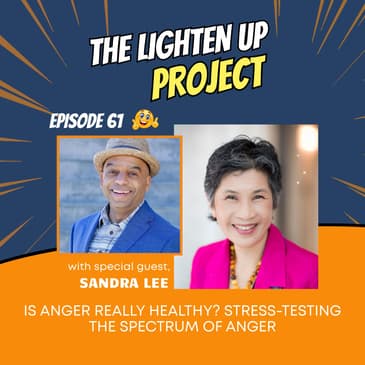
Is it possible for anger and laughter to actually be on the same side? In this spirited follow-up conversation, Malcolm pushes back on returning guest Sandra Lee's ideas about anger, suppression, and healing—stress-testing her Spectrum of Anger framework and discovering they may be more aligned than anyone expected.
"It's not Lee versus Grissom in the battle of the century. It's actually Lee and Grissom in the battle of the century.” Lee and Grissom vs. emotional suppression.
What You’ll Hear
- Why Sandra believes anger itself isn’t the problem and how she distinguishes healthy anger from destructive or explosive behavior
- Malcolm’s challenge: When does “expressing my truth” become an excuse for hurting someone else?
- How curiosity can help turn anger into understanding and communication
- Why expressing anger and exploding in anger are not the same thing
- How childhood experiences can influence beliefs about whether it is safe to speak, feel, or express ourselves
- The surprising overlap between the Spectrum of Anger and Malcolm’s work with laughter, play, and the World Laughter Organization™
- Sandra’s vision for the Reframing Anger Summit, a free month-long audio event exploring anger and self-expression in families, business, relationships, and everyday life
Resources Mentioned on this Episode
- Reframing Anger Summit — Sandra's free, month-long audio summit running throughout October; link: https://reframing.summits.fun/?aff=malcolmgrissom
- Podcast: Brain Health and Healing: Receiving Adversity's Gifts — Sandra's own podcast
- Related Episode: Episode 56 — Sandra's first appearance on The Lighten Up Project, including a live demonstration of her tuning fork grounding technique
- Learn more about Malcolm's work at the World Laughter Organization™
Featured Guest: Sandra Lee
Sandra Lee is a Caltech-trained scientist turned Intuitive Sound Healer and Creator of The Spectrum of Anger™. After nearly 40 years helping people heal, she recently turned her focus to brain injury recovery. She hosts the podcast Brain Health & Healing, Receiving Adversity's Gifts.
Connect with Sandra Lee:
- Website: https://miracleinspirations.com/
- Email: sandra@miracleinspirations.com
- LinkedIn: https://www.linkedin.com/in/sandra-lee-701662250/
- Facebook: https://www.facebook.com/SandraLeeInspiration/
- YouTube: https://www.youtube.com/@sandralee1miracleinspirations
Free Gift: Body Symptoms Decoder What is your body trying to tell you? and what is it stopping you from doing? This guide helps you see the connection between suppressed emotions, symptoms in the body, ... and the thoughts that keep you from making progress.
Decode common symptoms:
* Jaw tension
* Headaches
* Digestive upset
* Tight shoulders
* Low back pain
This isn’t diagnosis. It’s awareness.
https://shinewithsandra.com/body
Meet the Host: Malcolm Grissom
Malcolm Grissom, affectionately known as "The Stand-up C.E.O.," is a team-building and employee engagement expert. Malcolm, an award-winning actor, comedian, International speaker, and best-selling author, masterfully blends humor, improv, and business acumen to enhance team dynamics and profitability. As a certified laughter leader, he leverages the power of positive psychology and his social work background to create engaging, results-driven experiences. Whether inspiring executives, strengthening teams, or energizing audiences, Malcolm’s unique approach fosters connection, creativity, and success. His ability to transform corporate culture with humor and insight makes him a sought-after speaker and consultant.
Follow Malcolm:
Website: malcolmgrissom.com
Facebook: facebook.com/malcolmgrissom
LinkedIn: linkedin.com/in/malcolmgrissom
Stressed, stuck, or leading on autopilot? It’s not a motivation problem—it’s a connection problem. Malcolm’s weekly virtual improv classes boost engagement, collaboration, and retention—all while having fun. Register now for a complimentary month: https://malcolmgrissom.thrivecart.com/everyday-encores/
We are proud to have The Lighten Up Project on the *High Vibe Podcast Network .* Grab your free gift from Malcolm in our Our High Vibe Gift Vault.
Love this show, check out the other shows on the High Vibe Podcast Network.
Share the Love
✨ If this episode lit something up in you… tag us on Instagram @HighVibeLeaders and let us know your biggest takeaway!
🦋 Don’t forget to rate & review — it helps us reach more conscious rebels like you.
🔊 Listen & Subscribe
🎧 Spotify
That was fun. It was. It was. It was. Hello, Lighten Up Nation. Welcome back to the Lighten Up Project. It is I, Malcolm Grissom, the Stand Up CEO and founder of the World Laughter Organization. Yes, I am the founder of the World Laughter Organization, and you are not, unless I've written the script wrong. Let me see. No, I'm the founder and you are not. But today on the Lighten Up Project, we are going to be doing something completely different. Well, I don't know about completely because I'll still be interviewing, and showy talking, so it's not going to be completely different, but it's going to be different. My guest is a returning friend to our show, Sandra Lee. She was just actually on episode 56. She is a Caltech trained scientist turned intuitive sound healer, and she's now the creator of the spectrum of anger. After nearly 40 years of helping people heal, Sandra had recently turned her focus to brain injury recovery, and she now hosts her own podcast called Brain Health and Healing, receiving adversity's gifts. Now, Sandra and I, we we actually agree a lot. She talks about anger, and she believes anger shouldn't be automatically suppressed and and judged. And I believe that laughter is much more than something that we we only do when something's funny, much more than a reaction. Both laughter and anger can be signals. They can both be tools, and they can both tell us when something is happening beneath the surface that we need to pay attention to. I'm very supportive of Sandra's work, and this time I'm going to be playing devil's advocate a little bit. I'm going to be poking holes, going to be pushing back because her ideas can take it, and I want to really stress test her process. After all, do we need to fully express our emotions like anger before we can actually move through them. I mean, can laughter help us just shift without without avoiding these emotions and experiencing laughter? Anger. We're gonna find out
Malcolm Grissom:more about Sandra's Audio Summit that's coming up next month as well. So we're going to have fun. It's going to be interesting. So buckle up. Let's lighten up with Sandra Lee. Hey, Sandra, how are you?
Sandra Lee:Oh, this is gonna be fun.
Malcolm Grissom:I'm sorry, your your voice there sounded a little terrified. Don't be 10. Don't be terrified at all. So you say last time you you said that anger is healthy and normal, and it's something that we should experience. But plenty of people use "it's just not my fruits" as an excuse to hurt people around them. How do you tell the difference between healthy expression and someone who's just being a jerk with a high vocabulary?
Sandra Lee:Thanks for asking that really terrific question that enables us to get to the bottom of what's really going on here, when people have explosive anger, dangerous anger, anger that causes a problem for people, a danger anger that is dangerous for people, I don't see that as being a healthy expression of anger. That's someone who has so much anger and suppressed emotion and suppressed self-expression built up inside them that it explodes out, and it becomes problematic. It becomes dangerous. It attacks other people. I don't consider that a healthy expression of anger. A healthy expression of anger is when anger comes up, but because I have been healing myself, I have been understanding what's going on inside me, and I take all of that old stuff from the past and I heal it, so I don't have this built-up accumulation of unresolved emotion and stuff inside me to set off with kindling and explode. That is unhealthy anger when I let that unresolved stuff explode out, and that's dangerous anger. But I think of anger as being a signal. It's when I feel angry. What is it that leads me to feel angry? And go inside and and understand what is it I'm responding to. Oh, I feel like this person has said something that is misunderstanding me, or is saying something about me that I don't want to believe this about myself. Oh, that's why I'm angry. So there's understanding that comes with it, and then because of that, I don't feel angry in the same way anymore? Does that make sense? It
Malcolm Grissom:does. Yes, yes, it does. But it
Sandra Lee:enables me to then say to the person, "When you say that, here's what I feel. I feel like you're not understanding me. I feel like I'm not being seen, I feel like you and I aren't communicating very effectively. So it enables me to understand what's going on, communicate what's going on, and then not have anger itself come out. Right? I can say, "Oh, you say that, and I feel a little bit angry inside. But it doesn't come out as an expression of anger at the person. It comes out as understanding.
Malcolm Grissom:All right. Okay. Let's shift gears here for just a moment. What does humor mean to you?
Sandra Lee:Humor is when I receive something, and inside is like there's the there's that response. It it touches something inside me that leads me to want to laugh.
Malcolm Grissom:Where does laughter show up in your work.
Sandra Lee:In my work, you know, Malcolm, I haven't thought about that before. I don't actively use laughter in my work, and it might be valuable to start doing that.
Malcolm Grissom:Yeah, I think so. So, in my work, I work with laughter, of course, but you know emotions, you know the whole gamut of emotions, and I think laughter and anger do work together, you know. So yeah, maybe it's something that you should try out with the client, or just on your own before you have a try with the client.
Sandra Lee:You do improv, right? So improv would give opportunities to work with all of those emotions and explore them and experience them in different ways and learn through them.
Malcolm Grissom:Very true, very true. All right, what would your life be? Without humor,
Sandra Lee:boring, right? It would be boring.
Malcolm Grissom:It would, yeah, yeah.
Sandra Lee:And I was like, "There's another thing. So I look at the effects on the body of experiences, and when laughing, it's like all of the organs get massaged inside the body, and this is a side benefit of laughter. And so, without laughter, there would be more tension inside the body, and perhaps less physical health, even because the experience of laughter, you know, massages all the organs, increasing health. But you know, at the most basic level, be boring. Serious, you know, too serious.
Malcolm Grissom:I agree. I agree. Yep, I agree. Life would be boring without humor. So now, in our last episode, you said that you often use a tuning fork and a hockey puck during your grinding work. Now, I'll be honest. To be a skeptical about this, it it sounds it sounds like a prop. Those sound like props rather than protocols. What do you say to someone who thinks that your spectrum of your work with spectrum of anger or any of your work is more performative than practice.
Sandra Lee:I would say that it's not performative because I'm actually doing something that is interactive with the person's body with the person's energy field, with the person's emotional state, with the person's thoughts, and when I use the tuning fork, it gives me intuitive information, and then I interact with the person around it. So I would say I use it as a tool that provides access to something rather than performing. I'm not. I'm not doing it like a sound performance of any kind. And if you want, I can go get it. I don't have the tuning fork here with me at this moment, but I can go get it if you want to demonstrate it.
Malcolm Grissom:No, that's okay. We had the demonstration in episode 56. So, if any of our listeners want, they can just go back and and share your actual tuning fork during our during our episode. So, you also in our last episode, you were talking about a story. There was a story of a woman who had 13 month daily headaches, and they disappeared after one session with you. Then came back, but they they disappeared after one session. Since they came back, how do you know it was really that sound and grounding work that fixed it, or something else entirely?
Sandra Lee:So the first session with people who have headaches, often makes a substantial difference because it's focused on the movement of energy that's been stuck. So when somebody has persistent issues with headaches, I look at it. Well, so it's like with the tuning fork, right? I see in my mind an image of of their head and of their brain, and where the energy is stuck and where it's moving. So if somebody has headaches all the time and the energy gets all stuck in their head, then the energy is like, and then when I allow it to move down into their body, so that there's more flow between their head and the rest of their body, a lot of times that will provide very fast relief of the symptom. Does that make sense? So that's what happens initially. Okay, but if that is not the only contributing reason for the headaches, then it can come back. So, if the person has beliefs, fears, nutritional things going on that contribute to the symptom, then the real cause of the issue has not been resolved. So very frequently, when somebody has energy all stuck in some place, and then we get that energy moving, then the symptom will relieve. So if there's shoulder pain from having this tension here, allowing the energy to flow out, there can be relief of the physical pain. The same thing with the headache, okay. But if the person has so much stress in their life, and they have all these responsibilities that weigh on them, and there's all sorts of other reasons than just the energy being stuck in their shoulder, then the symptom is going to come back. So, with the person in that case, with that, with those headaches, it was wonderful to have to go from you know 13 months of continuous headaches, well every day having a headache, to four days without a headache. That was amazing. Showed her that it was possible for her to find relief from the headaches, but she hadn't actually addressed the cause, which was her beliefs and fears and thoughts. So we proceeded to do
Sandra Lee:other work to help her understand. Okay, so what is it that is really underlying this experience of headaches? So now, when she starts to get the little bit of a symptom of the headache coming on, or the things that show her that it's coming, she starts paying attention to. Okay, I was like, "What have I been thinking? You know, what are the stresses? What what are the situations? And she resolves them so that the signal of the headache is no longer necessary. I look at emotions as a signal. What am I supposed to pay attention to? And the same thing, the physical symptoms, they can be not necessarily always, but they can be a call for help. I need you to pay attention to something. Hello, there's something you need to deal with, and the only way your unconscious mind and your body have to get you to pay attention to that is to give you a symptom to pay attention to. So, if somebody has a pain or a symptom, it's like, oh, is there something I'm supposed to pay attention to? Is there something I'm supposed to know here? And when you address that, then the need for the symptom, perhaps, is gone, and you can negotiate with your body. Okay, got the message. Thank you. I don't need the signal anymore. That makes sense.
Malcolm Grissom:Definitely. So you said that suppressing anger is what is causing this this pain. So suppressing anger, it led to her headaches. Obviously, there were other things, but first and foremost, it was suppressing anger, and that's why she got that reaction after the first session with you. Now, why do so many people who scream and rage and ran all the time they also end up with chronic pain. I mean, doesn't that just poke a hole in your theory?
Sandra Lee:So people who scream and rant and rave have much more than just anger that they've suppressed. So I look at it that this really starts early in life, where in childhood we learn that it's not okay to feel these things, and there can be a couple of different situations where people learn that anger, per se, is is not allowed. Okay, one is if they had someone in their their family or in their environment who was one of those explosive, dangerous people, and they learn us like, oh, that is bad, anger is bad, have to suppress that. Okay, the another the other side is if it's somebody like me who wasn't allowed to express their emotions. I know I got in trouble if I got upset. If I, you know, expressed my, I just learned it wasn't okay for me to feel any of these emotions and to express them, and so I just suppressed all of them. So when you learn to be safe by suppressing your self-expression, suppressing your experience of whatever emotions there are. The way that you do that is by physically restraining it. It stores in the body, and it stores this muscle tension. This is a theory I have. I don't have evidence for it beyond just personal experience, but I believe that we store it in our bodies. That's the only way we have to stop that self-expression, and it builds up in the body over time. Does that make sense? If I'm over and over and over again suppressing my emotions because it's not safe to express my emotions, then I'm stuffing them, holding them in, swallowing them down, leads to pain, leads to other symptoms, and I believe that it then also leads to beliefs. It's not safe for me to be myself in the world. I can't be seen. I can't be heard. Everything I do and say is wrong. These are all beliefs that I had, right? I'm not okay. There's something wrong with me. All these beliefs that limit my sense of what's possible for me in the world. That's what happens when we suppress all these emotions-they become these beliefs that then
Sandra Lee:affect how I act in the world. If I don't think I'm seen, I'm heard, and nobody likes me, and all I do is make mistakes, I hurt people. These are these are my beliefs I had, right? Then I am not going to express myself. I'm not going to be myself in the world. I have this to say, but you know, I can't say that to them. They're not going to hear me. I can't put myself out in the world. Leads to all these limiting beliefs that have a huge impact on what was possible for me in life.
Malcolm Grissom:All right. Well, I'd like to transition to talk a little bit about your upcoming summit. Now, you have an audio summit is coming up in the month of October. So, tell us what it is. What it is. Who it's for, and why now's the moment to bring that work to a bigger stage.
Sandra Lee:So, in 2025, I created the spectrum of anger, which is a little bit of what I've been talking about, and what led me to do this is seeing all of the crazy things happening in the world, all of the violence and the bombing and shooting, all these crazy things happening in the world. That to me, given this whole you know theory I've been saying about suppressed self-expression is what leads to all of this, you know, ineffective behavior, and that's what led me to create this framework of the spectrum of anger, which I just described some of to you, and then I decided to create a summit talking about this, because I'm on a mission to reframe our experience of anger, to make it so that people everywhere have the freedom to be themselves, to express themselves, including their emotions, which includes all of these uncomfortable emotions. So on the spectrum of anger, all of the uncomfortable emotions, everything from "I don't know what I'm doing, I'm uncomfortable. If I say this, people aren't going to like me, and how do I look in this dress? All these normal, low-level, uncomfortable experiences-they're on the spectrum of anger. And on the other side, you have terror and rage and all the really intense, crazy emotions, and everything in between. So discomfort, resistance, fear, anger, guilt, shame, everything. It's all on the spectrum of emotions, the spectrum of anger. Does that make sense? Yes. Our ability to be with our emotions, understand our emotions and express ourselves and get our needs met in healthy ways, which we've been talking about already. That's the reframing anger, so that everyone has the freedom to be ourselves, and this applies in all areas of life. So, in the Reframing Anger Summit, we are talking about this and how anger applies in all of these areas of life. So, who is this for? Really, it's for anyone, because anger is an issue. The expression of this spectrum of anger is an issue for people everywhere. So I have people in
Sandra Lee:the summit talking about children and raising children so they can be fully self-expressed themselves in early in life, so they never stuff it in the beginning. And I'm hoping we have people talking about teenagers. And all the struggles that teenagers have, and then marriage and family and domestic violence and all of these personal-related things. There's definitely areas where all of these have spectrum of anger involvement. Does that make sense? Then we have business, the corporate environment. You know, we hear about toxic workplace environments and all the people who are in jobs with corporate and want to get out of corporate because of how horrible you know the environment in corporate is, and they want to start their own business. So I want you know people talking about the corporate environment and then entrepreneurship. Entrepreneurship is full of barriers to self-expression. I don't know who I'm helping. How is it I'm benefiting people? How do I get the message out there? I'm not seen. I can't get all these things, these struggles that people have with getting their message out about their business. It's all about self-expression, and so looking them at them all as about this spectrum of anger, and can we express ourselves and be ourselves in the world?
Malcolm Grissom:Yeah, I love
Sandra Lee:that. And I'm going to say, my big picture is that someday all people have the freedom to express themselves and be themselves in the world that we no longer have to suppress who we are, and when that occurs, that the governments and corporations and organizations and the food production system and the medical system and the energy production system, all of these systems that run the world. That the people who make the decisions make the decisions best based on what's best for people in the planet. That's the big picture goal, dream of when everything is great in the world, and that requires all people to be able to be self-expressed and to make decisions based on what's best for everyone.
Malcolm Grissom:Now, I really love your answer, especially. And what I'd like to do is I'd like to tie it in a little bit more about what I do because a lot of people, when they hear laughter, they think laughter is the opposite of anger, and so they view us as, you know, grissom versus Lee in the bout of this century kind of thing. And it's not that way at all. It's not at all. I'm in. So, for instance, I'm using your spectrum of anger, laughter. Laughter is. It's the easiest emotion. It's the emotion that we are all born with. It's it's play a lot. So this really goes down back to my definition of humor, and and there's play involved in all that, and I won't get into that. But listeners can listen to episode two for I talk about the definition of humor, but there's a lot of play involved, and play is natural, and laughter comes from play, and laughter is the very first step. Often, it's the very first step in getting to where someone can express these awkward emotions that you're talking about. Not not even the serious emotions like the the rage and but just the small difficult. You know, I'd rather not talk about this type of Anger issues, and and so laughter is the first way that we release those emotions, and so that is the basis of my work, and that is really why what you and I do are so much like. So it's not Lee versus Grissom in the Battle of the Century. Century. It's actually Lee and Grissom in the Battle of the Century. Because like the laughter, the World Laughter Organization. My mission with that is to do very much what you just described, only coming from a laughter play standpoint. So, for all of you that thought that San. Sandra and I are different. Now you know better, at least my opinion. So, Sandra, what's one word that you try and live by?
Sandra Lee:Clear. And let me explain that. So, any time there is something that has happened that I continue thinking about, it's incomplete for me. There's something that's not clear about it, and I need to do whatever is necessary to be able to reach that point of being clear, and if this means communicating with the person so that it feels like what needs to be communicated has been communicated, then then then is that if there is something I need to do, if there is something I need to finish, but it's like I need to be able to complete whatever it is, so that I can be clear, and that enables me to not accumulate tension, not accumulate, you know, thoughts that are out of alignment. So it's like if I have something going on to somebody, and and they're upset with me. Then it's like you know, it's like I can't let it go. It's mingling. It's incomplete, and so I communicate with them until I can reach a point of being clear.
Malcolm Grissom:Okay, what's one word that your friends would use to describe you
Sandra Lee:intuitive.
Malcolm Grissom:What's your biggest pet peeve?
Sandra Lee:Oh, my biggest pet peeve is there are some people who apologize for themselves all the time. Yeah, I don't let them. I don't let them do that. I call them on it all the time.
Malcolm Grissom:How do you want to be remembered by the people who work with you?
Sandra Lee:That because they worked with me, their experience of themselves and their life has fundamentally changed.
Malcolm Grissom:What would surprise your younger self about who you've become.
Sandra Lee:You know, my younger self believed that everything I didn't said was wrong. There was a point which I remember promising to myself over and over again that I was never going to speak again because everything I didn't say was wrong, I used to keep track of the number of times I got in trouble during the day. You know, six years old, and and so that person would be completely surprised at who I am now.
Malcolm Grissom:What lights you up.
Sandra Lee:I love connecting with people, like feeling like it's like in the same place, and having conversations that, like you can't stop talking. You ever meet somebody and you just can't stop talking because you have such a connection and you're having a good time together. I was like, I love that.
Malcolm Grissom:Okay, great. Okay, well, tell us more about your summit. Why did you choose an audio summit that's going to be played throughout? You know, for one entire month, throughout the month of October.
Sandra Lee:So, a lot of us have had the experience of summits where you sit on Zoom meeting, like all day for three days, and it's like you just-it's like it's overload. This summit has each speaker has a talk that's about 15 minutes long, and it's just audio, so you don't have to be on on a computer. You can listen to it while you're walking, or while you're cooking, or are you doing the laundry, or whatever? You can just listen while you're doing something else, and so you just get these little short bursts of information. And if it's like, ah, that's really interesting, then you can connect with the person through a gift that they have, and then you can interact with them more. So you get a little tidbit of what they offer, and then decide, oh, hey, I want more of that. And the talks are available. For everyone to listen to all of the talks, the whole month, and it's fun. So you get points if you listen to something. You get points if you rate something, and so it gives you this opportunity to accumulate points, and it's fun.
Malcolm Grissom:What are the points for? Do we get a big prize?
Sandra Lee:If you get a certain number of points, then yes, you do get extra gifts and prizes. Oh, and another thing. So, because there's this broad spectrum of speakers, there's speakers who are talking about business specifically. There's speakers talking about family. There's speakers talking about mindset, all variety of different things, and so there's things that are going to be of interest to pretty much anybody, which is
Malcolm Grissom:nice. Now, just a moment ago, you said that something that you really lights you up is connecting with people, and when something's recorded, we're listening to a recording. That same connection of being live, even if it's over Zoom, at least being live with that person, we don't have that. What do you say about that loss of connection.
Sandra Lee:Interesting question. So, as I am thinking about when I am on a summit, and there's a speaker, I don't have that feeling of actually being connected with them, like I do when I'm in a one-on-one conversation with you, unless I am interacting with the speaker directly and having a one-on-one conversation with them. So, just the regular summit where I'm listening to a bunch of speakers, I don't have that experience of one-on-one connection. Even though it's live in the moment, I don't have that experience. But it was interesting to to ask that question. It's like interesting about that, yeah. So it just misses that that live component.
Malcolm Grissom:All right, so this is exciting. Where can I find out more about this?
Sandra Lee:There's going to be a link that people can go to to sign up for this free summit. It's free event that you can attend, and it will be in the show notes that Malcolm will have.
Malcolm Grissom:Wonderful, wonderful that Malcolm. Yeah, soup will be in the show notes. Thank you. Yes, I'm glad you said that. So, Sandra, once again, it was a joy the first time. It was a joy to have you back and to ask different questions and see it wasn't that scary. No reason to be terrible. It
Sandra Lee:wasn't scary at all, Malcolm. I don't think you could be scary.
Malcolm Grissom:I love it. So we begin the episode with laughter. We end the episode with laughter. Thanks, Sandra. All right, ladies and gentlemen, Laden Up Nation, thank you so much for tuning in to another episode of the Lighten Up Project, and we're talking with Sandra Lee all about the spectrum of anger and her work, and how it's so similar to my work, and her ongoing podcast, and her upcoming summit, her audio summit, throughout the month of October. So, as she said, the link is in the show notes, and it is free. So, go ahead and sign up, sign up, and tell them that you heard about this through the Lighten Up Project, through from Malcolm Grissom, and enjoy. I I just had a there was an AI summit. Not I just had an AI summit, but there was an AI summit that was very much done the same same way by the same producer, and I enjoyed it. I enjoyed it because, especially when I got busy in different times of the month, towards the end of the month, I was able just to go back and listen to the speeches that I hadn't heard before, and like Sandra mentioned, well, then I could take advantage of those free gifts and connect further. So go ahead and tune in to the pot. There you go with the podcast again. I'm doing a podcast. The Lighten Up Project is a podcast. Sandra's talking about her summit, so tune into her summit. But also keep tuning into my podcast, our podcast actually it's our podcast because we are the Lighten Up Nation and we can do this without you, without your help. So please share our podcast with other people, and until next time, keep remember every smile can open a door, every laugh can open a heart, and every step can be your next victory. And. next time. See ya.