
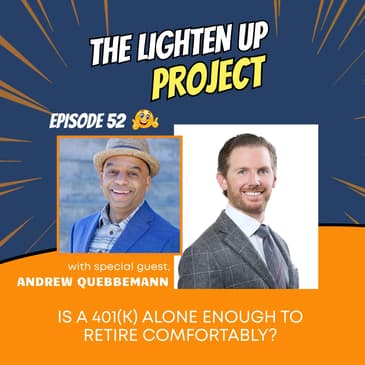
Financial advisor Andrew Quebbemann believes there's no shame in a dollar — money isn't a personality test or something to apologize for, it's simply a tool. In this refreshingly honest conversation, he and Malcolm explore why laughter and money rarely get talked about in the same breath, and why they should.
What You'll Hear
- Why Andrew believes money is just a tool — and how reframing it that way removes years of unnecessary shame
- The 401(k) myth Andrew had to personally unlearn, and why "enough" only shows up when you actually do the math
- One simple rule about money we should all quietly stop following: waiting, because "no one thinks they'll be the one who runs out of time"
- Andrew's favorite question to ask any financial professional before hiring them: "What are you most proud of?"
- His four-step reset after a hard day — walk, talk, an old comfort movie, and 15 minutes of meditation
- The DoorDash budgeting moment that changes how people see their own spending power
- Two Truths and a Lie: a candy store job at 10, a run-in with a boat, and a career in professional hockey — find out which one is false
Resources Mentioned on this Episode
- noshameinadollar.com — connect with Andrew for a financial planning conversation
- Learn more about Malcolm's work at the World Laughter Organization™
Featured Guest:
Andrew's current project is helping people understand that there is No Shame in a Dollar as a financial advisor with GoldBook Financial in California. He lives there with his wife and their corgi, Colt. Andrew's passion for his project is driven by his desire to see everyone realize the optionality and freedom everyone deserves in this life. On the weekends, you can find him between local car shows and teaching kids how to play ice hockey.
Connect with Andrew:
Website: https://goldbookfinancial.com/our-team/andrew-quebbemann/
LinkedIn: https://www.linkedin.com/in/andrew-quebbemann/
Facebook: https://www.facebook.com/profile.php?id=61555879178553
Instagram: https://www.instagram.com/andrewquebbemann/
Gift: I am offering an opportunity to continue the conversation. https://forms.office.com/r/fTEGWswSxL?origin=lprLink
Follow Malcolm:
Website: malcolmgrissom.com
Facebook: facebook.com/malcolmgrissom
LinkedIn: linkedin.com/in/malcolmgrissom
Stressed, stuck, or leading on autopilot? It’s not a motivation problem—it’s a connection problem. Malcolm’s weekly virtual improv classes boost engagement, collaboration, and retention—all while having fun. Register now for a complimentary month: https://malcolmgrissom.thrivecart.com/everyday-encores/
We are proud to have The Lighten Up Project on the *High Vibe Podcast Network .* Grab your free gift from Malcolm in our Our High Vibe Gift Vault.
Love this show, check out the other shows on the High Vibe Podcast Network.
Share the Love
✨ If this episode lit something up in you… tag us on Instagram @HighVibeLeaders and let us know your biggest takeaway!
🦋 Don’t forget to rate & review — it helps us reach more conscious rebels like you.
🔊 Listen & Subscribe
🎧 Spotify
Hello, all my wonderful people. Thank you again for joining us on the Lighten Up Project. My name is Malcolm Grissom. I am the stand-up CEO and founder of the World Laughter Organization, and you're not. So today on the Lighten Up Project, we're tackling a topic that makes people sweat more than dodgeball in middle school. Money, money. We're talking about money today. My guest, Andrew Quebbemann, is a financial advisor with Gold Goldbook Financial and the creator of a refreshingly radical idea: there is no shame in a dollar. Andrew helps people understand that money isn't a moral failing, a personality test, or something you apologize for at dinner parties. It's a tool. I wish I knew him when I was younger, and you get to hear him now. And when you use this tool with confidence and clarity, it operates and it creates optionality, which is a fancy way to say freedom. It creates freedom. In fact, Andrew does this wonderful impression of Mel Gibson. And the un-did freedom! Anyway, when he's not helping people rethink their money mindset, he's at car shows and he's teaching kids hockey, and he's being supervised by his corgi, Colt. He absolutely believes that all treats are essential expenses. Please help me welcome Andrew Quebbemann.
Andrew Quebbemann:Malcolm, thank you. That was a wonderful introduction, and I have to say I've been looking so forward to being on your show this whole week. And to all of you listening, you're in the right spot. I love Malcolm's mission to just bring laughter to the world.
Malcolm Grissom:And I and mistakes, mistakes are gifts. See, that's the wonderful thing about improv. It teaches us that mistakes are gifts. Andrew, I mispronounced your last name that second time around. I mean, that happens all the time. There. I I don't know why I just invented. Oh, let me call him Quebermann. Yes.
Andrew Quebbemann:Yeah.
Malcolm Grissom:I put an R there. I'm sorry.
Andrew Quebbemann:Quite right. That actually is the most common mispronunciation of my name, is that R going in there.
Malcolm Grissom:Did I Did I ever tell you that the very first time that I did stand-up comedy, the MC announced me as Malachi Chisholm? I yeah, so. I guess
Andrew Quebbemann:I'll take the R then.
Malcolm Grissom:Hey, Andrew, can do you mind joining me in 20 seconds of spontaneous laughter? Sure. All right, let's go. All right. So, Mr. Quebbemann, I'm sorry, Quebbman.
Andrew Quebbemann:Yeah.
Malcolm Grissom:Yeah, no. Quebbemann.
Andrew Quebbemann:That's why I always got shortened when I was a kid. I think my first nickname was Q Man, then Quebs, Quebetron, and you know, it's a whole thing.
Malcolm Grissom:Ah, all right. All right. Yeah. What is your relationship with laughter, sir?
Andrew Quebbemann:My relationship with laughter is I So I I'm the kind of person that like if I'm watching something funny, like TV show or movie or whatever in the other room, and I'm alone, I'm still gonna laugh, and you're gonna hear me in the other room. So, cuz I love stuff like, you know, I guess kind of more like old-school slapstick stuff. So like modern-day equivalent, like I love the Minions, because I think they're just big goofballs and they beat on each other, and then they just laugh about it. You know, that's that's my kind of stuff. So, yeah, it's Yeah. I mean I I actually, you know, just in preparation for this conversation, I actually watched a a video on Instagram I knew would make me laugh, just to get ready for this, so. Interesting.
Malcolm Grissom:Thanks thanks for sharing that. I there's something else that just popped into my head as you mentioned that, being in the other room. So, in my episode in it's episode It's still in season one. It's the when was it? What I think it was the beginning of National Humor Month? Let's see. I'll look it up exactly. No, it was the beginning of Mental Health Month. So May, back on May 7th, it was episode 20 in actually season two. I shared a story about how laughter saved my life, and it was laughter that I overheard, so in the other room. So thank you for mentioning that, because even the power of hearing someone else laugh is extremely comforting and does wonders. So.
Andrew Quebbemann:Yeah. Well, that's cool that's a cool story. I would have never thought that, and, you know, I'm just, you know, laughing because I thought it was funny. So, Just another example of kind of how that, you know, carries carries us all forward.
Malcolm Grissom:Mm-hmm. Mm-hmm. So, Andrew, what was your favorite game as a kid?
Andrew Quebbemann:My favorite game as a kid, really without question, you know, was hockey. So that was my favorite, you know, game. But if we're talking more like board games or, you know, that kind of stuff, my brother and I and some friends of ours, we played a game called Warhammer 40,000, which was a tabletop game where like you build and and paint your own miniatures, and then you pretty much just argue for the next 3-4 hours cuz there's a lot of interpretation with the rules and everything. But yeah, so we enjoyed the heck out of that game.
Malcolm Grissom:Okay. Okay. A perfect segue to our to our game here at the Lighten Up Project. We're playing two truths and a lie. So we start every episode with two truths and a lie about our guest, and our listeners need to listen carefully and see if they can detect and find out the answer by the end of the episode. So, Andrew's truths and a lie is actually that he Not only did he love playing hockey, but he was, at one point in his life, a professional hockey player. Another thing is that he was run over by a boat, and the third was that he started working when he was 10. He worked at a candy store. Okay. So, candy store, run over by the boat, professional hockey player. See if you can guess. All right, Andrew. So, excuse me. So, when is a time either early on or now, can you tell us a moment when you experienced pure, genuine laughter, and tell us how that felt in your body?
Andrew Quebbemann:Yeah. Well, I'll go with the most recent example, cuz this brought me to tears. It was It was this Like I said, I love slapstick humor, and so it was this video where three guys were blindfolded, and they all had metal trays about, I don't know, six to 12 inches large, and they're aluminum, so nothing like super heavy. But they're all blindfolded, and then they were in these cylinders, and they would pop up and pop down and try to hit one another in the head with these metal trays. And of course, they're blindfolded, so sometimes you're seeing them swing and miss. Sometimes like someone gets hit in the face and it's not expected, so like you see that whole body reaction, and the more this video was going, I just kept like the laughter kept building and building, and, you know, then this poor guy that was in the middle, like he got hit like twice in a row by each guy from the other side, and like I just I absolutely lost it. I started crying, tears coming down my face, and I was going into a, you know, I think that I did that over my lunch break, so I had a meeting coming up after lunch, and I had to go like blow my nose and wipe my eyes because it looked like I was like crying, cuz I I was, but I was crying because it was It was so stupid. Like it's it's not anything really intelligent, but I think the blindfold element for the guys, like it just added the uncertainty for them of like and the shock of when they got hit. It just killed me. Mm.
Malcolm Grissom:Okay. So, that that brings up a very interesting transition. So you said you were at work when you were watching this?
Andrew Quebbemann:Yeah, it was just over my lunch break. Right. You You know, what I do on a regular basis is pretty serious, you know, I try to inject some levity into it, but we're having really really serious conversations. And so I just use that as a way to kind of pick things up a little bit, you know, at lunchtime there.
Malcolm Grissom:Mhm. Okay. And you went right you did this right before a a meeting, which is cool. Now, when do you think it is so you, when do you think that it is inappropriate to laugh or play at work?
Andrew Quebbemann:You know, for for my job, I guess the inappropriate moments would be when someone like, cause when I have conversations with folks, you know, we're talking about, you know, what have they done in the past with their money and what are they really concerned about, what are their fears, and when they're opening up and getting vulnerable, like really sincerely vulnerable, cause I I believe in some cases I end up knowing, so some of the people that I work with, better than their best friends in a lot of cases. And so, that would be a situation where I'd say it's probably inappropriate to laugh, you know, at someone sharing, you know, some big fears of theirs, and so that's where, you know, try to lighten it up in other spots. But in that moment, you know, you know, acknowledge what it is and and, you know, sympathize or empathize, you know, where appropriate.
Malcolm Grissom:Now, laughter is very, very vulnerable, and one of one of the reasons why producers, comedy producers, have it in the dark, they keep their comedy clubs and whatnot in the dark, is because people don't want to laugh. People don't want to see others. People don't want others to see them laugh. Sometimes, sometimes, anyway. And because laughter, laughter can be, depending on the amount of laughter, I mean, when people can laugh, like like you said in your example, you're laughing so hard you started to cry, and
Andrew Quebbemann:Yeah.
Malcolm Grissom:There have been stories of people where, you know, they're not only are they crying, but there's fluid coming out of all other parts of the body, and it it's not necessarily a pretty thing, but it's very vulnerable. So here you are talking about a vulnerable moment, and yes, we don't want to laugh. See, there's a thing in our culture that people tend to think when you're laughing, you're laughing at something. You're laughing at them, or you're laughing at the situation, and that's it's a shame that that's in effect, because there is this joy that people get from laughing that they're not able to experience in certain moments or situations.
Andrew Quebbemann:Sure.
Malcolm Grissom:So what the question is, and I'm getting I'm getting back to it, I know I'm talking a lot, but what the question is is do you think that there's a way to interject play, not necessarily laughter, but play into these very serious and vulnerable moments that you are referring to?
Andrew Quebbemann:Yeah, absolutely. And I try to keep some, you know, quick anecdotes on standby for kind of lightening the mood, and some of it's in how I deliver things with people too because I agree, like laughter can be vulnerable, but I I always feel like a room full of laughing people, like they also there's immediate bond that can happen between all the individuals, and all of a sudden we're collectively laughing together. You're getting an instant human recognition pattern of like we're to, you know, we're together, we're in this, we're you know, understanding and accepting the situation for what it is, and it's funny, and that's okay.
Malcolm Grissom:Yeah. Okay. So, if laughter had a job title, what would it be, and why?
Andrew Quebbemann:I, you know, I think Minion is a good, you know, job title for laughter. I I, you know, I think Despicable Me got that one right. I think, you know, those characters and and what laughter is, right? It's it's making the situation like you can't, it's difficult to laugh half-hearted. Like, same as ways, it's difficult to play a game half-hearted. Like if you play the game half-hearted, everyone else in the, you know, that you're playing with is going to know that you're not putting it all in, it's going to be less fun. But when you fully laugh and like the minions, they're always full in, right? They're always eating all the candy or blowing each other up or, you know, the big high fives or the big hugs, whatever it is, they're always all in, and I think that's the job of laughter is to you know, bring everyone all in and all together.
Malcolm Grissom:Well put, yes. Well put. So, money. How does or where does laughter or play, because not necessarily just laughter, but also play of any type, where does that come in into relationship with money?
Andrew Quebbemann:Yeah, I I would love to see laughter, you know, be more associated with money. I think a lot of people grow up, you know, money is this taboo topic, right? Can't ask what your neighbor makes, or if they get a new car, you can't ask, you know, you know, how much did you pay for it? You know, there's societal norms around it that are quote unquote not polite. And then when it gets down to it, it just adds a lot of anxiety and angst, you know, and that that was the way I grew up, you know, which like we didn't know, we didn't know what my parents made for money, we didn't know what they were doing to set aside anything for retirement. So that's just the way it was. It wasn't even questioned, and I didn't even know to ask the question. But money is just a tool, and the emotions that go with it, if anything, should be light. You I know in casinos not too many people are really laughing when they, you know, put the money on red and they lose it. But if you look at it and step back, it's kind of funny because you thought something was going to pop up one way, and and it didn't, and it was a random chance scenario in which it didn't happen, and it wasn't the roulette table's fault, or the chips fault, or you know, the air conditioner's fault. It's just the way that it worked out. And so I you know, I think when you have conversations with yourself or with others, you know, to give yourself the grace and the respect to say, Hey, you know, this is just this is just a tool in my toolbox to achieve other things in life. You know, it it can be very funny. You know, it's it's just a tool.
Malcolm Grissom:It's just a tool. I love that. That That's a great transition. What's the What's the one rule, or not the one, but what's one rule that about money that we think about money that you we should all quietly step stop following that rule.
Andrew Quebbemann:Well, I think when you're when you're thinking about all this, you know, and and I think this just I I think this just ties into laughter and and like why enjoy life, you know, why enjoy these moments and smile. This isn't my quote. This is a a quote from someone else. But like people only think other people die. And what that causes in in my world is people put off things. Just like they put off their favorite vacation or put off whatever because like I'll get to it, I'll get to it, I'll get to it, I'll get to it. Well, now you're going to put yourself in a situation where you're constantly saying, you know, Oh, this is another year, or another New Year's resolution that I'll get to eventually. But there's no guarantees. And the cool thing is when you handle some of this stuff, when you book your favorite vacation, when you take care of your your finances and you know, take care of a budget and set up everything for your kids, you get to leave all that behind you. And now, guess what? You get to be more present, more in the moment. You get to enjoy more of what's going on with your kids lives, with what you're going on with your business, because you've got this thing checked off and behind you. And I think that's just a release of weight to allow your your chest and your shoulders that space to laugh and smile and say, Doesn't matter what life's going to throw at me, I got it today. This is going to be great. Yeah.
Malcolm Grissom:What's one thing about money that you were taught when you were a kid that you've had to unlearn?
Andrew Quebbemann:I think the big one there for what I've had to unlearn is that a 401k is enough. It seemed, and I don't, you know, again because we never talked about it, I can't I can't really confirm this, but it seemed like everyone just set money in a savings account, and, you know, you went to work for some corporation, they gave you a 401k match, and then you just put your money in, and that was the end of it, and that was going to be enough. On the other side of it, now that I've kind of learned what I've learned, it can be the case, but there's no guarantee, and until you dig in and really figure that out, like you won't know what you don't know. And so, you know, that's where I would say like, you know, it's an important habit to set money aside in savings, it's an important habit to set money aside in retirement accounts, but is it enough or not? Am I doing enough? You won't really know until you apply some math to it. And I think that's one of the things that people are told, Oh, if I do this, we'll do the minimum, you get Social Security, and then the government just takes care of the rest, and your family takes care of the rest. Sure, but do you want to bet on that? And so that's that's one of the big things that I've had to unlearn personally.
Malcolm Grissom:Especially nowadays with, with children, or I shouldn't say children necessarily, but young people just growing up, you know, the government's already making all these cuts now. And so they might not have very much help,
Andrew Quebbemann:Yeah.
Malcolm Grissom:Or any help from the government, Right. You know, later on. So, Great. Okay. Excuse me. So, what do you personally do to recover after you had an especially emotional day?
Andrew Quebbemann:Well, I think the the first thing I I try to do, if if I can't get to the gym or like work out, I'll at least try to get, you know, get outside for a walk and get some fresh air. I find just, and it's easy to say, I'm here in Southern California, there's not too many days where that's going to be a problem, but that's that's the first step usually. And, you know, as I'm processing things, I definitely lean on my wife, you know, as a sounding board, and we have a great understanding and a great relationship, where some days her or I will need to talk about something, and I don't necessarily need an answer or a solution, I just need to talk, I need to get it out so I have the space to think about it. And so, you know, that's step two, and you know, step three would be, you know, I do like to find like, if it's a really bad day, I find myself going back to like old movies like Mighty Ducks D2 or stuff like that, stuff that made me smile. Cool Runnings, a favorite of mine from when I was a kid. You know, sank a coffee and, you know, Hey, you dead, man? Oh, no! Like so, I love that, and then I usually close out the day, you know, step four, right before I go to sleep, just to make sure that I get my mind, you know, fully ready for the next day, is I actually, you know, spend, you know, about 15 minutes every night meditating. And that helps, you know, get that final space from my thoughts and gets me gets me back in control.
Malcolm Grissom:Mm. Yeah. Yeah. Yeah. What So when you're back in control, when you feel like you belong, you're like you belong in, what does that feel like?
Andrew Quebbemann:It It feels calm. I I've done I I've done that process for enough now to like recognize like this might be just me, but if you're listening and and you get like you feel like the thoughts are like literal physical presences flying back and forth behind your like right behind your forehead and like above your eyes, like where your brain is like actively sending these messages back and forth and it feels like a ping pong ball going back, sometimes it goes so fast. And going through the process, you know, doing the the the lighthearted movies and and finding that space to laugh and to talk and to get the exercise, and then go to the meditation, it gets that little ping pong ball to just rest. And, you know, again, kind of gives you that space where like my head doesn't feel like, you know, it's bouncing all over the place.
Andrew Quebbemann:It's like I'm calmly reasserting that I tell my mind not what to do. My mind doesn't tell me what to do.
Malcolm Grissom:Right. Right. Very good. Very good. Which is yet another transition back to talking about money. Mhm. You talked about, you said, and I love this, that money is a tool. Yeah. You said money is a tool. Yeah. Andrew, how can we use that tool better?
Andrew Quebbemann:A little bit's going to depend on a case-by-case basis. So, I encourage you you all like, you know, if you want to have that conversation, like, more detail, no shame at no shame at all.com is a great way to get in touch with me to have that conversation. But, just generally as a tool, I guess understand that you know, having more money doesn't necessarily eliminate problems, even on the finance side, you know, not to mention, which, you know, buying things, of course, is the old adage, is not going to make you happier. But how everything is structured and and and how that all looks, like, an easy thing for people to do if, like, you know, sometimes this is like really staring in the mirror and facing yourself a little bit you know, if it's just yourself or you have a family that you need to do this with, sit down and take a look at what that budget looks like. Like it's an easy step; you don't need to pay anyone to do it, but you've got money coming in, you've got money going out, and taking the time to understand what that is, and you know, for a lot of the people I work with, food deliveries, that's actually usually a funny one. Some, you know, had someone go like, I had no idea I spent that much on DoorDash, and they're like They were kind of upset with themselves, and it was a cool realization. It's like, oh, we just, you know, we didn't You didn't have to make any more money to discover that you had some more power in your world to set aside for your future. And so that's an easy way, but that's a very, you know, going back to the vulnerable conversation that we had before, like you have to be pretty straight with yourself to sit down and do that and be like, you know, hey, do I need four TV subscriptions, or can I get by with two, or three, or maybe even one? And really kind of having that honest conversation with yourself, and allowing yourself the space and the grace to be like, yeah, I did this. Maybe it wasn't all necessarily
Andrew Quebbemann:intentional, but I can make some changes and and, you know, create a little bit of options and flexibility for myself.
Malcolm Grissom:Mm. Yeah. Okay. Cool. So, I just a couple of more questions. Now, we have all of your information is in our show notes. And you have said your website once before, but I'd like to give you another opportunity to share with our listeners how they can best get a hold of you.
Andrew Quebbemann:Sure. Appreciate that. You know, noshameinadollar.com is is definitely the easiest way to get in touch with me. All that is is really a promise to continue the conversation. And if not now, sometime in the future, that's definitely the easiest. Of course, you can always find me on LinkedIn or something like that as well. But, you know, I'm here and I do what I do because I love it. Don't tell anyone this, but I would do what I do for free if I could. I I think it's that important to help out in this kind of stuff because I help families create options and flexibility in their in their lives through, you know, simple and compassionate planning.
Malcolm Grissom:Yeah. Yeah.
Andrew Quebbemann:And kind of taking a look at that holistically, using the tools that are available to us specific to your situation, I think is really important because I want to create the environment that you have nothing in the world to worry about, and it's kind of a a don't worry, be happy, you know, to steal the song. I I want that release and that that ability to be present for your life, so you can just laugh, you know? When your kids do something funny, let it be funny. When I coach when I coach the toddlers, they are absolutely hilarious what they do in head-to-toe protective equipment and padding. So, being able to be there, not have to worry about this other stuff in life, to kind of eliminate some of that chaos behind the scenes, that that's what I'm there for, and that's how I love to work with people and help them achieve that that state.
Malcolm Grissom:Great. Great. So, Andrew, what's one thing that you'd like our listeners to remember after this episode ends?
Andrew Quebbemann:I'd like everyone to remember that there are a lot of reasons why the financial industry in general has earned some bad press. So when you're, you know, if you do take the time, you want to, you know, continue the conversation with me or any other financial professional out there, take the time to interview carefully, and I guess, you know, my favorite question to tell people to ask is, you know, what are you most proud of? You know, ask that person, and, honestly, you could do that with any professional really, but I think that question, you know, it'll allow the other person to answer what they think is the most important and how they show up, and if that aligns with you, then great. If it doesn't, then you know you know it's time to move on to the the next person, you know, whatever that looks like. So you deserve to work with someone that you trust, you deserve to work with someone that you enjoy, you deserve to work with someone that is going to be ultimately beneficial to you and your family, and really, you know, in all things. So that's that's what I would say is just because, you know, someone did it first, maybe it's not the right fit, and maybe there's someone out there that can help achieve kind of your goals more holistically.
Malcolm Grissom:Okay, and with that, Andrew, what are you most proud of?
Andrew Quebbemann:Fair question. The the situation for my job that I'm most proud of was really exactly that, is the unfortunate situation where a client of mine she gave me a call and she said, Dad died. And I said I said, Oh my gosh, what happened? Cause I I knew her dad, you know, they're family friends of ours, and it was not expected. And what we did together, and and me helping her and her husband out through that situation is I allowed her the space to be a daughter, and to, you know, you know, do go through the emotions that that situation entails and give her that space to be a a human and really recover and and kind of get through that all as really smooth as possible.
Malcolm Grissom:Mhm. Beautiful, beautiful. All right, so let us go back and reveal the lie. Once again, I will remind the audience: Andrew was once run over by a boat, he started working at the age of 10 in a candy store, and he was at one time of his life a professional hockey player. Andrew, which is the lie?
Andrew Quebbemann:I I never played hockey professionally.
Malcolm Grissom:Okay. Well, Andrew, thank you so much for playing with us, for talking with us, for sharing your soul with us. This was such a wonderful, full of full of gems, full of gems and and takeaways, and for those of you who are listening, please come back next week. We are going to have yet another special guest. If you are experiencing any emotional trouble, then call someone, talk to someone. You should never have to go through it alone. And if you are, if you know of someone who's experiencing some emotional trouble, laugh, just laugh, because healing doesn't have to be heavy, and your laughter helps open the door for your friend. Until next week, I'm Malcolm Grissom, and he is Andrew not Quebbemann, but Andrew Quebbemann. Thank you so much for tuning in to The Lighten Up Project. Bye y'all.