
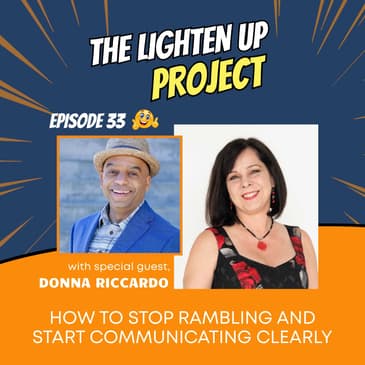
Having something important to say is only half the battle. In this engaging and practical conversation, public speaking expert Donna Riccardo shares how to communicate with clarity, confidence, and authenticity so your message doesn't just get heard—it gets remembered.
What You'll Hear:
- Why confidence in speaking is an inside job, not a performance skill
- The biggest mistake speakers make when trying to be memorable
- How to stop rambling and finally get to the point
- Why preparation and practice matter more than talent
- A simple NLP technique to quiet your inner critic and communicate more effectively
- How humor, authenticity, and play can transform your message and your audience's experience
- Why listening may be the most underrated communication skill of all
Resources Mentioned on This Episode
- Public Speaking for Entrepreneurs by Donna Riccardo
- Red Stiletto Get to the Point
- Donna's Free Gift: Top 10 Public Speaking Tips to Keep Your Audience Hanging on Every Word
- Learn more about The Lighten Up Project and the World Laughter Organization
Featured Guest: Donna Riccardo
Donna Riccardo is the Founder/CEO of Red Stiletto – Get to the point! It is a public speaking training/coaching company. Donna has 30+ years of speaking and training experience. Drawing on her experience of 20 years in a global personal development company, she brings the art of training, coaching and supporting people to express themselves with clarity and confidence – while attracting clients. She is a 14-year participant in Toastmasters and has earned the highest award of Distinguished Toastmaster. Donna is a trained neurolinguistic programming practitioner (NLP). She is also an active member of the National Speakers Association. Donna is the best-selling author of Public Speaking for Entrepreneurs: How to show up, speak up and get what you want for your business and your life!
Connect with Donna:
Website: donnariccardo.com
LinkedIn: https://www.linkedin.com/in/donnariccardo/
Instagram: https://www.instagram.com/donnariccardo
Facebook: https://www.facebook.com/donna.riccardo.96
Free Gift: Not your ordinary, predictable top 10 speaking tips. These 10 powerful strategies help you sound more polished immediately, connect more naturally, and keep your audience hanging on instead of checking out: https://publicspeakingforentrepreneurs.com/freegift-top10tips
Meet the Host: Malcolm Grissom
Malcolm Grissom, affectionately known as "The Stand-up C.E.O.," is a team-building and employee engagement expert. Malcolm, an award-winning actor, comedian, International speaker, and best-selling author, masterfully blends humor, improv, and business acumen to enhance team dynamics and profitability. As a certified laughter leader, he leverages the power of positive psychology and his social work background to create engaging, results-driven experiences. Whether inspiring executives, strengthening teams, or energizing audiences, Malcolm’s unique approach fosters connection, creativity, and success. His ability to transform corporate culture with humor and insight makes him a sought-after speaker and consultant.
Follow Malcolm:
Website: malcolmgrissom.com
Facebook: facebook.com/malcolmgrissom
LinkedIn: linkedin.com/in/malcolmgrissom
Stressed, stuck, or leading on autopilot? It’s not a motivation problem—it’s a connection problem. Malcolm’s weekly virtual improv classes boost engagement, collaboration, and retention—all while having fun. Register now for a complimentary month: https://malcolmgrissom.thrivecart.com/everyday-encores/
We are proud to have The Lighten Up Project on the *High Vibe Podcast Network .* Grab your free gift from Malcolm in our Our High Vibe Gift Vault.
Love this show, check out the other shows on the High Vibe Podcast Network.
Share the Love
✨ If this episode lit something up in you… tag us on Instagram @HighVibeLeaders and let us know your biggest takeaway!
🦋 Don’t forget to rate & review — it helps us reach more conscious rebels like you.
🔊 Listen & Subscribe
🎧 Spotify
[00:00:03] Welcome to The Lighten Up Project, the show that reminds us that healing doesn't have to be heavy. I'm Malcolm Grissom, the stand-up CEO and founder of the World Laughter Organization. Let's explore how humor, heart, and play save the day and create spaces for healing and connection.
[00:00:33] So let's get ready to laugh, learn, and lighten up. Hello all my fellow light makers. It is I again, Malcolm Grissom with The Lighten Up Project. Thank you so much for coming back today.
[00:01:01] Actually, for those of you who don't know me, I am Malcolm Grissom. I am the stand-up CEO and founder of the World Laughter Organization. And you're not. Sorry, you're just, you're not. I don't know what else to say. There can only be one Malcolm Grissom and that's me. So I took that role.
[00:01:30] But you're special too. You really are. Anyway, The Lighten Up Project, I am so happy that you are joining us today. Because we are going to be talking about public speaking and everything around that. You know, because having something great to say, well, it's great.
[00:01:59] But being able to say it clearly, that's where the magic happens, right? So my guest today is Donna Ricardo. She is the founder and CEO of Red Stiletto. So get to the point. It's a public speaking company, a coaching company dedicated to helping people show up,
[00:02:28] speak up, and actually get results. With over 30 years experience, she's a distinguished Toastmaster. She has a distinguished Toastmaster award as well. But I think most distinguished Toastmasters do. So I, who am I to say? She has a background in global personal development.
[00:02:57] Donna knows exactly how to help entrepreneurs and other people communicate clearly with clarity, confidence, and impact. She's also the best-selling author of Public Speaking for Entrepreneurs. She spelled it right, by the way.
[00:03:21] She's a master at turning your message into something people actually remember. This conversation today will be about finding your voice and using it for a purpose. So let's lighten up. Let's get to the point. And let's welcome Donna Ricardo. How are you, Donna? I'm great. Thanks so much for having me on here, Malcolm. This is fun already.
[00:03:51] Yeah. Yeah. Thank you. So, hey, after you finish that set, would you mind joining me in 20 seconds of spontaneous laughter? Of course. Of course. I love it. All right. One, two, three.
[00:04:38] Last thing. And laughing is, I can't even talk and say it right. That's laughing, not laughing. I'm putting the T as laughing. It's great. Laughing is, it always makes you feel, it always makes me feel so much better after I laugh. And you're shaking your head, so I guess you're right. What's your relationship with laughter? Early and often.
[00:05:10] Nice and brief, early and often. All right, early and often. You want to expound on that? Sure. Well, firstly, I mean, I like to laugh when I agree with you. It definitely makes me feel better. And, you know, even with that little short bit we just did, at first it's a little forced. And I've done things like that when I'll photo shoot. And they'll say, you know, just laugh. And at first you're like, ha, ha, ha.
[00:05:37] And then it starts to get real because you realize how ridiculous it is that you're just laughing at nothing while they take pictures. And then you can't stop. You know, then a real laugh starts to come out. And even just now, you know, it started to just be fun and silly and laughing for no reason. So, you know, I think it's really important to laugh. And I like to make people laugh. Well, not like you can make people do anything because you really can't.
[00:06:02] But, you know, I like to create a space around me where people are amused and they can laugh and they can show up their best way. And they get to have fun and laugh themselves. So, do you ever use laughter throughout your, let's talk about your personal life first before we dive into your company.
[00:06:29] So, in your day-to-day being an entrepreneur, because that's hard, do you ever use laughter in your day-to-day process? How intentionally I do it. But I think after this I will. But I noticed that I am like, I have two cats, right? And I find them highly amusing.
[00:06:55] And sometimes I'm just feeling like, oh, because, you know, you know, as an entrepreneur, some days are a little bit solitary and maybe not all that fun. Especially doing the things that aren't that fun to do. And, you know, I'll look around. I'll see my little cat over there on her little window perch and, you know, her paws over the face. And, you know, I just look. I'll look for things to be amused by and look for reasons to laugh. And, you know, that's, I think I will bring that in whenever I can.
[00:07:25] And sometimes I have to look for it. Yeah, for sure. When was the last time you actually had a genuine laugh? And what sparked it? That's a really good question that I do not have a really good answer for. Okay. I don't know. Well, how about this? Let's talk about play.
[00:07:55] You do a lot of public speaking. You've done a lot of public speaking in your life and your coaching. And play is a big part of public speaking. Big part of public speaking. Being able to play. Okay. So, where do you most play in your life? And where do you still hold back?
[00:08:26] Okay. So, the play shows up when I'm working with my clients. And they'll, you know, be talking. I'll be writing. Let's say I'm writing a signature talk with them. Where I'm literally typing it with them. And they're talking. And then I'll hear things. How can I make that more playful? How can I make that more fun? Or, you know. Well, I don't ask them really. I'll say, I think you should do this. You can say that. Like your personality. You know. Because I can hear them and feel them. And, yeah.
[00:08:53] I can hear what they would be comfortable with being funny about. And then I also do a lot of networking. I go to live networking events. I'm in a big chamber of commerce. And I go to a lot of networking. And so, that is a great opportunity. You know. Being in person with people. To be playful. And I even run a networking group within this chamber of commerce. And it's just. I'm always looking for ways to make anything I do more playful. Okay.
[00:09:20] So, you spent over 30 years helping people speak with clarity. What first drew you to this? Yes. Well, it was not fun or playful or any of that at first. In fact, when I was younger, my original career, I was a hairdresser. And I like to say it was divine intervention. That I was very clearly drawn. Like, I wanted to do it. And I don't know why. Because I really don't like doing it.
[00:09:50] And I have since many years. But now that I did it. And then I have since stopped. But I think I was terrified. And I had this very strong, let's say message came to me one day. That I was to teach. And it was not to be ignored. And I thought, well, what will I teach? I guess I'll teach what I have. Which is haircutting. And started out teaching other hairdressers at first. And that was not easy. It was not fun. It was quite terrifying.
[00:10:18] I had to be rescued on the stage a couple of times in different high stakes scenarios. And then over time, you know, then I think that that was not okay with me. That I could not be myself. That I could not be comfortable. That I could not do something that I wanted to do. Because I was so scared of expressing myself. And so I, over time, I did the work to do that. And now, you know, fast forward. It has become, and for a long time now also. But it has become fun.
[00:10:48] It has become fun. Because I don't feel stuck inside myself anymore. Hmm. Okay. Yes, there. So, for our listeners. For the listeners out there who still feel stuck inside themselves. Do you remember what it was that first instinct or that first time.
[00:11:17] Incident, event, however you want to define that. That you realize, hey, I don't have to be stuck inside myself. And this is what I can do. How about it? Huh. I don't know that there was a moment. It was more like, more like dealing with myself and unfolding. Unfolding. I suppose if I had to pick something, it was after I had worked with a couple of different
[00:11:46] professional hair product manufacturer. And I went around and taught their classes. And the first company, that didn't go so well. There was no training. And I think I taught a 20-minute product knowledge class. I taught a 20-product class in 20 minutes. I taught so fast. And then I went to a different company where they actually trained me. And I think it had to have been when I went out on behalf of that company.
[00:12:14] And I had the training, which gave me the confidence. And I was able to learn to connect with the other, you know, the staff, the hairdressers. And it was more like during that time. But it came from dealing with myself and trying some different things and then getting some training to actually do what I needed to do what they were expecting me to do. Hmm. Okay. So, laughter.
[00:12:45] They say a lot of coaches, a lot of public speaking coaches that I am familiar with. They come on and they say that one of the best things to do to start a speech, especially for beginning speakers or speakers that haven't been talking, giving speeches for very long,
[00:13:14] is to start with a joke, with humor. What's your stance on that? I think that is risky. I think that is risky. Because you really, I think if you're in front of people that you don't know, which often, you know, we are as an entrepreneur speaker, you don't necessarily know how it's going to be received. And I think that has to be practiced quite a bit. It needs to be very, very simple.
[00:13:43] I think a joke could better come in later. I just think that's too risky. And those first few moments of speaking when you open your talk are, those are the ones. You know, you have to do something to get people's attention and not say something that could land weird for them. So I would rather see somebody start with a bold statement, you know, like declare something,
[00:14:09] maybe even something a little controversial, but something that gets people's attention or maybe a startling statistic, something like that. I think that's a better way and maybe put the joke in later. And the joke should be very generic or on one's self. Why do people, so many people, they struggle with getting to the point when they speak? Why do you think that is?
[00:14:39] I think that is because they try to give too much all at once. And they forget that whatever they now know, whatever topic that they are the expert on, they did not get it all at once. They got it over time. They learn from various different people. They take different courses and classes that, you know, they got it over time. And now they have so much to give and that they want to give, you know, those people, right, they want to give so much.
[00:15:09] And they try to say too much and give it all at once instead of giving the audience a little bit at a time so that the audience can take it in. Because they're not ever going to get it from the speaker all at once, no matter what best intentions the speaker has. So the speaker has to carefully select what they want to say so that the audience can receive it. Okay. All right. So that, yes.
[00:15:35] And that's the, from a public speaking point of view, from an expert point of view. Now let's look at it from a personal point of view. So for those people out there who are listening who are not public speakers, who are not experts,
[00:15:55] experts, but as we know, there are so many people out there who just have trouble getting to the point. Why do you think the everyday man, everyday woman has trouble getting to the point? I think it could be a number of different things, but one of them I think is that they,
[00:16:20] so I don't know if I shouldn't say this, but I think people sometimes are so fascinated with themselves that they imagine that other people want to hear everything they have to say. And it's still also goes back to speaking to what the audience, even if it's an audience of one and it's your friends, saying something that's going to be something they want to hear or not going on and on and on. No one likes that.
[00:16:47] No one likes to have somebody just talking and talking and talking. So that actually brings me to my next question. So what's the difference between someone that's just saying more and talking and talking and talking and someone who's actually communicating better? Not a whole lot. And it comes from the person thinking about what before it comes out of their mouth.
[00:17:16] And you probably know people, I've heard people, they're like, oh, you know, I just start talking and it just comes out. And even I've heard people who were speakers, public speakers, they'll say, oh, I do my best when I'm just talking, speaking off the cuff. But I don't think that's the best way to go. And in networking groups, the people that just ramble on and they don't talk clearly about their business, they're not remembered.
[00:17:41] And it's the ones that speak in a way that the other person can hear is the one. However, on the flip side of that, if I may, in a personal conversation, if a person is doing more listening than talking, the other person will think you're a great conversationalist. So true. So true. Yes. Thank you. Great point. Don't say sometimes. What you don't say. Right.
[00:18:11] When you hold back, when you listen. I love it. I love it. So if someone out there could improve just one thing about how they speak. And so let's take this in two parts. First, let's speak to the experts, the entrepreneurs who are listening. Right.
[00:18:36] If they can improve just one thing about how they speak, what could they focus on first? Mm-hmm. Well, I think it's like a front of the hand, back of the hand kind of a thing, like two sides of the same coin. Preparation and practice. I think people very insufficiently do the two things. And then I wonder why they're nervous. They wonder why they beat themselves up afterwards. Like, oh, I should have said that.
[00:19:05] I could have done that. I could have said this. Because they weren't sufficiently prepared. And for our everyday speaker, I forgot what I was going to say. You asked, what could somebody do? So for the speaker, speaker, preparation and practice. For the other person, listening. Listening. Aha. So listen more to speak better. I like that. Listen more to speak better. Okay.
[00:19:35] So you mentioned getting nervous and fear, lack of confidence. So where does that real speaking confidence come from? And how is it different from the people that say, I'm just going to go wing it? Well, I think it comes from knowing what's important.
[00:20:02] Being connected inside yourself to why what you're saying matters. Right. Okay. Okay. So how does a speaker go about creating a relationship with the audience? Hmm. Hmm. Well, first of all, it helps to know. And I'm not sure that people always do this.
[00:20:32] It helps to know who the audience is. And even look for, as an entrepreneur speaker, even looking for audiences that could be, you know, full of people that might be able to become your client. Right. So there's that. That's a big one, actually. Okay. All right. Know who you're speaking to. How can someone show up powerfully, even when they don't feel 100% confident?
[00:21:01] Even when they don't, they haven't gotten as much practice as they would have liked. How can they still show up confident? That is the source of that is inside oneself. And I think when people are trying to remember what to say and how to say it and what words come next or what do I do with my hands and all that, that they're up in their head. So that confidence is actually an inner thing.
[00:21:28] I like to say public speaking is an inside job because that's an inner experience. That's where, again, you're connected to what's important to you, but you're in your body, like literally in your body. You're not like thinking, thinking, thinking and all up in your head. And I like to, you know, to help ground myself, feel my feet on the floor, feel my breathing. This is the time that people will say, oh, you know, I always run out of breath because they're kind of choking up their breath way up in here instead of breathing in their full
[00:21:56] body and feeling themselves connect to the floor and feeling their own presence. It's being connected inside oneself, inside their body that will give back. Okay. Okay. Okay. So let's talk a little bit about neuro-linguistic programming.
[00:22:18] How does that neuro-linguistic programming, how would that help people become better communicators? Hmm. Because that is, I will say in short, it's all about how you communicate to yourself, which translates into how you communicate to others. So again, that's part of the inside job aspect of being a human being because really don't want
[00:22:47] to be a different person in front of others. Like whether it's one person or a hundred or a thousand or 10,000, you want to be that same person everywhere. Right. Right. And NLP can help you with that. Okay. Okay. So what's one NLP-based technique then that our listeners can immediately use to improve
[00:23:16] how they connect with others? Well, one little technique that I like to use is so, you know, you have people, we all have that little voice that talks to us and it's not really our friend most of the time. I mean, if it's your friend, by all means, keep it. But if it's saying things to you that are not friendly, this voice is not your friend. So I think to take a minute and be quiet, be still and hear what it's saying, it's probably
[00:23:45] saying that the stupid, you know, like I don't have an inner void or something like that. That's the voice. And see if you can make it maybe sound like Mickey Mouse, maybe make it have a different voice, maybe make it go higher, make it go lower, then see if you can move where it's coming from. Where is it coming from to start with? Maybe it's coming from over your right shoulder. See if you can move it across the room.
[00:24:09] See if you can relocate the sound and the texture and literally the location of where it appears to come from. And that can help take the charge off it because usually we think that voice is true and we think it's really us and it's neither one. Okay. So you're talking a little bit about being playful with that inner voice, right?
[00:24:35] And I love that because that's actually a bridge back to talking about humor. So we were talking about opening up of the joke and making a joke later in the speech as you suggested. But where does, how can people use humor effectively without forcing it?
[00:25:05] I think the best way is to, and people are so serious. I mean, you know, right? The best way is on oneself. And if you're going to use it in a talk, it has to go with what you're saying. It can't be humor just for the sake of humor. It has to go with what you're saying. And I think that one of the best ways is to make fun of yourself, not in like a self-deprecating way necessarily, but a tiny bit of that is okay.
[00:25:33] But I think that's the best way is your own best example. Right. Okay. Okay. So have you seen moments where a little laughter just completely changed how the message was received? Like in life, do you mean? Or moments of what kind? Yeah. Like either in life or in your coaching or in Toastmasters.
[00:26:01] So a speech or a moment where a little laughter completely changed how the speaker's message was received. I don't think I have a particular example that stands out, but I have a little story I can tell that is something that happened to me where it wasn't fun and it wasn't funny.
[00:26:27] At least I didn't think it was until I realized how silly, how ridiculous I was. I can tell that. Yeah. Would you like me to tell that? Okay. Yeah. So I signed on with this company to make a video, kind of like a documentary kind of a video. And I had to go, this was just like a month ago, and I had to go to South Beach, to Miami to do it. And so the day I was there for the whole week, there were all these other events.
[00:26:56] And then the day came, and now I'm going to make this video. And to go to the studio, you know, like all dressed up and, you know, I was bringing an extra set of clothes. And I decided I was not going to worry about, you know, how I look so much. And I have these giant purple, actually I have one made here, these like giant purple rollers in my hair. And I'm all dressed up to do the video. And I was going to go pick up a sandwich. Oh, it's really hot, really humid for the first time for the whole week, right?
[00:27:26] And of course, this day was the day. So that's why I left rollers in my hair. So I'm out, like now I go down the street, I go down the block to get a sandwich to take with me. And so I get over to the place and they don't have my sandwich. And I'm carrying all these clothes because I was just going to get an Uber. And you know, once I grabbed my sandwich down the block. Well, oh, and I'm wearing three inch red, shiny, red, pointy stiletto heels in this outfit. Right? So I get the dressed up outfit. I got the purple rollers.
[00:27:53] I got the three, you know, the red high heels on, carrying all this stuff. All I was going to do is get a sandwich and get a cab. So I go in the place and they don't have it. They don't have it. So I was not happy because now this is going to make me late. So I go, okay. They go, well, you accidentally ordered it at our other location. It's just four blocks away. So now four blocks, how four blocks in the heels, like by the time I wait for a car, I could be there.
[00:28:22] So with all my stuff in the heels with the purple rollers, I start trudging down the avenue. This is like the main avenue down the middle of South Beach. And I'm trudging with all my stuff. And I was getting madder and madder and madder. And it's not four blocks. It's not five blocks. And finally, it's like more like six and a half blocks. Right? In that last block, I was like miserable. And I finally went, you know what?
[00:28:51] This is ridiculous. This is ridiculous. Like here I am. Like I'm going to be late. Like that's the deal. Like I just accept I'm going to be late. I let the people know. And here I am in the middle of this like major tourist area with these big purple rollers in my hair with my high heel shoes on. And I'm like, that's just like absurd. So I decided that I was just going to laugh at myself.
[00:29:19] I'm going to pick up my sandwich and go on my way. So at the last minute there, that's what I did. And I called the Uber and, you know, I got to the place. But it did not start out funny at all. Hey, life, life. Yeah, life is great.
[00:29:39] Throwing you zingers and U-turns and not giving you what you expected or want sometimes. With that, I hear that you have a free gift for our audience. I do. Okay. What is it?
[00:30:02] Well, it is my idea of the top 10 public speaking tip to keep your audience hanging on to every word. But it's not your ordinary tip. I mean, they're not like goofy or anything. I mean, they're actually things that the more experienced speakers either learn along the way or have figured out or, you know, know to do or not do. But it would they'll help even a new speaker be more professional and polished right away. And I'm actually surprised at how many experienced speakers.
[00:30:32] In fact, the number one on the list, I learned from a very, very experienced speaker because I saw him do this at a very high level speaker event. And I'm like, that is not cool. So if any level of speaker can benefit from these speaking tips. Okay. Okay. Speaking tips. Yeah. All right. So Donna, what?
[00:31:01] Let's see. How lightning up. So first of all, what do you think lightning up means when it comes to speaking and showing up authentically? Well, cannot take yourself so seriously. It cannot be. And what goes right along there with it is trying to do it perfectly because our audience
[00:31:31] doesn't want perfection. They want authenticity. They want our humanity. I like to say they're greedy. They want all of us. So trying to get it right and do it perfect is a huge yawn. And the audience is not going to be inspired, motivated, interested, amused or anything else we might like them to be because that is just not what they want. Yeah. They want us. They want the real. Yes.
[00:32:01] Yeah. They want us. All right. Great. So Donna, finish this sentence for us, please. Speaking isn't about being perfect. It's about. Speaking isn't about being perfect. It's about being real and giving your true self-expression to others. I love it.
[00:32:25] And Donna, thank you so much for being on the Lighten Up Project today and joining the newest member for the Lighten Up Nation. Thank you very much. Thank you very much. And for our audience out there, thank you so much for your continued support. We could not do this. We could not do this without you.
[00:32:50] Please, if you like this project, if you like what we're doing, if you want to share more laughter, more humor, more play with other people in the world, invite them to our podcast. Invite them to our Facebook page. Invite them to leave a review for our podcast on your favorite platform.
[00:33:20] Or invite them to our YouTube channel. That's so many invites. So many invites for you. Keep coming back and remember that every smile can open a door. Every laugh can open a heart. And every step can be your next victory. Until next time, I've been Malcolm Grissom.
[00:33:49] And you haven't. No, I'm sorry. You haven't. As Donna said, speaking is about showing up authentically. And I am authentically Malcolm. And you're not. So, sorry. Keep coming back. Love y'all. Take care. Bye.
[00:34:15] You've been listening to The Lighten Up Project with Malcolm Grissom. Dressed out? Stuck? Or leaving on autopilot? It's not a motivational problem. It's a connection problem. My weekly virtual improv classes boost engagement, collaboration, and retention. All while having fun. Register now for a complimentary month.
[00:34:44] Details are in the show notes. Healing doesn't have to be heavy. And Facebook doesn't have to be boring. Find out about upcoming episodes, suggest future guests, and join in on the conversation. Like our Facebook page, Lighten Up Project Podcast.
[00:35:09] If you've enjoyed today's episode, share it. If not, share it anyway. Please subscribe to our YouTube channel at Lighten Up Project Podcast. And rate us on the podcast platform of your choice. Remember, laughter isn't just reaction.
[00:35:35] It's a revolution against the heaviness of the world. So keep shining. Keep showing up. And when life gets heavy, don't tough it out. Lighten up.