
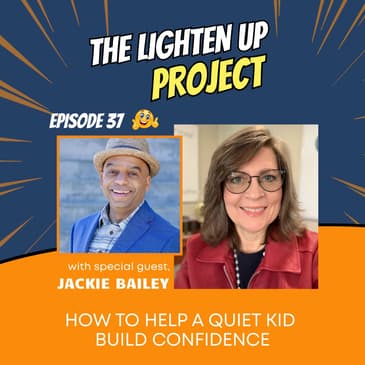
Speaker, author, and TEDx alum Jackie Bailey believes no child should ever feel they have nothing worth saying. In this tender Mental Health Month conversation, she shares how breaking a lifelong silence became her own path to healing — and how that same power of voice now helps quiet, overwhelmed young people discover they belong and have something the world needs to hear.
What You'll Hear
- Why so many "quiet" kids aren't shy at all — they simply aren't sure what they have to contribute, and how Jackie helps them find their aha moment
- The Dale Carnegie principle Jackie shares with every lonely student: stop waiting for people to be interested in you, and get interested in them
- A simple hand-tracing laughter exercise Jackie uses to help kids release pressure and reset in the moment
- How writing things down — pen on paper — can be the first, gentlest step toward healing before you ever say a word out loud
- Jackie's reframe on trauma (with a nod to Gabor Maté): it's not only what happened to you, but how it changed the way you see yourself
- What "belonging" actually feels like in the body, and why it's a basic human need we're wired for
- The two meanings of "lighten up" — releasing what weighs you down, and turning toward the light of someone who inspires you
Resources Mentioned on this Episode
- The Speak Feed Lead project — Jackie's nonprofit helping young people find their voice and a stage to use it on
- Book: How to Win Friends and Influence People by Dale Carnegie — the classic Jackie returns to again and again with her students
- In the Groove with Todd and Jackie — the rebranded podcast Jackie co-hosts with her husband Todd Cuddeback
- Learn more about Malcolm's work at the World Laughter Organization
Featured Guest: Jackie Bailey
Jackie Bailey is The International Conversation Coach. She inspires clients to speak with significance, triumph over trauma, and champion their challenges.
Jackie is:
• Founder and executive director of The Speak Feed Lead Project
• Cohost of In the Groove with Todd and Jackie podcast
• Author/contributor of 7 books on topics ranging from leadership, healing, communication, and parenting.
• A TEDx speaker, has been featured on SPEAK in New York, and a 2015 semi-finalist in The World Championship of Public Speaking putting her in the top 98 of 33,000 competitors.
• An international award-winning team-builder, educator, leader, and coach.
Connect with Jackie:
Website: https://jackiebailey360.com/
Personal Facebook: https://www.facebook.com/jackie.bailey2
The Speak Feed Lead Project Facebook: https://www.facebook.com/SpeakFeedLead
Instagram: https://www.instagram.com/speakfeedlead/?hl=en
LinkedIn: https://www.linkedin.com/in/jackie-bailey-4532287/
TikTok: https://www.tiktok.com/@jackiespeakfeedle?
Youtube: https://www.youtube.com/channel/UC-UK77I3lt7K2X64e6UXX0g
In the Groove with Todd and Jackie podcast: https://www.toddandjackie.com/
Meet the Host: Malcolm Grissom
Malcolm Grissom, affectionately known as "The Stand-up C.E.O.," is a team-building and employee engagement expert. Malcolm, an award-winning actor, comedian, International speaker, and best-selling author, masterfully blends humor, improv, and business acumen to enhance team dynamics and profitability. As a certified laughter leader, he leverages the power of positive psychology and his social work background to create engaging, results-driven experiences. Whether inspiring executives, strengthening teams, or energizing audiences, Malcolm’s unique approach fosters connection, creativity, and success. His ability to transform corporate culture with humor and insight makes him a sought-after speaker and consultant.
Follow Malcolm:
Website: malcolmgrissom.com
Facebook: facebook.com/malcolmgrissom
LinkedIn: linkedin.com/in/malcolmgrissom
Stressed, stuck, or leading on autopilot? It’s not a motivation problem—it’s a connection problem. Malcolm’s weekly virtual improv classes boost engagement, collaboration, and retention—all while having fun. Register now for a complimentary month: https://malcolmgrissom.thrivecart.com/everyday-encores/
We are proud to have The Lighten Up Project on the *High Vibe Podcast Network .* Grab your free gift from Malcolm in our Our High Vibe Gift Vault.
Love this show, check out the other shows on the High Vibe Podcast Network.
Share the Love
✨ If this episode lit something up in you… tag us on Instagram @HighVibeLeaders and let us know your biggest takeaway!
🦋 Don’t forget to rate & review — it helps us reach more conscious rebels like you.
🔊 Listen & Subscribe
🎧 Spotify
Hello everyone, and thank you so much for joining us on another episode of The Lighten Up Project. Boy, oh boy, am I.. I have a treat for you, but I always say that every week, don't I? I don't.. I always say that, and don't I come through? Really, I come through for y'all. I know I do, I know I do, because I said I do. This week is no exception. I have for you a very dear friend of mine, she is a speaker, author. She has TEDx, she has a TEDx talk, that's that's the word I was looking for, talk. Yes, she, she is the director of the nonprofit, along with her husband, the nonprofit Speak Feed Lead. It is a program for youth to help them find their voice and to help them explore the I, and I, you know, when I, when I lose the words, then the gestures come up to explore, to explore finding their voice and putting it out there in the world, so please welcome my friend Jackie Bailey.
Jackie Bailey:Hey, Malcolm, it's fun to be here, and I'm so glad that you're doing this podcast. I know it's going to be such a treat, as you say, to anybody who listens to it.
Malcolm Grissom:Yes, yes, yes, yes. Definitely, definitely. Is Jackie. Would you mind joining me in 20 seconds of spontaneous laughter?
Jackie Bailey:I would love to.
Malcolm Grissom:All right, let's go. Jackie, share with our audience, if you will, your relationship with laughter.
Jackie Bailey:My relationship with laughter, you know, it has been, I'd say, in the last five or six years where it's been a good relationship with laughter. Before that, I didn't feel like I had much to laugh about. I'm kind of a witty person, I'm not put on the spot and be funny kind of person, and I'm not necessarily comedian, but I can, in the moment, come up with something clever and witty, and so I can make other people laugh, and I really enjoy making other people laugh, but usually being witty, it's not like people go, you know, hysterically breaking out laughter like we just did, but they'll go, yeah, that was good, you know, so I kind of, I've, in the last 10 years, I would say I've started to embrace that ability to just be witty in the moment, but I don't know that I had a lot of opportunities to really belly laugh in my younger years, but life is great now, and so I find more time for laughter, and in fact, at some of the retreats that I've had, we've had a laughing yoga expert there that would get us laughing every day, because it's that important.
Malcolm Grissom:Yes, great, yes, yes, it is. I every every time I ask that question, I love hearing different answers, especially people from people who think the first, the first thought is, well, I have to be funny, and you. There are some people who, they, they have it in their head, they tell their own, they tell the story. I'm not funny, and therefore I don't have a relationship with laughter, and I just love, I love hearing that story, because those stories, because that's actually, that's actually part of what, what this podcast and the World Laughter Organization, what it's all about is it's about changing that dynamic a little bit, whereas you know, leaning more towards the yoga laughter, leaning more towards the therapeutic laughter, the fun, you know, we don't have to be funny laughter in episode two, for my listeners, if you want to go back to episode two in season one, the humor tree, that's where I define laughter and humor, but real quickly I'll give a very brief overview, humor it's not just comedy or jokes or being amusing, but it's also the play, the natural play that we have, the natural, like, like the animals, they, they have their natural sense of humor, their natural sense of play, which is where laughter comes from.
Jackie Bailey:Yeah
Malcolm Grissom:So just, just a quick aside. All right,
Jackie Bailey:Speaking of animals, that is often what makes me laugh the hardest, is watching a puppy play or a kitten, you know, they're just so free and natural that they do the quirkiest things, and it makes me laugh, and so those are the simple joys in life, right? Yeah,
Malcolm Grissom:Yeah, yeah, yeah, very, very much like babies and young kids, you know, that's why some, some, the back in the 70s, I'm giving my age away, but you know, back where the smile Young Candid Camera in the Dol Cosby, I interviewed these kids right to get their reactions, and just their, their very innocent reactions, not trying to be funny at all. They were very hilarious, just because of that innocent naivete kind of thing that you'll find in animals. This great, and that actually is a great bridge to my next question, which is, you, you work with youth, and tell me, tell us, what, what's something that young people do that gives you just gives you incredible hope.
Jackie Bailey:That's such a great question, and I love what I do because of that outcome, quite frankly. When I work with a young person, maybe for the first couple of times, for sessions or so, and let me back up a little bit. A lot of times parents who start to see that their kids are not communicating well, or they're not speaking up for themselves, or they're giving answers to questions that are only one or two words. They start to think, is there something wrong with my kid, you know. Why isn't he or she talking? Why is it so hard for them to seemingly make friends or to connect with people? And so they'll look for someone that might be able to help their kids, and I'm so grateful that many times they find me. And so they'll have a conversation with me, and of course, I like to have their child there, and the parents will tell me what they're seeing, and then I'll go to the, to the young person, and I'll say, Is your parent right? You know, do you, do you, do they throw merit to what he or she's saying about you? And many times they'll go, hmm, I don't think so, but then there's other times I'll go, yeah, I could see that, you know, and all the times, 99% of the time, it's, it's based on their, their quietness, if you will, of pertaining to the youth, is because they're just not sure what they can contribute, contribute either to a conversation, to a relationship. To a team, to a project, to the classroom, whatever it is they're involved in, they're not quite sure how, through communication, they can contribute, and so rather than go to some place that's unsafe or that they're unsure about, they'll just be quiet and they'll answer as minimally as possible, right, so the joy for me and the hope that I have comes from when I start to work with one of these young people, and I help them recognize what life has taught them through their experiences, and how those lessons now can be used to inspire other people to uplift other people to be
Jackie Bailey:better friends with people to communicate better to connect to engage whatever the case might be. In every child's purpose to work with me is different, but those are the things that bring me joys when they have the aha moment and they realize, wow, I didn't really know before this that I had something that was a value to say, and now that I recognize I do, I really want to get out there and say it. That's that's magic for me.
Malcolm Grissom:Now you've, you're mentioning connection and all the value once the once the young person opens up and their communication and you also mentioned in your seminars are yeah seminars um I think retreats,
Jackie Bailey:Blur retreats, yeah,
Malcolm Grissom:The word you use that you often use, laughter yoga, someone to come in and do laughter yoga. Do you do, is there any type of laughter involved in the work that you do with with the youth,
Jackie Bailey:Yeah. Actually, there is sometimes kids are so they're under so much pressure these days, and they don't often take a moment to release that pressure through laughter, you know, and that's a great way to release that pressure, and if I sense that during one of my coaching sessions with them, we'll do an activity where I take my hand, I'll put my hand up like this, and I'll ask them to do the same, and then I'll instruct them that they're going to take the finger, their index finger of the other hand, and they're going to just trace the outline of their hand with it, but as they're doing that, every time they go down into a valley, they laugh, belly laugh, and then we come back up, and then we drop into another valley and laugh as hard as we can, then come back up, so we do that, I have done that many times, and then we'll go with the other hand as well, and that's just a quick exercise to to relieve that pressure, whatever it is they're feeling, to center them again on focusing someplace else that where they can do the most good and quit worrying about the homework and the chores and maybe the relationships with parents that aren't as great as they hoped and they can just focus on for this moment that we're together, let's just focus on your message and let's focus on how you contribute. Yeah,
Malcolm Grissom:Okay, yeah, yeah, so now is there a what would you say, what, what tool or what advice would you give a student or a young person who felt alone and just overwhelmed. Is there, is there something, one thing that you would, that you would use today in today's society?
Jackie Bailey:Sure, I use it all the time with my students. Dale Carnegie authored a book, probably 100 years ago. I should look that up, because I keep saying it's about 100 years ago. I should really look that up, but I think it's, I think it's a classic by this point. Was how to win friends and influence people, and in that book he is quoted as saying you can win more friends in two months by being interested in other people than you can, in two years, trying to get them interested in you, so when someone tells me that they're lonely, I say, well, it's because you're not interested in other people enough, you're waiting for people to come to initiate conversation with you, not going to work, it's going to take a long time for it to work, so my advice always is, even to young people, and I teach them the five codes of conversation, so that they feel comfortable initiating conversations with people, so that they never have to wait for someone to be interested in them. They just need to be interested in other people, and they won't be lonely anymore. And that would include joining clubs. It will, it will include becoming poor. Part of a troop, like a scout troop, or part of a church, or some sort of other social or community organization, that's where they're going to make friends, and that's where they can engage, and again, that word contribute for them, which for young people is really important, they need to feel that they belong somewhere, and that means contributing to something, and that's the way that they can get out of that feeling of loneliness is to learn how to engage with other people and just go out there and make friends.
Malcolm Grissom:Okay, okay. Wow. Tell us, what first drew you to this work?
Jackie Bailey:Well, I, it wasn't my life's mission, that's for certain. I grew up in a household where I was abused and therefore silenced, and not being able to tell what was happening to me, because that was a threat that, if you know, that I shouldn't ever tell, or I was taught to lie about what was happening to me, and having been silenced like that, I can tell you that it truly changed my personality. It changed my relationships, and it changed how I felt about myself, and I didn't experience the ability to heal, to start to heal from that, until I was a young woman, married, and had two children of my own, when one of the people that was a chronic abuser of mine throughout my childhood, then had their own child, and I was forced into this position of knowing that child was in danger, and yet no one knew about my history, and so I had this groundbreaking news to share, and yet it was going to rock not only my world, but the world of my immediate family, my husband and children, as well as my family of origin, and it was a scary situation, and it, it left me living months and months in this emotional turmoil of suicidal thoughts, wanting knowing that I had this responsibility to say something, but also not wanting to rock the boat, as you would imagine with what that news might bring, and in the end I realized that I couldn't leave this planet without letting someone know that that child was in danger, and also because my own children might have been in danger had no one known that that person was someone to be concerned about, so I eventually did break my silence and started to tell, and it was in those moments as I was talking to individual family members and friends and revealing my secrets to them, that I began to realize how important my voice was, and that as I started to release that literally through my throat and through my voice box out into the world, I was healing, I was healing little by little, and I can say now, Malcolm,
Jackie Bailey:that years and decades later, every time I share my message, I heal even more, and I know because people approach me every time I speak and say thank you, that your message changed me, your message helped me to open my eyes and my heart for another action I need to take, or someone I need to tell, or something I need to say, and so not only do I heal each time I share my story, but I know that that power of healing is provided to the people that hear my story, because so many of us have similar stories to share, so that leads me to my mission today, which is no child within my influential sphere is ever going to be silenced if I can help it. So my, my program, the Speak Feed Lead Project, is about helping to unsilence children and give them a voice and a stage to speak on,
Malcolm Grissom:Yeah. Okay, so in one sentence, how, how can we make healing less heavy?
Jackie Bailey:We need to communicate what we're feeling, and that doesn't always mean that we have to say it out loud sometimes. That's challenging. It's hard, but what I started with, based on this wonderful therapist that I had, was to start writing. There is something magical when you put a pen or a pencil in your hand and you write on a piece of paper, we don't do that as much anymore, because of the computer technology that has come into our lives, but there is something healing about taking an instrument in your hand and releasing through ink on paper your feelings and memories and thoughts. And so that's what I would suggest, is start writing down your feelings, your memories, your thoughts, and that will be healing enough, and then when you're ready, start speaking it
Malcolm Grissom:Right. Okay. Okay. Very good.
Jackie Bailey:Did I choke you up? Okay. Okay,
Malcolm Grissom:Spontaneous laughter, just the best. Yeah, I, you know, you're talking about healing, and then I don't. laughter, just.
Jackie Bailey:It's a really, yes,
Malcolm Grissom:Yes, yes, it is. So, and actually, that again goes right into the question that I'm going to ask. So, how would you first, how would you personally define healing, and then two, what role does laughter and an or play play into that.
Jackie Bailey:Wow, these are great questions. What is healing? Healing in my book is the ability to release pain, trauma, memories that have been unhappy that have changed you in not a good way, I don't want to say it's in a bad way, but that have changed you in a less than positive way, and when we start to recognize that that we are not necessarily the person that we really want to be, it's because something inside us needs to be healed, something inside us needs to be changed, and so that's what healing is for me, is recognizing the need to change something in ourselves. Gabor Mate has said that trauma is not actually what happened to you, it is how it changed the way you think about yourself, because of that actual trauma. So, when I, when I use that to describe the childhood abuse that I suffered, there was a lot of trauma there, but what actually happened that was more traumatic was the silencing that took place to where I had to hold it all in, and it changed me by being silent. So that's the real,
Jackie Bailey:That's the real Trump. Yeah,
Malcolm Grissom:Trauma, definitely does it changes, it rewires the mind, trauma rewires the mind. Yes, that's a great quote. Thank you. So, now let's go through that trauma. Now, belonging. So, now you're working with a child, they're starting to blossom, starting to open up, starting to belong. Could you describe for our audience what does belonging feel like in the body?
Jackie Bailey:Well, that's different for everybody. I've had students who claim that belonging feels like home. It feels like a warm blanket around you. It feels like freedom to be who you actually are, with no one to judge you, right? Or not feeling like you're being judged by anyone, or that you're satisfying anybody else's requirements of behavior, or whatever. Right, I've had people describe it as being serene, having serenity, or peace, so it feels different. Belonging feels different to everybody, but I truly believe that we as human beings have that in our nature. There's, we have to feel like we belong somewhere, whether it's to a family, to community, to a church, to a troop, to some people would call it a tribe or a network, and when we don't feel. Like we belong in one place, we seek out the belonging in others, and so it is such an inherent need in us that if we can help our kids to feel like they belong in positive and good places, then hopefully we won't have as many of them leaving home or taking substances or acting out all those types of things.
Malcolm Grissom:What does lighten up mean to you?
Jackie Bailey:Lighten up. Ah, that there were.. there's a couple of meanings to me. First of all, what came to mind was feeling lighter, is that sense of releasing the pain, the emotion, the pent-up energy, hostility, whatever the emotion might be, right, is is lightening your actual body by releasing something through writing, through speaking, through laughter. So that's one way I look at lighten up. The other way is to look toward light, look up toward light, something a power that is greater than you, someone that you admire, someone who has been a positive influence on you, look toward their light, look toward their example, their brightness, their ability to be a positive influence on you and others, and try to mirror that, or find that sense in yourself that you can do the same.
Malcolm Grissom:Yes, beautiful, beautiful, beautiful. So just to let our listeners know, I have links to the book that Jackie has been was talking about by Del Carnegie. I have links to Jackie's nonprofit. Jackie, you would you like to say a little something about the podcast you and Todd do?
Jackie Bailey:Sure, I'd love to. Yeah, so I, Todd, cut it back. Cuddeback, has been the president of the board of directors for the Speak Feed Lead Project since its inception, and he's also been a great friend of mine for 16 years, and we have done a lot of nonprofit organizing and training and teaching leaders in organizations, and what we didn't know in all those 16 years is that we were somehow being led together. I was in a marriage of 40 years to someone else, and during, like I said, 16 years of that, Todd has been just a really good friend, and when I filed for divorce from that husband two or three years ago, Todd was there to say, hey, by the way, I've kind of been in love with you this whole time, and I had no clue, and I had no clue, and so we were doing a podcast for eight or nine years. It was called Life Mystery Radio with Todd and Jackie, and we were bringing on guests that were enlightened, if you will, people that were astral travelers, so that they could, in their mind, and through the field, travel to different places and see things that were happening. We'd had guests that were Akashic record readers. We had guests that could remember 1000 past lives, I mean, kind of woo woo stuff, right, but then we also had guests who were looking at, say, the 10 commandments in a more metaphysical way, so I was really growing and opening, and not only opening my knowledge, but my heart as well, and a lot of these people now are my best friends, and so we had done that for many years, and then Todd took a hiatus because he had cancer, and he was going through treatment, and then when we, when he told me of his feelings for me, and I considered it for a little bit, and I started to realize there's something there, there's a spark there as well, and then when we got married, we decided, hey, let's rebrand, we're kind of rebranding our life. Let's rebrand our podcast and bring it, breathe it back into life. So, Todd's favorite word, and he used it a
Jackie Bailey:lot on Life Mesury Radio, was groovy. In fact, he'd start every episode going, "It's another groovy day, that's because I make it that way, and so. When we were coming up with new names for our rebranded podcast, we thought we're in the groove. We are finally in the groove, both of us in our lives feeling like we're in the groove. So, let's call it in the groove, in the groove with Todd and Jackie. So, now our focus is not necessarily on the woo woo space, although we still love to talk to those kinds of people, but it's mostly on let's give a stage to the people who may not often get to be heard, so that includes young people, and it includes entrepreneurs, it includes parents and families that sometimes have great ideas to share about how they're staying connected and engaged with their kids that we would never hear from, right, so those are who the those are the people that we really like to talk with now as people that are coaches and consultants or fail actual families going through the motions of real life with their kids and the struggles that come with that and hearing what they've found that that works for them and that's positive so it's about getting in the groove and how you get in the groove every day so that's what we like to hear from our guests, and we're having a lot of fun with it.
Malcolm Grissom:Cool. That sounds great. Yeah, lovely. All right, so as we end our interview today, this has been just fabulous. We could go on forever and ever, but alas, we don't have that much time. What's the one thing that you want listeners to remember about this episode?
Jackie Bailey:Thank you for that question. I appreciate, and I appreciate that you've given me voice today, Malcolm. Like I said, we can't be silenced, and so when people like you allow people like me to use their voice to share messages, it changes the planet. So, thank you for that. What I want people to know is that you have something vital to say, and the world needs to hear it, and if you're afraid to say it, start writing it down. Write it down, get it out. You can throw it away, you can burn it, or you can start sharing it with people. But if you're nervous about saying it, just start writing it, getting, get it released out of you, laugh, cry, yell, whatever needs to come out, but let it be released from you one way or another, and don't stay silent any longer.
Malcolm Grissom:Lovely, lovely. All right, lovely. So, as, as I said, we do have all of the contact information for Jackie Bailey in our show notes, so please, please, please refer to those, and please contact Jackie, and just she's a wonderful person to know, if nothing else, even if you don't have children, just contact her, because she's wonderful. I don't know Todd, but hey, if Jackie chose Todd, Todd must be wonderful too. He's groovy, I hear
Jackie Bailey:He is groovy.
Malcolm Grissom:Well, Jackie Bailey, thank you so much. I appreciate it. And all the rest of you, thank you so much for tuning in. Tune in next week for yet another stimulating conversation. You can go to our Facebook page, that will tell you about the upcoming guest. And until then, remember, chuckles can create change. I'll talk to you later. Bye bye.