
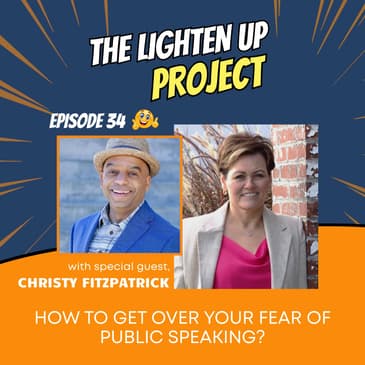
What would you do if fear stopped being in charge? In this inspiring and laughter-filled conversation, Christy Fitzpatrick shares how one courageous moment transformed her life, helping her overcome self-doubt, find her voice, and become a sought-after communication and public speaking coach. If you've ever struggled with confidence, imposter syndrome, or speaking up when it matters most, this episode will remind you that courage comes before confidence.
What You'll Hear
- Why confidence is often mistaken for courage—and why courage comes first
- Christy's powerful "Act As If" strategy for overcoming fear and self-doubt
- How a single public speaking moment changed the trajectory of her life
- The surprising role laughter plays in connection, communication, and leadership
- Practical techniques for becoming more confident in presentations, meetings, and everyday conversations
- How to challenge the inner voice that says you're not good enough
- Why taking the first step matters more than seeing the entire staircase ahead
Resources Mentioned on This Episode
- Cann Coaching Communication Training
- Website: cann-co.com
- Email: christy@cannco.com
- Toastmasters International
- Martin Luther King Jr.'s "Take the First Step" philosophy
- Related Lighten Up Project episodes on confidence, resilience, and personal growth
Memorable Quote
"Act as if you are the person you desire to be. The confidence will arrive."
One Big Takeaway
You don't need confidence before you begin. You need the courage to take the first step. Confidence often shows up later and says, "Thanks for getting us started."
Featured Guest: Christy FitzPatrick
Christy FitzPatrick is the founder of CANN Co., a communication coach and a professional speaker who believes everyone has a message worth sharing—most people just need a little help getting it out. Known for her encouraging style and real‑world coaching, Christy helps clients find their voice, own their story, and communicate with confidence. She brings energy, authenticity, and a genuine passion for helping people shine when it matters most.
Meet the Host: Malcolm Grissom
Malcolm Grissom, affectionately known as "The Stand-up C.E.O.," is a team-building and employee engagement expert. Malcolm, an award-winning actor, comedian, International speaker, and best-selling author, masterfully blends humor, improv, and business acumen to enhance team dynamics and profitability. As a certified laughter leader, he leverages the power of positive psychology and his social work background to create engaging, results-driven experiences. Whether inspiring executives, strengthening teams, or energizing audiences, Malcolm’s unique approach fosters connection, creativity, and success. His ability to transform corporate culture with humor and insight makes him a sought-after speaker and consultant.
Follow Malcolm:
Website: malcolmgrissom.com
Facebook: facebook.com/malcolmgrissom
LinkedIn: linkedin.com/in/malcolmgrissom
Stressed, stuck, or leading on autopilot? It’s not a motivation problem—it’s a connection problem. Malcolm’s weekly virtual improv classes boost engagement, collaboration, and retention—all while having fun. Register now for a complimentary month: https://malcolmgrissom.thrivecart.com/everyday-encores/
We are proud to have The Lighten Up Project on the *High Vibe Podcast Network .* Grab your free gift from Malcolm in our Our High Vibe Gift Vault.
Love this show, check out the other shows on the High Vibe Podcast Network.
Share the Love
✨ If this episode lit something up in you… tag us on Instagram @HighVibeLeaders and let us know your biggest takeaway!
🦋 Don’t forget to rate & review — it helps us reach more conscious rebels like you.
🔊 Listen & Subscribe
🎧 Spotify
[00:00:03] Welcome to The Lighten Up Project, the show that reminds us that healing doesn't have to be heavy. I'm Malcolm Grissom, the stand-up CEO and founder of the World Laughter Organization. Let's explore how humor, heart, and play save the day and create spaces for healing and connection.
[00:00:33] So let's get ready to laugh, learn, and lighten up. Welcome everyone, back to another episode of The Lighten Up Project. I am Malcolm Grissom, the stand-up CEO and founder of the World Laughter Organization.
[00:01:02] And you're not. Today, I have a great guest for you. I'm going to talk all about finding your voice and really the courage to speak out loud. And I'm going to tell you a lot about public speaking and her experience behind public speaking,
[00:01:30] which I know you'll find interesting. At least I hope you are. Anyway, I would love to introduce. I love how I do that. I preface what I'm going to do by telling you what I'm going to do. Instead of just doing it. That's something I'm working on. My next guest, her name is Donna Riccardo.
[00:02:00] Now, we are going to play another, we are going to play a new game here at The Lighten Up Project. The first time we're going to do this, it's called Two Truths and a Lie intro. So, how this works is Christy has given me two truths and a lie.
[00:02:25] I'm going to introduce her with all the gusto that I have. And then throughout the interview, you're going to ask the guests. But you won't know exactly until the very last moment when she will reveal. Right? Okay. Okay. I'm excited.
[00:02:54] So, Christy Fitzpatrick, she's a friend of mine. We are in Toastmasters International together. She is a military veteran. She has been stationed at Guantanamo Bay, Cuba, and Camp David. Christy, how are you today? I'm doing fabulous. It's Friday.
[00:03:22] So, that cures just about whatever's ailing you. It's Friday. It's a good day. It does. It does. Yeah. Yeah. It is. It's tiring, though. I find myself a little tired. Oh, sure. Yeah. But, yeah. I'm glad it's Friday. And it's a three-day weekend. So. That's right. It is a three-day. Yes. Very nice. That's right. That's right.
[00:03:50] So, can I invite you to join us, as in me and the audience, in 20 seconds of spontaneous laughter? Oh, I would love to. Okay. All right. So, here we go.
[00:04:38] Oh, I need a drink after that. And this is only water. Thank you for that. You're welcome. Oh, it's so fun. So, Christy, let's start with what is your relationship to laughter? Laughter is how I connect.
[00:05:01] I've kind of always been, I wouldn't say the class clown, but I'm the youngest of three children. And when I was growing up, my sister would bring the young gentlemen that were calling over to the house. And I would entertain them. I was 10, 11, 12. She was a teenager. And I was always joking and entertaining and making laughs.
[00:05:31] And I don't know why, but I've just always enjoyed kind of being that funny person in the room. Okay. Okay. So, what does being the funny person in the room, or in other words, belonging, the sense of belonging, the sense that you are loved because you have a gift. What does that feel like in your body?
[00:06:02] It feels like my walls are down. It feels like I'm open. It feels like I'm inviting others to join me. Whether I was a young child or an adult, humor and laughter can break down those walls. It can make people feel invited into your little world. As long as you're not laughing at them, you're laughing with them.
[00:06:32] Right. And I've been very good over the years that just situational humor, finding humor in everyday life. And I think that that does kind of break down those barriers and make people feel comfortable. And I've gained a wealth of friends doing that over the years. And I've just really enjoyed feeling comfortable doing that and inviting those people into my little world, sometimes crazy world.
[00:07:03] Mm-hmm. Mm-hmm. Okay. Okay. So, where in your life now? So, let's go now. Let's take this question two parts. One, let's take it now. And then two, or part B, let's take it when you were younger. Okay. Okay. Your younger self point of view.
[00:07:27] So, from your point of view now, where in your life do you give yourself permission to play? Whether it be laughter or however you define play. And then where do you still hold back? Hmm. The holding back, I'll have to think about for a minute because I don't hold back often. But I would say in my personal life, it's everywhere.
[00:07:56] It's everywhere in my personal life. In my professional life, I try to bring that in in a professional way, a respectful way. I was doing a workshop a couple days ago in Kansas City. And I really knew that the team I was working with, I had met them before a few times, several of the team. This was a small team of 12 people. But I knew they knew each other really well. And they've worked together for a very long time.
[00:08:25] So, I knew that they knew each other to the point that we could play some games and really lighten up the mood as almost like a warm-up to this workshop. This was all about professional communication and how I could help them take them to next levels with their communication and public speaking. But I really warmed them up with a game. Knowing your audience is key. If I didn't know this audience, I would not do this.
[00:08:55] But I knew that they would be open to this opening game. So, I have this game. You may have heard of it. It's called The Vote. I think it's fairly new. I purchased it not that long ago online. I happen to have it right here. Or The Voting Game. I guess it's called The Voting Game. There's like a thousand cards in there. I went through them, gathered about 15 of them that I thought were appropriate.
[00:09:25] Because there is a version that's not appropriate for the professional world. And I went around and just asked. We played this rapid fire game of I'll ask a question and you yell out and point to who comes to mind first when I ask this question in the group. So, it was here's an example. Who doesn't act their age? You know.
[00:09:54] So, everybody's yelling and pointing to whoever's in the group. If you're on an airplane next to this path. Just so I can clarify this for myself and for the audience. So, it sounds like these questions are specifically about this group. So. They're not. They're not. They're not. They're not. They're general questions you could ask anybody. I went through.
[00:10:24] Oh, wait, wait, wait. But when you're asking them. Am I correct when I hear you say that the question that you're asking them is really point to who in the group. In the group. Does not act the age. Yes. Yes. All right.
[00:10:49] So, the question is to the group of 12 and they are to point and call out the name of someone in the group that they identify with with the question. Mm-hmm. Right. Who comes to mind when I say this question? One of them, if you're a passenger on a plane, this person next to you is the one, you know, that is talking the whole trip or something like that, you know. Right.
[00:11:18] Anyway, they were very lighthearted, appropriate questions. And they had a blast pointing out and yelling out names. And they weren't to embarrass anybody or to call someone out in any form or fashion that wasn't appropriate. But it was a quick, rapid fire, fun, lighthearted way to kick off this training and kind of let them know.
[00:11:44] And I will tell you, when I started this training, the first question I asked the group is, are you ready to have fun? Are you ready to have fun? And are you ready to get out of your comfort zone? Because we were going to get out of their comfort zone, but I wanted it to be fun. And we did. We had a lot of fun.
[00:12:08] But that was the first thing I did was ask these random questions and got the room kind of all lightened up. We played some other games throughout this workshop that really had them use their sense of humor to take that combination of humor.
[00:12:31] Yet, we're at a work environment and how can we learn something, take a professional skill that we're learning and bring in the fun aspect or the humor aspect of it. So, I really liked connecting the two. And it went over really, really well. Okay. Okay.
[00:12:49] Now, mind you, people have, well, hopefully they've had a chance to read your bio because I just focused on the two truths and a lie in the intro. Didn't really mention this whole coaching and everything.
[00:13:09] So, for those in the audience that when you said that, that came as a surprise, could you let us know, clue us in on the type of training this was? Sure. It was just an intro to effective communication. And I was training a small company of about 30 employees. I just had really the top echelon.
[00:13:38] I had the CEO, the director of human resources, people in that realm. We were doing a workshop on confidence in prepared speaking. When you do have time to prepare for speaking, helping them with that and building their confidence for that and some training tips on how they can be more effective at that.
[00:14:00] We did a section on learning their communication style and what that means, how they like to give and receive communication, finding out what their teammates' communication styles were and how they can adjust their style depending on who they're speaking with. Also, we talked a lot about impromptu speaking.
[00:14:23] And we did a whole section on preparing, if you can, you can, on how to be effective at impromptu speaking. I have met so many professionals that in a prepared speaking situation, they've got it. They've had time to prepare, time to practice. They know their audience. They're good to go.
[00:14:50] What terrifies them is the Q&A afterwards where the audience has the ability to ask them questions and they have to answer off the cuff. And I've had many professionals come to me kind of quietly and say, you know, yes, I think I've got it together. But this part of presenting and communication really scares me and I get nervous every time it comes to the impromptu side of speaking.
[00:15:20] So we did a whole section on that and we did some interactive work on that. And I gave everybody the opportunity to get up and speak. And one of the games that I played was I had a grab bag full of random objects and I told them to be creative.
[00:15:41] And I pulled an object out of the bag, handed it to them, and they had to speak for one minute about that random object. And we used a lot of humor. They got very creative with this game. And it kind of helped loosen them up for impromptu speaking. And then we went into a little bit more professional side of impromptu speaking.
[00:16:06] So you mentioned confidence or the confidence behind impromptu speaking or improv. What's something that people call confidence that you think is actually courage? I think the person that's raising their hand first, the person that puts themselves out there in a group setting when volunteers are asked for.
[00:16:37] And I did have an individual in this setting when I asked for a volunteer. He raised his hand first. And that does take courage. Now, maybe he's been doing this a while. Who knows why he raised his hand? But I encourage everyone to put themselves out there. It is courage to take the hit first, to raise your hand, to say, I'll go first.
[00:17:05] I'll set the bar. I'll set the standard. I'll let everybody sit back and relax and I'll take the hit. I absolutely encourage that. And it does take courage to do that. Mm-hmm. Yeah.
[00:17:20] So what is one thing that you would say to someone out there listening today who really wants to get over this hump of not having the courage to do whatever it is? Whatever it is. Say whatever it is. Ask someone out. Whatever it is.
[00:17:49] And so the one thing that you would say to someone who wants to do something and really wants to find this courage but can't. They still have a block. What would you say to them? Well, I'll give my own personal advice and my own personal experience because I got over my fear of public speaking 20 years ago and have been speaking publicly ever since.
[00:18:18] I now train others to do that. And I will tell you, and it's a story. It's a speech that I've given many times about my journey of getting over the fear of public speaking. But I will tell you to act as if. Not fake it till you make it. That's not my favorite phrase. I like the phrase. I like the phrase act as if.
[00:18:39] I take people through a mental exercise where I have them literally close their eyes and picture themselves on the stage. Watch themselves from afar. What are you wearing? What does your hair look like? How are your shoulders? How is your stance? Picture yourself as the confident, professional speaker that you desire to be. What does that look like in your head?
[00:19:09] I want you to act as if that is you. Just for a brief time. Act as if until the confidence arrives. It will arrive. For me, it was a block of time that I had to do this. And this was for a job that I had. I had to put myself out there. And I had to do this for a job.
[00:19:35] And in a very short amount of time, I was no longer acting as if I was this confident person. I became and I truly believed in my skills and abilities to be that confident person. And once that happened, it was never taken away from me. I wouldn't allow it. I held on to it with everything I had. And I just kept continuing to grow.
[00:20:05] Act as if you are the person that you desire to be. It will get there. It'll be scary at first. But just trust me. It will happen. Yes. Okay. When you said that, it reminded me of a quote. Martin Luther King Jr. quote, one of my favorites.
[00:20:29] And since it's his, well, his celebrated birthday, not his actual birthday. But since it's the celebrated Martin Luther King day on Monday, I thought this would be a perfect time. The quote is, you don't have to see the whole staircase. Just take the first step.
[00:20:56] So, in other words, take the first step and the staircase will appear. Oh, yes. Absolutely. Mm-hmm. Yeah. In this case, just go out there and speak. Act as if. And before you know it, that's who you are. Right? I agree 100%. Yes.
[00:21:25] The journey of a thousand miles starts with one step. Mm-hmm. Just have to trust in yourself to take that one step. Yes. Yes. Correct. Or then the first step, I should say. Tell us, where in your life do you lack courage? Hmm.
[00:21:48] You know, 20 years ago, 30, I'd say 30 years ago, we wouldn't have enough time for me to go over all of that. But I think for me right now, where I lack courage is that inner voice, that deep down inside voice that sometimes creeps up and tells me I'm not who I think I am. Or I don't have the ability that I trust that I do.
[00:22:16] I will tell you, this is just for me personally, and I'm sure other people go through this at times. But I know that I would never, ever allow someone to talk to me the way that I talk to myself at times. And when those voices creep up, I have to really just stop and just literally say stop. This is the old me. I am not that person anymore.
[00:22:45] I have a long history of all kinds of... It's a Dr. Phil, a Jerry Springer, and an Oprah all rolled into one probably episode. But today, when those voices come in and that doubt of my own courage to believe in my abilities and my skill sets to help others, I just have to kick it to the curb. Just keep moving forward.
[00:23:13] So you've mentioned Lighten Up before in one of your answers. And this is the Lighten Up Project. So what does Lighten Up mean to you? Not as an avoidance of something, but as courage.
[00:23:33] For me, and I learned this a long time ago, but when I think of Lighten Up, when I think of our everyday walk in life, I think about the small things that I see so many people get frustrated with. I see so many people get upset over little things.
[00:23:56] Being in line at the grocery store and someone in front of you is taking a long time and people verbally and physically showing signs of frustration and aggravation. And I look at it as, I'm just grateful I have the money to pay for what I'm purchasing. If I get cut off in traffic or I'm behind somebody slow and I can't go around them,
[00:24:22] maybe that was meant for me to be held up just slightly so that I can avoid an accident. Or I just look at life so much differently than I did some 20, 30 years ago. Lighten Up to me. See the beauty and the humor in everyday life and those small little moments that make or break your attitude towards the day.
[00:24:47] The people in my life, my inner circle, they get a better version of me when I lighten up, when I find the humor and the beauty in the small things in life. So that's what I think of when I think of lighten up. Okay. Okay. So that's wonderful. And so wonderful philosophy of life and a wonderful philosophy to approach everyday life.
[00:25:15] But, or I shouldn't say but, I should say and, we know that sometimes seeing the beauty and all of that is just too hard. There's just so much that life can, it can get, feel overwhelming at times. And so when life gets really heavy for you, what helps you lighten up the load at that point?
[00:25:45] I think recognizing, well, I'll say one, I'll say one phrase, pick your battles. Pick your battles. There are things in our life that we can control. And there's things in our life we can't control. And knowing what we have the ability to impact and knowing the things that we don't have the ability to impact and learning how to pivot in those moments, I think is very important.
[00:26:16] I, I'm a very optimistic person. But yes, there are times when things get overwhelming. There's times when you feel like the world is coming down on you and you want to say, why me? And what I've learned, you know, I've been around a while, you can tell. What I've learned over the years is to ask myself, what am I meant to learn out of this situation? Am I meant to learn patience?
[00:26:43] Am I meant to learn how to be agile and to pivot and change when something rears its ugly head that I wasn't expecting? If it's something I can't control, then I have to look at it differently than put on my hat of, okay, become the person that is the leader in you, take charge, overcome and adapt and solve the problem.
[00:27:09] Or is this something that I need to let go of and say, this isn't worth my time and energy to argue over, to fight over or to really put myself in a bad mood over? I have to, I have to determine those. And, and I'm talking nanoseconds here. We really don't have a lot of time to make those decisions and, and they involve other people in our lives. So that's, that's what I try to do.
[00:27:36] And that's just years of figure, figuring it out. And I'm at a really good place of knowing what battles that I choose to fight and what battles I choose to let go of. Yes. Okay. Great. Let's pivot to public speaking because that's something that, I mean, you, you coach, you coach people about public speaking.
[00:28:06] And so let's talk about your journey for a moment in public speaking. When is laughter inappropriate in public speaking? Well, it's absolutely inappropriate when it's at the expense of someone else. And that is really, I've never felt that I've ever crossed that line.
[00:28:31] I think when you use humor that boasts you up, that lifts you up, that puts someone else down, is definitely not a good time to use humor. I think when you can involve and connect people with a common bond, as far as humor goes, I think that's great. But definitely when it's at the expense of either an individual or a group of individuals, that's inappropriate.
[00:29:00] Now, let me ask you to elaborate on that. So, do you see using humor as to one-up on someone else? You know, I'm better than this than you are. You know, I've got a better car than you have. I've been doing this longer than you have, that kind of thing.
[00:29:29] Do you see that as an inappropriate use of humor, i.e. laughter? It depends on the context. As you worded it, I would say yes. But sometimes there's friendly competition. Sometimes there are situations where that person really is better than you or has more experience. And so, you might make a joke about trying to catch up to them.
[00:29:57] Or maybe I have one-up on you now because you're here and I'm here, but now I'm going to be here. It's all relative to context. But I think there is a way that you could do that and it'd be appropriate. But in the black of white of how you described it, I would say no. Right. Not appropriate. Gotcha. Very good. Okay. So, tell us about your journey.
[00:30:26] What led you to start studying public speaking in the first place? Well, I will tell you, 21 years ago, I had had my third child and needed to lose some weight. And I went to Weight Watchers, worked very, very hard, lost a significant amount of weight.
[00:30:53] At the time, I had a day job, was working on my career and so forth. And the staff at Weight Watchers came to me and asked me if I would work for them part-time. Will you help others get to where you are? Now, keep in mind, a lot of those meetings, they're done in churches and other community-type facilities.
[00:31:20] So, when I went to this meeting, it was a Saturday early morning meeting. And it was at a church. And I would slowly, as I lost more weight, move up from the back row to the middle row and so forth. And my confidence grew because I was feeling much better about myself.
[00:31:39] And as I moved closer to the front of the room and would raise my hand and get involved and have tips and tricks that was working for me to help others, they asked me to come and work for them. And so, I did part-time and continued working during the day. And I was sent off to training. And I was sent to training on how to be a coach and how to be a leader and how to do public speaking. And it was like a three-day workshop.
[00:32:09] And I have a speech about this, as I mentioned. And there was a pivotal moment at this workshop that changed my life tremendously. And there was about 30 people at this workshop. And there was one person that did not make the pass or fail of this workshop. She did not survive. And she does not know this.
[00:32:38] And I have no idea how to ever find out who this person is and where to find her today. But because she was nervous and she was the first person called when we had to get up and give a five-minute presentation, and the way she reacted, she taught me a lesson. She was nervous. She could not barely stand.
[00:33:05] She froze in fear, could barely muster the confidence to speak. And really, the only thing she could say was, I can't do this. I can't do this. And she sat down and she cried. And it was just devastating. I felt terrible for her. And the trainer, she just moved on. And I'm sure it's happened before. I'd never seen it. But she moved on. And I was the next person called.
[00:33:34] And I said to myself, you're at a crossroads here. You feel like she does. But I'm the only one that knows that. No one else knows how I feel on the inside but me. And I don't have to let them see it the way that she did. So I stood up. My shoulders were back. My head was high. I walked up to the front of the room. I turned around. I turned around. And I nailed my presentation.
[00:34:04] And that's where that act as if comes in. I acted as if. And I had just a nanosecond to pull this all together. But I was not about to let these other professionals see me crumble. And she took the hit. I learned the lesson. And it took about three months for me to act as if. And then it was there.
[00:34:32] But I have been speaking ever since then. That was 20 years ago, 21 years ago. And it changed my life. And if I had not had that moment of clarity to get up, to stand up, and to do the right thing for myself, and to take this opportunity and not lose it, I would not be where I am today. Well, thank you very much.
[00:35:00] So I'm going to act as if I'm a podcast host. And I'm going to ask you another question. Okay. I like prefacing that way. I think that time I needed to preface because I was acting as if. And I wanted to let everyone know this is me, podcast host.
[00:35:28] So could you tell us has so since that very moment where you decided to take the step, you didn't see this staircase, but you decided to take the step. Tell us more about this staircase. Describe this staircase to us.
[00:35:55] What were some of the hard times and the hardships that you've had along the way? I will tell you they've been few and far between because that pivotal moment for me just changed everything. I can tell you that in my day job, my ability to raise my hand, to get up in front of a group
[00:36:20] and to speak absolutely skyrocketed my other career. And what I was able to do was stand up and stand out in places where others were hesitant to do that. And it really changed everything for me. I worked for a gentleman where he gave a weekly briefing in front of 100 people every week.
[00:36:48] And I was the one that put his notes together. He would go out. We talked about what he needed to discuss. And I would type it up for him and I would hand it to him. And one day he was just really under the gun for a report. And they were waiting on him. These 100 people were waiting. And he just was in the middle of something that he had a deadline for. And I went in his office kind of like, okay, what are we doing here? And I could just see it on his face.
[00:37:18] Like I am conflicted. I have two commitments here and I don't know which way to go. And I thought, how can I help him? How can I be an asset to my boss in this moment? And I picked up the piece of paper off his desk and I looked him in the eye and I said, Paul, get your report done. I'll do your briefing for you. And he just looked at me like, you would do that? I said, absolutely. I know exactly what you have to say. I typed it up.
[00:37:48] And I had no problem going out there. And these employees I knew, they saw me every day. It wasn't a group of strangers. But the ability without hesitation to take on something that was not in my realm of responsibility, but to also allow him to continue what he was doing and get both things done was a huge advantage for me.
[00:38:16] I looked at it as helping him, but I also looked at it, these employees are waiting. And it's also going to put me in a good light to my boss that I have the courage to do that. And I went out there. I just, you know, yelled really loud because I didn't have a microphone. I said, hey, y'all are getting a bonus today. It's a treat. Today, it's the Christie show. I'm going to be giving the briefing and the weekly briefing. And they cheered and they laughed and we had a great time.
[00:38:46] And I put a little humor in it because I could. And it was a great moment in my career where I took that step and I knew when the opportunity ever presented it again, that I could do it again. And I have many times since then in all different types of situations. That was a good example of it wasn't really a lot of tough, arduous times for me.
[00:39:14] It was a lot of those little opportunities that I grabbed and ran with. Right. And grateful for. Perfect segue. What would you say to your younger self if you were to write the letter right now? What would you say? I would say you're a liar. You're a liar. You are not incompetent. You're not worthless.
[00:39:43] You are lovable. You are a beautiful person. You are going to believe it someday. You might as well start now. Start today believing in yourself. You are going to grow up to be a beautiful, confident person. You might as well get started on it now because it will happen. That's what I would say to my younger self. Okay.
[00:40:13] All right. So now, if you could send a message of hope through laughter, who would it be for and why? If I could send a message of hope to laughter. Hope. Or for laughter. Through laughter. Through laughter. Yes, hope. You're sending it through laughter. Through laughter. Humor, playing games, whatever.
[00:40:42] The message of hope through that. I would have to say, my husband, Kevin, you may know this, but a lot of people don't know this, that I am a newlywed. I have gotten married this past year. And I will tell you, finding at this age someone that I can laugh with is amazing.
[00:41:11] It's wonderful. Someone that gets my humor. Sometimes it's dry. Sometimes it's naughty. Sometimes it's all over the map. And to find someone that gets me in that sense is amazing. So I would love to continue this journey through laughter with my husband, Kevin. We try to take care of ourselves. We're trying everything we can to elongate this beautiful, wonderful life that we've created together.
[00:41:42] And a big part of it is laughter. And I so enjoy it. It keeps us young. It keeps us vibrant. And it just really connects us on a level that I've never experienced before. Christy, what's one thing that you would want listeners to remember after this episode?
[00:42:04] One thing that I would want them to remember after this episode is that you are worth the time and effort it takes to take care of yourself. You are. Not me. She wasn't saying Malcolm is worse. She was saying you are. Well, you are too. You are too, Malcolm. But I am talking to the audience here. You are worth the time and effort.
[00:42:31] I have spent many years, as I will say for women, a lot of women do. We put a lot of effort into everyone else in our lives. And we put family members, work, whatever, children. We put a lot of things in front of ourselves. And we think that that's a good thing. We think that we're supposed to do that.
[00:42:55] And I will tell you, there wasn't a lot of humor and laughter in my life when I worked in that direction. And when I stopped and realized that if I actually take some time for myself without feeling selfish about it, that it's okay. If I allow what I need to do to make myself a better version, do the things that makes me laugh and feel good about myself.
[00:43:23] When I stop and spend time on myself first, then my family, my coworkers, my inner circle gets a better version of myself. So don't forget to take time for yourself so that the love and the laughter and the humor can be there automatically. And you don't have to search for it. You don't have to wonder where it's at. It's going to be there because you're taking the time to create it. Yes.
[00:43:53] I love that. I love that. So before we announce to the audience, which was a lie in your introduction, and I know that all of your information and audience know that all of Christy's information is down in our show notes.
[00:44:15] But Christy, I would like to give you an opportunity to actually tell someone how they could reach you and work with you. Sure. My company name is CanCo, and it is C-A-N-N, two Ns in can. The reason can doesn't really stand for anything.
[00:44:40] It's my first initial, Christy, and my middle name, Ann. That's where I came up with CanCo. You can reach me at christy at canco.com or my website at can-co.com is how you can reach me. I work with individuals. I work with companies, groups, you name it. You need help with communication or getting over the fear or taking yourself to a level that you probably didn't even know you could get to.
[00:45:09] I can do that for you. Very good. Very good. All right. So here are, here's the intro that I gave to you, the two truths and a lie. I said that Christy Fitzpatrick is a military veteran. She has been stationed in Guantanamo Bay, Cuba, and Camp David. Yes.
[00:45:38] Do you have a guess? Hmm. Um. Let's see. Well, yeah. Camp David, that's where the president lives. So, I would say you weren't stationed at Camp David. That's true. No, you're not true. It's true. We were stationed there. Ah. We were stationed at Camp David. Really? Okay. Okay. Mm-hmm.
[00:46:07] Okay. So, Guantanamo Bay, where were you? I have a confession. You're a military veteran. Got that. You know what, Malcolm? I don't think I played your game right. I have a confession. Okay. They're all three true. True. I am a military veteran. I was stationed at Guantanamo Bay and stationed at Camp David. Yes, I knew that.
[00:46:37] I knew that. I was just trying to, I was trying to help you out there, Christy. So. I didn't intend that. I don't know why. I really meant to give a lie. And then I thought, oh, my God, I started thinking about it and I'm like, yes, I have been in the military myself and the other two are true. And I thought, oh, no, I've messed it up. Well, sorry about that. But they are all three true. Oops.
[00:47:06] Great experiences, all three of them. Yes. Great. And I wish we had time. Maybe, maybe you can come back and tell us more about your military experiences and all of that. I'm sure that played into public speaking and confidence and everything else. But alas, we don't for this particular episode. Thank you, everybody for joining us. Thank you, Christy.
[00:47:36] Very stimulating conversation. I had a good time. You don't have to tell me you had a good time. We could act as if you thought it was. All right. So it was wonderful. I so enjoyed it. Good. Good.
[00:47:56] For you out there, please tune in next week when we have yet another stimulating and fascinating guest. Until next week, remember, every smile can open a door. Every heart can open our, I'm sorry, every laugh can open a heart. And every step can be a victory.
[00:48:25] I'll talk to you next week. Thank you. Bye. You've been listening to The Lighten Up Project with Malcolm Grissom. Stressed out, stuck, or leaving on autopilot? It's not a motivational problem. It's a connection problem.
[00:48:48] My weekly virtual improv classes boost engagement, collaboration, and retention all while having fun. Register now for a complimentary month. Details are in the show notes. Healing doesn't have to be heavy. And Facebook doesn't have to be boring.
[00:49:12] Find out about upcoming episodes, suggest future guests, and join in on the conversation. Like our Facebook page, Lighten Up Project Podcast. If you've enjoyed today's episode, share it. If not, share it anyway. Please subscribe to our YouTube channel at Lighten Up Project Podcast.
[00:49:42] And rate us on the podcast platform of your choice. Remember, laughter isn't just reaction. It's a revolution against the heaviness of the world. So keep shining. Keep showing up. And when life gets heavy, don't tough it out. Lighten up. as well. Goodbye. Espero got it. Expect We'll see you later. Find out Boa Boa .авно