
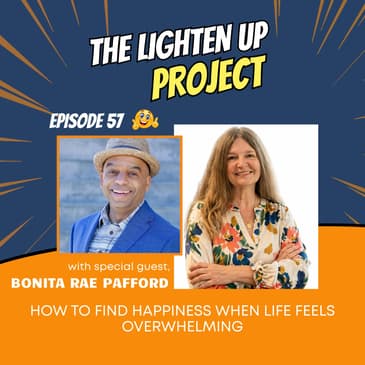
What if happiness isn’t something you find after life gets better, but something you can begin building while life is still hard? After two traumatic brain injuries dramatically changed her life, happiness strategist Bonita Rae Pafford began rebuilding through tiny, intentional moments of joy. She joins Malcolm to explore how noticing the good, tracking small wins, laughter, play, and a few baby goats in pajamas can help us create emotional momentum when life feels overwhelming
What You'll Hear
- How Bonita's second traumatic brain injury took her to a genuinely dark place — and the small, unexpected thing that helped her hold on
- Her "Notice, Nudge, Nurture" system, and why simply noticing a good moment isn't enough unless you write it down
- The neuroscience of tiny wins: why cumulative small moments rebuild your brain's pathways to happiness better than one big fix
- A simple, science-backed trick for rewiring your brain — switch hands, take a new route, or change your routine to jolt your brain awake
- Why self-soothing habits (a drink, a snack, a scroll) aren't the same as real happiness, and how to tell the difference
- The three paths inside her book 100 Days, 100 Ways to Happier — Butterfly, Fire, and Woo and Do — and why different days call for different approaches
- Why laughter doesn't have to start out genuine to become genuine — and how "faking it" can be the doorway in
- Bonita's closing thought: happiness isn't a luxury, it can be a lifesaver
A note to listeners: this episode includes an honest discussion of brain injury recovery and a difficult period of depression. Bonita shares her journey with hope — if anything in this episode resonates with you personally, please know that support is available.
Resources Mentioned on this Episode
- The Smile File — Bonita's free weekly email with a brain-training task and the neuroscience behind it
- Book: 100 Days, 100 Ways to Happier by Bonita Rae Pafford
- The Wild Happiness Society — Bonita's weekly Zoom community, held Thursdays
- Wild Happiness Radio — Bonita's podcast
- Learn more about Malcolm's work at the World Laughter Organization™
Featured Guest: Bonita Rae Pafford
Bonita Rae Pafford is a speaker, educator, entrepreneur, and happiness strategist who helps people create more joy, resilience, and emotional momentum through simple, science-backed practices. A retired high school teacher with a background in literacy, special education, communications, and media, Bonita has spent her life helping others learn, grow, and thrive.
Her work became even more personal after navigating major life plot twists, including recovery from traumatic brain injuries, which reshaped her path and deepened her commitment to helping others rebuild with hope, humor, and practical tools. Out of that journey came The Wild Happiness Project — a heart-led movement designed to help overwhelmed people feel happier and stay happier through tiny wins, habit stacking, brain-based strategies, and everyday moments of joy.
Bonita is the founder of The Wild Happiness Society, host of Wild Happiness Radio, and creator of programs, talks, and tools that make personal growth feel encouraging, doable, and human. She blends lived experience, neuroscience-informed insights, and a warm, uplifting approach that helps audiences feel seen, supported, and inspired to take their next smart step.
Known for her compassionate energy, creative ideas, and real-life honesty, Bonita brings conversations that are both meaningful and practical — the kind that leave listeners feeling lighter, stronger, and more hopeful.
Connect with Bonita Rae Pafford:
- Website: https://wildhappiness.life/
- Email: Bonitarae99@gmail.com
- Instagram: https://www.instagram.com/100days100ways_life?igsh=MWlsdDRneGoxbGh2dQ==
- LinkedIn: https://www.linkedin.com/in/bonita-mcc/
- Telegram: https://t.me/+5kBrEsE1S9FiNGEx
Meet the Host: Malcolm Grissom
Malcolm Grissom, affectionately known as "The Stand-up C.E.O.," is a team-building and employee engagement expert. Malcolm, an award-winning actor, comedian, International speaker, and best-selling author, masterfully blends humor, improv, and business acumen to enhance team dynamics and profitability. As a certified laughter leader, he leverages the power of positive psychology and his social work background to create engaging, results-driven experiences. Whether inspiring executives, strengthening teams, or energizing audiences, Malcolm’s unique approach fosters connection, creativity, and success. His ability to transform corporate culture with humor and insight makes him a sought-after speaker and consultant.
Follow Malcolm:
Website: malcolmgrissom.com
Facebook: facebook.com/malcolmgrissom
LinkedIn: linkedin.com/in/malcolmgrissom
Stressed, stuck, or leading on autopilot? It’s not a motivation problem—it’s a connection problem. Malcolm’s weekly virtual improv classes boost engagement, collaboration, and retention—all while having fun. Register now for a complimentary month: https://malcolmgrissom.thrivecart.com/everyday-encores/
We are proud to have The Lighten Up Project on the *High Vibe Podcast Network .* Grab your free gift from Malcolm in our Our High Vibe Gift Vault.
Love this show, check out the other shows on the High Vibe Podcast Network.
Share the Love
✨ If this episode lit something up in you… tag us on Instagram @HighVibeLeaders and let us know your biggest takeaway!
🦋 Don’t forget to rate & review — it helps us reach more conscious rebels like you.
🔊 Listen & Subscribe
🎧 Spotify
Hey, all you fellow lightmakers! Welcome back to the Lighten Up Project with me, Malcolm Grissom. I am the founder of the World Laughter Organization, and I am the stand-up CEO. And you are not. Sorry, you're you're just not. There's only one, just like Pepsi. There's a a Coke, the similar, but it's not the Pepsi. It's you know there's differences, which we are going to be talking about today. Today on the Lighten Up Project, we're going to be talking about happiness, happiness. Yes, yes. Not the waiting till everything's perfect kind of happiness. We're gonna be talking about the happiness that you build one small moment at a time. My guest today is Bonita Ray Pafford. She's a speaker, an educator, happiness strategist who just helps people create more joy, resilience, and emotional momentum through simple and science-based practices. After navigating some like challenges of her own, including the recovery from a traumatic brain injury, she has turned her experience into a powerful movement called the Wild Happiness Project, helping people rebuild with hope, humor, and tiny, tiny doable wins. Yes, I know you can see some. Anybody who knows me and knows the story of the laughter, the Lighten Up Project, and the World Laughter Organization can see the similarities between me and her. But I'm really happy to talk to her. She's the founder, like I said, of the the Wild Happiness Society. She's the host of Wild Happiness Radio, and today you have two experts that are going to be talking about what we can do when life becomes overwhelming, Bonita's approach reminds us that happiness doesn't have to be complicated. It can be easy, but it has to be practiced. So let's lighten up. Let's look for our next small win, tiny steps, and let's welcome Benita Way Packard.
Malcolm Grissom:Bonita Rae Pafford: Thank you so much, Malcolm.
Malcolm Grissom:Yes, yes.
Malcolm Grissom:Bonita Rae Pafford: Great to be here.
Malcolm Grissom:Glad to have you here? Glad to have you here. There are a lot of similarities between us. I too have. I had a yeah. It was a major brain trauma, traumatic. I had to relearn how to walk and talk as a child, and so I use that to help stimulate me, and it I use that through my standup, through my work, through improv, and it it really functions about it's the foundation of what I do now, and I'm really excited to learn the foundation and all about what you do. But first, would you mind joining me in 20 seconds of spontaneous laughter? Absolutely. Okay. All right. So 123, Yeah, laughing for no reason is best. It is. Because when we laugh for no reason, often that stimulates us to laugh. It turns into genuine laughter, and when we do it with someone else. As I've experienced several times on on this podcast with other guests, we laugh off each other, so we play off each other, and the laughter just continues going and going and getting stronger. And Ben Ray, can you tell us what? When was the last time? Describe the last time that you had a genuine laugh, and tell us what sparked that for you. I make sure I do it at least once a day, and my most recent one was when I was walking my dog today. We were down by the lake, and it was quite windy. My hair was in my eyes, and I didn't realize he had wrapped his leash all around me. So I started to walk, and over I went. I don't figure if anybody was watching it. There, if I might show up on YouTube, it's a possibility
Malcolm Grissom:Bonita Rae Pafford: because I'm sure it was quite entertaining for anybody watching, but I also ended up laughing, just laying there on the ground. He comes over like, "Hey, mom, what are you doing?
Malcolm Grissom:Bob, why do Paul? Okay, yeah,
Malcolm Grissom:Bonita Rae Pafford: yeah, that's a hazard, but it makes it entertaining.
Malcolm Grissom:What's one small moment that recently gave you one of these wild happiness feelings. Besides what you just shared, but a small moment because that was kind of a big moment or a medium-sized moment. But just what's an everyday small moment that?
Malcolm Grissom:Bonita Rae Pafford: Well, whenever I'm out for a walk. I always look for things that are unusual, interesting, entertaining, funny, whatever. And today, I I make a list, right? A mental list as I'm walking. There were random crocuses in people's lawns because the squirrels had dug them up and replanted them elsewhere. So you see these little pops of color in people's lawns. And I went by one house that had an interlocking brick walkway, and it was a really long walkway. And their children had taken chalk, you know, sidewalk chalk, and painted each one of the bricks a different color the entire length of the walkway, and it looked really cool. So I had to stop and take the picture.
Malcolm Grissom:Yeah, so noticing those small mums just taking a walk, taking a walk, looking around, and just noticing what is around you.
Malcolm Grissom:Bonita Rae Pafford: Yeah, at planning to find something every time you go out for a walk because there's something every time. It's just you're not paying attention, and the trick is, you got to notice it, and then you got to nudge it into your brain and say, "Ah, that's cool, or "Oh, that was neat, or "That was funny. Label it, and then you nurture it by retaining it, telling somebody about it, writing it down, taking a picture, or something like that, and that levels up your happiness.
Malcolm Grissom:Okay, okay. So let's let's dig right in. Let's jump right in. You so you've had this major traumatic brain injury. How did that experience reshape your your life and your understanding of happiness and resilience?
Malcolm Grissom:Bonita Rae Pafford: Well, prior to the accident, I was a chronic overachiever, high school teacher. I was a dance teacher and performer. I was an extra in movies. I was even in the movie Red with Bruce Willis, and I was just very busy, and I loved it. And then I was out for a drive with my friend, and I had this feeling of something bad is about to happen, and it did. And I remember spinning the sudden stop of the car, and that's when I got the traumatic brain injury. And it did shake up my life, but I attacked it. Like yes, I can fix this because I was a chronic overachiever. So I worked really, really hard. I went to all the physical therapy. I went to all the appointments, just learning everything I could about how to get better, how to teach my tongue to work again, how to walk without falling, and I was doing pretty good. And I started actually thinking, you know what? Maybe I can go back to teaching, not full time, but maybe one class a day, and then I walked into a building with my mom, and a section of ceiling hit me in the head. I got another traumatic brain injury, and the second one I did not recover from nearly as well. I was devastated because the first time I thought I can do this, I can fix it, but then again, I just figured out the walking and talking pretty well after the first injury, and now I've got to do it again. And honestly, it was it was a very dark time, and I had to do it a totally different way. The first time was just go go go, I've got this. The second time, I had to do it very gently with myself. I had to really seek something. Good in this world, because it was hard. It was very difficult. My partner left. My son had to go live with his dad. My mother had to come and take care of me. It was it was bleak. It was very bleak. But I decided I had to stay. I had to figure it out, and I had to find one thing every day that was good, and that's how it started.
Malcolm Grissom:What was that one thing that the very first thing that you focused on that turned this direction for you that helped me turn this direction? I made a
Malcolm Grissom:Bonita Rae Pafford: conscious effort to go online and look for baby animal videos. I did that every day, just watching goats in pajamas jumping around or baby otters playing, things like that. I had to force myself to do this just to break my mood because I, I was like I said, in a very very dark place, and I didn't want to be here anymore. I was tired. I had just gone through you know a year of hard work trying to get better, and here I was in this again. And so it started off with baby goats and pajamas. So whatever glimmer you can find, you hold on to that tight.
Malcolm Grissom:Okay, okay. And so, what is another thing that you learned about rebuilding your life and rebuilding yourself, but something that most people don't talk
Malcolm Grissom:Bonita Rae Pafford: about-how dark it can be-because a lot of people don't talk about the mental health aspects. They're all worried about the broken body. Because I-I was falling a lot, and I broke a lot of bones. I shattered my arm. I broke my tailbone, I broke my heel, you know, fun things like that. And there's there's a mental health aspect as well. And your friends leave, you know, my partner left, my son had to go live with his dad. It was very dark, and I didn't know who to talk to. And here I am, you know, totally enveloped by all this therapy, trying to fix my body and my brain, and trying to figure out if I even wanted to fix it at this point because I was so devastated and in such a dark place. I didn't didn't know, but I thought I have to fix this. I've got to find a way through it. I don't want my son to think his mom was a quitter and gave up on life, so I pushed, and I was bound and determined every single day, I was going to find something to laugh at. So I would watch those videos of people laughing, and I'd laugh along. I'd watch the animals, and just little things, you know, even around the house. Anything that's a little bit out of order, like I'd laugh at. I go, okay. When did you start leaning over to the left, like talking to a painting on my wall? When did you start doing that? And they would practice the the speech and practice my noticing, so it was the the noticing of things. And I pay more attention to what my dogs were doing, the silly little things I used to take for granted before, like the way they would stretch their face when they were scratching. You know, they get that perfect spot. Oh yeah, I got it. And then their face would go all funny, and then I learned to laugh at those things rather than just take it for granted.
Malcolm Grissom:David, okay. So let's talk a little bit about what you do now. So you've done a lot of investigating and come up with some science-based practices. So, in these science-based practices, what's happening in your brain when we experience the joy or momentum? What's going on?
Malcolm Grissom:Bonita Rae Pafford: Well, you're getting a hit of dopamine. You know the the happy chemicals that are in your brain. So what you're trying to do is make your brain produce those by things other than doom scrolling, or you know the addictions that can really drag you down. You want it to be from your environment or from something happy, something positive. So that's what I've worked on. And like I said, I was a chronic overachiever, and my brain, my research part of my brain, was just fine. So I said to myself, I have to fix this. And the therapist can only do so much, you know, to get me better. The rest of it was up to me. So I thought, all right, I guess I'm into research mode, and that part of my brain worked well. So I just started making notes and watching all the videos I could get, getting out my textbooks again in psychology and sociology and all the other ologies, and trying to relearn the different things that I could do to make my brain better. And then I worked that into the things that I did and started a a three path system for myself because some days were really rough, so I had to be very gentle with myself. Other days, I had fire, like yeah, I can do this. And then another one would be more into the creative line of things. But all of them were working together to help me get better. So that was the goal. Every day I had to do something, and then it became two things in a day, and then it became. Three things in a day as I built my own capacity, and I didn't. You don't have the straight trajectory, you know, getting better. There's those ups and those downs, but the downs weren't as down, and the ups were getting more up. So I was building capacity, and I was getting better, and I can see the results. And I discovered another big trick about this, which is a big part of my program, is you got to track it. Your brain wants proof, so I have to write it down. Say here's what I saw on my walk today. I took a picture of it. I told somebody
Malcolm Grissom:about it, and I wrote it in my journal. So I can say I saw crocuses in the middle of the lawn, and I saw daffodils were coming up, and I saw a painted walkway, and my dog tripped me. So I write it down, and that little act is a way of keeping score. And our brains love keeping score. So anytime something fun happens, somebody lets you out in traffic, you find a dime on the sidewalk, you win a free ticket in the lottery, whatever it is, write it down because then it's proof of good. Because when you're in a dark place, everything is dark. But if you can find that one glimmer, that tiny little light that's coming through that crack somewhere, and really focus on that little crack, it gets a whole lot brighter. So write it down, keep score, and do what have whatever you have capacity for that day. If you got fire in your belly and you know you got the energy to do something big. Go ahead, do something big. Really work towards getting better. But some days you just can't do it. All right, you're going to sit and watch baby goat videos. That's fine. It still counts. Whatever your capacity is, just do it.
Malcolm Grissom:Okay, okay. Just do it. I like that. Just do it. Okay, just doing. Those are the tiny ones. So we've talked a lot about the tiny wins, and make a picture, make a note of these tiny wins. Now, what's the connection between these tiny wins and the long-term emotional change?
Malcolm Grissom:Bonita Rae Pafford: Well, what you're doing, your brain has all these pathways that are really carved in stone in there because of the way you've lived your life. And then when you have something major, traumatic that takes you offline, you've got to find a way back. And sometimes you can't go back to that path you were on. Like in my case, I couldn't. I am face blind now. Like if I run into you tomorrow in the grocery store, I probably won't recognize you. It takes me a lot of times meeting somebody over and over again to learn who they are. So that's that's a challenge in life. So I always go around with a little smile on my face just in case I run into somebody I shouldn't know. But hey, smiles don't hurt. Smiles always help. But sorry, I lost my train of thought there. Oh yeah, rewiring our brain. So what you got to do is start new neural pathways. So one of the other little tricks in my program is bringing in something new that you don't normally do. If you normally turn left when you go to your drive in the morning, turn right. If you normally brush your teeth with your right hand, switch over to your left. This wakes your brain up. You can stand on a bath mat that's kind of prickly to wake up those nerve endings in your feet. Just change up something in your world because then your brain goes, "Okay, she's doing something different. What's going on? And it makes you pay more attention because about one half to two thirds of everything you do and think is just habit. And if you want to change up the way your world is, you got to break some of those habits, and the easiest way to break a habit is add something new to one you already got. So while you're brushing your teeth with the non-dominant hand, have a note on the mirror that just says, "Today is an awesome day" or "I love you. Anything that is going to wake your brain, like your brain is being woken up because of the brushing teeth with the wrong hand, and then you're going to be processing this
Malcolm Grissom:new chunk of information in a different manner, and the little pathways inside your head are going to go, "Oh, that's different. Things are weird. I need to pay more attention. So it gets you out of that complacency of like, "Here's what I do: right foot, left foot, right foot, left foot. No, something different. Washing the dishes. Stand on one foot if your balance is good. Don't don't don't go messing around. You got balance issues, but if your balance is good, stand on one foot. Again, your brain goes, "Huh, what is she doing? So it'll be awake and paying attention. You're already washing the dishes again. Put a little note on the edge of the window, saying your bed is going to be so comfy and cozy tonight, and you're going to get a great night's sleep. Just something that you're processing and looking at. Listen to uplifting music. Maybe you're used to listening to a certain type of music. Switch over to another type that's got really positive lyrics. And again, your brain goes, "What is she doing? Or what is he doing? Why? What's going on here? So it has to take that time to think about it, process it, and it's more open than to the new things that you're trying to bring in.
Malcolm Grissom:Okay, okay. So if you can, for the sake of our audience, let's take let's take an example of a small win. A very small win. So, the taking a walk and noticing something that story that you told just a minute ago. Let's take that small win, and now, how can noticing these small wins and making note of them, how specifically do we use these small wins to create that long-term emotional change? So you've told us how to how to generally go from the tiny win to the the long term change. Now, how can we even more specifically take a specific tiny win and have that help with the long term change?
Malcolm Grissom:Bonita Rae Pafford: If you think of it like you're building a house and you're using cinder blocks for the basement. Most people don't have a nice solid foundation. There's a lot of holes in the basement. So what we're doing is we're finding good things out there in the world that we can plug into those holes to help hold the house up better. So all of these little things have a cumulative effect, especially when you write them down. If you do not do the notice, nudge, and nurture, it just passes by. It's like you need a butterfly net to catch it. So the notice, nudge, and nurture, which is the system that I teach, is your butterfly net because you have a task. You must find something every single day. You have home play. I don't call it homework. I call it home play. So your homework, home play every day is. You must find one good thing. You must write it down, share it with somebody, or tell me about it. In our group, we have the Wild Happiness Society, which is a Zoom where we get together and they have to report back. And those little things make the bricks for your foundation of your house, and they give you your happy bricks that help fill in, that help support that house that's there, because most of us we can get through our days. We fake it. We have to fake smile. You know, yeah, I got to do through go through this. I got traffic, and but if you can learn to find those happy things and hold on to them tight, and then work with them, then your foundation is better, and your days get better. And overall, I mean, if you're if you've got your baseline for happy raised, everything gets better. If you're just barely making it, it's really tough getting through the day. You come home and you just collapse. Whereas if your baseline for happy is higher, you've got more energy to do other things. And then if you have a setback and you do drop down a little bit, you're still above the baseline of an awful lot of people who do not look for happy.
Malcolm Grissom:Okay,
Malcolm Grissom:Bonita Rae Pafford: when I was a high school teacher, I always used to have them do this task. If they got the class on time, they could come to the front of the room and tell me something good. So they had to tell the whole class something good that happened between this class and the last time we got together, and because we were high school students, there had to be rules because they do like pushing the limits a little bit. So I said nothing illegal, immoral, or fattening, and nothing that would make my grandmother blush. So that gave them parameters, and one of them they they caught on to what I was doing because they all wanted to one up the others in the class, as to something that was good in their life, right? And this miss, you're doing this to make us focus on good, aren't you? I went, don't tell anybody, but it's true. And it also got them over their fear of speaking in front of the class because they were just talking about their own life, and it took a minute or less. Just tell me something good, and it could be anything silly, it could be anything wonderful, whatever. As long as it was something that they saw in their world that was positive, and it really worked really, really well. And that's something I do with people as well in the Wild Happiness Society. Tell me something good.
Malcolm Grissom:All right. So now we're talking about this. Tell us Something good, and when we do that, that is when we do that over and over and repeatedly, we're creating an emotional momentum. Why does having an emotional momentum? What does that matter?
Malcolm Grissom:Bonita Rae Pafford: Well, it makes it so that your brain has that pathway, and it's easily accessible once it's beaten down. It's kind of like when you were a kid and you were taking shortcuts through the woods, and all your friends were together. Those paths got beaten down into the ground, and they were easy to follow because there were so many kids out in the neighborhood, you know, doing this kind of thing. Well, now you go back as somebody in your 30s, 40s, 50s, or 60s. Like I could have sworn there was a pathway here, but it's not beaten down anymore because you haven't been using it. But if it's used, if it's been used a lot, it's accessible, and if it's accessible, you can rely on it then to pull you out of a deep dark thing when something bad happens, like you end up in a car accident or. Something like that. Again, your baseline doesn't drop down so low because you've got these great pathways for good stuff already ingrained in your brain. You've already gone through with a machete and cut back all the foliage that's there. Like this was nice and clear, and there's happy here. This is the road to happy.
Malcolm Grissom:Now we've been talking a lot about the happy, the positive side of happiness and creative creating happiness. What is one habit that a lot of people think that will make them happier, but it actually doesn't.
Malcolm Grissom:Bonita Rae Pafford: Well, a lot of people they self self soothe. They think that having a drink, having a smoke, eating an extra chocolate bar will make them happier. But those are self soothing, and yeah, you know it takes the edge off for a little while. But you've got to find the happy within because the external stuff it can be taken away from you. If you say, "Oh, I'm dating this person because they make me happy, well, your happiness is now in their hands. That's not a safe place for it. You need to have the happy in here so that you can retrieve it, you can take care of it, and you can make it grow. Because don't let it be in somebody else's hands. Take care of it yourself.
Malcolm Grissom:So tell us about the let's let's talk about the on the wild happiness project. What makes it different from the traditional personal development project?
Malcolm Grissom:Bonita Rae Pafford: Well, it was meant to be just a book at first. Several of my friends suggested that I should write a book about my recovery from the two brain injuries, and I really did not want to revisit that. I just wanted it gone. I didn't want anything to do with that. It's over and it's done with. And then I started thinking, well, it could probably help people. And I was a teacher for well over 20 years, and helping people is kind of in my system, so I thought, how about I write a book about what I did to get better, as opposed to the misery that I went through to get better. Here's the here's the path I created. Here's what worked for me, and here's what I have shared with people and has been helping them. And then it started to grow. It was you know one of those little seeds you plant, and then it kept getting watered because of it. Oh yeah, and I did this, and I did this, and I was making my lists for the book, and I realized all the things that I had been doing, and some of it was just silly and goofy, but I thought it still counts. It made me laugh. It makes friends laugh. So why not? I'll put that in the book too. So the book totally evolved into something very, very different. It has three paths in it, and each one it's it's called 100 days, 100 ways to happier. And there's three paths within it, so there's actually 300 ways to happier. So there's 100 that are in the category I call butterfly, which is after I had the second brain injury and I had nothing left, like no energy left, I was burned out. I was done, so that's the butterfly path. And then there's the fire path, which was after the first brain injury. Was like, yeah, let me fix this. And then there's what I call the woo and the do, which is the physical stuff because physical movement really can help your happiness too. I wasn't able to do much of it because of my balance issues and you know being alone, I need to be supervised for a lot of things. So the the woo and the
Malcolm Grissom:do also has the things like the vision boards and the affirmations because it's got the woo stuff plus the physical. So that's how the book took shape. And then as that was happening, I ended up with this little guy, as you can see, over my shoulder here. So he he appeared, and then he just like you know he's just there like whatever. And then the idea for the Zoom started as the society, the Wild Happiness Society, getting people together to just talk about happiness. And I was talking to several people who had had concussions and brain injuries, just you know, offering assistance and moral support, and that was working really well. And then I used to be a radio announcer before I was a teacher, and somebody said, "You really should do a podcast about happiness. So Wild Happiness Radio was born, and it just it just kept evolving and growing, so people can pick and choose their path and their level, and which portions are going to fit their makeup the best. Because we're all different, some people need that woo and do. They need to get out there and do something physical. Other people just want to talk to somebody about it. So fine, the society would be the right thing for you. The Zoom meetings that we have, and then the radio. When you know I'm talking to people about happiness or the things that I went through, and that yeah, they can listen to that. So there's a lot of different options, and there's a lot of fun stuff too. Like I had a lady make a large version of my buddy Sonny here. So I'm always looking for things that I could add to this that will make people happy, and I have workshops as well with the Wild Happiness Rising, and yeah, just anything and everything I can do to to spread the joy. That's my goal.
Malcolm Grissom:Okay, so let's get back to laughter. Was where does laughter fit in to building happiness and
Malcolm Grissom:Bonita Rae Pafford: resilience? You know, it depends on the person. Some people are not laughers; they might giggle, they might chuckle, they might just smile. Other people, it's a full up belly laugh, and that's like a an ab workout for them because it is just such a big belly laugh. Some people don't feel comfortable enough yet to do a laugh, but then it takes a little bit of time, a little bit of hand holding, a little bit of goats in pajamas, or whatever it is that you can do to find that thing that tickles your funny bone. Most of us have it, but you got to figure it out. Some people haven't allowed themselves to be kids, they've grown up way too fast, and never grow up so far that you can't reach back and be a kid. One of the things that I do is I have a thing I call the treasure tote, which is stuff that I have anytime I'm having a now what kind of moment. I actually have a box of stuff that's on my desk, and actually, I happen to have it right here. I have a box of stuff that I just go okay. What am I going to dig out now? I used to have one in my classroom for the students too. They could reach in and guess what it was they were touching, and they'd have to have everybody in the class would have to guess what the item was, and then you know quite often they were allowed to keep it as well because it'd be you know certain things for them like erasers and stuff, but if you got to have a mouse anyway, might as well have one that's fun. So a mouse pad. So there's my mouse pad, and it's part of my logo. Whoops, over my head here too. There we go. There's my butterfly, and then I'm going to bend down here and get rested. But yeah, it's just a a mystery box, and just go okay. But I'm going to play with now. There's like, you know, all these things for fixing your hands so you can work the muscles in your hands. It's not a funny thing per se, but it's something that okay, it changes my mood. It gets me out of that. Oh, now what? So okay, I need to
Malcolm Grissom:do this anyway because of the issues that I have had because of the accident. So I have an assortment of these little doodads. If you're going to have post-it notes anyway, why not have ones that are multicolors and heart shapes? Other post-it notes-they just happen to be happy faces. I leave these in places too for people to find, like in my friends' pockets and things like that. So then they go, "Ah, Bonita was here, but yeah, just little things like that. Again, another one of these stress balls. It's a happy face, of course. I love my multicolor pens. Color coding is always fun. So just little things like that, and it's just I keep it on the desk just to break a mood because if you allow yourself to settle down too low for too long, it's harder to get back up. So I have rules that every hour I have to get up. I have to move and break the spell of being on a screen for so long, that kind of thing. Because that can get you down. You got to get up. You got to move. Got to look for those goats in pajamas.
Malcolm Grissom:So when we've been discussing laughter a couple times now, you what I've heard is that you have your approach to laughter is at least in the questions, and what you've said is very often the same approach. A lot of people think is that laughter is a response. It and it often is a response, but you, it doesn't always have to be a response. Yeah. What is your? So you you mentioned that some people just they're not ready to laugh, but then if laughter's not always a response, how would that type of person benefit from any type of laughter, whether it's a giggle or a smirk, anything like that.
Malcolm Grissom:Bonita Rae Pafford: I think laughter is good for anybody. Any level of laughter is good for everybody. Just got to be careful where you do it. Sometimes you don't want it to be at an inappropriate time or place. And you know those kinds of laughs. Like I was a teacher; those laughs would go through the classroom. You know the kids are all giggling, and nobody knows why. But everybody, even I, would start laughing too, unless it was during an exam. Like, okay, guys, come on, we got to calm down here. But any type of laughter, any level, as long as it's not in a funeral, that kind of thing, then yeah, go for it. And sometimes, have you ever seen that video of the guy? On the subway, he's reading a book, and he just starts laughing. And pretty soon, everybody that's on that car in the subway is laughing too. They have no idea what's in the book, but he's got the whole crowd of them laughing, and they're all enjoying it. But first, they're kind of embarrassed. But it's contagious, so laughter is infectious in such a good way. So if you can get somebody laughing like that. Go for it. I mean, I've done that, you know, on purpose in the class to try and break a mood in my classroom teaching high school kids, and I would pretend I was reading something that was funny, and meanwhile, I'm not. I'm just seeing that they're kind of down, and I need to break this mood. So I just start going, you know, trying to pretend I'm stifling a laugh, and they're like, "Oh, come on, tell us, tell us. And then I have have a joke ready or something like, "Oh, yeah, I just remembered this, or I just read this, and that can do it. I mean, you can start off fake, but then it can become real, and that's the thing. I mean, laughter is wonderful like that, and it really is a wonderful medicine. No matter if you take it in a small dose as a little giggle or a smirk, or if it's a full belly laugh, and then you get the benefit of your ab muscles doing some work
Malcolm Grissom:too. Yep, love those belly laughs.
Malcolm Grissom:Bonita Rae Pafford: Yes,
Malcolm Grissom:workout definitely. Yeah,
Malcolm Grissom:Bonita Rae Pafford: and you should do it every day. Every day you should have a real guffaw, like a you know a major laugh, and I treat it as like a prescription. I you know for my clients I just say no every day eat something like honey.
Malcolm Grissom:Laughter laughter has been connected with memory, too.
Malcolm Grissom:Bonita Rae Pafford: Yes, yeah. It wakes up. It sparks so much of your brain. Yeah. So why not do it? It's silly. It's silly to leave out something that is so simple and so attainable. And but there's some people that you know what I actually have when people join my program. It's a curmudgeon release form. They have to release their old curmudgeon ways. As I may have behaved as a curmudgeon in the past, you know, poo-pooing laughter and this sort of stuff. But I promise that I will give it a chance now, you know, this sort of thing. So by making them read this and sign it, it's saying let it go. It's over and it's done with. We're going to go back. Yeah, you might be in your 50s, 60s, or 70s, and you're all grown up now, but you're not too old to be laughing and having fun, so let go of the curmudgeon. Stop yelling at the kids to get off your lawn, and get out there and play with them too. Run through the sprinkler.
Malcolm Grissom:Is it always inappropriate to laugh at your funeral?
Malcolm Grissom:Bonita Rae Pafford: No, it's not actually. I was at one where we were told no black was allowed. Everybody had to wear bright colors. If you cried, you had to leave. What were the other rules? It was a big, long list of rules, and they had various sound effects being played at random times throughout when people were getting up and talking about this person. And it was actually quite entertaining. This was this was very interesting, and it had to be a big party. They had no family, so it was just you know we're spending everything on this huge big party and go enjoy yourselves.
Malcolm Grissom:Was a rapid and boiling funeral?
Malcolm Grissom:Bonita Rae Pafford: No,
Malcolm Grissom:I I understand. Huh? I'm sorry. I
Malcolm Grissom:Bonita Rae Pafford: said no. It was just you know an average everyday person who had a really good sense of humor and knew that you know his time was pretty well up and he made a plan and stuck with it, and we delivered. We had fun.
Malcolm Grissom:Love it. Love it. Love it. Definitely. I heard you have a free gift for for our audience.
Malcolm Grissom:Bonita Rae Pafford: I certainly do. I have something I call the smile file, which is a an email that comes every week, and it has a brain friendly and brain training task for you to do some home play again, not homework, but something that you can do that will spark up the the happy part of your brain, and it tells you not just what to do but why to do it, the neuroscience behind it, and there's always a link there for something silly. And I think this past week it was dogs being silly, so it's always something a little bit different. And that's every week, so they're welcome to that, and it is no charge at all. And I'd be happy to welcome them as well to visit the Wild Happiness Society, which is our Zoom, and that's once a week. There's three different time slots on Thursdays, and they can pick and choose.
Malcolm Grissom:Okay, and all this information is in the show notes. Lovely. So, Benite Ray, what is one small thing that you want people to remember, you like people. Let's stay away from want. One thing that you would like people to remember about happiness after this episode is over,
Malcolm Grissom:Bonita Rae Pafford: it can be a lifesaver. It can save your life.
Malcolm Grissom:And save your life. All right, and finish this sentence for us, please. Healing doesn't have to be heavy because
Malcolm Grissom:Bonita Rae Pafford: laughter helped me with my healing, and laughter is not heavy.
Malcolm Grissom:Yes, laughter isn't heavy. So why should healing be heavy? I love it. Well, Bonita Ray, thank you so much for joining us with this episode. Thank you so much. You are the next member of the Lighten Up Nation. Thank you for that. Thank you, audience, for listening to us and continuing to support us, we could not do this without you. Let's please help. Let's spread this momentum of laughter and joy and happiness and the benefits of this of healing and personal development, let's continue spreading this around the world because we need it desperately. Pat, we do. So, thank you so much. Keep coming back. Keep listening. We always have more and more experts with different ideas that are lovely and needing to be spread and shared. So please, when you come back or between the moments that you have the lighten up project to come to. Please remember that every smile can open the door, every laugh can open a heart, and every step can be your next victory. Bonita Rae, thank you so much for being here. Appreciate it. Thank you, everyone, and I'll see you next time.