
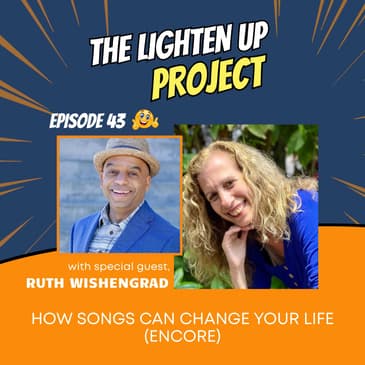
What if the words playing in your head could actually heal you? In this powerful episode, Ruth Wishingrad reveals how music, repetition, and emotion can help you shift your inner dialogue, reconnect with your heart, and create lasting change from the inside out.
What You’ll Hear:
- Why the words you repeat become who you are
- How music helps anchor positive beliefs deep into the body
- The emotional power of turning affirmations into personalized songs
- Real-life stories of healing—from childbirth to recovery—through music
- How to find (or create) your own “power song” for transformation
- Ruth’s journey of turning inner messages into a life-changing practice
Resources Mentioned on this Episode
- Free Gratitude Song Gift (shift your mindset through music)
- Learn more about Happy Heart Songs
- Malcolm’s improv + laughter experiences
Featured Guest: Ruth Wishengrad
Ruth Wishengrad designs personalized experiences that help others feel seen, loved, and celebrated. She is the creator of Happy Heart Songs, a heart-centered project that blends music, emotion, and neuroscience to create new ways of talking to ourselves. After noticing how deeply songs and lyrics shaped her own thoughts and feelings, she began exploring how repetition and melody could turn encouraging words into something people actually connect with and remember. With over 30 years of experience teaching, training, and coaching, Ruth turns encouragement into music that supports emotional well-being.
Connect with Ruth:
Website: https://happyheartsongs.com
Featured Guest: Frank King
Frank King, Suicide Prevention Speaker, writer for The Tonight Show for 20 years, speaker and comedian for 40. His speaking is informed by his lifetime of Depression and Suicidality and coming close enough to ending his life that he can tell you what the barrel of his gun tastes like. Turning that long dark journey of the soul into 13 TEDx Talks, sharing his lifesaving insights with corporations, and associations. He’s shared the stage with comedians, Jeff Foxworthy, Adam Sandler, Jerry Seinfeld, Dr. Ken Jung, Ellen DeGeneres, Dennis Miller, and Bill Hicks, as well as entertainers, Lou Rawls, The Beach Boys, Randy Travis, and Nancy Wilson. On top of all of that, he has survived 2 aortic valve replacements, a double bypass, a heart attack, and losing to a puppet on the original Star Search and has lived to joke about it all.
Connect with Frank:
https://mentalhealthcomedian.com
http://www.facebook.com/thementalhealthcomedian
https://www.instagram.com/thementalhealthcomedian/
https://bsky.app/profile/frankking.bsky.social
https://www.youtube.com/thementalhealthcomedian
https://www.linkedin.com/in/frankkingthemhcomedian
Free Gift: Free 30-Minute TEDx and How to Make Money Speaking Zoom https://link.freezdigital.com/widget/bookings/virtual-cup-of-coffee-and-live
Meet the Host: Malcolm Grissom
Malcolm Grissom, affectionately known as "The Stand-up C.E.O.," is a team-building and employee engagement expert. Malcolm, an award-winning actor, comedian, International speaker, and best-selling author, masterfully blends humor, improv, and business acumen to enhance team dynamics and profitability. As a certified laughter leader, he leverages the power of positive psychology and his social work background to create engaging, results-driven experiences. Whether inspiring executives, strengthening teams, or energizing audiences, Malcolm’s unique approach fosters connection, creativity, and success. His ability to transform corporate culture with humor and insight makes him a sought-after speaker and consultant.
Follow Malcolm:
Website: malcolmgrissom.com
Facebook: facebook.com/malcolmgrissom
LinkedIn: linkedin.com/in/malcolmgrissom
Stressed, stuck, or leading on autopilot? It’s not a motivation problem—it’s a connection problem. Malcolm’s weekly virtual improv classes boost engagement, collaboration, and retention—all while having fun. Register now for a complimentary month: https://malcolmgrissom.thrivecart.com/everyday-encores/
We are proud to have The Lighten Up Project on the *High Vibe Podcast Network .* Grab your free gift from Malcolm in our Our High Vibe Gift Vault.
Love this show, check out the other shows on the High Vibe Podcast Network.
Share the Love
✨ If this episode lit something up in you… tag us on Instagram @HighVibeLeaders and let us know your biggest takeaway!
🦋 Don’t forget to rate & review — it helps us reach more conscious rebels like you.
🔊 Listen & Subscribe
🎧 Spotify
Welcome, all you light makers! Thank you so much for joining the Laughter Project. The the Laughter Project. Well, it is all about laughter and humor and and play and and you know lightening up and everything else. But the podcast is called the Lighten Up project, and I am called Malcolm Grissom, the stand-up CEO and founder of the World Laughter Organization, and you are not called that, and you're you're not sorry.
Ruth Wishengrad:No, no, that's not what I'm called.
Malcolm Grissom:No, no, nobody else is called that, but me.
Ruth Wishengrad:That's just you.
Malcolm Grissom:Yes, just me. Sorry. Hey, but today on the Lighten Up Project, we are going to be talking about something very, very powerful. We're going to be talking about words you repeat because voice. We're going to be talking about the power of voice and the power of speech. Yes, but even more importantly, we're going to be talking about that in music and song and. all that. My guest today is a good friend of mine, Ruth Weisengaard.
Ruth Wishengrad:Eisengrad, what did I do? What did I, Eisengard? Weisengaard, you see that Weising, you Weisenheimer, Weisencracks, Weisingcrack, yes, Weisencracks. No. Oh. Okay. Oh my goodness. Okay. Why is it cracks? Why is an Immer?
Malcolm Grissom:Wishing Grad. Yes, Ruth Wishengrad, and she is the founder of Happy Heart Songs. It's blending music, emotion, and neuroscience to help people turn encouraging words into something they can actually feel and remember. And as part of our episode today, so yeah, you're gonna hear from me. You're gonna hear from Ruth, but guess what? You're gonna hear from one of Ruth's clients. She's gonna tell you the power of one of Ruth's songs.
Ruth Wishengrad:So, song specially created for her. So it's not really my song; it's her song,
Malcolm Grissom:Her song. But you created it for her, right? Thank you, thank you for that correction. Yes, very important correction as well. So, with over 30 years of experience in teaching and coaching. Ruth helps people feel seen, supported, and celebrated. Often, something often was something as simple and powerful as a song, as words, words that we use every day. We overlook that power at times, but not today, because if you've ever had that tune stuck in your head, imagine that it's actually happening to you. I wish, I wish, I wish. Well, we're today. We're going to lighten up. We're going to change that soundtrack, and we're going to welcome Ruth Weisenheimer.
Ruth Wishengrad:Weisscragheimer Wishingrad, Ruth Wishengrad. Thank you. Well, you know, laughing wouldn't be the same if I wasn't laughing with you.
Malcolm Grissom:Oh gosh, yes. So I usually begin this with 20 seconds of spontaneous laughter, but hey, since we've had that throughout our introduction, and you know, and we laugh so easily, let's just get right into what Ruth is your relationship with laughter.
Ruth Wishengrad:Oh, my relationship with laughter is oh, that's a really good question. So, I just love to laugh, and you know, my my growing up, it was all about laughter. And you know, this is the first thing that popped up when you asked me that, and it doesn't sound like something to laugh about, although it's what happened at the moment. My mother was. Ailing, and she was sick, and she said to me, "Okay, I'm sick. We got to start laughing. We just got to start laughing. Laughing is going to heal everything. So that that just reminded me of that. It was a very very sweet time, and so I just would go. I would go over and visit her, and like, okay, this is laugh time. Let's laugh, and so we would laugh together. And when I moved across country, a few years later, many years later, actually, I I actually became a laughter yoga leader, and I got certified as a laughter. I'm a certified laughter.
Ruth Wishengrad:He's a laugh doctor. I'm certified to laugh.
Malcolm Grissom:Oh,
Ruth Wishengrad:Certified to laugh, Malcolm.
Malcolm Grissom:Very important. Very important to be certified for that. That is great. I love that story because there are so many people that I've talked to in this podcast and elsewhere that when they think of laughter, they think of laughter as a reaction. You know, we're we're going to a comedy show. We're watching comedy movies. We're watching we're watching something in order to make us laugh. And so that story, its laugh time, is wonderful, and and look at you now, you are certified to laugh.
Ruth Wishengrad:Well, and you know the certification about laughter is it's it's all about put a smile on your face. Yes, put a smile on your face and laugh for no reason,
Malcolm Grissom:yeah.
Ruth Wishengrad:What it's all about, and the benefits of laughter is are amazing. I think it was was a Norman Cousins. Is that who who who laughed at himself healthy? That's what my mother pointed to. She goes, "Well, if he can do it, I can do it. So we left.
Malcolm Grissom:Interesting. So Ruth and people watching. If you haven't done so, you might want to check out. So last month was International Humor Month, all all April. You know, starting with April Fools. Right,
Ruth Wishengrad:Right. That makes sense.
Malcolm Grissom:Right, and so on April 2, which happened to be a Thursday, Steve Wilson, who was actually the person who certified me as a laughter leader, he was interviewed. He's the he's the psychologist. He's very very done a lot of research throughout his life, on laughter and and Norman Cousins and the relationship there and all that, so that would be a very interesting episode for y'all to check out. Okay, yeah. So Ruth, so we talked about laughter. Let's talk about songs for a moment. So, what song has shaped you and how you see yourself and how you move through life?
Ruth Wishengrad:Oh, I don't think there's just one song. I think songs, for me at least. Well, I could tell you a story. I didn't understand that songs were actually helping me, helping guide me through my life. I didn't know that, and I would get songs stuck in my head when I was sleeping, and they would get stuck in my head so so much so that I would repeat and repeat them and I would stay awake repeating them all night long, just one or two lines of a song, and I couldn't understand it, and it was also taking away my sleep. Right, so that was not so good, and so finally it took me years. Okay, sometimes I'm a little thick, but it took me years to realize. Okay, well, if you wake up and you're singing this song, write it down. Get up, get a piece of paper. So I I ended up putting paper by my bed and I write it down. And I would write scribble it down, trying not to turn the light on. You know, scribble down the lyric, and then in the morning, and that, and that was enough to say, okay, it's it's been captured, it's remembered. Now you can go back to sleep. And in the morning, I would I would be able to. Sometimes I could read by chicken scratching, and I could look at it. And nine times out of 10, it was a message I needed to hear. It was something that was telling, guiding through whatever I was going through, and it was it was putting me on a path. And for me to come up with one particular song is hard. Although the one song that helped me on my journey to get here to Santa Barbara from Massachusetts was the song "Breakaway" by. Kelly Clarkson, that song, for whatever reason, was my my guide to say you know whatever whatever you need right now, and and it just allowed me to you know to break away. I guess I was breaking away from my family and breaking away from some safety, but I wasn't leaving. I I wasn't trying to leave. I was trying to move forward to something else. That does that make sense?
Malcolm Grissom:Yeah, sure does. Yeah, sure does. Is is there a song now that now that you've broken away? Now that you are in Santa Barbara, you are you have your you have your spit.
Ruth Wishengrad:I have what
Malcolm Grissom:You you have your spit.
Ruth Wishengrad:I have my spit. Okay.
Malcolm Grissom:I'm sorry. Yeah, just the word just left me.
Ruth Wishengrad:I got
Malcolm Grissom:Your your company now. Now that you have founded the Happy Heart songs, and now that you are you are on another step on the entrepreneurial ladder, do you have an a song now that guides you?
Ruth Wishengrad:Well, I was actually telling a client this the other day, all of these songs are pieces of me because it's from my heart to theirs, right? And so each one of the songs show up at different times for me. Different parts of the lyrics will show up to to keep me on my path, and these are songs of encouragement, empowerment, of joy, of of honoring where you are at the moment, and and lifting you up to where you want to be. And so, even though these are specifically for other people, they're all they all feel like part of me. And so that's the that's what's showing up, you know. To to jump back a little bit to that story about when these songs used, different songs used to show up in my you know while I was sleeping, I all of a sudden went, you know, hey, if I could get other people's songs stuck in my head, what if I got my own songs stuck in my head to help me feel better from the inside out and help me move to where I want to go, and that's that's when this whole idea showed up for me, and that was probably about 14 years ago, and I've done different things between that time and and now, and I have created a whole curriculum around this in terms of empowering you to the thoughts that you repeat have those the good thoughts the ones you want to repeat. Let's repeat them over and over again. Let's repeat them over and over again to anchor them in the body. And when you're doing it with joy and song and laughter, and you're you're creating that emotion around it. It it's there, and it anchors much deeper than just a plain flat kind of a statement saying over and over again. And so, what that does is, when you need it most, it will be there. I have a story around that if you'd like to hear it.
Malcolm Grissom:Just a minute, I did want to point out here and riff on that per second. Is that not only is it powerful to you know repeat those words and everything that comes in that song, but connected with that music because music is so emotional. So right now, my one of my power songs, one of my power songs is "Bird Set Free" by Thea. Are you familiar?
Ruth Wishengrad:You'd have to sing a little bit of it because I'm I'm more, and maybe you don't want to sing a little bit of it. But
Ruth Wishengrad:No, I don't actually. I wait.
Ruth Wishengrad:I'll write it down so I can open it up.
Malcolm Grissom:Bird set free. I I don't know the words really. I repeated some of the words in an episode that I did last March, but I don't. So I don't. I don't really know the words. But every time that I hear it, every time that I hear it, it's it's very emotional, very emotional. It it strikes a chord. So now going back to what you said, it now you're having you're having these words or your clients. Are having these words, and because the it's attached to the music, they have that extra emotional connection. And at like you pointed out, you have the same thing because not not only did you create it, but you also have that stuck in your head.
Ruth Wishengrad:Absolutely,
Malcolm Grissom:As something you created,
Ruth Wishengrad:right? Right.
Malcolm Grissom:It's always going to be there,
Ruth Wishengrad:And it's not. I don't feel like it's necessarily stuck in the head. I feel like it's stuck in the heart because yeah, now a realer wants yeah the heart wants to be heard
Malcolm Grissom:Yeah yeah exactly so yeah you when you are writing it when you're creating it I guess that's why I said head right now that it's created and you've given it away. These now it lives within you. Now it's yeah. Now it's in your heart as a creation that you've done.
Ruth Wishengrad:As I tell all of my clients, I say from my heart to yours.
Malcolm Grissom:Yeah,
Ruth Wishengrad:Because it really is. Yes, maybe I did. Yes, I created it. Some of it here, but and I also created a lot from my heart too. So it it just kind of came through me, and I don't I don't fully feel like it's just Ruth Wishengrad that's doing this. I feel like there is some higher power that's that's helping me to help others, and that's that's what I'm here for.
Malcolm Grissom:Great calling, great calling.
Ruth Wishengrad:Can I get back to that other story?
Malcolm Grissom:Gunny, you were going to tell us another story. Go ahead.
Ruth Wishengrad:So many years ago, when I had created some of these songs for kids and inner kids, they were fun, fun, very repetitive songs. And I had this one woman who was 90 years old, and she loved the songs, and she wanted to to tell me stuff about it. But I, she didn't have anything specific to say, so I invited her to listen to the songs for two months, and dance and sing with them, and and and just get silly with them. And at two months and two days later, Malcolm, I get a phone call. I mean, I get a text from this 90-year-old. A text, not a phone call. A text. Can you please meet me at the rehab? I fell and fractured my hip, and I was like, okay. And she said, please get a you know put your phone out and take the testimonial right then, right here and now. So I did, and basically the story was that in the middle of the night she'd gotten up to go to the bathroom. When she went to sit back down again, she didn't land on the bed. She went crack, and she heard her hip crack, and she was in excruciating pain. She thought, "Well, you know, I just saw the kids tonight, and my phone is six and a half feet away. It feels like 10 miles. I'm done. She was about to give up, and she heard the song, one of his three songs, in her head, and to the beat of the music and to the rhythm of my voice, she was able to move herself one inch. And she'd stop, and she'd pant and rest, and then the song would come back again, and inch by inch by inch, she made it to her phone in two hours. Out a shadow of a doubt that she was going to. It was like a flow of energy that was moving her across the floor. Exactly two hours later, and when she got there, she didn't. She didn't even call 911 She had concocted this whole plan because she didn't want the two deadbolts on her doors to get beaten down and cost her 1000 bucks. So she, so she called her neighbor to say, "My kids are going to come with the ladder. Don't don't go back to sleep. It's okay. The kids came. They
Ruth Wishengrad:came and and then they called called the ambulance. But they said, "No sirens. We don't want to wake the wake the rest of the neighborhood. And not until all of that did the did the pain come back, the rush of pain come back, because she had been singing the song for two hours, totally focused. Four months later, not only was she walking again, she was driving her car again. At 90 years old,
Malcolm Grissom:Amazing.
Ruth Wishengrad:So the power of music is just absolutely incredible, and I have another story. If you want to hear right from the client's mouth this time,
Malcolm Grissom:Ah, not yet. We're not yet. We're gonna we're gonna let our our audience just enhances.
Ruth Wishengrad:Okay.
Malcolm Grissom:Yeah, but I so you just that was a beautiful story about the power of music and the power of words connected with music. So now, where does joy or laughter fit in into the way that music helps support healing.
Ruth Wishengrad:Well, I feel that laughter. I mean, joy is part of of the music. Joy, because music brings joy, right? So that's that's what for me, at least, it does. And so the laughter part, I think, is the connection. I think it's connecting with others, connecting with yourself on it. I think almost it's probably more connecting with others. So when you share the song and others like embrace it with you, then there's that human connection, and we all need connection. And that's what that's what has that's why why laughter can continue longer and longer, and then you've done since you've been certified. You know, you know that you've done the laughter meditations, right? And even without looking at each other, you're still all connected when you're lying down and you're you're laughing. I've had laughter yoga sessions like that that went on for 10 to 20 minutes, that we would just everyone would be quiet, and then all of a sudden, one would person would go, and we would just all be done again.
Malcolm Grissom:Yep, exactly. So yeah, that goes to my core phrase, and you brought that up. Yes, laughter is connection. That is my core truth. I will. I want that on my gravestone. So have you seen? Have you seen? So you've told us the story that someone else told you about how the music and the songs shifted their entire emotional state in such a powerful way, but now have you actually seen it happen? Have I seen it happen? Yeah, yeah.
Ruth Wishengrad:Well, part of it is is one of the one of the benefits is when when I share the song with people, I when I share it with them for the first time, there are several people who who've wanted me wanted because we we're connected in other ways as well, and so they wanted me to be there when they when they when I share the song for the first time, and I see the emotion, and not only are they emoting, I I emote from along right along with them, so I have seen that, yeah, and does that answer your question?
Malcolm Grissom:It most certainly does. Yeah, and it leads me right into happy heart zone. So I want to talk about what inspired you to actually create it, and over years.
Ruth Wishengrad:Great question, of course. So I'm gonna I'm gonna fall back on what you said at the beginning. What you repeat repeats, and when you're repeating things that don't don't fit with who you are and what you want to be, then you don't feel so good. So why not repeat what you do want to feel and how you do want to feel and be and and that and repeat repeat those things and so that's kind of how this whole thing started started it's not about the song it's a it's about what happens because of it it's who you end up becoming
Malcolm Grissom:okay, okay,
Ruth Wishengrad:and it's more than a song; it's an experience.
Malcolm Grissom:And what another part of what you said that hopefully didn't go over people's heads, but just in case, so let me point it out: finding that thing to repeat takes a whole lot of experimentation, and you know because that thing that you repeat, you might find it when you're a child, and then again when you're a teenager or or you know a young adult, but you would still need to to experiment with other things because every little thing that you do in between, everything that you do in between, you. It leads you to really use everything that you have at the end to create the song or whatever, whatever it is that you want. So, what what I'm saying in my awkward way, is once you experiment. So you have you have a gift. You have something that you love. You might want to leave it for a while. Don't stick with it. Don't say, "Okay, I've made up my mind. This is my gift. This is what I love. This is what I'm going to focus all my time and attention on, and become a Ruth Weisengaard. That just all she does is create songs for people. That's all she does, she hasn't had all the other experiences in between. She hasn't had all the other, you know, business ventures and whatnot in between. That's all she does. She's a one-sided person. Well, you could do that. I wouldn't suggest it. You could do that, or you could do what you've done, which is you've had this gift, you've played around with other gifts, you've done other things, you've followed other business ventures and business ideas, and now you've come back to you know what you've loved. Even though it might, it's probably it was always still there. I mean, it's not like it went away, but it wasn't your main focus. Now you've come back to that love, with a more with a richer point of view on life, more things that you can add to songs and help people out, and it's just it it back itself is what personal development is really all about.
Ruth Wishengrad:Absolutely,
Malcolm Grissom:Really all about exploring,
Ruth Wishengrad:And it has definitely, you know, had its true, you know, changes and and my experiences help shape the new experiences for others and all of that, absolutely.
Malcolm Grissom:Sure, sure, yeah, yeah, definitely. So, what makes a good happy heart song? What makes it different from a feel good playlist? Or even now, you know, in Summer, you can go in and create music, AI. So, what what makes what you do even different than all that stuff?
Ruth Wishengrad:Well, it's the emotion and the repetition that makes it stick. So, it's really the questions that I ask to really tap into people's individual where they are now places, and one of the things that I do, one of the things that I offer is yes, I have a a survey that you can you know fill out this whole long survey, and you can do it on your own. And then even if you do it on your own, and I have questions when I read it. I will email back and forth to you. However, there are some people who have a very hard time just writing down the the things that really mean the most to them. So I have what's called a helper session, and we it's a happy helper session, but short helper session, and and in that session, it's a very focused one-on-one time where I kind of I ask you the same questions, but I'm helping pull out the the the gems, the pieces of you that are the most important, and I and having you help me paint a picture. You're painting a picture of what is important to you, so we take you from here to where you want to go, and the repetition, the the lines of repetition are the things. So I really feel like it's in in the songwriting, and it's the the the specific, it's the neuroscience that wraps it all together to anchor it deeper in the body, and it's the neuroscience and the things that are going to affect you, not the things that are going to affect me. But my listening to you, or or looking at your survey, and and the way that I've structured this, it's taking those pieces that's going to really wrap the song. In, in your heart, in in what's pointing to you at the moment. Does that make sense?
Malcolm Grissom:Yes, yes. So, how can the songs, how our music itself, how can it really help people express or access, not express necessarily. Will express and access. So access emotions that they don't normally express.
Ruth Wishengrad:Well, yeah. So I think I think it's all in the words. So I'm bringing you back to the very beginning of what we talked about. It's all in the words. It's what are the words that mean something to you that are going to trigger that emotion, that expression of you, and then you share those words with me, and I lace them and craft them into something that is just beautiful,
Malcolm Grissom:Right? So that that's beautiful. That that really now this is a now you get time. Yes, this is I get it now. I want our listeners to get it, and this and what better way to get our listeners to get it, but to have you share your story along with your client's
Ruth Wishengrad:Response? Right.
Malcolm Grissom:Yeah. Okay. Yes.
Ruth Wishengrad:So I will share the story, and then, yeah, I'll just share it, and we'll go from there. Toss up.
Malcolm Grissom:Yeah, yeah, yeah. Please.
Ruth Wishengrad:All right. So this is a woman who I wrote a song for, and the name of the song was called "Breathe and Believe, and I'm going to just now listen to her words. I was in labor for 12 hours, and now full time, all I could do was sing that song just over and over and over again, because it really gave me something to come back to and something to hold on to, and it really grounded me. Every time I felt like it was just too much, I was gonna explode and die. It just popped into my head, and it was like, all right, we're gonna we got this. My body knows exactly what to do, and I trust him while leading completely, and then I have like the contraction, and I and and like oh there's this guy, oh there's there's this part, oh there's this part, and then it just like all came together, just you know, and then you know, and then I had to have this horrible experience after that. But I'm asking out, yeah. When I woke up, I was still singing the song, and I like because I was so unconscious and not able to really form thought or like really know where it was or what was going on. The song had kept me in like this really cool psychedelic space of just like music. I don't know. It was I was really hard to explain, but it was. It really was. I don't know if I even had that song. I don't know how I would have thought through what I had to go through. Every time I get a song, I get shows. Everybody has. I've showed the song to also is like super emotional about it. Really, just depends on the day what's going on. But the song is so. I don't know. It's just I feel so connected to it for the second I for the first time I listened to it. It was just wow! Instantly, like this is my song. This is my jam, but this is my life.
Malcolm Grissom:Wow, my Alan.
Ruth Wishengrad:S o, would you like to hear a little piece of the song?
Malcolm Grissom:Yes, please.
Ruth Wishengrad:Okay, I'm just gonna do just a little little chunk, so you can get a sense of what it was.
Unknown:Every weight brings me closer, closer to me, and closer to you. I got this, I can do it. I trust myself, I can handle this, 'cause my body knows what to do. Yes, my body knows what to do.
Malcolm Grissom:Marvelous! I love, I love that that that actually that piece that you just played that that answers part of the next question I was gonna ask.
Ruth Wishengrad:Okay, yeah. So we don't even have to ask it. No, I'm kidding.
Malcolm Grissom:But okay, so so that was a playful, light-hearted type of song. What about the deeper emotional songs? Do they? Do they have the same impact?
Ruth Wishengrad:Almost even more impact.
Malcolm Grissom:Even more impact. Okay. Now
Ruth Wishengrad:I have some that are. I have a couple of songs so far that I've written, and I'm I'm working on another one right now that are acoustic, that are just guitar, just very soft music, but they are just-they really pack a punch too, because they get-they get to a different part, right? So there's there's the high energy, high beat, upbeat songs that can really like she needed that as a as her birth pant, you know, you know, to keep to keep right going, you know, where some of these other people have asked for it to be something kind of a very soothing thing, so it becomes a soothing mantra that you know mantra esque because it's you know not quite a mantra is usually pretty short, but this is this has that constant repetition, that constant feel, and
Malcolm Grissom:That actually, from what you just described, that actually goes back to what to that power song that I mentioned because and the I guess the um I I've lost the word the word song the word's gone. The coconut irony. The yeah. I guess the irony. The dichotomy of my being so upbeat and performance-like sometimes, and very engaging. And this is me. This is my personality. However, when you listen to like a bird set free, it is a very slow moving, very moving, very deeply emotional song, and so people don't wouldn't necessarily. think that I would go for a song like that or as much, but so so what you just said is yeah is so right on point, so right on point,
Ruth Wishengrad:Yeah, and and that's why it's custom because a song that works for you and for works for you in one moment might not work for you in another moment. So if you needed, in fact, my newest client right now wants two songs. She wants one right now for for really calming and really grounding, and then she wants another one that's kind of her. You know, I got you know like her her her upbeat dance type music kind of a song to to help her you know amp it up you know and so it's it's all about what feels right to you and you could have more than one song because we are we're we're not we're not flat people we are multi, multi dimensional, multi multi feeling type people, right?
Malcolm Grissom:Oh, you know one thought, one. At
Ruth Wishengrad:Different times, different things resonate. Would you like to hear another mother who wanted a song? This one's more. Just really quick, but this one is more. This one is is the. is the more acoustic version.
Malcolm Grissom:Okay,
Ruth Wishengrad:Here we go.
Unknown:I am safe to feel, feel all the fears, feel the joy, the fear, and the tenderness. And yes, my heart can handle this. I breathe, breathe and believe. Yes, I breathe.
Ruth Wishengrad:So interesting. There's both breathe and believe in these, but they are totally different. They're totally different.
Malcolm Grissom:Yeah, yeah, yeah. Not and. and they're totally and their custom, like like you just said. So like the um the mother in labor wouldn't have gotten as much out of that second version, probably.
Ruth Wishengrad:And this mother, this right, this mother, this was her second child, and she needed a different kind of anchoring.
Malcolm Grissom:Okay, yeah,
Ruth Wishengrad:And so I, I mean, I don't do, I do, I don't only do for for mothers who are pregnant, but I have other songs too. But you know, I've I've helped people who are going through cancer treatments. I've helped people who are just about to go into surgery. I've helped some a teenager who was feeling was very anxious and needing some some grounding in in a different way. So I've done a variety of different songs, and I meet you where you are and lift you to where you want to go.
Malcolm Grissom:Wow! Yeah.
Ruth Wishengrad:That's a great question. So I would say, find a song that that that soothes you, that comforts you, that lifts you up. Whatever it is that you're needing, and use that song as your go-to, as your way to when you're not feeling the way you want to feel, use that song to bring you to where you want to feel. Okay.
Malcolm Grissom:Okay. Okay. So that is sort of rewriting that inner dialogs using music.
Ruth Wishengrad:Oh, so you're suggesting how could I help you find your song that somebody else has written?
Malcolm Grissom:Yeah,
Ruth Wishengrad:Asking. Okay.
Malcolm Grissom:Yeah, just yeah. Let's say for before they come to you, because yeah, obviously anybody come to you if they want to rewrite their inner dialog. Well, hey, go see Ruth and the heart
Ruth Wishengrad:happyheartsongs.com
Malcolm Grissom:Right, right, but for tomorrow, then so something someone can do right away. They they know in this while we're in this discussion, they say I really need to change my interim dialog, and I want to find I want to find a different song or a different piece of music to help me do this. Okay, so. in that mean in the interim before they actually come to you and you know actually talk to you and get some questions, some root power, then what would you suggest that they do?
Ruth Wishengrad:Well, I actually created a short gratitude song as a gift for your audience. That's one thing. But before before that, I think what you're asking is what I would say is tap into the songs that that have an emotional pull for you. So I I was actually throughout this conversation I was thinking and is there another song other than Breakaway that was a very that that would make me cry that would make me cry in a good way not in a sad way and and song was music of the heart it always brought me back to see his heart seems to be a theme for me, but it always brought me back to like really believing in myself, and so I would find a song that you know what? Here's the answer: a song from your childhood, or a song from when you were a teenager, are songs that that can bring you back to the place that you once remembered in a good way. I mean, they might also there are so also songs that could bring you back and not so so wonderful memories. But there's been science and research done for people who are. There's a movie called Alive Inside. Have you heard of
Malcolm Grissom:No
Ruth Wishengrad:It's about a man who went around to nursing homes all around the United States, and this was back in the day of a Walkman. So he put a Walkman on these people in the nursing home. Some of the who were were catatonic and were not speaking. And he put their favorite music. He found out from their loved ones what their favorite music was when they were 1718, years old, and they woke up. There's a specific video. A guy named Henry, who, when he listened to music from when he was a young kid, he woke up and he started to talk. He he woke up out of his catatonic state, and he was laughing and crying and talking because he was listening to his favorite music.
Malcolm Grissom:That documentary does sound vaguely familiar.
Ruth Wishengrad:Live inside,
Malcolm Grissom:Yeah, live inside, alive inside. Yes, love it. Do you know where people can get it?
Ruth Wishengrad:Just Google it, and if you look for Henry, you will see this very dramatic man. that it will get at your heartstrings. Let me tell you,
Malcolm Grissom:Definitely, definitely. Okay, so now you you mentioned the giveaway, so could you tell us a little bit more about that?
Ruth Wishengrad:Yeah, it's a song that I wrote for myself of all around gratitude, and I, it's a it's a way to come back to something to make you feel good inside, to just be grateful for what you've got, and to get you out of the stuck feeling of trying to like figure out how.
Malcolm Grissom:Yeah, yeah, definitely. All right
Ruth Wishengrad:And I shared I shared that link with you in the chat. So yep, share that link with others. And my gift to you,
Malcolm Grissom:All all of these, every way to contact you, it's in our show notes.
Ruth Wishengrad:Okay, great.
Malcolm Grissom:Most definitely. So, as we finish here, what is one? What is one thing that you would like our listeners to remember after this episode ends?
Ruth Wishengrad:Listen to your heart. Your heart knows.
Malcolm Grissom:Yes, your heart knows. Your heart knows. Your heart knows. Listen to your heart. Your heart knows, and laugh and laugh, laugh and listen. Or for those of you, so another callback. I don't, I don't do this a whole lot, but I'm calling back to a lot of episodes that I just recorded that you're reminding me of. So at the begin, so the episode at the beginning of this month. So we're we're in National Health Month, and the episode at the very beginning was a solo episode about me and how laughter played such a big part in my. It, I was so I was on the brink of suicide. I was on the brink of suicide. Actually, seriously, the only time in my life when I was actually moments away from suicide, and laughter stopped me, and so laughter is. part of my heart, and going back to what you were saying earlier, laughter is connection. Connection is part of the heart. Music is connection. Music is part of the heart. So it's it's lovely. This is just great.
Ruth Wishengrad:Well, I truly believe that that both laughter and music hit a different part of your brain, and it triggers something different to help you get out of that stuckness.
Malcolm Grissom:And yeah, that it does, and it also goes right back to the heart.
Ruth Wishengrad:Yeah, back to the heart to bring you joy. Exactly up to the heart.
Malcolm Grissom:Exactly. Yes. Yes. Yes. Yes. So, how would you finish this sentence? The words we repeat to ourselves become. who we are, right? So be careful about what works
Ruth Wishengrad:Exactly.
Malcolm Grissom:That's
Ruth Wishengrad:That's the whole point. Thank you so much for having
Malcolm Grissom:Yes, and thank you, audience, for continuing to support us in this. Please tell your friends, even if even if you didn't like this episode, even if you don't like those projects. Tell your friends that I don't like you. This oh, oh, Malcolm, that guy Malcolm. He is such a terrible interviewer. I don't like him at all. You should hear some of the crazy stuff he says. Really, really, you should hear it, please hear it. So, keep sending people our way. Is what I'm asking, and remember every day that every smile can open a door, every laugh can open a heart. So can music. Not every music, but music in general can open a heart. And every step can be your next victory. So until next time, take care.