
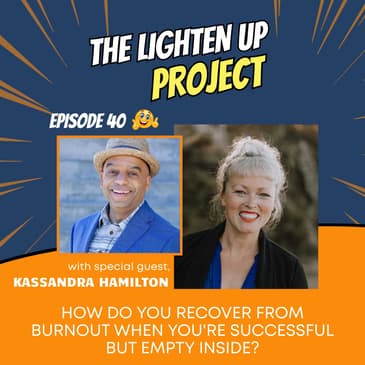
Alignment coach, bestselling author, and singer-songwriter Kassandra Hamilton knows what it feels like to be wildly successful on the outside while running on empty on the inside. In this rich, wide-ranging conversation, she shares her four-phase framework for going from burnout to clarity — and why the power to get there has been inside you all along.
What You'll Hear
- The four phases of Kassandra's "Realigning from the Inside Out" framework: Observe, Understand, Break Free, and Live from the Inside Out — and how each one brings you back to yourself
- Why "overgiving isn't love" — and the hard lesson Kassandra would write to her younger self about boundaries, burnout, and filling your own cup first
- How forced laughter is still energy in motion — and why even a non-genuine laugh can break a downward spiral and shift your awareness
- The airport security analogy that explains why speaking your needs (without blame) is always the answer when life feels like it's rushing you
- What alignment actually feels like in the body: not an adrenaline rush, but a quiet, alive sense of "this is why I'm here"
- Why Kassandra believes healing doesn't have to feel heavy — it can be fascinating, funny, and even fun to participate in
- The simple perspective shift she uses in road rage moments: zooming out to remember we're spinning on a rock in the universe — and suddenly the traffic doesn't matter quite as much
Resources Mentioned on this Episode
- Book: The Magic of Realigning from the Inside Out by Kassandra Hamilton — available on Amazon
- Book: Cracking the Rich Code — a collaborative project featuring Kassandra's chapter on using AI for positive impact
- Website: www.readysetrealign.ca — book a virtual coffee or learn more about her one-on-one and group offerings
- Instagram: @Cassandra_Hamilton
- Related Episode: The Lighten Up Project, Season 1, Episode 2 — "The Humor Tree," where Malcolm defines humor and introduces the Find Your Funny Formula™
- Learn more about Malcolm's work at the World Laughter Organization™
Featured Guest:
Kassandra Hamilton is a bestselling author, speaker, and founder of Ready Set Realign, where she helps high-achieving women realign their lives from the inside out - moving beyond burnout, misalignment, and the quiet drift into autopilot. With a Master’s in Global Health and over a decade of experience in digital health, including work alongside Indigenous communities, Kassandra brings a rare perspective that bridges science, lived experience, and human-centered systems.
Her work is grounded in the understanding that sustainable change doesn’t come from forcing people to fit into broken systems - but from reconnecting individuals to their inner clarity, capacity, and truth. After stepping away from a traditional medical path and navigating her own healing journey, Kassandra integrates nervous system awareness, bio-energetic healing, and practical alignment tools to help individuals reclaim their power, boundaries, and direction.
She is the author of The Magic of Realigning from the Inside Out, a guide for those ready to stop shrinking and start living in alignment with who they truly are. Her work now extends beyond individual transformation into organizational and societal impact. Kassandra speaks on the intersection of burnout, leadership, and system design—challenging the idea that either people or systems need to be “fixed.” Instead, she advocates for a more honest and sustainable path forward: recognizing both as inherently imperfect, and building bridges between them that allow for growth, adaptability, and shared responsibility.
She is also a voice in the evolving conversation around artificial intelligence—exploring how AI can be used not as a tool of fear or further disconnection, but as a force for amplification. When grounded in aligned leadership and human awareness, she believes AI has the potential to scale impact, deepen connection, and support more sustainable ways of working and living. Through her speaking, programs, and collaborative platforms, Kassandra is on a mission to redefine what sustainable success looks like—where inner alignment meets external impact, and where many hands truly make light work.
Connect with Kassandra:
Website: www.readysetrealign.ca
LinkedIn: https://www.linkedin.com/in/kassandra-hamilton
Facebook: https://www.facebook.com/VancouverIslandHealing
Instagram: https://www.instagram.com/kassandra_hamilton/
Tik tok: https://www.tiktok.com/@coachingwithkassandra?
Youtube: https://www.youtube.com/@readysetrealign
Book Trailer: https://www.youtube.com/watch?v=cDKW9ZNrsvA
Amazon Link to Book: https://a.co/d/2yWISSu
Meet the Host: Malcolm Grissom
Malcolm Grissom, affectionately known as "The Stand-up C.E.O.," is a team-building and employee engagement expert. Malcolm, an award-winning actor, comedian, International speaker, and best-selling author, masterfully blends humor, improv, and business acumen to enhance team dynamics and profitability. As a certified laughter leader, he leverages the power of positive psychology and his social work background to create engaging, results-driven experiences. Whether inspiring executives, strengthening teams, or energizing audiences, Malcolm’s unique approach fosters connection, creativity, and success. His ability to transform corporate culture with humor and insight makes him a sought-after speaker and consultant.
Follow Malcolm:
Website: malcolmgrissom.com
Facebook: facebook.com/malcolmgrissom
LinkedIn: linkedin.com/in/malcolmgrissom
Stressed, stuck, or leading on autopilot? It’s not a motivation problem—it’s a connection problem. Malcolm’s weekly virtual improv classes boost engagement, collaboration, and retention—all while having fun. Register now for a complimentary month: https://malcolmgrissom.thrivecart.com/everyday-encores/
We are proud to have The Lighten Up Project on the *High Vibe Podcast Network .* Grab your free gift from Malcolm in our Our High Vibe Gift Vault.
Love this show, check out the other shows on the High Vibe Podcast Network.
Share the Love
✨ If this episode lit something up in you… tag us on Instagram @HighVibeLeaders and let us know your biggest takeaway!
🦋 Don’t forget to rate & review — it helps us reach more conscious rebels like you.
🔊 Listen & Subscribe
🎧 Spotify
Thank you, ladies and gentlemen, and kids, and gentlemen, and kiddos, and gentlemen, and everything else, and everybody else, everybody entire around the entire world, everyone who's watching this podcast on YouTube, everyone who's listening to this podcast over the whatever podcast platform that you choose to listen to, I thank you very much. And this goes out to you. Thank you for listening. The Light Not Project. This is yet another very fascinating interview and person that I bring to you. I just love talking to this person. I know you're going to love her as well. Let me tell you a little bit about this person. She has a background in global health, so digital. She has, like, a decade plus experience in digital health, and so we'll talk about that. She is also a best-selling author, she is a best-selling author of the book. I just had the title. Where did I.. the book called The Magic of Realign, re realigning, realigning from the inside out, and she is an author, she's a speaker, she is an alignment coach, and her passion is working with high achieving women to help realign their lives from the inside out to prevent burnout, misalignment, living on autopilot. She combines science, she bridges science and the nervous system work and integrative work, which is really, really special with me, because of my background. We will talk all about this. It'll be a very fascinating conversation. Please welcome K assandra Hamilton.
Kassandra Hamilton:Hi, Malcolm. Thanks for having. Yeah, I'm well. How are you?
Malcolm Grissom:Good, good. Hey, Cassandra, do me a favor, I would like to invite you to join me in 20 seconds of spontaneous laughter.
Kassandra Hamilton:Perfect
Malcolm Grissom:For that. Oh, great. I love hearing that. Okay, and the audience can join us as well, because here we go. Oh.
Kassandra Hamilton:Oh,
Malcolm Grissom:Kassandra, what is your relationship with laughter?
Kassandra Hamilton:I love that question. I would say that every time I laugh, I feel this lightening up, actually, of energy, and I find sometimes I get in my head a lot, and so when I can laugh at something instead of cry or get upset, it really just shows me not to take things so seriously, and it's a practice you can't always go there intuitively, but I think with practice you can learn how to laugh at yourself and at life, and things don't. Have to feel so heavy all the time,
Malcolm Grissom:Exactly, and talking about realigning from the inside out. What more laughter does that? It realigns your mind and brain, and yeah, your brain and your whole nervous system, because of the oxygen oxygen intake and everything, which is it reminds me of the one one of the one of something that I found interesting in going over your biography, and really delving into your past in preparation for this interview is your work, especially aligning science along with the central nervous system and integration, now something that I've shared in episode episode one of season one with our audience, and share with you. Now I have a disability, it's brain damage now. There's some permanent brain damage, and it's as a result of a childhood disease that attacked my central nervous system. So, are you familiar with the disease, the virus Reyes syndrome,
Kassandra Hamilton:Actually. Yes, one of my best friends has that, or yeah, like still has it. I think there's varying degrees of like the impact, but she has that, and you know, some other immune immune deficiencies, so yeah, I'm familiar a little bit, but tell me more about your experience with it.
Malcolm Grissom:Well, my experience, I was probably one of the harder hit ones from based on just what I've heard, I had, so it all happened really fast. My mom gave me some acetaminophen, something that contained acetaminophen, when I had a common virus and so immediately I, you know, got dizzy, I went into, I fell into a coma right away, and that coma is when the, you know, that's when the brain, the liver cells, and the brain cells, they swell, and if it's not cut enough, caught soon enough, if the swelling, the swelling is not caught soon enough, then, of course the cells just explode and death is the result. Thankfully, for me it wasn't that they were caught soon enough. It was really a miraculous thing, because doctors at that time back in Hawaii, they didn't know about their brain swelling and all that enough to be able to catch that in time, and so for me it just, it, it just, the swelling, I guess, started to reverse the process. process, and I was bedridden. I woke up, I was bedridden. I lost the ability to walk and talk, and so I had to relearn how to walk and talk, and there was also, you know, some brain damage because of that, because that whole thing. So that was my experience with it, but the question that I wanted to ask you about, and I'm glad that you are somewhat familiar with it as well, so as someone who let's say you were working with a client, or, or even from your friend's point of view, if they were, if they had doc. Doctors that were working with them, and they'd ask you if your friend asked you for some, some advice as far as the integration, and the I can't, the word just so see part, part of this part of part of the my result year years later, part of where I am year now is I have frequent moments where the words just leave, you know, they're they're like senior moments. Only I'm not a senior, so I have frequent brain fire moments, frequent like I like to think of it as if my brain were like a computer, my brain would be
Malcolm Grissom:a PC, and it's constantly getting clogged with all the porn and spam and everything else, and so it's constantly in need of a reboot, and that's what happens with me, so I what I was asking is, your friend comes to you for some advice, or a client comes to you for some advice. Client who has this raised syndrome comes to you for some advice. What advice would you give them?
Kassandra Hamilton:About what.
Malcolm Grissom:Thank you. Thank you. Advice about how they can, how they can focus. Thank you. That the question was not focused in my mind necessarily, so they're coming to you and they're asking you, How can I focus, or let's say that I'm asking you, How can I prevent or help alleviate some of the moments that I'm just explaining to you. What can I do
Kassandra Hamilton:n moments where you have a brain fart?
Malcolm Grissom:Yeah, where I have a brain fart, where I just go blank, I lose the thought and focus,
Kassandra Hamilton:Knowing what I know about you so far, I would say that putting in some humor and laughing in those moments will lighten the mood for you, and also you can preframe with people like, hey, I have this thing, so if I just start laughing spontaneously and lose my train of thought, that's just part of it, and then it's known, and people you know can have like play with you in that way. What I would, you know, if you were coming to me with asking for advice, I would say that,
Malcolm Grissom:Okay, okay. good, good, good, good,
Kassandra Hamilton:And also my advice for anyone who maybe feels put on the spot or puts a lot of pressure on needing to find the right word or the right answer for things is just to slow things down. I think in our culture we don't ask for time or space to really process what it is that we need to say, and I'll just give you an example. It's not just about what we say, it's about the pace of society, so like being at the airport, for example, when you're trying to get your luggage through, like through security, I don't know if you've ever had this experience, but I'll just be going through, and I'm trying not to get anxious, and someone just like is pushing like their stuff behind me, just trying to like push me through, and I'm just like, why, like, we're all here, I know we have planes to catch, but like we have lots of time to get through security, or we should, and like, why do we need to rush, you know? I, so my, my advice for anyone doing anything or processing anything is just to slow down a little bit, just to give yourself that moment before you go on stage, or before you respond to someone, just to pause and give yourself permission.
Malcolm Grissom:Yes, yes. And so let's look at the, you made a wonderful aside. That they should, so when you're talking about people in the airport having enough time, you said they should, and yes, they should, but as we both know, not everybody is a planner, not everybody does what they should do, and people run into maybe getting to the airport at the very last moment, so using that airport analogy, what, what would you say to the person in your shoes, so if, if you had a client who was in your shoes, right, they were saying there's somebody behind me that really wants me to speed up, and they're not on the same wavelength, as far as taking a moment, you know, to let me gather my thoughts and respond appropriately, or in this case, they're not giving me enough time, they're pushing my stuff ahead and I'm trying to say, hey, wait, slow down, and they're saying no, I can't slow down, I've got to catch that plane right away. What kind of advice would you give to that, the person?
Kassandra Hamilton:I think that communication and speaking up is very important in that case. Just to say, hey, I, you know, I'm feeling rushed, and I need, I need things to slow down a little bit, you know, like speaking to your needs without blaming someone else just say, hey, this is what I need. I find that often, and this happens in, you know, relationships all the time, friendships otherwise, where we, we blame and we make assumptions, and so I think when we call it back to like what we need in those moments, it takes away blame, and then it allows for some curiosity around, you know, like why someone might be rushing, you know. We can have that conversation when we're in a regulated nervous system, but when we're just panicky all the time and rushing all the time, then it's easy to just make assumptions and blame and rush around with, you know, like chickens with our hands
Malcolm Grissom:Right? Okay, so reeling the magic of realigning from the inside out, define what is realigning from the inside out.
Kassandra Hamilton:Yeah, so it's actually a framework that I came up with through my own experience of understanding what it takes to go from a place of burnout to more clarity and calm and balance in my own life, and through journaling, and just going through that process, and reviewing my notes over time, it became the magic of realigning from the inside out, and I, when I looked at it, it's this four phased framework, and so you go from a place of observing yourself and seeing what your patterns are, right, like really slowing down again to understand what the patterns are, and then understand, and then once you understand them, that so observe, understand the next phase is to try something different, so I call that the break, the breaking breaking free phase, and once we start to break free from that, we can live from the inside out. So, what that means, really, is to be more intentional about how we're living, so that we take that power back and we're living the way we want to, instead of living in response to and reacting to our external environment. So, really, the message overall is that the power, our inner power, our strength is in taking that pause.
Malcolm Grissom:Wow. Okay. Alright. When, when you're talking, it just.. what. what's going through my head is how similar your what you're talking about has to do with my finding your funny formula, it's it's sort of the same process that I go with people, but it's more specifically. Be geared towards humor and joy and play and finding they're funny, so again it's I guess it's working from the inside out. Just I mentioned that for our audience, can also look at other episodes when I talk specifically about finding your funny formula. It's very similar to this
Kassandra Hamilton:Beautiful
Malcolm Grissom:Very similar. So, when life gets heavy for you, what helps you lighten the load? What helps you realign?
Kassandra Hamilton:Yeah, so breathing intentionally, singing songwriters, so playing music and singing gets me out of my head. I like to run in the woods with my dog, and that really helps kind of move the energy, I'm big on energy movement, because, and like, emotion is just energy in motion,
Malcolm Grissom:Right
Kassandra Hamilton:Right, and so if it gets stuck, that's where we kind of get crunchy, and so if we can facilitate the movement, then it allows that emotion to pass through, and that heaviness, you know, the responsibility of life, all that kind of thing. I can actually feel it in my body. It, it shows up as a heaviness in my shoulders, where I just, like, I can't seem to shake it. And part of my journey has been about recognizing that I don't have to take on responsibility for other people's things, and when I realized that I can sort of laugh at myself, and that helps. Yeah, so I think laughter.. I went to a laughter yoga session a couple weeks ago, actually, and that was really cool too, because I think in those moments when you're like crying, you can shift that into laughter if you choose, you know, but you have to have that awareness first, that oh, I can choose differently here, and it's not easy, but it is simple, right? Yeah, so laughter is a big one, for sure, and I really just feel like we just take ourselves so seriously. I, I often will think about, you know, when I'm in the car, for example, and there's road rage happening in my brain, I'm like, okay, wait a second. We are on planet Earth, which means we are spinning in the universe, and I'm just being held to this big rock with gravity, and like, when I think about that and zoom myself out, and then I'm like, mad about being in my car too, like, it just kind of shifts the perspective, you know, it's funny, so I think just like zooming out is really important, and not being so in our own world about things.
Malcolm Grissom:Yes, yes, that, that's that's one great thing about being in nature, is whenever you walk in nature, at least, whenever I should say, whenever I walk in nature, and look out at the trees that have been around for hundreds of years, then you know it puts everything into perspective. I'm I, and my problems are just this, this big in the massive universe of all the everything that exists, you know? So,
Kassandra Hamilton:Yeah, and also everything is cyclical in nature, and that has been really inspiring and guiding for me too, because as low as I feel sometimes, especially like in the winter, I always remember that everything is cyclical, like, and we wouldn't have the light without the dark, we wouldn't have joy without some sadness, so like it's okay, and we can hold both, but just to, yeah, remember that it's not going to be like that forever, even though, even though it feels like that, and we often fear, like, is this the last time that things are going to shift to the other direction, but, but they always do,
Malcolm Grissom:Yeah, yeah, okay, so let's, let's take this moment, and let's dig a little deeper. Was there a particular moment in your life that you could think of when this humor or this play really helped you survive something hard? Hm.
Kassandra Hamilton:Yeah, when I moved to Vancouver, I went through my own burnout, and that's kind of how I started on this journey, and want to help others out of that feeling, because all my grandparents died, and my dog and my boyfriend and I broke up, like all happened within three months, and I was really sad, and knew that there was a different way to live, because I was very successful on the outside, but feeling really empty and sad on the inside, so I really had to go through like a lot of darkness and like figuring out what it was that was going to fill that hole inside of me, and that around that time I met some really beautiful people and built some community over there that they were all about laughing and making light of serious heavy things, and that that was genuinely the way through, was to play, was to play with all of the, the heavy dark stuff, because it's, it gives it too much power when you are so focused and affected by it in a negative way, so if you could sort of flip the narrative and like play with it and see it for what it was, which is just again this like insulated instance of darkness and pain, and you know the other side of that is light and joy and laughter, and so, yeah, I just, I love looking at the duality of things, and really understanding that you can have so much joy even when you're sad,
Malcolm Grissom:Right? Okay, yeah,
Kassandra Hamilton:Yeah, yeah. So, laughter was really pivotal for me there. I hadn't really used laughter prior to that to play with a journey of going through, you know, grief or sadness or, yeah, painful experiences, but when I found that it was a really cool tool, because it helped me be like, oh yeah, get out of your own way, like stop being so serious. Yeah,
Malcolm Grissom:ow I've talked, I've talked before about Can laugh or force laughter, not can laughter, forced laughter versus genuine laughter. Do you, do you feel like you still get some benefits, so, so to some of the people out there in, in our audience who do not, they aren't at that point yet where they don't have a lot of genuine laughter in their life, they, they don't have, they don't watch a lot of comedy, or a lot of, they don't have a lot of things out there, a lot of stimulus, stimuli that, that makes them laugh, so they're thinking of laughter as a reaction, they don't have that very much, and they're not at the point where they can just laugh spontaneously, or they find things like you do with your singing, or or your dog, or running, they don't have those things that that help stimulate that play and that genuine laughter, so do you think that just the the force laughter just just getting started by recognizing, oh, hey, I can laugh, haha. Do you think that has the same, or it has the potential to have the same or similar benefits as what you experience with genuine,
Kassandra Hamilton:Yeah, 100% Why? Because it's energy moving, and you're moving it up instead of spiraling down. So,
Malcolm Grissom:Okay,
Kassandra Hamilton:Even if it's force. It's, it's inevitably going to bring it to a different place in your awareness, too. So, it's like it's not going to spiral you down the way that crying will,
Malcolm Grissom:Gotcha.
Kassandra Hamilton:Yeah,
Malcolm Grissom:And it's not going to.. there's so much, like there's so much in that goes on in the brain, as far as the fight or flight response, you know, and and all the the cortisol and all the anxiety and the stress that builds up, and so I say, what you're saying, so you're saying that even that fit, that I want to say fake, but it's forced, even the forced, the non-genuine laughter is, it's still energy in motion, and so it is breaking that routine of everything being stopped, and yes, gotcha,
Kassandra Hamilton:Yeah, so that's like when you observe yourself, and you could be sad, but you choose to force laughter, let's say,
Malcolm Grissom:right?
Kassandra Hamilton:You're understanding, and so that's like the second phase of that framework I was talking about. Then you're choosing differently by breaking free from an old pattern that doesn't really work, because it's not the result you want to be living in, so yeah, the forced laughter over time might become easier, you know, but it's still a tool.
Malcolm Grissom:It is still a tool, and as you said, it's a tool that you've learned throughout the years that you've learned, you've developed how to utilize this tool throughout the years and throughout experimenting, which leads me to another question, which is what if you were to write your younger self a letter. What would your advice be?
Kassandra Hamilton:What would my advice be. So I feel like I have always been well growing up, I was always really hard on myself, and I always equated productivity to be related to my self-worth, and so I would tell my younger self that you can be successful and unhappy, that productivity doesn't equal worth, that over giving isn't love, that burnout is a boundary issue. It's not a character flaw, and that slowing down doesn't make you fall behind. It brings you back to yourself and to a stronger place of alignment with who you're meant to be here on earth, so I actually think that our power is in the pause. I always say that,
Malcolm Grissom:But it's so true. Power is in the pause of that. The power's in the pause. Let's go back to something that you just said, I'm kind of curious if you can expand on that. You said maybe I misheard it too, but what I heard you say is that even like over giving doesn't mean love, is that what you said? First of all, did I hear that correctly?
Kassandra Hamilton:Over giving isn't love.
Malcolm Grissom:Over giving isn't love. Okay, so could you expand on that.
Kassandra Hamilton:Yeah, so for that one personally, what I would tell my younger self is that because I always felt that I think this is common for a lot of women too, that like in order to be accepted or loved I had to, you know, be giving even when I didn't have a full cup, it, and I don't know if it was ever explicitly said to me, but I always felt that sort of need to, to give even when I wasn't feeling fulfilled myself, so it's almost like I bypassed. My cup to fill others, and what I've come to understand is that my self-care and filling my cup and making sure I'm okay is foundational to me being of service to others, and so it's not selfish to say no when someone asks you for something, if you know where your capacity lies in that moment, but I think often we like to people please or to give more of ourselves than we truly want to or are capable of, and it never ends up well. We end up burnt out, we are aren't able to give in a way that feels genuine, or you know, there's too much demanded of us if we are constantly doing that, and then it's expected. So, yeah, I would tell myself that having that boundary is very much okay and necessary for the kind of work that I do, and how I want to be of service. Yeah,
Malcolm Grissom:Okay. All right, let's take a little turn, just a slight turn.
Kassandra Hamilton:Sure,
Malcolm Grissom:What what have you felt, or when not what, when, if you felt most like yourself, so most aligned with who you are? When have you found that, and what was happening for you in that moment,
Kassandra Hamilton:Yeah. So, I experienced this a lot when I am coaching and I'm sharing presence with someone when they're having a light bulb moment, so it's like I'm part of that facilitated change in real time with someone. It's like, wow, that feels so in alignment with what I'm here to do, which is to be of service to catalyze the positive impact or ripple effect that I want to have in the world, and another time I felt that is when I'm doing my sound healing, so I do sound healing bowls in ceremony once a month with my community, whoever wants to come, and just it's by donation most of the time, but just to come and nerve, like regulate the nervous system and be in circle with us and share what's going on, so I feel it then, and then I also feel it when I'm giving bio energy healing sessions, and so again in real time I can see and feel energy moving in someone and them making the connection between why they have pain in, you know, let's say a shoulder or something, and like, how it's related to a mental pattern that they're experiencing, and then being able to facilitate the actual like movement of energy in that moment to help them clear away those blocks that also has made me feel very much in alignment as part of that facilitated change in someone in real time. Yeah,
Malcolm Grissom:When you feel aligned, can you share with us with myself and the audience? Can you share with us what it feels like to you to be in alignment,
Kassandra Hamilton:Yeah. It feels right. It feels true. It feels.. it feels like it's not an adrenaline rush. It's more just like a. what's the word for it like alive, you just feel really alive and on purpose.
Malcolm Grissom:Okay,
Kassandra Hamilton:Like that thing where you're just like this is it, this is why I'm alive, this is what I meant to do, like moments like that in a few different areas of my life, and yeah, it's powerful, it's motivating, it's inspiring.
Malcolm Grissom:I feel so.. I've talked earlier in one of my earlier episodes, episode two, I believe, I talked about the definition of humor, and how I, what I think of humor, and how a lot of people define it. A lot of people, when they first hear humor, they, their minds first go to comedy, to jokes, that's. Humor, and yes, that is a part of humor, but the other part of humor is that natural part, that part, that sense of play that we were all born with. So I think that what you're describing, and when you're what you feel when you are aligned, is it sounds to me that that is very much, it's very natural to you, it's very much what what someone could and probably would feel like when they are playing, when they are naturally just free, they're naturally free.
Kassandra Hamilton:Yeah,
Malcolm Grissom:They're aligned with who they are, right. So that's wonderful. So, if you could send a message of hope through laughter, who would it be for, and why?
Kassandra Hamilton:Yeah, message of laughter to who and why? Huh, that's a good question. I would send it to my mom. She needs to laugh a little bit more. I would say, yeah, just about her own things that she struggles with. I would send doctor and love to my mom. Yeah,
Malcolm Grissom:Laughter to Cassandra's mom. Here we go, we're all laughing for you.
Kassandra Hamilton:Yes, yes. Lighten up.
Malcolm Grissom:Great question. What does lighten up mean to you?
Kassandra Hamilton:Ah, it means to let go of the seriousness and play with life.
Malcolm Grissom:Okay,
Kassandra Hamilton:So
Malcolm Grissom:Alright. So, Mom, lighten up, lighten up. I love it, love it, love it. So this is a great conversation, Cassandra. Unfortunately, we don't have forever and ever, but we can have you come back and talk more, because there's more that I would like to talk to you about, and I'm sure there's more the audience would love to know about you and, and your work. Just briefly, though, how can someone out there who's listening, how can they get in touch with you, find out more about you, maybe even tell us about how we can find your book or books?
Kassandra Hamilton:Beautiful. Thank you. So, behind me there's actually a QR code. I'm not sure if this is going on YouTube, but if you have a phone, you can scan that code and book a virtual coffee with me, or just have a conversation and learn more about what I offer, because I do offer a reset for women who are in healthcare and in high achieving roles and on the verge of burnout, realign with themselves and come back to a greater inner strength and power and clarity within themselves. So that's my main offering. I also facilitate group work, so for people who are looking for community around how to get back to feeling like themselves again and feel in alignment and feel alive with who they are and who they meant to be. Their five year old self coming out, I offer that as well, and I do one on one work as well. So I have a website, which is www dot Ready Set realign.ca It's here also in the background, and then in terms of my books, the first one, The Magic of Realigning from the Inside Out, is on Amazon, and soon to be 50 other platforms, I just don't have that all set up quite yet, and then the other one is called Cracking the Rich Code, and that was a collaborative project where I co-authored a piece around using AI for positive impact, and what else can I tell you? I'm on social media, so Instagram at Cassandra with a K underscore Hamilton is where you can find me, and I have Tick Tock and Facebook and LinkedIn, so there's lots of different ways to find me, and if you just Google my name, and you'll find something there, but yeah, lots of different ways to stay in touch, and I am trying to build my community and build awareness and share what I have to share, so I welcome any. One to book an appointment with me or just a virtual coffee, so yeah. Thank you for that.
Malcolm Grissom:Right, yeah. What would you tell someone who thinks that laughter or joy isn't appropriate? Say there it's not appropriate to laugh or to play at work,
Kassandra Hamilton:I would tell them to lighten up.
Malcolm Grissom:Yes. Okay, I love that. I love that. Okay, go ahead.
Kassandra Hamilton:Yeah. No, that was it.
Malcolm Grissom:Oh, okay, okay. So finish this, since healing doesn't have to be heavy, because,
Kassandra Hamilton:Because it's fascinating how we all come into this world unlike with nobody comes into this world unscathed, and the question is, What are you going to do about it? And are you going to come to a place of learning with it, and then sharing what you've learned to help others, or are you going to stay stuck? Yeah, so it doesn't have to feel heavy, it can be, it can be fascinating and fun to learn about, and funny to participate in, and observe. So, yeah, healing is healing. Yeah,
Malcolm Grissom:Wow, that's great. That's really great. Thank you very much, Cassandra, for coming on the show, for giving us another viewpoint of this, of how to lighten up, of how to realign from the inside out, and how to work with you some more. I love, I love this. And so to everyone out there, thank you for tuning in to this episode. Next week we'll have yet another very stimulating conversation. Please tune in next week, and remember that every smile opens the door, every laugh can brighten someone else's day, and every step is a victory, and until then, folks. Thank you very much. And talk to you soon. Bye.