
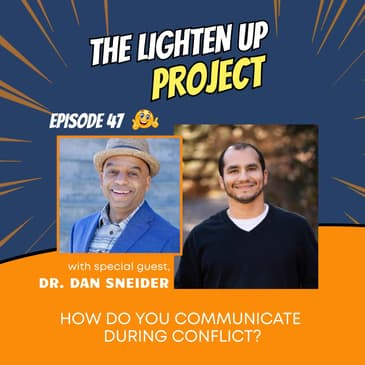
Licensed clinical social worker and couples counselor Dr. Dan Sneider has spent over a decade helping partners navigate conflict — and he'll be the first to admit he's had to unlearn his own rigidity along the way. In this warm, practical conversation, Dan shares how playfulness, presence, and a well-timed check-in can turn tension into connection.
What You'll Hear
- Why "lightening up" starts with learning to see the silliness in our daily habits — and how Dan's own kids have taught him to do it better than any class ever could
- The simple "temperature check" Dan teaches couples to use during transition moments, so playfulness never lands at the wrong time
- Why using "I" language instead of "you" language changes the entire trajectory of a difficult conversation
- The communication belief Dan had to unlearn: that a calm tone of voice alone means you're not being harmful
- How to handle it gracefully if laughter or humor accidentally lands wrong in an intimate moment
- Dan's dancing analogy for healthy relationships — knowing when to lead, when to follow, and how to stay fully yourself either way
- A daily practice (a morning walk and a few minutes of journaling) that helps Dan choose joy and presence again and again, one day at a time
Resources Mentioned on this Episode
- intimacyshift.com — Dan's website, including a free PDF with steps and frameworks for healthier, more intimate conversations
- Intimacy Shift Group Program — Dan's recurring program helping couples move from conflict to lasting connection
- Dan’s website: http://intimacyshift.com/
- Social Media: https://www.instagram.com/growthandgratitudetherapy/
- Learn more about Malcolm's work at the World Laughter Organization™
Featured Guest:
Dr. Dan Sneider is an experienced couples and individual therapist who teaches proven techniques to transform relationships. He lives in Asheville, North Carolina with his two amazing kids. His signature 12-part program ‘The Intimacy Shift: A Blueprint for Moving from Conflict to Lasting Connection’ has helped hundreds of people improve their relationships and is open to anybody ready to build or rebuild an intimate connection.
Connect with Dr. Dan:
Website: http://intimacyshift.com/
Instagram: https://www.instagram.com/growthandgratitudetherapy/
Meet the Host: Malcolm Grissom
Malcolm Grissom, affectionately known as "The Stand-up C.E.O.," is a team-building and employee engagement expert. Malcolm, an award-winning actor, comedian, International speaker, and best-selling author, masterfully blends humor, improv, and business acumen to enhance team dynamics and profitability. As a certified laughter leader, he leverages the power of positive psychology and his social work background to create engaging, results-driven experiences. Whether inspiring executives, strengthening teams, or energizing audiences, Malcolm’s unique approach fosters connection, creativity, and success. His ability to transform corporate culture with humor and insight makes him a sought-after speaker and consultant.
Follow Malcolm:
Website: malcolmgrissom.com
Facebook: facebook.com/malcolmgrissom
LinkedIn: linkedin.com/in/malcolmgrissom
Stressed, stuck, or leading on autopilot? It’s not a motivation problem—it’s a connection problem. Malcolm’s weekly virtual improv classes boost engagement, collaboration, and retention—all while having fun. Register now for a complimentary month: https://malcolmgrissom.thrivecart.com/everyday-encores/
We are proud to have The Lighten Up Project on the *High Vibe Podcast Network .* Grab your free gift from Malcolm in our Our High Vibe Gift Vault.
Love this show, check out the other shows on the High Vibe Podcast Network.
Share the Love
✨ If this episode lit something up in you… tag us on Instagram @HighVibeLeaders and let us know your biggest takeaway!
🦋 Don’t forget to rate & review — it helps us reach more conscious rebels like you.
🔊 Listen & Subscribe
🎧 Spotify
[00:00:03] Welcome to The Lighten Up Project, the show that reminds us that healing doesn't have to be heavy. I'm Malcolm Grissom, the stand-up CEO and founder of the World Laughter Organization. Let's explore how humor, heart, and play save the day and create spaces for healing and connection.
[00:00:33] So let's get ready to laugh, learn, and lighten up. Hello everyone and thank you so much for joining me. My name is Malcolm Grissom. I am the stand-up CEO and founder of the World Laughter Organization.
[00:01:00] And I am bringing a mouth that does not work, apparently. But I'm also bringing another wonderful guest. He is a licensed clinical social worker with over 10 years experience. He helps people navigate.
[00:01:26] He helps couples, especially, navigate their lives and their troubles. So navigating the waters, and that's what we're going to be doing today is navigating our waters. He is the proud father of two kids. He is none other than Dr. Dan Snyder.
[00:01:55] How are you today, Dan? Hi, Malcolm. I'm doing really well. Looking forward to laughing and talking and sharing with you and your audience. Great. Great. All right. Well, first of all, let's get into our game that we just started. It's called Two Truths and a Lie. Two Truths and a Lie. So Dan has given me two truths and a lie.
[00:02:24] So I'll give them to you. And I would like you to, throughout the conversation, see if you can figure out which is the lie. Put on little detective hats and figure it out. Because at the very end of our show, Dan will tell us. He'll reveal the lie.
[00:02:48] All right. Dan, would you mind joining me in 20 seconds of spontaneous laugh? Okay. Sure. I wasn't ready for that, but let's do it. Right. And let's just start. Shut up, man.
[00:03:28] Oh, yes. Yes, it's my unique way at the Lighten Up Project. We started our interviews with laughing because laughter itself, there are so many benefits to laughter. Like the releases of the hormones, the oxytocin,
[00:03:57] the reducing of the cortisol, the stress harm of the stress. I can't talk. I'm sorry. I'm tripping over my words right now, which is not a great thing for a podcast. Well, that's okay. You have so many things that you want to share. They have trouble getting out. But I'm right there with you that laughter is great medicine
[00:04:26] and something that I try hard to do is not to take myself so seriously. And that often plays out in the work that I do, especially when I'm doing couples counseling or work with couples. Often when we're in conflict, we're taking ourselves very seriously. We're taking the situation very seriously, like it's life or death, do or die, who's right and who's wrong.
[00:04:52] And often if we can relax, either with laughter or through grounding exercises, trust exercises, just being in the present moment, things get a whole lot better. So yeah, yeah. Trying to spontaneously laugh there is a little awkward, but I'm smiling now. I feel more relaxed. I feel better. So same idea. Yeah. Yeah. Yeah. Yeah. Definitely.
[00:05:19] So share with us, and I know you've already touched on this in your last answer, but if you could expound, how do you define lighten up? Yeah. Yeah. Well, so like I was just saying, not taking ourselves so seriously. And I consider myself an expert at taking myself too seriously.
[00:05:47] I have studied seriousness and rigidity. And in fact, with my ex-wife, I'm divorced, but I was in a couples counseling session one time with my ex-wife, and the therapist asked, Dan, do you want to try being more silly? And I said, no, I don't. And I was very serious at the time. I did not want to be more silly,
[00:06:13] but my relationship really could have used a little bit more silliness, and that was something that was lacking in that relationship. Yeah. So it's something that I've worked on. And so I would define lightening up as being able to see the silliness, really, in all of our daily lives and our daily habits. You know, very few things in our daily lives are so important
[00:06:40] that we can't pause for a moment to laugh at ourselves or smile at the situation. So you mentioned when you were introing me that I have two kids, and they are excellent at helping me be less serious. I think kids do that way better than adults. Yeah, they do a great job at helping me lighten up. Good. Good. Okay. All right.
[00:07:06] So I'm going to follow that with another question, but I want to, I introduced two truths and a lie, and I don't think I actually got into it because I was so excited to move forward with you, Dan. That's okay. We can bring it back. Okay. Yes. Yes. Let's do that. So, okay. Two truths are three things about Dan.
[00:07:36] Three things about Dan. And figure out which one of these is not true. So, number one is he has two cats. So he's a father of two kids and two cats. Number two, he does not speak Spanish. And number three, he is divorced. Okay.
[00:08:04] Two truths and a lie, which is the lie. Okay. And so, so now, Dan, going back to what you were saying, I'm curious. So in episode two of season one, I defined humor.
[00:08:25] And I, um, defined it as, well, humor itself is a vast topic. And a lot of people, when they hear humor, when they think about humor, they think comedy, jokes. That's the first thing that pops into people's mind when they think about humor.
[00:08:51] They don't take into consideration the aspect of play, the, the natural aspect of humor. And play. And play. If, if you can imagine two children playing, play is always interactive. At least I should, I should say not always, because one person can play solo.
[00:09:21] So I should say that play when, when you're looking at two people or more, two or more people. And let's say now two people in a relationship, right? Mm-hmm. And being playful. Yeah. One is ready to play and the other isn't. Mm-hmm. So there always has to be a give and take for play to happen.
[00:09:48] So if one is ready to play and the other isn't, what's your suggestion to the person? Let's say the person who's ready to play, they come to you, what would your suggestion be? Yeah, absolutely. And so because none of us are mind readers and none of us are exact duplicates, right? We're in relationship with people who are different than us, have a different approach to the world,
[00:10:18] different mood, different experiences. So some version of that happens every day in relationships, right? One person may be hungry. The other person may not be. One person may be really troubled and stressed from their day. The other person is feeling really light, silly, and playful. So this is a frequent thing. And at my website at intimacyshift.com, I have a great PDF that teaches couples
[00:10:47] how to engage the other person in conversation in really healthy and productive ways. And so one of the first things that I will help people to do is to really check in so that they know how the other person is feeling, what kind of mood they are in. Because if we guess and we try to engage our partner in some kind of silly play when they're feeling really stressed and troubled,
[00:11:15] it probably isn't going to go very well, at least not initially. So it helps to really do a quick check-in. And I look at transition moments as the best time to do that. So right when we're coming back into the room or right back into the house, one person comes home from work, you know, that transition point is really critical in the relationship. We really want to greet that person warmly
[00:11:42] and take their temperature, get their mood, right? Because they may not be in the mood to play right then and there. But if we can show up with a listening ear, understanding how their day has been, what maybe they need, you know, then even just a couple minutes later, they could be ready for play. But if we just sort of pounce on them when they're not ready, it's probably not going to go well. Mm-hmm. Mm-hmm. Okay.
[00:12:14] So for our audience, could you tell us what taking their temperature might look like? Yeah, of course. So there's lots of different ways that we can do that. I really recommend that when you're transitioning back into the house, there's some kind of eye contact or body contact. You know, if I'm not looking at my partner, if I'm at the sink doing dishes and they kind of walk past me and I say, oh, how was your day? And they say, fine.
[00:12:44] And they keep walking. I haven't looked at them and I didn't really get very much information there. So when we are connecting to do that kind of check-in, I recommend, you know, stop what you're doing, make eye contact, maybe give them a hug, a kiss, but really pause to be in their physical space for a moment. And then there's lots of different ways that we can check in. So simplest, quickest is really just like a 0 to 10 scale.
[00:13:12] You can do like 0, being totally calm, totally relaxed, 10, I am super stressed, super feeling bad, feeling terrible, low energy. You can do the scale however you want, 0 to 10, how much energy you have. That's an easy way. Sometimes couples I'll encourage, you know, to have kind of like a code word, kind of like a couple's shorthand for like, you know, are you in it?
[00:13:42] Are you feeling groovy? Are you feeling playful? And that can be kind of just a yes or no, just as a shorthand. But I encourage couples to talk with each other and to figure out, well, what's the best way for us to communicate when we get together, you know, after the work day, how we're feeling. So tell me, when life gets heavy for you personally, what helps you lighten the load?
[00:14:11] Ooh, yeah. For me, it's really about movement. So that's the first thing. Once I've moved, then I'm able to talk more. But when things are feeling heavy for me, I need to take a walk. I need to stretch. I need to dance. I need to get into a pillow fight with my kids. I need to do something in my body. And then I'm able to talk it through, or I'm able to like actually exhale and release that energy.
[00:14:38] For most people, some version of that's true. When we are literally feeling tension, our bodies get tense. Our bodies get tight. And so in some way, we have to relax that tension. And so for me, it's through movement. I imagine for you, it's some version of laughter, right? Finding ways to find humor in the situations. So those are a couple of really good ways. Other ways for people,
[00:15:07] like putting on music can be really good. Doing something that will help you to relax. So instead of active movement, it might be something relaxing, like changing clothes, getting into comfy clothes, getting under a blanket. Those are all ways to acknowledge how you're feeling and then take some kind of action to have it get better. What would you say to couples or to people out there who, let's say, they are wanting to
[00:15:36] take the temperature of their partner, but their partner's just non-responsive. Just so much stress, so much focus. They are just non-responsive at all. What do you suggest then? Hmm. Okay. Well, for different partners, again, we're not mind readers, but we know our partners pretty well. And so for some people, if they are giving you all the signs
[00:16:06] that they want to be left alone, right, they're not responding, then we can take them at, you know, I always encourage people to put a time limit out loud so that everybody knows instead of like, okay, I'll leave you alone and I leave the room, but I didn't say when I'm going to come back. It's kind of open-ended. I encourage people to say like, yeah, okay, seems like you need to be alone. I'll come and check back on you
[00:16:36] in 20 or 30 minutes or you can come find me, you know, in the other room whenever you're ready. But then we put a time limit on it. You know, I'll check back in 20 or 30 minutes. So that's one thing. And for other partners who know, you know, even if they're not being responsive, I know that they want me to stay with them, right, they want me to keep trying. I go to my five senses as a guide.
[00:17:03] So I will do things like adjust the lighting, adjust the sounds in the room, maybe put on music. Maybe I'll grab a blanket. Maybe I'll put my hand on their arm or their leg for some kind of touch. But I'll use those different senses as a way to connect with them and to let them know I'm there and I'm trying to connect with them. And I will probably let them know like, okay, it doesn't seem like you want to talk, but I'm here, you know,
[00:17:33] and I'm going to read a book just next to you. And if you want to talk, let me know. Yeah. Yeah. It's a difficult situation if your partner's not being responsive, but there are some things that you can do to let them know that you're still there and, you know, that they have some options. Mm-hmm. Mm-hmm. Okay. Okay. What's one belief about communication
[00:18:00] that you've had to unlearn? Mm-hmm. Mm-hmm. One belief about communication that I've had to unlearn. So there are many things about my communication style that I've had to unlearn. I don't know if I ever believed them differently, but I know that I believed that if I kept my tone of voice calm, Mm-hmm. then I was not being
[00:18:30] harmful with my words, right? If my tone of voice voice was calm and I wasn't name-calling or cursing or saying mean things, then I was doing okay with my communication. And I had to unlearn that because there were things that I used to do, much more so than now, like, I would roll my eyes or I would sigh really loudly, like, you know, at things that my partner was doing. And I wasn't yelling
[00:19:00] at them, I wasn't calling them names, but I was communicating that I was disappointed or angry, frustrated, or blaming them for something. So I was communicating things with more than just my words that were harmful to the relationship. And that's a big thing that I had to unlearn that now I work to help other people with. You know, we want to be very intentional with all of the ways that we communicate, not just our literal
[00:19:30] words or our tone, but there's more to it than that. Definitely. What are your suggestions if there are listeners out there who want to, they want to communicate better? Yeah. Well, again, like I mentioned before, at intimacyshift.com I have this great PDF that goes through all of what I'm about to say in more detail. But a huge thing
[00:19:59] that I encourage people to think about is using I language rather than you language. So, for example, constantly, right, all week long in my sessions with couples, I am hearing stories from arguments that happened where one person said something like, you know, you always do this, right, or you never do that. And when we say to our partners
[00:20:28] like you always or you never, we are accusing them of something, we're blaming them, we're calling them out, they are going to get defensive, right? If somebody says to me, you know, you did this, I'm going to be defensive, right? Because I'm being attacked in some kind of way. Even if there's truth to the statement, we have to communicate it in a different way if we want the other person to really hear the message and we really want to resolve or change whatever's been
[00:20:58] happening. So I teach and encourage people to practice using I language. So typical kind of example with a couple, something like, you know, you never clean up the kitchen after you've eaten, right? So instead, if we framed that as saying like, you know, I've been feeling really stressed lately because when I come home from work and I'm feeling
[00:21:28] tired, you know, I notice that there's a mess in the kitchen and, you know, I spend time cleaning it all up and then I'm even more tired at the end of the night, right? So I've used I statements to express how I feel when I get home and I see that mess rather than you, you, you. And it sets up a different kind of conversation. You know, my goal in all my sessions with couples is how can I get them to be on the same team? Instead of
[00:21:57] me versus you, who's wrong and who's right, and then I feel like a referee in the session, right? You know, I want the couples to be on the same team, right? How do we solve this problem together? We both want to feel more connected and loved at home and we both play a part in that. So in communication, especially with couples, when is humor or joy inappropriate? When is it inappropriate?
[00:22:27] Ah, okay. Yeah, so that's a very good question. When is it inappropriate? So like we talked before about kind of knowing your partner's mood, right? You didn't just meet this person, so it's not a total guessing game. You have a sense of their personality and when they are open or receptive to being silly or laughing, but you can also read cues. Body language is a good cue.
[00:22:56] Their words are a good cue. I mean, consent is a wonderful thing, so we can always ask the other person, hey, are you in a mood for laughter and for silliness? And the person can say yes or no. So we can also just ask that permission, right? If you're at a comedy club, you assume that the audience wants to laugh because they showed up there. If you're at home with your partner and you don't really know the mood they're in, I encourage people to just ask
[00:23:25] and check in. And that's the easiest, fastest way that people sometimes skip and they kind of just do trial and error when it's a really quick way to just ask. So what is... I'll give an example actually. Hold on, I'm going to cut you off because it's a funny story. So I was with my girlfriend recently and we were talking about music that we used to
[00:23:55] listen to when we were younger in our teens and 20s and just playing different music for each other. And then we started kissing and I started laughing in the middle of us kissing because the song that came on in the background was just, it did not fit the situation at all. It was really funny and we both started laughing and we changed the music and it was a fun time. But for some people I think that would have maybe been an inappropriate time to think like, oh,
[00:24:25] you're kissing your partner, it's maybe not the right time for humor or for laughing. But in this case, it was totally safe, totally appropriate. It wasn't intentional, but it was a funny moment for humor to happen. And so, yeah, that happened because we felt really safe with each other. We have that kind of relationship where there was nothing like emotionally intense going on that we couldn't pause to just laugh at the situation.
[00:24:55] Right. You made a great point. That might be a situation where it could have worked differently. Maybe you were laughing because of the absurdity and the irony in this situation. But let's say, for sake of this question, that your girlfriend then said, you know, she pulled away.
[00:25:25] Why are you laughing? You're, wait, we're, I'm being intimate with you and now you're laughing? You're laughing at me? What did I do wrong? What would you then do? What would you suggest that someone, if they were in your shoes and that happened, how would you suggest they react? Mm-hmm. Yeah, so, again, like,
[00:25:55] we could see that situation happening, right? Especially in, like, an intimate kind of vulnerable moment like that where, yeah, you're kissing or clothes are off or something different is happening. If laughter comes in there, it's easy to take that personally. Like, oh, they're laughing at me or, like, this isn't you want to keep your tone light and use your body language to indicate that it's not about
[00:26:25] the other person. You can certainly say that you are sorry if the other person is offended or upset, and you want to make clear as quickly as you can, like, not laughing at you, this thing happened, that was part of the situation, and then, you know, I would reach for touch pretty quickly, because with our physical body language, we indicate how we feel very, very meaningfully, sometimes more with our words. So I would reach for a hand,
[00:26:55] maybe, or for a shoulder, just to indicate that it's safe, that making eye contact, I can show them my seriousness, like, that's not about you, I wasn't laughing about you, I was laughing about this thing, and then hopefully letting them in on the joke, you know, whatever it was, making sure that they're part of understanding why it was funny, because often that's what will happen, if we don't understand what people are laughing at, that's pretty human nature to think it's
[00:27:24] about us, to take it personally, so you want to let them in on the joke pretty fast, and see if you can get them laughing with you. okay, all right, all right, so where in your life, either your professional life or at home with your kids, where in your life do you really give yourself permission to play and relax, and where do you still hold back? yeah,
[00:27:54] so I very much like, I think I've mentioned, you know, I can be a rigid thinker, and so I keep close to my schedule of the day, and so if it's a transition moment, like, we have to eat, finish dinner at a certain point, because then we have to get to an activity, or it's bedtime, it's hard to get me to laugh, my younger son and I will tickle each other, and when he will ask me, like, did you turn your
[00:28:23] tickles off? And I will say, yeah, I turned my tickles off, because it's time for us to get into pajamas, or whatever it is, so that's kind of our way of communicating with each other, like, when I'm open for silliness and play, and when, like, no, I turned my tickles off for these couple minutes right now. So, yeah, I try to do things like that, to give my kids an impression of, like, my mood. They also
[00:28:53] know when I am at the stove, and I'm cooking with hot food, like, don't, like, try to scare me, and, like, throw toys at me at that moment. I'm not open for silliness then, but I do indicate at lots of other times with my kids, with my body language, with my smile on my face, you know, that I want to be silly and playful with them, and so I do very much recommend, like, using our body language to indicate
[00:29:23] that, and I love being silly and playful with them when it's safe to or when, like, our schedule allows us to. Sometimes we just have to be somewhere at a certain time, and I have to, you know, be a little bit harsher than, like, not as much time for silliness. Right, right, right. what's one thing that you would say to your younger self? Yeah, stop taking yourself so seriously,
[00:29:52] I would say that. I would also tell my younger self that, that you deserve love, you deserve to love others, and to be loved, and to just be more yourself, and less what you think you're supposed to be, and more just like yourself. I was pretty harsh on myself as a younger man, so I'm gentler on myself these days, and I could have used those messages. Good, yeah, yeah, okay.
[00:30:22] Now, on the flip side of that question, is there a joy that you experienced as a kid that you're just reclaiming now, or that you haven't reclaimed? So, being a dad has really been a big thing for me in reclaiming some of my silliness, some of my joyfulness, because again, I took myself
[00:30:52] very seriously, it was very hard on myself for many years, and as a dad, there are more and more times where, you know what, it doesn't really matter if we're running late to this thing, or if bedtime goes longer, like this pillow fight that I'm in, is way more important than us being on time to whatever it is that we're going to. So, I'm absolutely reclaiming that gentleness and that
[00:31:21] go-with-the-flow attitude that kids have just more naturally, of being in the present moment, not worrying about the past, or about what's coming next. And that plays out too in my romantic relationship also with my partner where I have a lot more ease and gentleness with the two of us just being humans, right, and kind of silly things happening like funny background songs when we're kissing, you know, I can pause
[00:31:51] and laugh and just be in that present moment and I really love that about who I am today. Mm-hmm. So, was there a moment in your life that really changed someone's actions or something that happened, whether it be one person or whether it would have been something someone said or something you noticed, but
[00:32:20] something that really changed the trajectory of your life, especially when we're considering this change change of your mindset from the really rigid mindset to the more relaxed, the more joyful mindset that you have now? Yeah, and that's an important
[00:32:49] question, these sort of turning points, right, or these sliding doors moments. Mm-hmm. And so, well, I mentioned earlier, right, I had an opportunity in that couples counseling session to embrace silliness, right, and I didn't take it. So that was certainly a turning point. So I think about that because during that therapy session, I could have really questioned my approach, my personality, my relationship,
[00:33:19] and gone a different way, towards more joy and more silliness. I still think that that relationship was not the best for me and it wouldn't have worked out, but who knows? That certainly could have changed things and I did not take advantage of that opportunity. In the past couple years, though, I've had lots of opportunities to embrace silliness and joy, to be less rigid, so I can't pinpoint one specific moment. For me, it's really a daily practice. It's a
[00:33:49] daily reminder that my default setting or my default wiring is a bit more prone to anxiety or to rigidity, but each day I have a practice where I take a walk in the morning, I do some quick journaling, and I focus on what I want to do that day, who I want to be, and that's often really rooted in being present with myself, with my clients that
[00:34:19] I'm working with, with my kids, and that's when I really try to lock in on being more joyful, being more calm and at ease each day. So it's really a daily decision and practice, more than kind of one turning point, and then all of a sudden it's just easy. I think for many people out there, there's this hope that it'll just be easy, right? it'll just happen,
[00:34:49] rather than like, oh, I have to do work to do that thing. And yeah, for many things in life, including how we show up in relationships, it is a daily act, a daily decision, something that each day we have to decide to do and work on again. Exactly, exactly. Yes, it takes a lot of work. Now, we've been talking a lot about relationships in a couple, but for people,
[00:35:18] well, even if you are in a couple, who you are, and defining who you are, and being okay, with who you are, so you don't become, so you don't lose yourself in a couple. There may be some people who are listening today who are in a couple, and they're afraid that if they get too close, they'll lose
[00:35:48] themselves. So, when have you felt most like yourself, and what was happening in that moment? And then part C to that question, that was A and B, so part C to that question is how do you bring that into your relationship that you have? Yeah,
[00:36:18] that's a beautiful layered question, and it's a dance, right? I don't know if you like to go dancing, if anybody listening out there likes to dance. I really enjoy dancing, and I really enjoy exactly this element of, you know, when you are dancing with a partner, there's a leader and a follower, but you're creating something together. So if I have one idea of what
[00:36:48] the movement or the relationship is supposed to be, and I'm kind of forcing the action, but I'm not listening to my partner, it's not going to go very well. And if I totally abdicate, you know, and I'm totally following what they're doing, and I'm not giving them anything in return, and I'm kind of limp, and you can't really feel where I start and end, that's going to be pretty awkward and not work very well either. So dances like relationships
[00:37:18] function best when both persons have their own personalities, their own styles, and there's a middle place, a middle ground where we can come together and I can listen and follow a little bit what you're doing, you can listen and follow a little bit to the other person. And so the same is true in romantic relationships. You know, I have to have a sense of who I am, my own
[00:37:48] personality, my own style, the things that I like to do and think about. I also have to be able to listen and make space for my partner's interests and for what they want to do and be. And some days it's, you know, I'm leading, some days the other person is leading, sometimes it's situationally dependent, kind of who's more in the lead role, there's a give and take. And for people who are maybe more in
[00:38:18] like the people-pleaser role or feel like when they're in relationships they lose themselves in their partner, it is very important to have a sense of who you are, you know, what are your interests, what is important to you, what are your values separate from your partner, partner, and the more firm we know that about ourselves, the easier we can bring that into our relationship. And in a healthy relationship, your partner wants to know who
[00:38:48] you are, they want to know the things that you're thinking and interested in, and if they don't, if they're not expressing that curiosity or interest, then that's a problem, you know, that's an imbalance in the relationship, and you absolutely want to call that out, or you want to get professional help and support for that. Wow, this is just a great conversation, Dan, thank you so much. We have,
[00:39:16] in the show notes, we have all of Dan's contact information, Dan's website, everything, so please go there, but Dan, I would like to give you an opportunity people can reach out to you. Absolutely, so I've mentioned a couple times intimacy shift dot com, that's the best place to connect with me, can get on my mailing list, you can get that free
[00:39:46] PDF with steps, frameworks, practices to have healthier, more intimate conversations with your partner. I have a group program that I run a few different times during the year, so whenever you're hearing this, you can get more information on the website about when the next one is starting, but the group program that I run, it's also called intimacy shift, and it's a blueprint for helping couples move from conflict
[00:40:15] to lasting connection using a proven framework, some of which I've talked about here, and yeah, I hope to hear from some of your listeners, we can laugh and learn together. Wonderful, wonderful. So, what is one thing that you want our listeners to remember, even after this, long after this episode ends? Yeah, long after this episode ends, not,
[00:40:46] stop taking yourself so damn seriously, is my number one. You've heard me say it a few times, I say it to my kids, I say it often when I'm getting upset with my cats, because I do have two cats who sometimes drive me crazy, so I do have to remind myself that they're just cats living their lives, and I have to stop taking myself and the things they do so seriously. Aha, okay, yeah, all right, well, Dr.
[00:41:17] Dan Snyder, it's been so great, let us end with our two truths and lie, reveal this for our audience, so number one is Dan is a father of two kids and two cats, so two cats. That's right. Number two is Dan does not speak Spanish, and number
[00:41:45] three is Dan has been divorced. Correct, correct. So I mentioned during our call both being divorced, and then just now I mentioned my two cats. None of them have jumped on my face during our call to introduce themselves, but I do have two cats. My Spanish language skills are improving, but I don't know that I can truly say that I speak Spanish. I try, I speak Spanglish, like an expert, but truly being a fluent Spanish speaker,
[00:42:16] I'm not there yet. Okay, all right. Well, thank you so much, and thank you everyone for listening to the Lighten Up Project, and I encourage you and ask you to go out there to laugh, and don't take what happens this week, don't take it too seriously, because life,
[00:42:46] it's true, life, sometimes life has to be heavy, life has to be heavy, but healing doesn't have to be heavy. So, until next week, remember, every smile can open the door, every laugh can open a heart, and every step can be a victory. Tune in next week. Thanks. Bye.
[00:43:27] Bye. autopilot. It's not a motivational problem, it's a connection problem. My weekly virtual improv classes boost engagement, collaboration, and retention, all while having fun. Register now for a complimentary month. Details are in the show notes. Healing doesn't have to be heavy, and Facebook doesn't have to be
[00:43:57] boring. Find out about upcoming episodes, suggest future guests, and join in on the conversation like our Facebook page, Lighten Up Project Podcast. If you've enjoyed today's episode, share it. If not, share it anyway. Please subscribe to our YouTube channel at Lighten
[00:44:27] Up Project Podcast, and rate us on the podcast platform of your choice. Remember, laughter isn't just a reaction, it's a revolution against the heaviness of the world. So keep shining, keep showing up, and when life gets heavy, don't tough it out. Lighten up.