
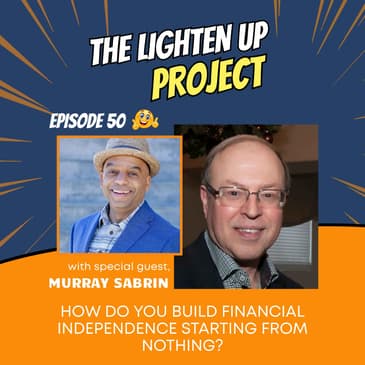
Professor emeritus of finance, six-time author, and son of Holocaust survivors, Dr. Murray Sabrin has spent over 35 years teaching Americans how to think about money, freedom, and independence. In this rich, wide-ranging conversation, he connects his family's story of resilience to a lifelong mission: helping people build financial independence and pursue genuine happiness, one good decision at a time.
What You'll Hear
- How growing up as the child of Holocaust survivors shaped Dr. Sabrin's lifelong commitment to freedom, resilience, and gratitude
- His father's remarkable story of survival as a partisan fighter in Poland — and the single decision that meant the difference between life and death
- Why Dr. Sabrin believes financial independence is about more than money — it's psychological and physical wellbeing too
- His personal philosophy on saving, living below your means, and the "two Ps" he believes go hand in hand: peace and prosperity
- What Making Americans Financially Independent (MAFI) means in practice, and how nonprofits fit into that vision
- The three foundational books Dr. Sabrin recommends for anyone wanting to understand free-market economics without a dictionary in hand
- His advice for anyone feeling overwhelmed by today's economic headlines: tune out the noise, find your why, and build your network
- Why laughter, Tai Chi, and a good comedy on TV still matter — even amid the serious work of economic education
A note to listeners: this episode includes Dr. Sabrin's personal economic and political viewpoints, including his perspectives on free markets, government spending, and healthcare policy. These reflect his own views and expertise, not an endorsement by the podcast.
Resources Mentioned on this Episode
- MAFI (Making Americans Financially Independent) — learn more and contact Dr. Sabrin at mafiusa.com
- Podcast: Health, Wealth, and the Pursuit of Happiness — Dr. Sabrin's own podcast
- Dr. Sabrin's Substack — articles on economics, inflation, and public policy
- Recommended Reading:Economics in One Lesson by Henry Hazlitt
- What Has Government Done to Our Money? by Murray Rothbard
- The Law by Frédéric Bastiat
- Learn more about Malcolm's work at the World Laughter Organization™
Featured Guest:
Murray Sabrin, PhD, is emeritus professor of finance at Ramapo College of New Jersey, where he was on the faculty of the Anisfield School of Business for 35 years and founder of the Sabrin Center for Free Enterprise. Currently, he is a Substack author and speaker and frequent radio, cable and podcast guest. Sabrin is one of the country’s leading advocates for replacing the welfare state with nonprofit solutions. He also is a passionate proponent of Making Americans Financially Independent (MAFI). Dr. Sabrin arrived in America on August 6, 1949, with his older brother and parents who were the only survivors of the Holocaust. Before he became a college professor Dr. Sabrin was a New York City school teacher, staff economist, and investment analyst. As a longtime advocate of free markets and limited government, Dr. Sabrin’s mission in his “golden years” is to educate the public and affect public policy to restore the values of the founders--limited government, civil liberties, and a peaceful foreign-policy. The author six books on taxes, health care, the Federal Reserve, and a memoir, Dr. Sabrin has been called the “Thomas Paines of the coming tax revolution,” and Judge Napolitano wrote, “Read this fascinating autobiography…[and] in Webster’s Unabridged, next to the word ‘courage’ should be a photo of Murray Sabrin.” Recently, Dr. Sabrin was appointed Associated Scholar of the Mises Institute, the country’s premiere free market research organization.
Meet the Host: Malcolm Grissom
Malcolm Grissom, affectionately known as "The Stand-up C.E.O.," is a team-building and employee engagement expert. Malcolm, an award-winning actor, comedian, International speaker, and best-selling author, masterfully blends humor, improv, and business acumen to enhance team dynamics and profitability. As a certified laughter leader, he leverages the power of positive psychology and his social work background to create engaging, results-driven experiences. Whether inspiring executives, strengthening teams, or energizing audiences, Malcolm’s unique approach fosters connection, creativity, and success. His ability to transform corporate culture with humor and insight makes him a sought-after speaker and consultant.
Follow Malcolm:
Website: malcolmgrissom.com
Facebook: facebook.com/malcolmgrissom
LinkedIn: linkedin.com/in/malcolmgrissom
Stressed, stuck, or leading on autopilot? It’s not a motivation problem—it’s a connection problem. Malcolm’s weekly virtual improv classes boost engagement, collaboration, and retention—all while having fun. Register now for a complimentary month: https://malcolmgrissom.thrivecart.com/everyday-encores/
We are proud to have The Lighten Up Project on the *High Vibe Podcast Network .* Grab your free gift from Malcolm in our Our High Vibe Gift Vault.
Love this show, check out the other shows on the High Vibe Podcast Network.
Share the Love
✨ If this episode lit something up in you… tag us on Instagram @HighVibeLeaders and let us know your biggest takeaway!
🦋 Don’t forget to rate & review — it helps us reach more conscious rebels like you.
🔊 Listen & Subscribe
🎧 Spotify
Hello, all my fellow lightmakers. It is I, Malcolm Grissom, the coughing Excuse me, I got a frog in my throat just as I started doing that. Ah, that's life, right? Anyway, I am Malcolm Grissom. I am the stand-up CEO and founder of the World Laughter Organization, and you're not. No, you're not. Sorry. There's only one, but you're you. You're you, and there's only one of you, so that's perfect. Anyway, this is the Lighten Up Project, and I'm so happy that you are joining us. If you're new to this project, thank you to this podcast, thank you so much. Our goal, what we're doing is we are creating a global network to really to talk about and and utilize the power of laughter, and play, and humor, and joy, and happiness, and hope, and how it integrates with healing and personal development of all sorts, of all sorts. And so that's what we're doing here on the Lighten Up Project, and in our community, which is called the Lighten Up Nation. Now, I say of sorts because today we have a very special and different conversation that I have. We are going to be talking not only about healing, but especially about finances. And that is a big part of healing. That's a big part of just living and surviving, and how we show up often, we tie that to our finances. So today, on the Lighten Up Project, I am going to be talking to an expert who talks about both healing and finances. His My guest today is Murray Sabrin. He is a PhD professor emeritus of finance at Ramapo College. Is that how you say it?
Murray Sabrin:You got it spot on, Malcolm.
Malcolm Grissom:Ramapo College. He's a longtime advocate for free markets and individual liberties, and that's We'll be talking a lot about that today as well. With a career spanning more than 35 years in academia, his experience as a teacher, economist, investment analyst, Dr. Sabrin has dedicated his work to helping people understand money, policy, and the path to financial independence. His perspective is also deeply personal, arriving in the U.S. United States as a Holocaust survivor. His life journey has shaped a powerful commitment to freedom, resilience, and opportunity. As an author of six books and a leading voice in the economic thought, his mission today is to educate and inspire. So this conversation we will have today is all about ideas. It's all about independence, because personal development does not come without independence, so that's the very first step, and thinking differently about our futures, what we'll be talking about. So let's lighten up. Let's open this conversation and welcome Dr. Murray Sabrin.
Murray Sabrin:Thank you, Malcolm. I appreciate the the introduction, and just want everybody to know my parents were Holocaust survivors. I was born right after World War II, so in a way, I'm a Holocaust survivor because if they didn't survive, I wouldn't have been born. So, in a way, I'm an indirect Holocaust survivor, but hearing their stories, asking them about how they survived World War II was a real inspiration to me since all their family members were killed during the war, and it takes a lot of resilience to get through 5 years of hostilities in Poland and and come out and be able to build a life not only in Europe where they where they were, but come to America in 1949 with me, my older brother, who was born during the war, and have a good life here. My younger brother was born a few years after we arrived here. And so my whole perspective growing up was, you've got to have a focus in life and have an uplifting view of life, even though you had the worst tragedy that could befall any family. All your family members were killed. No government has the right to do that, let alone kill one individual, but wipe out millions of people during a wartime. So, my whole view of life was shaped by not only their experience, but living in America in the 1950s and 60s, and then of course as the baby boom generation, we were faced with the Vietnam War in in the mid 60s and what that meant to young Americans. I was an undergraduate during this period, and then I started teaching in 1968 in the South Bronx, one of the most difficult areas to teach because the kids were very poor. They didn't have much in terms of food, clothing, what have you. They were basically at the subsistence level. But I tried to inspire them to look look beyond your current condition and get an education so you could become somebody that you can be by learning skills that will give you a a wonderful life, whatever that life that you want to pursue. And I decided to become a teacher when I
Murray Sabrin:was in high school because I thought that would be a very fulfilling job, especially in New York City. And after a couple of years, I realized that this was not going to be my career path, and I sat down with my wife. We talked about me going to graduate school full time to get a PhD so I could become a college professor. And through a roundabout way, that didn't happen until 1985 after I entered graduate school in 1972. but I picked up a lot of skills along the way until I got that college teaching position, even though I didn't have a degree in finance, I was able to teach finance because of all the things I learned in the financial world, in the investment world, in different positions because I had a background in economic analysis in my doctoral work. And so what I preach- not preach, I guess I guess recommend to students is never stop learning. That's become a cliche. Become a lifelong learner. And when I started teaching in 1985 at the college level, I was in my fifth career and they were all different jobs. They were in real estate, they were in investment analysis, they were as a staff economist, teaching at the at the at the intermediate school level, and then teaching at the college level. So, getting that job at the college level was to me one of the most gratifying things in life because now I was able to impact the lives of young people who were getting an education and then going out into the world, becoming entrepreneurs, becoming employees of large corporations or banks, financial institutions, and some of them have become hugely successful. And you know you're getting old, Malcolm, when your former students are grandparents. That's when you know you're getting really old. And so, one of my former students who lives in Virginia who has some challenging medical issues, he has several grandchildren and we communicate occasionally. He and just a wonderful young man. He's not not young anymore, but when I saw him, he was an undergraduate
Murray Sabrin:student. Very bright, knows finance inside out, and overcame his his health issues.
Murray Sabrin:And so, this is what I like to do with what I loved to do with students is not only teach them in the classroom, but many of them came to me during office hours and we talked about career choices and what they will be doing outside when they graduate, and hopefully I steered some of them in the right direction. I told students who were thinking about going to law school, I said, Listen, if you're going to spend three full years of going to law school, spend another year and also get an MBA. And in four years, you have an MBA and a law degree, which gives you a ticket basically in the business world that's second to none. Then I said, If you can learn another language, preferably Spanish, because Spanish-speaking Americans are one of the largest ethnic groups in the United States, you really got it made. And if you're really, and this is the mid-80s, early 90s-- I said, If you really want to be ambitious, and and you you have the language skills, learn Chinese. This is as China was emerging from from under the yoke of communism and they were starting to become no longer a third world nation, but a first world nation. And so I don't know how many of them learn Chinese, but Ladies
Malcolm Grissom:and gentlemen, Dr. Sabrin is He has just pointed out he is a future sayer. I love that. I love that, Murray. I love that. Hey, would you mind joining me in 20 seconds of spontaneous laughter?
Murray Sabrin:Oh boy, laughing is probably the best medicine. There are people who have sworn by laughter really brings in the the good What is it? I forgot what the term is, endorphins in your body, and it helps you heal. And last night my wife and I were watching a movie and we started laughing because there was a hysterical scene in the movie and we just couldn't stop laughing. Sometimes you you're watching a movie and it's so funny that you start laughing so hard that you're starting to cry because it is just an hysterical scene of people doing some weird things that is just very funny. And I find laughing That's why I go to YouTube and watch some of the old Tonight Show episodes with Rodney Dangerfield, who had the best one-liners in in comedy history, and Johnny Carson just broke up when Rodney Dangerfield was a guest, and some of the other guests that were on with him couldn't stop laughing either. So laughter laughter, good food, fresh air, hydrating, exercise. We start We've been doing Tai Chi every morning, and let me tell you, that is really invigorating. Not Not strenuous Tai Chi, but just really get your body moving, and that's really the key, I think, for your mind and body to be in sync because if you get your mind and body in sync, you're going to be a happy person, and if you're a happy person, you'll be a very productive person.
Malcolm Grissom:I agree with that. That is so true. And now, you're talking about watching YouTube and Rodney Dangerfield and Johnny Carson and my favorites. Yeah, go on and on and on. But now let me ask you this. Do you only see laughter as a response?
Murray Sabrin:I'm not quite sure I understand the question. Can you repeat that?
Malcolm Grissom:Sure. Do you only see laughter as a response? So, in other words, do you need In order to laugh, do you need a stimulus? Like a joke, for instance?
Murray Sabrin:Well, it's a joke or sometimes you see something that makes you laugh. I mean, sometimes laughter comes about because of a slight tragedy. Somebody takes a fall somewhere and hopefully they're not hurt, but they may slip on a banana peel, something like that. That's That's a a thing that happens to people, or somebody driving, they do something really weird, and you start laughing because it takes them forever to get in the parking spot or something like that. But there are so many stimuli that evokes laughter that I think it's probably one of the healthiest reactions you can have because it stimulates a lot of good things in your body and in your mind. And so
Malcolm Grissom:I I just before before you move on, I just want to point out to our our listeners and that if for those who have not listened to episode two, what Murray's talking about right now about the slipping on the banana peel and the parking, you know, is that's what is called a a benign violation. So it's it's like it's it's a violation, meaning like slipping on a banana peel, that that is a violation. That is something different that it sort of breaks the It violates what we expect to happen, but we laugh only because it's benign, like Dr. Sabrin said. So only if that person who slipped on the banana peel didn't fall and break a hip.
Murray Sabrin:Yeah.
Malcolm Grissom:And then, you know, it's benign, so now we laugh. And so the parking's the parking example that you gave was definitely benign violation.
Murray Sabrin:For sure.
Malcolm Grissom:It's not something that we would normally expect, you know, but it's definitely benign. It's so it's a violation, and no one gets hurt. So that's wonderful. So now let's let's go back and let's break down what let's break down your story because you had such a long history, you know, and it's rich, and I want to make sure that our audience doesn't skip over some things. So, first of all, so you came to America as a child of Holocaust survivors, right? So how exactly did that experience shape your worldview?
Murray Sabrin:Well, I was curious about why there was a a big war, World War II, why there was World War I, and that's what what helped get decide helped me decide that I wanted to be a history major and learn as much about American history and world history as I possibly could, to understand why would people in power decide to go to war. And so I was learning about that, and as I got older, I learned more about it because you don't learn too much about it in elementary school, junior high school, and high school, but in college, when you major in in in in a subject, you can do a deep dive in some of these issues. And so the concept of people going through a war, 5 years of their life, every day not knowing if you're going to survive till the end of the day, to me is such a mind-boggling concept. It's got to be psychologically debilitating. It's got to be physically challenging because you're scraping for food for 5 years when when you're in combat. And my father was in a a labor camp, and there's one story he told me, he was accused by a sergeant in the labor camp of stealing a hammer, and the sergeant put a gun to his head, was going to blow his brains out if he didn't tell him where the hammer was, and someone intervened and said he didn't take it. The next day, they found the person that took the hammer, and he was shot. So he eventually escaped from that camp and became a partisan commander for a year. He was in charge of the lot He was in charge of 230 people, and they were blowing up bridges and railroad tracks and roads to stop the German advance in in their in their native Poland. And so he was there with his machine gun and had, as he told me, a lot of Nazi German blood on his boots because that's what they did. They fought a guerrilla warfare in for all intents and purpose, yeah, in order to survive. And then the Soviet army came in in his part of Poland in July of 1944, and they were liberated because the Germans were driven out
Murray Sabrin:of the country. So, for all intents and purposes, even though the war ended in the the summer of 1945, the war was over for him in 1944. And in his memoir, he told he tell he relates a story at the end of the book, which I didn't know about, a Soviet colonel asked him and other partisans to be parachuted into Germany to do some I guess guerrilla activities. And he said, No, I have a I have a wife, I have a son. The war is over for me. And subsequently, he learned that 98% of those partisans were killed in Germany. So if he had agreed to to go into Germany as a as a guerrilla fighter, he probably would have been dead. And so we wouldn't be having this conversation. So again, these are the things that happen in life that one decision can impact you forever. And that's exactly what my parents story was all about is that they made decisions that allowed them to survive World War II. And so when you're growing up and you hear how they did it, and the interesting thing about for me as a youngster listening to them, they spoke about it as if it was like an outer-body experience. It was there was a very dispassionate accounting of what happened in World War II. They weren't angry, they weren't sad, they just were accounting it like they were a reporter of the events that they lived through. And I found that quite remarkable because it it takes I think a lot of courage to not have all this anger built up. And in 1992, my wife and I with friends decided to go to Germany for a visit because I was born in West Germany right after the war. And when I told my father that I was we were going to West Germany, he's he was thrilled. He didn't he didn't curse the German people or the German government. He said, You got to go visit the place you were born outside of Munich.
Murray Sabrin:Well, we were in Munich, but we couldn't get to the place that I was born. But he was thrilled that I was going to the land of my birth, and he didn't have any animosity toward the Germans. When I bought a German manufactured car, he didn't say don't do it. So he was fairly forgiving about about his experiences during World War II and didn't hold any animosity. And so I found that remarkable as well because there are people who were in the Pacific that wouldn't buy anything Japanese after the war or even in the later years. So again, th- this is I think part of the human experience. There are people who are unforgiving, there are people who are forgiving, and you try to do the best you can based upon your Exactly. internal fortitude, your your your world outlook, your personality, your values, and all those things that make us unique.
Malcolm Grissom:Mm-hmm. Mm-hmm. Yeah. So you've spent decades now studying finance and public policy.
Murray Sabrin:Yeah.
Malcolm Grissom:What are the core principles that guide you in your perspective?
Murray Sabrin:Well, it's very simple. In 1959, Malcolm, my parents took my older brother and me, five years after they they became U.S. citizens, and we went to the federal courthouse in Lower Manhattan. I raised my right hand, and I swore to uphold the Constitution of the United States. And I read through the Constitution before I became a citizen, and and I've been reading it ever since then. And what strikes me as a U.S. citizen, a naturalized citizen, is that there's a such a disconnect between what the federal government is doing and what the Constitution allows the federal government to do in Article I, Section 8. And that's the reason we have this incredible spending spree that's been going on in Washington for for decades. That's why we have a $39 trillion debt, a $7 trillion plus budget, and $2 trillion deficit every year because the members of Congress and whoever's president, they don't adhere to the Constitution regarding the authorized spending. And we've become a nation of of really of children when you think about it. How many tens of millions of Americans are dependent upon the federal government for the necessities of life? I'm talking about basic income, Social Security, medical care. And to me, growing up, that was an anathema to me because growing up, I saw my father go to work Monday through Friday in a sheet metal shop, and on the weekends he would drive a cab. And he would do that for many, many years, then he finally bought his own cab, and he was his he was an entrepreneur. He he was full fully in control of how much time he would work, and he made a decent living doing that. But driving in the streets of New York City, sometimes could be a little harrowing, needless to say. But he made a very good living, he retired when he was 65 in the early 80s, and he was able to provide for his family. We lived very modestly. And so they saved, and so that was part of my ethic growing up. You got to save. So when I got the job at
Murray Sabrin:the college, I saved the maximum I could and put it in a 401(k). So when I retired in 2020, I had a nice pot of money that accumulated over nearly 35 years of investing and saving and and the stock market growth. And so that's why we're the most comfortable we've ever been in our life because the stock market has been on a tear since the bottom of the financial crisis in 2009. So my personal financial advice to people is save as much as you can, live well under your means, not over your means. Don't take on any credit card debt, and live modestly. Don't buy the fancy car. You can get four wheels at a much lower price than an expensive car. We could buy. We have car. We bought cars well below our means because that was not part of my ethic of having the most expensive car or very expensive car to drive in, and we lived in a modest residence also. These are the things. We didn't go out very much. In the last few years, we haven't been traveling because of some family health issues. But prior to that, we were traveling as much as we could. We got to see many places around the world. We visited every continent on the planet, which is a nice feather in our cap. And so, seeing other cultures, see how other people live, find out about their history, how their society evolved, is a great experience because you This is what we are: we're human beings connected by humanity, basic principles that we all live by.
Malcolm Grissom:Let's go back to You were You were talking about financial and living within your means, and so you you promote something called Making Americans Financially Independent, MAFI, right? So, is this Is that an example of what the what that practice would actually look like?
Murray Sabrin:Oh, absolutely. The other component of MAFI is, instead of having this huge welfare system that we have, is that we have We support our nonprofits. My wife and I are very generous with nonprofits in our community, whether it's healthcare, Habitat for Humanity, food banks, and other organizations that are helping people get back on their feet. And instead of having this this nameless Not nameless, but faceless bureaucrat in Washington, D.C. or your state capital doling out money to you, I I think that is it's ineffective, it's counterproductive, it's it goes against my values, that people should not depend on the government for the basic necessities of life. And historically, the American people are the most generous people in the world.
Malcolm Grissom:Okay, so Yeah. If If I If I understand you correctly, making Americans financially independent, what you're saying, how what that looks like is that looks like establishing nonprofits. So living living under living under your means, not so within your means, but under, and then establishing nonprofits to help other people be financially independent as well. So financial independence is not relying on the government.
Murray Sabrin:Absolutely. Absolutely. This is This is the financial crisis that we're facing, and no one in Washington wants to deal with it. I had a letter in The Wall Street Journal today talking about this and in the past as well, is the nonprofit sector is our social service safety net. It's been around for more than 200 years.
Malcolm Grissom:So here's the question then: Why is Why do you believe that financial independence is so important to us?
Murray Sabrin:That's a great question. That's a great question. First of all, who I can't believe anybody that's growing up has been has been taught by their parents that you should be financially dependent when you become an adult. I mean, the whole point of being a child and a young adult and then an adult is that you learn how to be financially independent. That means getting some skill or skills that will allow you to earn a living, pay for your bills, be philanthropic if you want to be, whether it's through your church or whether it's through a local nonprofit, and enjoy the benefits of living in this country, which has a cornucopia of goods and services that make our life better. And so the concept of financial independence, to me, not only is it important financially, it's important psychologically and physically, because the greatest debt most people have in this country is medical debt, which shows you how out of whack our medical system is where we have so much people have so much debt for medical bills. And I've written about this in two books. We could have a much less costly medical system with better outcomes if we got the government out of the way, if we didn't rely so much on insurance, and save for our the so-called proverbial rainy day, because insurance medical insurance has been corrupted. You don't need medical insurance to see the doctor because you have a sore throat or a bellyache or something like that. That's not the purpose of insurance. Purpose of insurance is to take care of some big medical bill, and even those bills can be handled by organizations like the Surgery Center of Oklahoma and others around the country that don't accept insurance, you pay out of pocket. Let me give you a perfect example of how this works, because when I wrote my first book on on how to have universal medical care without the without the government, I contacted doctors who do direct primary care. In other words, you pay the doctor a
Murray Sabrin:monthly fee, and you have basically unlimited visits to the doctor, and doctors are usually available 24/7. And the beautiful thing from the doctor's perspective is the doctor has around 800 to 1,000 patients, while in a traditional medical practice, the doctor has about 2,000 patients, and they see you for maybe 15, 20 minutes per visit. But with a direct primary care doctor, you're there for a half hour, 45, or an hour visit. Here's the point: this one doctor here in Florida where I live, who I who I was able to find out that she does this, I called her up, and we had an hour or so interview on the phone, and she told me she had a patient who needed some sort of surgery. He didn't have insurance, so he he spoke to the local hospital, and they quoted him a $20,000 bill for the surgery. She said to the patient, Call the Surgery Center of Oklahoma in Tulsa and find out what they would charge for the same operation. P.S. He called the Surgery Center of Oklahoma. The whole the surgery, the travel to Oklahoma, the stay in Oklahoma, $5,000. If people did that by saving money in a health savings account, so if they needed an operation that was that they could afford out of pocket, they would have the money. And if you needed really expensive treatment, which you really shouldn't need, that's a topic for another day, how we can have much better outcomes with with a lot less expensive medical procedures. All you need is in in medical care is a catastrophic policy. Let's say you need a $100,000 procedure for whatever that is, and you have a policy that you would pay maybe a few hundred dollars or a couple thousand depending upon your health condition. That's the way I envision a free market medical system where the patient comes first, not the insurance company, not the government, not the bureaucrats, but the doctor-patient relationship, which would be based upon direct care between the doctor and the patient, and it would be a lot less costly than what
Murray Sabrin:we're spending today. We're spending the American people are spending $5 trillion a year, nearly 20% of GDP on medical care, and our outcomes are not that great, given all the chronic illnesses that the American people have.
Malcolm Grissom:Now, you're you're talking about you're talking about the good side of free markets and, you know, free markets and not relying on the government and all that. But now let's let's take the flip side. What are some of the misconceptions that people have about free markets and limited government?
Murray Sabrin:That's a great question. People think it's all based on greed. Well, we're hearing this now because prices have been going up. Well, prices go up in general because the Federal Reserve prints money, not literally printing money, but they have what's called an unlimited checking account, and they have electronic money. That money that new money was created in the trillions during COVID as there was lockdowns, and spending went through the roof, and the Federal Reserve stepped in and created literally trillions of dollars, which then spread through the economy and raised prices, including housing prices and stock market prices. So the misconception is that businessmen are greedy. Well, why aren't they why was inflation low before COVID when prices were rising 2% a year? Did business people decide not to be greedy during this period? It doesn't make any sense to say that greed causes inflation. There's there's only one cause of inflation. That's that's the money printing of the central bank, and this has been known for literally hundreds of years since the first central bank was created in the 1690s in England and in and in Sweden, I believe. So again, there's a lot of misconception about this. I write about it on my Substack. I've written scores of articles about inflation and its impact on the economy, and there's so much economic illiteracy, and that's the letter that I wrote to the Wall Street Journal that was published today, and it's on my Substack, where a senator claims that the government can basically micromanage the economy through different policies, and that's just probably the biggest fallacy of all. The free market doesn't need any guidance by the government. The free market is we getting together, we the people getting together to exchange money for goods and services. That is a free society. That I think is what the founders envisioned when they created America over over 250 years ago.
Malcolm Grissom:So, let us so, some some of the we're we're talk we're talking to educators and parents here and whatnot, and so some of these complex economic issues, it might seem overwhelming. So, break it down. How can people understand these complex issues without being overwhelmed?
Murray Sabrin:Well, there's one little monograph that that one a member of my dissertation committee wrote, who has the same first name as me, Murray Rothbard. It's available free on on the internet, called What Has Government Done to Our Money?, and it's basic economics and talks about inflation and the central bank and how it messes up the economy. So, that's one book. The other book, which was published the same year I was born in 1946, is Henry Hazlitt's Economics in One Lesson, a magnificent book about the fundamentals of how a society organizes itself based upon free market principles. So, those are the two books I would start with. They're written for the layman, so anyone who has any sort of education could read it, because it's not complicated. You don't need a dictionary to to read the book. Those are the two. The other one is called The Law, written by a French philosopher, legislator, an economist by Frederick Bastiat, The Law. These are all available free on the internet. The Law by Bastiat, Economics in One Lesson by Henry Hazlitt, and What Has Government Done to Our Money? by Murray Rothbard. Those three books, I first read them over 50 years ago when I was a graduate student, and they really opened my eyes as to what it takes to have a free market economy, where where you have prosperity, and here's the other point: you also will have peace because there'll be no need for a nation to go to war for any reason whatsoever unless they're attacked. And so peace and prosperity go hand in hand, the two P's. Because if you have a free market economy, you have free trade with other people around the world. There is a desire to make sure that goods can flow freely between nations, just as we goods flow freely among the states. You're in Missouri, I'm in Florida. We exchange goods and services between our two states and and the other 48 states around the country, and it's a seamless process. We see we see the railroad cars, we see the trucks on
Murray Sabrin:the highway. What are they doing? They're engaging in free trade. We go on the internet. We have e-commerce. That's free trade. Let's have that for the whole world without government intervening and and creating interference for us to trade with people around the world.
Malcolm Grissom:Now, what gives you hope about the next generation? How how do you see how do you see economics economics economics moving in the future?
Murray Sabrin:This is this is a wonderful question. You know why? Because a lot of young people are gravitating to socialist ideas, which have been discredited for over 100 years. And yet people resurrect these ideas occasionally-not occasionally-it's happening more and more because they're frustrated with what we have in Washington, which people think is the essence of free market. No, what we have in Washington is crony capitalism, or economic fascism, as one economist wrote 50 years ago, called America's emerging fascist economy. And so, people conflate the notion that what happens in Washington is free market economics. No, it's not. It's just the opposite of that. It's where government is trying to micromanage the economy. That's not the free market. The free market is we the people do not any do not need guidance from Washington. We we do our production, we do our consumption, we do our work without any interference from the government. That is a free market. That's why I'm doing what I'm doing, Malcolm, between my Substack, my podcast. I want to educate as many Americans. Letters to the editor, op-eds. So I'm trying to get as much material out there to as many people as possible, and hopefully they will then send it out to other people. And before you know it, maybe 5 million people will read what I have written about the economy. I mean, my letter in The Wall Street Journal today has probably been read by a lot of people, and it's probably circulate on the internet as well because I think it's a very powerful argument against government intervention in the economy, which is counterproductive. It doesn't achieve the results that the policymakers thinks it will. What did Albert Einstein say? If you do the same thing over and over again and expect a different result, that's called insanity. Well, that's what we have. We have an insane policy makers in Washington thinking that they can constantly intervene in the economy and and give us
Murray Sabrin:sustainable prosperity. It hasn't happened. We always go through these cycles, and I've talked about that in various books. These cycles come about because the Federal Reserve tries to micromanage the economy by manipulating interest rates. It's that simple. Professor Rothbard in What Has Government Done to Our Money? gives us a very clear and concise explanation of that process.
Malcolm Grissom:Murray, you you're used to talking a lot about these topics, and and you do a lot of research on these topics. And as you said, you have you have a couple of podcasts, you have you have all these six books, you have the Substack, the blogs that you do, a lot of work on these topics, and these are very serious topics. Now, where does lightness and humor fit into this?
Murray Sabrin:That that is another wonderful question because I like to look at the optimistic side of everything that I do, and like I say, I try to laugh as much as possible by looking at some of the things I find on YouTube. So sometimes I see things on Instagram and TikTok that are really funny of these benign things that you talked about before, where people you know slip on the ice or something like that, or they they make a mess in their own apartment or something like that. But I I try to lighten up as much as possible. I mean, this is serious stuff that I'm writing about, but my wife and I watch TV and we stream movies, and we and we especially the comedies have a lot of funny incidents in them, and that relieves a lot of the, I guess, anxiety, if you will, that we're all facing in today's economy with society with war and and protests in the streets and things like that. That's why I don't watch the news very often anymore because it just makes you a little bit unsettled, to say the least. So I try to go to websites that have informative people speaking about what's going on in the Mideast and in the and overseas, and just try to take it as it comes, but realizing I'm just one person doing what I think I can do best, which is educate people and help them lead better lives, because that's really what it's all about, Malcolm. We're not here very long, four three score and 10, maybe, hopefully for for most people, or longer. And so you try to do the best you can, and I'm retired for for nearly six years now. I don't have to do what I'm doing. I'm doing it because I think I have an obligation as an individual, as someone who background cries out for let's make America better rather than just accepting the status quo.
Malcolm Grissom:So I have in in the show notes I've put all the your books I've put especially those books that you that you've mentioned, not the books that you've written,
Murray Sabrin:Right.
Malcolm Grissom:but especially those three books that you found very helpful. And I have all the all your contacts in in the show notes as well. But I understand. Obviously, you you are very, very knowledgeable about the about this. You could talk and explain and teach this to people of all levels. So if someone wanted to contact you to have you speak to others, how would they best, where would they go to contact you?
Murray Sabrin:Well, mafiusa.com, there's my contact information there, my telephone number, my personal business phone number, my email, they can contact me. I'd be happy to speak to any organization that's looking for someone to give an inspiring talk to young people about how to forge their path forward to pursue their happiness, because here's the beauty thing about the humanity: we're all equal. By that I mean we all have 24 hours and seven days a week. No one has more, no one has less. It's what you do within that time that determines what type of life you will have. And if I had to do it over again, Malcolm, I would do a lot more reading than I did as a youngster. about things that interested me. I I read as much as I could at that what I was as a teenager and as a college student. But people who get started at a young age, who read incessantly and are passionate about things, they're the ones that become successful entrepreneurs. We were watching Shark Tank the other day, and there was a 12-year-old with a product. He got a deal with one of the sharks. He got a patent at 10 years of age. Think of that, a patent at 10 years of age. It shows you what a great country this is when young people take an idea and run with it and have a successful business. And I think I just read that his business is doing over a million dollars a year in sales. There are so many success stories from Shark Tank. People should watch Shark Tank, because that to me is the quintessential how to achieve the American dream. Come up with a product or a service that is going to be available to the masses. In fact, before Shark Tank went on the air, I started telling my students in 1985, when I started teaching, and told every class for 35 years, Come up with one idea in America and you will become wealthy. Come up with a super idea, a great idea, and you become super wealthy. And we know all the people who have become super wealthy, they came up with one idea or two ideas,
Murray Sabrin:and they ran with it. And we know what those companies are called: Microsoft, Apple, Nvidia, Netflix. The list goes Google. I mean, my goodness, these are the companies that started as Facebook. They started as a simple idea, and they pursued it because that was their passion. And these people have become Elon Musk with Tesla and SpaceX, and Bezos with Amazon. I mean, the list goes on and on and on of the companies that are successful because young people had an idea, and when you can implement a great idea, you become wildly successful in America.
Malcolm Grissom:So, what would you say to someone now who just feels really overwhelmed with the current economic landscape?
Murray Sabrin:Yeah. Well, I think you have to tune out the news, because if you if you listen to the news constantly, you're going to be depressed. That I think is sort of a given. I think you have to figure out from your own personality, looking inward from your own psyche, what do you want to do with your life? What will give you happiness? That's what it comes down to: what will give you happiness? That's why my podcast is called Health, Wealth, and the Pursuit of Happiness. And people have failed, and they've gotten back up and failed again and gotten back up and failed again. Unfortunately, too many people, when they fail a few times, they give up. That that is a big mistake, because you don't know what is what that next thing will be that will make you successful. I think the perfect example of that is Dyson with his vacuum cleaners. He said it took him 5,000 attempts to come up with the idea for the Dyson vacuum cleaner. 5,000! Most people would have given up at a dozen attempts. So,
Malcolm Grissom:so the the first thing is just don't watch the news, which is actually the first step in lightening up in this whole situation. And then what I hear you say is the next thing is to really figure out your why, and to be persistent to keep not let the the economic landscape overwhelm you or deter you from pursuing what it is that you want to pursue.
Murray Sabrin:And here's the other thing: two things. Find out who the smartest people in your area are, and call them up and speak to them, and then network. Those are the two things that'll help you become successful. Speaking to smart, successful people in your community, and who will share their story with you and provide you maybe with guidance and be a mentor to you, and then network as much with as many people as you can, and that's the recipe I think for success. Have a passion. Have have a have a solution to a problem that you think will be commercially successful, and then speak to people in your community.
Malcolm Grissom:Okay. All right. Well, thank you very much. Thank you much, very much, Murray. Murray Sabrin, Dr. Murray Sabrin, MAFE, making Americans financially independent.
Murray Sabrin:And that's MAFEUSA.com. Thank you so much, Malcolm. This was a great session.
Malcolm Grissom:Sure, yes. Yes, thank you. Thank you. And thank you everyone for listening and continuing to come back. Please share this with some share this podcast with someone that you know. Tell them about what we are trying to do. Have them come in and join our community. Have them come in and just listen to an episode. And another thing, if you could go onto our Facebook page, if you could go onto our Facebook page, start a conversation with us. Tell us what you like, what you don't like, what you want more of. We are here for you. So please keep coming back. Because if it wasn't for you, this this this movement would be nothing. So, thank you so much. Thank you so much. And remember, every smile can open a door, every laugh can open a heart, and every step can be your next victory. See you next time. Bye.