
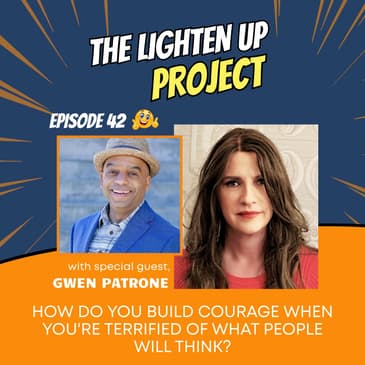
Marine veteran, lifelong entrepreneur, bestselling author, and self-described unicorn Gwen Patrone has spent four decades proving that courage isn't the absence of fear — it's knowing the danger and doing it anyway. In this bold, laugh-filled conversation, she shares how laughter lowers the shield, why small 60-second wins compound into real bravery, and what it took to walk into a hotel lobby in a mini skirt and own every second of it.
What You'll Hear
- Why courage isn't about avoiding fear — it's about recognizing it, naming it, and repurposing it as a tool (straight from the Marine Corps playbook)
- How laughter melts the "Captain America shield" people carry into every room — and why Gwen uses humor to let the real her enter people's world before her reputation does
- The WIIFM principle ("What's In It For Me") — everybody's favorite radio station — and what it teaches us about how to stop waiting for people to accept us and just go for it
- The Relief Valve Method and Marksmanship for the Mind: two military-inspired techniques from Dysphoria Hacks for defusing fear before it freezes you
- Why you don't have to hit a grand slam every time — the power of 60-second micro-wins and how small courageous acts compound like interest
- Gwen's honest take on the collateral damage of living authentically: fewer close friends, real loneliness, and why the pot at the end of the rainbow is still worth every step of the climb
- Two Truths and a Lie: Jodie Foster, Top Chef, and a high school full of artistic talent — find out which one is the lie
Resources Mentioned on this Episode
- Book: Dysphoria Hacks by Gwen Patrone (with workbook) — military-inspired tactics for turning fear, anxiety, and discomfort into courage; available on Amazon
- Book: WIZ Kids: Stories of Empowerment by Gwen Patrone — a children's book series featuring animal characters designed for parents and kids to read and discuss together
- Book: Trans Truth by Gwen Patrone — a guide to navigating the gender spectrum and finding your own clarity
- Veterans Coffee — Gwen's GoFundMe-backed charity effort to support veteran mental health and PTSD service animal programs
- "Make Your Bed" — Admiral William H. McRaven's famous commencement speech (referenced in the discussion on small acts of courage)
- Learn more about Malcolm and his work at the World Laughter Organization™
- Gwen’s website: Dysphoriahacks.com
Featured Guest: Dr. Gwen Patrone
Gwen is a lifelong entrepreneur, USMC veteran, restauranteur, best selling author and proud parent. She's dedicated the last 40 years to educating in leadership, entrepreneurship ventures and helping tens of thousands of people around the world through print, audio, video and stage presentations. Her most recent book called Dysphoria Hacks tackles the emotion of fear using Marine Military tactics to redirect and repurpose fear.
Connect with Dr. Gwen:
Website: Dysphoriahacks.com
Gift: Free 90 minute zoom on methods anyone can use to generate income from home GetWealthyWithGwen.com
Meet the Host: Malcolm Grissom
Malcolm Grissom, affectionately known as "The Stand-up C.E.O.," is a team-building and employee engagement expert. Malcolm, an award-winning actor, comedian, International speaker, and best-selling author, masterfully blends humor, improv, and business acumen to enhance team dynamics and profitability. As a certified laughter leader, he leverages the power of positive psychology and his social work background to create engaging, results-driven experiences. Whether inspiring executives, strengthening teams, or energizing audiences, Malcolm’s unique approach fosters connection, creativity, and success. His ability to transform corporate culture with humor and insight makes him a sought-after speaker and consultant.
Follow Malcolm:
Website: malcolmgrissom.com
Facebook: facebook.com/malcolmgrissom
LinkedIn: linkedin.com/in/malcolmgrissom
Stressed, stuck, or leading on autopilot? It’s not a motivation problem—it’s a connection problem. Malcolm’s weekly virtual improv classes boost engagement, collaboration, and retention—all while having fun. Register now for a complimentary month: https://malcolmgrissom.thrivecart.com/everyday-encores/
We are proud to have The Lighten Up Project on the *High Vibe Podcast Network .* Grab your free gift from Malcolm in our Our High Vibe Gift Vault.
Love this show, check out the other shows on the High Vibe Podcast Network.
Share the Love
✨ If this episode lit something up in you… tag us on Instagram @HighVibeLeaders and let us know your biggest takeaway!
🦋 Don’t forget to rate & review — it helps us reach more conscious rebels like you.
🔊 Listen & Subscribe
🎧 Spotify
Hi and welcome everyone for joining me. Welcome for joining me. I love it. My mouth is just-it's not worth picking things up today. Thank you very much for joining me on the Lighten Up Project. My name is Malcolm Gurism. I am the stand-up CEO and founder of the World Laughter Organization, and today on the Lighten Up Project, we are going to talk about a very deep topic-one that we've talked about on the podcast very often, but it continue we continue to dwell into it because it is that deep. We're going to talk about courage and fear, whether they are the opposites, whatnot. A lot fear is something that a lot of us, well, I should say myself, especially let fear dictate my life often, and I would bet that some of you do that as well. So today we're going to be talking about that and courage, and I think my guest today is the perfect person to come and talk about that. My guest is Gwen Patrone. She is a lifelong entrepreneur, U.S. Marine Corps, Marine Corps veteran, restaurant, restaurant, the restauranture, and restaurantpreneur, restaurateur, yeah, exactly, restaurateur, entrepreneur, and you know, entrepreneur, and all that. Anyway, restaurants. You know what I'm saying.
Malcolm Grissom:Dr. Gwen Patrone: Well, that's why I told you to put that in there because I wanted to see how you'd be able to say it.
Malcolm Grissom:Tried me up. I love it. I love it. She's she's the character just like me. She's a rascal. She's a best-selling author. She's a proud parent, basically someone who doesn't scare easily, and if she does, she always has a plan to deal with it. After 40 years, Gwen has educated, or for 40 years, Gwen is educated and empowered 10s of 1000s of people around the world in leadership and entrepreneurship through her books, stages, and media. Her latest book, "Dysphoria Hacks, takes fear head-on. It using what she's learned from Marine military tactics, and she's redirected it, repurposed it, turned it around, turned it from a saboteur to a tool that we can use. So, dysphoria hacks is her book. The conversation that we will have about courage and discipline and learning how to lead, we can't really see that because
Malcolm Grissom:Dr. Gwen Patrone: I figured that out.
Malcolm Grissom:Yeah, like, but anyway, please help me welcome Gwyn Patron. Patrone.
Malcolm Grissom:Dr. Gwen Patrone: Hey, Malcolm.
Malcolm Grissom:Hey,
Malcolm Grissom:Dr. Gwen Patrone: We're both characters. That's for sure. That's for sure.
Malcolm Grissom:Yeah
Malcolm Grissom:Dr. Gwen Patrone: Love to laugh. Love to laugh.
Malcolm Grissom:Yes, yes, yes. And in fact, why don't we start with 20 seconds of just spontaneous laughter?
Malcolm Grissom:Dr. Gwen Patrone: Love it.
Malcolm Grissom:Right. 123, two, three.
Malcolm Grissom:Dr. Gwen Patrone: How long? The best laughs are when you start crying?
Malcolm Grissom:Yes, yeah. So, Gwen, great transition. Tell us about a time when you laugh, when you genuinely laughed really hard up to the point of tears and snot, mainly snot. You know, snorts, and tell us about that moment and how it really felt in your body.
Malcolm Grissom:Dr. Gwen Patrone: Ah, you know, because it it rises up from inside of you, and and it's the belly laugh, right? It just comes up like, and yeah, I I just love to laugh. Is is just such a release of tension inside your body, and I love animal humor. So a lot of times, if I'm just sitting there flipping through some videos online, and I love seeing the different animal videos, the short clips that are on there, and sometimes I see some really really funny ones. That yeah, sometimes you're not sure if they're AI generated or not, but I don't care because they're so funny. And it's just my eyes start to cry, and and my and I just you know your face starts to hurt, you know, for laughing so much, and you know just a lot of times self-deprecating humor. I love I do that. I joke around myself quite a bit, and and what that does too is you know when I go to meet people and you're smiling and you're and you're happy and you're laughing and you don't take things overly serious, they tend to light lighten up a lot and they let you enter their world, which is has served me well over the years to be able to connect with people on a more personal basis.
Malcolm Grissom:So define lighten up for us.
Malcolm Grissom:Dr. Gwen Patrone: Well, well, lighten up is is everybody has their their shield, you know, their Captain America shield like this all the time, and we inherently some of us have thicker shields than others. And when you're going into situations, myself as a as a transgender person, person. In case you haven't noticed, shocker, is when I go in and I automatically have this preconceived notion that people have about me. So one of the things that I do is I go in with confidence, and then I lighten up and I start to speak to them with a smile and and even laugh sometimes if I can in the proper situation, and it allows the the walls to melt down. So when you lighten up, it's like you take away that shield, and it's like it just melts. And so that's what I mean by lighten up. Don't be so serious about everything. Just take it as it comes. Life is more flowing instead of stiff. And and when you are able to let it go and laugh, then you're able to allow things to bounce off you a lot more, s o it doesn't it doesn't what they call trigger you or whatever people's triggers are because it doesn't stick. So when it sticks and it injures you more, you're able to allow things to bounce off you because of laughter, and that starts lightening up.
Malcolm Grissom:Yeah. Okay. So how has humor and laughter? You've touched upon it, but I'm wondering if you could expand on how how laughter has how you connect it with courage.
Malcolm Grissom:Dr. Gwen Patrone: Well, I often have to. I'm six foot three, so I'm not a small person, and I put on heels and six foot five, six foot six, so I don't blend. What I'm one of my taglines, and I came up with this kind of part of laughter because I tried to blend in for a long time, and it's not going to happen. So I thought about. I said, "Okay, oh, Glenn, don't blend, right? Glenn, don't blend. Not gonna happen. Just be here. Be yourself. Be be the best you you can be. And you're gonna turn some people off. You're not gonna turn, and you're gonna attract more people. And in in so many different projects, keep that in mind. You're always gonna turn people off because if you're creating waves, you're creating movement. Some people aren't gonna like it, and you'll attract many more people with the resonance that you have from other people. So, so with laughing, it allows you to resonate with the right people, right, and the right atmosphere that you want that resonates with your personality, and it allows you to go deeper into people's world, thus allowing your courage to be able to go further and deeper, because courage isn't so much avoiding things; it's knowing the danger but doing it anyway, knowing the stress but doing it anyway. Right? Doing things in the that you know that the that the the stress of the situation is there, but doing it anyway. So it's not avoiding. So you don't want to. Too many people go through life and try to avoid different things, and when they're in real situations, they get hurt because they don't have the experience of being in that situation. So when I was in the service, we would do that all the time: is we would purposely go into situations that would cause us to develop a thicker skin. I call it a spine, and for lack of a better word, a tougher spine. So, if that ever happened again, or something even worse than that, we're able to go towards the danger or the fear and do it anyway. And so, one of the mechanisms that I
Malcolm Grissom:came with, I came up with, and normally this wouldn't be in the Marines, is is to not take things so seriously, and that goes in conjunction with laughter.
Malcolm Grissom:Yes, yes, yes, yes. Okay. So, for some of our listeners out there, can you tell us, give us, maybe some some ways that we can that that you. Think laughter. I tell you, I just can't1. of those, one of those moments, right? So, can you share with our listeners how they can use laughter, especially or laughter or lightening up. How they can use that to make courage more accessible?
Malcolm Grissom:Dr. Gwen Patrone: Well, I kind of hinted and went into that a little bit with my previous answers, which all melted together. So to go kind of a little bit deeper into it is that you're going to need courage in your life to be able to go through and withstand relationship issues, job-related issues. Maybe you have to go in public speak in front of a group of people. Many, maybe many people. They say that's the worst fear, other than even more than so. The death is public speaking in front of people. Maybe it's it could be really anything. Asking someone out on a date or or whatever it happens to be. There's so many different fears that you have to confront every day, and that you need the courage to step up and do that. But if you can take it, take a breath. Even think of a like what you just did before. Think of a funny moment in your life to just it just gives you that automatic laugh that you just can't help it. It just triggers you, right? It's it just starts to laughing and that funny moment, and that is going to help that fear and that allow the courage to be able to dissipate to be able to enter you more, so the fear dissipates more, and you're going to be able to accomplish much more than you could anyway. So what you're doing is now many times in speaking, I used to speak on stage, and they said, imagine there's some people, imagine your whole audience is naked, imagine somebody in the audience is totally naked, which is and that's lightening up, right? It causes you to laugh a little bit, chuckle a little bit, and so you you kind of forget the fear that's paralyzing you. So if you allow lightening up and the the the comedy or the laughter to lighten you up, so this way you can use that to repurpose the fear and thus use courage even more. You replace what you're repurposing with more courage to be able to do what you need to do. I covered that even even with my book, the dysphoria hacks is is there's dysphoria and fear very close to each
Malcolm Grissom:other, and it's always going to be there. And so the first thing is recognizing it, right? If you recognize what it is, what's happening to me, and and thus you can actually take that, understand it, and be able to repurpose it for your your better good. Thus, other than letting it really devastate you and and freeze you, because it's really your subconscious mind is all kind of playing games with you. Because it's really not real. It's false evidence appearing real. Fear. So, but and but as you mention that, it's it's really comedy, laughter, lightening up, and so on are all along the same lines of of being able to diffuse the fear and so on, so you can use courage to repurpose.
Malcolm Grissom:Wonderful. So you touched on this a little bit earlier about the the importance of connection. What role do you think that feelings safe play? Like. what role does that have in connection with someone being courageous?
Malcolm Grissom:Dr. Gwen Patrone: Do me a favor, rephrase it. Safe play. What do you mean by that?
Malcolm Grissom:Okay, safe play, appropriate play in the situation. Appropriate. So play that's appropriate for this situation. Does that help?
Malcolm Grissom:Dr. Gwen Patrone: A little bit.
Malcolm Grissom:Okay. Well, ignore ignore safe play. Ignore appropriate play.
Malcolm Grissom:Dr. Gwen Patrone: I think. I think. I think. I know what you're asking. Is that many points people think they have so much courage when they're talking about something perfectly is is online. You're online and you're talking to your people. Your people means they they think that you think you know they think like you and everything, and you're just mouthing off about something specific, criticizing something specific without to go into detail. It can be anything, and they're like yeah yeah yeah yeah, but you're not. You think you're being courageous by saying whatever it is to them, but you're really not because these are people. These are your people. You're not being brave. You're not being courageous because these people accept you. It's the courageous part is stepping out of that and being able to voice your opinion on something or voice even something you think is funny, maybe someone else doesn't, to another crowd of people that maybe not be your peeps, right? So I hope that's kind of answered. You have to step out of that and not always speak to a room filled with or a a chat room filled with all those people that you think you think like me is to going into like even. Like comedians do that all the time, right? They go out and they they're they're trying to find a happy medium. They might have a room full of all different types of people. Some might like their type of comedy, and some don't. And so they have to deal with that every day and try to feel the room out a little bit first before they get started to see where they can best use the the jokes that they have in their repertoire.
Malcolm Grissom:Okay, so. So yes, that's that answered it because I know that was your your wondering if if you answered that and with specifically now you're you're talking about getting out of your your box your safety zone with your friends, your the peeps that you connect with. So now, how can play the sense of play? How can someone use that to help them break out of that that box,
Malcolm Grissom:Dr. Gwen Patrone: And as far as play or what what kind of no point.
Malcolm Grissom:Let let's go let's go back to laughter or humor. Lightening up, lightening up. How can someone use lightning up to break out of that that literal box?
Malcolm Grissom:Dr. Gwen Patrone: But it's a lot of the answers kind of go in conjunction with what I've mentioned before. It's very very scary to get out. Look, let's face it. I'm a transgender woman. I have issues I have to deal with societal issues, prejudices, things of that nature. How do I deal with it? Well, stepping out of I have a whole 10s of 1000s of people online that know me. Hopefully, like me, they're followers and so on of people. But then I have many, many other people that you know the trolls and everything just hate my guts, right? So I had to deal with that, and I have to deal with also in my society. I'm in a 55 and older community, 850 houses, people from all over the United States and the world come to live here. They're all from all walks of life. I have to deal with that. So stepping out of those people that I know into a community of so many different people, one of the things that I do is we have activities that we have to. There's bocce ball, there's pickleball, there's all the rage, right? And all sorts of other things. A dog park that I bring my dog in, and I try to interact and play with those people in in those different situations. Sports is a great thing to do that, where you're actually doing things, playing, and they have like what they call open pickleball, where we go in and it's not about winning; it's about just playing, right? And that's it's. I want people to get to know me, other than superficial that they've they think they know, right? And I do this all the time when I go on cruises. I love cruises. I go out all the time, and is to be a hot tub, laugh, joke around, have a great time. It inevitably gets throughout to me, and the conversation goes on and on. And they're like, "Wow, you're nothing like I thought you would be. That's exactly what I'm shooting for, right? You're nothing like I thought you'd be. You're actually pretty funny. I give it all the time because I live all the time. Yeah, you're actually pretty
Malcolm Grissom:funny. You're pretty cool, and and you're nothing like I thought would be because I want people to see the the real me, not what they think is me, and so they have to break down that that barrier we talked about to get into the essence of the person, and I call the energy of the person. So I like to deal with a person's energy, not my preconceived notion of who they are based on what you see, because that that's how humans deal with people initially is by what they see. And we got to break that down first to see who are you really, who's Malcolm really, who's quite really, and the play helps to do that, and the laughter helps to do that as well too, lightening up, so to speak.
Malcolm Grissom:Yes, thank you. So now another great transition. Usually, I start the episodes off with this, but we had our conversation was just flowing that this seemed like the most appropriate time to bring this up. So, talking about getting to know the real Gwen, Gwen Gwen gave me two truths and a lie about herself. So I will repeat that to you, audience, and then go ahead and put on your detective hats and see if you can figure this out by the end of the episode. All right. So Gwen was cast in the very first season of Top Chef. Gwen was cast in the very first season of Top Chef. She was voted best artist in high school. Voted best artist in high school, and she was in. A movie. She played in a movie with Jodie Foster in the 1970s Played in a movie with Jodie Foster. She was devoted best artist, and she was cast in Top Chef. So those are the three things about Gwen.
Malcolm Grissom:Dr. Gwen Patrone: I cansee everyone going like this.
Malcolm Grissom:Yeah, exactly. We'll we'll find out which was the lie. Okay, but Gwen, when have you felt most most like yourself, and what was really happening for you in that moment.
Malcolm Grissom:Dr. Gwen Patrone: Well, a lot's happened in my life over the last five or so years. I am right now 65 years old. I discovered someone inside of me, Gwen, at the age of 59, and decided to go down that path and see see what what I like to explore more, and see see if I liked or not liked, and so on. And what I found was that the more I, the more you think about, which is the more you're feeding, because everything starts with your thoughts first, energy first, and then it becomes real in in the real world. So everything starts here first with your thoughts and your energy, so they say. Well, the more you think about, you bring about, right? What you think about, you bring about, and the more you feed it, which is the more you think about it, the more you're apt to manifest that in the real world, whatever it happens to be, and that's what I did. So I I started to think about life and my female side, and and thus started to feed into that, and she started to germinate. And I just felt more of myself. And when people started to tell me, "Wow, I know you as a guy, and you're you're great guy, but you're very not very, you're more reserved, quieter. But as Gwen, you're like right, more explode, happier, bubbly, and so thus feeling myself. I was always myself, but I was. I just felt more alive as Gwen and being being Gwen, being the Gwen version of my myself. It's kind of yin and yang, so to speak, and so I really felt more myself. And I look at it as life is in color, life is so much happier, funnier, and and just lightening up myself as Gwen. And I never hated being a guy. Loved being a guy in in many aspects. So I've learned to take some good things that I like about being a guy and and put it into my female side. And now I'm kind of like a unicorn because I see myself. I'm a unicorn combination, but I think I'm a much better version of myself these days, and much happier in myself these days with who I am and who I've become, who I accepted myself as, and
Malcolm Grissom:being authentic to myself, and thus becoming a much better person, well-rounded person in in the long run. So,
Malcolm Grissom:Okay, all right. So, where, where specifically where in your life? So, so you mentioned, you mentioned how how you've given yourself more permission to play, and how you've really come in into your own, but now, now let me ask you: Where specifically in your life do you give yourself permission to play, and then where do you still hold back?
Malcolm Grissom:Dr. Gwen Patrone: I well, I still hold back in the business world. I can say that for sure. After being in the business world for four four decades, did very well financially, many hundreds of 1000s of dollars a year made. And when thus, when I decided to retire a few years ago, and I'm kind of getting back into the business world, I didn't give my permission to full out play because I was the opposite of laughter is afraid. Yes, I still get afraid. I get I get afraid of it's always a thing. What are other people going to think, right? What are other my friends, people that know me in business, what are they going to think? And when push comes to shove, those select few people that I've known for 20 years, when they found out, yes, they're shocked, but they're okay. You know that they're still okay. Actually, a story is that I was introduced to a product coming from the Orient, a crypto product, web call it Web three crypto product, and they paid for my flight and my hotel. I bought everything to get over there because I was a big wig, okay? What back in the day, and they wanted to introduce and see if I wanted to market it. And the person putting it together, I've known him for 20 years, and one of my best friends, known him for 30 years, but they never knew about Gwen, right? So I'm over there at hotel. Going, hey buddy, I'm in the hotel. Are you in the lobby? He says, Yeah, yeah, come on down. We'll go back. Going out for lunch. He said, I said, listen, I'm really nervous. I'm scared, and holding back. And I was like, Do I hold? And before I went, I was like, Do I hold back? Do I hold back? And I'm I'm trying to say, okay, how can I change my appearance to be more masculine, be be a guy? And I did that on Zooms for years, but it's kind of hard to do that with with female attributes. Let me just say, and I'm like, listen, I'm really scared. I'm I'm very very nervous. Way nervous about it. Don't worry. I said, listen, you'll understand when I see you.
Malcolm Grissom:And I have no hair, right? So I went in the Marines and they shaved my hair off, and I kind of jokingly say it never grew back, right? Like they put something in the water and never grew back, and like you, Malcolm, just like you, right, and it makes it much easier for the wigs. I just I'll be jokingly, hey, I can pop on, pop off wigs all the time, right, and it's much easier that way. So that's another that's kind of a a joke I play on myself, self deprecating thing. So I come down and I'm in this short dress and and the whole thing, he was like his his jaw like was disconnected and hit the floor, right? Billing, they hit my own throat, and but they accepted, they accepted, they were still shocked, which I expected and accepted, and you know what I found I found is that you're gonna again you're going to turn some people off, even people that you love and people you thought would accept you as you are. And it doesn't have to be transition; it can be anything, right? A new project you're working on, a new business venture you're working on. What makes you think you can do that? You know, it can be anything. I'm just speaking for myself in my specific situation, and people that you that you think would accept you would join you in your business venture or whatever it is, and they're just your worst critics, right? Because they think they know you, right? Then there's other people you think they never never do it. They know your outlook, and they're your best advocates, right? So you never really can know. So you kind of just have to throw caution to the wind and do it, and it allows it. So that decision to do that allows you to become better because you you understand that everybody is they want to hear their radio station they'd love the most W I I F M have you ever heard that what's in it for me W I I F M What's in it for me
Malcolm Grissom:I've never heard that phrase I I know I know there's if you I'm a toast master I say that all the time in me. Right. Well, I know that, but I've never heard that radio station.
Malcolm Grissom:Dr. Gwen Patrone: Yeah, that everybody's favorite radio station is W I R F M. What's in it for me?
Malcolm Grissom:I'm Kelly. Yeah. Right.
Malcolm Grissom:Dr. Gwen Patrone: So they don't. They want to talk about themselves and everything, and so they're so concerned about themselves that stuff that you do, that you become, that you're doing in business, it really doesn't matter to them, to most people. So just go for it. So, so that I held back. I I still have some people that I hold back with because I kind of think, do they really need to know? I mean, how often do I see them? Almost never. It's like, what's the point? You know. So I still hold back for some regard, and but I do find that the more you let your dreams explode to people and tell them, the freer you feel, the lighter you feel, because it's it's not a concern that's on you all the time. So like you said, lighten up, let it go. Just tell them and let caution go to the wind, and then you'll find most people will accept you as you are, or or your dream or your goal as whatever it happens to be-a business venture, go to college, whatever it happens to be-they're going to accept that as it is, and you'll feel much much better.
Malcolm Grissom:Yes,
Malcolm Grissom:Dr. Gwen Patrone: it's off your shoulders, right? Yep.
Malcolm Grissom:So there's a very important point that you made in there. Not everyone's going to like you. Not everyone's going to want to be around you. Not everyone's going to agree with you. Does not mean that you should hold back in sharing your those ideas. If you like something else that you pointed out, there is that. What's the point? You know, sometimes it doesn't. Sometimes what you have to share and the ideas you have to share, the part of your personality that you have to share is not not that not appropriate. Appropriate's not the right word. It's just it's not. It doesn't have to be. You you can let it go. It doesn't have to be shared. But in that moment, so going back to your story, and in that moment when you finally, you know, you're really nervous to come down and see see your friend who's seen you knows you as as a male, and and you're you're dressed up, you have a. You know, you you're wearing a mini skirt and whatnot, and you're bald. And did you have a wig at that moment?
Malcolm Grissom:Dr. Gwen Patrone: Oh yeah, of course.
Malcolm Grissom:Okay
Malcolm Grissom:Dr. Gwen Patrone: I came down. He goes, "Well, I wasn't expecting that. And I said, "I thought you were going to told me that you got a hair transplant.
Malcolm Grissom:Oh, in in that moment when when you when you decide to be courageous, when you decide to go ahead and do something even though you don't want to and it's not in your comfort zone, and I'm not I didn't quite grasp whether this particular person was accepting after their initial shock, or if they weren't. But let's just say, for the sake of this question, that they're not accepting. So they have that shock, and then they're not at they're not accepting of you. What, um, what does your experience of being courageous in that moment, whether or not they accept you, what has that taught you about yourself.
Malcolm Grissom:Dr. Gwen Patrone: Well, I definitely feel it's a double-edged sword. I feel lighter, and that I that I actually did it. And yes, I would say they're accepting. We still keep in contact with business terms, but for most people, they're still accepting. Is is there's degrees of accepting, right? So there's one extreme where they don't accept, and there's another extreme where they do accept, and there's variations in between. I'll accept, but in business terms, we got to keep our distance, right? So, or for whatever you know. So that's during that that that event. That's what happened. He says, "Listen, I have people from coming here from all over the world. I got to focus on this. I don't want to have to explain you to them. I want to be, you know, I want I want to focus on the problem. Wait, I totally understand. And so there's variations of that that degree of acceptance, but it did make me feel very very good. However, that happening quite often usually means that you have very very very few very close friends. Everyone's most everyone is superficially friends, like they're on the outer bubble to be friends. You see them, they're happy to see you. You smile, you converse a little bit. But are they going to invite you over for lunch? Probably not. And usually, for me, people in my situation, being a trans woman, trans man, it's because of the social stigma, right? And they don't want they don't want to have to deal with it. There are a few people that really can care less, which is great because I can care less. I'm actually a cool person. At least I like to think so. But but there's still that, and that does wear down on you, and it kind of hurts because you get lonely. You know, you get. I mean, I get lonely because I have very few close friends, and but it's it's. I look at it and I say, listen, it's the path I've chosen. It just comes with my territory. I feel much better, but there's consequence. There's what I call in military
Malcolm Grissom:terms collateral damage that I have to deal with.
Malcolm Grissom:Okay, definitely. Can can you give? So, if someone in our audience today is experiencing this collateral damage, can you give a suggestion, a takeaway, or something that that person can do at that moment.
Malcolm Grissom:Dr. Gwen Patrone: Well, the first thing you got to dial it back and think before you do anything. You think, do I really want to do this? Because success in anything is always uphill, right? You always got to go uphill. You're gonna, and it's never a straight line. It's always like this, right? And unless you really, really want, it's got to be a hot, white-hot, burning desire that you are going to do this no matter what happens. And so that's always the first step because it's always going to be negative, negative, positive, negative. But and it's like slalom downhill. You're going like this, but eventually you get to the target. So you have to remember, okay, what's my target? What do I want? And it could be a business, it could be a relationship, it could be whatever I did, whatever, right? Doesn't matter, and so that white hot burning desire has to be there because you're going to go through all of that, and you have to decide. Okay, I'm going to be, I'm going to do that, and I'm going to accomplish this goal because the goal is going to be so satisfying. So understand that before you go into it, because it is going to be satisfying along the way. The journey is almost like the journey is is worth every step of the way, even though it's up and down. And as long as you understand that, I'm very very happy with my choice. It's not to say it wasn't a straight line. Was you know it's long, painful, and expensive. What I have to do, right? It's not easy. Just the physical parts, and then you deal with the social parts and the family parts and all the other parts, and that's all sorts of the havoc that goes on out there. So there's always going to be all of that, no matter what you decide. But the the pot at the end of the rainbow, you have to say I'm willing to go there to get that, and I'm so happy that I did. I feel very peaceful in myself, calm, peaceful, and content with what I've done to myself. And that could be again the same thing for a
Malcolm Grissom:business that you run because I went through the same thing. I had a business for 25 years. It was like this, very difficult, but it was very satisfying to be have accomplishments and notoriety and things like that. So, and relationships and it could be anything, college or high school or whatever. Yeah,
Malcolm Grissom:For our parents out there, or someone who is dealing with, or even for teachers, someone who is dealing with someone who is not courageous. What do you think? Are are how can we help others feel brave without pushing or fixing them?
Malcolm Grissom:Dr. Gwen Patrone: In my book, dysphoria hacks. People think, "Oh, dysphorias is usually for people like myself that have dysphoria, male, female issues, and comfort, so on. But it's really how to deal with fear, and it's I take military tactics, Marine Corps tactics on how to be able to deal with stress, anxiety, fear, discomfort, dysphoria. Right. So it could be for anything. So one of the techniques that we use on there is and is called the relief valve method. So if you think of plumbing and pipes, the pressure builds and builds and builds. Unless you let the steam out to diffuse it, you're going to explode, hurt yourself, hurt other people, and that's that's one of the technique called the relief valve method, and another one is called marksmanship for the mind. So it's all military type stuff. So you have to decide what you're going to, and what you're going to accept. I kind of I forgot I forgot the question you were going to tell me. You told me the answer. I forgot the question. I can't believe it. Give me the question, Ian. I forgot. I was going on a tangent to tell you, and it kind of got went around a long way.
Malcolm Grissom:Sure. So, how can someone in a position help someone else feel? Ah,
Malcolm Grissom:Dr. Gwen Patrone: I know.
Malcolm Grissom:More, yeah. Okay, more by pushing.
Malcolm Grissom:Dr. Gwen Patrone: And so, my point was that one of the techniques that we describe is success and doing something doesn't always have to be this monster thing that you're doing. You do it doesn't have to be like you don't have to hit a grand slam every time, right? You in turn focus on the little things. I call it the 60 second things, the really small things you can do to incrementally move the needle. That's that's like oh that was pretty easy, right? And how much courage did you need to do to do that? Not that much. There's a famous speech on YouTube. His name is General McRaven, and he goes to the different steps of being a military, a marine, or whatever it was. I think it was a navy, and one of the number one was make your bed every morning. Right, it's just the the small successful things you think that have no impact on your life that actually do have impact in your life because they compound on each other. The small 60-second decisions that you make. So if you don't think you have courage, you can do these little things, and it really over time it compounds and it pushes the need a little bit more and a little bit more. And after a while of doing that, you look back and you're like, "Wow, I really did move the needle. I have more than I thought I did, right? And and and it could be for courage. It could be for anything that you really want to accomplish and kind of move that terror barrier out more. And these small incremental things add up to be even with compounding interest, right? The the eyesight said the compounding interest is the best invention of mankind. Best thing is same thing with ideas, belief in yourself, overcoming fear, overcoming everything, and courage is those small incremental steps. And before you know it, you're like, "Well, I'm I'm so I'm really am a badass, right?
Malcolm Grissom:Yeah, definitely. All right, Gwen. Well, we've talked we've talked a lot about dysphoria hacks, but you have a lot of other books, and I actually, when you told me about this, I found it interesting. I wouldn't have even ever thought that you had children's books or you wrote children's books, but you you have children's books and other books. So so let's take a moment here, even though links are in our show notes. Let's take a moment for you to share some of the the other books that you've written. Well, the children's.
Malcolm Grissom:Dr. Gwen Patrone: You mentioned is called Whiz Kids. W it's number. It's not W H I Z. It's W I Z Kids Stories of Empowerment, and it's small stories professionally, artistically drawn and done. And it's each one of the stories has a motto to it, and it's meant for the parent to read with the child to help them with overcoming fear, with friendship, with courage, with all these different standard type things that you would want to teach your child, and they're all done with animals. So it's two animals talking to each other, and like a frog wants to be able to speak up and speak his mind, and he wants to become mayor of the frog town, and he can't find it within his voice to be able to do that, and he finally does. So these types of stories that have a moral to the story, and they look back, and it's meant for the parent to ask the child. So what do you think about that? Interact with the child. So stories empower whiz kids is the children's story that I have. I have one for those people in my area, which is called Trans Truth, T R A N S, Truth. and it's about the mental aspect of trying to decide where do I fall in this whole gender spectrum, and being able to make the right decision for myself. Should I? Shouldn't I? It's not there to say do this and do this specifically, but it's there to have to be able to come to come to a happy place of where I land in in my decision to stay where I'm at, to move forward here, or to go for it, and that's trans truth. I'm working the dysphoria hacks, of course, and it has a workbook with that as well too, to be able to help people with fear and anxiety and so on. And so those are those are some of the books that I've done. I've done many other ones that aren't on Amazon, but they're more-I would say PR books. But one with Richard Branson that I wrote with, and and many other people regarding leadership and and business aspects of entrepreneurship.
Malcolm Grissom:Okay, when what is one thing that you'd want the audience to remember after this episodeians,
Malcolm Grissom:Dr. Gwen Patrone: wow! My one thing always is wow. She's pretty cool, right? She's actually funny, great. Like I love, I love to have a beer with Gwen. You know, just talking to you know, I have many male friends that know Gwen. They don't, they they don't know my male side, but they know obviously I'm transgender. I'm not fooling anybody. I am who I am. They're like, you know, you're just like one of the guys that we could talk about locker room stuff. We could talk about this, like that. And you're just so cool to talk with, to be with, to have a good time, and laugh and have great time. They just love hanging with me, and that's like the best compliment. The best compliment. So I would love to be able to instill upon those that are watching, that hey, Gwen is just like me, just like you, just like everybody else, just presents different, and the essence of who Gwen is is pretty cool person, and I do have something to say and to to give to the world. One of the projects I'm working on is for veterans, and I knew this this stat a long time ago. I just didn't bring it true to me at that point, but since I'm a veteran, is over up 17 to 20 veterans a day commit suicide. Over 6,300 a year commit suicide, PTSD, and so on. So what can I do? What can I do? Well, I'm in the culinary, so I love culinary. So I'm putting together a charity effort to be able to to help them with a coffee brand called Veterans Coffee on GoFundMe to be able to take the profits from that and to send it to worthy vetted charities to be able to help with PTSD, maybe get them a comfort animal, something to be with them. The dogs are incredible for for that type of thing. They train them for months and months and months to be able to calm them down and to be able to if they're to recognize if they're having a moment and the dogs are so it's so expensive to do that, and to be able to help train those animals to get them over to a veteran and save lives. That's my my whole goal is how can
Malcolm Grissom:I save a life today? So different projects like that and cooking is always I'm a foodie, so I have cooking stuff on on on online that I'm starting, which is pretty fun. And so a lot of things going on, and just trying to move the needle a little bit and do some of the things that I enjoy doing and impact people's lives in some way or another.
Malcolm Grissom:Wow, fascinating, fascinating, very good. So, Gwen Patron, thank you so much for this very fascinating conversation. Lots and lots of gems. I love this.
Malcolm Grissom:Dr. Gwen Patrone: Just remember, it's patrolled like tequila, but it's got an e at the end because I'm spicy.
Malcolm Grissom:Spicy, spicy, spicy.
Malcolm Grissom:Dr. Gwen Patrone: I'm spicy. It's not. It's got an e at the end. I'm spicy.
Malcolm Grissom:So let's talk about these two truths and a lie, and let's see how well our audience did. All right, so and if you were listening, I hope you were listening closely. You might have guessed, might have guessed. Hopefully, so once again, Gwen was what. Voted best artist in high school, Gwen was played in a movie with Jodie Foster in the 70s, and Gwen was cast in the first season of Top Chef. And well,
Malcolm Grissom:Dr. Gwen Patrone: The real. Can I stand up?
Malcolm Grissom:Yes.
Malcolm Grissom:Dr. Gwen Patrone: Okay.
Malcolm Grissom:What is the lie?
Malcolm Grissom:Dr. Gwen Patrone: Ah, well, the the truths are. I was voted best artist in my high school out of 800 900 people. So I love to draw, and that's where the artsy kind of half of my brain, as well as the businessy part, so I was voted best artist in my high school. And while this, once I give the next one, you're going to know what the lie is. In the early '70s, I was cast with Jodie Foster, and I made an ABC After School special called Rookie of the Year, and won Emmy Awards and so on. You would go to after school, and you would watch them. I think it was like four to 534 to six, three to 430 something like that. And it was one of the first movies that Jodie Foster did about girls breaking into all boys softball, enough baseball leagues. So yes, that's true. So the untruth is, although I am a foodie and I love to cook and I do have a culinary degree. I was not on Top Chef.
Malcolm Grissom:Okay, all right, Gwen. Thank you so much. This has been such a wonderful episode, audience peeps. Thanks so much for tuning in. Couldn't do this without you. Please, please, please keep sharing our movement. Please invite more people to our podcast and tune in next week when we share yet another very interesting character like Gwen and myself were all were all characters.
Malcolm Grissom:Dr. Gwen Patrone: That's right. That's right.
Malcolm Grissom:But until then, remember that every smile can open a door. Every heart can open be opened with a laugh, and every step can be a victory. Until next week, talk to you later. Bye.