
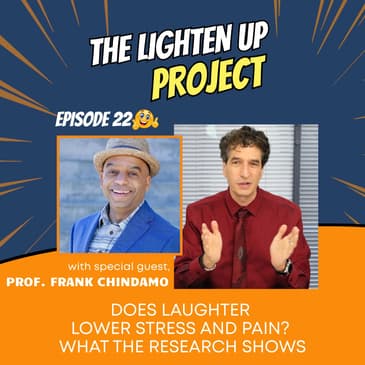
What if laughter wasn’t just a feel-good moment—but a scientifically proven path to healing? In this fascinating episode, Frank Cimato reveals how humor impacts pain, stress, and recovery—and why it might be the most overlooked medicine we have.
What You’ll Hear:
- The science behind laughter: how it reduces pain, stress, and cortisol
- Why humor isn’t just entertainment—it’s a powerful healing tool
- The surprising research showing laughter can outperform traditional treatments
- How laughter creates connection, emotional relief, and resilience
- The origin story of LaughMD and its mission to bring humor into healthcare
- Frank’s personal journey from comedy writer to laughter-as-medicine advocate
Resources Mentioned on this Episode
- LaughMD (Contact + Book Inquiry) Email: info@laughmd.com
- Book: If Laughter Is The Best Medicine, Why The F Don’t We Use It As Medicine? www.LaughMed.com -is the book website for "If Laughter is the Best Medicine, Let's Use It as MedicineThe New Science of Humor in Healthcare"
- Malcolm’s improv + laughter experiences https://malcolmgrissom.thrivecart.com/everyday-encores/
Meet the Host: Malcolm Grissom
Malcolm Grissom, affectionately known as "The Stand-up C.E.O.," is a team-building and employee engagement expert. Malcolm, an award-winning actor, comedian, International speaker, and best-selling author, masterfully blends humor, improv, and business acumen to enhance team dynamics and profitability. As a certified laughter leader, he leverages the power of positive psychology and his social work background to create engaging, results-driven experiences. Whether inspiring executives, strengthening teams, or energizing audiences, Malcolm’s unique approach fosters connection, creativity, and success. His ability to transform corporate culture with humor and insight makes him a sought-after speaker and consultant.
Follow Malcolm:
Website: malcolmgrissom.com
Facebook: facebook.com/malcolmgrissom
LinkedIn: linkedin.com/in/malcolmgrissom
Stressed, stuck, or leading on autopilot? It’s not a motivation problem—it’s a connection problem. Malcolm’s weekly virtual improv classes boost engagement, collaboration, and retention—all while having fun. Register now for a complimentary month: https://malcolmgrissom.thrivecart.com/everyday-encores/
We are proud to have The Lighten Up Project on the *High Vibe Podcast Network .* Grab your free gift from Malcolm in our Our High Vibe Gift Vault.
Love this show, check out the other shows on the High Vibe Podcast Network.
Share the Love
✨ If this episode lit something up in you… tag us on Instagram @HighVibeLeaders and let us know your biggest takeaway!
🦋 Don’t forget to rate & review — it helps us reach more conscious rebels like you.
🔊 Listen & Subscribe
🎧 Spotify
[00:00:03] Welcome to The Lighten Up Project, the show that reminds us that healing doesn't have to be heavy. I'm Malcolm Grissom, the stand-up CEO and founder of the World Laughter Organization. Let's explore how humor, heart, and play save the day and create spaces for healing and connection.
[00:00:33] So let's get ready to laugh, learn, and lighten up. Hey everybody, thank you very much for joining once again, The Lighten Up Project. Yes, another episode. Yay!
[00:00:57] Yay! And I, as you all know, and even if you don't, I'm going to tell you anyway, I'm Malcolm Grissom, the stand-up CEO and founder of the World Laughter Organization. And I have yet another great guest for you that I want to have a very stimulating conversation with.
[00:01:24] This man has been in comedy for over 45 years. He has been, did a little performing as an actor, mostly writing and producing movies for HBO, for Showtime.
[00:01:42] And now he's transitioned over to helping the medical field realize the power of laughter and humor in the healing process. He's founded a company called LaughMD. Please help me welcome Professor Frank Shimato. Thank you very much, Malcolm. Miss Groud. Oh, I'm sorry. It's Grissom.
[00:02:11] I'm Chindamo. The way I kept pronouncing it in my head and, you know, the mouth is just what the mind says. It's okay. Chindamo. Chindamo. Yeah. Chindamo. Chindamo. Like. That's okay. Italian. Chindamo. Chindamo. That's it. Yes.
[00:02:38] But it doesn't come out the way that my, I keep rehearsing it. You know, it's what it's like that actor's nightmare. You know, you keep rehearsing something over and over and over again. And then you actually say it and it's the wrong thing. You say it backwards. You know. I have no problem, Malkoff. Sorry. Malk. How come? Talcom. Talcom. Talcom. There it is.
[00:03:08] Malcolm. Yeah. Malcolm. Malcolm. Graysome. Graysome. Graysome. Actually, when I was my very first open mic, the emcee announced me as Malachi Gism. Woo. Wow. Which is a cream that you can get at the corner store. Yes. Yes. It is. We know it is now, but at that time, I didn't know. So.
[00:03:39] Right. Yeah. Anyway. Yeah. Chindamo. Sorry. That's okay. That's all right. Frank Chindamo. That's okay. Yeah. So, Malcolm. Yeah. What can I tell you? What would you like to ask about? Well, Frank, would you mind joining me in 20 seconds of spontaneous laughter? Sure. You go first. All right. All right. Ha, ha, ha, ha, ha, ha.
[00:04:10] Ha, ha, ha, ha. Ha, ha, ha, ha. Ha, ha, ha, ha, ha, ha. Okay. 20 seconds. Oh. Frank, what is your relationship with laughter? We're very good friends. We partied on good company. The lawyers really, you know, worked something really nice out between us. Now I get to see the kids on the weekends. Okay. Yeah.
[00:04:38] And really, so you don't have that much relations with laughter. That's interesting. No kidding. No kidding. Yes, I know. Rae. Oh, wow. Okay. You're the first. Ha, ha, ha, ha, ha, ha. So, yeah, I mean, I was a kid. I was probably in a really rough neighborhood in Queens.
[00:05:02] It was where they, it's where the movie Goodfellas takes place, except this was the real life version of that. So, a lot of tough guys. I was a short little guy with a jufro and a big nose. So, not the most popular. And as they would say, I had a very punchable face. And so, I learned to avoid getting a beating. You could just make the bullies laugh. Mm-hmm.
[00:05:29] That, especially with self-deprecating humor, worked really well. Why would they hit you when you'd already, you know, crapped on yourself, right? Right. Right. Right. Yeah. It was a survival technique. I had some issues in high school where it was a similar thing where I was really batted around a lot. And I found a tribe of other guys. It was an old boy, old Catholic high school.
[00:05:56] But I found a tribe of other guys who all loved Monty Python the way I did. And so, we bonded on, like, performing Monty Python sketches for each other. And that kind of led me into college where I worked writing and producing comedy videos and things. And that led to my career at SNL.
[00:06:21] So, as a child, did you, I know you made others laugh. Did you laugh a lot as a child? Oh, I did. I loved comedy. You know, when I was a kid, I had more. Sorry, my dog is going crazy there. Can you hear the dog in the background? I, one woof. That's it. One woof. Okay. So, I had more comedy records than music records. Here, I'll show you.
[00:06:51] I had, like, the Monty Python record. And how many people bring props? I had this Monty Python record. Uh-huh. And I had, let's see, a Charlie Brown record. And this is a rare one, actually. This is Woody Allen. Oh, yeah, yep. Yeah. Yeah. He actually took all those back. Here's the, SNL had a record.
[00:07:20] You know, it goes on and on. Fire Sign Theater. Mm-hmm. I don't like, I don't want to bore you or your listeners here, but I even had Monty Python's previous record. So. Okay. Yeah. That was what I was listening to instead of music. Right. Loved, loved comedy. I think comedy to this day is an unsung, underappreciated art form.
[00:07:48] Did you know that it's like a five to one ratio with comedy versus drama for the Oscars? What do you mean? In other words, the Oscar for Best Picture goes for every one Oscar for Best Picture that's a comedy, fire go to dramas. Oh, yeah. Oh, yeah. Yeah. For sure. Yeah. They don't take the unserious seriously. Right. Right.
[00:08:17] No, they don't. They don't. But you do now, especially with your Laugh MD, and I'm really looking forward to talking more about that. But before I do, I want to get to know you a little bit more. Who was, so you said that comedy and making bullies laugh was a way to get a lot of people
[00:08:47] get them on your side. Was there ever a time that you felt or did you feel that comedy or your ability to make others laugh gave you a certain superpower, so to speak? Well, yeah. Yeah.
[00:09:12] In that it made people pretend to like me or maybe like me. And when you're a highly low self-confidence, low self-esteem teenager, it was a way to get people to pay attention to you and to not ignore you. You know what I mean? And it became very useful.
[00:09:39] And it became a useful skill even when I started to go to film school and things like that. Because if you could make people laugh, they'd want to work with you. And when I went to get my master's at Columbia University, everybody there had to make one film per year and you were supposed to do it in two years. So some people made only two films. And I held the record.
[00:10:06] I made nine movies while at Columbia because people just like working with me and it was fun to do. And I made comedies. So that's fun, right? So it helped. Yeah. Yeah. Okay. So when was the first time that you realized that laughter wasn't merely this entertainment
[00:10:28] thing that helps you avoid being bullied or helps you make movies and entertainment, but it actually had that power to heal? So it's 1981 and I'm working on a TV show. And this TV show was a comedy. Can you read what that says there? No.
[00:10:58] Can't. Oh, yes, I can now. Saturday Night Live. Exactly. So here I am. I'm this script boy for SNL and I'm making my notes and I'm 19 years old and I'm there working every day at SNL and getting my undergraduate degree at NYU. And at the same time, my dad was passing away of cancer, right?
[00:11:25] And so when I would go to his hospital room, I wished that there was some way that I could bring what we were doing in SNL to his hospital room because of the old expression, you know, laughter is, what is it, Malcolm? It's the best medicine. There you go. So I knew he was, you know, a goner. He had cancer pretty badly, but it still felt like there was some way that, you know, we
[00:11:52] could make his final days on earth a little bit lighter, a little bit better. He was watching stuff like Matlock and CSI or, you know, terrible, horrible, bloody underwear detective dramas, right? And laughter would have done him good. So that kind of stayed with me for a long time until I got my first break. Okay. Okay.
[00:12:17] What is it that you really want people to remember about you, you know, and about your laughter even more than the punchlines? I think the fact that laughter can make you feel better, that laughter is something that brings people together, that laughter, a joke is a, is like an island between two people that you can both stand on, right?
[00:12:47] Mm-hmm. And it's, it's a, it's a beautiful thing for someone to say something that's funny and for someone else to catch that wave and get the joke, especially impromptu humor. Right. Yeah. Yeah. Definitely.
[00:13:10] So you like you, so if I'm understanding you correctly, you are saying that you want to be known for creating laughter that hopefully somebody else will get the joke and so you- And feel better from it. Yeah. Yeah. Yeah.
[00:13:50] Sometimes custom service people are being crapped on by mean customers and stuff like that. And if you can brighten their day with a smile and a, you know, a funny little observation that's, that's not hurtful or harmful in any way, then you just, you know, you just made somebody's day, right? Right. Yeah. What's not to love? That's true. That's true. Okay. If I could do it for millions of people, even better.
[00:14:16] And that's the whole idea behind Laugh MD is to use the power of humor, that God given gift that we have to laugh that produces endorphins and serotonin and dopamine, lowers your cortisol and your adrenaline, the negative hormones. Why not use that, right? It's free. Go for it. True. How do you personally define healing? Healing. I don't know.
[00:14:45] Feeling better in the future than you did in the past? And then that, so obviously that is what drew you to then form Laugh MD. So tell us the story, if you will, behind how Laugh MD got started.
[00:15:12] So having had that experience in the hospitals with my father, when a very good friend of mine, John Bonswell, was in Kaiser Permanente Hospital for a year and survived, they said, well, congratulations, you're going, Laugh MD. And you've been the longest customer we've ever had that's lived. What's your feedback about this place? What's the customer service feedback? What's your exit interview? What would you change? And he said, the nurses are delightful.
[00:15:41] The doctors are phenomenal. The facility is beautiful. But the TVs suck. You just have basic cable on the TVs that it's nothing but loud commercials and graphics coming at your face. And it's very stressful. And even if I'm not watching it, the guy in the bed next to me is watching it. And he said, it's still loud and annoying and interrupting. And you really need to do better on that. And they said, well, what should we do? And he said, I've got a friend with a company called Fun Little Movies.
[00:16:11] And they make short, little, funny, pleasant, family-friendly comedies. Why don't you call him? And they did. And that's for your viewing audience. Those are some of the awards that I won for making those movies for HBO and Showtime and CBS and things like that. And we offered to put a channel of comedy videos on the TVs at Pazer Permanente and Hollywood. And it worked out. It worked out really well. They liked it.
[00:16:41] We liked it. The patients liked it, especially. And we felt like, great, this is fantastic. I'm glad this works because it cost me $20,000 in equipment and manpower and jacking into the cable system and all this. And we said, well, so if we charge you $80,000 a year, then we can make enough money to do this and make this a business. And they went, huh, you're hilarious. We're not paying you.
[00:17:11] What? And they said, yeah, I know. This is like the volunteer stuff. This isn't medicine. There's no scientific proof that laughter helps. And I went, oh, my God. And so that's been the 10-year journey is to prove the science that these funny videos will help with your healing. Mm-hmm. Okay. And how did they have you gone about doing that?
[00:17:41] Well, so far, we've done five studies or studies or surveys. The first one, we got some doctors at USC where I was teaching in the University of Southern California to watch comedy for an hour. And they did. And their stress was lowered by like 94%. And we went, great, fantastic. Okay, we know this works. And everybody went, a doctor doesn't have 60 minutes free until about three months after they retire.
[00:18:09] So try again, Kim Wasabi. And so I was then teaching at Chapman University. And we took the psychologists there. And we showed them a three-minute comedy video. And it reduced their stress by 13%. And it made the front page of their paper. And we thought, okay, we've done it. We've proven it, right? It's great. And not so fast.
[00:18:35] To try and sell it as an app was, you need more and more and more data to prove it out. So we did another study during COVID, mind you, at USC's Norris Cancer Center. And we lowered pain and stress in 94% of the patients. We reduced symptoms. We did a whole bunch of good things there. And that's not been quite enough. So we did our fifth study.
[00:19:05] I promise, no more boring study talk. But our fifth study showed that we lowered chronic pain by 60% in chronic pain patients. And do you know what drug lowers pain 60%, Malcolm? Laughter. No. That's it. Hey. That's it. Nothing else. Even opioids do 50% at best. And we did 60%.
[00:19:31] The patients went from a 10.6 pain level to a 4.2 pain level. Wow. And how is this? I mean, how do you measure someone's pain level? That's a good question. There's a number of different tools for measurement. One of them is called the McGill Pain Questionnaire. And it's a rigorous set of questions that takes about 15, 20 minutes to fill out.
[00:20:00] So if you weren't in pain at the start of it, you will be by the end. That kind of happened. Yeah. And so we would measure what's your level of pain right now and then watch comedy for a week. And now what's your level of pain and watch comedy for another week. And we went on for four weeks. And like I said, it just kept dropping and dropping. But they were doing it rigorously every day. And they got to keep the iPad if they did it.
[00:20:28] And that's why people did it, yeah. But it really worked. We're doing it now with oncology patients at the Oncology Institute of Hope and Innovation. And we're allowing pain and stress and even blood pressure there with comedy videos. That's excellent. That really is excellent. Thank you very much.
[00:20:51] And how do you, like with blood pressure, I know that laughter does help with blood pressure and with stress. I know that. And I know how to measure. Like with me, I can take my measurement on my blood, my beep. Frank, something that you should know about me.
[00:21:18] And some of my guests, if you've been watching for a long time, you know this as well. But as a child, I had a virus that now I have some slight brain damage. And so once in a while, I lose my words. I lose focus. I, you know, just get tongue-tied. I just don't know what to say for a second.
[00:21:48] So when that happens, just bear with me because it's coming back. I'm like my words are like these little children, these mischievous children playing right to speak, you know. But I will find them and I will come back. So bear with me when that happens. Well, if they're like missing children, just look on the back of a milk carton and you'll find them. There you go. There you go.
[00:22:18] Yep. There you go. Hey, so where in your life, where in your life do you really give yourself permission not only to laugh, but just to play? And then where do you still find yourself holding back? Wow, that's a complicated question.
[00:22:45] I'd say I give myself permission to laugh when I'm with friends like everybody does. I have a prescription of watching comedy right before bed. I'll finish working. I, you know, just finish writing a book. So that meant I was at the desk till 11 o'clock every night. But then at 11 o'clock I'll put on, you know, the funny monologues of Colbert and Jimmy Kimmel and things like that.
[00:23:10] And I give myself permission to laugh at that time until I fall asleep. And it's always really good and it helps a lot. I'm 66. People say I don't look it. Probably because I have that youthfulness that is given to you by laughter. Mm-hmm. Yeah. Is there somewhere in your life that you find that you hold back?
[00:23:38] Like with me, even though I am, I'm an extrovert and I love to laugh and make other people laugh. Especially because of my, what I went through with my disability and being teased and bullied and my internal bullying and all that.
[00:24:02] And flipping back into my shell, especially because of that, I find myself going back in my shell. And there's times when I really wish that I could lighten up a little bit. Are there any times like that for you? Yes.
[00:24:24] Because having, you know, self-esteem issues, having confidence issues and things like that. It can be especially challenging when you have depression, let's say. And then laughter, you know, a comedy movie, a comedy video, sharing a joke, hanging with friends, getting my girlfriend to laugh, which is not easy.
[00:24:53] And if I can do that, then all those things kind of make the bad stuff float away. Mm-hmm. Okay. Yeah. Yeah. I love it. I love it. All right. Great. How would you finish this sentence? Because healing doesn't have to be heavy because.
[00:25:20] Because healing is bringing you towards a better place and you can use humor and comedy to get there faster. Yes. Okay. Okay. All right. I like that. I like everything. People come up with wonderful answers to that and I really like that.
[00:25:50] So, if you could send a message of hope through laughter, who would it be for and why? I would send it to Dr. Ken Jeong. Ken Jeong is a guy who's in the book that I like to talk about. Ken Jeong is a guy who started out as an MD. His wife, Trian, was an MD as well.
[00:26:20] And between sets, between shifts, he started doing stand-up comedy, right? And he was an outrageous and energetic and he was just a Roman candle as a stand-up. And people really took to him. So, he started to get parts in movies and TV shows and he was on The Masked Singer. He's in Crazy Rich Asians. He's in K-pop Demon Hunters.
[00:26:46] He's in just a trillion different movies, Community and all this stuff, right? And sure, he can carve his own path, but he doesn't stop being an MD. He renews his medical license every year and he's actually been on stage doing stand-up where he's actually had to save a life of somebody who was having a seizure.
[00:27:12] And the most heroic thing that I think he's done, during the low point of COVID, he went on to Jimmy Kimmel as a guest, right? And instead of talking about promoting his latest project, he actually talked with Kimmel as a doctor, as an MD, and talked about what did work and didn't work and why vaccines do work and there were mythical drugs that didn't work and that sort of a thing.
[00:27:40] And he was very serious about it. And there was something super special about the fact that a guy who is in the business of being funny and making a laugh and being a really good actor and all that, would take his opportunity on a national TV show to tell you how to be healthier in a dark time of COVID. To me, that's the one guy that I would want to reach out to. Yeah. Yeah.
[00:28:10] Yeah. Beautiful. So our time is winding down, but before we close, one I would like to, I have for our listeners, you can go in the show notes, you can find the links to books, you could find links to how to connect with Frank. But Frank, I would actually like to give you an opportunity
[00:28:40] to actually verbalize before you talk about the book that you just mentioned and you said you want to talk about more. Tell people how they could connect with you. Let's see. Well, I'm usually on the entrance to the freeway with a window washer. So you can just get me there.
[00:29:00] And if not there, you know, info at LaughMD, info at L-A-U-G-H-M-D.com is the best place to do it, info at LaughMD. And if you want to get a copy of the book, you can write to us there. It's a pre-published version of it. It's going to be published, but before that, you can get a copy of it. And should I tell them about it?
[00:29:31] Yes, please do. Okay. Well, it's called, If Laughter is the Best Medicine, Why the F Don't We Use It as Medicine? I'm keeping it clean for you, Malcolm. Thank you. But if laughter is the best medicine, why the F don't we use it as medicine? And it's a guide to how you as a patient or you as a doctor or you as a healthcare facility
[00:29:54] can use laughter and humor to your benefit, to your health benefit, to your emotional benefit, and to your financial benefit. Yeah. Yeah, definitely. The finances is one that we've talked about on this podcast, and we'll continue,
[00:30:19] because we have some CPAs coming up in later episodes. But, yeah, laughter, a lot of people do overlook, you know, the many aspects of how laughter can really help. My dog does not. I guess not. Yeah. I suppose not. No? The dog whines.
[00:30:49] How professional of me to have a dog in the studio. So, what's... Oh, that's okay. This is super non-professional. Super non-professional. Not just non-professional, Frank. It's super non-professional. That's the rating I usually get when, you know, my work is assessed. So, perfect. Perfect.
[00:31:16] Well, Malcolm, it's been a joy to talk to you. I would never have known that you had any sort of a handicap unless you mentioned it. So, thank you for sharing that. You're a unique and wonderful and very charming and sweet man. So, I'm glad we got to know each other. Yeah. Do you tell people how they can contact you? I do. I do. People can always contact me.
[00:31:43] My website, which is MalcolmGrissom.com. And that's M-A- Oh, well, my name's spelled right there. Right there, believe me. Yeah. Malcolm with two L's. Don't forget, it's not one L. It's two L's in Malcolm and then Grissom. So, Malcolm like Malcolm X and Grissom like the astronaut Gus Grissom. But the young people don't know that.
[00:32:14] Like Gus Grissom. Who's Gus Grissom? Oh, they shouldn't feel bad for themselves. I don't know who Gus Grissom is either. Oh, okay. Okay. Yeah. He was the one that went up right before Neil Armstrong. He was in that. Yeah. Oh. Well, Lieutenant. Yeah, the Apollo 10 right before Neil Armstrong. And unfortunately, he did not make it. Oh, wow. What do you mean he didn't make it?
[00:32:43] What, did they leave him on the moon? He's still waiting. No. No. Meaning it, his, um, they crashed. They crashed. Apollo 10 crashed? Apollo 10, yeah. Yeah, it crashed. Wow. What a delightful way to end the show. Well, we're not going to end the show that way. So sure. I would like to know, what's the one thing that you would like our listeners to remember?
[00:33:13] Probably their own name and social security number. Mm-hmm. Would be good. You know, stopped on the street. You should know that in case ICE comes after you. Yeah. Definitely. Yeah. Definitely. Do you want them to remember anything about you or LaughMD? Oh, well, about, about us. Yeah. I would say that if you can remember that there is a book out there called, If Laughter Is the Best Medicine, Why the F Don't We Use It as Medicine? And that it gives you instructions.
[00:33:43] It doesn't just talk about the science of humor or the history of laughter. It also talks about heroes in our society from the Pope to Norman Cousins, to Patch Adams, to Lieutenant Command, Lieutenant Colonel Robin Phoenix Johnson, who all found ways to use humor in phenomenal, heroic ways. Yes.
[00:34:11] And then it says, well, if they can do it, so can you. The way you're doing in Malcolm, for example, is one way. And so it says how you can do it as a human being. You as a doctor could do it. And you as a healthcare facility can use laughter to your benefit. Yeah. Yeah. Most definitely. Most definitely. So remember that. I will. And the audience, please remember that. Info at LaughMD.com is where they should go.
[00:34:41] All right. Great. Well, Frank, thank you so much for your time and your knowledge about laughter and your stories about the healing power of laughter and humor and comedy. It's been so great. Thank you very much for being part of the episode.
[00:35:07] And audience, thank you all for paying attention, for tuning in once again to the Lighten Up Project. And please come back next week when we have yet another stimulating conversation. And until then, please remember every smile can open a door. Every laugh can open a heart.
[00:35:35] And every step can be a victory. Thank you so much. Until now. Yeah. Thank you. Thank you. Thank you. You've been listening to the Lighten Up Project with Malcolm Grissom. Stressed out, stuck, or leaving on autopilot? It's not a motivational problem. It's a connection problem.
[00:36:04] My weekly virtual improv classes boost engagement, collaboration, and retention all while having fun. Register now for a complimentary month. Details are in the show notes. Healing doesn't have to be heavy. And Facebook doesn't have to be boring.
[00:36:27] Find out about upcoming episodes, suggest future guests, and join in on the conversation. Like our Facebook page, Lighten Up Project Podcast. If you've enjoyed today's episode, share it. If not, share it anyway. Please subscribe to our YouTube channel at Lighten Up Project Podcast.
[00:36:58] And rate us on the podcast platform of your choice. Remember, laughter isn't just reaction. It's a revolution against the heaviness of the world. So keep shining. Keep showing up. And when life gets heavy, don't tough it out. Lighten up. チーン up. Okay. And we'll see. Bye.