
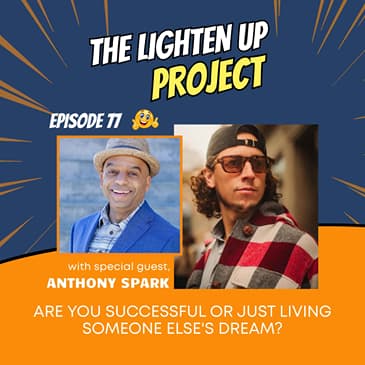
What if chasing success is actually keeping you from it? Anthony Spark — founder of Spark A Change Coaching, a top-tier leader in network marketing for over 20 years, and a guy who retired from his day job at 25 — joins Malcolm to talk about laughter as a deliberate choice (not just a reaction), why being authentically yourself always comes with a cost, and how identity, not income, is the real starting point for financial and personal freedom. Because real success isn't about becoming who the world wants you to be. It's about having the courage to become who you truly are.
What You'll Hear
- Redefining success: Why money, status, and recognition aren't the only measures of a meaningful life.
- Authenticity takes courage: How trying to please everyone can disconnect you from your true identity.
- Laughter as a choice: Why humor can help us navigate setbacks, uncertainty, and everyday challenges.
- Financial freedom: How shifting your mindset and developing better money habits can create more choices.
- Leadership and personal growth: Why great leaders empower others to think independently rather than simply follow instructions.
- The power of discomfort: How embracing uncertainty and applying improvisational thinking can support personal and professional growth.
Resources Mentioned on This Episode
- Spark A Change Coaching: Anthony's business and life coaching practice.
- Complimentary coaching consultation: Anthony mentions offering a free 30-minute introductory session.
- Anthony's book: A complimentary copy is offered during the episode, although the title isn't specified in the transcript.
- Man's Search for Meaning by Viktor Frankl: Referenced during the conversation about choosing our responses to difficult circumstances.
Featured Guest:
Founder of Spark a Change Coaching, a values-based coaching practice focused on sustainable personal and business growth. Top 0.4% leader in the global network marketing industry for over 20 years. I’ve helped built and led international organizations and run companies with the cumulative total of millions of dollars of revenue. Helped clients eliminate more than $10 million in debt, and supported them increasing their annual income by $8 million per year. My work has reached hundreds of thousands of people worldwide through coaching, leadership training, and live events across the U.S., Dominican Republic, Australia, New Zealand, England, and beyond.
More about me: I'm Life and business coach | Philanthropist | Money coach | Author |
Personal development specialist. I began working full time at fifteen, launched my first business by eighteen, and retired from traditional work by twenty five to pursue leadership and impact-driven entrepreneurship. I recently built my Ai Company with my brother in law called Atlas Minds and a Virtual Assistant Placement Agency called Founder's Right Hand.
Connect with Anthony:
Websites & Funnels Podcast: www.extraordinaryexcellence.com
Coaching Website-www.sparkachangecoaching.com
1-1 Coaching Landing Page-https://sparkachangecoaching.com/mentorship
Free Lead Magnet- https://sparkachangecoaching.com/opt-in-page
Spark’s Notes https://sparkachangecoaching.com/newsletter-page
Ai company: https://atlasmindsco.com/
Social Media Accounts:
Youtube: https://www.youtube.com/@SparkAChangeCoaching
Instagram: https://www.instagram.com/sparkachangecoaching/
Tiktok: https://www.tiktok.com/@_sparkachangecoaching
LinkedIn: https://www.linkedin.com/in/anthonykspark/
X: https://x.com/_sparkachange
Facebook: https://www.facebook.com/profile.php?id=61585084903103
https://www.facebook.com/mr.anthony.spark/
Book: https://www.amazon.com/Phoenix-Manifesto-Control-Destiny-Ashes/dp/B085RV56KR
Newsletter page: Spark’s Notes https://sparkachangecoaching.com/newsletter-page
Meet the Host: Malcolm Grissom
Malcolm Grissom, affectionately known as "The Stand-up C.E.O.," is a team-building and employee engagement expert. Malcolm, an award-winning actor, comedian, International speaker, and best-selling author, masterfully blends humor, improv, and business acumen to enhance team dynamics and profitability. As a certified laughter leader, he leverages the power of positive psychology and his social work background to create engaging, results-driven experiences. Whether inspiring executives, strengthening teams, or energizing audiences, Malcolm’s unique approach fosters connection, creativity, and success. His ability to transform corporate culture with humor and insight makes him a sought-after speaker and consultant.
Follow Malcolm:
Website: malcolmgrissom.com
Facebook: facebook.com/malcolmgrissom
LinkedIn: linkedin.com/in/malcolmgrissom
Stressed, stuck, or leading on autopilot? It’s not a motivation problem—it’s a connection problem. Malcolm’s weekly virtual improv classes boost engagement, collaboration, and retention—all while having fun. Register now for a complimentary month: https://malcolmgrissom.thrivecart.com/everyday-encores/
Share the Love
✨ If this episode lit something up in you… tag us on Instagram @HighVibeLeaders and let us know your biggest takeaway!
🦋 Don’t forget to rate & review — it helps us reach more conscious rebels like you.
🔊 Listen & Subscribe
🎧 Spotify
Hello, all my fellow light makers. It is I again, the leader of the pack. Yes, it is Malcolm Grissom, the stand-up CEO and founder of the World Laughter Organization. And thank you so much for joining me again on the Light Not. Up project because today we have yet another fabulous member of our Lighten Up nation. You are going to love this. It is going to be a great conversation today. We are going to be talking about growth, and I know we talk about growth every episode. Say, Malcolm, what's different about this? Well, we're not talking just about the kind of growth that you post on social media. Hey, I went there, here, and look, hey, celebrate my life. No, we're talking about the kind of growth that actually changes your life. Today, my guest is Anthony Spark. Anthony Spark is the founder of Spark a Change Coaching, a top point 4% leader in the global network marketing industry for over 20 years, so he knows something about what he's talking about. Just a little something, something. Anthony has also helped build organizations generating millions in revenue, supported clients, eliminating over $10 million in debt. He's helped increase incomes by millions more, all by reaching hundreds of 1000s of people all around the world, he started at age 15. He launched his first business at age 18. He retired from work at 25, and he kept building anyway because that's what we do. That's life. We just keep building. We keep moving, and Anthony is a great example of that. So now he's in AI and business and systems and creating that. Now our conversation today is going to be about leadership. It's going to be about money. It's going to be about creating a life that actually works for you. It's going to be about laughing and enjoying and all all of the above. It's all the things basically. This conversation is all the things. So let's lighten up. Let's spark some change and welcome Anthony Spark.
Anthony Spark:What an illustrious introduction! Thank you, Malcolm. You're a lot of fun. It makes a lot of sense that this is the main thing you're doing. You know, I'm really looking forward to spending some time with you. So I do want to make sure I don't want to ever over overemphasize myself. I'm in the .04% of the network marketing company, so decimal is a little bit smaller, but not the whole. I want to misrepresent, and I was able to leave my full-time job at 25, and I made enough for my network marketing company at that point. And you know my wife's able to leave her job a few years later. But it's been a fun ride. We're so thankful for our life, and I'm so thankful to speak to you today. And I appreciate you sharing your audience. And I look to hopefully make sure this next 30 to 700 minutes is worthwhile for you guys in your life.
Malcolm Grissom:I'll definitely, definitely, it will be. It will be. Can you join me in 20 seconds of spontaneous laughter?
Anthony Spark:Sure.
Malcolm Grissom:All right.
Anthony Spark:Let's go.
Malcolm Grissom:All right. 123, go.
Anthony Spark:Oh man! You are fun, Malcolm.
Malcolm Grissom:Yes, it is. Yes, it is. It's just it's the beginning of the roller coaster of fun that we here call.
Anthony Spark:I love it.
Malcolm Grissom:The lighten up project. Yes. So, Anthony, what is your relationship with laughter?
Anthony Spark:If you're not having fun in your life, and we don't take the honest perspective that we've chosen a very large percentage of what we do, things we can't control, we certainly can. We can certainly choose our point of point of view, our mental frame, our paradigm. You know, anyone that's Red Man's Search for Meaning by Viktor Frankl. If a guy in the middle of the Holocaust can choose control of his minds and thoughts. No matter what situation we're dealing with, good, bad, terrible, or in between, we certainly can choose it. But if you're not enjoying your life, the past doesn't exist. The future is a construct. If you're not having fun and you're not laughing, you're not laughing as things happen. You know, I had a just this morning. I woke up. I have a whole bunch of stuff. Business is how it goes. Why you make a lot of money? Big swings, big problems. Things don't go the way you want. I woke up this morning and somebody had accidentally deleted one of my corporate calendars for the entire year with several 100 events and everything in there. What are you gonna do? All you could do is laugh. You figure it out and you just move forward. Otherwise, you lose your life. We can't control everything, so I think laughter is absolutely paramount. Because if you're not laughing and you're not enjoying, what is everything else worth?
Malcolm Grissom:Very well put. Very well put. Yes, I love that. When so we so you mentioned laughing every day and laughing things off, and great example about something that went wrong today. Yeah, this
Anthony Spark:morning. I'm still in the middle of it.
Malcolm Grissom:Yeah, yeah, great example. Now, when is the last time that you actually had a genuine gut-busting laugh.
Anthony Spark:That's a at absolute minimum two to three times a week, but that's most days. That's most days. Me and my wife and my kids and the people I work with laughing. I think is one of the most important things, you know. I also I I send probably hundreds of memes per day that are different categories based on the person I'm sending it to for what they find funny. Finding laughing and enjoying life, I I can't emphasize enough. There's no amount of money or status or fame or the things that very often respect. There's nothing that takes the place of laughter and joy, and very often we try to fit things into a hole that doesn't fit in. That's that's as often as possible, and if I'm not giving that to at least somebody else a few times a week, if not really every day, then we have we need to reorient in my world.
Malcolm Grissom:Have you ever seen so laughter's obviously changed the course of your everyday life.
Anthony Spark:Oh yeah,
Malcolm Grissom:you know you you mentioned that several examples, but is there a moment where you've noticed that it's really altered someone else's not their entire life, but just their day or the the direction of their day.
Anthony Spark:I will think as I'm talking of trying to make more of a specific example, but I can say in my second or third grade class, I can remember back where you were supposed to write something about someone. I think it's primarily their birthday or something, and I got about 90% funnies and about 10 or 20% smarts. And funny, I think, is the most important of all of them. So that's been the way I've always lived my life. I come from a lot of dysfunction, a lot of craziness. The reality is that laughter does not need to be in a perfect place. Laughter is not only when things are going good. Laughter is an antidote to the storm and the challenges of life, and it's one of the only ways that you can bulwark your soul to be able to deal with a lot of this stuff. So, a specific example of where it changes things that's been my whole life: making people laugh, laughing myself, having fun. Now, I did lose a lot of that as I, you know, in more global sense, I did lose that a lot as I was building companies and I became out of alignment with what my values were, and I really started to try to act in a certain way that was going to get me professional acclaim, that was going to get me money, that was going to get me success, that was going to rise me on the political social hierarchy ladder. I started really shaving a lot of those edges down until that avatar became impossible to carry. So there were some real dark times in my life where I did just not laugh, and I was taking everything way too seriously. And this thing was crushing me, you know. But the reality is, some people are going to like you. Some people aren't. Some people are gonna like the direction you go. Some people aren't. But if we live our life in a way that we're trying to win a global popularity contest where everyone likes what we're doing, there's a guarantee that you're not gonna like what you're doing and who you are because you've you fit yourself. You've become a chameleon where you're
Anthony Spark:not true to yourself. So a specific instance, I think that you know, my wife and I, we used to just fight, and we had to work really hard on our marriage. Now we just fight and laugh, and we laugh it off, and we make fun of each other and make it fun. And you know, people are different. You know what I mean. So rather than being angry and staying angry, I'll say that's probably one of the biggest ones. Staying angry for hours or days about the way someone is or what someone said, we we joke about it and we laugh with each other, and and you move on, you know. And you're not going to always change. Everything's not going to be perfect, but we choose to find joy and laughter. So I say, as micro as I can get, I would say that that in my life as a pattern is probably one of the biggest.
Malcolm Grissom:Wow, you've just brought up so many things that so many gems just in what you said right there, and this is great. But let so there's one thing that you said that I want to emphasize for our listeners, and it's about life. It's not a popularity contest. Yeah, life is not Facebook. You know who cares? I mean, who cares? You don't. It. It's not keeping up with the Joneses. It's about being who you are, and um, and that is very true for companies and organizations
Anthony Spark:as
Malcolm Grissom:well. So the more you define yourself, the more you are yourself, the more you attract people who follow you.
Anthony Spark:Yeah,
Malcolm Grissom:and just like you said, some people will not follow you either personally or business. Oh well, you know there's always the people that don't. So we as humans we have a tendency to focus on the people that don't follow us. Like
Anthony Spark:yes,
Malcolm Grissom:as a stand-up, as a stand-up comic, when I was actively performing, myself and other fellow comics would have a tendency to focus on the people who aren't laughing. Why is this person not laughing? You know we're getting laughs from nine from 80% of the crowd. You know, but we're focused on the 20%. And you're right. It that's not that's not no way to live.
Anthony Spark:Right.
Malcolm Grissom:That's no way to grow and become who we are and who we should be.
Anthony Spark:Yes.
Malcolm Grissom:So wonderful. I I'm glad you pointed that out.
Anthony Spark:Yeah.
Malcolm Grissom:Something else that
Anthony Spark:I think if I could riff off that first, Malcolm, would that be okay? Yeah.
Malcolm Grissom:Please, please. Because
Anthony Spark:this is a really important thing that can sound really good on paper, but I think it's important people understand both ends of it. First off, people may like you for a season, and your direction may change, and that's okay. It's never fun, but there are real world business and personal costs to being yourself, and the challenge sometimes people don't realize is that it sounds easy to be yourself. It sounds easy to not focus on those people, but people not liking what you're doing, not liking who you are, is never the goal, and it's never fun. It's not like that's a like it's not like a hey I love when people hate me. I don't think anybody really feels that way. They may build a defense mechanism and maybe use that as some type of fuel, but the challenge becomes is when we're not who we actually are, then there's no reality to any of the relationships. So if you don't have the courage to be yourself, and that's why I knew I was going to like you from the jump because you're unapologetically being yourself, and the reality is, if you're going to unapologetically be yourself, it guarantees that there's a lot of people that are going to love you, but it also guarantees there's a lot of people that are going to hate you and make fun of you and not like. And I think sometimes people get lost. I don't think it's a right or wrong because it's really easy from our own perspective, being the main character in our own life, to say that I'm right and they're wrong, there's just different rights for different people. So some people they like me, some people like my talents, but they don't like how I am. Some people like Malcolm, some people don't. But if we're not going to stand in that and have the courage to do that, our entire life is fiction, narrative, and us playing a character. And I'm not discounting the real world business financial costs of being yourself because I've encountered a lot of them in doing this and acting this way. But I
Anthony Spark:believe that the benefit of who you look in the mirror, you respecting them, liking them, loving them, and the people in your life actually knowing you to love you or hate you is much more important.
Malcolm Grissom:Right. Yes. Yes. Okay. All right. There's. Um. I'm glad. I'm glad that you mentioned that because yes, it is not. It is definitely not all good.
Anthony Spark:No, it isn't, and that's okay.
Malcolm Grissom:There's a a bad part, and yes, that is okay, and it's important to be okay with that not being okay.
Anthony Spark:Yes,
Malcolm Grissom:to have to to make because this just came to my mind. So I teach virtual improv classes, and people ask ask me, and I I especially market that towards entrepreneurs and corporations, but
Anthony Spark:love that
Malcolm Grissom:entrepreneurs and sales, especially for sales and a lot of entrepreneurs ask me about well, how can improv help with sales? And I think what you just mentioned is one of the small ways that improv can help is with sales, and you know, in life, that's what we're doing. We're selling ourselves. In we're selling our business every time we get out there and we market. We're selling our business, so it's all about sales. And with improv, or wait, I'm sorry. With sales, we need to be comfortable with the uncomfortable.
Anthony Spark:Correct.
Malcolm Grissom:We need to be comfortable knowing that we're going to lose 50% of the sales. 50% of the people aren't going to buy. They aren't going to care about us.
Anthony Spark:If you're the best at it, 50%. Hey,
Malcolm Grissom:thank you. you, thank you. Yes, if you are the best, 50%, great, great. Yes, and improv helps us be comfortable with those uncomfortable moments.
Anthony Spark:Yes,
Malcolm Grissom:helps us say, okay, well, we're ready to accept whatever you give, and we are going to react off whatever you give and enjoy whatever you give, right? And build on
Anthony Spark:it,
Malcolm Grissom:right? So, just I'm sorry, I just thought it. I'm
Anthony Spark:with you,
Malcolm Grissom:Rich. You
Anthony Spark:never, you never disagree in improv. That's the first rule, and the second thing I think a lot of people will often miss is that when you take a discipline that is totally separate, and then you take some of the things that are known and obvious in the rules in that discipline, and you move it to a place where those rules and those lessons are foreign, you get this beautiful overlap, and it's why very often people that over specialize their whole life in one thing, they're very very rarely innovators or creating crazy things. You know, because you got to take something from one place and then cross discipline, see the the overlap in that Venn diagram, and now suddenly you become an innovative trailblazer when everyone in improv knew this, everyone in sales knew that, but very few people know both.
Malcolm Grissom:Right, right. Thank you. Great. Yes. Excuse me. So we were talking about laughing and and your life, and I wanted. I was very curious. Do you think laughter is only a reaction?
Anthony Spark:No, that can be a choice. You can choose to laugh. You can choose to be crushed. You can choose to laugh. You can choose to be upset. You can choose to be joyful. You know, so laughter is something. It's it's almost it's the designing of the environment that you want to live in. Anything that is masterful looks effortless, and you end up with these double compound interesting things. A law of mastery is that you make things look effortless, and it also raises your social social status. So you take a guy like Houdini; he would never let anybody see him practice, and he would spend hundreds of hours never seen practicing something, so that when he did an unbelievable death-defying thing, it looked like it was nothing. It looked like the guy woke up being able to escape handcuffs, chains underwater in a time frame. But it came from hundreds of hours of intentional effort, and I think very often people live in this Nicholas Sparks kind of I'm just going to find my soulmate and everything's going to work out, and that's just not how life is. So laughter does not need to. Reaction laughter can absolutely be an offensive choice for the way you deal with things, and when you look at all of the different philosophers, all of the different spiritual texts, it's always the same. You know, if you can't laugh and find gratefulness, because I think gratefulness can be a good complement to laughter, you're not going to be able to make it in a way that's even worth making it. So laughter can be an offensive choice and something that we choose actively, regardless of the situation.
Malcolm Grissom:Yes, thank you. Great, great. So let's talk about success for a moment, sure. So, why why do you do you think so many people chase success without getting clear on their values first?
Anthony Spark:Yeah, cultural pressure, family of origin, the traumas in the background of your family, living a shadow version of your life that someone else put on you, living the version of your life someone else tried to tell you to live that was maybe never your own, limiting beliefs, lack of discipline, lack of focus. Most often, people fail to know that the word success is a subjective interpretation. There isn't an objective right of success. So, if we take a titan of industry, is that person more successful than someone that chooses to work for very little money and dedicate their support to someone with special needs that's nonverbal? Is that person less successful than someone that becomes the best in their craft, regardless of how much money they make and the recognition that they have? Is that person more or less successful than the person that chooses to give all of their time and and their energy to their family to be a homemaker or to be a present parent? We just have to get clear for ourselves of what success is, and I think most people don't take the time outside of the cultural, societal, and family pressures to get really clear: is what kind of life do I really want to live? Because that answer has got to come from inside, not outside.
Malcolm Grissom:I love that. Thank you. Yes, defining success. So now let's let's talk a little bit about sustainable growth. So how do our values help create the sustainable growth, and not just in short term wins, but The actual, um, the actual not being able to talk, but yeah, the actual.
Anthony Spark:I'm tracking.
Malcolm Grissom:Okay,
Anthony Spark:I'm tracking, Malcolm. I got you.
Malcolm Grissom:Tracking.
Anthony Spark:I'm picking up what you're putting down. I'm smoking what you're rolling, bro. It's all good.
Malcolm Grissom:Right. All right. Okay.
Anthony Spark:So just because something works doesn't mean it's moral. So just because something can get a result doesn't mean we should do it. And this is very often, I think, a very slippery slope when it comes to a lot of different mentalities. I'll give two examples, right? So just because something makes more money in business doesn't mean it's ethical and it's properly making the right difference for people. When we treat people like numbers, we treat people like resources. Then it puts us in a position where we could get a outcome, but is it right? And that's a question everybody needs to sit with. You take I'm a big movie guy, big television guy, big reader. I love story. I love narrative. So I'm almost finished with the bear. I'm a bit late. Sometimes I miss the the wave, but there's this scene in the bear for anyone that's seen it, where you have Carmy, the head chef, and he's constantly had a lot of dysfunction, and you can see the coping mechanisms playing out if you've done any type of psychological and emotional work, and the the things it's causing good and the things it's causing terrible in his personal relationship versus professional success, and there's this scene that he keeps going back to of this guy treating him like absolute garbage, and this executive chef that's talking down to him, and it's like this PTSD flashback he has. Which, of course, if we don't forgive and we don't move forward, we replicate. So he has both the trauma from the situation, and he is now replicating it and having the guilt for doing the thing that was done to him, which becomes super layered. But he has a conversation with this guy. He's able to run into him, and the guy has this conversation. Like when I met you? You were a good chef. Now you're an excellent chef. Obviously, it worked, and a lot of people miss the point that just because something can get an outcome doesn't mean that it's right. So if we don't know what our values are ahead of
Anthony Spark:time, if we have a price that we're willing to put on our ethics and our integrity. Which again is one of those things that sounds a lot easier. It's a lot easier said than done, especially in the constraints of money and the social hierarchy and the politics and the repercussions that can come from standing to power and standing for what you believe in, even if it's not objectively right. If it's true to you, we have to know what these values are ahead of time, and we have to make a decision if we're going to live those, that there isn't a price that I'm willing to sell out for. Now, values also are very important. We have a syntax. Very often, people are arguing, and I think this is also very largely, and this is a you know touchy topic. But if we actually look at everybody on the left in American politics and the right, they almost always, if you take the time to understand, they have the same values in a different syntax. So they have the same kind of basic values, but they're in a different order of importance, which creates totally different outcomes, totally different desires, totally different desire for different political candidates. So not only do we need to know what our values are, we need to know what's more important than the other? But if we take the time to get clear on that, it makes our actions be a lot less of a slippery slope to maybe do something like you said for the short term, or to do something like you said for a short term gain that maybe take us out of alignment. But again, it takes a lot of courage to do those types of things. What am I willing to do? What am I willing to sacrifice? What am I not? What are my boundaries? What are the things that you know? What am I willing to give for that outcome? And where is it beyond the line where I'm not willing to do that anymore?
Malcolm Grissom:Beautiful. Okay, let's transition to money.
Anthony Spark:Money,
Malcolm Grissom:Because yeah, money, money, money. I I love the fact that I love your philosophy around around not being able to talk. No, I around being who you are and leading and how you show up in the world. I really love that. And money is a big part of how, unfortunately, a lot of people show up in the world. They tie
Anthony Spark:their value.
Malcolm Grissom:They are
Anthony Spark:yeah
Malcolm Grissom:tie the value of who they are. They tie the value of their business and what they do. They tie it all back into money.
Anthony Spark:Yeah, yeah. So
Malcolm Grissom:money is a big thing, and so you've helped people eliminate over $10 million in debt and
Unknown:corporately.
Malcolm Grissom:Okay, and corporately, yeah,
Anthony Spark:like over the whole organization.
Malcolm Grissom:Oh right, okay, yeah. What's what's the biggest shift people need, both corporations and individuals? I
Anthony Spark:mean, corporately as in a whole, not actually. So it's individuals, but it's corporately, as in like I didn't help one person pay off. No,
Malcolm Grissom:no, I, I got, I got you there. No, I, I got you there. So, I, so maybe, maybe let's approach this question in two parts. Okay, if that's yeah. So one, let's approach it from a corporation standpoint, and two, can you answer it from an individual standpoint? Yeah. So, what is the biggest shift that people or organizations need to make around money?
Anthony Spark:Okay, there's a few. First off, most people are taught by those who benefit by it that money is for consumption, it's for acquisition, and it's not for investment. The way that money should be looked at is it needs to be a tool. A lot of people have confused capitalism with consumerism, and the people that that end up benefiting from anyone that confuses capitalism with consumerism is the capitalist, because they're the one that's making the money and they're using their capital in a way to grow. A lot of people, there's a common thing that gets floated around. There's this idea that capitalism rewards hard work. It doesn't. Capitalism only rewards ownership. If you do not own assets, if you don't own things, and it could be anything, doesn't have to be. It could be a business, it could be homes, it could be property, it could be stocks, whatever ownership. Then you're not really participating in the capitalist society. So when we look at money and we buy things we don't have money for, money should be looked at to create interest for you, not to pay interest to someone else. If we don't have the money to buy the thing on the front end, especially when we're talking about luxuries, obviously there's going to be situation. I've been poor. My dad was my dad was in prison. My dad was a single mom. I had a crazy background. I know what it's like. I might cut them checked. Not. Having it looks like to have money and have the privilege to be able to do that, but when we're spending money on things that we don't get clear and we're not organized about, our money leaks. Money is not a logical decision. Money is an emotional decision. It's why people spend money in ways that they don't. So when we took an individual, first we need to start looking at an actual system. How are you managing your money? Because if you're not, that's like having diabetes and being like, I don't want to look at my blood sugars because they're bad. It's never
Anthony Spark:going to go. It's never going to turn out great. So we have to have a system of management. We have to get really clear before the money comes in of where it's going. You also mentioned mentioned performance orientation. If we tie our identity and our value to our success and our money, it's a pyrrhic victory. You can win the battle and lose the war. You're never going to feel great about who you are because things are never going to just go up and down. Your intrinsic value as a person has to become come from your identity of your effort and who you are, and your treatment of people, and your values and your willingness to be honest and authentic, or to to really do your best in the situation because we can't control outcomes. We really can only control the efforts that we put in. So, from a financial point of view, we need systems. We need to start to change our orientation to money, and we need to put ourselves in the strongest position possible. Because money, for me, is freedom. The more money that is had, the more money that is invested, the more money that is made, it gives you more and more option to be able to choose who you work with, when you work, how you work, and gives you greater freedom to live your value system out. When we're tied to making a certain amount of money in someone else's deal, it's not that I don't think jobs are bad, but it does not give you the luxury of that freedom, but if we don't discipline ourselves, someone else will always discipline us. Very often, people they can't get themselves to pursue their passion or their business or their art, but they show up to work every day because they need someone else to discipline them. But if we're not going to discipline ourselves, you're always going to rely, and you're going to pay quite a price, in my opinion, in doing that. So it's a little bit on finances. Performance orientation is an entire conversation in and of itself, but hopefully that answers some of the
Anthony Spark:parts. If you got any follow up,
Malcolm Grissom:yeah, yeah. Thank you, thank you. Now, share a little bit about myself. I
Anthony Spark:please.
Malcolm Grissom:So I started stand up. I really began my pursuit of stand up. I guess in my 20s, it was back in college, and one thing about my dad. So I I came from a family. My my father is very. He's got that worker mentality.
Anthony Spark:Yeah,
Malcolm Grissom:the worker mentality. The nine to five. Let's go into our job nine to five, and he often we we often got not arguments, but he would often say to me, "You know, what's wrong with the working nine to five? Because I wanted to be a comic, and as a comic, that's an entrepreneur. That's not a nine to five job, right? So I had the nine to five job, but that was only
Anthony Spark:to support my
Malcolm Grissom:yeah, my wanting to grow and and do the non traditional work, and he but he kept going, and that message it unfortunately sunk in, and I didn't pursue comedy as much as I had wanted to. Now, not that I, looking back, I don't really regret it because it's just part of the journey. It's part of the journey. It's part of what brought me to where I am today.
Anthony Spark:Yeah.
Malcolm Grissom:All this said, you on the flip side, you started working at 15 and you launched your first business at 18. So, what drove you to do that so early in life?
Anthony Spark:I think this comes back to the same dynamic, and the reason I'm talking about this in this context is I think that empathy and mutual understanding is at an all-time low. It's driven by algorithm, it's driven by interests, it's driven by people that benefit from that. So when we talk about the worker nine-to-five corporate mentality person versus an entrepreneur, we end up in that same type of just a different syntax, a different order of importance of values as the right and the left. So we talk about someone that has a job; they value security, they value consistency, they value putting their their job in a certain box and their life. In a certain box, and I don't think anybody is in a place to say that's wrong. It just may be wrong for you, which is a very, very different stance. So very often we try to speak from these different philosophical frameworks, and they just have a different belief system. So it's having mutual respect to seek to understand the other person. But most people talk from their experience as if it's objective, rather than saying that different people think different things. Entrepreneurs value freedom, and they value self-actualization, and very often a creative pursuit. It's not that they don't want security. I'm sure every comic, every actor, every entrepreneur, when it's dark at night and shit goes south, you're like, I wish I could just fall back on an income. It's not that security isn't important, just less important than the creative endeavor. So when we look at this idea of why I started that, I came from a poor background. I came from a dysfunctional family. We had no money. I started working at 13. I was working full time, 40 hours a week at 15. I had to manage my own money. I was helping my mom and the eldest of three, and I didn't want to not have money. I knew that for sure. Sometimes people act like that's a distasteful thing to have. I knew two things graduating high school. I
Anthony Spark:wanted to make a lot of money, and I want to do something that helped people. I want to do something that made a net difference. So I didn't go into finance in Wall Street where I didn't feel like I was going to make a direct difference. I wasn't selling arms and ammunition, you know, for wars where you could make money and maybe not have the best outcome from a humanity point of view, but I did want to make a lot of money, so I knew that I wanted that freedom. I knew I wanted to bet on myself. I knew I wanted the autonomy to work with people I wanted to work with, and I just is a little bit of a different fit. So if someone is corporate and you have a different philosophy, it is important. I'm not here to say that mine's right. I'm here to say very strongly that my philosophy is right for me, and I want you to make sure that you're honest and find a philosophy that's right for you. But I started business. I met someone retired in their 20s. They were in the network marketing background. They had the life I wanted. It was an opportunity to start a business without capital, which I didn't have any. That they would train me and they would teach me, and I. That's what I always wanted. So as soon as I found that opportunity, that was something that I just, I, I really pursued because I always wanted my freedom. I'm not a money guy. I love to make money, and I'm happy to make more. And if anyone has any they don't want, I'm happy to take it. But I'm not a money for money's sake guy. I'm not a money in a business for some type of fame or recognition. I got all the fame and recognition I need inside, and with my wife and my kids. So for me, it's about freedom. It's about the choice to work with who you want, how you want, have creative expression, be able to have the option to design your schedule the way that you want, and those things are the most important. So I worked real hard for a long time. I've been in network marketing for 20 years.
Anthony Spark:I've started several other companies, as you mentioned, and it's a grind building a company. But it's something that I have a passion for, and I love to, because the creative juices and bringing something into fruition, and having the option to design and to build and to iterate and to brainstorm and to work together without the confines of bureaucracy or rules or different things that have to come later in a big company. It's just not the space that I prefer to live in. So that's why I started things I did.
Malcolm Grissom:Okay. So before we move on to leadership, what's what? How how do people move from financial stress to financial confidence on a step-by-step basis. What is that?
Anthony Spark:First, it starts with your identity. Our identity is like a thermostat. So what happens is anyone that comes from a traumatic background or a bad background or different things, and this could be with a lot of money or not a lot of money, but we have this homeostasis that's baked into ours, which is what I'm going to call you the self-image thermostat. And what happens is, if anyone grew up, I grew up with a lot without a lot of money, and I had friends that had a lot of money. No one's ever as comfortable. Like you could come from a crazy background, super dysfunctional. You know you don't like it, but you're more comfortable in that environment, then a functional one, whether it be a relationship or with more money. Anyone that doesn't come for money usually doesn't feel super comfortable on the country club at a base, especially in the beginning. They don't feel as comfortable in a mansion or in a nice car or with a nice watch because their thermostat is set to a certain expectation, even if it's not desirable, and even if it's not what they want, it's why end up people end up end up end up in traumatic and repeating trauma relationships because they hate the dysfunction, they hate the abuse, but it's where their comfort is. So you can succeed to a certain level, but if you don't recalibrate that thermostat, it's going to bring you right back down to self to self destruct back to the level that you're actually comfortable with. So that's a long discussion. But it starts with identity. Second of all, it's how you spend your money. Oh, you want to take something
Malcolm Grissom:before you move on to the next step? I'm just just a really quick interject. Yeah, that too is where improv really helps. Love that that that. That routine that we're yeah yeah okay gone
Anthony Spark:makes you act a character. I mean, there's a psychological study. You tell someone to act like Batman, they create an avatar for themselves. It gets you out of that internal construct and allows you to act as if, which then can begin. Our identity is formed from our repeated actions. So if we can act as if, which is what improv is, act as if, then you can use that tool to then act as if you're successful. Act as if you have a relationship. What would this? What would Batman do in this situation? From a strategic point of view, it's the way we spend our money. We have to reduce our liabilities. We have to be willing to not spend money we don't have. We got to get out of the debt cycle. And everybody that everyone wants should have debt. They make a lot of money from the debt. I don't believe very often we have to make people villains. Just follow the money. If somebody profits from you staying small or from you having debt, they're incentivized to keep you in debt and to keep you small. You can't look for the person that benefits from eroding your self-image or eroding your finances to help save you because they're benefiting from it. So we have to take control and we have to start to live within our means. And sometimes that means letting pride go and working a second job or doing something that's maybe below just to catch up, you know, to put ourselves in a position where we can start accumulating, right? So that's a the I'd say it starts with identity, and then you have those strategic parts to start to put yourself in a different financial position, but if your money's not working, if you're not saving, if you're not putting yourself in a position, and again, it's easier said than done. I often sometimes it's an income problem. Sometimes we need to raise our skills. We need to become more marketable. Sometimes we need to have the guts to change the comfort for where we are. Sometimes we got to change seasons, which sometimes people don't want
Anthony Spark:to. But there are ways to figure it, but we can't do it if we act the victim. We have to choose our circumstances.
Malcolm Grissom:Okay. Now we've talked a lot about leadership on this podcast throughout the different episodes, and I want. I would like to invite you to approach this next question one from both from a leadership in business and then leadership as parents as a parent.
Anthony Spark:Sure.
Malcolm Grissom:So, what is the one leadership mistake that cost people growth or income without them realizing it.
Anthony Spark:Okay, I think there's a really important balance between understanding that everybody doesn't want what you want, everybody doesn't see the world as you see it, everybody doesn't believe what you believe, and if you do everything from your own personal point of view, you're going to have a very difficult time being able to lead. Particularly as the number of people get bigger. On the flip side, this is also something that needs to be balanced because we can't just be the chameleon, like I said, where we're not willing to stand for certain things. So the question becomes: What is the least viable list of non-negotiables that we can have? Making sure preferences aren't there, making sure personal perspective that isn't as important. The smallest list of the non-negotiables to allow you to be able to work with the widest diversity of different types of people is going to be a really important leadership thing because a lot of people think everyone sees the way they think people buy the way they buy they think people think the way they think they think people want what they want very often they don't so that's an important thing in leadership leadership from both a parenting and a business point of view also requires you take on roles you never wanted I never wanted to be a corrections officer but being a dad has an element of being a corrections officer. There are certain rules that need to be kept. There are certain disciplines. I don't want to tell anyone what to do, but it would be irresponsible for me. I'd be disregarding my leadership role if I didn't do some of the roles that come with the parts I wanted and the parts, the things that I wanted to do. So, in leadership, as a parent or as as a leader of people, a leader of yourself. Hey, buddy, I'm doing a podcast. Hey, I'm doing a podcast. You gotta go, please. Thank you. I know. Thanks, sweetie pie. So on that though, we need to make sure. I lost me. What was I
Anthony Spark:saying? Say that again for me, Malcolm. The kids broke. The kids broke in. Oh,
Malcolm Grissom:okay. All right. So we're talking about leadership, leadership mistakes, health
Anthony Spark:leadership, leadership mistakes.
Malcolm Grissom:Yeah,
Anthony Spark:it was good. I had it. I had it, Malcolm. I had it. So now we're now we're both swimming. Now we're both swimming, bro.
Malcolm Grissom:Okay. All right. I
Anthony Spark:love
Malcolm Grissom:it.
Anthony Spark:Give me one
Malcolm Grissom:second. So one one thing one thing that you were talking about is you were talking about your the roles that you have to take.
Anthony Spark:Yeah.
Malcolm Grissom:You know, as a parent now.
Anthony Spark:Yeah.
Malcolm Grissom:That um that you never expect expected. So again, quick flashback to improv. Act as if.
Anthony Spark:Yes.
Malcolm Grissom:Again, for parents, this is a great thing. You get to act as if you get to try a bunch of different roles. Anyway, yeah. So, so you're back on track. All right, let's. Yeah,
Anthony Spark:I'm back.
Malcolm Grissom:All right.
Anthony Spark:I was saying it's irresponsible to try to only take the piece of the role that you wanted and disregard some of the other elements that come with it. If you're going to lead, sometimes you have to you're going to have to have hard conversations. If you're a people pleaser, that doesn't mean that it's going to let you off the hook. Otherwise, you're going to be a bad leader. I'm going to be a bad dad if I don't enforce rules and enforce discipline. You know how we do that, what that looks like. That's a personal choice. But I can't just disregard and have no rules, no boundaries, no anything. Now, just because I don't like having to to do that doesn't excuse me from it. So, a lot of times, I think people with leadership they look for the reward, but they fail to acknowledge the necessary responsibility that comes with it.
Malcolm Grissom:This this is such a beautiful conversation. I wish we could just go on and on and on and on, but we can't. So, just a couple more questions. Let Let's talk about your your your coaching style and how you develop leaders who can act and think independently.
Anthony Spark:You have to work really hard to equip them with the skills, the principles, and the mindset and the identity to act from their point of view, not just do what you say. If we don't teach people to think, if we don't help to improve their self-image and their identity, and anchor it to the right things. If we don't give them, when you give responsibility, you have to give authority. A lot of people they think like a manager, and they want to give people responsibility for stuff, but they don't give them the authority to make the choices or make the mistakes or to be able to see that thing through as they see fit, and it it stifles people, so a lot of people they're afraid of the mistakes. They're afraid of the people leaving. They're afraid of the people quitting. They're afraid of the people direction. They're afraid of you know loss of revenue. There's a much greater loss if we don't do the work to help develop people into being able to stand on their own. Because a lot of people they use people as extensions of themselves. They do this with their kids. They want to dress them up and make them look a very very certain way for their image. Is that what the kid wants, or is that what you want? In leadership, very often it's you want a certain outcome. Are you allowing them to grow to one day be as good or better than you, or are you looking them for it always to be your lemming, your yes person? Do what you say, how you say it. And a lot of leaders they'll frame these different things, and they'll run a banana republic where they pretend like there's votes, they pretend like there's insight, but nothing anybody says or does is going to change the ultimate outcome. They made the decision. It's theatrics. Do you actually have conversation? Do you actually have an ability for people to move things, or are you just playing theater in your leadership, where you're going to do what you're going to do anyway, and you make it seem like it's
Anthony Spark:their idea if they agree. But if they disagree, you're just going to do it anyway and pretend like it was some type of vote when the decision was already made. So, in equipping leaders and developing people, those are some really important parts. And it takes time. People need to be apprenticed. They need to take time to do these things. It's not just some seminar that's going to do it for people.
Malcolm Grissom:So important. That is so important. So important to hear people. People hear that it takes time, and then they they hear a lot about these companies that have these make a million dollars in 30 days, kind of thing, and you know all these quick get rich quick schemes.
Anthony Spark:Totally
Malcolm Grissom:that, and so it's very important to come back to what you just said. That it really takes time. It it it really does. It
Anthony Spark:does.
Malcolm Grissom:Now, now said, now said.
Anthony Spark:A few anecdotes just for anyone. John Maxwell had a young kid in the front row of his seminar, and he was taking notes, and he was engaged. He was asking questions, and he said to him, "He said, 'Hey, listen, young man, if you keep this up, and John Maxwell is like one of the leadership authorities. If you keep this up with this intensity for the next 10 or 20 years, you could be a great leader. Good anecdote. Another thing: talent often takes people to places character can't sustain them, and the fast success will almost always result in the fast degradation back to where your character is. It's why you see a lot of people with tremendous talent and sports and you know fame. You have if you don't take the time to build that character, your character has to be strong enough to sustain the success. And talent can take us to places that character was never developed for. We can't sustain it. Last is anyone that's selling something for nothing. It's the easiest way to make money and disregard people. There is no fast success. There's just different versions of hard, different paths, different versions of pros and cons. Network marketing isn't the best. Being a comic isn't best. Being a corporate person isn't best. There's just different lists of pros and cons. We just have to honestly assess them and choose what they look like. But anyone that's trying to sell you something to get rich quick or lose weight fast, it's always a money play because it plays on the fundamental human weakness of trying to get something for nothing.
Malcolm Grissom:And to add, just to add to that, is you know we hear the people that we hear stories all the time about people who win the lottery, and then in you know a month or three months later they they go bankrupt. Same kind of thing. It's they they've got the success, but they don't have the character to sustain it.
Anthony Spark:Yes, right.
Malcolm Grissom:Yes. So important. So, Anthony, you have a free gift for the audience.
Anthony Spark:Yeah. So a few things. First off, I wrote a book. It was meant to not be a masterpiece. You know, I did it in 24 hours. Friend of mine. I helped to plant a church that's up in the Northeast with Pastor Mike Signorelli, and I said, I want to write a book when I'm successful. He's like, Well, if you write a book, maybe become more successful. Why isn't only one? So I did this project. I found a company. I recorded five and a half hours of audio off the cuff in a 24-hour period between my appointments, so I could say to people, This isn't that great. I did it in 24 hours. But then it became this whole thing. Like Anthony wrote a book in 24 hours. I recorded it. They typeset it. All that stuff. Give you a free copy of that. That was eight nine years ago. You want to connect with me? I've given my personal cell phone out for the last 20 years. The reality is that 99.99% of people are never going to reach out. But my my personal cell phone is 631-327-2241. It's my actual number. I've had one or two crazies call me in 20 years. The net benefit of being open to opportunity, to help, to connect with people. If something, if I could help, you have an idea, you have something that you want to talk about. I'm here. With my coaching business, I do a half an hour free intake session. Obviously, you know a lot of people do something like that, but there'll be a lot of actionable data to see if it's a good fit. My coaching company is fixed. It's a kind of time to money thing, so I can only take on a handful of additional clients. But I do have spots now. So if you're looking for coach coaching, life coaching, business coaching, something I talked about resonated. I love to grab a half hour, get to know you, and it might be right, it might not be right, but be a privilege to help if I can.
Malcolm Grissom:Amen. That great. I love it, love it. Yeah, I love these these episodes because there's, you know, when you're in that conversation that you know could go hours and hours. Yes.
Malcolm Grissom:Now you have to find a moment to end it. You have to end it. And and this is one of those. So thank you very much for being a part of this.
Anthony Spark:Thank you.
Malcolm Grissom:What is if if we could boil it down and give just one or two actionable steps for our listeners to remember after this episode ends? What would they be?
Anthony Spark:Have the courage to find out who you try, and be willing to walk that out. Look, I knocked the wire out again.
Malcolm Grissom:Yeah. Could you say that again, please? Yeah.
Anthony Spark:Hold on. Yeah. I
Malcolm Grissom:Lovely. All right, sir.
Anthony Spark:It's been a pleasure. Make sure you reach out to Malcolm. He works a lot on this project. You very rarely get the insight. I would reach out to him and learn about his improv courses. I would reach out and tell him that this podcast, anytime you've ever listened, has helped. Make sure. I would love for you to email and to text Malcolm for all these people that are listening, driving, that they've gotten value. And they've maybe never communicated it. Doing a podcast can be a real great service, but it's a lonely thing because we're not here with you. We're not in the car. We're not hearing your responses. We're not seeing the difference it makes in your life. So 510, 20 messages to Malcolm for all the work he's done and all the time he's done for all the things if it's helped you means the world. So I'd reach out to Malcolm if I were you.
Malcolm Grissom:Yes, and we have a Facebook page, Facebook groups. So yes, you can reach out to us that way. Love to hear from you. Would love to, and and definitely we respond. And we we're here for you. And every actually, we're all in this together. The lighten up nation is all about bringing this laughter, bringing play, bringing humor to life, to every part of life, to personal growth, to personal development, to the hard things like mental
Anthony Spark:health,
Malcolm Grissom:Yeah, mental health and suicide prevention, bullying prevention, you know, on and on to organizations, to leaderships, all of that is very, very much needed. We we need to relearn how to play. No matter how old we are, we need to get back and to learn how to play again. How to get in touch with that that self,
Anthony Spark:yeah,
Malcolm Grissom:that part. So thank you so much for saying that. Finish this sentence for for Miss for us, please. Success isn't about chasing more; it's about
Anthony Spark:aligning yourself with who you are,
Malcolm Grissom:and that is Anthony Spark. Yes, the great and that's what makes Anthony Spark great, and thank you, everyone, for continuing to support the Lighten Up Project and the Lighten Up Nation. We could not do this without you. We are now every Tuesday and Thursday, and gosh, if you if we get more popularity, we'll be every day.
Anthony Spark:Love it
Malcolm Grissom:for a while. So wow! Keep coming back. This is great, Anthony. Thank you so much. Thank
Anthony Spark:you,
Malcolm Grissom:everyone else. Come back for another stimulating episode, and remember, as you go out there in life, remember that every smile can open a door, every laugh can open a heart, and every step can be your next victory.
Anthony Spark:Yep,
Malcolm Grissom:and it happens step by step, just like Anthony said. Not overnight, not leaps. Step by step.
Anthony Spark:Oh yeah.
Malcolm Grissom:All right, everyone. Thanks,
Anthony Spark:Malcolm. Thanks, everyone.
Malcolm Grissom:Thank you.