
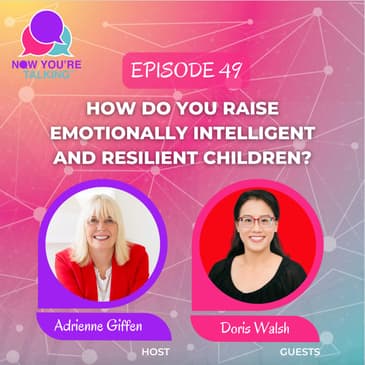
What if success isn't about achievement, but about raising confident, emotionally intelligent children? Doris Walsh shares why vulnerability, self-awareness, and connection may matter more than perfection in parenting.
What You’ll Hear:
- Why emotional intelligence may be more important than achievement when preparing children for life
- The parenting shift that helps children build confidence, resilience, and self-awareness
- Why the greatest gift we can give our children may be the freedom to become who they are meant to be
Doris Walsh’s personal breakthrough moment
Doris reflects on the moment she realized that the greatest influence she could have on her children wasn't through what she taught them, but through the work she was willing to do on herself.
Featured Guest: Doris Walsh
Doris Walsh is a life and leadership coach who helps working parents reconnect with themselves and the people they love most. Through a blend of emotional intelligence, self-awareness, and practical coaching, she supports families in creating deeper connection, healthier communication, and more intentional lives.
Follow Doris:
https://www.linkedin.com/in/doris-walsh/
https://www.instagram.com/doriswalsh_hbc/
Meet the Host: Adrienne Giffen
Adrienne Giffen is an executive recruiter, author of Unravel You, podcast host, and creator of the Now You’re Talking® conversation board game. Through her work, she helps people reconnect through meaningful conversations, shared values, and experiences that bring people closer together in today’s digital world.
Connect with Adrienne:
LinkedIn: https://www.linkedin.com/in/adriennegiffen/
Website: https://www.adriennegiffen.com/
Now You’re Talking® Game: https://nowyouretalkinggame.com/
YouTube: https://www.youtube.com/@NowYoureTalkingPodcast
Instagram:
Adrienne Giffen: https://www.instagram.com/adriennegiffen/
Now You’re Talking®: https://www.instagram.com/nowyouretalkinggame/
Spark Conversations That Surprise You
Every podcast episode includes a question from the Now You’re Talking® game designed to spark meaningful conversations and deeper connection.
🎲 Explore the Now You’re Talking® conversation board game (currently available in the USA):https://www.adriennegiffen.com/buy-game
Stay connected with new conversations, updates, and more from Now You’re Talking®. Join here
Because conversation builds connection.
Start Talking Today
Download: 5 Questions to Spark Real Conversations
https://www.adriennegiffen.com/game/start-talking-today/
Subscribe for more conversations that matter.
Now You're Talking is proud to be on the High Vibe Podcast Network. Check out Adrienne’s Gift in the Vault https://highvibepodcastnetwork.com/gifts
Share the Love
✨ If this episode lit something up in you… tag us on Instagram @HighVibeLeaders and let us know your biggest takeaway!
🦋 Don’t forget to rate & review — it helps us reach more conscious rebels like you.
Listen & Subscribe
[00:00:04] I'm Adrienne Giffen. Welcome to Now Youre Talking, the podcast. I believe real conversation connects us in a distracted world. One of the greatest gifts you can give your family and yourself is your presence. Because leadership doesn't begin at work, it begins at home. This is your space to pause, to listen, to reflect.
[00:00:30] Your journey toward deeper connections starts right here. Dan joined by Doris Walsh, a life and leadership coach who helps working parents reconnect with themselves and the people they love most.
[00:00:46] Drawing on nearly 20 years in the corporate world and her own experiences as a parent, Doris shares insights on raising emotionally intelligent children, embracing vulnerability and redefining what success really means. We explore how self-awareness can transform our relationships, why asking for help is a strength, and how creating space for emotions can help families thrive.
[00:01:14] Let the conversation begin. Doris, welcome to the podcast today and thank you.
[00:01:30] Thank you. I look so forward to hearing your perspective on how you help business leaders and you help business leaders who are parents to raise emotionally intelligent kids who are resilient. Yes, thank you. I think you have me on your show. My pleasure. So let's start with that. You work with business leaders who are parents that are pulled in many directions.
[00:01:58] Yeah, isn't it wonderful, right? Being, you know, none of us are really prepared to become parents, right? Most of us want to become parents. And then once you become parents, it's kind of like, how do I go back to not being parents? Yeah. I tried for one of my first ones. I tried for many months. You see, let me try again because I don't think this one works out the way and how I expected it. But there's no return. There's no return label. There's no return label. Yeah, I tried really hard.
[00:02:28] But yeah, how do we get here? I think right now my children are still young, pre-teenagers. Being a parent is probably the single most challenging but life-affirming but difficult yet most joyful event, job, career they've had so far.
[00:02:50] And working with, and it has even more challenges when you're also being a full-time employee, you know, career professional. So yeah, so I, it's, it's, this journey came from my own personal experience, I guess, you know. I didn't really realize the challenges I had. It was that everyone seems to do it, you know. Right.
[00:03:17] You know, am I just the only one who's feeling it as if it's so hard, right? Well, I just got to push through it because obviously I'm not doing it right. So I've got to do more or just do better. Isn't that amazing that we, yeah, we go to that dark place that we're not doing it right. And obviously I'm not doing it right because everyone else around me is doing it right. So, you know, right, right. So, and it's this perception, right. And it's this perception.
[00:03:42] And I wasn't until I left corporate after nearly 20 years when I, first time in my entire life where I had time and space to really think about what Doris wants to be mentioned truly when she grows up. Yes. And I was in my mid-40s when I did that. So, you know, and I just turned 50. So, and yeah, that was a huge gift, you know, to really think. I didn't set out to be a coach. No, you know, I had no idea.
[00:04:12] I was like, I'm starting with a black sheet of paper. And where do I want to go? And yeah, and through life, I guess, you know, just, I was listening. For the first time in my adult life, I wasn't really listening to what was happening around me. And this word coaching kept coming up. So I was like, oh, what is this? You know, I had like kind of a career coach as I was transitioning out of corporate. I was like, okay, there's some aspects of that that I really enjoy. There are other aspects, maybe not.
[00:04:42] But let me explore it because it kept coming up. Yes. And so, yeah. And so then the long story short, it was, I think I might really enjoy this. And in true Doris fashion, I don't kind of sit on the edges. I'm like, oh, let's jump in both feet first. Let's go. Right. So I went to coaching school for a year. I loved it. So I loved it. And then I did also my professional qualifications and became a coach. And I kind of style myself as to be a life and leadership coach.
[00:05:10] And I particularly love those high achieving parents, you know, who have these particular struggles. You know, they really want to continue with the careers that they really enjoy or the businesses that they really enjoy. And they want to be also the best parent that they can be and be there and not feel as if for me for a lot of the time, you know, before I left corporate was children were kind of, they got the leftover from me, right?
[00:05:40] At the end of the day because I had 10 hours worth of work every single day. Right. Yes. So what was that moment, Doris, when you said, okay, it's time for me to leave corporate? And what was the journey? Did you have a, like one of those moments that life changing moment where you said, I have to change my life? It wasn't fireworks. It wasn't a bomb going off or anything like that. I think it was consistent towards the kind of the last three to five years of my corporate career.
[00:06:07] There was, I call it my season of discontent. There was just a little bit, there was just this little bit of, hmm, is it? Right. And yes, constantly there. I wasn't depressed. I wasn't unhappy. It was just this little inkling of, there's supposed to be more. And I didn't know what it was. Right. And then COVID hit, right?
[00:06:32] And COVID was this gift to me, you know, and I know COVID, you know, turned lots of lives upside down. But for me, I see it as a gift because that event, that world event meant that my company was downsizing in the UK and there's an opportunity for me to take redundancy. And that's what I did. Oh, okay. And that's how it started, really. And a country move. We moved from there to Greece for three years, you know, which was amazing. And yeah, and that's, I had the time.
[00:07:02] Okay. So you were sort of out of fork in the road because you could have gone back probably to some sort of crawl, but you decided to change the whole course of your life. That's correct. Yeah. So how has your life been different? And are you still asking, you know, is there more? Yes. Always asking for more, but there is just from a, it's a different feeling of more. My life has turned literally 180.
[00:07:32] It's, I'm a totally different person in the same shell. It is my outlook. Yeah. It is fascinating. It's real fascinating. This kind of internal personal development has gone through. But through how I look at life now, it's changed one, who I am. I am less stressed. I am much more patient. I think I am a nice, nicer human being. Actually, hand on heart.
[00:08:02] As an adult, this is since I've kind of started this journey, it's the first time hand on heart that I can say that I really like myself. That's interesting. Yep. Before, before, before this period of my life, I never thought like that. I always thought that I wasn't good enough. I must try harder. And yeah, I was always measuring myself against something. And I was like, I was, I was always the, I'm a good enough mother.
[00:08:31] You know, I tried to be the best wife. I tried to be, you know, the perfect corporate person, the perfect wife and the perfect mother. But I never thought about, do I like myself? And now I think I'm a very awesome person. Right. Yeah. Interesting. So why the shift? Can you sort of take us through that? Yeah. Yeah. The shift is the different way of thinking and being.
[00:08:55] Coaching, as I was learning coaching and the cultural skills, I got obviously coached through Iden Sinsen and I've always been coached, is this opening of the eyes and the heart to a different way of being. You know, life, life is no longer binary, political white, yes or no. Right. It is, there is much more choice in my life now. And I'm aware of those choices.
[00:09:22] So I guess if there was, if there is one way, it's more awareness. Yes. And the other thing was, I didn't realize I had as much control as I, versus how much I actually have. I always thought that I didn't have much control. Yes. And everything was kind of done towards me. So I just have to accept it type kind of thing.
[00:09:46] But actually knowing now that I have way more control than I thought was just liberating. And moving myself away from the world that I was living in and seeing that there are different ways was just, yeah, life changing really. Yeah. Yeah. That was a courageous move.
[00:10:11] I mean, I know part of it was made for you, but you could have said, okay, I'm going back to where I was. Yeah. What was it that gave you the courage to be able to take that real leap of faith? Well, a lot of it came down to, I felt safe to take a leap. Part of it was also, I didn't have to work. I'd had, one, I got a payout from my corporate. Yes. Yeah.
[00:10:37] Two, my husband had a role that meant that I didn't have to really contribute financially to the family income, right? To support the family. So my husband, you know, ultimately, what gave me the courage? My husband gave me the gift of time really. Fantastic. And that is when, and I was ready, I guess I was ready to try something different because the niggling, you know, what else is out there, right? I was constantly there.
[00:11:07] And I thought, well, this is a perfect time because we transitioned from one country to another. I was going to take some time anyway to settle the kids in a new school, find a house and all this kind of stuff, the logistics that go behind all of that. It was like, you know, there wasn't really time for the first kind of six months anyway for a job. I was like, okay, let me go and explore this. So yeah, it was just that spaciousness, I guess, and that time afforded to me where I wanted to go and do some of the personal development.
[00:11:35] And how has that choice impacted your kids who you said are now 11? Yeah, 12 and 11. I'm going to be 13. Oh my God. I'm nearly a mother of a teenager. I'll be coming to you for lessons. I survived them barely, but yeah. For sure you'll have huge amounts of words of wisdom. Right now, I'm not quite sure I'm going to survive it, you know, but you know, I did say to
[00:12:02] my friends earlier today, I was like, I'm going to get a nearly 13 year old, right? So I'm sure I'm due a Nobel Prize of some sort, all right? You know, in terms of keeping a human alive for that long. Their relationship with my kids, previously, you know, I'm Dutch born Chinese, right? And I grew up in a very Chinese way of upbringing. And I have no idea, obviously, because that's all I knew. That's all you knew. Kind of how I grew up with my kids. I was very authoritative, very actually dictatorial, right?
[00:12:31] I told, I gave instructions and I expected them to follow instructions. Oh, no conversation, no discussion. I say yes. As your parents had done. Yes. Exactly. Exactly as your parents, yeah. Exactly like that. And actually, what then happened was that it didn't work, obviously, after a while. And I sat there and I was like, how is this not working? I don't know. I have no other parenting skills. Right?
[00:13:02] We only know from what we've experienced ourselves unless we choose to change history. Exactly. Which is what you're doing. Yeah. And actually, my son, you know, helped with that. And so, he had been removed to Greece about six months afterwards. There was this huge emotional, he was really, really, really angry a lot of the time.
[00:13:27] And obviously, I, as a mummy, was, you know, at the bottom of it all, right? I was the worst thing that ever happened to him. I was at fault for everything, even though I had nothing to do with it, right? It was, everything was my fault. And yeah, as I said, I had no more parenting skills, right? So, I actually then moved my first time as an adult parent. I put my hand up and said, I need some help. I don't know how to do this anymore. And I actually went to parenting classes. And then coaching came after that.
[00:13:56] But coaching, interesting, allowed me to see things in a different way, as I said, you know. And I realized, I very quickly, you know, gained the kind of awareness and insight that actually how I was being with my children wasn't truly how I wanted to show up. It was kind of like that mirror. You know, no one actually tells you until, you know, you actually get to experience it and to see it, right? So, I had to confront my own way of being with my children. And I thought, ooh, let's, right?
[00:14:26] And it's not quite sure that's the best I can be. So, literally overnight, I changed how I spoke with my kids and how I was being with them. So, from a literally swift term, you know, dictatorial instruction to open-ended, empowering questions. And the kids had no idea. They were like, literally, they were like, about six months. Especially my son, he was the older one, obviously.
[00:14:50] He really pushed back because I was like, I don't know how to deal with this mother because you're doing something different. But I was telling them, I was very open. I was like, look, this is what mummy is learning, right? Interesting. Right? Yes. I was very open with them. And I was like, this is what mummy is learning. I'm, you know, you guys are my guinea pigs, right? So, everything that I'm learning, I'm sharing it with you, right? Yes. Yeah.
[00:15:17] Ultimately, kids, and they were like, mummy, are you doing this coaching thing on me? I don't like it. And I'm like, well, I am really sorry, Samuel, but this mummy wants to change. Yeah. Wow. What a great example. I'm doing it. What a great example. That it's possible to evolve and grow at any time. Real life. Yeah. So, fast forward. How long ago was that, Doris?
[00:15:44] I started that, I started the kind of personal development journey about five years ago. Okay. I became a coach, a qualified coach, kind of two years after that. This was about three years ago. So, how has everybody's life shifted since you decided to shift your way of being in the world? And this is where it's fascinating, right? So, there was no demand on my children to change, right? Yes. I was like, I'm just going to be different.
[00:16:12] And over time, I mean, you know, as I said, there was pushback from the kids. But over time, as I look back now, the highs and lows in terms of emotions has, you know, it's not massive highs and massive lows anymore. It's come a lot closer together. So, therefore, there's much more calm and peace. And because I am less volatile. As you see, your highs and lows. Yeah. Yeah. Yeah. Because I am calmer.
[00:16:42] Actually, the kids are calmer, right? And how we talk to each other. And we've just become, actually, a lot closer together. So, actually, in some ways, it's kind of less, even though they're still little, less parent as in the hierarchy, parent as in child. It's much more, you know, quite a lot of the time, it's kind of we see each other as peers, right? And it's something that I say to my kids. And you're like, mommy's learning every single day, right?
[00:17:10] I am, yes, I am an authority figure because I'm older and I'm a legal adult and you're little kids, right? So, you know, in terms of that responsibility I've got. Yes. But I've never been here before. I've never been a parent of a nearly 13-year-old and an 11-and-a-half-year-old before, right? So, we're all learning here. So, if it's teamwork, we get to do it together. Yes, mommy pays the bills and I do most of the cooking and whatever else, right? And get you to school and buy your clothes.
[00:17:40] But the rest of it, right, we get to figure it out together, right? And that is a beautiful, I think, a beautiful way of being because I don't make all the decisions anymore, you know? So, they get to make their decisions about their life and I get to make the decisions for my life, which actually simplifies my life a bit. You know? Yes. Because there's less decisions. Like, well, your homework.
[00:18:07] I'm not going to, you know, sit over your shoulders and making sure that you do it. It's your homework, your responsibility. You went to school, you learned. You get to do it. I've gone on to do it. Hey, it's not to say, you know, you can't ask me questions or anything, but I'm not doing it for you. I'm not going to sit right next to you and making sure that you do it. Your responsibility, you do it. If you need help, ask for help. Like, I will ask for help if, hey, are either of you busy? Could you help me set the table or, you know, all this kind of stuff? I ask for help too. Yes. Right? Yeah.
[00:18:38] So, it's become much more collaborative. Yes. It's become much more closer, actually. And, you know, and it's the same, you know, relationship with my husband. It's, it is, was for a long period of time, life was very kind of transactional. Yeah. You know what it's like, Adrian, right? When, you know, they've got two young kids and, you know, things have to happen, right? You know, there's homes and the school and the doctors, like opticians and the dentists and whatever else. Yeah. It became very transactional.
[00:19:05] But actually, by looking at life a different way, it became more intimate again, back to being that when one person shifts in the family, then everybody else is, is forced or, you know, everybody can choose. But there is that natural shifting for, for everybody. Yeah. It's cool. So, and this is really, and for me, that was just fascinating because.
[00:19:35] Yes. I always had the view that if two people have to change, both of them have to want to change. Yes. Yeah. But actually, it's that realization that all I have to do, if I want things to change, all I have to do is change me. And how much easier is that, right? Than changing four things, you know? I've got to donate. Yeah. Because, you know, that is the only thing we have power over. Yeah. And then. Your experience as well. Yeah. It is.
[00:20:03] But boy, it's taken a long time to learn that because for a long time, I just thought, oh, no, what I say, you do. And it's the same thing. But I see my kids now raising their kids differently. And I think, okay, something didn't work completely right. And they're, you know, they're having to sort of look at things differently. And that's good. Yeah. You know. Yeah.
[00:20:29] And what's really interesting is that do you find that you are, well, grandparenting them, right? Your grandchildren differently to how you are by a parenting yourself. For sure. Yeah. For sure. And as a grandparent, I find it really interesting because I am not frontline. So I then have, I have to sit, I stand back and I have to watch it. And that is difficult for me. Oh. Not to say anything. And I find, I catch myself saying stuff all the time. And then I think, not my role.
[00:20:59] It's, this is no longer, I am not the decision maker here. And in a way it's freeing, but in a way it's, it's challenging too. Yeah. I can imagine. I can imagine. So I do upload my parental responsibilities, especially during the vacation periods, especially the long summer vacation. I take, and my parents are still living in Glasgow. So I take my two kids and literally drive one day or fly them up, right? And then literally drop them off.
[00:21:27] And then the next day I'm like, ciao, I'll see you. I'll come back for you maybe two to three weeks or four weeks. You know, see how long I get away. And I literally move away. I'll go, I'll come back home, right? And then my husband and I, you know, continue working or whatever else. We can go on, you know, some holiday, just the two of us or whatever. Yes. Because kids are being taken care of. But I've always said to my kids and to my mom and dad. Yeah. Or how's your rules? My house, my rules. Right.
[00:21:55] So even though my kids know they're not allowed to do certain things in my house, they know that when they're at Popol Gong Gong's house, it's Popol Gong Gong's, right? Rules. So they'll do things that they know they're not allowed to do in my house, but they'll do it at their house. And as long as the grandparents are okay with it, I'm like, because at this point I've given over responsibility, right? For the next two or three weeks. And then, but like you say, when they do come back, it is banning down the hatches, right? Because it doesn't take long for bad habits to creep in, right?
[00:22:25] And then the next four weeks is like, no, no, no, like this. But you know, that's high. Yeah. So, well, that's interesting. So here your parents were very regimented and sort of authoritative raising you, but it doesn't sound like they are that way with your children. So they've shifted, it seems, a little bit. Yeah. Well, I say they just don't care as much. Okay. That's right. Yeah. Yeah. It is very much.
[00:22:52] I am just the way that I was brought up. There wasn't much verbal or physical indications of love. You just, you know, you were loved, but it wasn't through the words, I love you or cuddles. I never got them. It's very different to how my parents behave with my two kids. There are a lot of cuddles, there are lots of I love yous and all this kind of stuff. So it's like, what? You know? Yeah.
[00:23:18] But like you say, they are nowhere near a street because my parents, you know, had this kind of like, no, grandchildren are there to be fun. And actually, for them, I think it's a naughtiness. Ha ha. If I can make your kids misbehave, that is kind of payback for when you were a little, you know, when you were a child. It's kind of payback period for them. I think that's how they look at it. I'm not quite sure, but that's how it feels like. Let me feed them the sweeties. Let me give them McDonald's.
[00:23:47] Let me give them fried food. Let me live. You know, stay up until 10 o'clock at night when a normal bedtime is 8 o'clock. Yeah, no problems at all. You get to deal with after math. Yeah. That is funny. So when you're talking, Doris, what I hear is that you've allowed yourself to become vulnerable in raising your kids. So you're saying, hey, I don't have all the answers.
[00:24:15] I don't have it all figured out. Let's work on this together. But that's what you're showing your human side, which allows them to be able to work with you in the process. Yeah. Yeah. I'm not here to put in that way before, actually. But yes, I think once I figured out that, or not what I figured out, once I realized that,
[00:24:40] and I guess it was that kind of permission, giving myself permission to live the life that I want to live, and not according to someone else's rules or someone else's guidelines or expectations. Yeah. There was this kind of breaking of some of the invisible shackles that I'd, up until that point, had no idea. Right? And once I go over, you know, the initial was that, look, I have no idea.
[00:25:08] I've got no more tools in my parenting toolbox. I think it was the start to, I can ask for help, and no one really is judging. There's no one judging here. So, and that's okay. And then, and it's learning that because, you know, when I was in corporate, you know, kind of putting your hand up and asking for help was kind of a weakness, right? You know, and of course, we all ask for assistance, you know, yeah, this is your part of the project. And, you know, how do you, you know, form line, Excel or whatever.
[00:25:34] But it wasn't about things that could potentially be hurtful to me. It's like, if I put my hand up as an adult, as a parent, right, and that's for help, the parents, or other people are going to look at me and it's like, oh, she's not worthy being a parent. How can you be a parent if you can't even that, right? And once I go over that, I was like, oh, why is that?
[00:25:59] And through coaching, there was this realization that I didn't have to take feedback, right? And for it to mean anything and for it to really, you know, hit me as an individual person. And that allowed me a lot of freedom. I just felt a lot lighter to being able to live the life that I want. You know, it doesn't mean it's perfect. Of course it isn't, right?
[00:26:22] But the lessening of expectations that I didn't actually realize that I was taking on, which was heavy, that realization that, oh, actually, I can leave some of this baggage behind was very helpful. And then that's kind of having that kind of holistic view to say, look, you know, the world is different to how I grew up, right?
[00:26:49] But how I grew up my kids so that they are adaptable and flexible and resilient. Because I never had training from my parents, right? Everything was all about silence, you know, and loyalty, right? And hard work. We never talked about feelings when I was a child. But I think maybe it's a change in terms of the current world that we're living, you know, with social media and more awareness about mental well-being and all of that kind
[00:27:19] of thing. And obviously now being a coach, right, which is kind of what we do, it's kind of like, well, it's actually really important because there's certain ways when I look at my kids, they are so much more aware of how they're feeling and why they're feeling angrier. That actually, I didn't come to realize until I was in my 20s. I am like, because there was always this expectation, no, you've got to force through, you've got to go do this.
[00:27:44] Whereas my kids can have the words to explain why they're feeling and be able to turn back to themselves and say, okay, this is my role in the argument with their friends, right? What is that they could see? And we can have this conversation about, okay, what could he be doing? Is he doing it or is she doing it intentionally to annoy you or make you angry? Or could there be a different perspective?
[00:28:12] I never had those conversations, right? With my parents. And I think it's that kind of, there is also a desire to kind of support them. Yes. To gain the skills, right? The soft skills that we call back in our days, right? The soft skills that help them become successful in life. And it comes from that desire. Are we forcing it in their throat? Obviously not. But it's that kind of openness to discuss everything.
[00:28:40] So we say to our kids, all the emotions are welcome in this house. Whereas when I was a child, all the negative emotions are not, right? Just a smile. Smile and do. Right? That was... Oh, boy. Yeah. Such a contrast. Isn't it? So when you talk, Doris, what I'm getting from you is that once you stopped judging yourself, you could go forward. But you had to get out of your own way in terms of that.
[00:29:11] Yeah. And the judgment that you were placing on yourself. Because then, because when you went out in the world and said, hey, I need help, you didn't feel judged. But you had to make that big leap to put yourself out in the world to get help on the first clip. Yeah. That was probably one of the first unlocks, you know, to become a different person. And then the rest of it was through coaching, you know, kind of having a bear right in front of your face, whether you liked it or not, right?
[00:29:39] And see how I, what I was saying and how I was behaving was really how it could be seen from my child's perspective. And I had no idea that for, you know, from a long period of time, I wanted subconsciously to shove my kids into a pigeonhole, right? Where I thought they would be safe, right? Or I thought that would make them successful, right?
[00:30:09] Yes. And that's when I got that shown back at me. I was like, but that is what I've been trying my whole entire other life to break out of. And here I am trying to shove my kids back into the same pigeonhole that I've been really trying hard to move right off. And I'm like, whoa. And that was one of the biggest aha moments. I was like, okay, right. I got to change. I got to change because I don't want my children to experience some of the, you know, the trauma
[00:30:37] and the pain that I had as a child growing up, right? Yes. It doesn't look like anyone in their class, right? Because, you know, different ethnicity and different upbringing. I want my children to be much more confident in who they are. Yes. That they know whether they want to change or not, right? To be accepted in that group or not, right? Yeah. Our view has always been, you're just being you. Yes. Yes.
[00:31:07] Just you. Doesn't mean that, you know, you've got no more skills to live. Doesn't mean you can't be more polite. Doesn't mean, you know, you will say your please and thank yous, right? You don't know what and stuff. But it isn't the, just because all of them are doing X, Y, Z, you've got to do X, Y, Z. If X, Y, Z really doesn't even excite you. You stay and do your ABCs, right? Yes. Everyone else is doing one, two, threes, but you want to do ABC, you go and do ABC, right? Yeah.
[00:31:33] Because that's, because ultimately, if it makes you happy, it's a place to be. Yes.
[00:32:08] Yes. But if you don't want it, that's okay. Yes. Do whatever you're passionate about, right? Right. Yes. It makes you up. And that's, that's not easy because you're, you're relinquishing control. And yeah. It's a, that can have its challenges too. Yeah. So Doris, knowing what you know now, what would you do the same?
[00:32:33] And what would you do differently from any vantage point that comes to your mind? I've always said that since I started this journey, I think what I would have done differently in terms of my career would have been taking some time out regularly, whether that's two years, three years, five years.
[00:32:51] And take a step back and look at my life and see, look at my job, my life, what I'm doing and see whether that is bringing me joy. And really still aligned with who I want to be. I did none of that. I did none of that. I did 20 years with literally with one company, right? Yes. Never took time out. I was just like, oh yeah, it's fine. You know, you're in, you're in that kind of hamster in the hamster wheel when you just keep on going. Right? Yeah.
[00:33:19] I didn't seek time out to do that kind of self-reflection. If I could go back in time, that's what I would do. In terms of what I would do again is when my husband and I were talking about having children, we did sit down and say, hey, how are we bringing up our kids? Right? Yes. What does this look like, right? In a moment when, say for instance, you know, you think about all these, you know, bad things that kiss you, your throat tantrums for no apparent reason, right? What is our stance?
[00:33:49] And our stance was always, as long as you and I are aligned, it's okay. Right? We will never disagree with each other in front of the kids. Mm-hmm. Right? We can have discussions afterwards, right? We say, hey, honey, maybe we should have been, you know, not as strict or, you know, we maybe should have just taken a breath before or whatever afterwards. Yes. But in the moment, we're always aligned, even though I might not agree with him in a moment and he might not agree with me. Right? Yes.
[00:34:17] We will not interfere with each other. Right? Because mommy and daddy are a united front. Right? Right. And how we would deal with the kids is that, but, you know, because obviously they try, right? They try to play mommy off against daddy or daddy against mommy, right? When we find out about that, if mommy said yes and then daddy said no. Brilliant. Yeah. Yeah. We would come down on them at tennis breaks, right? Like, this is not acceptable. Right? Yes.
[00:34:47] Mommy said no, but I really want to do something. What would you say? If you were open about that, you might get to change an answer, right? But if you go back and back, then obviously they try, right? Because that's their first job in life, right? To push the boundaries, right? Absolutely. Yeah.
[00:35:05] And the rest of it, you know, apart from reflecting more on my career and being, and I guess it's that kind of confidence, which is what I'm teaching, trying to, you know, help, encourage, guide our kids to, is that confidence in themselves. I didn't have that confidence. I had no confidence in myself when I first started. When you was do hard work, do more. Right. Yes. It's that kind of self-trust, that certainty about yourself.
[00:35:32] I think if I'd had that as I started off my corporate career, I think life would have been a bit easier in terms of less angst, less stress. I would do children again if I could go back. There was a period of times like, oh, if I could go back and tell me, would we have kids? You know, I think I would because they bring a really joyful and very annoying aspect in life. So yes, yes. No more change. What about you?
[00:36:02] Do you have? I just wanted to reflect what you said, that we need to fail in order to gain confidence in ourselves. We need to be able to fall and then pick ourselves up in order to move forward. And when we're surrounded by a situation where we're not allowed to, or I guess we always do, but not given permission to fail and that's okay. Then, yeah, that arose our confidence. Yes. Yeah, that's what it is.
[00:36:31] May I ask you some questions off of the Now You're Talking board game? Yeah, of course. So what is something, Doris, that people would never guess about you? That they would never guess about me. That I've been for how many years? For eight years. I did Kung Fu. I did Kung Fu. So Chinese martial arts. Really? Interesting. Huh.
[00:37:02] But what did that teach you? Discipline. Yes. Yes. Taught me respect as well, actually, in a different manner. It taught me responsibility because as I was there for quite a while, I took some responsibility for younger kids to get them in the warm-ups and the exercises and all that kind of stuff. So it taught me responsibility. It was Chinese New Year coming up.
[00:37:29] When I was doing coffee, we used to go and do performances, you know, with the Chinese dancers and dragons and all that kind of stuff. Yes. Yeah. So part of it was the whole little bit of like kind of event organizing. Okay. Yeah. So I had some fun with that. And you learned those skills or that mindset that you needed? Yeah. Which is power of something that you did, right? Yeah. You know, I gave me kind of instructions and you're like, oh my God, how does this land together? When is the bus coming?
[00:37:59] And, you know, all that kind of organizational skills. Okay. That came in through that. Interesting. So, you know, really great life skills. Yeah. Yeah. Finish this sentence, please. If you could do anything or if I could do anything, I would. How would you finish that sentence?
[00:38:20] If I could do anything, I would travel the world and every place I ended up in, I would find one piece of local or type of local food that I could bring back home with me and learn and cook and then share. With other people. Interesting. Good. Thank you.
[00:38:49] What is the greatest life lesson that you learned in high school? The greatest life lesson that I learned in high school is tightness goes a long way. When I moved from the Netherlands to Glasgow, to Scotland, that was the first time I was racially abused and I had no idea what's going on because one. I had learned English, but English, if you know anything about Scotland, they don't really speak English.
[00:39:17] You know, so I was, kids were just being kids, right? Being horrible. Yeah. But there were some kids who were very nice and, you know, including me, although I barely spoke language at that point. And they're very kind and that made that whole experience so much more enjoyable. And you were just 12. Is that right? So you were young. So you're at the age where your son is now. Yeah.
[00:39:44] And coming into a new environment, not speaking the language to us, what did that teach you about who you are? At that moment in time when I look back, it taught me survival. It taught me grit. Yeah. It is because I still had to go to school. I didn't want my parents to worry because they were setting up their own Chinese restaurant. So the tears would start as soon as I left the school gates to walk home.
[00:40:12] And the tears would then in miraculous dry up by the time I got to the front door. And it was that kind of experience that, you know, for me is that kind of I don't ever want to make others feel like that. Right.
[00:40:31] And I also want to ensure that my kids are much more open and judgmental just because other people are different than them. You know, not make a judgment. And that's my blessing from that. Yeah. And talk about resilience. So you became resilient in that process because you were not able to show your emotions.
[00:40:58] And so you had to keep them all in but still survive that. Yeah. Wow. Boy, one more question. And as a life and leadership coach, how have you helped someone through adversity? Through staying open and curious. That simplest way of looking at it. Let's see. Being open and having compassion and empathy for someone.
[00:41:28] But not feeding them advice or telling them how I would do it. It is just holding that space and be there with them but not in it with them. Does that make sense? It's that kind of I can it's that creating that safe space for someone to be vulnerable and share. Right. Something that is, you know, potentially painful or traumatic to them or something that they're going through.
[00:41:54] And just sharing kind of my energy with them and trusting that they've got it. Right. You know, not make judgment, obviously. Be empathetic. You know, acknowledge, validate, whatever. But that's it. I don't give them advice unless they specifically ask for it. And even when they ask for it, we'll typically turn it back to them and say,
[00:42:19] because if I have not experienced that similar situation before, I may not have the right advice to give. I may share things that other clients have similar experiences with. But I always like to turn it back to them and trust that they know what is needed for them because they are the expert on them. I'm not the expert on them. I'm here. Yes. Never.
[00:42:45] And that's what I say when you talk about your coaching experience and what it was like for you. It was like putting a mirror up for somebody to put a mirror up for you. And so how does that align with who you are as a life and leadership coach? Totally. It is what I like. It is one of the most, I guess, in some ways, enjoyable aspects of coaching.
[00:43:11] To put up that mirror and, you know, and I may be using, it's obviously kind of my interpretation of what's going on, you know, but just playing that back and seeing someone hearing it back in just a slightly different way or me asking a question that they would never ask themselves because obviously I ask questions a different way to how you would.
[00:43:33] And for them to suddenly say, and you can feel that change in them, you know, whether that's a change of different feeling or emotion or even just the bodies, it's that kind of like sometimes just giving them that space and say, and it's that space of not being judged. And then someone says, that feeling of, I'm not an idiot. I'm not, you know, it's like, well, no wonder that you're feeling like this because of, you know,
[00:44:00] and they haven't, you know, they haven't had the words themselves or been able to see it. And yeah, play it back to them for them to then see it and then accept it and then say, okay. And then internalize it. What do you want to do now? Yes. Yeah. So thank you very much. So words of wisdom, Doris. What are some words of wisdom that you can share with parents, with whoever, first person,
[00:44:29] first people that come into your mind? Okay. For me, one of the biggest words of wisdom is that you have one life. Live it the way that you want to, not according to your parents' rules or because it's been handed down by ancestors or generations or whatever. Live your life. No one owes you anyone. No one owes you anything. But you owe the universe a life well lived.
[00:44:58] That's one piece. And the other piece is don't overtake responsibility. You know, we are, especially as, you know, working parents and kids, it's that kind of, your kids are not here to be managed. Right? Your kids are here to lead their own lives. All we are, you know, we've got the privilege to be their guide. Right? I'm not their boss. Yes, I'm a parent. And obviously, you know, I've got parental, you know, responsibility.
[00:45:26] But all I'm here to do is to guide them. Right? To show them, you know, what good and bad decisions look like. And that's it. Right? So the whole, because, you know, I did this, you know, I was over there, you know, literally over, you know, shoulders and making sure that I wrote it beautifully.
[00:45:45] You know, the curse of writing and, you know, I bet I got one wrong, made them do it five times to make sure, you know, and that, that make anyone feel happy, at least above me, you know, because ultimately, the results is for them. Right? Like I say to my kids, like, it doesn't matter whether you get 100% or 0%. I'm okay. Right? That 100% or that 70% is for you, not for me. Right?
[00:46:10] If you got 100% and mommy got 100% pay rise, yeah, that'd be a different story. Right? But you getting 100% has no impact on me. Either way, I'm going to be proud of you. As long as you tried your best. Yes. That's all we had to go. As long as you're learning, right? Because, and, and one, another of us that has come to me is that nothing is about the 100%. Right? 100% perfection doesn't exist. Right?
[00:46:37] Because if you always get 100% in a test, as I say to my kids, it's either too easy or you're spending way too much time to get that last little bit when you could actually spend that time, go play, play Lego, do something else. Right? It's more enjoyable. Yes. Because Lego isn't about 100%, right? Do the best of your capability. Whereas I used to, whenever, say for instance, a spelling test, they get 11 out of 12. I'd be like, oh, which one did you get wrong? Why? You know, they don't do spelling tests anymore.
[00:47:06] But I told them 180, change that to, you got one wrong. Hey, hey, hey, hey. You got one wrong. And they'd be like, what? And I'm like, there's room for improvement. Excellent. Let's go. You know? Which is totally, yeah. What about you? What about you? What wisdoms would you share with me? What would I share with you? I would share that the courage that you've taken to get from where you were to where you are is monumental.
[00:47:35] And I would say that you were given the, probably the family that you were given in order to learn the lessons that you did learn in that family in order to be able to break free of that. And had you not experience that, you may not be where you are. And I believe, too, that as parents, we're meant to make mistakes so our kids can work through them.
[00:48:03] And that's part of our job because we're just humans trying to do the best we can. Oh, yeah. Oh, yeah. One thousand percent. One thousand percent. Yeah. Yeah. So, well, thank you, Doris, for being here and sharing your truth and your journey. It's been a privilege to get to know you better. I have had such a blast. So, thank you very much for having me on your show.
[00:48:33] I had an amazing conversation with you. Well, thank you. One of the biggest takeaways from today's discussion is that parenting isn't about getting it right all the time. It's about being willing to grow alongside our children. Doris reminds us that emotional intelligence, vulnerability, and self-awareness aren't just gifts we can give our children.
[00:49:00] They're skills we continue to develop throughout our own lives. Whether you're raising young children, supporting adult children, or simply working to become more intentional in your relationships, remember that life isn't about perfection. It's about learning, growing, and showing up as your authentic self. Because leadership begins at home, and meaningful connection starts with conversation.
[00:49:28] I'm Adrienne Giffen, and you've been listening to Now You're Talking. If something in this conversation spoke to you, follow along on YouTube, LinkedIn, or Instagram, and subscribe or leave a review to help others find the show. Meaningful conversation can change how we see ourselves and each other. That's why I created Now You're Talking Board Game, a simple way to spark real conversation.
[00:49:57] If you'd like a way to start conversations like this with people in your life, and be part of the movement to get people talking again, you can join the waitlist for the game in the show notes. Let the conversations begin. Now You're Talking.