
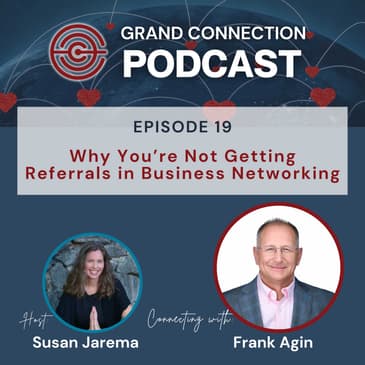
What shifts when networking stops being about visibility and starts becoming about genuine connection? Susan Jarema sits down with Frank Agin to explore why referrals often feel inconsistent, even for those doing everything “right.” The conversation centers on the Collaborate stage of the Connect, Create, Collaborate framework, where relationships begin to translate into meaningful opportunities.
Together, they unpack the deeper reasons referrals do not happen, not as a failure of effort, but as a gap in clarity, connection, and communication. Through grounded examples and real-world stories, the discussion reframes referral-building as a shared skill rooted in generosity, awareness, and trust. Practical shifts emerge around how to communicate value, recognize opportunities, and guide others in supporting business growth in a way that feels natural and sustainable.
What You’ll Hear:
- A deeper awareness forms around how strong relationships are the true foundation behind consistent referrals.
- Frustration in networking is reframed as a clarity gap rather than a lack of opportunity or effort.
- The shift from explaining what someone does to when they are needed changes how others recognize referral moments.
- The concept of “Velcro messaging” highlights how memorable communication drives real connection and recall.
- It becomes clear that even supportive relationships do not lead to referrals without intentional education.
- The importance of guiding others in how to start referral conversations brings a more collaborative approach to growth.
- A grounded perspective on generosity reveals how helping others first naturally strengthens visibility and trust.
Featured Guest: Frank Agin
Frank Agin is president of AmSpirit Business Connections, which empowers entrepreneurs, sales representatives, and professionals to become successful and gain more referrals through networking.
He also shares information and insights on professional relationships, business networking and best practices for generating referrals on his Networking Rx podcast and through various professional programs.
Finally, Frank is the author of several books, including Foundational Networking: Creating Know, Like & Trust For A Lifetime of Extraordinary Success and The Three Reasons You Don’t Get Referrals. See all his books and programs at frankagin.com.
Follow Frank:
Website: www.frankagin.com
LinkedIn: https://www.linkedin.com/in/frankagin/
Meet the Host: Susan Jarema
Susan Jarema is a marketing strategist, internetologist, and co-founder of The Grand Connection. She helps entrepreneurs grow through collaboration, smart strategy, and high-impact digital presence. Susan is also president of New Earth Marketing, where she builds brands, websites, and ecosystems designed for real growth.
Connect with Susan and the Grand Connection Community:
Website: https://grandconnection.ca/
Facebook Group: https://www.facebook.com/groups/grand.connection
Facebook: https://www.facebook.com/GrandConnectionCommunity
Instagram: https://www.instagram.com/grandconnection.ca/
LinkedIn: linkedin.com/company/66749100
Youtube: https://www.youtube.com/channel/UCxq03yde7nb57HKV1hhztYA
Access your Grand Growth Bundle and Free Guest Pass: https://grandconnection.ca/gifts
We are proud to have Grand Connection Podcast on the High Vibe Podcast Network. Grab your free gift from Susan in our Our High Vibe Gift Vault.
Love this show? Check out the other shows on the High Vibe Podcast Network.
Share the Love
✨ If this episode lit something up in you… tag us on Instagram @HighVibeLeaders and let us know your biggest takeaway!
🦋 Don’t forget to rate & review — it helps us reach more conscious rebels like you.
🔊 Listen & Subscribe
🎧 Spotify
Hello everyone, and welcome to The Grand Connection podcast. I'm your host, Susan jarima, today and on this podcast, we explore ideas and conversations that help entrepreneurs connect, create and collaborate, because meaningful relationships are often the foundation of business growth and opportunity. Today we're focusing on the Collaborate stage of that journey, that moment when relationships turn into referrals. Our topic today is the three reasons you don't get referrals. We'll be talking about what people often do wrong when it comes to referrals and how to become more referable with insights from a true expert in networking and professional relationships. Today, I'm delighted to welcome Frank agan, president of am spirit business connection, an organization that helps entrepreneurs, sales, professionals and professionals grow their businesses through networking and referrals. Frank is also the host of the networking RX podcast, one of my favorite podcasts, and I hope it will be one of yours too, and the author of several books on professional relationships and networking, including the three reasons you don't get referrals. Frank, welcome to the podcast. It is great to have you here, or should I say, grand to have you here. It's grand.
Frank Agin:It's grand to be here. Thank you.
Susan Jarema:Susan, Frank, you spent many years helping entrepreneurs build stronger relationships and generate referrals through networking. So this is a perfect topic to explore with you. And I have to say, you know, I'm an avid listener of your networking RX podcast. I've learned a lot through the community. I've sent many of our members to go listen to it. And you know, you have been doing referral marketing for a long time. I actually think when I think referral marketing, I think of Frank. So just let me so I wanted to start with your story. How did you first get involved in networking, and what led you to start? Am spirit business connections.
Frank Agin:Yeah, this goes. That's a great question. It's a great place to start. I live in Columbus, Ohio, central part of the United States, for our Canadian friends. I live here. I'm not from here. I came here to go to law school 40 years ago. I've got a law degree, got an MBA, started my career in public accounting as a tax consultant. Pretty boring, but I grew up in a household of educators. My dad was a professor, my mom was a teacher, my stepmom was a was an educator. And so we would talk about those sorts of things sitting around the table, and we never really talked business. And then the whole notion in education, you just do well, get yourself a job and hang on right. Hang on till you retire right? Doesn't work that way in the business world. So when I went off and was starting this professional career, it was, it was fine, but like many of us, it's like, you know, this is not this can't be my whole life. And so I decided to leave after about six years, and go into the private practice of law. And I tell people that a funny thing happened to me when I went into the private practice of law. And the funny thing was, nothing happened. I had no idea how to get clients. I had no idea. I didn't know what networking was. It didn't really understand referrals. I just thought people would just come out of the woodwork to help you or do business with you, and it doesn't work that way. And so I struggled for I struggled for a while, a while, it wasn't years, but I struggled for weeks. It felt like years. And didn't really know how to get business. And somebody said, why don't you join a tips club or leads group? And I had no idea what they were talking about, but through a couple introductions, I found myself in a meeting of a Thursday morning, February 1995 of an organization was based out of Pittsburgh, very similar to BNI, and as it was explained to me, this was a brand new chapter, as it was explained to me, that you could Lift your
Frank Agin:whole world up just helping other people. And to me, that made so much sense, because Susan, I could just, you know, I can go on and on about you and feel great about it, right? But if you self promote, it's like exhausting. It's so tiring nobody wants to do that. Most people don't want to do that. So I really got involved in that, became president of my chapter. Really had a lot of success, was helping other groups. Had an opportunity to become their first franchisee. The woman who started it was was much older. She passed away 15 years ago. Now. She was much older. But anyhow, at one point, I had an opportunity to buy her out. And part of the deal is I had to rebrand it as am spirit business connection. So I didn't really just, how did you invent this? I didn't invent this. It's just that's just, that's a mouthful to kind of explain. People call me the founder of am spirit business connections. Okay, we'll go with that. It just makes it simple. But there was already a business there, and there's, you know, I have competitors. You grew it.
Susan Jarema:From there you were one chapter. Were there multiple chapters? When you I think there were
Frank Agin:Maybe five at that point, you know, now we're in the 130s you know, and continues to grow. So, yeah, it's, it's, yeah, it's grown a lot. I had a very different approach than the woman I bought it from, and she had chapters in Pittsburgh, which I did not buy. She had. Pack chapters around the country that I just bought what I had in Columbus and grew it from there.
Susan Jarema:And you remit and you rebranded it. Did she keep hers running under the old name?
Frank Agin:She did for a time Cleveland, I think she sold out as well. They had a different name. Part of the reason for the rebrand was she was associated with other people around the country that were kind of using what was called, it was called network professionals. They were using the network professionals name so she had no right to sell it or allow somebody to use it. The other problem Susan is, is that the words network professionals, network professionals is so generic that you can't, you can't copyright it, and so I would have people competing against me using a name that a brand I was building. And when I was in law school, I came up the word am spirit, short for American spirit, and I just, I'm in law school, I'm going to trademark this. And I did, and so I had it, and it's like, okay, this is unique. Nobody's I own it. Nobody can steal it. So I went with it. I got a little pushback early on, but now it kind of resonates with people. It's, it's unique. So, yeah, no.
Susan Jarema:And if you move to Canada, you could call it cam spirit this lightly. So you're, you're, you're in their franchises. Everybody that's listening here and they're, it's located throughout all of the US right now.
Frank Agin:Well man, we're, we're in several states. There's places where we're not and we'd like to be, but that's just the nature of trying to grow a business.
Susan Jarema:So, yeah, yeah. So, so anyone in the wants to start a referral, and it's mostly local, right? Local referral marketing?
Frank Agin:Yeah. 99% of our groups are in person,
Susan Jarema:In person, so in person events. So the type of person who would be a perfect person that would start one of your franchises?
Frank Agin:Well, it would probably be a realtor, a mortgage lender, a financial advisor, property casualty, because those categories are generally closed, and those are the types of people who are reaching out. And how it usually works is somebody will reach out and say, Hey, can you help me start a chapter? And once you start working with them to start a chapter, we just say, you know, there's also an opportunity. Here. If you want to buy in and own your chapter, you know, they can own the chapter. It's the franchise fee for that is, is only $2,000 and the way, you know, if they build a group, they get their money back pretty, pretty quickly.
Susan Jarema:Now, your business model is very is very good, and it's very fair, too. What makes you different from a BNI?
Frank Agin:You know, I've never been in BNI, so it's really hard for me to address that. I think a couple things I hear from other people who have been there is one, they see us as being kinder and gentler. And I think part of that is BNI has been the 800 pound gorilla, right? I mean, they really haven't had a lot of competition and and competition is good. Competition softens you. Competition makes you innovate. And I see a BNI becoming better on those fronts. But that's one thing I hear. The other thing we don't we tend to keep our groups smaller. I don't want groups to get into the 30s. I have some very productive groups that are 15 members, and they generate a lot of referrals. And then the third thing is, is that we're really focused on referrals. You know, I want everybody. I don't want two people in the room passing referrals back and forth, just, you know, great guns and other people starving. I want everybody to understand how it works and to benefit from it.
Susan Jarema:Well, that's what your podcast is very good at. And we're going to talk a bit about referrals too, because what, what's not working in referrals? Or, yeah, here today, because of your new book that's that was really well written and very clear and concise and not too long for those, for those listening, I'm definitely it'll be in the show notes, how to get Frank's book. But also, you can look it up right away here. What's the name of your new book? The three reasons you don't get referrals, three. So okay, so we're going to learn about that today, because I'm excited to share this with you, because I thought you know what this is true, and what I love about my collaborating here with Frank today is is his we we're in the same world, but our businesses are very different, like brand connection we have. We do a lot of referrals, but that's not my focus. My focus is educating people about collaboration. So because we're a global community, and a lot of people are in the same space, you guys have one per category, right? So yes, and you're, yeah, so you, you're not in that competitive space, but we have, we have hundreds of coaches in our in our community, right? Yeah. So we're, you know, you would think that they're all competing, but they're not. They're getting together and they collaborate, and they find their niche, and they get to know each other, and they pull people in, and they share audiences, and from collaboration, they all grow together. So I focus on collaboration, and you're focusing mostly on referrals, which is, it's very unique and different, but they both overlap so
Frank Agin:Yeah, oh, yeah. I mean, it's just, there's, well, I always tell people, there's lots of different kinds of networking out there, right? My My stepmom is in a quilting club. That's networking, right? It's networking, but, you know, but it's, you know. So there's lots of different things out there. We're really, you're focused on education, and you know what, that is needed. And my end of it. It's referrals, and that's needed as well.
Susan Jarema:So, yeah, no, they're all needed. And we kind of try to do everything in ours. But I think that, like, you know, the local, like, I used to belong to a live a web design company, and I was perfect when I belonged to a local referral marketing group for many years. And you know, you got your realtor, you got your your mortgage broker, you got your your your insurance person, they're all there, the web designer, there's the accountant, the lawyer, and they all became close connections, what I could call a grand powerpod, or a grand team, and we got business from each other, and I still get business from those people. Yeah, it's an investment. Yeah, yep. So let's jump onto your book. In your book, you share a story from earlier in your career. You were deeply involved in networking. You showed up consistently, stayed late, and were even the president of your chapter. But despite doing everything people say you should do, you were still not getting many referrals. So what made you questions? What made you start questioning? What was missing.
Frank Agin:Well, I don't know, at that point I was really questioning anything. I was just frustrated. And, you know, a lot of I've been doing this a long time, and, you know, in the early days of the organization, before I was involved, there really wasn't a lot of, there was a lot of what I call bring people together and hope, hope that something great happens when it happens. Everybody point at it and see that's it. This works, right? Just stick around long enough it works. And that always kind of bothered me, because it's like, that's not really a formula for success. So why did it work? What was the difference there? And it wasn't until years later that I started. You know, I've been to a lot of meetings. I've seen a lot of 32nd commercials. I see a lot of people who are really successful, and I see a lot of really great people who struggle, and it's always bothered me. I don't want people to I've got people who've been in the organization since 93 I mean, this has been their whole life. I've got one guy who met his wife through here. I mean, it's just, and those things, you know, those are the things I want to build. Those are the types of people I want to help. Well, I want to help everybody, but that's the success I want to create, you know, so in just kind of looking through it and dissecting and saying, okay, yeah, that's not right, you know. And I was thinking back to when I was an attorney, and, you know, good referral for me is anybody who needs an attorney. You all know that that's pretty broad. Yeah, it is broad, right? But there was nobody there to say, Well, wait a minute here, right? And everybody was kind of talking about what they did. And it wasn't until I stumbled on it at some point, rather than saying, you know, anybody who needs an attorney. I just happened to mention, mention something at a meeting, if, if, I'll just use an example, if you know somebody who is going to be leasing commercial property, like for an office
Frank Agin:or a retail business, I work with those people because there's a lease and it's, it's really thick and it's hard to understand, you know, and people lean forward and they're like, oh, yeah, I know people, you know, I didn't realize that was a law thing. Well, yeah, you know, you didn't know that. I figured everybody don't you watch television. I'm just figuring people watch TV and then they would know. But the reality is, is that most people didn't think about the law unless they were in trouble. And then I wasn't a criminal attorney, you know. So they didn't really understand what business people do. So I started just kind of messaging differently and becoming more successful. And I don't know that I was conscious about it. I just knew that okay, when I shared little stories about things I did that, you know. You know, it's kind of like the little rat in the cage. I press the button, I get food, right? If I just do the right thing, I'll get food. And that's right
Susan Jarema:Positive reinforcement on when you were doing these, these stories, and
Frank Agin:Yeah, but, yeah, but I didn't know enough to help other people at that point, right? It's just, hey, I'm getting my food. I don't understand, you know, yeah. And you know, now I kind of sit in a different chair as far as trying to help people. And I, you know, I see people in it, it, I don't say it breaks my heart. I see it as opportunity. I do a lot of one on ones with people, members and non members, you know, let's talk about this, you know, because in 15 minutes, I can help someone really understand what they should be saying, how they should be saying it. We can use AI to put together all sorts of messages for them. And they're on their way. And I see some of these people who have really leaned into it, really becoming successful, and then they're starting to help other people. So is this, you know, it's, it's our, you know, we have a very narrow educational aspect, you know, education around referrals, but I see that proliferating throughout the organization
Susan Jarema:Yeah? Well, and you have your podcast, and you have your books, you're always sharing that information to your community as well, right? Yeah. And definitely, I would say that your two books that I've read, the new one, the three reasons you don't get referrals, and we're going to talk a little bit later. You're about foundational networking that's kind of like the the skills or the qualities of qualities of your life that maybe good networking. And they're both together. They they work, they really work well together. And they're, they're, um, I would say, a must read for anyone listening who wants to jump into this world of networking. So I highly recommend them and to listen to your podcast. So I want to jump right into these three reasons. You don't get referrals. Can you walk us through what they are and why they're so important?
Frank Agin:Yeah, I mean, I'll, we'll touch on them, and then we'll just kind of take a deeper dive, or it's your podcast. We'll do whatever you want to do. Three reasons, you know, and I've, again, I've just seen lots of people. The first reason is, you don't have a relationship. People need to know you. They need to like you. They need to trust you. And I've talked about in the book, you know, getting a call from, you know, consultants seven states away is during covid, right? Hey, I want to be your guy. I want to be your financial advisor. And I don't even know you. You might be the best financial advisor in the world. I don't know you, so I'm not going to refer you. I'm not going to do business with you. And so these aren't my rules. These are human nature. We don't do you know you think about if you've had kids, you're just not going to grab some babysitter off the street. You're going to get a referral from somebody. These are your kids, at least. I hope that's the case. And so business, as much business, operates much the same way. You have to have that feeling towards someone that you really want to help them. So that's the first, yeah, the second is the it's not just having a relationship, but it's getting those people to be able to recognize opportunities. And I use my father as an example in the book. He passed away in December, as you as you know, but at any rate, I always joke about, I said, I've never got a referral for my referral for my dad. I like to think he loved me, right? We did a lot of things together. He put me through college. He put up with all my crap. I like to think he loved me, but I never got a referral, and I'm okay with that, right? We had a different relationship. We'd watch sports and, you know, fix things around the house, and that was our relationship. But I use it to underscore Susan, the whole notion that there are people in our lives that really care about us, that don't refer us. And that's a powerful thing, because if
Frank Agin:you stop and think about it, you know, people are in these groups, your groups, or my groups, or BNI group, or whatever, and they're like, Man, I'm not getting referrals. You know, what are you know, these people must not like me. No, they do. They really do. They want to, but you haven't done a good job of educating them on what to look for, what to listen for. So that's the second thing, getting people to be able to recognize opportunities for you. And I spend a lot of time in the book talking about there, because there's a lot to that. It like anything. It takes work, if I could have, you know, if the book could have been written on a postage stamp and and been disseminated, there really wouldn't be a lot of value in it, and someone would have done it years ago. But there's a lot to work on here. But the third reason why people don't get referrals is is that people they have a relationship, and people know who to refer them to, but they don't know how to have that conversation with somebody else. And sometimes it's just they don't really know how to how to create conversation, how to bring it up. Sometimes it's a tough it can be a touchy subject. For example, you know, if you had a weight loss product, you know, that's a really hard conversation to have with somebody. Hey, honey, I met somebody today. I think you should, you know? I mean, it's just that's a hard life insurance is another one, just a hard conversation to have. And so if you're, you know, you need to coach the people you're looking for referrals from, and how to have conversations with people. And, you know, and there's, I see it as having two aspects to it. One, you need to be able to engage the person in conversation. And then the second thing is, you need to be able to connect them to who you're trying to get the referral to. So for example, if you're a property casualty agent, I assume it's the same in in Canada is United States, if you have a teen driver, your insurance goes through
Frank Agin:the roof. It's really expensive, terrible. Yeah, it is. It's, you know, and so you know, a property casualty person would say, Listen, if you know somebody who's got a teen driver, that could be a good opportunity for me. Okay, that's, I recognize that, right? I see that. That's kind of in my head. And so I'm talking to my neighbor, and like, Yeah, little little Johnny got it, you know, got his license today. I know there's a problem, because that's what the insurance agent has told me, there's a problem. They're paying a lot for insurance. And so what I would do then is I would say, this is the engagement piece. What is having little Johnny driving done to your insurance? What did that do? Your insurance rates? Well, I know the answer, but I'm going to let them vent about it, right? Oh my gosh, Frank, you wouldn't believe it. You know, we're making them get a job to pay for it, or whatever it is, right? I'm not talking about the insurance agent at that point. I'm just talking about insurance, right? I've just engaged, brought it up into conversation, and then the connection piece of it. Would be, you know, I know this insurance agent. He's my insurance agent. Or I know this person. I meet with him every week, or however you want to, you know, couch it. I know this guy, and he really helped me when, when Lucas got his license, you know, you should talk to your agent. There are special programs out there if you're not comfortable. I'm happy to introduce you to my agent, you know? And that's having that, that last piece, engaging somebody in conversation,
Susan Jarema:And that's a missing part in most referral training. I see you know you you'd learn how to introduce yourself. Your elevator pitch is, everybody focuses on that, but they don't focus on the second part, which is your when statements, right? You now, I remember you said you have a lovely video on that too. Yeah, what? When statements are, so when something we do this, we've now, we've now implemented your idea into our minis so that we, we call them trigger words. But what are those trigger words that that, that you should be listening for, kind of keywords? And then you can say, oh, oh, you know, Jan, she's the perfect coach for you. Or, you know, you just know it. Or, this is the person who knows those affiliate marketing they're really perfect for that. And you think of them, right? They become top of mind. But then how do you talk about it? And especially like those, those more awkward conversations, I have a client that was she did addiction coach counseling. That was a really hard one, because nobody really wants to talk about that kind of stuff. It's very right. Yes, you had to. I was, when I worked with her, I was saying, you know, you need to educate people on what to look for and and then how to approach it in a gentle way. Yes, yeah, grief, grief coaching is another one that's hard, very hard too, right?
Frank Agin:Yeah, I told a story in the book about that. You know, when I was still an attorney, there was somebody who was a business psychologist, and he taught me exactly what to look for, and I liked him, and he told me what to recognize. And one of my clients, it was like, Oh my gosh, that's his client, right? I mean, it should be and, but it was a situation where she had, she had an armed security guard business, and it just, they're just things. There are all sorts of problems, and they just kept problems just kept coming. And it's like, what's the deal? And I went to visit her office one day, and I realized that her ex husband was still an employee walking around with a gun at his side. I mean, it's just intimidating, you know, I don't know if it's loaded. Doesn't matter. It's just intimidating. And I didn't know what to say to her, because that's a hard conversation. You know, I think this guy's still in your head. I wouldn't have put it that way, but that's, you know, that's the best way to sum it up. And so I want to talk to this guy, Jerry. I just said, How do I approach this, you know? I mean, I just said, she needs help. You need clients, but that's not the reason. But she needs help, and I think you can be the one to help her. And he coached me through it. He says, you know, take her to lunch, do this, say this. And, boom. It worked beautifully. I mean, you know, she broke down. And, you know, she's like, Yeah, I really appreciate you taking the time and doing that. But it wasn't easy. You know, is that moments where it's the moment where it's coming out of your mouth, where i Hey, I think you, I think you have an issue, yeah, you don't know where that's how that's going to go. That could have just blown up in my face, and it didn't generally, people want to be cared for. You know, they want to be cared for if you handle it tactfully. So, yeah, but yeah.
Susan Jarema:But you need those skills, and this is where a relationship with the people that you are referring each other to that you start building that relationship. And what the nice thing about your groups is you're seeing the same people. Same people every week, right? So you get to know them over time. You're building those relationships over breakfast or coffee or whatever you guys are doing. And then, you know, you get opportunities to go through many different when statements or trigger words over the meetings. So you really get to learn what to listen for for each other. So you become each other's sales people, yes, and then you have the opportunities when you do your one on ones, more likely, not in the bigger events, but to how to, how to do those conversations, yeah, yeah.
Frank Agin:Well, what I tell people is, you don't, you know, people feel like they're diffusing a bomb. Okay? I recognize something. I need to, I need to say something in the moment. It's like, No, don't, don't worry about that. You can come back later and say, Hey, you mentioned this. You know, it sounds like you might need a vacation. I've got, I got the perfect person for you to talk to, right? Or whatever it is. You can come back afterwards. So you also
Susan Jarema:described in your book a story about Teflon versus Velcro. Can you talk a little bit more
Frank Agin:about that? Yeah, it's not really a story. It's more just a metaphor. We all kind of know what velcro is. We all kind of know what Teflon is, and Teflon is, nothing sticks to Teflon, right? And a lot of times when people talk, give their messages, it's Teflon. It's, you know, want wise Charlie Brown's teacher, it just goes one in one ear and out the other. Doesn't. You know it's, it just slides in your ear and out, you know, you don't remember it. Whereas velcro are those statements that people say that just just gets stuck in your brain and just, Okay, I can't, you know, teen driver, right? That's. You know that somebody just kind of gets stuck. And when somebody says, Yeah, little Johnny's getting his driver's license, it's like, okay, yeah, wow, I remember. And there are lots of people who have lots of wonderful things that they've said that they say them in a way that, okay, I remember that. And I call those Velcro, whereas Teflon is this. That's, you know, it's just kind of a, oh, you know, I'm a Holistic coach that helps people improve all aspects of their business. It's like, okay, that doesn't really say anything.
Susan Jarema:I help you get rid of stress. It's just everyone is saying,
Frank Agin:yeah, yes, yes, yeah. That's where I get into the Don't tell me what you do. Tell me when you do it. Tell me, you know, and really, in the organization that we really pushing people to to tell what I call our 32nd stories, wrap what you have to say in a story, because that's even more powerful than you know. Hey, if you gotta know somebody with a teen driver, tell that story about the neighbor that's, you know, crying because Johnny wants to drive, and picking on Johnny here, Johnny wants to drive, and they don't know how they're going to afford it. You know, people remember those things, and it's just, it's really how the brain is wired,
Susan Jarema:yeah, and that you need to be properly insured for your teen drivers, and they need to follow all of the rules. I have a many a story of friends that have had kids that didn't their kids didn't follow the rules, and insurance didn't cover it. So be careful. Anyone listening, make sure your kids follow those rules. Yeah. So do you want to just go a little more into the when statements, because I think that's so important for everybody. It kind of relates to this. This the being velcro too, because the when statement really supports us as a referrer, to be able to help refer other people.
Frank Agin:Well, the reality is, Susan is is that when people talk about what they do, let's pick on realtors, right? We all kind of understand what Realtors do. A realtor can describe what they do 16 different ways, and it all says the same thing. And I see Realtors always trying to do different ways talking about when what they're due, and it all says the same thing. I'm an intermediary between someone buying property and someone selling property. That's what they do. And it just becomes white noise after a while. And so again, it's it's Teflon. But when that realtor starts talking about, when they help people, it becomes so much more powerful. And I share in the book, it's, it's a it's a true, a true story. I was in one of our our groups, and there was a new member. She was a realtor named Sabrina. She's chapter president now, doing great, but early on they're like, you know, help us. Help Sabrina. We're trying to get her referrals, and we're just trying to figure it out. Like, okay, Sabrina, tell us, you know, you know, let us know. Well, anybody buying or selling property, you know? And, and, okay, everybody, yeah, what else can you you know? How else can you help us? And she just said it again, kind of in a different tone, she's kind of getting mad at me, and at one point I said I thought she wanted to strangle me, I really did, because she was getting mad. And so I just stopped, and I just said, Hold on, let's just shift gears here for a second. Tell me about a client you're working with, and I didn't really realize this was kind of the epiphany for me. Tell me about a client you're working with, and her old Demeter changed, and she started to tell this quick little story about this couple she was helping. They were moving mom, mother in law, into a home, just time for her to go into a home, and helping them sell the house. And in that moment, I mean, it couldn't have been choreographed any better, the accountant said, leaned forward and said, I
Frank Agin:have a referral for you. I'm helping somebody, one of my clients, fill out the paperwork to move their mom into a home. I never thought real estate was part of that process. It never dawned on me. Now I see it. I see how it's all intertwined. And so that's just one of many when statements that realtors can tell and every realtor, every realtor who's helping somebody buy a house or sell a house, there's a different story. They're all not the same thing. There's always this person wants a house that's got a mother in law suite. This one, one that doesn't that mother in law can't move into, right? I mean, it's, it's all across the board, getting out of a school district, getting into a school district. I mean, it's just lots of different things. And although talking about all those different wins, it sticks in the brain. It just comes down to brain science is really what it is. Well, I do websites,
Susan Jarema:And if you know of anybody that has malware, we've been we're really good at removing malware from sites, and your host will often rip you off and put you down for a couple of weeks. We can do it in a day. Yeah? So that's a when one statement for in my world, that's a big one, or when someone says, My website's ugly, that's another Yeah, yeah,
Frank Agin:No, but those are, those are things to to listen for, yeah,
Susan Jarema:Yeah, yeah. And yeah, you also talked about not being too, too general, right? Being very specific.
Frank Agin:Specific, yeah, to a degree. You don't want to get too specific, but yeah, you want to be specific enough that, you know, in one of the things I talk about is don't use jargon people, you know, if you're trying to you can, you can sound smart if you want, or you can get referrals. You can't do both, usually, right? And that was part of my failing early on, standing up talking about all these legal stuff, like, oh, this. They must think I'm really impressive. Well, they probably do, but they don't know how to refer me. And, you know, do I want to look impressive, or do I want to eat? Well, I want to eat, so I'm going to dumb it down.
Susan Jarema:I struggled at the very beginning, because I didn't know anybody in the group. I was new coming into it, and everybody's already working together, but I hadn't worked with them. And, you know, there was a few people I wasn't sure I wanted to refer people to. Yeah, so it's, I guess that's how, when you're managing the groups, is trying to find that good fit of everybody that gets along together. And I guess not everybody's going to refer everybody.
Frank Agin:No, you know, I tell our groups that everybody comes to the chapter with relationships. If your accountant is your brother in law, I don't expect anybody to change. In reality, as an attorney, I didn't want to do the legal work for the people in the chapter, because I saw them every week, and I didn't, you know, one person came here getting having trouble with their husband. I really wasn't a divorce attorney, but they wanted to reveal that to me, and it's like, oh my gosh, you know, now I got to see this person, and, you know, it's just I didn't want to know, right? Refer me all your friends, all your family, all the people I don't need to see on a regular basis, but I didn't really want to be dealing with people in the chapter.
Susan Jarema:But lawyers are kind of a different, a different sort of is right? Yeah, yeah. I did a lot of websites for the people in my chat, sure, yeah, yeah. And it's good, because once they've done it, then it's easier for them to give me referrals, because people say, Who did your website, right? So it was very easy. So, so we've kind of gone through this. We've learned about the, you know, what people are, the three different ways I want to just refer, okay, right now, review them again, what they are so you first is number one, you don't have a relationship. Yep, you don't you. They aren't recognizing the opportunities. Yep, that happen. So, so this is where the when statements come in, very, very well, right? Yeah. And then they don't know how to have that conversation. So educating people on how to be ready to how to be able to sell you, because you're really training them to be your sales force.
Frank Agin:Well, it's, I mean, it's not even so much selling, it's just connecting me. Can you putting me in the putting me in front of the person I lead?
Susan Jarema:Kind of like a lead generation, because you want to get them interested in, wanting to have it fall with you. Yes, yeah, yeah. So you're, you're following up. And, I mean, by far, I've been in the world of marketing for decades, and I've tried out every marketing tool having a marketing agency, I'm always trying them for my clients and testing things myself. Referral marketing is the best investment you can have as a small business owner. I you know, hands down, it's, it's, by far. It lasts forever. It doesn't cost you a lot. It builds relationships, and the relationships are relationships that can help you in so many other ways too, besides the referrals you get out of it, you find out, you know, what's what's going on. You could get tickets to games, probably through your referral network. Yeah, yeah. So there's just so many other things you can learn about stuff. You ask each other questions how things are going. Can almost become like a mastermind, too. So it does, it does, yeah, yeah. So as we end this episode, because we're going to split this into two parts, Frank and I have so much to talk about at the Grand connection. We talked about the CCC framework for us, it's Frank, it's connect, create, collaborate. First we connect and build relationships, then we create and value and trust, and eventually we collaborate through introductions and referrals and other JD partnerships. So when you think about, I just kind of want to go through the story, when you think about networking and referrals, do you see a similar progression in how your relationships are developing to connect, create and collaborate. Does it align? Oh, absolutely, yeah.
Frank Agin:I mean, it's, you know, what you do, and, you know, networking is all about relationships. And, you know, relationships, the whole notion of, know, like and trust, those aren't things I've invented. They're not something that Ivan Meisner has invented, or anybody's it's human nature. I mean, it's really, it gets down to human nature. You know, we have that comfort level before we're going to be doing anything with people.
Susan Jarema:So in closing here, I'm going to ask you one last question for listeners who want to become more referable and build stronger relationships, what is one simple thing they could do right away.
Frank Agin:Well, as far as building relationships, find ways to help other people. That's that draws people in. I was dealing with some LinkedIn messages before we started today, and it's like, hey, I want to have a call, you know. Want to find ways we can work together. And it's like, you know, I've seen the previous. Exchanges we've had. It's very, you know, they're looking for who I know to refer them, and I don't get the sense they really have an interest in helping me, which isn't horrible, right? I mean, they're not, mean they're not robbing a bank or anything like that. But it's like I only have 24 hours in a day. Is this something I want to devote my time to? But the people i Well, look at us, right? I mean, it's like, I'm not selling you, you're not selling me. We're just, how can we help each other? This is a great collaboration, you know. And you're somebody who, you know, I want to kind of keep in my orbit, because, well, you never know, right? I had somebody you
Susan Jarema:sent me a post Christmas email saying, how's the new year going? Kind of thing that reminded me, oh, I want to have you on my podcast.
Frank Agin:Yeah, no, yeah. It's just, you know, how can we help each other? And those are the people I like to lean into keeping in my world.
Susan Jarema:So yeah, and, you know, I see it over and over again here at the Grand connection, you know, you you start off, you get to know, like and trust somebody. You build that relationship. And next thing I noticed, oh, they built they're doing a summit together. They have a product together. They are working together. They've started a business together. Like this is how it goes. There's a progression, you know, you go on your coffee dates. You don't get married right away, yeah, that's right, you go through many days. You get to know each other, and you do little test things along the way, build credit, you know, build that credibility and trust throughout the relationship. And then, of course, you can move on to other things. And then the other nice thing is sometimes people will come back into my life after 510 years, like, that's what happened. Carolyn and I, we hadn't seen each other for over 10 years, and we came and got together, and we started the grand connection together. So you never know, like you'd build those relationships, and they are investments in your life and and it's fun, right? You don't want to do things alone. No, no. So this has been a great conversation before we wrap up. How can listeners connect with you listen to your podcast and learn more about am spirit.
Frank Agin:Well, the best way if you go to my I have a website, Frank agan.com, it shows all my books. It will link you to the podcast, networking, RX, which you can find on Apple, Spotify, you know, all the usual places, and my emails on there, and people can connect with me there, or LinkedIn. I'm pretty easy to find it. I think there's two Frank eggins in the world, one guy down in Alabama. I think he's in jail at least. I hope he is. He not doing me any favors. And so I'm pretty unique in that
Susan Jarema:So well. Thank you so much. Thanks for sharing your insights. Everybody you got to get his books. The two the names of the books, foundational networking. I'm just going to show it here is book number two. Well, this is your first book. And then this other one, which keep forgetting the name of. It's saying three reasons, the
Frank Agin:The three reasons you don't get referrals.
Susan Jarema:Yeah, yeah. The three is, I always it's like, you got it in a negative, which is actually more catchy, because it's it that. So I always think of it the other way around how to get referrals, but it's the three reasons you don't get referrals. Yep. So everybody, this is part one of our grand conversation with Frank. Be sure to stay tuned for part two, where we explore Frank's other book, foundation stational networking, and his powerful message, forget about all those networking skills and techniques. Here's another one. Okay, I'm curious about that. So things we want to forget, we're going to forget about the networking skills, and now we're going to talk about foundational networking, and we're also going to talk about my favorite topic, grand giving, and how generosity can lead to meaningful collaboration and success. And for our listeners, thank you for being part of the grand connection community, where heart centered entrepreneurs come together to connect, create and collaborate. If you'd like to experience the community for yourself, you can grab a guest pass and attend up the three events at Grand connection.ca. Forward slash, free guest pass or go to the bottom right corner and until next time, connect, create, collaborate.