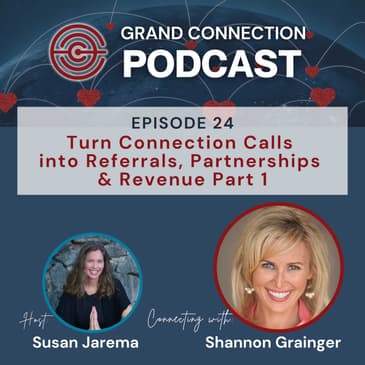
What happens when business growth stops feeling sustainable, even while success appears to be accelerating? Susan Jarema welcomes Shannon Grainger for a grounded exploration of partnerships, referrals, and relationship-driven growth that creates momentum without burnout. Together, in Part 1, they unpack the early stages of Shannon’s D.E.A.L. Deal Flow Method, focusing on discovery, establish, and the role intentional conversations play in creating aligned opportunities.
Susan and Shannon explore the difference between transactional networking and meaningful collaboration, while highlighting how clarity, preparation, and shared values shape stronger partnerships. The conversation emphasizes sustainable visibility, referral opportunities, and collaborative growth through authentic connection and trusted relationships.
What You’ll Hear:
- Why networking for partnerships creates more leverage than constantly searching for individual clients.
- How burnout led Shannon Grainger to build a more collaborative and sustainable business model.
- The difference between transactional networking and meaningful connection calls.
- Why message clarity and audience alignment matter before pursuing partnerships.
- How the discovery and establish phases help create stronger referral relationships.
- The “magic question” that reveals values alignment and partnership compatibility.
Resources Mentioned on this Episode
- Free Gift: DEAL Flow Method - http://partnershipparty.com/susan
- Lead Magnet Workbook: https://grandconnection.ca/lead-magnets-guide-workbook/
Featured Guest: Shannon Grainger
Shannon Grainger is The Million Dollar Deal Maker.
She’s the Co-Founder and CEO of BigImpactHQ™ - a premier seminar and training company serving multi 6 + 7-Figure Women Speakers.
Together with her husband, Mark, she created the renowned “Speak Your Path to Cash” System, which has generated over $100M in revenue for their clients and secured speaking opportunities on some of the world’s most coveted stages, including Tony Robbins, The View, CNN, Mama Gena, Brendan Burchard and TED Talks.
She’s the Founder of The Women’s Influence Network, an exclusive community helping multi 6 + 7 Figure Women Speakers get bigger stages and better partners - so they can scale with ease and joy instead of hustle and burnout.
Shannon has personally curated over 500 strategic partnerships, driving more than $15M in revenue without ad spend or complicated funnels.
Connect with Shannon:
Website: https://bigimpacthq.com/
Social Media Links: LinkedIn: https://www.linkedin.com/in/shannonlaw/
Facebook: https://www.facebook.com/ShannonLaw123
Free Gift: DEAL Flow Method - http://partnershipparty.com/susan
Lead Magnet Workbook https://grandconnection.ca/lead-magnets-guide-workbook/
Meet the Host: Susan Jarema
Susan Jarema is a marketing strategist, internetologist, and co-founder of The Grand Connection. She helps entrepreneurs grow through collaboration, smart strategy, and high-impact digital presence. Susan is also president of New Earth Marketing, where she builds brands, websites, and ecosystems designed for real growth.
Connect with Susan and the Grand Connection Community:
Website: https://grandconnection.ca/
Facebook Group: https://www.facebook.com/groups/grand.connection
Facebook: https://www.facebook.com/GrandConnectionCommunity
Instagram: https://www.instagram.com/grandconnection.ca/
LinkedIn: linkedin.com/company/66749100
Youtube: https://www.youtube.com/channel/UCxq03yde7nb57HKV1hhztYA
Access your Grand Growth Bundle and Free Guest Pass: https://grandconnection.ca/gifts
We are proud to have Grand Connection Podcast on the High Vibe Podcast Network. Grab your free gift from Susan in our Our High Vibe Gift Vault.
Love this show? Check out the other shows on the High Vibe Podcast Network.
Share the Love
✨ If this episode lit something up in you… tag us on Instagram @HighVibeLeaders and let us know your biggest takeaway!
🦋 Don’t forget to rate & review — it helps us reach more conscious rebels like you.
🔊 Listen & Subscribe
🎧 Spotify
Welcome to the Grand Connection Podcast. I'm Susan Jarema, your host for today, and we are joined today by Shannon Grainger, known as the Million Dollar Deal Maker, co-founder and CEO of Big Impact HQ, and together with her husband, Mark, Shannon has generated over 150 million for clients through strategic speaking opportunities, partnerships, and collaboration driven growth. So, Shannon, I'm especially excited for today's conversation because you've been incredible collaborative partner within the Grand Connection community, and I have learned so much from you already, and I've personally been impressed with working through you with our brand mixers, finding JV partners, helping us through list building collaborations, and the intentional way you create meaningful business relationships that truly support everyone involved. So much gratitude for you, Shannon, today, and so excited that you're here. Shannon specializes in helping entrepreneurs turn relationships, referrals, and strategic conversations into real business opportunities without relying on complicated funnels or hustle-based marketing. Now, I wouldn't - we all love that this conversation was so rich and valuable that we decided we're going to break it into two episodes. In today's episode, we are focusing on the foundation of Shannon's D E A L deal flow method, including discovery and establish, and exploring how preparation, trust, values alignment, and meaningful conversations can open the door to referrals, partnerships, speaking opportunities, and long-term collaboration. Then, in part two we'll dive into how to assess aligned opportunities, build strategic partnerships, lock in collaborations, and turn conversations into real business growth. Now let's dive in. So, Shannon, I'd love to start with your story. What first drew you into the world of partnerships, referrals, and deal making?
Shannon Grainger:Well, first, Susan, thanks so much for having me. I'm looking forward to this conversation as well. It's going to be really fun. I'd love to say that, you know, I just like popped out of the womb of like I'm a deal maker, and you know, like let's leverage our time and grow through collaboration and partnership, but actually it was not always that way, Susan. I actually, what led me into partnerships, collaborations, referral-based and relationship-based marketing. What led me to this place was I went through a huge dark night of the soul and a huge burnout because I was trying to do everything on my own, the pressure and the pace, we had 14 employees, we had a payroll of $70,000 a month, I mean it was a lot, and you know, on social media and on our website it looked all polished and all the things, and yes, we've gotten these amazing results for our clients, and you know, the movement was growing and everything, but it started to like kind of take on a life of its own beyond what I had capacity for, and so I went through a huge burnout, adrenal fatigue, and all the things, hormone havoc, and everything, and it was like one day I like woke up, and I'm like, wait, why am I trying to do this all on my own, why am I not partnering with people? Why am I not doing more like collaborations? And so that was the beginning of me realizing I need to do something different.
Susan Jarema:Well, I think a lot of our listeners are going through the same thing, or have gone through the same thing. I know I have, to the point where I nearly died. So you know, you, you gotta really watch for that, that burnout, and you know, to do some reflection on on what works for you and what you love doing, and how to do it in an easier way. So that 100 and $50 million sounds really intriguing to me. That's that you've helped create over one 50 million client results through strategic speaking opportunities and partnerships. Can you share some insight into how you help those clients achieve those kind of results? Like, that's big.
Shannon Grainger:Yeah, yeah. So this was mostly through our signature system, our Speak Your Path to Cash system, where we like teach them how to use speaking to attract a flood of leads and high paying clients all at once, which I love speaking, because it's a leverage strategy. The same reason why joint ventures and affiliates and referral partners are a leverage strategy. So now I've combined these two together, right, with speaking from the stage, having one conversation with a group of people, of course, leverages your time, and then when you partner with people, you're aligning with their audiences and their communities, and again, that's a leverage strategy. So, the more leverage that you can bake in to your business model, from my experience, the happier you're going to be.
Susan Jarema:Yeah, yeah, for sure. So many people network regularly, but few of them actually seem to consistently turn those conversations into meaningful opportunities. Now, why do you think that happens?
Shannon Grainger:Well, I think that there's a lot of confusion and misinformation out there about, like, affiliates, joint ventures, referrals, like, there's all these terms, right? So let's kind of break it down, of, like, you know what I'm referring to when I talk about partnerships, I'm talking about partnering with another business owner who serves a similar or same audience that you do, you basically have the same niche, the ideal client, but you solve different problems for them, right? Like that's like a joint venture or an affiliate, these all these terms can be, you know, kind of used, you know, haphazardly all over the place, but for the sake of this conversation, when I say partnerships, that's what I'm talking about, is partnering with another business owner who serves like the same type of audience. Okay, so why do so many people spin their wheels networking, you know, all over the place, and quite frankly, wasting a lot of time. All right, well, one of the reasons is you're networking for clients, that's mistake number one. So, sure, you can pick up clients when you're networking or doing connection calls on Zoom. There's nothing wrong with that, but that's like a ones and twosie game, and versus like you could have a partner who could send you hundreds of clients every single year from one conversation. So, to me, that is a much bigger leverage play, you know, of like one conversation could turn into hundreds of 1000s of dollars or hundreds of clients within a year, you know, over five years, like, you know, so that's the way you want to start thinking, is how can I network for partners and also speaking gigs, network for those two things, and then you know, clients are those will just sort of happen automatically.
Susan Jarema:Now, this assumes that you have a product and service that people want.
Shannon Grainger:Well, yes,
Susan Jarema:Okay, or clarity around it. So, so sometimes there's a lot that's going on in your business, right? We're starting off, we're trying out new things, we don't know what's working, and you are trying to figure out what is that, you know, what's your signature product, what's going to land with people. And then there's so that's the side of having the right product, and a lot of people work with a business coach to help make that happen, and you gotta get feedback, right, feedback from potential clients or your existing clients, and what's working and what's not. And then the other side is, I notice it in networking is people are out there, and I know they actually do really good work and have really good value, but they don't tell people in the right way, their message isn't aligned.
Shannon Grainger:Yes,
Susan Jarema:And so that's another thing that you need to work on, is that messaging, so you have that clarity in the messaging, you actually have a product of value that people are willing to pay for, and it gives results and transformation, so you've got that, and then they have clear, and then people can really become a good partner.
Shannon Grainger:Yes, this is such a good point, Susan. Okay, so over close to 20 years of my experience working with 1000s of speakers and experts and entrepreneurs, I see so many brilliant people, quite frankly, spinning their wheels in a sea of confusion, overwhelm, and you're like, what is going on? Like, where is all the money? Where are all the clients? And a lot of times you're doing the right things, but in the wrong order. Okay, so the sequence in which you do the strategy or implement the tactic really matters, so to your point, if you know, message clarity. Who's your ideal client? What's the problem you solve? What's the service that you offer? How much do you charge for it, and how do you offer it? How do you sell it? Okay, all of those foundational pieces really need to be in place before you're even JV ready or partner ready. Okay, so like my husband and I created this framework called the phases of business. Phase one is messaging and sales. You've got to get that honed in, and that needs to be a solid foundation in your business, once you have that dialed and you know you're rocking phase one of business when you're at anywhere from like 80 to 100k a year in top line revenue, now you're ready to move on to phase two, which is leverage and systems and team, so a lot of the partnership conversation is a great strategy for, like, once you're in phase two, you've, you've gotten to that, like, six figure mark, or around that 10k a month mark, and you know your offer, and you're getting clients, and you know how to talk about what you do. Now you're ready to partner with other business owners and experts that serve. The same audience and solve different problems and really start to rock the partnership game.
Susan Jarema:So we're going to assume we're all at this deal place now. We're ready to get some JV partnerships, and if not, there's going to be podcast episodes, or you come to a Grand Connection. There's a lot of information, and we've got recordings and everything on getting that clarity to be get things in place to be JV ready, so moving on. What inspired you to create the D E A L flow method,
Shannon Grainger:The deal flow method? Okay, so what inspired me? Well, there were two things. I had a.. I work with a lot of seven figure women speakers, and so I was working with this gal, and I connected her to, like, it was like a perfect, was like a perfect partner, like the alignment, the synergy, the vibe, the ideal client, like everything was lined up. So they have, they met for tea, and so I followed up with her. I said, "Hey, how did.. how did it go? And she said, "Oh, we hit it off. Oh my god, you're so right. We just fell in love with each other. I'm like, "Okay, that's great. Okay. And so, what kind of deal did you make? Deal, what's a deal? I'm like, that was the purpose of the connection, my friend. Okay, so I had to, I had to really kind of break it down, of like the purpose of you meeting is yes, we want to build relationship and we want to make friends and everything, and we have a business. Okay, this is not a hobby, this is not a nonprofit, this is a for profit and for impact movement that we have. Right, so you got to make money in your business. So the purpose of the connection was to see how they could partner together, and it was like, I mean, actually she spent three hours on this tea date and they booked a follow up. I'm like, what is there to follow up on? I mean, after three hours together, so that was the first thing that inspired me to create this framework. And then, you know, my husband and I have our business together, and his office is right down the hall, and I, you know, I tend to talk a little loud because I'm a speaker, right? So he could hear me oftentimes in my office, and he's like, you are in there having a party every day. Oh my god, you're rocking your connection calls. You really need to break down your framework, because most people don't know how to take a 30 minute connection call and turn it into $100,000 partner and get a flood of clients. I'm like, they don't. He's like, no, they don't know how
Shannon Grainger:to do that. Like, you need to break down that framework, right? So those two things really inspired me to create the what's now the deal flow framework, and I'll share with you how you can get a copy of that, and that's what we're, that's what we're here to talk about today.
Susan Jarema:I know, and I'm so excited, and I just have to add in that my, my significant other in my life has sound cancelation headphones right now, and he's far away, but that's how loud I am. So, yes, got that going along. We're aligned in being loud speakers, aren't we?
Shannon Grainger:Yeah, I know. I know it's funny, Susan. I had a college boyfriend, he would say, Shannon, did you swallow a microphone? This is way before I started speaking or anything like that. Now I'm like, well, look who's laughing now, you know.
Susan Jarema:We'll take the quiet date, the table in the far corner, so we don't have to worry about disturbing everybody else.
Unknown:Yes, yes.
Susan Jarema:So, well, despite that, everybody listening, you can turn down the volume on your phone, so we're not so loud. Let's talk a little bit about your deal framework. Do you want to give an overview to the listeners of the full framework? And then we're going to dive into D and E today.
Shannon Grainger:Yeah, yeah, that sounds great. Okay, so this is the four, the four easy steps of what to do in a 30 minute connection call. Now, a connection call is not a sales call, it's not a strategy session, it's not an enrollment conversation, that's what you use in order to enroll a one on one client into your program. Okay, and that's an important framework as well. All right, but just for clarity, a connection call, the purpose is, if it's a fit, if you do have the same values and the same audience, to lock in a partnership that is the purpose of a 30 minute connection call, and so the deal flow framework breaks down what to do before, during, and after that 30 minute call to lock in a partnership and actually activate it and monetize it.
Susan Jarema:So, just if listeners, there, this is very different than your enrollment call, and sometimes you get on a call and you don't know what bucket they fall into, so I guess you have to qualify right at the beginning of the call. Are you somebody that would be interested in being in my program, or are you a partner?
Shannon Grainger:Yeah, and I like to do that, like you can do that, like through your online scheduler, right? You know, is this like a 30 minute collaboration call, is this, you know, are you looking for XYZ service? Are you looking to, you know, monetize your message and get more speaking gigs? I might say, right, like the problem that I solve, so you know before you even go into the call, the purpose of the call, and that's very important, because the. Very first step of the deal flow method is what you do before the call, and that's the discovery phase. Okay, so in the discovery phase, you want to pop over to their website, pop over to their socials. You don't need to spend, you know, arduous amount of time, you know, digging around, doing a ton of research, but do you know five or 10 minutes, and see what they have going on now. When I go to their website, there's a few things that I'm looking for. How clear are they on their message on the problem that they solve, and who their ideal client is? Is the website like a DIY hodgepodge situation that they're like, if it is, you're like, they're probably not going to be an ideal partner, because they haven't reached the level of business development to even understand, like, how to market themselves effectively, let alone market you effectively. Okay, so I'm kind of looking for, like, clarity of message, and then alignment of, do we serve the same people, and then I pop over to their social, Facebook, LinkedIn, Instagram, whatever, you know, any of the platforms that you tend to be on the most, and I just kind of see what's going on for them personally, you know, and so I'm bringing all that information into the call, you know, so maybe they just got a new puppy, and you mentioned that, oh my god, I love Labradoodles, I saw you just got a new puppy. Oh my god. Okay, so that actually goes into the second phase, which is establish, and in the beginning of that call, just like any call, you're
Shannon Grainger:establishing rapport and connection, so bringing in some of those personal pieces, you know. Oh my god, I saw that, you know, you just announced on Facebook that you're six months pregnant. Congratulations, that's such a huge milestone, right? Bringing in some personal pieces that they can tell, like, wow, you did your research, and I appreciate that.
Susan Jarema:Yeah, and it builds that connection between you right away. Yeah, yeah, we call it neuro resonance when we in the neuroscience, yeah,
Unknown:I like that.
Susan Jarema:Yeah, so getting our brains are we're in the same brain brain residence happening. So that's D and E, right?
Shannon Grainger:Yeah,
Susan Jarema:Okay. Just tell, just an overview of the full one, so that people who are here,
Shannon Grainger:Okay? Yeah, just okay. So the full overview, D is discovery, E is establish, A is assess. and L is lock it in, that's my favorite one, lock it in. Yeah, yeah, and you gotta say it like that, Susan, lock it in, yeah.
Susan Jarema:So, so overall, like we're still on the general side of things. What makes this approach different from traditional networking or sales conversations?
Shannon Grainger:Yes, well, traditional networking is going to teach you to network for clients. Okay, the ones and twosie, and that is going to take a long time. I'm about leverage and speed, right, efficiency. So, so that really, that mindset alone is like, okay, we're going to start networking for ideal joint venture partners, ideal affiliates, right? You know, so when you go to either virtual networking events or in person, start networking for joint venture partners. This automatically sets you apart from everybody else at that networking group, because most people are networking for clients, and everybody can kind of feel it, like, are you my client? Are you my client? Could you be my client? Like, there's this, like, air of desperation that is not attractive. Okay,
Susan Jarema:You know, they're, and they're pitching, right? Yes, I was meeting with somebody earlier today, and he was, he was, he reaches corporate, corporate clients, mid-sized companies, so they would be at, you know, five to 20 million in revenue, and he said, "Well, your community isn't those people, and I said, "Yeah, but our community is people who know or are also reaching that audience and are different from what you're doing, yeah, and doing a different services. So, you know, then he just sort of went, "Oh, oh, and I said, "We focus on collaboration and how to find JVs and collaborative partners and referral partners and ways to cross promote each other's audiences at in one place, and so it changed, but he was definitely thinking, oh, I, I, you know, I'm looking for a community to join that's that's my, my ideal client, and it's very hard to find that, like, yes,
Shannon Grainger:Yes, but then, meanwhile, there's probably tons of people within your network that know people who could refer him, right? You know, definitely. So that's, that's, that's a great example of, you know, collaboration being way more fruitful, and that leverage piece, right, being way more fruitful than just getting one or two clients, you know. So, automatically, when you're networking, you want to start networking again for partnerships, as well as stages and speaking gigs. If you're an expert, you should be speaking, whether that's virtual speaking, pop. Podcasts, guesting, webinars, live stages, your own events, speaking is just the fastest, easiest way to get a flood of clients all at once, right. So, as you're networking, like I like to combine these strategies. So, going back to your question of like what makes this approach different than traditional networking, essentially what I'm doing is I'm stacking two highly leveraged marketing strategies together to have, like, you know, Uber leverage,
Susan Jarema:And we all want Uber leverage,
Shannon Grainger:Very
Susan Jarema:Good way to reach other people's audiences and achieve more with less, and of course have more time for the things we love to do, so what kind of opportunities can come from a well-structured 30 minute connection call? Give us some ideas of what we could be looking at, because you know, I might go in and that person you described, that went for tea, right? Maybe she didn't have that in her back of her mind. Oh, I could be looking for a book thing together, or maybe we can do a webinar together. So,
Shannon Grainger:Yes, yes, great question. Okay, so all kinds of opportunities can come out of it, but you do want to be really focused on like what's your ideal outcome. Okay, so ideally, when you're in the 30 minute connection call, like different opportunities that I like to do is lining up a partnership, lining up affiliates to promote maybe an upcoming launch that I have now. When it comes to launching, that's another big word, like, oh gosh, what does it even mean? Like scaling, what are these words mean? Everybody just sort of uses it all the time, or even deals, right? So giving some clarity with that for you, you know there's different ways that you can quote unquote launch. Maybe you have a masterclass or a webinar, and so in your 30 minute connection call, when they're, when it's a fit, you're going to ask them to promote that masterclass or webinar, and then you're having all your partners promote that same masterclass or webinar at the same time versus these offshoots, and a co-hosted here, and all over, right? Just have them all promote the same thing, and everybody's literally rowing in the same direction. And by the way, most people, surprise, surprise, Susan, are on one than more than one email list. Have you noticed this? Okay, so most likely through the law of frequency, people are going to hear about that webinar multiple times from different partners of yours, and then that law of frequency also acts like another leverage strategy, where they're like, man, I just keep hearing about, you know, how important live events are well, yeah. Because that promo has gone out to, you know, 1520 people lists all at the same time. Okay, so that's just one example. You could have all your partners promote a masterclass or a webinar, maybe you're doing it for a list build, and you're having all your partners promote a lead magnet or a free gift, a free opt-in, right. So that's a list build strategy. I also really love to use connection
Shannon Grainger:calls to help me fill events. Okay, so for those of you that are speaking, you want to fill events, you're like, we gotta get the butts in the seats. I like to say souls in seats, because I do care about people's souls, not their, not just their butt, okay, but you can also use these 30 minute connection calls to line people up to promote your event, and so when I'm doing my 30 minute connection calls and I'm doing an affiliate launch, I do all three assets: I've got a lead magnet, I've got a masterclass, and I've got a virtual enrollment event where we offer our high ticket program, so that's sort of, you know, that's the more advanced, right? Some of you are like, "Let's go, Shannon, give me the advanced ninja stuff, and others of you are like, "What's a lead magnet?
Shannon Grainger:And that's okay, that's totally fine. Okay, no matter where you're at, no shame in your game, like, you know, you just want to say, "Okay, what is my next leverage strategy that I could have partners promote? If you don't yet have a lead magnet, put that together, like an easy checklist, an easy downloadable, you know, you've done it 100 times on other people's emails, you opt in, right, an email, a name in an email, and then you get something in your inbox, right? Most of you know what a lead magnet is, or a free option, so if you don't have that yet, set that up, and then you're going to have your partners promote that. If you don't yet have a masterclass, or maybe you've just been doing your webinar or masterclass to your own email list, great. Now you have that asset, now you can have partners promote it as well. Okay, and then if you are already doing, say, events or enrollment events, then you can, you know, maybe you're ready for like the whole enchilada, okay? So just kind of take like the next easy step that works best for you for where you're at in your business.
Susan Jarema:So I'm just going to share a little bit about lead magnets, because we have our grand giveaway coming up, we always. Grand giveaway coming up, because there's two big ones a year, which is where people in the community, and you should get involved in that one too. We collaborate to reach other people's audiences all together. I have a lead magnet that's a lead magnet tips lead magnet. So, how put together a good lead magnet? So, I will put that in the show notes, it's not normally in our show notes here today, but you can grab that if you're not sure about a lead magnet and how to make it successful. You want that lead magnet to give an immediate transformation, because it's an immediate consumable, but then you want it afterwards to leave with, okay, what's the next step, and the next step would be possibly your masterclass or your signature program, so you, you do want to plan out, like, don't just throw up a meditative free meditation lead magnet, and you don't, you know, that doesn't lead them to your solution, plan that out, so that there's a system that it's, it's helping you create more interest in the next part of the problem, which you saw, so that's a little tip there on lead magnets, and you know, great way of thinking this through. I see that you're, you're talking about, you know, you'll have a call, and then you say, "I've got this, but you, it's a give and take. So, how are you creating more of an integrated partnership when you're meeting with somebody?
Shannon Grainger:Yes. Okay, so this is going to be, so we've done our homework ahead of time in the discovery phase. Okay, now we're on the call, and we're in the establish phase. Okay, and in the established phase, here's some good questions to be asking. Who's your ideal client? We want to know who is their ideal client, and also I'm listening for how clear are they on their ideal client? Do they take 10 minutes to answer that question, and they are not clear at all? That's good to know. All right, or are they like, yes, I work with women speakers, I help them scale with ease through partnerships and speaking gigs. Boom. Okay, it should be very succinct. That's what you're listening for. And then you want to ask, who's an ideal partner of yours, right? Who's an ideal joint venture partner, referral partner? Again, are you a good fit to collaborate, and how clear are they on who their partners are? Okay, so those are some of the questions to be asking in the established phase. Most of the time, the law of reciprocity kicks in, and then they'll ask you the same questions, and then a magic question that I really love asking is, when you partner with people, what's most important to you. This is a magic question that almost every time I forget to ask it soon, I'm like, oh, I forgot to ask the magic question. Okay, so what happens when you don't ask this magic question is that months can go by and you're in the partnership and things go sideways. I mean, this can get anywhere from they ghost you and they don't do what they said that they were going to do to all like it being like a huge show of all kinds of problems and reputation management. I mean, it can, it can get really ugly. All right, so we want to avoid all of that.
Susan Jarema:Yeah,
Shannon Grainger:By asking one simple question, and essentially what this question does is I'm eliciting their values. Okay, what's most important to you when you partner with people, and I'm listening for again what their values are, you know. Some people will say, "Well, I'm looking for guest experts to bring great quality content into my audience, that's what's most important to me. Or some people will say, "Well, I'm really looking for a reciprocal for other people who can also promote my lead magnet and my masterclass, my event, right? Like, do you reciprocate other people? They might actually have a whole business model where a large percentage of their revenue is based on affiliate commission dollars, and there's nothing wrong with any of these answers, by the way. Okay, but if they say, you know, I'm what's most important to me is the affiliate commission, you want to know what is their motivating factor, so you can speak into their listening. You probably heard that, if you're a landmark grad,
Susan Jarema:Yeah,
Shannon Grainger:They're listening. Okay, you're going to be using these personal development and communication tools in every area of your business, and especially in these connection calls. The other thing that that magic question does, is it deepens the connection and the rapport. I just went from surface transactional to something real and meaningful, and now we're having that dialog again. The law of reciprocity kicks in. Oftentimes, they're going to ask me, what's most important to you, Shannon, when you're partnering with people, right? So now we're in like a real conversation, versus can you get me opt-ins? You know, very transactional, like, well, can you get me enough opt-ins that I can get you? What's your list size? You know, it just becomes very transactional, and I like to play the game in a very relational way. I find it more fun and. Frankly, more effective as well.
Susan Jarema:Well, in those open expectations at the beginning, like if it's more clear the partnership isn't going to go and go, you know, what did you say? Go shitty,
Shannon Grainger:Right? Go sideways. Yeah,
Susan Jarema:Right. Yeah, so if you have those expectations clear, that okay, you're looking for, for you know, you want me to also promote you, because that's really what I do. I look for people to partner my mixers. I do need them to bring bums and seats, because if nobody brings bums and seats, we have nobody at the mixer, right? And we got it, that's the goal, is to have those people, but I do my darndest to promote everybody as much as I can, and give them as much visibility as possible, and give them great introductions, and they get to share an offer, and hopefully they get some good signups right at the event, and then if they have an affiliate commit affiliate partnership program, we can share affiliate links as well in both both directions, and I donate all of the affiliate commissions to our charity, so it's kind of a win win for for me, and my charity gets very happy when it's a really good promo get program and they get an extra couple $1,000 or something, so I can't give the list out right, so that's something to do with our castle compliance in that, and I've had, you know, one time somebody had thought they were going to get the full list afterwards and they were disappointed, and and I felt really bad about that, and I guess we weren't clear enough beforehand, and I haven't writing, but people actually don't read things,
Shannon Grainger:They don't read, no, no,
Susan Jarema:So, so you do have to, I guess, that conversation on, you know, what are you looking for, and what do you value in a collaboration will help some of that come out,
Shannon Grainger:Yes, yeah, and the clearer you can be of like what I'm able and willing to do and what you're able and willing to do, right, like having those clear expectations that really helps tremendously. Later in our part two of this conversation, I'll talk about what to do after the call, so that like there's a.. it's a.. it's in writing, like, it doesn't need to be a big long contract or something, but you have it in writing, of like, this is the agreement, this is what we worked out, here's what I'm going to do, here's what you're going to do, because oftentimes you're.. you're having the connection call, but maybe you're not promoting each other for two or three months down the road, right? You know, and I don't know about you, but I'm not going to remember every single conversation and every single detail that we talked about, you know. So that's also another point. In before you even get into the call, you want to make sure if you don't already have like an AI note taker set up, you're going to want to have that set up and make sure that's running for the call, so you can be fully present with the person you're talking with, you don't have to like frantically be taking notes, and then also it gives you something to pull from in the follow up.
Susan Jarema:Yeah, and then I guess the follow up email is a good idea with what was said and agreed to.
Shannon Grainger:Yeah, exactly, exactly. And I have like a format for like how to activate the partnership after the call, so you'll have to join us for part two of this conversation to get
Susan Jarema:up. That's why we broke this up. Well, mostly because I wanted to have you to have the opportunity to hear more from Shannon than one episode, because this is so valuable, and I have really enjoyed being a partner with you and seeing this working live.
Shannon Grainger:Awesome, awesome season. Yeah, it's such a delight. And what I was going to mention before, as you were, as you were saying, your values, right? You know, you're like, 'Hey, I'm looking for partners who can promote the event. I need bums and seats. Okay, so that's a value that I'm listening for. That's that's what that's kind of her north star, right? That's her hot button. I want to make sure I can deliver on that, and then she also mentioned the affiliate commission that goes to my charity, so that tells me she's more impact and contribution motivated than money motivated. Okay, after I get that information, if I continued with the conversation, say I'm in a connection call with Susan, and we've had many - we've had many connection calls, right. So, hence, why we're here. But if I continue down the road, once I figure out, oh, she's impact and contribution motivated, and if I started talking all about the money and the commission, it's going to turn you off, isn't it? It's going to be like, well, yeah, but I mean, that's not really that important to me. I mean, it goes to my charity, and that's really wonderful. That's what's important to me. So, you want to really speak into someone's listening. If I can, if I can listen for she's impact and contribution motivated, and I can talk about the difference that we're going to make, and the reach we're going to make, and the impact we're going to have together, and how it's going to be an even bigger reach together, like that's like, oh yeah, talk to me, baby. Okay, so that's what I'm talking about when we're eliciting their values and we're listening for their motivating factors, and again, those things deepen the rapport, and you don't need a three hour tea date to do that when you're asking the right questions.
Susan Jarema:Yeah, that saves a lot of time when you're. Your connection call is structured, you can get down to 30 minutes and have a real result from it, and not need call number three, four, and five happenings. Yeah,
Shannon Grainger:Yeah.
Susan Jarema:So, anything I've missed here that we need to cover in D and E that we haven't, that you think listeners want to know?
Shannon Grainger:Let's see. So, D, we're going to prepare before the call. What about research?
Susan Jarema:Indeed, what about preparing, like, to make the conversation not so scripted sounding? Like, this happens a lot. Like, I over prepare, and then it sounds, doesn't sound like a conversation, right?
Shannon Grainger:Yeah, you want to be yourself. Okay, like, don't have, like, a big long script, you know? If you want to jot down, you know, a few of these magic questions, I'm going to actually give you the opportunity to download my $100,000 deal flow method, so you can print this on, you can print it, put it on your office wall, and this can act like your script. Okay, but essentially you want to be authentic, you know? If people feel like you're reading, or you're like so robotic, I mean, that's going to break rapport more than anything else, you know. So definitely you want to be prepared, but don't be over prepared, you know? Like I said, 10 minutes or less doing a little bit of research and a little homework, and you reference some things that they have going on personally and in business, is it's plenty, that's plenty.
Susan Jarema:Yeah, yeah. Okay. Well, I think that I've got, you know, some great new ideas. I'm going to prepare a little bit more for my calls, and having that plan around what you are listening for. I mean, those questions about the Kate repeat, what's the main question you want to ask everybody, because I think that's a big, big takeaway.
Shannon Grainger:Yep, so you want to ask, when you're partnering with people, what's most important to you? Yeah, when you're partnering with people, what's most important to you? And then you're going to be like listening for their values, right? Like, perk your ears up and listen for what's important to them, and speak into that listening, are they impact and contribution motivated, or are they money motivated? And again, there is no wrong answer. We don't, if somebody's money motivated, we don't have to like make up this story, oh, they're greedy, it's fine, we're running businesses, I mean, they should be profitable, you know. So that's totally fine, right? But if you, if you speak differently to different people, it's actually going to turn them off and break rapport versus deepen rapport.
Susan Jarema:I love it, I love it, really, really a great concept to think about. So, in closing, for part one, How can listeners learn more about you and the work you're doing.
Shannon Grainger:Yes. Okay, so I have a free gift, aka a lead magnet. Oh my, imagine that. Okay, so in the show notes, Susan's going to add the link. You're going to be able to download a free copy of the $100,000 deal flow method, and what I recommend is you print it out. Okay, if you can, if you can see, if you're watching us on YouTube, you can see I have the $100,000 deal flow method right here, and if you're listening, that's fine. You'll be able to download it, print it off, and I recommend having it on your office wall somewhere where you can see it, and then you can reference that during your 30 minute connection calls.
Susan Jarema:Wonderful. And a website that they can go to, or
Shannon Grainger:Yeah, did you on LinkedIn? Yep, so that's Big Impact hq.com
Susan Jarema:Okay, and you're readily available on LinkedIn for connections too. Your last name is spelled G R A I N G E R. So, for those listening, Shannon Granger. So, thank you so much, Shannon, for joining us today and sharing your wisdom around building meaningful connections and rooted in trust, alignment, and intentional relationship building. Today we explored the first half of the deal flow framework, including discovery and establish, and how preparation, curiosity, and authentic connection can completely transform the quality of your networking conversation, and this is just the beginning. Because part two is the second half of the deal framework, including how to assess partnership opportunities, lock in collaborations, because we want to do that. Let's make that dinner work for us, right? Create referral opportunities, and turn conversations into real business growth through strategic follow-up and meaningful partnerships. So, be sure to join us for the next episode. And before we wrap up, here's one simple action you can take today: reach out to one person already in your network and invite them to a genuine 30 minute connection conversation. Also, download Shannon's gift, so you can follow the process and focus on learning about their goals, values, and opportunities to support one another. Sometimes one intentional conversation can change everything, and if you're looking for a heart-centered community where these kind of conversations and collaboration happen every week, we invite you to experience the Grand Connection and Grant. Have your free guest pass and attend up to three events at Grand connection.ca at the bottom right corner, and be sure to explore the Grand Growth bundle at Grand connection.ca forward slash gifts, and don't forget to grab Shannon's gift too to start applying the D E A L deal flow framework right away. Until next time, keep connecting, keep creating, and keep collaborating, and be part of something grand.