
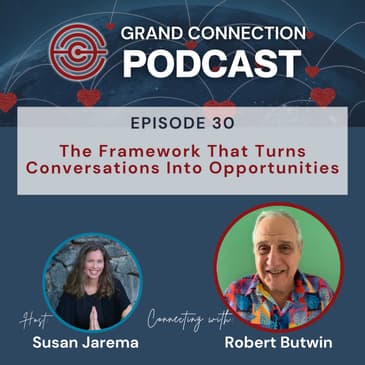
What if the opportunity that changes everything begins with a single conversation? Susan Jarema welcomes networking strategist Robert Butwin for a thoughtful conversation about the power of meaningful relationships in business. Drawing from decades of experience, Robert shares the frameworks that have guided his approach to networking, collaboration, and creating opportunities through authentic connection. Together, they explore why generosity, curiosity, and genuine relationships remain the foundation of sustainable success and a thriving business community.
What You’ll Hear:
- Why one meaningful conversation can create unexpected opportunities.
- Robert Butwin's networking frameworks for building stronger relationships.
- The mindset shift from selling to serving through genuine connection.
- How reputation and authenticity shape long-term business success.
- Why collaboration creates more opportunities than competition.
- Practical principles for building a trusted and supportive network.
Featured Guest: Robert Butwin
Robert Butwin is a best-selling author, international speaker, elite networker, strategist, and superconnector who is known for helping entrepreneurs turn meaningful relationships into profitable opportunities. He is the author of Street Smart Networking and Street Smart Success- Networking that fuels business, who has spent decades teaching business leaders how to create powerful connections, uncover hidden opportunities, and accelerate success through strategic collaboration. He has not worked a job since September 7, 1990, and is psychologically unemployable. Living the life most people dream of, based on the money he has earned. His life purpose is to help more entrepreneurs accelerate their impact by drawing on his wisdom and experience.
Connect with Robert:
LinkedIn: https://linkedin.com/in/robertbutwin
Gift : Personal conversation with the sole intention of being of value to the person, accelerating their success in a 30-minute, no-cost conversation...calendly.com/butwin
Meet the Host: Susan Jarema
Susan Jarema is a marketing strategist, internetologist, and co-founder of The Grand Connection. She helps entrepreneurs grow through collaboration, smart strategy, and high-impact digital presence. Susan is also president of New Earth Marketing, where she builds brands, websites, and ecosystems designed for real growth.
Connect with Susan and the Grand Connection Community:
Website: https://grandconnection.ca/
Facebook Group: https://www.facebook.com/groups/grand.connection
Facebook: https://www.facebook.com/GrandConnectionCommunity
Instagram: https://www.instagram.com/grandconnection.ca/
LinkedIn: linkedin.com/company/66749100
Youtube: https://www.youtube.com/channel/UCxq03yde7nb57HKV1hhztYA
Lead Magnet Workbook https://grandconnection.ca/lead-magnets-guide-workbook/
Access your Grand Growth Bundle and Free Guest Pass: https://grandconnection.ca/gifts
We are proud to have Grand Connection Podcast on the High Vibe Podcast Network. Grab your free gift from Susan in our Our High Vibe Gift Vault.
Love this show? Check out the other shows on the High Vibe Podcast Network.
Share the Love
✨ If this episode lit something up in you… tag us on Instagram @HighVibeLeaders and let us know your biggest takeaway!
🦋 Don’t forget to rate & review — it helps us reach more conscious rebels like you.
What if the relationship you need most is just one conversation away. Hello, everyone, and welcome to the Grand Connection Podcast, where we explore how meaningful relationships help us connect, create, and collaborate for grand growth. I'm your host, Susan Jarima, founder of the Grand Connection, and today I'm delighted to welcome Robert Butwin. Robert is a best-selling author, international speaker, elite networker, strategist, and a super connector. He's the author of Street Smart Networking and Street Smart Success Networking That Fuels Business. For decades, Robert has helped entrepreneurs uncover opportunities, build powerful relationships and create success through strategic collaboration, and Robert, you've been a gracious and supportive part of our community for a long, long time. And I think the most common question I hear is, have you met Robert Butwin? That's what we hear in the breakout rooms doing
Robert Butwin:The right things, if that's you're well known.
Susan Jarema:Yeah, and one of the things I love about Robert's philosophy is that he believes the right conversation can change the trajectory of your business and your life. Robert, welcome to the podcast.
Robert Butwin:Well, I'm glad to be here, and I'm glad to share my insight, wisdoms, things that I've learned over a long period of time that I know really work, because that's part of the key in everything that I do, is you know, being authentic, telling people you know what they can do as it relates to accomplishing whatever they're looking to accomplish.
Susan Jarema:Well, I know you do it well, and you know one of the things you often say is that the relationship we need most may be only one conversation away. So, what do you mean by that?
Robert Butwin:Well, let me date back all the way to 1984 and I've got to set a little bit of the background to this, I just got running the number one nightclub. I walked away from it in the Twin Cities, and we're talking about one conversation, and a lot of it starts with the questions you ask yourself. And so the question I asked myself, and this was before there was online dating, I asked myself, Who would ever need to resort to putting an ad in the personal, so it's a Twin City reader. Now, and again, you never know when that one conversation is going to happen. So, out of a curiosity in question yourself, I did that, and one of the people that ended up responding to that, and I was never anticipating meeting a person that could end up being my life partner, and now we've been happily married for be 41 years in August, but the point is it's one cover, cover one relationship. She had strengths where I had weaknesses, I had weaknesses where she had strengths, and you never know who you're going to meet, where you're going to meet them, and where it's going to lead you, and I've got so many different examples of that, which we'll, you know, get into as we continually go through this conversation with that one conversation that I met, you know, believing in synchronicity, and based on the strategies that we'll talk about.
Susan Jarema:Oh, and I wonder, how your ad wrote, like, was it a really good ad? Do you remember it?
Robert Butwin:My wife kept it, of course, was first time listening. You know, life is missing that special zest with that right person, or something like that. I don't remember exactly, but we've got the ad, no question.
Susan Jarema:Well, I definitely want you to tell me exactly what that is at some point, because I'm curious, I, you know, because something words that work in 1984 might still work now. Oh, well, I've been on the online dating role, but it was on, it was digital then. Then, so back then I was pretty young, I wasn't even allowed to get in a club then, but I was around, and I was, you know, I was, I was going to school dances, would have been what I did, so I was actually thinking, what was the number one song in 1984 It was a
Robert Butwin:Disclaimer, because the nightclub was a disco night club, it's called the Oz, and what is sort of unique about that, because I've been on stages with many of the iconic speakers, but a lot of the stuff that I do is behind the curtains, sort of like in the Oz, The Wizard of Oz. I like, I can handle both roles.
Susan Jarema:Okay. All right. And I guess that is the club still around.
Robert Butwin:No, I was the Rainmaker, and within a few months afterwards, and there's stories behind this, they went out of business.
Susan Jarema:Yeah, well, everyone has a season, right? Yeah, especially in that business, it's very, it's very seasonal. So, so how did you first know that? I mean, you went back to this 1984 that's where you first discovered the importance of making the connection. Not that was for personal. How did you discover the importance of networking in your business? Yes,
Robert Butwin:Same year, 1984 and I graduated from the University of Minnesota. So, if you look back in the records, 1983 the Minnesota Gophers had zero wins, all the rest losses. They were outscored by their opponents approximately three to one. Harvey McKay, who's a 70 year friend of our family, through the power of networking, was able to convince Lou Holtz, which was a premier coach, to come and coach the University of Minnesota, and within the next year they had four wins, and the next year they were at a bowl game, you know. So I saw the power of networking, and I sort of always have modeled myself after Harvey's written eight eight books, seven were New York Times bestseller, the one from a networking perspective is Dig It Well Before You're Thirsty, so I saw the power of networking and I sort of, you know, jumped into it, and that is, you know, and obviously networking for the most part has changed since then, especially since March, uh, March of 2020 when everything went online, but we'll get in, get into that later. But I saw the power of networking from at that point in time.
Susan Jarema:Well, the importance of networking has always been there, and I mean it, it happened in, you know, hundreds, 1000s of years ago, to people, people that worked. You networked it with the tribe next door to get, find a bride for your, for your son, right? Like, yeah. So, there was always things happening in the world of networking. So, you've been self-employed since 1990 right? And you now describe yourself as psychologically unemployable. Tell us about that.
Robert Butwin:Well, the last job I have, to be exact, was september 7, 1990 You know, and what that means is, no matter how much somebody would want to pay me, I'm not interested in working on somebody else's dream. You know, I understand when you've got that life of freedom when nobody's telling you what to do, and you know, originally I was chasing money. Now my whole life is focused on purpose, making a positive impact, living a life of meaning. But I'm not ever interested in working a job again. First of all, I don't need to financially, but you know, the bottom line is, I, you know, I focus on living that life, you know, that allows me the freedom, flexibility to make a difference and help other people.
Susan Jarema:Well, they'll, I've had some contract work, but I haven't had employment work really since 1990 as well for myself, and I got fired from my job. This is why. my first job out of university. I got fired, and then I went, traveled, and then started a business while I was traveling. So that was my little journey, and I've been an entrepreneur ever since. Many different businesses, kind of, you know, seasonal, based on where I'm at in my life and what I'm passionate about, and that's what's lovely about entrepreneurship, is you can do what you love,
Robert Butwin:Exactly. You know, in fact, talking about that, and mentioning travel next month, my wife and I are headed on a luxury cruise, an oceanic cruise. For we're going to be gone for three weeks, so I'm going to unplug. No business.
Susan Jarema:You mentioned that before. You must be very excited about that cruise. Well, we're going to hear about it when you get back. Maybe by the time this is out, you've already done the cruise. We'll see what happens for our timing. So, back to networking. Why do you believe networking is one of the most valuable skills for an entrepreneur?
Robert Butwin:You know, I look at networking as the bridge to creating the kind of impact that you aspire to actually accomplish. When I started networking back in 1984 they talked about six degrees of separation. Today it's like one to two degrees of separation. One person, if you don't think about just how am I going to sell that person, but more think about how can I collaborate, how can I be of value? One of the key things I've always learned, and part of the core of everything that I do, is the concept of givers gain. You know, I know the key to creating the right relationships is asking the right questions, figuring out how you can be of value. Don't think about the short term, I think more long term. So, the point of, you know, the point of networking is developing the right relationships. I believe your net worth is in direct relationship to the strength of your network. You want the right people around you. I basically do one thing, and only, well, for the most part, one thing: talk. I show networking events. I have one in ones. I talk one to many benefits on a podcast or stage, but you know, obviously everything else of people around me are people that I collaborate with. My whole strategy, when I started networking, because I know what is the highest income producing activities, even though I never charge, but in quite often people will say, How. How do I make money? Well, that's a whole nother story. But the point is, it's all about collaboration. But you first got to connect, you've got to, you've got to be able to show that you're somebody that they're going to want to have as a long-term kind of relationship with, and that happens because you focus on being a value and service. You start doing the proper exploration, and then you figure out, as you're asking the right questions, how you will be able to be of value to the other person.
Susan Jarema:Yeah, well, I, in my calls with, with my one on one calls, connection calls, I guess you can call them that. Try to listen to what you know, one of my big questions, what challenge are you facing right now, right, and people will just start sharing what's going on in their world, and then you can help them find solutions for it, or or connect them with somebody that can help them.
Robert Butwin:Well, you know, you hit a key point, because I go into every conversation understanding 3c's Number one, most people are confused. All you have to do is take a look at what's happening in the world today, but this has always been the case. There's a lot of confusion. We don't even need to look at that. Second C is most people are challenged, which is for what you just talked about. In the third C is certainty, knowing that you are going to be able to help them, because if your focus is 100% on the other person, not on yourself. Don't you know the biggest one of the biggest challenges, and there's many challenges that people have when they network, is they're thinking about me, me, me. If you flip the M up upside down, what do you have?
Unknown:We, we, we, we.
Robert Butwin:So, if you're thinking collaboration, then that's exactly what the grand connection is all about, connect and collaborate. Nothing happens unless you make that human to human connection, and then you focus on collaboration, because you've done your exploration, you get the chance to understand what's going on in the other person's world.
Susan Jarema:We have the 3c's our ours 3c are different, so it's a connect, create, collaborate framework, so yours is confused, confusion, challenges, and certainty. Describe the certainty part.
Robert Butwin:Well, I know that if I, you know, understand where the other person is, and this is one of the things I learned from a common friend of ours, who's spoken at the Grand Connection, James Feldman, and so you know, he, he told me about the three Ds, and I start with the first D, and the key, key thing that I want to know, what is, what do you do, and what are you doing, which is more important than what they do, that's the first D. The second D is determine determination. determination, are they really determined? There's a lot of people that will say something, but they're not congruent of from what they say and what they do. In the last D is distance, but I'm not getting into the D's. And when I originally met James, he told me, you know, because I made a statement, you know, and you never know where a cup, you know, when you're meeting with somebody, where the conversation's going, and he's, I said, I'm, I'm an out of the box thinker, and he very politely, as politely as James can be, said my whole career is understanding in the box thinking, he said he got to get in the box with the other person, and the story he told me says I was going through law school in 1968 and I get a call from a fellow student. He says, I cannot attend the focus group, I've got to go out and adjust a boxcar. Jim said, What do you mean adjust a boxcar? Said I work for an insurance company, the railroad lost the boxcar. Jim was intrigued. He says, I've never seen anybody that's just a boxer? Can I come with sure they go to find the boxcar? This is before computers open the boxcar, and there's 33,000 gallons of pasta sauce in the boxcar,
Susan Jarema:Gallons of what pasta sauce, pasta sauce, spaghetti sauce, getting sauce. Yeah, yeah, okay,
Robert Butwin:Yeah. Jim says, what are you gonna do now? He says, well, we've already paid the claim. I got to figure out how to monetize it, and this is really relevant to networking. So he says, 'How much you want? Said $5,000 Jim said, 'Sold. Two problems. Jim didn't have the $5,000 nor did he know what he was going to do with the pasta sauce, but he got in the box. He opened the box. So let me tell you the end of the story. He ended up making $60,000 in that transaction. The next 12 months, he ended up making a half a million dollars. He bought 12 more, 14 more boxcars, made a half a million dollars. But you've got to get in the box with who you're speaking with. You need to understand what's going on in their world, because in reality, the key to success is people need to be speaking to more people. You know, what are people really looking for? They need more visibility, be it if it's a book, podcasts, be a speaking of events, networking. They need more visibility, so they can have more connectivity, so that they can, you know, accompany. Whatever they want to accomplish. Remember, six degrees of separation. Today it's one to two degrees of separation. You know, it's always if you're open and willing to connect at a human to human level. You know, and focus on how can it be of value. I don't need to sell anybody, you know, because I'm looking at the long term relationship. My wife and I are still happily and madly in love after 40 years, many of the relationships that I've developed over the years are 1020, 30 years, you know, in the making, and some of them are newer relationships.
Susan Jarema:You've had a great relationship with your wife and still continue to have one, and I know that's a big part of your story and part of your success. You guys are a team.
Robert Butwin:Yeah, definitely.
Susan Jarema:Yeah, so when so people are out networking, you know. You talked about how they can be successful in networking. What are the mistakes they make?
Robert Butwin:Well, first of all, they're not thinking enough about collaborations. I mean, there's many, you know, I want to focus more from 2020 because that's 99% of what I do now is online, even though the foundation of everything I did was in person. So, there's many different ways, because the whole focus is developing the, you know, the connection. The magic happens when you do the one on one, you know. Nobody's going to a networking event to be pitched to. You're really pitching the one on one, and there's different ways to be more effective, like if somebody's, if you're listening, not trying to sell them, but you're listening to what other people are saying, you can very easily direct message them. I've got something where I can copy and paste and send a direct message right to that person, because again, you want to, you know, you want to set the one on ones, you want to understand your metrics, you want to focus on having the meaningful connections, knowing what your metrics are. I do approximately 50 plus hours of networking a month, that's me, 101 on ones a month, but you know, if I'm going to tell other people they need to be talking to more people, I've got to be congruent, I've got to do one way or the other. So, one of the biggest mistakes that people are making is they're not congruent. People can, people are transparent, and people are any way you want to look at it. People are judging us by how we, how we show up. So, if you've got one minute to speak and you're still speaking at two minutes, if the host hasn't cut you off, people are judging that. You know, there's so many different ways, and it just is the way it is, so you always want to look professional, polite, you know. Anytime you can grab the mic, you know, when you have the opportunity to grab the mic, you want to have top of mind awareness, but you want to do it in a strategic way, because people are watching you.
Susan Jarema:Yeah, yeah. So, what would be strategic way like at a grand connection if you get the mic? What are you going to do that's strategic?
Robert Butwin:What it's contributing based on the flow of what the conversation is. It's not about yourself, it's about the it's about the community. You want to contribute, you want to say something that's relevant in relationship to what the other people are talking about, not self-serving. There's certain people that every time you hear them talk, all they're doing is trying to sell the room. I mean, people can see that they feel no,
Susan Jarema:It's that it's I call the ickiness, it just feels icky, and you notice it, and I get, I'm the one that manages the complaints, right? So I get all the complaints about people that have come into our community and and been spamming people, right, or that they take over in the, in the rooms, and don't let other people have a chance to talk, and you know, then I have a conversation with them, and sometimes they learn, and sometimes they leave. You are very good at being very present at the events, so it's very strategic, so you know what's going on, and you also pull in and thank people, and you're gracious, and you, you weave in things that are happening at the event into what you're talking about when you do get the mic, and so people often will give you the mic because they know when Robert is given the mic, he's going to say something wise, and it's going to tie in with what we're talking about, and you're not going to be pitching yourself
Robert Butwin:Exactly, and again, it's everything's a strategy, you know, and you want to make sure, because you want to have that top of mind awareness, you want to create, have the reputation that you're coming from contribution as a giver, so if there's, it's got to be consistent, because you know, I used to have a headline, relationships in the broken plate. You know, once you break a plate, you can't put it back together the way it was normally. I mean, people are forgiving and they'll understand, but to me everything is reputation.
Susan Jarema:Yeah, yeah, you can't. You and, and what about one on one conversation? Same thing, yep. And you have to, same thing.
Robert Butwin:I want to make sure, and I probably, since March of 2020 have had over 1000 unsolicited letters from people after I've had a one on one. That's when you know you're doing the right, you know, the right thing.
Susan Jarema:Well, that's amazing. Well, this is a reason why everybody says, have you met Robert Butwin, because you.
Robert Butwin:You know, if you're a coach, to you know, whatever it is, you've got to invite them to take the next level. You need to be able to, in a very strategic way, let them know you've gotten enough for free. Now it's time to, whatever that is.
Susan Jarema:Yeah, invite them to, to, to take that next level, that, that the free, the free is kind of over now, in a nice way. It's a hard conversation. I know many people struggle with that, is finding those boundaries around it, because the people that are out there, they're looking for, you know, they don't want to pay, they're looking for opportunities to, to get information and resources, as say, and within their budget, which could be zero.
Robert Butwin:Let me give something that's could be very valuable, and just some was what somebody did for me. They said, you know, because they were sharing things, and they knew that I needed to. I'll give you my friends and family discount.
Susan Jarema:Yeah,
Robert Butwin:I've appreciated the fact that you know that I've been able to contribute to some of the your success, but in the meantime, if you want to continually going, I'll be happy to give you my friends and family discount, so that you know, you know, you understand the value, or however you want to word that.
Susan Jarema:How do people work with you?
Robert Butwin:I'm sort of changing that based on an event that we talked about earlier, but typically you know if they're collaborating with me, because one of my business models is based on helping other people, it's a leveraged business model, so it varies, you know, it's not the same for everybody, you know, it depends upon what they do, what I'm doing, and is it the right collaborative relationship? Everything goes back to what the Grand Connection is all about, collaborations.
Susan Jarema:Yes, because you've done some, some, some joint venture events with different people, and you've, you've monetized them in some ways, so you're doing different things, and then you do stuff with affiliate commissions as well, with some partners.
Robert Butwin:Yes, yeah, definitely. I mean, Jim and I, James Feldman, I 100% collaboration. We don't sit back and keep a scorecard because we both want to help one another. So every everyone's similar but different, same, same but different.
Susan Jarema:So you talked a little bit about Tom's platform, so that's a system, what overall? So you've got the, you're using the Engage Pro suite, I guess. But what systems are you using to stay connected and become a better networker? Anything else besides that?
Robert Butwin:Yes. Well, first of all, you know, I've loved acronyms, so let me give you my acronym for system.
Susan Jarema:Okay,
Robert Butwin:My acronym for system is shape your strategies to execute and multiply, you want things to go viral. I get on average one referral a day. It's a lot easier if people are referring based on the fact that I was able to have an impact that impact with them, and they feel a need to reciprocate and guide me to, you know, other people, so you know that's part of, you know, part of my system. You know, I started explaining the other part of it, you know. Yes, I use Tom's. They get a follow-up email after I do the next one on one with them, and then from there, because my collaboration, one of the people that I met through a networking event, I don't know if you met or if you remember Sue Willhite, she handles my whole newsletter, you know, and so she will handle that now. Another person, I think you know, Linda Wimple, and we're starting a collaboration there, she's going to have a video directory for people one way or the other, but everything that I do is based on collaboration, and I'm focused on developing the right relationships that I can be of value to, for them and for me.
Susan Jarema:So, you're kind of like a grand connection yourself, because everything at the Grand Connection is a collaboration too. Our podcast, like everything we do, all of our groups are collaborations. Yes, the magazine is a collaboration. Yeah, so it's the kind of the same world I'm living in. Is definitely collaboration is my middle name now. Sorry, Mom changed my middle name. So you, you know, you've, you've hinted at your framework, you got the 3c's the three Ds, and then what you just said. Now, do you want to kind of describe this framework that you're working with, so that I can understand it better? Aren't our listeners
Robert Butwin:When you say the framework?
Susan Jarema:So, so your framework for relationship building, like you, the like you have the there's there's the scalp framework, and how it helped entrepreneurs create multiple streams of income, is that part of this, or is that different?
Robert Butwin:Well, yeah, I mean, that's one of my collaborations, and as we take a look at multiple streams of income, and then we'll talk a little bit about how to reach the next level, but you know, whatever their main thing is, and you know, this is my own philosophy, and I went through what we started off. Was Iba that became CEO space. They talked about multiple streams of income, and so I came up with the acronym SCOP, and it's, you know, the SS here speaking, you know, be it if it's one to one. I had a networking, I had a networking event, one to one, like when you're doing your one to one or one to many, and everything's based on do they have a short tail, long tail, C is your coaching or consulting now at this point, and I have not yet charged for my coaching or consulting, but that's understanding your boundaries. A is affiliate income, L is your leveraged resources. Now, resources come in a variety of different forms. That's why I've made millions, why I'm a millionaire or multimillionaire today is because of leveraged resources. MLM is a perfect model, so if somebody you know, and again, most people just don't understand MLM. I look at it in another acronym, MLM, making life meaningful. If somebody's going to collaborate in a proper way, and if I believe, if people really understood MLM, everybody be involved, but you're always dealing with perception every time you're having a conversation with whoever you're having that conversation with. The real of the word perception is precept, it's their fixed idea, you've got to understand their perception of it, so that you can help them see things, assuming they're somewhat open to see it from a different perspective, and then the P is your passive income, and that's why I've got my money works for my money. We invested very wisely, you know, and dividend paying blue chip stocks, silver and gold, back many years ago.
Susan Jarema:That's that. So the Sculpt framework is giving entrepreneurs multiple streams of income, so by understanding this as when you're out networking, it changes how you look at the relationships you're building, right?
Robert Butwin:It does, because, and here's the key, whenever I'm meeting somebody, their main thing should always be the main thing, whatever their main thing is. This is my overall understanding of the framework, so I don't want to take any, anybody away, but if somebody that they're talking with or two is not open to their main thing, it's nice to have a plan B. But the biggest problem that a lot of people have is they're chasing all these shiny objects. The key is you don't want to look like the person that opens up their trench coat and says, which watch do you want? You've got to be strategic in everything that you do, and so if somebody's going to be involved, because it's not about, you know, selling, I mean, the key in selling from my perspective, if I do my job of educating, the influence process becomes easy, no matter what it is that I'm trying to communicate with the other person. It's how you educate them, and then the influencing process becomes easy, because everything that we do in life, we've got to be able to influence people at some level, so you want to, in one of the books I read, you know, I was on the speaking circle for a long time, and a lot of the people that were really good at persuasion would always refer to Robert Cialdini's book, Influence or Pre-Persuasion, but there's many quality ways to be able to influence people in a way that you're not manipulating people.
Susan Jarema:Yeah, yeah, that's.. we'll have to.. I'll have to do the book summary on that one. That's a good book to talk about, and how it applies to relationship building. So, you talk about scalp, so speaking coaching affiliates leverage resources and passive income, so that's different ways to have different multiple streams of income. Now you got another, you got a lot of acronyms here. So, what's LAC all about? Can you explain LAC, how it is, because this is all part of one big framework, right? These little multiple parts of it.
Robert Butwin:Yeah, the key, and I really believe, for a variety of different reasons, it's easier to become successful that today than any other time in history. And the reason I say that, I remember I started my journey in 1984 I had to figure out how to learn. I could tell you how much. Well, I can't tell you exactly how much, but I spent a lot of money on books, CDs, going to events today. If you know where to find it, you can pick it up for pennies on the dollar or free. Then you've got new technology that wasn't there in 1984 Then you've got AI. So the key to luck, and I believe the key to your success is luck, and my acronym of luck is laboring under correct knowledge. Laboring under correct knowledge is the key to being lucky, and it starts with you. You know, my intention was to be successful. I didn't know how. I just knew what I wanted, and I knew that if others could do it, I could learn, and even with networking. When I originally started, you know, people - my wife would tell you I'm an introvert, you know, she said when we were dating, she had to handle both sides of the conversation, but I became a situational extrovert. I knew that if I wanted to be a good networker, I had to learn how to ask to listen, ask the right questions, and figure out how, based on what's going on in the other person's world. It's, it's a skill that everybody can learn. So, the key is part of it's a mindset, you know. Success was never an option in my mind, because I pre-program my, you know, the way I think from everything that's, you know, that that has happened and gone on, and so the key, if you want to reach the next level, no matter what it is that you're looking to accomplish, and for those listeners, and part of the acronym, and I'll talk about a little bit about the acronyms, and why the acronyms. For me,
Susan Jarema:It reaches an acronym too. Are you going to go through what that one is?
Robert Butwin:Okay, because I'm like,
Susan Jarema:I'm like, I love acronyms too, and I've got half of them noted down here, and I'm sure listeners here are going, "Oh, I'm missing a part. What was the P? They have to rewind it.
Robert Butwin:Okay, I was your reputation,
Susan Jarema:Okay? Reputation, this is under reach, okay? Yeah,
Robert Butwin:E is the experience that people have when they're with you,
Susan Jarema:okay?
Robert Butwin:A is authenticity. I think today that's more important than any other time. You've got to be authentic. C is clarity. Were you able to help the other person get more clarity? And is your messaging clear, so that people understand what you're trying to see, you know, communicate in H, were you helpful, and did you give them hope, and the acronym of HOPE is helping other people elevate part of the key to success is you need to take responsibility for your success, but unfortunately most people aren't taking responsibility, they're in a state of denial, and I've got an acronym for denial, which is don't even notice I am lying to themselves by not taking responsibility for the success, you know, success is out there for the taking, you've got to choose, life is the choices we make, and you've got to choose the fact that you want to, you know, live that life that you know that will allow you the freedom as an entrepreneurship, you know, when I originally started off, Michael Gerber, you know, one of the things I listened to, Michael, Michael Gerber wrote a book, CDs, you know, called The E-Myth for Entrepreneur Mythology. He said four out of five, five businesses are going to fail in the first five years of the 20% that make it five years, four to five of you are going to fail in the next five years. I'm listening to myself talk, and I said that's not me. Failure is not an option. If other people could learn what they need to do to be successful, I can do it myself. You know, I remember when I first started speaking in front of groups, the first time I spoke in front of a group, within the first 30 seconds, my knees buckled, my eyes were back in my head, and somebody had to drag me off a stage, but I continually focused on what I needed to do to be able to improve my speaking skills.
Susan Jarema:I, I'm having a tough time imagining you being dragged off the stage that was in your introvert life, right?
Robert Butwin:Yeah. Well,
Susan Jarema:And people listening here, a lot of, a lot of people, I, I have a side of me that's very introverted, and like, I sometimes get these knots in my stomach. I sometimes will get a pain in my back from stress and speaking in front of big groups, and that's that's that's stress. And people, oh, you're such an extrovert. Well, I'm not really. No, I just.. it's.. I practiced it, learned how to talk to people and communicate, and I think a lot of young people these days, you know, they spent so much time online, and COVID happened during their.. their.. the.. when they were, you know, learning foundational skills, and they didn't get out much, and it's a struggle to become social in a way that's strategic for your business growth and your personal growth too,
Robert Butwin:Exactly.
Susan Jarema:Yeah,
Robert Butwin:But again, I, I did not, you know, I tell myself I don't have that luxury, you know, to, you know, every time, even the words I always speak, I'm very careful, you know. It's like when people, you know, when I meet people. How are you doing? Amazing. And how are you? You know, it's.. it's the words you use, the thoughts you have, the actions you take.
Susan Jarema:That's very wise words for us to think about. So, what have we missed anything on the the acronyms that I might have skimmed over? You've talked about the 3c's and like, how does it all fit together? You got the 3c in the 4d's is that with the beginning?
Robert Butwin:No
Susan Jarema:Three Ds,
Robert Butwin:yes.
Susan Jarema:Okay, so, so the 3c and the D's, that's the beginning part when you're connecting with people, right?
Robert Butwin:Yes. Well, it's my mindset going into the three season, my mindset going in, because I know that every conversation is focused on being a value to the other person. So, I've got to do my exploration first, and part it starts off with understanding what do you do and what are you doing. I want to know what's going on in their world. I want to do my question, doing my exploration, so I can be of value. My mindset is figure out how I can be of value to the other person. I'm not trying to sell them, I'm trying to set the stage for a long-term relationship.
Susan Jarema:So that's where the 3c and D's come in, and then afterwards you talk about luck, so laboring under correct knowledge.
Robert Butwin:Yep,
Susan Jarema:Then you talk about your reach, which is the reach is how you build your success. Yeah, reputation,
Robert Butwin:Reputation, experience, authenticity, clarity, and helpfulness and hope,
Susan Jarema:Helpfulness and towards other people and giving them hope, and hope stands for helping other people elevate,
Robert Butwin:correct.
Susan Jarema:Yeah, and then you have, and it ends with, you know, people nowadays need multiple streams of income,
Robert Butwin:Yeah,
Susan Jarema:And it's really important in today's economy nowadays, and then you have your scalp framework.
Robert Butwin:Yeah, I could throw one other thing in, if you want.
Susan Jarema:Yeah, yeah, yeah.
Robert Butwin:My 6f words,
Susan Jarema:Okay? 6f's
Robert Butwin:The first one is okay.
Susan Jarema:Is this.. is
Unknown:this
Susan Jarema:friendly list,
Robert Butwin:of course. Come on now, I would never go out anything that's not family friendly. So, the first one is fear, which is face everything and rise. Second was faith. Third one is focus. Fourth one is fun. Fifth one is flexibility. You got to be flexible in the 661 it's fail, and the acronym for fail is for all I've learned. Everything that you do is a learning experience, you know. It's like, how did this serve me in moving towards the success that I deserve mindset? How is what I'm doing serving me?
Susan Jarema:Mm hmm.
Robert Butwin:So there you go, 6f words,
Susan Jarema:6f words to take away today. Well, this has been amazing. Okay, so what advice would you give to someone who feels stuck and wants to accelerate their success through networking and collaboration?
Robert Butwin:Find a mastermind group, a collaboration, remember one person, one person through networking, and so I would master the art of networking. Chick can have a significant positive impact, and the destination that you're looking to accomplish. If others can do it, so can you. You know, we all have the same 24 hours. We get dressed the same way, you know. Take the things that are, you know, focus on the vision that you're looking to accomplish, release the things, the negative thoughts, the negative ideas, whatever those are. I don't, you know, if you're going to go through life and carrying around too much baggage, it's going to slow you from creating to getting to the altitude of what you're looking to accomplish. You cannot, you don't have the luxury of allowing yourself to carry around this negative baggage. Release it however you need to do it, whatever is holding you back. There's always a solution in relationship to what's going on in your life, and if you don't know what it is, there's a lot of quality people in the Grand Connection, and you're going to want to show up with the, you know, show up and be a contributor, not a taker, but be a giver, you know, giver's game, givers, you know, the key is being of value. The more that you give, the more you get, the more you gi v e, the more your g e t.
Susan Jarema:That's it. Well, we've had a great lesson in spelling, we've learned a lot of new words and new acronyms. This is great, Robert. Where can people get a hold of you?
Robert Butwin:You know, they can. The best thing to do is go to my calendar at the Grand Connections. I'm in the directory.
Susan Jarema:Yep,
Robert Butwin:so just go to the directory at the Grand Connections. The easiest way,
Susan Jarema:and you're also on LinkedIn, right? You're easy to find on LinkedIn. Yes, so Robert, Robert is a Grand Connection member. You can find him in our community. You can also meet Robert at. Any of our events, he's usually at the Grand Mixers, so that's a big event that you, you often attend, and you know, maybe be in a room with Robert, and then if you're not in a room, you're probably going to hear someone say, Have you met Robert Butwin? Thank you for sharing your wisdom and reminding us that opportunities often lead with a simple conversation, I just want to thank you so much, Robert. This has really been a great conversation. I love how you put things together into a framework. And for those listening, if today's discussion inspired you to be more intentional about building relationships, remember that meaningful connections create opportunities, collaboration creates momentum, and together they lead to grand growth. Thank you for joining us for another episode of The Grand Connection Podcast. Would you like to add one more thing, Robert?
Robert Butwin:One last thing. You know the key in your networking is creating a team around you. My acronym for Team is Together Everybody Achieves Mastery.
Susan Jarema:So we got that together at the Grand Connection, we will all achieve mastery, and that's really how it works in a community. People will help support you on your journey, because we're all in a different place in our journey, and in many different areas of our business in life. So somebody could be helping you release all that baggage, and you could be helping them with business growth. There's so many ways to collaborate, to skill share, to learn from each other, to partner, to find ways to do joint ventures together. The power of connection and community is, is something that I just want the world to know, and I know, Robert, you do too, and that's why you're out there doing what you do.
Robert Butwin:You got it, and it's been a pleasure, as it always is when I'm in your, in your presence.
Susan Jarema:Until next time, everybody, remember to connect, create, and collaborate.