What becomes possible when business growth is built on trusted relationships instead of increasingly complex marketing tactics?
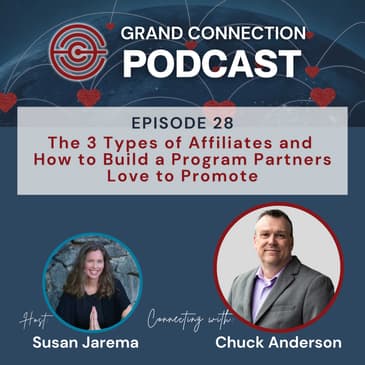
Susan Jarema is joined by affiliate marketing and partnership expert Chuck Anderson to explore how businesses can grow through referral partnerships, ambassador programs, and strategic collaborations. Drawing on nearly 30 years of experience, Chuck shares why relationship-driven affiliate marketing often outperforms traditional advertising and how entrepreneurs can create simple systems that encourage others to actively promote their products, services, events, and communities.
What You’ll Hear:
- Affiliate marketing works best when it is built on trust, alignment, and genuine relationships rather than transactions.
- Ambassador programs can become one of the most powerful long-term growth strategies because advocates already believe in the value being shared.
- Many entrepreneurs overlook the opportunities sitting within their existing communities, clients, and networks.
- Collaboration often creates greater visibility and growth than trying to market alone.
- Simplicity matters more than technology when building a successful referral or affiliate program.
- Gamification can increase engagement and make promotion more enjoyable for partners and ambassadors.
- Generosity and recognition strengthen loyalty and encourage ongoing referrals.
- Sustainable business growth often starts with taking one practical step and building momentum through partnerships.
Featured Guest: Chuck Anderson
Chuck Anderson is a trusted guide in the world of affiliate management, bringing over 20 years of expertise to the table. As an authority in recruiting, training, and managing affiliates, he has dedicated his career to mastering the intricacies of what it takes to run a highly successful affiliate program. In his upcoming presentation, Chuck will share the insights and strategies you need to attract and empower affiliates to promote your products, events, and services effectively.
Connect with Chuck:
LinkedIn: https://www.linkedin.com/in/limitlesschuck/
Gift [FREE WORKSHOP]: How To Get Affiliates To Sell Your Products & Fill Your Events. Discover the 3 types of affiliates that can fill your webinars, workshops, and coaching programs to full capacity : https://www.cmapn.com/webinar-gift
Meet the Host: Susan Jarema
Susan Jarema is a marketing strategist, internetologist, and co-founder of The Grand Connection. She helps entrepreneurs grow through collaboration, smart strategy, and high-impact digital presence. Susan is also president of New Earth Marketing, where she builds brands, websites, and ecosystems designed for real growth.
Connect with Susan and the Grand Connection Community:
Website: https://grandconnection.ca/
Facebook Group: https://www.facebook.com/groups/grand.connection
Facebook: https://www.facebook.com/GrandConnectionCommunity
Instagram: https://www.instagram.com/grandconnection.ca/
LinkedIn: linkedin.com/company/66749100
Youtube: https://www.youtube.com/channel/UCxq03yde7nb57HKV1hhztYA
Lead Magnet Workbook https://grandconnection.ca/lead-magnets-guide-workbook/
Access your Grand Growth Bundle and Free Guest Pass: https://grandconnection.ca/gifts
We are proud to have Grand Connection Podcast on the High Vibe Podcast Network. Grab your free gift from Susan in our Our High Vibe Gift Vault.
Love this show? Check out the other shows on the High Vibe Podcast Network.
Share the Love
✨ If this episode lit something up in you… tag us on Instagram @HighVibeLeaders and let us know your biggest takeaway!
🦋 Don’t forget to rate & review — it helps us reach more conscious rebels like you.
🔊 Listen & Subscribe
🎧 Spotify
Welcome, everyone, to the Grand Connection Podcast. I'm Susan, and this is the place where we explore ideas, strategies, and stories that help heart-centered entrepreneurs grow through connection, collaboration, and community. And today I am super excited to welcome Chuck Anderson, the guru of affiliates, and a lot of you heard about him in other episodes, so he's finally here. I found him on another podcast show today, and said, "You gotta come, we gotta, we gotta have a podcast interview. So, thank you for your time, Chuck. Chuck is a trusted guide in the world of affiliate marketing and partnership development, bringing more than 20 years of experience helping businesses recruit, train, and support affiliates who successfully promote products, services, programs, webinars, and events. Many of you already know Chuck. He's been a valued Grand Connection collaborator, shared his expertise on our stage, and has supported a lot of members in the community through his education, his own community, and events, and practical strategies for growth through affiliates behind the scenes. Chuck has also been helping us here at the Grand Connection as we continue to develop our own referral partner, that's what we call it, our referral partner program, which is an affiliate program, and he's not only teaching these concepts, he's helping us put them into practice with our ambassador program, and one of the things I appreciate most about Chuck's approach is that he focuses on relationships first in a world where many entrepreneurs are told they need more ads, more funnels, more complicated marketing systems. Chuck teaches a different path, building partnerships that create value for everyone involved. And today we're going to explore affiliate marketing, referral partnerships, common marketing mistakes, readiness, and the three types of affiliates that can help fill virtually any program or event, I can't wait to hear about that, and practical ways to
Susan Jarema:grow your business through collaboration. Chuck, welcome to the Grand Connection Podcast. It's great to have you here.
Chuck Anderson:It's great to be here, and I can't believe how long it's taken us to do that. And look, when you're reading my bio, which is awesome, I gotta update it, because I think this is our 28th year of working with affiliates. I started in 1998 working with affiliates, and so we're not too far off.
Susan Jarema:Well, I think I first heard about you around 19 2004 or five. It was somebody told me who wanted to use Clickbank, Clickbank, I think it was called, and you, you came up, and I think we ended up meeting for a while, and you probably did some work for them, so it's been a while you've been in this space.
Chuck Anderson:It has been a minute, and so, yes, thank you for reminding me of the, yeah, at oh four, we were, we were doing a lot of seminars, I was working a lot of people, I mean, we're both in BC, we're working with people locally here, and Clickbank was, yeah, we did a lot of work with Clickbank affiliates back then. So,
Susan Jarema:does it still exist? It
Chuck Anderson:does. It does. It continues to evolve. It's probably one of the more I would say affiliate networks that have had longevity, and so a lot of people will list their offers there, hoping to get affiliates, and a lot of affiliates will go looking for offers there, because they're looking for stuff that they can promote and make money with, so, so, yeah, so it's an affiliate marketplace,
Susan Jarema:and the Grand Connection itself is almost like an affiliate marketplace, because we've got a lot of coaches, consultants, and people with programs that have affiliate systems in place or want to have one, so let's start back at the beginning. For those who may be new to the concept, what exactly is affiliate marketing?
Chuck Anderson:Yeah, well, I'll try to be as simple as possible. So the concept is this, and that is, if you sell a product or service, there are other people out there who have that, your ideal customer already on their list, and the way affiliate marketing works is if you're the, if you're the one with the product or service, you set up an affiliate program, you can pay somebody a commission if they send you a customer, and so imagine that there's these affiliates who can send you customers, they make you make a sale, the money's already in your bank, you're going to take a percentage of that, you're going to pay it back to them as a commission, and then on the other side you might have an audience or a network, a newsletter, podcast, YouTube channel, and you're looking to monetize that audience, you can go looking for somebody who has a good product or service, who pays a commission, and you can earn money, earn those commissions. You could even do both. So, there's the two sides: there's promoting things and earning a commission, and there are having people promote you and paying them a commission, and those are really the two. Sides of affiliate marketing,
Susan Jarema:and a lot of different words come up in this space, like referral partners, JV partners, strategic partners. What's the difference?
Chuck Anderson:Yeah, so at a high level, nothing, right? At a granular level, sure. And since we both, you know, serve a lot of coaches and consultants. I'm going to talk about something that comes up again and again and again in the coaching space, and that is, you know, Jay, you know, you got to do JVs, or you got to do J joint venture partnerships, and what they really mean when they, because joint ventures mean something different to me, because I come from a different world, but in the coaching world, what they usually mean is two people coming together, I promote you, you promote me, and it's a reciprocal promotion, right? And it's like we agreed to do a cross promotion or promote each other, and that is commonly in the coaching space referred to as a JV, and it requires that reciprocal agreement. You can also get affiliates or influencers who just have a big list, they have no interest in having you promote them back, they're just interested in the monetization, so they're hoping that by promoting you, they're going to earn commissions, they're going to earn money, you're looking to acquire the clients, once you've done that and you have the money, you can take a percentage of that and pay it back to your partners, and so we talk about different kinds, and we can go deeper into this, into like specific types of affiliates that you can look at, but you know, when we hear promotional partners, strategic partnership, billiards, like I said, at a high level, it's all the same thing, it's performance based, meaning you don't pay unless a sale is made and the money is already in your bank account. At a granular level, it's really about how the relationship is structured and how the campaign is structured. So,
Susan Jarema:And some people like the wording ambassador better. We use referral partners in our program, and I do have an ambassador program too, with select people, which is set up a little bit differently, because they're doing extra work, and that we kind of arrange things differently around that. Some people don't like the word affiliate; they feel like it might be an icky word, so they change the words on it. But affiliates is absolutely an amazing way to gain to achieve more sales in your business, right?
Chuck Anderson:Exactly, it absolutely is. In fact, what I often tell people, it's the only marketing strategy you can put in place where you don't pay for the bulk of it until after the money is already in your bank account, and you compare that to other things you're doing, so let's say you're doing a lot of content marketing or social media marketing. Well, you're you're creating a lot of content, you're you're commenting, you're clicking, you're liking, and all that, and and DMing, and all of that, hoping that that is going to turn into a client. It's the long game, it's very, very time consuming, and it is not always reliable. And then there's paid advertising, where look, you can pay out of your pocket for any amount of leads and clicks, and all of that, that you, that you can afford, but again, you're paying upfront with no guarantee that you're going to get a client come back with affiliate marketing, is if one of my affiliates promotes me, it's up to me to sell the lead to the leads that come in, and I only owe that affiliate a commission if a sale was made, so this is why I tell people, like, if somebody's promoting you and a sale is made, that person pays you, the money's already in your bank account. Then you, you're really just paying a percentage or a portion of that money after you've already received it. And out of all the marketing strategies you can do, it's the only one where you pay by performance and not paid upfront with either your time or your money, or both, right.
Susan Jarema:Yeah, and and it's very scalable,
Chuck Anderson:Very scalable, right. And a lot of people think that they have to be at a certain stage before they can start to do it, but we work with plenty of people who are at zero, right. If I was going to launch a new business tomorrow, the first thing I would do is schedule a webinar to promote my thing, and the second thing I would do is I would find at least one affiliate to help me fill it, and so you can start from zero, right? And so, yeah,
Susan Jarema:I want to just circle back to when I said icky, because we, why do people think it's an icky word? I mean, it comes up all the time. Oh, is that an affiliate link? They like,
Chuck Anderson:Yeah. So, and look, they just different industries and stuff, and so for some reason some people are offended, like by if I or somehow perceive it as being inauthentic, that okay. Okay, if I send out an email and it's got a link in it, meaning I didn't just promote that, or you know, recommend it because I wanted to, but I'm actually getting paid or monetized to do it, and for some there's that perception of that, but, but really the way I look at it is it's a measurement of how, how the partnership is, is working, and so, so when we integrate into somebody else's brand
Susan Jarema:Or they're sending us, promoting us out through their newsletter, or their podcast, or their YouTube channel, an affiliate link is just simply a way to verify who came from who, and, and is it actually working right, and so there's nothing icky about an affiliate link. I mean, let me ask you this, is there anything icky about putting money in your bank account? Well, I kind of used to have an icky feeling about it, and I've changed over time, because it is what I call almost like an integrated joint JV partnership with people. We were, I only work with people I know, like, and trust, so thinking this is basically gone. Then, what I think has happened in the space is sometimes you, you get on some email list and somebody's promoting something, and they're only promoting it for the commission, and there's just.. there's a certain amount of bad seeds out there that give that same ickiness factor happening. Same within the SEO world, which I live in with my web design company, there's some bad seeds out there, and people go, "Oh, SEO isn't real, right? or they're ripping you off, so it's. it's a challenge for some of us to to figure out the messaging around it to make it feel and people to understand that these are people we know like and trust, we're working with them in partnership, we're promoting them, we want you to be part of our community and you do this so well because you're so relationship driven that it doesn't, when you talk about affiliates, it doesn't sound icky, but other people it may. So, how do you make it different? Chuck,
Chuck Anderson:I love what you just said. I think that's where maybe the ickiness factor comes in, where traditional affiliate marketing, and especially big companies, they're very transactional, and so on. The affiliate side, I'm only going to promote you if a certain number of clicks result in a certain number of dollars, and they call it earnings per click, and so they'll measure it, and you know they're trying to maximize the dollars for every click. On the company side, it's I'm only going to work with affiliates who are most profitable, that's extremely transactional, and, and so I think if there ever was an icky part of it, it's that only doing it for the money and only valuing a relationship if it's profitable. My attitude is very, very different, and that is that I first and foremost is my attitude is quality over quantity, so it's not a transactional who can, who can make me the most money, it's who do I align with, who serves the same or similar target audience or type of customer that I do, is there a collaboration opportunity? Are they collaborative-minded? Can we work well together, and do we even like each other? And a lot of the big corporate affiliate programs, you don't have to like any of them, it's all about the, it's all about the money, and how much money you can make, but in the coaching world it's about working with people that you respect, you're not in direct competition with, you can be collaborative with, and it's it's definitely a win, win, win, it's a win for you, it's a win for your partner, and it's a win for the people who are exposed to the promotions that you're doing, right? And so, yeah,
Susan Jarema:Well, we have a lot of members who are affiliates, and you set up the system for it. I call it referral rewards, just because I like that word better. You call it whatever you want, a lot of people call it
Chuck Anderson:Whatever you want,
Susan Jarema:And, and you know, my members enjoy sharing, they were already sharing the value of the brand connection to people that they know to bring them in, part of bringing them in as a community, and this is a way that I can thank them too, and it's been, it's been really positive, and I love sending those, those $100 payments to people, I feel really good about it, because I know that they're going to continue to promote it. They're thanked for the event, and it's something that it feels really good when it happens, like you know, it's not to me. It's exciting when, when I have affiliate commissions come, like I have to pay them out. It's, it's a win for me, and I know in order for you to.
Chuck Anderson:So, in order for you to have had to pay out $100 bonus, meet it means that you acquired a customer and you got, you received that value already, and, and so, and on the side of your affiliate, when they receive the $100 because they're not always expecting it, but when they get it, it's like, oh, wow, okay, this works. Who else can I recommend? Who else can I send there? And that's what you want, because that now is it. That's what promotes the longevity of that relationship, is, is that exciting? Forget,
Susan Jarema:They forget that they, they've done it, because it might take, you know, six months or something before the person they told about it signs up and eventually joins, and then it's like, oh, this is a present, especially for those,
Chuck Anderson:Yeah, especially for those types of affiliates, we call them ambassadors, and that it's people who are in your program already, they're your clients, or they're in your group program, or your membership or whatever, and they don't have large lists, but they know other people that they would like to recommend this to, so they're not large volume, but they're very passionate, like you said earlier, they would promote it for free, because, because they already love you, and they already love what you do, right,
Susan Jarema:yeah,
Chuck Anderson:So why not make it even better, and so that we call those ambassador programs, and which is a little different than some of the other types, and we can talk more about types here at some point, but we really love those, that's our favorite, because again they're so excited and so passionate about about sharing that, like you know, they would do it for free, because they already love you, and but then when you can put in that structure that motivates them to do it on purpose, you know, even if they just referred two people a month to you, that adds up over time, and and is super powerful.
Susan Jarema:Well, you might as well share with us, what are the three types? Because I'll share this.
Chuck Anderson:Let's, let's get that other way, so we have those definitions right, and we've already talked about each one of them a little bit, so let's, we'll just going to kind of dial this in a little bit. And so, the three types: JV partnerships, influencers, and ambassadors. And so, I'll define those for you here in a moment. So, first one is JV, or joint venture partners in the coaching space, like we were saying earlier. What that usually means is reciprocal promotion. I promote you, you promote me. It's kind of become the default. I'm suggesting that it's not, it's not your default. Only do it when it makes sense, but that's a form of a joint, joint venture. There's other types as well, like a collaborative event, so I'll share something that you and I have a mutual friend, Michelle, and Michelle has been my friend for a long time, and she is a podcasting expert, and I'm an affiliate marketing partnership expert, and we came together years ago to create a program called Podcasting for Partners, and so she brought her expertise, and I brought my expertise, and we did a collaborative event that is another form of a JV. Could you pair what you do and your audience with somebody else who's very complimentary in their audience and do something together, so so there's lots of different forms of JVs or collaboration or or joint ventures beyond just reciprocal promotion, but like I said, it's it's kind of become the default where we work with people on their creativity. When you understand the different ways that you can collaborate and partner with people that no longer has to be the default, right, as is that reciprocal promotion. So that's the first type, JV, JV partners. The second type is influencers. Influencers are not looking for you to promote them, they are simply looking to monetize their audience, and so these are people with newsletters, email lists, podcasts, YouTube channels, Facebook groups, and wherever else, whatever
Chuck Anderson:other community they have, like, you know, our partnership with, you know, Grand Connection, you have a great community that you know I would definitely put you in the influencer, you kind of have your foot in multiple, but but in the influencer example, that's that's that one, and and so you can look for people who have groups or large lists or reach of your ideal target audience, and you're going to offer them an opportunity to monetize that audience by promoting your product or services, and you're going to take a percentage, and you're going to pay it back to them for every customer that that that they get, and so look, you, I'll give you an example, you do that too with a with a. Channel or a podcast host, they're going to be super interested, especially podcast hosts. Podcast hosts don't make any money, usually, unless they are a little bit more sophisticated and they have that built in. But what if, as a guest, you had an affiliate program and a service, and you went out and found a host and said, hey host, if you have me on my show, not only do I offer this value in terms of content, but also give you an affiliate link. Anyone from your show who signs up for my program, I'm going to pay you this percentage, or I'm going to pay you this amount, and they will jump on it, because they are not monetizing usually in, in, in very creative ways, so, so you're going to look for those, so those are influencers, they have your audience already, they're looking to monetize, and then my favorite, the third one, and that's ambassadors, and you and I were just talking about that, these are your clients, they're your group members, they are your community, they're people you're already working with, they all, they're already passionate enough about you and the work that you do, they would promote you for free, but we give them an opportunity to monetize, and so an example there is the people in my group coaching program, where I'm teaching them how to go and,
Chuck Anderson:you know, do these affiliate campaigns? I will say to them, very simple question, Who else do you know that should be in this program right now? And they'll be like, oh yeah, I know so and so.
Chuck Anderson:It's like, great, invite them to my webinar. Here's a link, so we know who referred who. Invite them to my webinar, and if they join the program, I will pay you a commission, and you'll have a choice. You can either take that in cash, or you can reinvest it into any one of other other programs, and you know, in the last three years, everyone except for one has reinvested it into additional services or programs. Only one person has taken the money, right? And so they're my favorite, and they don't have big lists. They're highly overlooked, but if you have enough of them in your group, and you have a very structured way of having them invite people to, like, you have the guest pass, which is great. Like, members can invite their friends to get a guest pass. And what a wonderful idea. I have my free webinar that I do every month, and that's mine. And, but, and so they can just invite a couple of people a month, and, and, and that grows and grows and grows over time, and so that's why ambassadors are my favorite. I've seen ambassador programs grow to exceed anything you could ever do with an influencer or a JV partner, and so, but it grows more slowly over time, because these people don't usually have big lists, but they are passionate, very high-quality referrals when you get them. So, so those are the three types: JV partners, influencers, and ambassadors.
Susan Jarema:So, I'm not really doing the influencer one that much, like I do a lot of JVs, because I reciprocate with our grand mixers, and we figure out a way in some sort of integrated partnership of some sort. And there's links tracking, and sometimes it's just for bums and seats in both sides of it. We're not even doing the money thing, depending on the arrangement, and then the ambassadors, of course, is what you set me up with, is a wonderful guest pass link that any, any member of the grand community wants to invite a friend, give them a gift of value, you can come to three events as a guest, give them that link, and it's tracked to you if they join later on, and that's why something sometimes you know, end up giving out this money, you know, a year later, and somebody's like, "What did they come from? And then they're all excited about it, and then they start inviting more people again. It's sort of a little, little rally happens there, which is exciting. How do you make it attractive so some ambassador will want to work with you
Chuck Anderson:With ambassador programs? I find the best motivator is gamification, and so one of the things that we do with ambassadors, like, we'll have separate Zoom calls for ambassadors, and so it's like for those who really want to refer others, and we might, well, it's going to turn it into a game, and see, like, okay, we're gonna have a contest in June. Let's see the person with the most number of referrals, or the most number of, let's say, we can reward on different categories, so it's not just all going to one person, so person with the most registrations, or people with the most people who, who attended our webinar sales or whatever, and we can give them or the most creative Facebook post, or or did a posted a video on social media and tagged us, or there's different ways that you can gamify it, that's going to help you to. Spread your visibility and reward them not just for sales, but for that, for the marketing activities themselves, right. And, and so it's actually reminding me that I probably don't do enough of that with my ambassadors. I do more of that with my clients' ambassador programs than I do with my own, but you can gamify, you can measure what you want them to do to help to spread the word, and gamify it. And ambassadors are different than affiliates, because they already love you. They're, they, they're already your clients, they're already in your community, you know. You already have a relationship with them, that's the key word, relationship to this whole thing. They will do it because of that relationship, so when and then when you gamify it, you make it fun and rewarding, even if that, even if their referrals don't turn into clients right away, the contest and the gamification work extremely well, and there's fun and there's energy and there's life to it, and you know, a real sense of community.
Susan Jarema:We both know Elisa, Elisa, Elisa loves to be top of the leaderboard. She just did. She really gets into the gamification when she's, when she's partnering with you. It's a lot of fun. I do too. I love leaderboards, but sometimes the odd time I'll be on something, and I don't have the bandwidth to, to do really well. I kind of will just do medium, because I just don't have my email schedule isn't working, and things like that. So it just depends on the partnership, and I have to really plan them in. Do you find that with people?
Chuck Anderson:Oh, absolutely, you have to. You have to schedule it in, and so one of the things that is, we ask people for dates, so first thing we ask them for is a commitment, like, hey, are you going to promote this, and they'll say, yes, great, let's find three dates within between this date and this date that work for you when you're going to promote, and we let them choose the dates, when they do that, it becomes a scheduled thing that then we can support them on, we can, we can remind them, and and give them everything that they need. And I wanted to mention, too, you mentioned about, so that's scheduling it in, you, you mentioned about leaderboards, and leaderboards can kind of work for you and against you, right? Because you, and you kind of touched on it here. It's like, well, I'm not going to be at the top of the leaderboard, but you know, I'm giving it my best try, and I'm in there somewhere, which is totally cool. But, and we've seen this happen, where if some, you know, the top three are battling it out to see who, who, who can be the number one, but the people who are in the lower end of the list are going on, there's no way I can compete with those three, and so it becomes a bit of a demotivator, and so that's where in the gamification, so gamification, it's giving you know, rewarding something else that, that you know, kind of lowers the playing field, so in the leaderboard it might be registrations for my summit or my webinar, or whatever, and, and so that's a pretty obvious one, but what about most creative social media posts, or you know, or hey, if you record a video posted on Facebook and tag us back, you'll be entered into a draw for an extra prize, right. Well, anyone can do that, that's motivated. Where you, you want your ambassadors or your affiliates to feel like they can succeed, but you know, if you look at the top three in a leaderboard and you realize there's no way in hell I'm ever going to be one of those three, that's not
Chuck Anderson:motivator, that's a demotivator, right? It's no incentive for you to try harder, but and so, so yes, do the leaderboard, but also incentivize other things that is completely equal, like anyone can win, and and so you'll get you, and plus, what's the benefit if you had, let's say, you had 20 people in your program, all create videos on their phone, post it on Facebook, and tag Grand Connection, and tag you, right? What's the ripple effect of of all of that content going out there? It's huge, like it's going to actually, it's going to be good for the person doing it, it's going to be good for you and your program, and they're excited because now they feel like they have a chance to win or be successful or be rewarded for that, and so
Susan Jarema:I haven't done that, so I'm just been focusing on the tracking of the leaderboard because I have that tracking in place, and I'm using Event Raptor, which you know Steve and Jen from Event Raptor - they're members of the community too, and it tracks based on all the people that are promoting a different event, and I know Go High Level can do that as well, and you know there's speaking of all of this, I think we could move into how do you say. This up, like, what if you're like new to this? This is like kind of like tech talk starting up. What's a link? What's a good right?
Chuck Anderson:Yes, so I'll start with the definition. An affiliate link is simply a link that you can give your affiliate or your ambassador or your partner that has the URL of wherever you want to send them, but it's got a little tracking code or something on it, so you know who referred that person. So, if Susan is referring people to my webinar, I give her a little extra code. When you click that and you register, I know that you came from Susan, right? So, so that's the tracking link. Here's the good news: we're very pro using whatever you have. A lot of people are saying, "Oh, well, go high level is the best, so you must leave whatever you have and you go to go high level. And then someone will might say, "Well, we don't like go high level, we really think that this other platform, Click Funnels, is the best, so you should be in Click Funnels. So let's move everybody there. I'm, I'm saying most of our clients who come to us already have what they need, and when they don't, we actually have our own system called Colab Pilot, which is now all AI powered, and it will attach to any platform, whether you're on Go High Level, WordPress, or you know, using whatever you've got, so our message to people is you probably already have the tech that you need, and when you don't, we have some really cool low-cost options that will get you what you need, but here, but hear me when I say this: being successful in affiliates is not about the tech, it's not about the tracking, it's part of it, because your affiliates are going to expect you to track, but that's not what makes you successful, it's really the relationships and the follow through of your affiliates that will make your program ultimately successful, but you know, so keep the tech simple as long as you can track who referred who, you're good, move on to the more important parts. So,
Susan Jarema:Yeah, and working with somebody like yourself, you can help us get the tech going quickly. And what I loved was when we worked together, you went through my tech stack, saw what I had, and found a simple way to make something work with the tools I already had in place and was paying for.
Chuck Anderson:Sometimes it's simple, and sometimes there's complexity, and so we're really good at weeding through the complexity and making it as simple as possible. And I say simple as possible because sometimes there's a lot of moving parts, depending on where you're at in your journey. Just so happens like with you, you have so many events, and you have the platforms, and you have WordPress site, and going level, and all, and so, yeah. How do we get those things talking together? Whereas, you know, let's say one of our coach members, you know, they have a, they have a website and an email list, great, wherever you're at, there's a solution for you, and look, we work in about 20 plus different platforms, we know them all, it's muscle memory for you. There is no value in you becoming a technical expert on setting it up yourself, just have us and our team set it up for you, so you can get on to the most important part, and that is recruiting affiliates and starting to build your partnership network and running an affiliate program that's already set up is, is, is easy. Setting it up, you're only going to do it once, so you know, don't, don't go down the tech rabbit hole. Just have you know, like, we usually, when we get access to something, we can set it up in a day or two, right? When it's simple, complexity takes a little bit longer, but still, but we know how to navigate it, right? And at the end of the day, there's no value, you know, there's no value to you. You will not make more money by learning how to do the tech part yourself. Learn how to do the relationship and the management piece yourself, because that's where the money is.
Susan Jarema:Well, and it's not like you leave us sitting there, that we can't go in and make new links for our people or change a commission rating. It's just the getting it in place, it's kind of like getting
Chuck Anderson:it in place foundation,
Susan Jarema:And then you've got the tools to use afterwards yourself, and it's already configured
Chuck Anderson:Right precisely right. And so, yes, your complete control. And thank you for mentioning that, by the way. Because, yes, you can create a link for anyone, you can change a commission rate if you want, you can even add something else that's commissionable. Once it's all set up, that's pretty easy to do, and usually that's one of the first things we do once we set it up, is we show our clients how it all works, so you know where everything is, right?
Susan Jarema:Yeah,
Chuck Anderson:Just don't go down the tech rabbit hole. I think is our message.
Susan Jarema:Yeah, no, and that's a waste. It's not a good use of your time, as working in tech myself is doing, you know, building websites and dealing with all the malware and all the things you, you don't want to do malware removal. It's really not a skill you need to learn, you. Hire somebody one time to do it, and we've got the tools for it, and we can do it in a few hours, and your site is back going, so
Chuck Anderson:We could do an entire one hour podcast just on that, from, you know, removing removing viruses from WordPress hosting.
Susan Jarema:Oh my god, yeah, and we're just heads up, everybody, I never talk about my new earth marketing business, but we're really good at malware removal. I've been in this space for 20 years. There we
Chuck Anderson:So, if you have a WordPress site and something weird happens, reach out to Susan. Yeah,
Susan Jarema:Yeah. Well, back to you, Chuck, because this is about you and affiliate marketing. We got, we understand the tech, we know the different types of affiliates. Now, we never really talked about the, the what's the influencer one? Are they easy to get those people?
Chuck Anderson:They, they, it depends on who they are, and, and say, look, you know, if we're, if we're trying to get, you know, XYZ big company that has 2 million people on their list, you're probably going to have to grow into that one, because they're going to have some questions, like, you know, what, what's your track record, what's your history, what is your average commission paid out over the last three to six months, they're going to have some questions, so you know, when you're at the beginning, go for what we call low hanging fruit, so look for influencers who will give you an easy yes. I've given you one example already, and that's podcasters. So, if there's somebody with a podcast that speaks to your ideal type of audience, reach out to that host and pitch yourself as being a guest based on your content, and you say, "Hey, by the way, I've got a free gift for all your listeners, and that's all affiliate track to you. If anybody does that, takes me up on that gift, and becomes a client from being on your show, I'm going to pay you $200 for every for every new customer that can, I'm just giving an example. You can pay whatever amount you want, but if I go to a podcast house and say, hey, if you have me on your show, my content is a great fit for your audience, and I'm going to pay you $200 for every listener that becomes a client, right? And they're not making any money, like most podcasters are out of pocket for their show, and there's different, you know, some of them are a little bit more savvy, and they're trying to monetize in different ways. Most of them not. You could use Chat GBT, you could, you could use any number of tools. You could probably find 100 podcasts that serve your target audience today, and you could start reaching out to them and offering to be on your show with an affiliate link, and then if, and here's the thing, if you're, if you go on their show and you, you pay them a commission, they're going to probably want to
Chuck Anderson:promote you again, because you're the only, again, podcasters aren't always monetized, same thing goes for YouTube channels, not everyone you see on YouTube is making a gazillion dollars, just because they're, we know a few that, that are most of them are not making any money, and or they're not even at that point of monetization yet. If they have an audience, if their videos are getting viewed, you can just reach out to them through the YouTube platform, and same thing is an offer them this opportunity to make money, they're probably going to jump on it because they're not getting a whole lot of other people requesting or offering to pay them anything, and so there's that, but so what you're going to look for are podcasts and YouTube channels, and people with newsletters, and people with Facebook groups look for these people at a place where they're probably not going to ask you too many questions, they're just gonna, they're, they're not monetizing in any other way, so they're, it's probably an easy yes, you know, if I'm gonna go and try to turn Coca Cola into a partner, I'm probably going to be in multiple board meetings and getting through the gatekeepers and all that kind of stuff, so you know, be reasonable with who you identify, but
Susan Jarema:I liked how you said grow into it,
Chuck Anderson:Grow into it, but Facebook groups and podcasts and YouTube channels start, and newsletters start there, because they're not making money,
Susan Jarema:And another thing that might come as an idea, too, is sometimes there may be a place that you're thinking about paying for advertising, maybe paying to be in somebody's newsletter, or paying to do some special posts in a big, big Facebook group, and they, the person, is monetizing their group through some of these offers, if you have a meeting with them, and they love what you are about, and you have a good referral program or affiliate program, they may compromise on the package price that they charge for their advertising if they think that there's commissions along the way, instead, so you can negotiate too on some things that would be paid at. And say, you know, what? How about we.. I, this is too much for my budget. I'd like to try something. Why don't we do something that's.. that's a discounted price, or even free for a commission? Doesn't hurt asking.
Chuck Anderson:It does. It never hurts to ask. And I'm going to add two other scenarios to what you just said. I love that suggestion. So, one is, you know, pitch that idea of of them instead of taking the upfront fee to promote their newsletter, the commissions, especially if they stand to make more money on the commission side, and you can convince them of that, then, then, yeah, they're not going to charge you anything upfront, and you get in. We have seen it go the other way too, where it was, and especially with larger newsletters, where we knew that there was reach. So, what we did was, we, we pitched that they rejected it, and so we decided, okay, but we think it's good enough, a good enough deal, anyways. We're going to go ahead and buy an insertion on your newsletter, and so we do that, but we tracked it as though it was an affiliate, and and so then you go back to them, and you, you with your gratitude afterwards, and you say, great, hey, thanks, we're looking forward to being in your newsletter again, by the way, if we had done the affiliate deal, here's how much money you would have made, and in that case it was like five times what we paid them, right? And so we would like to reopen the conversation about how we could partner and do more of this together. We're not going to pay you those commissions, we paid you upfront, right? But if we had do that and we do have this in the future, you stand to make a lot more money than us paying up front,
Susan Jarema:Had a call with Jessica Koch. You may know her from our community.
Chuck Anderson:I do know Jessica.
Susan Jarema:Jessica was saying how she uses affiliates, affiliate links with the people on her team. She's got a VA agency, but they're always out doing different work, and because they have their affiliate link and they're promoting, you know, other clients and things, they also end up promoting her at the same time, but she's set up a commission structure. It may not be the same structure as with some of her partners, her ambassadors, or JV partners, but because they're already, as she said, they're already being paid a salary. But she has set that up and incentivized it, and she also has some gamification in it too. But it was an interesting way to look at the people within your company of having affiliate links too, and how that could work for you, and they're around, and they're, they're working for you, they should be ambassadors as well.
Chuck Anderson:Absolutely, and if you don't give them that, and they're probably promoting something anyways, so you might as well get yourself in there and empower them to make that little extra money on top of what you're already paying them, because, and I say that because I've seen people go, "Well, why would I do that? I'm already paying them, I'm not going to pay them more. I'm like, "You know, again, that's transactional when it's okay to be generous, and I always tell people, be generous, but not too generous, but not, you know, not generous enough, right? You got to find that balance, and you know, when people feel honored, when they feel like you want to see them succeed, they will be loyal, they will do so much extra to get the word out about you, but when that energy of nope, that's enough, not going to pay you anymore, then that energy stifles their creativity and their enthusiasm for promoting you, right? And so that little tiny bit up front on top of what you're already paying them is so much worth it, right? And you're making way more on the back end anyway, so be generous.
Susan Jarema:One of one person on my team is a Go High Level expert, and she actually brought somebody over to that needed Go High Level in our community, that it was a client from another client she had, but they wanted to be on part of our grand connection to get our go high level deal, which we've talked about probably before in these episodes, and I gave her commission for bringing that, and she was like, so happy, like she didn't even know about that, right, and I was like a big deal, and she's just very grateful, so I was exciting, and I love doing it, I felt really good about it, so you know that generosity comes back, I think, is what you're saying, right? It's creating that generosity and having a generous affiliate system that makes people want to share what you do.
Chuck Anderson:You just said the phrase right there. How do you set it up so that they want to promote you, not that they have to, not that they're obligated to, right, that's again that transactional language, but How do you structure your commission structure, your campaigns, your whatever it is you're asking them to do, How do you do it so that they want to do it, and when you. Do that, you don't have to worry so much about motivation, you don't have to worry so much about follow through, you don't have to worry so much about people saying, oh, I will promote you, and then never promoting you, right? When you build that into your ecosystem, you don't have to worry about those things, because they want to, and paying someone a commission, I guarantee, was as soon as you pay them that $100 they're already thinking, Who else can I refer, right? They're already spending the next $100 in their mind,
Susan Jarema:In their mind for sure. Well, speaking of that, How do you make people want to promote you. Like, okay, we mentioned a few things: being having a generous commission, offering maybe it as a surprise to somebody. Any other things come to mind? Do you talk about gamification to your ambassador?
Chuck Anderson:Gamification, we talked about with your, with your ambassadors, and rewarding more than just sales and lead generation. You can reward, you can measure that on other things, so gamification for sure. The in short, the word is collaboration. Get them involved. So, what does that mean? Well, we kind of see that in the summit model, we kind of see that in the free giveaway model. We see it all the time, where it's a, it's a, it's the, it's not just, hey, will you promote this thing, but they're involved, so let's use summits and free giveaways as an example. So, as a summit, you are a speaker on that summit, so now they're involved, and the speakers are asked to help with the promotion, and so you've basically turned your an affiliate into a guest speaker who is now on the registration page, so they're getting visibility, and guess what, they aren't looking at this as they are promoting you, they are looking at this as they are promoting themselves, so when you can structure your stuff in a way where they see promoting you as a way to promote themselves, then the follow through goes up to like 99% So we see this with our podcast guests, we ask all of our podcast guests to share out the episode, we write copy and we give them a link and say, please share this out, and they're like, wow, no one else has asked me to do that before. Yes, I'll gladly share it. And so I'd say about 80% of our guests share it out. We do summits, we do pan smaller, like micro summits, what should we call panel events, where we'll have like a small group of experts that we want to collaborate with, and we give them a link, but their faces on the registration page as well, and, and I know you do some things like this too, Susan, and, and so they're involved, and so they're more likely to follow through. Free gift giveaways, I'm not a big fan of free gift giveaways, but it's a form of collaborative campaigns where they're involved, they have contributed a gift,
Chuck Anderson:but they're also promoting it, and the collective is promoting it. I'm more of a fan of bundled products than I am of free giveaways, because free giveaways will build your list, but not a high-quality list. If I'm going to do a campaign like that, I'd much rather do a bundled product campaign where there's actually some money involved, and we could pay that out. But campaigns like that, where if you involve them and you turn it into a collaboration, right? Those are just a few examples. Could be a simple example, like Susan and I decide to do a webinar together. We both, we're both going to promote it, and we're going to share the revenue that comes from that webinar. It could be just as simple as just two people coming together. Doesn't have to be a summit, doesn't have to be a big thing, you know. It can be just two people. The point is involve them, make them part of it, and now they are incentivized to follow through because it's their name too.
Susan Jarema:Yeah, very good point. Yeah, we do a lot of that at the Grand Connection because they're members too. So, my goal is to give everybody as much visibility as possible, and help them make those connections with each other. So I'm always promoting everybody to everybody, and we have the giveaways. We are, we do have our grand giveaway twice a year that people can build their lists. Everybody participates in that, some participate more than others. That's the way of the land, I think. And our mixers are basically little mini summits every month, right. And then we have our two bigger events a year that have more speakers involved, and there's there's a strategy too to keeping people who are participating as affiliates or ambassadors or win a campaign excited about it during it, because we forget, right.
Chuck Anderson:Oh, absolutely, the more you involve everyone, the more the follow-through is going to be, and the more enthusiasm they're going to put into it, right. And so then you can get fancy, you can start combining some of the things we're talking about, so you can have them collaborate, and you can gamify it, and and you can turn them into ambassadors, like you know, like you can get start to get really creative in the beginning, start simple, but you know, as you. To build these relationships, you really don't have to beg, you don't have to ask that hard. Is you give someone a good experience in the beginning, especially if you pay the money, it's really easy to get them to do it again. And so that's, you know, we have a mantra in our agency, and it's the campaign structure that we do for everything: it's recruit, it's train, it's manage, it's celebrate, and repeat. Repeat is the key, because that's the longevity. So, recruit, I think everybody gets that. You got to find affiliates,
Susan Jarema:Yeah.
Chuck Anderson:And, but most people start and stop right there. We go a step further, we train them, and say, here's how the emails work. Here's how the social media posts work. Here's how the affiliate links work. Even though it's simple, don't assume anything, train them. And then we go, well, now that you're trained, what dates can you can you promote this out? That's the management piece. So we're going to ask all of our affiliates to choose three dates to promote and say, great, is it okay if I reach out to you on those three dates, and they're going to say yes, and say wonderful. And so now I'm going to manage the follow through, and then I'm going to celebrate. So it's recruit, train, manage, celebrate. That's gratitude. Couldn't do this without you. You are amazing. Thank you so much for every bit of effort that you've put in, and you are, and thank you, even if they only sent you one person, gratitude, gratitude, gratitude, right? And then repeat, right? What's going to make them repeat? And when you do that thing, especially the gratitude piece and the paying the commissions piece, that is going to make people want to repeat again and again and again, and so, but it's how they're treated, and when you do it this way, you're honoring the relationship, not the transaction,
Susan Jarema:And I guess, too, if you make it easy for them,
Chuck Anderson:Make it as easy. I like to use the analogy of, you know, when you go to Walmart and you walk up to the doors at Walmart, and the doors just open, and you walk through, you don't have to, you don't have to open the door. There's no effort. Can you make it that easy for your affiliates? Give them the link, give them the swipe copy, insert, you know, give them each their own swipe copy with the link already inserted and their name already inserted, where it needs to go, and all they need to do is copy, paste, and send, or a copy, paste, and post, and it's that easy. It's literally the Walmart doors opening.
Susan Jarema:It needs to be easy enough for a leader to pass over to their VA, and they don't have to be involved and just say that. And I'm still not getting stuff from people when I'm working with them. I have to go through and organize it and change it, because I, some people are great, and it's super easy. I just say, 'Here's my speech, here's my package for my a new JV partner. This is what you gotta run with, and they'll create posts, send it all out, and it's all, it's all done. And I end up having a great campaign. It's when I have to get involved and make some edits and fine tune it and customize it too much that I end up being the bottleneck in being the good partner, because I get busy and I forget about
Chuck Anderson:So, what if you had a your marketing materials template and a system where it already has the affiliate links, it already has their particulars? You click a button and it will email, let's say you had 50 partners, 50 different versions of that swipe copy with their link already in it, their name already in it, all of that already customized and ready to send. We built that because of what you just said. Well, yeah, because it's the bottleneck. This is why people are taking shortcuts, like, oh, here's my generic swipe copy template, all you got to do is put your link in, and all, but that's too much. That's not the Walmart doors opening, right? That's you giving them work to do, right? No, no, it's copy, paste, and send, and yeah, we're not.. we don't have the time to go and manually put the links. We were doing that, or paying someone to do that, manually put the links in, and sending everybody their complete package, ready to send, with their all their link in it, their name in it, and everything, but now in the age of AI, we could build systems that do that, and so now when we do bigger campaigns, or big, I shouldn't say bigger, I mean we could do it for a campaign of one, a campaign of five, a campaign of 50, a campaign of 500 it doesn't matter, we so we built the system, because that's what needs to happen, and it needs to be super easy for everybody, it needs to be easy for you, needs to be easy for them.
Susan Jarema:Well, this is pretty new, isn't it?
Chuck Anderson:It is, it's very, very new, in fact, we just launched it in a new webinar that we, that we did last week, called AI Powered affiliates, and so we, where we talk about the three apps that we've generated, created one for finding affiliates who are you don't know yet to one, and that's the one, the one that manages the whole affiliate relationship, that's the one I was just describing with all the materials and everything, and a. Third one, especially if you're doing webinars that tracks the performance of your webinar, it gives you audience insights before your webinar, and it helps you to follow up after you've already made your offer, so you're making more sales during the webinar and after the webinar, and so those three pieces working together, we're finding affiliates, managing affiliates, and getting them to fill our events, and that that trio works extremely well. And so, yeah, we've, we've spent almost a year developing. We started almost exactly one year ago developing those, and they're all in production right now.
Susan Jarema:Oh my gosh. Well, congratulations, that's amazing. We, I definitely have to come to that webinar, and everybody listening, your contact information is going to be in the show notes. You also have a gift for everybody here today. What's your gift? Share with everybody your gift.
Chuck Anderson:So, my gift is a 90 minute recording of my training. Now, I use.. I don't give away my replays at my webinars, if you know you have to attend them, usually to get access to it. So we charge everybody $97 for the replay. I do a 90 minute training every single month that teaches you everything you need to know about setting up your affiliate program, the tech, the marketing copy, where to find affiliates, the different campaign structures, all of it. It's a 90 minute training. We usually sell for $97 Your members can get that for free with that link, and and it's self-serve. You can watch that recording today, start be doing this tomorrow, and you can still come to my live events and learn from me directly. So that's my gift.
Susan Jarema:Oh, that's very generous. So I mean, I have so many questions for you. They're going to be answered in this, this free gift, so you can follow up if affiliates is on your mind and you're thinking, how do I figure out how to get more, more sales? Because that's really what it is. And this is, we had a member talking kind of about your different types of work that you spend, and that there's certain buckets that are sales generation type of work. This is it, like this brings you much closer to sales than working on content for a book that's going to come out in two years. So you know, if you want to get more sales in your pro, in your program, you're going to get more bums and seats, more clients. Definitely talk to Chuck, he's a member of the Grand Connection. You can meet, reach him at the information that's in the chat. Where's the best way for people to connect with you? Just for anyone,
Chuck Anderson:You can find me on LinkedIn, I'm Limitless Chuck on LinkedIn, and my agency website is Event affiliates.com You can find us there as well.
Susan Jarema:Thank you. And if you have one tip of the day for somebody who's brand new, they have not set up an affiliate system. What is it?
Chuck Anderson:It's take the next step, and I say this because people are analyzing, they're trying to see the whole roadmap in front of them in its entirety, but I'm telling you that after almost 30 years of doing this, the next step is usually revealed after you take a step. So, take a step towards your first mission is to decide to promote yourself. You're going to schedule an event and find someone to help you to promote that event. That's a great place to start, whether you're starting at zero or you're just looking for your next client. Schedule a webinar, find some an affiliate who will promote that webinar, offer them a commission, that'll get you started.
Susan Jarema:And how would they track that?
Chuck Anderson:There's lots of ways, but I mean, if sometimes you already have what you need in the software, like you might already be on Go High Level or software, or whatever, and if it's just you're just partnering with one person, clone the page and hard code their name into it, right. And so you know, start with wherever you can, that's not a good long-term solution, but it'll get you out of the gate real fast. And then, and then, once you're sold on that, reinvest that into a more, you know, you know, more scalable system. But start schedule your first event. Find someone who's going to help you to promote that event in any way possible. Do it,
Susan Jarema:And for me, who's already using an affiliate system, I'm going to look at more ways to encourage the people that are already affiliates to want to share my events and membership more, so that as we talked about it, making them want to share, so I'm going to think about creative ways to do that. Chuck, thank you so much for joining us and sharing your insights. My biggest takeaway overall is that growth doesn't always come from doing more marketing, sometimes it comes from building better relationships and creating more value and finding ways to collaborate with people who already serve the same audience you want to help, and of course having a simple way to track it. So this is really the essence of what we believe here at the Grand Connection to connect, create, and. Collaborate. Thanks, everyone, for joining us today. If you found value in this conversation, please share it with a fellow entrepreneur, community leader, or business owner who would benefit from these ideas. Grab your free guest pass and Grand Growth Bundle at Grand connection.ca forward slash gifts. And until next time, keep growing, keep collaborating, and keep being part of something grand.