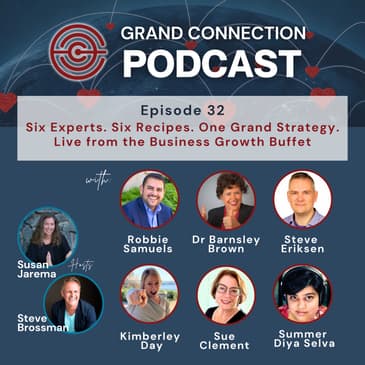
Business growth becomes more sustainable when visibility, trust, clear systems, and supportive relationships work together. Susan Jarema brings together insights from Steve Erickson, Sue Clement, Robbie Samuels, Kimberley Day, Summer Dia Stelva, and Dr. Barnsley Brown, with Steve Brossman guiding the Grand Business Growth Buffet conversation. Each expert contributes a distinct perspective on creating conversations, strengthening buyer confidence, building authority, organizing ideas, and following through with greater clarity.
Rather than presenting growth as a solitary pursuit, the discussion shows how meaningful progress develops through shared knowledge and generous leadership. Virtual summits and workshops create space for trust. Books become pathways into deeper relationships. Simple systems turn mental clutter into practical action. Mindset, accountability, and community help those actions continue.
What You’ll Hear:
- Creating sales conversations through invitation and shared experiences rather than pressure.
- Recognizing when a lead problem is actually a trust or buyer-confidence problem.
- Using workshops to build certainty, share insight, and support stronger decisions.
- Turning books into tools for credibility, visibility, and deeper client relationships.
- Designing a clear pathway from reader to workshop participant to client.
- Creating simple systems that reduce mental clutter and support consistent action.
- Strengthening implementation through mindset, accountability, and community support.
Featured Experts:
Steve Eriksen helps coaches, consultants, and experts turn virtual events into qualified conversations, stronger follow-up, and more clients through EventRaptor. He specializes in practical campaign strategy, audience targeting, and sales messaging that feels natural instead of pushy. Steve shows business owners how to build authority, attract the right prospects, and create simple systems that keep opportunities moving after the event ends.
https://www.linkedin.com/in/steveeriksen/
Free Gift: The Stage-to-Clients Roadmap - https://eventraptor.com/stage-to-clients-roadmap?utm_source=gcpodcastmag
You've spoken on podcasts, summits, and other people's stages. People clapped. Nobody booked a call.
The Stage-to-Clients Roadmap shows you what to change. It's a short, practical guide for coaches and experts who use speaking to get clients.
A 60-second diagnostic tells you which of 3 stages you're in: Get Booked, Own the Stage, or Build the Machine. For each stage you get the mistake keeping coaches stuck, your one next move, and the fastest way to make it.
Sue Clement is a Revenue Acceleration Strategist who helps established coaches and experts turn visibility into clients through stronger positioning, authority, and conversion. With 26 years of coaching experience and a track record of building and selling a multi-7-figure company, she helps entrepreneurs shorten the path from attention to revenue. Her signature approach uses workshops as one of today’s most effective trust-building and client-acquisition strategies.
The Money-Making Workshop Method™: https://www.aperfectmasterclass.com/gift-workshop
https://www.linkedin.com/in/sueclementcoach/
Robbie Samuels is a book launch strategist who coaches entrepreneurs to turn their books into business development tools through prospect-filled launch teams that lead to revenue, reviews, and media opportunities. He founded the Biz Book Pub Hub, a resource ecosystem for entrepreneurial authors, and hosts its podcast and networking events. Robbie is the author of four books with 900+ Amazon reviews.
Launch Your Book Kit: http://www.BookLaunchBrainstorm.com
https://www.linkedin.com/in/robbiesamuels/
Summer Diya Selva is a business strategy, productivity, and marketing consultant, affectionately known as the “Get Shit Done Coach.” She is the author of Stop! Mind The Gap! and serves as a community curator for Konnexions and Fab Collabs, where she helps entrepreneurs and professionals build meaningful connections, improve productivity, and grow their businesses.
"Stop! Mind The Gap!" Free Audio Book: https://links.konnexions.ca/widget/form/KWBU0xyfgKwiN6mzLoj0
https://www.linkedin.com/in/diyaselva/
Kimberley Day serves up a simple recipe for business growth. She helps coaches, consultants, and entrepreneurs stop chasing clients and start attracting them using her proven Book-to-Buyer Method… a simple blend of a strategic book, a powerful event, and an irresistible offer that creates more visibility, leads, authority, and sales… on autopilot.
Join the 7 Day Free trail to grab your free resources
https://www.skool.com/booklaunchlab/about
https://www.linkedin.com/in/therealkimday/
Dr Barnsley Brown helps heart-centered entrepreneurs who are stuck at 2k or less months to create consistent 8 to 10k+ months so they can pay their bills easily, stop worrying about money, and be able to give to the causes they care about in the world! She is also the creator and host of the popular Bold Badass Business Show. Grab your free copy of “How to Overcome Overwhelm in 7 Easy Steps” at www.spirited-solutions.com. (Remember the dash!).
Complimentary Get Results Now Session
https://bit.ly/getresultsnowsession
https://www.linkedin.com/in/kickasscoachingandreiki/
Meet the Hosts:
Steve Brossman is a 9-time Amazon Best-Selling Author who has built multiple 6- and 7-figure international businesses. He has supported many of our members, including myself, with high-value training that brings clarity to their Bankable Story and helps them sell their programs with ease. Through his signature FLOW Selling System, Steve empowers entrepreneurs to create inspired desirability and sell authentically without ever feeling pushy or salesy.
Connect with Steve: https://stevebrossman.com/
Susan Jarema is a marketing strategist, internetologist, and co-founder of The Grand Connection. She helps entrepreneurs grow through collaboration, smart strategy, and high-impact digital presence. Susan is also president of New Earth Marketing, where she builds brands, websites, and ecosystems designed for real growth.
Connect with Susan and the Grand Connection Community:
Website: https://grandconnection.ca/
Facebook Group: https://www.facebook.com/groups/grand.connection
Facebook: https://www.facebook.com/GrandConnectionCommunity
Instagram: https://www.instagram.com/grandconnection.ca/
LinkedIn: linkedin.com/company/66749100
Youtube: https://www.youtube.com/channel/UCxq03yde7nb57HKV1hhztYA
Lead Magnet Workbook https://grandconnection.ca/lead-magnets-guide-workbook/
Access your Grand Growth Bundle and Free Guest Pass: https://grandconnection.ca/gifts
We are proud to have Grand Connection Podcast on the High Vibe Podcast Network. Grab your free gift from Susan in our Our High Vibe Gift Vault.
Love this show? Check out the other shows on the High Vibe Podcast Network.
Share the Love
✨ If this episode lit something up in you… tag us on Instagram @HighVibeLeaders and let us know your biggest takeaway!
🦋 Don’t forget to rate & review — it helps us reach more conscious rebels like you.
🔊 Listen & Subscribe
🎧 Spotify
Welcome to the Grand Connection podcast. I'm Susan, the Chief Connection Officer here at the GC, where heart-centered entrepreneurs come together to connect, create, and collaborate. Today, I'm excited to share highlights from one of our signature events, the Grand Business Growth Buffet. One of the things I love most about the Grand Connection is that we don't just network together; we learn together. We teach one another. We generously share our experience, ideas, and expertise to help each other grow. And the six speakers you'll hear from today are all valued members of our community. Each has built expertise in their field and brings a unique perspective on what it takes to build a successful business. As I listened to their presentations, I noticed something interesting. While every speaker approaches business growth from a different angle, they were all contributing to something much bigger. Each was sharing one important recipe for sustainable business growth. That's why I've called today's episode "Six Experts, Six Recipes, One Grand Strategy for Sustainable Business Growth. What is that strategy? It's simple: learn together, share generously, implement what serves you, then pass it on. And that's what makes the Grand Connection special, and it's how businesses, relationships, and the communities grow stronger together. As you listen today, imagine you're walking through a buffet. You don't need to take everything. Instead, choose the ideas that are most valuable for where you are right now in your journey. Maybe it's a new marketing strategy. Maybe it's a better system. Maybe it's a mindset shift that changes everything. By the end of this episode, I hope you'll leave with one or two new recipes you can put into practice right away. And before we begin, I'd also like to introduce our MC for the Business Growth Buffet, Steve Brossman. Steve is a nine-time Amazon best-selling author who has built multiple six and seven-figure
Susan Jarema:international businesses. He's also been a tremendous supporter of the Grand Connection community.
Steve Brossman:Really smart guy we got coming up. And how many people have host events, want to host events, but don't really feel as if they're getting the true value out of them? We got Steve Erickson here, and he is a very smart dude with some great, great systems. Event Raptor is probably one of the best on the planet to be able to use to host your events, get your events out there. But not only that, be able to follow up with the people and actually maximize the value that you're putting in getting the event off the ground. He specializes in the practical campaigns, the strategies, audience targeting, and sales messaging that feels natural without pushy. He's going to give us some insights on how to get more sales conversations without being pushy and using the way that he does it. It just feels natural, Steve. I'm going to hand straight over to you. I'm going to get my notepad ready because I know that I can always pick up stuff from you.
Steve Eriksen:Awesome. Awesome! Thank you so much for for that introduction. Yeah, so the title of this is actually how to get more sales conversations without being pushy. We have all all been in that situation. We would love to have a conversation with people, and some of us are not asking enough, and some of us, like I don't know, whether you've been in the rooms where you're running away from them because they're just so pushy and trying to have a conversation, and there's so much trying to get sales when you're in front of them. And I'm here to tell you that the the way to do this, the way to do this effectively, to get in front of people without being pushy, is to invite them to a virtual event, right? Invite them to a place where you can actually show your expertise, where you can demonstrate to them why they should be listening to you, and I think this is becoming more and more important now in the AI world that we're living in. You know, we are having a lot of information out there on the internet, social media posts, emails, websites being created by AI, and still today, the or rather today, the only way you're going to know that you're actually speaking to a human being and hearing what the human being has to say is to be in there in the same room as them, being in a Zoom room with them and listening to what they say, and we have been experimenting over the years with various ways of how do we get that conversation with people, and we don't like to be pushy. I'll tell you very briefly. In May of sorry, in March of 2020, I was at a crossroads. I wondered what am I going to do next? I was working with a company and I wanted to go out on my own, and I was really struggling to figure out what I was supposed to do. And they invited me to a conversation. They were going to sort me out in that conversation, and you talk about being pushy. They said, "Oh no, we're not going to help you in this call. We you need to buy into the $10,000 program, and if
Steve Eriksen:you don't." Join your wife is going to divorce you, and your kids are going to despise you because you'll never be successful. That is literally what they said to me verbatim quoted. You know, now we're talking about being pushy. So how do you get the conversation where people are coming to you and saying, "Wow, can you help me? And the way we do it now, very very effectively, is to run a virtual summit to host our own virtual summit. Now, here's what you may not know: if you're trying any other kind of method of filling an event with people who's going to listen to you, it's very very challenging, or takes a long time, or it costs you a lot of money to run ads to an event, to to maybe go out there and and talk on Facebook Live and and things like this. You know, I've done Facebook Lives even with a community of 17,000 people. We've done Facebook Live and had five people on that Facebook Live, but if you actually create a virtual summit that addresses the problems that your audience has, making them want to come and listen to what the kind of solutions are, and you are there with other experts talking about these solutions. You are a building your own authority, b building your list, and c. And this is very very important in that process. When you're getting to register for your event, here's the secret: when they've registered for your event, when they go like, "Yes, I'm really interested, invite them to a conversation with you. Right there and then, put your booking link for your calendar on the thank you page of the registration for your event, and people will book time with you. We run a virtual summit not long ago; it was in April, and we had more than 30-five sales calls booked. But when did you last, within the space of about two three weeks, get 30-five sales calls booked on your calendar?
Steve Eriksen:That was the result we got from running a virtual summit, and several of those calls have already converted into clients, into high-end clients. And we have more conversations coming up. We have people who said to us, "I'm not ready to do it yet, but I'm going to be ready in two or three months. We're going to have follow-ups with these people and converting them into high-end clients. And when I say high-end clients, $10,000 or more, right? So I would like to say to you, if you are wondering how you're going to get in front of people without seeming to be pushy, it needs to be an invitation when they when you catch them at the time when they're interested in the solutions that you're providing, and there is no better method. I've thrown this out as a challenge to people in the past, saying if you can find a way where you can grow your list faster, you can do it cheaper, you can do it in a more effective way. Tell me about it, and I will include it in my presentations as a way of getting clients. Nobody has taken me up on that challenge. Nobody has told me anything that is faster than a virtual summit. So I want to leave you with this: consider how you could use a virtual summit to drive your business forward, right? And and I want to also say this: I was eight weeks into my business when I hosted my virtual first virtual summit. I had 100 people on my list. I didn't have any industry contacts. I had nobody knew about it. I was completely new, and you can do this too. You can also run a virtual summit, even if you're starting from scratch, and actually explode the number of appointments that you have, explode the sales you have. Our two first summits, we summits, we made over $40,000 in sales from those, going from a complete and utter like being an unknown to actually making sales. So, if you want to be getting sales conversations without being pushy, consider virtual summits and have a conversation with me. I'll put my details in the chat. So
Steve Eriksen:if you want to have that conversation and see how that could work for you, let's have a chat. Thank you.
Steve Brossman:Brilliant, Steve. Brilliant. Did we organize that you've got something for the people as well that you want them to grab a gift or something? And I've got a great comment on something that you said and stimulated. While while you've got that, some of the one of the people that I've been working with, and we've been doing it ourselves. One of the things that you said there, a lot of people register for your summit, and quite often it's the people that are too busy doing their work that are making money are the people that you want to talk to?
Steve Eriksen:Yeah, the
Steve Brossman:people that have got plenty of time on their hand and they turn up and they spend all this time. They may not be the right people. I know people that make more money, have better conversations, and grow their business more from the people that they have a call with before the summit that don't. Time to turn up than those that do. So the strategy that you just shared there is absolutely brilliant. If you're running events, workshops, etc. and summits, yeah, you should always have on the registration page maybe a quick little video or something. Hey, if you can't turn up to the summit, some people want to just jump straight on a call and do this, and then you like you you book 35 calls. Absolutely brilliant! That was a great strategy, Steve, and really do appreciate it.
Susan Jarema:Steve showed us that meaningful business growth begins with creating opportunities for businesses to experience us. Instead of chasing prospects, we create conversations that build genuine relationships. But attracting people into our world is only the first step. The next question is: How do we turn those conversations into trust? How do we help people feel confident enough to take the next step with us? That's exactly what Sue Clement will explore. She'll share practical strategies for building buyer confidence, strengthening relationships, and creating trust before transactions. Let's hear it from Sue.
Steve Brossman:Definitely got somebody special coming up because we had Steve that's going to help you get the visibility and start the conversation. Sue Clement is revenue acceleration strategist. She helps the coaches turn the visibility into clients, and that's what you really do want. How do you turn them into clients with your stronger positioning, authority, and conversation. She's got 26 years' experience coaching and got a great track record building multiple seven-figure businesses. And she helps you guys. She helps the entrepreneurs shorten the path from attention to revenue, and that's the biggest thing. A lot of people like going out and getting attention, but how do you turn that into revenue. Her signature approach uses workshops and one of today's most effective trust building and client acquisition strategies. In the next five minutes, she's going to really show you and tell you the strategies that she's used and has been very successful with her clients. How to take that visibility and actually turn it into income. Hey, Sue, the floor is yours, mate.
Sue Clement:Hey there, thank you. Appreciate the welcome. Yeah, you know I'm here to talk all about why leads really aren't your problem. A lot of people think, oh, I need more leads, and so they're chasing them all the time. I think that what happens is we get in that downward spiral of always doing more networking, more DMs, more posting, more content. I mean, feel sometimes that my brain's going to blow up with all the content creation, and we're chasing visibility all the time, and it feels productive. But the challenge is, is it's not always bringing in the revenue. You know, activity and progress aren't the same things, and what I notice is that more leads don't always create more sales. Everyone feel that way? I'm sure we're all going to say yes for that one. And here's why: what I've noticed is that it's not really about getting more leads; it's really about creating more certainty in the marketplace. Buyers have more information than ever these days. You know, there's more experts, there's more choices, there's more noise out in the marketplace. AI has created content like crazy, and so what's happening is that we're overwhelmed with information. So the challenge today isn't about getting more information; it's about creating buyer decision, because buyers are indecisive right now. What I notice when I look at what businessers there's two real key problems I think that people have when growing their business. The first one is their offer isn't clearly defined. It's kind of like going fishing without a hook. You know, you cast the line out there, but if you don't have a hook on the end or a good hook on the end, you're not going to attract the right fish. In this case, the right clients. You know, my husband and I we used to always go fishing, and he'd dig up the grubbiest, ugliest worm, and he would put this worm on the hook, and I would go for the you know pretty fancy spinner looking thing, thinking that that would attract the fish, well, it did
Sue Clement:not, and that's the the thing we have to consider is that if your offer is not aligned with what the buyers are looking for, more leads won't fix the problem. So if you keep tracking more leads and more leads and more leads without doing the offer creation work first, you're wasting your time. The second problem I find is that business owners they don't have a conversion strategy. They're addicted to the chase: more leads, more content, more activity. It feels good, but it's not really creating what they need. So they haven't built the process that actually turns interest into clients, and that's what we need to do more of. You know, it's not that clients have necessarily a marketing problem; they have a conversion problem. You know, just this last week, I had the opportunity to talk to four different business owners, and it was interesting. They're talented; they have stuff going on, but they were struggling with cash flow. Just the short. Term cash flow fix that I gave them. The fastest path isn't about doing more marketing. It's about leveraging the leads and the relationships you already have. I want to repeat that twice: leveraging the leads and relationships you already have. Today we're making lots of new connections and new leverage, you know, new opportunities. But if you're not leveraging them, you're wasting your time. So reach out to past clients, reactivate dormant clients or past prospects that didn't buy at the time. They might buy now. Start conversations with people already engaging in your content. You know you can look at your LinkedIn, your Facebook, and see anyone who's commented or liked on it. Have you engaged with those people, we have so many opportunities around us that we don't need to go look for more opportunities. We need to leverage the opportunities we have. You know, the fastest path to cash is often about you know really the hidden opportunities within relationships we already have. So if you want to get more
Sue Clement:clients, tackle what you currently have rather than going looking for more leads. So here's though, if you want a longer term strategy, that's that's a short fix in a way. But the long term strategy really has to be about solving buyer indecision. This marketplace trust is at an all time low.
Sue Clement:Skepticism is at an all-time high, and if you don't have a strategy that solves the buyer indecision problem, it's going to be harder for you to convert those buyers into clients. Buyers make decisions when they have certainty to move forward. I call it the trust trinity. They have to trust you. They have to trust your process. They have to trust themselves, and so you need to find ways to create that trust trinity in order to convert those leads into clients. You know that's why I'm such a believer of workshops, and that's what you know my favorite marketing strategy is. So I kind of echo what Steve was saying just before me. You know I really feel that one monthly workshop can give you three to five clients on a consistent basis, so you don't have all that marketing chaoticness. You know all the chaos of posting, commenting, writing, doing all those things. One monthly workshop can fill your business so easy. And why it works so well is that you're creating a trust experience. I call it the pre-buy experience when people have a chance to see you think, see you lead, see you live in person, you know, upfront and personal through Zoom, of course. But you can also do live events. But when they see that, that's what builds trust in today's marketplace. So you know, trust grows, certainty grows, and your revenue revenue grows as well, so before you spend another minute chasing more leads because you don't need more leads, you need to leverage the leads you have. But ask yourself: Do you really have a lead problem, or do you have a buyer confidence problem? More leads don't automatically create more sales. Your focus isn't simply to generate more leads in business, although it does feel good sometimes because you're busy, but really it's about creating certainty that helps those leads become your clients. And so that's what I want to leave you with: is where are you at? Are you chasing leads all the time, or are you actually investing more time and
Sue Clement:leverage into getting those leads to become your clients.
Susan Jarema:Thank you, Sue. I always take away so much wisdom. Does anybody have any questions for Sue? I saw one in the chat where somebody asked about what's the difference between a workshop and a masterclass and a webinar and all that.
Sue Clement:I love that question. Nothing. There's seriously the
Susan Jarema:answer
Sue Clement:it really is. No, you know it's funny. I'm I'm of the vintage that we used to tell the seminars and we get 100 people on a phone call, and then we went to webinars because we had slides, and then we then we call them masterclasses one day, and now we're calling them workshops. And ultimately, it doesn't matter what you call it; it's virtual one-to-many selling, and I don't even look at it as selling. In a way, it's a conversion event. It's an opportunity for you to get in front of people, share your wisdom, share your knowledge, give some value, but do not overteach. That's a tip I'll give you: is that when you do workshops, regardless of what you call them, teaching is the enemy of converting. That's a writer downer, guys, because so many people spend so much time teaching, but they don't convert, and that's one of the specialties that I help clients with is how to create that decision environment, how to create a buyer's environment in that.
Susan Jarema:It's very powerful what you teach, Sue, and there is a full masterclass that you have done. It's in the learning library for those who are members. There's quite a few talks by Sue, and one that's a full and one and a half hour masterclass.
Sue Clement:Just one more little thing. I'll jump in here. Is the marketplace has changed dramatically? What used to sell before you could show up and give information and people would buy like crazy. That was pre 2024. 2025, the marketplace dramatically shifted. Trust fell, skepticism rose, and now teaching good stuff isn't what converts. I know that sounds kind of strange because you're thinking, "Well, what am I supposed to talk about for an hour? But really, it's about showcasing the insights-insights over information. That's another real strong tip: is you want to share insights for people because that's what creates the connection with you that they want to step forward and work with you. If you just give them information, we have chat AI. We, you know, we have so much AI. We can just get information. If we're slammed by it, we're drowning in it. So don't give people more information. Give them insights. That's what works.
Maureen:What is your overall message to people on how to incorporate AI into their work, based on what you said?
Sue Clement:Yeah, that's a kind of a sideline topic here. I think that AI is a phenomenal tool. I'm using it every day, I have custom AI bots that I use with my clients to help them create workshops and create their presentations. But ultimately, it's a tool, garbage in, garbage out, like the old computer days. And so, you need to make sure you train your AI. It's like training my dog Teagan on the floor here. You need to train your AI, but it's also I think that it's 80% me and 20% it. It helps me fine tune and and polish, but it can't write for me. It can't. I mean, it writes for me, but it doesn't create ideas for me. It has to be me. That's that's what I'm selling. That's who I am. I hope that helped.
Susan Jarema:Thank you, Sue. So we'll just do two more questions, Maureen, and then Annie.
Maureen:Great presentation, Sue. Lots of great info that I've taken away. I have one question, though. Can you explain to me insight when you're doing workshops? Let me clarify. Opposed to information, I'm trying to grasp that concept. If you can expand on what that means, I'd love it.
Sue Clement:I loved expand on that one because it's so relevant. It's a difference. Insights are what and why. Information is what and how. That's the quickest, shortest way I can say that. It's really about helping people understand why something is working, why something's not working, so that they really it's helping people become more problem aware, frankly, and that problem aware where people are more ready to buy than unproblem aware. So it's really thinking about that the what and the why is more relevant. And think about insights. Like here's an insight I shared today: is that your real problem isn't leads. That's a new insight. It's something fresh, and that kind of gets you thinking. Then you think, okay, how do I fix that? And the how piece is what you sell. That work? Thank you. Yes, thank you.
Susan Jarema:Annie, short question.
Sue Clement:Yeah, insight. You just said is insight is why, and information is what and how. Yes, why something isn't working? Why something they do something differently? It's the why piece that really matters. You know, you you really want to structure your workshop that you are sharing that insight, but you're you know you're articulating what the problem is. You're illustrating through example and story, and then you're demonstrating a piece of your framework, and that's how you put together your content on a workplace, on a master, a workshop, masterclass. Call it what you want.
Susan Jarema:Sue reminded us that trust is the foundation of every successful business relationship. Once we've earned that trust, another opportunity opens. How do we establish ourselves as the trusted expert before someone even meets us, how do we build authority that attracts opportunities? Our next speaker, Robbie Samuels, shares how becoming an author can do exactly that. He'll show us how a book becomes much more than something you publish. It becomes a tool for building credibility, opening doors, and creating meaningful conversations.
Steve Brossman:How many of you ever thought of having a book, written a book, and it just sits there? Robbie's the guy that's going to help you strategize and create a book launch where you can actually get your book in front of lots more people. It and use it as a business development tool. If you want to write a book, you want to get some return on the time and everything that you put into it. He's founded Biz Book Pub Hub. I love it. I'm going to find out more about that. It's a resource ecosystem for entrepreneurial authors and hosts. It pod. It's got a podcast. It's got networking events, and he's the author of four books. And cop this. There's not just books, but 900 plus Amazon reviews. That's engagement with the books, and that means there's people reading the books. People probably end up talking to you, and ideally, people that want to work with you and pay you money. Robbie, the stage is yours, mate, and let's see how we can help people. Turn their book into a constant stream of clients.
Robbie Samuels:Well, hello everyone. Thrilled to be doing this. I want to jump right into the deep end, shall we? I have an unpopular opinion, which is that paying for a bestseller campaign, well, it just doesn't really make sense. Becoming a number one Amazon bestseller for an hour or even a day isn't going to increase the appeal of your book, the success of your book. It's not going to allow you to get more clients. And I totally get it. I have gotten the number one bestseller ribbon 30-seven times across my books, and so I understand how how appealing it can be. I've got all the screenshots to prove it, but of course, none of that is is visible on the book's sales page on Amazon. And my question is whether I should call myself a number one international best-selling author. So, in the chat, if you think yes, no, maybe, I want you to think about this. I've hit number 130-seven times across four countries, and I'll just go back. This is the four countries I've hit it across. But there are authors who are claiming the international best-selling, you know, ribbon. They're they're putting it on their book covers because they hit number one in just 1u.S and one Canadian category, and likely they sold fewer than 100 copies. And I just want to compare that to others who have sold millions of copies and had their books translated into dozens of languages, like Phil M. Jones, who wrote exactly what to say. You know what I did is genuinely an international success in its own right, which is why I say the whole thing, but I don't shortcut it by calling myself a number one international best-selling author because it just feels a little off. Like I'm not in the same category as someone who is still selling millions of copies. So call us both international best-selling authors doesn't make sense. And by the way, little side note: don't put anything like a ribbon or a badge on your book cover. It just calls out the fact that it is not traditionally published. Here's
Robbie Samuels:the thing I want you to focus on instead: the better goal is to gather written reviews. What you see here on your screen might be news to you. Your launch date is not the same as your publication date. I may have to repeat that your launch date is not the same as your publication date. Your launch date is actually when the book becomes available for purchase on Amazon. And in my launch strategy, there's a two and a half to three week soft launch period between that date and the date we announce it publicly. The purpose of the soft launch to give your launch team time to read your book and post a thoughtful review. Studies have shown that more than 90% of buyers check reviews before making a purchase, but most of us don't regularly leave reviews. Which means that a small number of people have an outsized influence on everyone else's buying habits. How do you get people to write reviews when it's not a common practice? You have to make the request as easy as possible. Take a screenshot of these four review prompts. These are the kinds of questions that a reviewer can could respond to with two or three sentences. They can answer maybe two of these and write what I would see as a helpful review, you're not asking for a positive review. You're not asking for a five-star review. You're asking for a helpful review. What is your biggest takeaway from this book? What quote or line from the book resonated? What would you do differently because this book? Who would benefit from reading this book? And I also one more, which is how would you describe this book to a friend? There's a difference I want to point out between global ratings and written reviews. So on the screen, I list my four books, and I'm noting this is actually these are screenshots from May of 2026, so about a month ago, and they actually have gone up since then. I'm right now at just over 1000 global ratings and just over 900 written reviews on Amazon. If you look at my first book, 230-three people
Robbie Samuels:left a one through five star rating, and 190-two left a written review.
Robbie Samuels:If you look at my most recent book, 260-four left a rating, and 250-nine left a review. Much a much higher ratio between reviews and ratings. The reviews are the part that really matters. Reviews influence Amazon search results page. The quantity reviews, the quality meaning one through five stars, the recency reviews, and the verified purchase percentage of verified purchase reviews will all push your book organically higher up on the search results page. I'm not paying for sponsorship, my book organically will show up towards the top of the page if you search the term "book launch" as a keyword in Amazon. That's not happening because I chased a badge; it's because the reviews are creating credibility and momentum. Now we talk about revenue, right? Since June of last year, my book came out. Which, by the way, I had 463 people on my launch team, so that was the beginning of building a pipeline. I have met with over 150 people in the last year to do a 30-minute book launch brainstorming session, and I last counted 17 of those people booked with me, and I made a little over $100,000 from that group. So this is how I have really started to establish this offer, and it's different between launching for vanity and launching with strategy. Here's another screenshot you can take of the five phases of a profitable book launch. And in the chat, I'm going to share another free download, which is think did it not just go in. There it is. My how ready are you to launch checklist. So it's a free PDF. You can just download it. You can get the other bonus content at booklaunchbrainstorm.com. Always willing to have a conversation with an entrepreneurial author. And back to you.
Steve Brossman:Fantastic. We've been around the around the book area and for a long time, and the way that you're helping people launch books, get in front of more people, get more sales, and more importantly, the reviews, because the reviews tell the people not only a lot about the book, but a lot about you and potentially why they should work with you, and that's what most people write a book for, isn't it, Robbie? That you know we do want to write a book for authority and positioning, but hey, we want to turn it into clients. So you help people take that next step, not just sit on the shelf, but really actively engage people and know the real person behind you. Would you say that, mate?
Robbie Samuels:Yes, I do, and I also want to note that there's a question going on in chat about how reviews are being removed at an alarming rate on Amazon. I will say it was a very alarming rate, and it seems to have evened out. Apologies to those of you who launched right as it was bad. I had a client lose 23 reviews, and only some of them came back. There is clearly a new AI filter, and it was a little too filtery. But with that said, don't mention knowing the author. Don't talk about. Don't just give a glow up about the author. Like it's not a testimonial about how great Kim Grushick is! Like it's about the quantity, quality of her work, right? And I've seen this happen where some of my clients, their their friends and colleagues, are basically like, "Oh my God, most amazing person! I love, love, love this person. It's like no exclamation points, no no uppercase, you know, capitals. No, everyone needs this book on their their bedside. Highly recommend it. None of that language. It's not a promotional piece. It's also not a long LinkedIn post. I've seen the other thing, which is like a really dense with bullet points. Those get high. Sometimes those get through, but they get held for like a week and a half. But sometimes they get through. So really, two or three sentences about something in the book and why you liked it-not just copying a sentence, but why it resonated with you, what you're going to do differently, you know why why this is beneficial, who it's for, but nothing too over the top. And don't contact Amazon if your review doesn't show up, because that just causes more scrutiny for that book, which is not always a good thing. Sometimes reviews do come back. It's it's the last launch I did in May and june 3. Only one review got taken down, which is so much better than than before. So so yeah, like double check that. They're also looking for AI written crap reviews. Just to be truthful, like you got to do better.
Steve Brossman:Yeah, absolutely. Yeah, a short personal review about the book is better than the bot BS.
Andrew Darlow:Okay, well, thank you, Robbie. I've had one-on-one with Robbie, and I also participated as a client for his Kindle flash sale review. I just got an email a week or two ago, maybe you can mention that because I think there's so much value in how Robbie brings together Kindle authors and asks them to lower their price, and then he blasts it out. So maybe you can tell it better than I'm talking about it.
Robbie Samuels:Kindle flash salads, and I organize three times a year. It's very much in line with what Susan loves. It's a collaborative global campaign to raise visibility for entrepreneurial authors. So if you wrote a book tied to a business, speaking, coaching, consulting, you can use this to connect with fellow authors to relaunch. As Kim said, Kim's been part of this a long time. You can relaunch a book. So if it's got a book that's like eight years old, great content you haven't talked about in a while. Uses to get a refocus on your network. I teach it's $100 I will be fair. It's not free, but it's $100 and I basically am giving you a lot of marketing advice, tips, scripts, graphics, teaching you how to use LinkedIn better, LinkedIn Pods, LinkedIn Lives. Plus, you get to be on a pod. Podcast. There's just a lot of goods that comes from it, and I love how the author comes together. It's really, it's really lovely. So, if you are an author, you can go to KindleFlashSale.com now, and if you aren't, save that for July 13th through 16th, and go check out dozens of books discounted to 99 cents.
Susan Jarema:And you have a gift, right, Robbie? Did you share? I did. I
Robbie Samuels:dropped it in the chat, and I can I can drop it in again. I've got the how ready are you to launch checklist.
Susan Jarema:Robbie showed us how a book can build authority and help people discover your expertise. But writing the book isn't the destination? It's the beginning of the journey. Once someone sees you as the expert, how do you genuinely guide them towards working with you? Kimberly Day answers that question by showing how books, workshops, and intentional offers can create a natural pathway that serves your audience while growing your business. Pass
Steve Brossman:the spatula to Stevo, will you? What we've got, we're going from Stevo to Kimbo, good friend Kimbo. We're talking about recipes. She serves up a recipe for business growth, helping coaches, consultants, and entrepreneurs stop chasing clients and start attracting them through her book to buyer. Yes, book is the theme of today. It sounds like more importantly, how to use your book to get clients. Simple blend, strategic book, powerful event, irresistible offer. So they're actually running towards you. Leads, authority, and sales on autopilot. Kimbo. She only ever hears that when I'm on introducing her Kimberly Day. Tell us what do you got in store for us?
Kimberley Day:Oh my God, thanks so much, Steve. I love it when you call me Kimbo. I'll take that and a drop some reactions. Go to the reactions at the bottom of the screen right now. If Steve and Susan have been doing an amazing job hosting the grand business buffet, and if you're learning some amazing stuff, like have the speakers not been out of this world? Pop a yes in the chat if you've learned at least one thing you're going to take out of this buffet and implement into your business. I know I have. I always learn from all of the other speakers, and isn't it also ironic that this theme has emerged all about books? So I'm going to actually drop some slides into the chat because I don't know how to run slides like Robbie does. So I'm just going to talk because I tried to share my screen and it shares every other screen. So if you if you're the type of person who doesn't like to scramble to take notes, I've got the slides that I was going to present in the chat, so you can use those. But the best part about the recipe that I'm going to share today with you that it's only three ingredients, so you don't actually have to really remember a whole lot, anyways. So in my world of books, because I love what everybody else was talking about the previous speakers, because I agree with a lot of that, right? In the world of books, the vanity metrics like bestseller status-I don't know. I mean, bestseller status is awesome. I'm a three-time best-selling Amazon published author, but what I think is better than bestseller status is butts in seats to my events and to my programs, right? And no offense to Robbie, because reviews are great too. But I also have a little bit of a different strategy, which I'm going to share in a minute in my three-ingredient little recipe. But also sometimes better than reviews is revenue in your bank account. So yes, getting good feedback for your book is super important. Getting testimonials, getting sharing all of that is
Kimberley Day:fantastic. But when I send people to Amazon, or for anybody that has a published book on Amazon, so actually drop a one in the chat right now if you have a published book on Amazon right now. And okay, great. So we got tons of published authors here. The one thing, though, that Amazon doesn't do to do for me is it doesn't send me a list every month of all the people that bought my book. So I can't even build a relationship with that person because I don't know who they are. So for me in my world, even though I do teach my clients how to publish on Amazon and it's part of the strategy. What we also do is what Wayne popped up and talked about, which is create our own landing page where we can sell our own book, and we can create a masterclass or a webinar. You know, maybe with the help of Sue, who can help you do it do do it a lot better. And the idea behind that is that you're bringing your client down a journey, down a path. You're and not your client at this point. It's still your reader, right? You're bringing your reader down a journey to working with you because there is no money, folks, in selling books. The big money is in the business behind the book, right? What is it that you're selling? And so you want to begin with the. End in mind, you want to figure out what your irresistible offer is that you're selling somebody at the end of the client journey, and back engineer that, right? So in my world, I talk about three things. So let's start with those three ingredients. The first ingredient is the book, and what is the book designed to do? It's designed to attract. It's designed for somebody to raise their hand because it solves a problem that you uniquely have the solution for, and when they raise their hand, now you know that they're not just any lead; they're a qualified lead. They're somebody that has the problem that you solve, and you've hopefully done this the right way through your book, and now you've got an actual lead. You've
Kimberley Day:got their name.
Kimberley Day:You've hopefully got their email because you brought them to your website that has your book on it. And now you can begin the now that you've attracted them. You can begin the process of nurturing them and building a trust relationship with them. And the way I do that in my world with my clients is I invite them to a conversion event, right? So webinar, masterclass, workshop, whatever you want to call it, because the book gives them a bunch of information: the what and the why, right? In Sue's world, same, similar in my world, and then you bring them to that event to help them do some implementation, right? So they go from having the information in the book to you helping them with implementing some of the strategies in that book, and maybe helping them get a small result, a small win, a little bit faster than they could on their own. And then once they're at your conversion event, that is when you're presenting your offer, right? Your irresistible offer, where that now becomes the place where they're going to get the transformation. So people hire you as a coach to get the transformation, right? So, and if you think about it in the buffet world, we're talking about the Grand Buffet here. Think about your book as the appetizer, right? It's giving them a little bit of a taste, but it's not filling them up yet. And then when you bring them to the main course, which is your conversion event, now you're talking through the challenges that they have. You're helping eliminate some limiting beliefs. You're working through objections right there inside of the workshop. You're giving them some some quick wins, and then you're asking them to take another step. Which, if you think about your offer as a dessert, the dessert is what everybody wants, right? They want the transformational results, and how do they get those? They get those with the help of you as the coach, as the service provider, and that is where the big magic happens, right? So think about you've
Kimberley Day:got your appetizer, which is your book, which is designed to give your reader some information. You've got your conversion event, which is the main course, which helps them with the implementation piece, and you've got your irresistible offer at the bottom of the funnel as the dessert, which gives your client what they're really, really looking for, which is those transformational results that only you can provide with your solution. So, I have a gift for everyone here today. Which, if you want to see kind of that in more action, you can see it in the slide that I dropped into the chat, but also I have a book to buyers toolkit, which gives you a blueprint for with the ChatGPT prompts to help you ideate and create your table of contents and maybe get your book idea started. It helps you with niche selection and who your best client or your reader is, and all sorts of good stuff there. It also has some launch maps, so it goes through a process for which type of event you'd like to host. Because not all, even though we call them now a webinar, a masterclass, or a challenge, there is some strategy behind which one you would host. And it's typically the higher priced your offer is, the longer the conversion event that you're going to have, right? They need more time to build that trust with you. So I've got a some maps that help you pick out the best one for you and for your business and your offer, and then some strategies on how to fill your event with with your ideal potential client so that you can actually convert them at the end. So I'll drop the link for that inside of the chat as well, and back to you, Steve and Susan.
Susan Jarema:Thank you, Kim. That was great. Well, so we're starting to see a bit of a theme here: how our books can be used to help us create the next step and convert our ideal audience into wonderful clients who we can provide value to. Thank you, Kim. Well, I want to get into the rooms right away, Kim. What's a great discussion topic?
Kimberley Day:Great discussion topic, since we're already on it. You now know your topic, your book. You know, know how you're going to, or I think I forget what the question Summer asked for, which was where you're going to do, where you're going to share
Steve Eriksen:it.
Kimberley Day:How you're going to share it? What I'd like to know is, could can you think about what. Type of a workshop you would invite your reader to if you were going to ask your reader to get out of your book and step into your world where you can start nurturing them down the path of becoming a client. What does your conversion event look like?
Susan Jarema:Kimberly reminded us that every successful business creates a clear journey for its clients, but delivering that experience consistently takes more than great ideas. It takes focus. It takes organization. It takes systems. As entrepreneurs, it's easy to become overwhelmed by everything we need to do. Summer Dia Stelva shares a practical strategy for simplifying our work, creating momentum, and building systems that support sustainable growth. Here's Summer.
Steve Brossman:How many of you feel overwhelmed? You're not getting things done, and that's what Summer is. She's a business strategies and productivity and marketing specialist, and her little catchphrase is "I help you get shit done. She's the author of Stop Mind the Gap and serves a great community of connections and fab collabs. So she's going to give you some great tips on how to get more done, how to get out there, get in front of more people, and connect and collaborate with a lot more people. Summer, birthday girl or birthday month girl, it's all yours.
Steve Brossman:Summer Diya Selva: Thank you. Let's get your kitchen straight. Everybody seems to forget that it's a grand buffet today. Okay, executive brain dump is what I was going to talk about, but then when Susan brought out her utensils, I was like, no, we need to make it all about kitchen. So executive kitchen dump. How does that sound? It's still about cleaning the mental countertop and systemizing your business. Systems is what all of them all about. So let me start with a question that many people in my community feel very comfortable with or comfortably familiar with. How much of your business is currently cluttering up the kitchen counter. I have only five minutes, so I won't wait for you to answer. But put that in the chat. How much of your business is currently cluttering up your kitchen counter or kitchen table? I'm talking about the client follow-up gathering dust next to the kettle, or the content idea you had while you were making your tea, or the unpaid invoices, or the refined, unrefined offers. I would say the event that you are going to plan, all the recipe for success that you told yourself you're going to remember for later. So I'm going to cook this. We're never short of ingredients, you guys, and never short on ambition either. The problem is the entire menu is floating inside our heads, so there is no proper praxtation for this buffet. When that happens, our brain tries to be the head chef, and the dishwasher, and the pantry, and the sous chef, and the emotional support line all at once. So this is the direct route to a burnt dinner, bad buffet. That's why I teach what I call executive brain dumping, or for today it's kitchen brain dumping. Kitchen dumping. This is not about sweeping random crumbs under the dining table. Okay, walking away like you're temporarily relieved, but there's lots going on behind the scenes. Normal brain dump just clears a tiny corner of the counter just for a few minutes, but the the clutter still
Steve Brossman:accumulates. If you have a proper system, you can turn that mental clutter into a complete prep line of like decisions, actions, structure. As somebody who's lovingly called the get shit done coach, like Steve said, I don't want you to. I don't want to help you cook prettier chaos. Instead, I want you to run a commercial kitchen that's easier to manage. I have a five step prep routine for this. First, unpack the grocery bags. That means first step is to get everything out of your head onto the countertop without judging. You're not chopping. You're not seasoning. You're just getting it out of your head. Your brain cannot focus on cooking a masterpiece if it is stressed about did I forget the milk at the mall, or milk at the store, or something like that? So empty that mental fridge so you can see what you have with you and what you're actually going to be working with. Second, sort into proper pantries, or in your case, the the clean bucket. There's tasks, there's projects, there's people, there's ideas and decisions. Whatever there is in your brain, pull it out and sort it out. Like you know, it's it's a sorting channel. Then organize your stations. Ingredient needs a home, right? So this is where a lot of people miscalculate things. They they dump the groceries on the counter and they feel better. Like they close the notebook and they feel better. The kitchen is a disaster three days later. Is your business tasks can go into your daily prep list. Your projects can go into your master menu plan, and people should go into your Go High Level or your other CRM that you're using. Ideas go into your recipe archive. Kitchen tools matter less than the habits. So you have your Trello, you have your Notion, you have your Go high level Canva, everything else into the physical clipboard. You can you need a trusted station where everything lives. Step number four: Do a weekly stock check. A kitchen can only stay clean if you maintain it. So once a week, sit down and
Steve Brossman:look what you have captured. Every single time, go through whatever your brain dump, and what is still what is still accessible and what is still relevant. Ask yourself what needs to be cooked this week. That is setting your priorities.
Steve Brossman:What can stay in the freezer? That means you're banking your ideas for later. What needs to be delegated to other people, to your team? What needs to be thrown in the bin, like totally discard. You don't need that idea anymore. This helps you stop treating every single request like it's a right now emergency. Lastly, step five: select next three dishes. This this is once again priorities. What are your priorities? Pick your clean priorities. Clean kitchen. Coming back to the buffet is only useful if it leads to a proper service. At the end of this process, you should be able to choose your next three actions with total confidence. You need to know what you want, not like a gazillion dishes, not an overwhelming buffet, but only what you can eat for now. Just the next three things that that's going to move your business forward. So this is how you stop operating from panic. You stop waking up with 10 pots boiling in your brain before even the the day even starts. When your business lives entirely here, the kitchen becomes hot. Kitchen becomes overwhelming. Just like that, your business becomes overwhelming. When it lives inside a system, you can see your menu clearly. You can you can scale the whole restaurant and stop it from crashing down because the head chef just forgot one single order. So here's an invitation from you: Don't wait until you're drowning in order to design your system. Don't live in the every single day business. Every single day you shouldn't be making decisions about something. You need to have a system for every single thing you do. Start with one honest kitchen dump today. Clear your counter, sort your ingredients, check the stock weekly, and decide what your next three actions are going to be. And that is how you move from scattered to structure. So how you actually get shit done without carrying the whole restaurant on your back, whole buffet on your back. I wrote a beautiful book called "Stop, Mind the Gap. The person that wrote
Steve Brossman:my foreword for my book in print is Jen Erickson. Thank you, Jen. And that book is coming out in a very few days. It's called "Stop, Mind the Gap. So what I did was I put my soft copy on Amazon first, so that a few people give me a good review or a feedback of what the book should look like, and then I started putting the book in print. Meanwhile, I created an AI Red audio version, which I'm going to give it to you for free. That is my gift. I'm going to put the link in the chat, and please have a listen. It's a six-hour of listening time, and it's all stories. It's stories that are my client stories that I've been coaching since 2012 until most recent, and here it is.
Andrew Darlow:As someone who has listened to Mind the Gap, it's fantastic, and you really get a feel for the people you've been able to help over the years. And then also, you go into very specific things that are actionable, which I love, on getting things done, and I could go on and on and on. So I highly recommend it, and it's just a wonderful gift to make available to them.
Andrew Darlow:Summer Diya Selva: Thank you. I wish I could capture this in my video.
Steve Brossman:It's awesome. Hey, Summer, I'm just going to let you know this doesn't apply to me. I'm the cook in the house, so I'm the person that messes up the kitchen and walks away.
Steve Brossman:Summer Diya Selva: Get out of town. I know you. You're better than that.
Steve Brossman:Pan clean, so it's a good it's a good division of labor. So I make the mess and just walk out of here. But love the concept, love, and we've done some stuff together. I love what you're doing, but yeah, helping people get things done is one of the biggest things these days because there are so many shiny objects out there that clutter up the kitchen, and if you can help them focus on the things that they need to do, not run around and want to do, it's absolutely brilliant. So, really appreciate what you gave today and what you've got in the book.
Steve Brossman:Summer Diya Selva: Thank you, thank you.
Susan Jarema:Summer showed us that systems help us turn ideas into consistent action, but even the best systems depend on something more: our mindset, our resilience, and the community that encourages us to keep moving forward. Our final speaker today, Dr. Barnsley Brown, reminds us that sustainable success isn't just about what we do; it's about who we become along the journey and the people we surround ourselves with. Here's Dr. Barnsley Brown.
Steve Brossman:Doc Barnsley, we're going to finish with something really hot. If you're a heart-centered entrepreneur, if you really want to get your message out there and help people, but also make a great living for you and or your family, then this is what you need to step up and listen to, she's got the popular bold badass business show, and she's got some great information on how you, if you're heading a couple of 1000 per month to eight to 10,000 per month, she's going to give it to you in the next five minutes. Barnsley, it's all yours.
Steve Brossman:Dr. Barnsley Brown: There was a loud knock at my door. It. was the year 2001 year to the day before the twin towers came down. I looked out my front door, and there was the man who had been confused and had left, coming back to my door the very same day, I had the call for the tenure track job opportunity. I thought I'd been spending my whole life getting ready for by doing the masters and the Ph.D. Well, I know you want to know what happened. I said no to both, and I started my own business. Now, you all, I did not know how to run a business, and I'm just. This is the no BS. I do no BS business. Took me over 13 years to get to six figures and beyond. Now I've been in business 26 years now, and I have never gone out of business, and I've been profitable from the get go, but I built very slowly. Why? Largely because I tried to do it on my own. I know some of you can really identify with that. It is the danger of being a solopreneur and also a small business owner, and also because I did not hire the experts I needed fast enough. So what I do is I take that amount of time that I spent and I shrink it down for the people I work with, so that they can actually hit eight to 10 plus. There's a plus there. It's not just eight to 10. For example, one client of mine just hit 18,002 rows two months in a row, and she's super excited. Over 18,000 actually, it was almost 19. So, what do we need to know today? What percentage of business owners never make it to 100,000 Actually, what percentage do make it? Let's do it that way. I want to see who's on camera. If you're on camera and you put the right thing up there, you're gonna win a prize. Woohoo! So use the chat. What percentage of business owners get to 100,000 and beyond? All right, I see Jeff says 5% 1% 20% 8% 3% 2% Nobody's got it yet. 3% 10% I'm like an auctioneer. 10, 120-210, 411, five. Nobody's got it yet. Ah, we got a winner, Ariel Faith, 6% Yay! Wasn't that exciting, you all? I should be an auctioneer
Steve Brossman:or something. Ariel, you just need to drop your email there, and I'm going to send you one of my audios audios from the Get Fired Up collection and congratulations! 6% of business owners only 6% get to six figures or more, and 1.7% get to seven figures or more. In case you're wondering that, so that being said, why does this happen? There are three things I want to talk about today: the three little known action stoppers that are destroying your life and your business, and the first one is scarcity conversations. Somebody pop it up in the chat. I I hate using slides because then everybody's looking at the slides and reading them rather than listening. So pop up there. What did I just say? Scarcity conversations. Thank you. It's the end of the day, and those are those conversations where you're saying things like, "I don't have enough clients, "I don't have enough time, "I don't have enough energy, "There's not enough money in my bank, "It's a really bad economy. Just like in Charlie Brown. All right, that is the scarcity conversation. I know some of you can identify that with that, and one of my biggest ones has been there is not enough time. I don't have enough time. That is also a scarcity conversation. The second one I want to talk about really fast is one I know very well. This might surprise you all. I'm being sarcastic, by the way. It is the know-it-all conversation, and the know-it-all conversation, and some of you may be already saying, "Well, I already knew that about scarcity conversations. Well, okay, great. Well, why are you still having one? The point is, we need to get results, and the know-it-all conversation makes us the opposite of coachable. We become uncoachable, and we do not have a growth mindset, and we are stuck in comfort zone with a glass ceiling, which sucks. Can I be real? Which sucks?
Steve Brossman:All of us have a glass ceiling on how much we can make, on how much impact we can make, how much money we can make. And I'm all about let's shatter the glass ceiling. We're the ones who put it over ourselves, so the know-it-all conversation will keep that glass ceiling there, and it'll actually make the glass thicker, so it won't even break. All right. Finally, the third one is. Oh, I love this. Okay, you all can tell. I, I just, I love words. Okay, and I'm going to put it up here. Allodoxophobia. Let's all smile and say it together. Allodoxophobia. And in fact, somebody pointed out in another presentation I was giving this week. It sounds like a Mary Poppins song. Allodoxphobia. Anyway, this means fear of being ridiculed. Now, when I was in fourth grade, David Lee tripped me in front of the entire class, and I sat there with a busted lip. I was a complete nerd. I I was very quiet, very introverted. Sat there the whole fricking class with a busted lip because my my teacher did nothing. Well, I did get revenge on David Lee, but that's another story. So aladoxophobia. I was afraid to be ridiculed, and all of us have something like this from our childhood or that our youthhood, where we were for some reason we were different, and as entrepreneurs were definitely different, and somebody ridiculed us, and we've got to leave this behind and give ourselves permission to be unabashedly, unapologetically ourselves, because that's what people want in business. You know, if you don't want the real, then I'm not the right coach for you because I'm gonna I'm gonna call out the bullshit. I do, and I'm I'm going to use profanity sometimes too, with love. All right. So the three scarcity, know-it-all conversation, and alodoxophobia. Quickly, I want to give you. I'm the last speaker, so I'm getting the least amount of time. So I'm going to talk really fast, y'all. Five, six things. Six things, okay. Tactic. Somebody got to stick these up in the chat. These are your
Steve Brossman:antidote to these three little-known action stoppers that we've already gone over. T is for training. We all absolutely need training, and it's usually what small businesses do not have a budget for. That's why you need to join the Grand Connection, Vera. If you're still here, I'm expecting you to join my friend, and you will save so much money on Zoom and all the subscriptions. Will it'll totally membership pays for itself? All right. Second thing, a is accountability. Sorry, your partner, your friend, your lover, your dog are not good accountability partners. They are not, and you need group and individual accountability. That's why in my Make It Happen Mastermind, every day people are sending their RGAs, and we're all tweaking them, the revenue generating activities. You all, some people call them IPAs, income producing activities, so that we can tweak them, and they can have a successful revenue generating day. Accountability, a C is for coaching. It should be individual as well as group, and it should be with the person who's the creator of the program. Yes, I said that. It annoys me when the big gurus hire a bunch of people and you never get access to them. Who's been in a program like that? Raise your hand. All right, yeah, and we know that the results of such programs are about 3% success rate. That's three out of 100 Wow! And I have 80 out of 100 success rate. I have an 80% success rate in getting people the results because they can't fall through the cracks. I will not let them. I will go to your door. I don't care where you live. I'll be there. I hula danced in front of one of my clients' stores. I did just to get her back in. I had to. She was analytical and she was totally backed up. And I got bought from the dollar store some some coconuts and put them on and some hula stuff and went over to her door and got her back in the program and got her back going. She was a local client, obviously. All right, T is for tailored solutions. We don't need cookie
Steve Brossman:cutters. We need tailored solutions. I think that's pretty self evident. I is for implementation.
Steve Brossman:If I have my way with you today, I want all of you to become implementation divas. And yes, Vaughn. Yes, Steve. You guys can be divas too. Implementation divas. And. and finally the C is for community. We all need community, especially post COVID, and we need a community that goads us on, that gives us the spatula pop on the rear end if we need it, that or the whisk. I did get out my props, and we need that community that's going to celebrate our successes so that we build momentum every step of the way. So those are those six things tactics that you need to find in a program. And the question I would have for everyone is: What are you missing out of those six? And how long are you continuing letting it be missing because you and your business are missing out, and someone is missing out on your service. You are the answer to someone's prayer.
Steve Brossman:Well, well done, Doc. You squeezed a lot in in a very, very short period of time. So, taking notes on all of that.
Susan Jarema:What is your gift, Barnsley?
Susan Jarema:Dr. Barnsley Brown: My gift is one of my books: How to Overcome Overwhelm and Seven Easy Steps. You can get it right over there. And also for anyone who is serious about getting to 10K and beyond, I will offer a complimentary Get Results Now session. And I'm going to put that up there, but only if you're serious. All right. So we don't. I don't want to waste your time, and you don't want to waste your time either.
Susan Jarema:There's many of your clients here in our community, and they rave about you, Barnsley. So thank you so much for everything you do in the community. As we come to the end of today's business growth buffet, I hope you've noticed how beautifully each presentation built on the one before it. We began by learning how to attract the right people through meaningful conversations. Then we explored how trust creates stronger relationships. From there, we discovered how to build authority, create intentional client journeys, develop systems that support growth, and finally cultivate the mindset and a community that help us sustain success over the long term, six experts, six recipes, one grand strategy for sustainable growth. At the Grand Connection, we believe that growth doesn't happen in isolation. It happens when we learn from one another, when we share generously, when we implement the ideas that resonate with us, and then pass those lessons on to someone else. That's our philosophy. Learn together, share generously, implement what serves you, then pass it along. If today's episode inspired you, I'd love to invite you to experience the Grand Connection for yourself. Join us at an upcoming event with a complimentary guest pass and discover what happens when entrepreneurs come together to connect, create, and collaborate. Remember to go to grandconnection.ca/gifts for your Grand Growth Bundle and your Guest Pass. Thank you again for listening. Until next time, keep learning, keep growing, and keep making Grand Connections.