
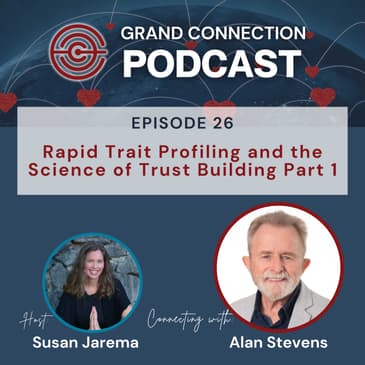
What changes when conversations begin with curiosity instead of assumptions? Susan Jarema welcomes Alan Stevens, international profiling and communication specialist and creator of Rapid Trait Profiling, for a thoughtful discussion on trust, communication, and relationship building. Together, they explore how body language, facial expressions, attentive listening, and genuine interest help create stronger connections in business and life.
The conversation highlights why understanding people is at the heart of the Connect, Create, Collaborate framework and why human connection skills are becoming even more valuable in an increasingly AI-driven world. Alan also shares practical insights for building trust more quickly, strengthening professional relationships, and approaching every interaction with greater awareness and empathy.
What You’ll Hear:
- Why people form impressions and trust judgments long before a conversation begins.
- How personality differences influence communication, connection, and relationship-building.
- The role of curiosity and active listening in creating meaningful networking conversations.
- What body language, facial expressions, and subtle cues can reveal about engagement and trust.
- Why the strongest business relationships are built through understanding rather than selling.
- How stress impacts communication and the ability to connect with others effectively.
- Why authentic human connection remains a critical skill in an AI-powered world.
Featured Guest: Alan Stevens
Alan Stevens is an International Profiling and Communications Specialist and the creator of the Rapid Trait Profiling (RTP) system. Recognised globally for his work in human behaviour and communication, Alan has worked with organisations including Disney Films, Gillette, law enforcement agencies, educators, business leaders, and media professionals. His work helps people better understand human behaviour, strengthen relationships, improve communication, and make more effective decisions in both business and personal environments. Alan is also the founder of The Campfire Project and co-founder of The Business Of Smiles charity, initiatives focused on inclusion, communication, and mental wellbeing.
Connect with Alan:
Website: https://alanstevens.com.au/
LinkedIn: https://www.linkedin.com/in/readingfaces
Facebook: https://www.facebook.com/CelebrityProfiler
Free Gift: https://store.alanstevens.com.au/free This free course introduces people to the foundations of Rapid Trait Profiling and how understanding human behaviour, which can improve communication, relationships, sales, negotiations, parenting, and business interactions. Participants learn practical techniques they can apply immediately to better understand personality styles, communication preferences, and decision-making patterns, helping them build stronger connections and communicate more effectively in everyday life.
Meet the Host: Susan Jarema
Susan Jarema is a marketing strategist, internetologist, and co-founder of The Grand Connection. She helps entrepreneurs grow through collaboration, smart strategy, and high-impact digital presence. Susan is also president of New Earth Marketing, where she builds brands, websites, and ecosystems designed for real growth.
Connect with Susan and the Grand Connection Community:
Website: https://grandconnection.ca/
Facebook Group: https://www.facebook.com/groups/grand.connection
Facebook: https://www.facebook.com/GrandConnectionCommunity
Instagram: https://www.instagram.com/grandconnection.ca/
LinkedIn: linkedin.com/company/66749100
Youtube: https://www.youtube.com/channel/UCxq03yde7nb57HKV1hhztYA
Access your Grand Growth Bundle and Free Guest Pass: https://grandconnection.ca/gifts
We are proud to have Grand Connection Podcast on the High Vibe Podcast Network. Grab your free gift from Susan in our Our High Vibe Gift Vault.
Love this show? Check out the other shows on the High Vibe Podcast Network.
Share the Love
✨ If this episode lit something up in you… tag us on Instagram @HighVibeLeaders and let us know your biggest takeaway!
🦋 Don’t forget to rate & review — it helps us reach more conscious rebels like you.
🔊 Listen & Subscribe
🎧 Spotify
Hello, everyone, and welcome to the Grand
Susan Jarema:Connection podcast. I'm Susan Jarima, your host for today and
Susan Jarema:co-founder of The Grand Connection, where we believe
Susan Jarema:business grows through meaningful relationships,
Susan Jarema:trusted connections, and collaboration. At the Grand
Susan Jarema:Connection, we often talk about our CCC framework: Connect,
Susan Jarema:Create, Collaborate. First, we connect through meaningful
Susan Jarema:relationships. Then, we create trust, ideas, opportunities, and
Susan Jarema:understanding together, and from there, true collaboration can
Susan Jarema:happen. Today, we're exploring one of the most important skills
Susan Jarema:behind all of that: understanding people. Our guest
Susan Jarema:today is Alan Stevens, and I'm so excited, Alan. I have to say
Susan Jarema:that this has been really exciting, and he's Alan is an
Susan Jarema:international profiling and communication specialist and
Susan Jarema:creator of the Rapid Trait Profiling System. Alan has
Susan Jarema:worked with organizations, including Disney Films,
Susan Jarema:Gillette, educators, business leaders, law enforcement, and
Susan Jarema:media professionals, Alan has been a wonderful collaborator
Susan Jarema:within our Grand Connection community, speaking at many
Susan Jarema:events, generously referring others, and becoming very well
Susan Jarema:loved within the community for his conversations and podcast
Susan Jarema:interviews, and I've also had the pleasure of meeting Alan
Susan Jarema:twice now in person, which always feels like the icing on
Susan Jarema:the cake when we built so many great connections virtually
Susan Jarema:first. Alan, welcome to the Grand Connection Podcast.
Alan Stevens:Thanks very much. And next time on that, I'll have
Alan Stevens:to come over and see you instead of you coming over here twice.
Susan Jarema:Yeah, it is my turn for you to come visit me,
Susan Jarema:and I'm going to show you a lot of snow, so I want to jump into
Susan Jarema:this right away. What does profiling or reading people
Susan Jarema:actually mean? Because I know we're all curious about this.
Alan Stevens:Yeah, well, first of all, when people usually hear
Alan Stevens:the word profiling, they think forensics, and they go into
Alan Stevens:panic straight away, and I go, no, it's, it's more of an
Alan Stevens:approach of being able to reach somebody to understand their
Alan Stevens:personality, so you can create a stronger relationship with them.
Alan Stevens:It's about bringing people together, not trying to uncover
Alan Stevens:criminals and things like that, because I just want to know if I
Alan Stevens:meet somebody, I want to know how to talk to them in the way
Alan Stevens:that they need to be spoken to and build that relationship very
Alan Stevens:quickly.
Susan Jarema:Well, I have to say that when I first met you, I
Susan Jarema:was a little nervous. I felt like, oh my gosh, he's gonna be
Susan Jarema:able to like know everything about me. But no, you are just a
Susan Jarema:really great person. You're here in this space because you care
Susan Jarema:about people. And how did you get into this field?
Alan Stevens:Well, mainly because I was pretty crook at
Alan Stevens:it, I went through two divorces, a lot of broken relationships,
Alan Stevens:and even business partners went to the bank out, and it was
Alan Stevens:after my second divorce I thought I need a better way of
Alan Stevens:reading people. I've been working with body language,
Alan Stevens:micro expressions - sorry, body language, I should say, not
Alan Stevens:micro expressions at that point, but body language, NLP, doing
Alan Stevens:all the different systems I could to find out how to read
Alan Stevens:people, Myers Briggs disk profiling, etc. But at the turn
Alan Stevens:of the century, I love that term, turn of the century, it
Alan Stevens:sort of makes me feel very old. That was when I realized I
Alan Stevens:needed a better system, and somebody said to me, looked at
Alan Stevens:reading faces, and I went, well, this sounds pretty interesting,
Alan Stevens:I'm going to go and find out about it. I found Paul Ekman,
Alan Stevens:who did all the research on the micro expressions, and an
Alan Stevens:English lady living in California who worked with all
Alan Stevens:the facial features, trained with both their groups. Then
Alan Stevens:realized that what they were doing needed to be put together,
Alan Stevens:and that's when I created Rapid Trade Profiling.
Susan Jarema:Okay, so you've been researching this for a
Susan Jarema:while. When did all.. how many years have you been in the
Susan Jarema:space?
Alan Stevens:Almost two and a half decades.
Susan Jarema:Oh my gosh. Well, that is a long time. That is
Susan Jarema:turn to the century. Oh, well, I've been in this space for
Susan Jarema:quite a while too. We won't talk about that right now, but it..
Susan Jarema:you know, it's lovely to have that experience behind us, and
Susan Jarema:it's fun to be able to share it with people, and I know that's
Susan Jarema:what you're doing now. So, why do people instantly connect
Susan Jarema:while others struggle?
Alan Stevens:Usually, it's a difference in our personalities,
Alan Stevens:and that we meet people. Most people, even if they struggle
Alan Stevens:meeting people, there's usually some people they connect with
Alan Stevens:quicker anyway, and that'll be because there's a similarity in
Alan Stevens:their personalities, some people just don't have the ability to
Alan Stevens:read people because they weren't taught. We have a number of
Alan Stevens:conditions in very young children that they can't
Alan Stevens:recognize facial features or expressions, and that's what we
Alan Stevens:need to be able to recognize. We can see that we know somebody's
Alan Stevens:personality, we know who they are, we know what they're
Alan Stevens:feeling, we know whether we should be around them or not,
Alan Stevens:and that's part of survival as a child, but in most cases it's
Alan Stevens:usually comes down as we're getting older, it's a lack of
Alan Stevens:being able to understand the other person, and until we can
Alan Stevens:understand the other person, we're going to have problems.
Susan Jarema:I think a lot of times people are in their own
Susan Jarema:head and not paying attention to the other person either, right?
Susan Jarema:So.
Alan Stevens:That's right, yeah. Well, if you're having a
Alan Stevens:conversation, how often does a person who you're talking to
Alan Stevens:jump in straight away afterwards? And the reason for
Alan Stevens:that is that, well, we're all schizophrenic, as far as I'm
Alan Stevens:concerned, in our heads. We're having two conversations all the
Alan Stevens:time. While somebody is talking to us, we're thinking about how
Alan Stevens:we're going to respond to them, and then when we're talking to
Alan Stevens:them, we're thinking about what we're saying, we're not focusing
Alan Stevens:on them, and you find the people who usually wait a little bit,
Alan Stevens:moment after somebody's finished speaking, that they're actually
Alan Stevens:been listening to what the person's been saying, and in
Alan Stevens:that moment after, then they're thinking about how do I respond
Alan Stevens:to this.
Susan Jarema:It's really hard on Zoom too, because you're kind
Susan Jarema:of like watching cameras, and things are popping up around
Susan Jarema:you, like it. I find when I'm having coffee with somebody in a
Susan Jarema:coffee shop, I'm just like there, I'm right there with
Susan Jarema:them. But it's difficult. There are so many more distractions
Susan Jarema:when we're sitting at our desk in our own home, having it,
Susan Jarema:trying to have a conversation. Even right now, while I'm doing
Susan Jarema:this conversation with you, I'm thinking about how am I going to
Susan Jarema:make this a really interesting podcast, that little voice is
Susan Jarema:going in there, and I want to make sure the questions are
Susan Jarema:good, and that I'm moving on sometimes a little too quickly
Susan Jarema:to the next question before I'm listening to you. So I see that
Susan Jarema:I'm doing that myself right now.
Alan Stevens:You stop when you ask yourself why you're doing
Alan Stevens:that, because I know that you're passionate about what you do,
Alan Stevens:you're passionate about the network and the people you're
Alan Stevens:working with. So, center of mind is always going to be, how do I
Alan Stevens:get the best out of this podcast for the people who are going to
Alan Stevens:show this to? So, it's a genuine interest in other people that's
Alan Stevens:causing you to rush.
Susan Jarema:Yeah,
Alan Stevens:But when you're having a one on one conversation
Alan Stevens:with somebody, that's when you can see the difference.
Susan Jarema:So, what are people communicating before they
Susan Jarema:even speak? What happens there? Like, you know, I guess you
Susan Jarema:talked about it being in our heads.
Alan Stevens:Well, we look at somebody straight away, we're
Alan Stevens:going to look at their facial features, etc. and their body,
Alan Stevens:and all the rest of it, and we make an impression straight
Alan Stevens:away. Everybody is a profiler, everybody reads other people,
Alan Stevens:and they straight away have an idea of who that person is. They
Alan Stevens:make a judgment of them, and it's quite judgmental because
Alan Stevens:it's based on their past experiences. And so straight
Alan Stevens:away, that's what's going to happen. You look at somebody,
Alan Stevens:you've made an interpretation of who they are. It's less than a
Alan Stevens:mil a second, it's around about 300 milliseconds. But when you
Alan Stevens:look at somebody, you've already worked out whether you like them
Alan Stevens:or not, whether you trust them, whether there's something wrong
Alan Stevens:with them. It's that fast. It's faster than a second.
Susan Jarema:And I guess we don't even know what we're
Susan Jarema:looking at. This is all subconscious for most of us,
Susan Jarema:except you understand it. You've made that, you've gotten aware
Susan Jarema:of what it is. So, tell us, what are you looking for when you're,
Susan Jarema:when you're connecting with somebody?
Alan Stevens:Well, it depends on the situation. If it's on
Alan Stevens:Zoom, I'm not going to be worried about how much space
Alan Stevens:they need when we meet them for the first time, because if I
Alan Stevens:want to connect with somebody, got to make sure they're
Alan Stevens:comfortable, and there are those people like you and I are both
Alan Stevens:affable. We'll stand close to people when we meet them for the
Alan Stevens:first time, so that's fine. But there are people who are more
Alan Stevens:discerning, they need more space, and the Facebook tells us
Alan Stevens:that straight away. So, as they're walking towards us, we
Alan Stevens:know not to invade their space, because we invade their space,
Alan Stevens:they're not going to be listening to what they were
Alan Stevens:saying, they're going to feel uncomfortable, so we know how to
Alan Stevens:structure that, so the face tones is everything we need at
Alan Stevens:the moment, or well before the moment that we need it. It's
Alan Stevens:like,
Susan Jarema:so if I'm in a meeting in person, so we're
Susan Jarema:doing networking in a, in a room, and I, you'd step in and
Susan Jarema:you're too close to somebody, I guess you tend to get the
Susan Jarema:feeling they'll, they'll step back right, so you've invaded
Susan Jarema:their personal space too much there, or I guess there'd be
Susan Jarema:some sign on their face where they're looking a little
Susan Jarema:anxious.
Alan Stevens:That's right. And quite often in those enclosed
Alan Stevens:areas, in a networking room, for instance, there's not much room
Alan Stevens:to move, but you'll instead of them moving back, because they
Alan Stevens:can't move back, it's going to walk into other people, so
Alan Stevens:they're virtually stuck where they are. You'll see it on their
Alan Stevens:body language, to see it in the expression on their face. You'll
Alan Stevens:see a shift in there. You'll even see if there's no change in
Alan Stevens:light, even the pupils will change size, depending on
Alan Stevens:whether they're in fear or whether they're aroused, or
Alan Stevens:whatever it might be. So, there's so many indicators.
Susan Jarema:So, what's an indication that somebody's
Susan Jarema:aligned with you, and as a person you could trust.
Alan Stevens:Well, one of the things is their body language,
Alan Stevens:where they're aligned. They'll step in when they're talking to
Alan Stevens:you, or you're talking, they're going to be nodding. The whole
Alan Stevens:body language is going to be pointing towards you. And by the
Alan Stevens:way, it's a combination of all the body language. For instance,
Alan Stevens:folded arms used to be meaning that somebody was disinterested,
Alan Stevens:they were switched off. It could be that they're intimidated by
Alan Stevens:you, your position. They may really want to know more, but
Alan Stevens:what's the rest of the body language? So, are they leaning
Alan Stevens:in? Are they talking, nodding in response to what you're saying,
Alan Stevens:or their feet and half their body facing towards the door?
Alan Stevens:Well, then
Susan Jarema:I do pull my arms when I'm.. I do. Fold my arms
Susan Jarema:when I'm cold, though.
Alan Stevens:I do got damaged shoulders, so I'll stand there
Alan Stevens:with my arms folded as well.
Susan Jarema:Yeah, yeah. So you got your, the folding in, you
Susan Jarema:know? You notice stuff on their faces too. I remember when we
Susan Jarema:met, we were, we actually sat in a coffee shop, and you, you
Susan Jarema:people walking down the street, you were, you were profiling
Susan Jarema:them for me now. How do you do that? That's pretty amazing,
Susan Jarema:like they weren't even that close to us.
Alan Stevens:Well, I'm picking up the pic ticker indicators on
Alan Stevens:the face that I could see. For instance, if they're walking at
Alan Stevens:a distance from us, I can see the proportion between their
Alan Stevens:upper body and lower body. I know straight away whether that
Alan Stevens:person needs to be able to sit if you were talking to them, or
Alan Stevens:they need to be on the move, so I'd know what sort of career
Alan Stevens:would suit them. Would it be a receptionist? Would it be
Alan Stevens:working in construction, working outside? So some of those things
Alan Stevens:I can see straight away.
Susan Jarema:Okay,
Alan Stevens:as they get closer, there's other
Alan Stevens:indicators, because everything is stored on the face as well as
Alan Stevens:the in the body as well, but main thing is in the face
Alan Stevens:because everything we feel we express outwardly, and so if
Alan Stevens:you're concentrating and thinking in a certain way, the
Alan Stevens:end result is like the moment you're concentrating, I can see
Alan Stevens:those little vertical lines start to appear, so you're
Alan Stevens:thinking about how exact this thing is, you're looking at the
Alan Stevens:detail that we're talking about, so I know that you're focused on
Alan Stevens:getting
Susan Jarema:Leaning in a little bit too, so that means
Susan Jarema:I'm interested that that happens,
Alan Stevens:So just on the face as well, I've got that as
Alan Stevens:well. So then you've got, as you said, your person's leaning in,
Alan Stevens:is their body facing towards you when they come up to you, but if
Alan Stevens:they're at a distance, I can tell you where they get to us,
Alan Stevens:where they need to sit down. If we have a long conversation, or
Alan Stevens:do we need to get up and walk around if they arrive 20 feet
Alan Stevens:away, I can see straight away where they need space when we
Alan Stevens:first meet. So I'll walk up, stop if I need, know they need
Alan Stevens:more space, and I'll stop, and I'll put my hand out to shake
Alan Stevens:hands. They will set their own space up where they're
Alan Stevens:comfortable, so I've gotten rid of that issue out of the way.
Alan Stevens:Then I know straight away from their face, while we're talking,
Alan Stevens:how much information do they want to take in? Is it got to be
Alan Stevens:in a certain formatted order, or can I bounce around the place?
Alan Stevens:Have they got a dry wit where somebody who will joke and
Alan Stevens:everything goes, or do I have to be very careful about being
Alan Stevens:politically correct about things? Because I've got a
Alan Stevens:couple of mates when we start talking, we throw all sorts of
Alan Stevens:stuff around, and we're laughing, but we're also careful
Alan Stevens:about who's around us, people with the opposite trait may take
Alan Stevens:offense to what we're saying, so we're mindful of that as well.
Alan Stevens:This is where this really helps, being able to not only have a
Alan Stevens:conversation with somebody but be respectful of the people
Alan Stevens:around you as well,
Susan Jarema:So you're actually being aware of everything going
Susan Jarema:on in the room,
Alan Stevens:That's it. Yeah,
Susan Jarema:Sometimes we're pretty loud. We've got a loud
Susan Jarema:family looking around a restaurant and see these little
Susan Jarema:schmuck looks at us. Right,
Alan Stevens:I first met one guy, and we met in a coffee in a
Alan Stevens:hotel in a bar, and there were about 60 tables in the place,
Alan Stevens:and people sitting at every table. I think between he and I
Alan Stevens:with joke, this is the moment we met each other. We just really
Alan Stevens:clicked, we were laughing and everything, because we made more
Alan Stevens:noise than the whole 60 tables put together.
Susan Jarema:Usually, that, that you're pretty quiet,
Susan Jarema:normally, aren't you?
Alan Stevens:Yeah, well, with this particular gentleman, we
Alan Stevens:just clicked really fast, but normally, yes, because I'm
Alan Stevens:always thinking about, like, when we met for the first time,
Alan Stevens:I wanted to know about you. As far as I'm concerned, I didn't
Alan Stevens:need to know about me, I wanted to know about you. You come all
Alan Stevens:this way, so I'm giving you that respect as well. It's all about
Alan Stevens:consideration for the other person. It's not about using it
Alan Stevens:to manipulate somebody, but how do I really show the deepest
Alan Stevens:respect for that person. How do I build a strong relationship
Alan Stevens:with them? Because I look at everything, well, if I'm in
Alan Stevens:business, I look at everything as a strategic alliance, and to
Alan Stevens:have a strategic alliance, because I don't believe in
Alan Stevens:competition. I look at all my competitors as strategic
Alan Stevens:alliances, so I'm going to build a strong relationship with them.
Susan Jarema:Yeah, so I just kind of want to know, we do a
Susan Jarema:lot of one on one calls in the Grand Connection, and so we're
Susan Jarema:getting it on a Zoom call, like, what, what would be some
Susan Jarema:technique somebody can can apply to make their calls go better
Susan Jarema:from what you teach.
Alan Stevens:Well, one of the things I always do, whether it
Alan Stevens:be a live one or on Zoom, when I'm meeting somebody for the
Alan Stevens:first time, I want to get them talking before they ask me about
Alan Stevens:what I'm doing, you know. If I'm in a networking, do for
Alan Stevens:instance, I'll actually say to somebody, "Tell them my name,
Alan Stevens:because that's respectful. But then, before they get a chance,
Alan Stevens:I'll ask them, "Well, you know, you're here today, how can I
Alan Stevens:help you? Why did you come here today? And get them talking
Alan Stevens:about that, if I'm on a Zoom call, I've met somebody on a -
Alan Stevens:we've met through LinkedIn or somewhere like that, or
Alan Stevens:somebody's introduced us. First thing I'm going to do, I'm going
Alan Stevens:to do some research. First of all, I'm going to look at their
Alan Stevens:profile, find out a little bit about them, and this is where AI
Alan Stevens:can be quite helpful. You can get their website or their
Alan Stevens:LinkedIn profile and. Say, right, just give me a summary of
Alan Stevens:this person, and it will tell you the key points, and you ask
Alan Stevens:it a couple of questions, so you, when you talk to that
Alan Stevens:person the first time, you can say, look, from what I've been
Alan Stevens:realizing about you, I can see that you do these things, what
Alan Stevens:got you into this, why are you passionate about this, and now
Alan Stevens:you've got them talking about them,
Susan Jarema:Yeah,
Alan Stevens:And once you've got that conversation going,
Alan Stevens:you've, you've also then got the expressions on their face,
Alan Stevens:little twitches and micro expressions, they call them,
Alan Stevens:which will tell you how much they're getting involved in
Alan Stevens:this. You can see,
Susan Jarema:We just had a previous episode with Shannon
Susan Jarema:Granger, and she talked about her deal flow framework, and D
Susan Jarema:is is discovery, which is what she just talked about. So, Alan,
Susan Jarema:you're doing it. You probably didn't even know that I'm going
Susan Jarema:to introduce you to Shannon. You guys need to meet. I told her
Susan Jarema:about you, and you, you take the LinkedIn profile, you get a
Susan Jarema:summary, you're ready, you've got some good questions,
Susan Jarema:probably some very good open-ended questions. Now you're
Susan Jarema:having this conversation. What are you watching for in their face?
Alan Stevens:Well, I'm looking for the expressions, changes,
Alan Stevens:etc. See, at the moment, where you're sitting, if we, because I
Alan Stevens:know that you were, you know, we were interested in what we're
Alan Stevens:doing, so I'm looking for changes in size of the pupil,
Alan Stevens:for instance. If I notice they get smaller, because I know that
Alan Stevens:I can see the light through your windows, so yours are small at
Alan Stevens:the moment, because of the light, but if I'm talking to
Alan Stevens:somebody now, I know the what the benchmarked them, and so if
Alan Stevens:there's a change in the size, I know the interest level, that's
Alan Stevens:how it's going, it's going up or it's going down. I'm looking for
Alan Stevens:the way you're looking at the screen, for instance, if I can
Alan Stevens:see that some of the like the these little lines appearing or
Alan Stevens:the different muscles on the face moving, I know what you,
Alan Stevens:how you're thinking is this that, yeah, you're thinking
Alan Stevens:about, well, this is really interesting. What can I ask
Alan Stevens:about this? I'm looking for all those indicators that are on the
Alan Stevens:face, and your face is, you will just give away everything that
Alan Stevens:we need to know while you're having that conversation.
Susan Jarema:Well, I didn't know it'd be an open book.
Alan Stevens:There's a lot of people out there who believe
Alan Stevens:they're not an open book, but the people who believe that they
Alan Stevens:can tell stories and get away with it, that they can pick up
Alan Stevens:lies very easily. Well, there's a bridge in New South, in
Alan Stevens:Sydney, on that, that I'd like to sell them, because you
Alan Stevens:generally find that people have that high opinion that they're
Alan Stevens:the easiest ones to convince the other way.
Susan Jarema:So we talk a lot about trust at the Grand
Susan Jarema:Connection, connect, create, collaborate. The second part,
Susan Jarema:create, is really creating trust, really creating those
Susan Jarema:relationships that create ideas, opportunities, but it all is
Susan Jarema:this relationship you're building of trust. Now, in a
Susan Jarema:conversation, when you're watching people, how do you
Susan Jarema:sense through the skills you have, if this is a person you
Susan Jarema:can trust,
Alan Stevens:It'll be in the way in which they've answered
Alan Stevens:the questions as well, because it's also the para language. So
Alan Stevens:we're looking at the facial features that tell us their
Alan Stevens:personality, then we're listening, we worked out what
Alan Stevens:words we're going to use, the structure of them, you know,
Alan Stevens:they're going to be in a structured order, bounce around
Alan Stevens:the place, etc. How much detail and all the rest, but then
Alan Stevens:listening to the other person, the paralanguage they're using,
Alan Stevens:the body language that goes with it, and the expressions we put
Alan Stevens:all that together and you start to see shifts. You're looking
Alan Stevens:for changes, and so once you start to see a change, you go,
Alan Stevens:okay, what? Why? What did I just say then? Why was that? See, a
Alan Stevens:micro expression, a little twitch on the face. I might be
Alan Stevens:talking about something, we're going really well, but I
Alan Stevens:mentioned something, all of a sudden, there's a little twitch
Alan Stevens:on the one side of the face. I know what I just said, hit your
Alan Stevens:contempt button, and so I might have been too jovial about
Alan Stevens:something, and that's then hit your values, and so I might see
Alan Stevens:that little twitch, and I go, "Ah, I just said something
Alan Stevens:wrong. Then, so I can then go back, and I can correct things.
Susan Jarema:How would you correct it?
Alan Stevens:Well, again, depends on what I've actually
Alan Stevens:said, and how severe it's going to be. It might be a full-on
Alan Stevens:apology,
Susan Jarema:I guess. You could clarify, and would you say
Susan Jarema:something like, like, did something offend you, or would
Susan Jarema:you actually come out and say something, or would you just try
Susan Jarema:to sort of weave it back in? And,
Alan Stevens:Well, I might, about, you know, yeah, what I
Alan Stevens:just said was really totally wrong, that was stupid of me, or
Alan Stevens:something, or whatever, and steer it down that direction, so
Alan Stevens:I can sort of make an apology, or correct myself without
Alan Stevens:telling that I've just realized, you know, that I picked it up on
Alan Stevens:their face.
Susan Jarema:Yeah
Alan Stevens:This is something I've realized that I just didn't
Alan Stevens:know. I've just been silly. I just been, yeah, we've been
Alan Stevens:having a good time, and I just went a little bit overboard, and
Alan Stevens:that was inappropriate. Sorry about that type thing.
Susan Jarema:Well, you see a lot of that when politics creep
Susan Jarema:into conversations, because you don't really know people's
Susan Jarema:political preferences, and you'll see these little twixts,
Susan Jarema:and you go, okay? They are the other side, or I'm just gonna be
Susan Jarema:careful in here. I'm gonna be Switzerland.
Alan Stevens:Well, this is where it's wise now. They said
Alan Stevens:religion, sex, and politics - don't talk about those three.
Susan Jarema:Yeah, no, keep them out of your conversations
Susan Jarema:if you can. I mean, it does come up, but especially. With the
Susan Jarema:global community here, you know, we do get politics coming up in
Susan Jarema:it, but it's only after you get to know people. I think I would
Susan Jarema:not bring that up in a first conversation.
Alan Stevens:That's it. But I always say it goes back to one
Alan Stevens:of my first rules, and that is, you got two eyes, two ears, and
Alan Stevens:one mouth. Use them in that proportion, and when you're
Alan Stevens:using your mouth, ask every possible question you can think
Alan Stevens:of, and then once you've done that, ask one more. It's always
Alan Stevens:a case of I've asked a lot of questions, and I'm going to say
Alan Stevens:to somebody, well, from what you've been telling me, this is
Alan Stevens:what I understand. Have I got it right? The beautiful part of
Alan Stevens:that is, if you have got it right, they will say yes, and
Alan Stevens:they know that you've been listening, you've been focused
Alan Stevens:on, so you've got trust, if they say no, that could even be
Alan Stevens:better now, because we're into a full depth conversation, not
Alan Stevens:just me talking to them, but now having a conversation with them,
Alan Stevens:where they now explain to me what I got wrong, and they know
Alan Stevens:at that point I'm truly invested in understanding them and
Alan Stevens:building a relationship, so by asking questions before you make
Alan Stevens:statements, it's like somebody says something and it pushes one
Alan Stevens:of my buttons. I'm not going to respond in kind. I'm going to
Alan Stevens:turn around and try and understand what was it you were
Alan Stevens:trying to really say. Then
Susan Jarema:we did a episode on Chris Voss and how he, he's,
Susan Jarema:he's a negotiator for the FBI and has written a book on on
Susan Jarema:communication skills, it's really, you can use it and apply
Susan Jarema:it to all parts of your life, but asking impactful questions
Susan Jarema:like that makes such a big difference, and I'm trying to do
Susan Jarema:that more in my own life practice. Yeah, great. So great
Susan Jarema:tip there. So, what do you think are some of the biggest mistakes
Susan Jarema:people make in networking conversations?
Alan Stevens:Well, well, first of all, when they get into any
Alan Stevens:network, and that the whole thing is networking is about
Alan Stevens:building relationships, it's not about selling. How often do you
Alan Stevens:hear people come in and the first thing they do is talking
Alan Stevens:about their business, and it's all about what they can do for
Alan Stevens:people, etc. You know, when I go into a networking do in a group
Alan Stevens:for any, as I said before, is first thing I to do is ask the
Alan Stevens:other person about them, what it is that they do, etc. Get them
Alan Stevens:talking about that. Why are they passionate about doing that?
Alan Stevens:What, who do they help, how do they help them? And then how can
Alan Stevens:I help them help other people. And so we're looking at doing
Alan Stevens:that, so it's about building that relationship, but most
Alan Stevens:people I've been into chambers of commerce back in the 90s when
Alan Stevens:I first started my first business, and I'd ask people,
Alan Stevens:and that who came here to sell, all the hands would go up, and
Alan Stevens:they go, and who came here to buy, not one hand, and the end
Alan Stevens:result was I went right, so you've come here to talk at each
Alan Stevens:other, not to each other, and so, and I remembered a friend, a
Alan Stevens:lady who became a friend over a long time, a period ago. I met
Alan Stevens:her, she said, when she first met me, and it must be about 15
Alan Stevens:years ago now, she said, the first thing you did when you
Alan Stevens:came up to me is you told me your name, and then you asked
Alan Stevens:me, How could I help you? And she says, I've never forgotten
Alan Stevens:it.
Susan Jarema:Yeah,
Alan Stevens:And that's how our relationship started. That's one
Alan Stevens:thing to remember. It starts in the first instant. It's not
Alan Stevens:something that you know all of a sudden happens down the track.
Alan Stevens:It started very early in your first connection with somebody,
Alan Stevens:because, as I said before, in less than a second, they've
Alan Stevens:decided whether they like you or not, whether they trust you.
Alan Stevens:They just look at your face, and all of that is based on their
Alan Stevens:past experiences. So, it's bias.
Susan Jarema:Yeah, amazing. And it's primarily subconscious, all
Susan Jarema:this stuff.
Alan Stevens:Yeah, exactly. So, it's like a micro expression
Alan Stevens:when that happens around you. Somebody says something,
Alan Stevens:something, something happens unconsciously. We react, and we
Alan Stevens:have an expression on our face. Then our conscious mind steps
Alan Stevens:in, and that expression changes, and that can be as fast as a
Alan Stevens:fifth of a second down to 1/5 of a second, virtually the click of
Alan Stevens:the fingers. It's that fast, but our eyes can pick it up.
Susan Jarema:So I guess a technique for trying to build
Susan Jarema:trust is to be very present, be in the moment, and channel that
Susan Jarema:compassion towards the other and true interest in the other
Susan Jarema:person, and they will feel
Alan Stevens:That's it. What helped me in doing this was
Alan Stevens:realizing that I needed to practice with having
Alan Stevens:conversations with people and focusing on them without having
Alan Stevens:an agenda of, you know, talking to people who were not involved
Alan Stevens:in a sale, they weren't possible clients or anything like that. I
Alan Stevens:found a thing on online, which is now closed. It was called
Alan Stevens:Lunch Club. That was a great place to go and meet people and
Alan Stevens:have a chat, people from all over the world with no agenda
Alan Stevens:other than to meet them and find out about them, that's since
Alan Stevens:closed, but there's another one that opened up, and I'm now on
Alan Stevens:that one as well, called V Me, and I was on there last night
Alan Stevens:with a gentleman who's English, living over in Denmark, and we
Alan Stevens:were just laughing so much, we had a great time, you know, so
Alan Stevens:at the end of that, by the time we'd finished the conversation,
Alan Stevens:and the way I was watching him, etcetera, I know I can trust
Alan Stevens:him. I know his passion for helping people, etc. I decided I
Alan Stevens:needed to get this out to more people who could go out and
Alan Stevens:deliver it to more people again, because I can only train so many
Alan Stevens:in a lifetime. But if I train those people and they go out and
Alan Stevens:train others, it's almost looking like, you know, network
Alan Stevens:marketing, where you work with so many people, they don't work
Alan Stevens:with so many people, and they go out with so many more people,
Alan Stevens:and I believe that's the way that we should all be doing it,
Alan Stevens:leaving the world in a better place than we found it.
Susan Jarema:Network marketing to make the world a better
Susan Jarema:place, that's great. Just paying it forward and having other
Susan Jarema:people share your legacy, very lovely approach to thinking of
Susan Jarema:this, and so valuable for our world right now I want to just
Susan Jarema:jump back, just as we sort of end off. This is part one of two
Susan Jarema:parts, some skills that we can take away today. So, what could
Susan Jarema:we do with our face, or anything we're doing to be seen as more
Susan Jarema:memorable and trusted in conversations, because we, we
Susan Jarema:feel like we are, but sometimes people don't take what we do the
Susan Jarema:right way, and maybe we're not presenting ourselves in the best
Susan Jarema:way.
Alan Stevens:See, it's not so much what we can do with our
Alan Stevens:face, because, as I said before, micro expressions happen in the
Alan Stevens:unconscious section when something said, or that happens
Alan Stevens:around us, before our conscious mind steps in. So, if we're
Alan Stevens:trying to think about keeping our face in a certain way, our
Alan Stevens:body's going to give it away. We can't control everything, so
Alan Stevens:it's virtually comes from within, not from without. It's a
Alan Stevens:case of, well, how do I actually really show I'm genuine? Well,
Alan Stevens:it's simple: be genuine. That's what it comes down to. The
Alan Stevens:bottom line is, go. Okay, I'm getting a conversation. Yes, I
Alan Stevens:want to improve my life. I want to improve my business, etc. But
Alan Stevens:knowing well, there was a saying there before. I know Richard
Alan Stevens:Branch and a whole bunch of others have used it as well, and
Alan Stevens:that was, if you want to look after your customers, you got to
Alan Stevens:put your staff first, because when you put your staff first,
Alan Stevens:they're the ones working with the customers, and you're
Alan Stevens:actually putting your customers first by putting your staff
Alan Stevens:first. It plays with people's minds when they try and start
Alan Stevens:thinking about
Susan Jarema:Got me all messed up, but I'm going to re-listen
Susan Jarema:to it, so I'll be fine on the second round.
Alan Stevens:So, if we do that, then the end result, we focus on
Alan Stevens:the other person, we're going to grow our business faster, we're
Alan Stevens:going to get what we're looking for faster, because we've built
Alan Stevens:that relationship, so forget about what I want right now.
Alan Stevens:Other than the one thing I do want to do is build a stronger
Alan Stevens:relationship, that's the only focus I've got. So, therefore,
Alan Stevens:everything I do from there goes on to the focusing on the other
Alan Stevens:person. How can I listen to them genuinely? So, if I want to
Alan Stevens:appear that I'm listening to him genuinely, I've got to be doing
Alan Stevens:that in the first place.
Susan Jarema:All this ties in so well with what we're doing in
Susan Jarema:our neuroscience of communication self-mastery
Susan Jarema:program, because we're learning how brain network switching can
Susan Jarema:be used to calm yourself, tap into your salient network, but
Susan Jarema:to be used in a fast and efficient way, to be focused,
Susan Jarema:but yet stay calm and connected to the values that are part of
Susan Jarema:what's important to you, and connect with what Ray calls
Susan Jarema:neuro resonance with the other person in the room too. So, if
Susan Jarema:you're both doing it, and she teaches us how to do mindful
Susan Jarema:conversations, and I don't know if you have met Ray yet, but I'm
Susan Jarema:sending you an introduction to her as well. So another intro
Susan Jarema:for you. This is what we do with the Grand Connection. You're
Susan Jarema:going to have a fabulous conversation. That's what we're
Susan Jarema:doing, is we're practicing these mindful conversations, how to be
Susan Jarema:present, how to be very mindful, so we're actually sharing those
Susan Jarema:values beforehand and during the conversation, and of course it
Susan Jarema:makes all the difference in having a very good conversation
Susan Jarema:where you're building that trust, you're communicating
Susan Jarema:effectively, and you're leaving in a place where both people
Susan Jarema:have moved towards a better relationship, for you know,
Susan Jarema:collaboration, strategic alliances, whatever it is, maybe
Susan Jarema:it's just, you know, getting along better at family dinner,
Susan Jarema:you know, whatever
Alan Stevens:Exactly.
Susan Jarema:There's so many places that this comes into
Susan Jarema:place in your life. Oh my gosh, this has been really amazing.
Susan Jarema:How does stress change the way we communicate?
Alan Stevens:Well, stress is going to our focus, then goes on
Alan Stevens:ourselves, the stress that we've got, etc. Now, from the point of
Alan Stevens:view, having the stress yourself, and that this is going
Alan Stevens:to impact on how you talk, how you listen, because you're going
Alan Stevens:to be focused on what's bothering you. But if somebody
Alan Stevens:else has got the stress, this is where you can really step in and
Alan Stevens:be really helpful, because if you recognize that they're
Alan Stevens:getting stressed, etc. Well, one of the things signs of stress is
Alan Stevens:in the pupil, sorry, in the iris itself. Irises can actually
Alan Stevens:shrink in size. There's a medical condition for it, but
Alan Stevens:there's also, if somebody's really stressed, the irises will
Alan Stevens:start getting smaller. There used to be a saying that if
Alan Stevens:somebody had BD eyes, you couldn't. Trust them. Well, the
Alan Stevens:thing is that somebody who's got those really small irises, those
Alan Stevens:that look like beady eyes, they're going through one of the
Alan Stevens:highest levels of stress. You know that their life is, they're
Alan Stevens:feeling that it's rubbish, it's crap, it's never going to
Alan Stevens:change. They can be within the point of being suicidal, etc.
Alan Stevens:And so by recognizing that, instead of pulling away from
Alan Stevens:them, which is our normal thing, when we see those small eyes, is
Alan Stevens:to actually see if we can build a relationship with them, find
Alan Stevens:out what's going on, because if you're genuinely connected to
Alan Stevens:other people and want to be connected to them, you will then
Alan Stevens:focus on those things, you'll put whatever you're feeling at
Alan Stevens:the time, that little pushback that you're getting inside of
Alan Stevens:yourself when you look at somebody and go, "Hang on, this
Alan Stevens:is not the true story. There's something else going on here.
Alan Stevens:It's not that I can't trust them. The fact is that they
Alan Stevens:don't trust anybody else because of their stress levels, and if I
Alan Stevens:pull back, I'm just confirming that for them. But if I come
Alan Stevens:forward and have a bit of a conversation with, see if I can
Alan Stevens:help them and understand what's going on, and if I can help them
Alan Stevens:through that, that can change their lives, and just in helping
Alan Stevens:somebody else change their life, it changes yours as well.
Susan Jarema:I know you do a lot of work with helping people
Susan Jarema:change their lives, don't you? What are some of the charities
Susan Jarema:you're involved in? Do you want to share a little bit about
Susan Jarema:that?
Alan Stevens:Well, I started the Campfire Project. It's not a
Alan Stevens:charity, but it's a, it's a safe place for men and women from all
Alan Stevens:over the world to tell their stories. I started out
Alan Stevens:originally with only interviewing men, but had women
Alan Stevens:in the group from day one, because I wanted the women to be
Alan Stevens:able to hear how men could speak when they felt safe to do so.
Alan Stevens:And I didn't interview the women first, because I knew if I
Alan Stevens:interviewed the men, the women first, the men wouldn't start,
Alan Stevens:they'd feel intimidated because women are much more open and
Alan Stevens:more natural, and the guys have been taught, especially us baby
Alan Stevens:boomers. We were taught, "suck it up, push it down. You also
Alan Stevens:don't cry now. I get some, a man on the screen with me, and I can
Alan Stevens:see them holding back tears, and they start to tear up a little
Alan Stevens:bit. I would just say to you, "that's crying, that's crap.
Alan Stevens:I'll show you how to cry if you like. Yeah, this is an example
Alan Stevens:of it. You know, because the strength is not in holding it
Alan Stevens:down, the strength is in showing the courage to be able to let it
Alan Stevens:out. And so, with that, having those conversations with those
Alan Stevens:people, I bought them, had one on ones, then brought them into
Alan Stevens:panel discussions. Then the women said, well, we love these
Alan Stevens:guys, we've never heard men talk about their emotions so deeply
Alan Stevens:or so wisely about how to improve society, so they want to
Alan Stevens:get involved. So I then started interviewing the women. We've
Alan Stevens:had panel discussions, we've covered everything you can think
Alan Stevens:of. We've had menstruation, menopause, does size matter in
Alan Stevens:the bedroom, all the different toxicities, and anything you
Alan Stevens:want to talk about, we'll talk about. We've never had any
Alan Stevens:bigotry, sexism, or racism. The group now has the highest score
Alan Stevens:when it comes to inclusion worldwide. When you look at what
Alan Stevens:makes an inclusive group, it also ticks five of the United
Alan Stevens:Nations Sustainable Development Goals, which is pretty high as
Alan Stevens:well. And then, with that led on to the camp, sorry, the Campfire
Alan Stevens:Project led on to the business of Smiles, which is a charity
Alan Stevens:with socks, and I know you've got a pair,
Susan Jarema:I know. I don't have them with me right now
Alan Stevens:There we go
Susan Jarema:But yes
Alan Stevens:I got the black ones as well, and there's a
Alan Stevens:story behind those, but we go out into the public and we talk
Alan Stevens:to people on the streets, they could be politicians,
Alan Stevens:professionals of all forms, people living on the streets.
Alan Stevens:We'll sit down next to them, we'll have a conversation with
Alan Stevens:them. We usually give them a pair of socks and thank them for
Alan Stevens:doing the best they can. And when they say, "What the hell
Alan Stevens:are you talking about? We go, "Or do you make the best
Alan Stevens:decisions with the information you have? You don't just
Alan Stevens:obviously go out and make back deliberate bad ones. You make
Alan Stevens:the best decisions you can with your family, your friends, if
Alan Stevens:you're at work, your colleagues, and everything. I go, yes, of
Alan Stevens:course, we do. And we give them a pair of socks, and we tell
Alan Stevens:them the story of the socks, and usually that leads into a
Alan Stevens:conversation where they tell us their life stories. And we
Alan Stevens:handed it, we've handed out 10s of 1000s of those socks, and had
Alan Stevens:10s of 1000s of conversations with people, and in that, you've
Alan Stevens:got no choice to listen to somebody, and this has been the
Alan Stevens:best education for me to walk my talk. If I'm telling other
Alan Stevens:people, you need to pay your attention to other people on
Alan Stevens:this. I've talked with people who have, like, males who are
Alan Stevens:trans transitioned to females, females who have transitioned to
Alan Stevens:males, all the different religions, cultures, etc. And
Alan Stevens:I've never had a boring conversation yet. When somebody
Alan Stevens:opens up and tells us their life stories, etc. or why they, why
Alan Stevens:they're doing what they're doing, I can understand them.
Alan Stevens:I'm not looking to see whether I agree with them. I'm looking at
Alan Stevens:understanding where they're coming from, what's happened in
Alan Stevens:their life. That understanding then gets rid of the judgmental
Alan Stevens:side of things, and I can then look at them and to go, okay,
Alan Stevens:well, and in the conversation, if I don't think they're doing
Alan Stevens:the right thing, I can ask questions that gets them
Alan Stevens:thinking, well, maybe I'm not doing the right thing, and all
Alan Stevens:of a sudden they're saying to me, "Oh, well, maybe I should be
Alan Stevens:doing this instead. I haven't told them anything, and they've
Alan Stevens:worked it out themselves, so they own that answer that
Alan Stevens:they've given me,
Susan Jarema:I. Oh, Alan, I mean, I know what you're doing
Susan Jarema:is absolutely fabulous, and you're such a generous grand
Susan Jarema:giver in your community and in our community. I want to kind of
Susan Jarema:end back and circle back to AI, just at the end of this part
Susan Jarema:one. Okay, in our world of, you know, that's in an AI world now,
Susan Jarema:the world is changing very rapidly. Why are human
Susan Jarema:connection skills becoming even more valuable?
Alan Stevens:Well, being able to recognize whether, like
Alan Stevens:looking at an image of somebody, for instance, especially videos,
Alan Stevens:deep fake videos, it's knowing to be able to pick up some of
Alan Stevens:these indicators, they're going to get so good that you won't be
Alan Stevens:able to pick up the difference, that's going to be one of the
Alan Stevens:issues, but the tone of voice, etc. I've heard a conversation
Alan Stevens:where the woman would go to a phone call from what was
Alan Stevens:supposed to be in one of the bottle shops, you know, a wine
Alan Stevens:outlet, talking about her special one, the one that she
Alan Stevens:really loved, they'd come in and everything, call that a special
Alan Stevens:price on it. She's talking back to the thing, saying no, I can't
Alan Stevens:afford it. My husband's telling him I'm spending too much money.
Alan Stevens:At the end of it, the sales conversation went right along
Alan Stevens:really nicely. At the final point, she ended up getting a
Alan Stevens:credit card out and buying some of the wine, and we found out
Alan Stevens:the voice she was talking to was totally AI, and so it's going to
Alan Stevens:get that good, so it's going to get harder and harder, but the
Alan Stevens:more skills you've got, the longer that's going to take
Alan Stevens:before they can then have that advantage over you, where you
Alan Stevens:don't know the difference.
Susan Jarema:Yeah, I wonder how long it's going to take before
Susan Jarema:they catch up, like it is the AI way better than it was a year
Susan Jarema:ago.
Alan Stevens:Exactly, it's getting to the point where yes,
Alan Stevens:you meet people on Zoom, and things like that. If they're in
Alan Stevens:your local area, it's going to be a face-to-face at some point.
Alan Stevens:It has to be,
Susan Jarema:Yeah, yeah.
Alan Stevens:If they're overseas, we're going to have to
Alan Stevens:find other ways to qualify and make sure they are who they are.
Alan Stevens:And this is where, okay, checking websites, other things
Alan Stevens:like that, looking at backgrounds, seeing how long
Alan Stevens:they've been in the market, etc. all of that will give you an
Alan Stevens:idea of, are they a real person, but in the conversations you'll
Alan Stevens:have with them on Zoom, for instance, yeah, you'll be able
Alan Stevens:to pick up whether they are a genuine person or not, as in
Alan Stevens:their attitude, their beliefs, what they're telling you,
Alan Stevens:whether they've been truthful,
Susan Jarema:And the people you know who know them, and you can
Susan Jarema:get that through some of the connections in a community.
Susan Jarema:People know each other, yeah. And, and it's also like when
Susan Jarema:money's crossing, crossing hands, like you know, be careful
Susan Jarema:of the fakes with with somebody trying to urgently get you to
Susan Jarema:give you some money for some reason, and stuff like that. So,
Susan Jarema:lots of things to be aware of. We're going to do another
Susan Jarema:podcast episode on that, as the cyber safety now in an AI world,
Susan Jarema:I think that would be a really good episode. So, this has been
Susan Jarema:a fascinating conversation, because communication and
Susan Jarema:understanding people really are at the heart of networking,
Susan Jarema:referrals, collaboration, and building meaningful
Susan Jarema:relationships. In part two, we deeper into emotional
Susan Jarema:intelligence, collaboration dynamics, self-awareness, and
Susan Jarema:we've touched a bit on that already, and building stronger
Susan Jarema:relationships in business and life. Alan, where can people
Susan Jarema:connect with you and learn about your work?
Alan Stevens:Well, there's always best places. Find me on
Alan Stevens:LinkedIn, you'll be able to see a lot of posts up there as well,
Alan Stevens:because, as you said, I like to keep educating people, and you
Alan Stevens:can find me very, very easily, but my website's probably the
Alan Stevens:best, and that is Alan stevens.com.au for Australia,
Alan Stevens:and Alan with 1l A L A N, and Stevens with a V,
Susan Jarema:Stevens with a V, and you have a free gift.
Alan Stevens:Yep, if they put the link into your show notes,
Alan Stevens:if you like, there's a short course, we only take them 28
Alan Stevens:minutes to go through, but it will give them a couple of
Alan Stevens:traits that they go out and look for in people and test them for
Alan Stevens:themselves, because when I grew up, my mother used to always say
Alan Stevens:to me, Alan, the proof of the pudding is in the eating, no
Alan Stevens:matter who the person is, you know, Gordon Ramsay, or anybody
Alan Stevens:else standing in front of you who's a chef, and all the rest
Alan Stevens:of it, you don't know how good their thing is until you put
Alan Stevens:your set teeth into it and taste it, and so it's the same thing
Alan Stevens:with what I can talk about this stuff, I can be very convincing,
Alan Stevens:and everything goes, but you do not know how good it is until
Alan Stevens:you test it for yourself, and once you test it for yourself,
Alan Stevens:that removes the critic, as far as I don't know if these things
Alan Stevens:work well, test it for yourself and get your own knowledge,
Alan Stevens:prove it to yourself,
Susan Jarema:That's exciting. So, grab Alan's free gift, and
Susan Jarema:then come to a grand connection too, because you can practice
Susan Jarema:some of the new skills you learn from his course in our
Susan Jarema:community, because that's what we do. We're here to practice
Susan Jarema:with each other to get clarity around our offers, clarity
Susan Jarema:around what our communication styles are, and of course become
Susan Jarema:trusted connections where we can help each other grow in our
Susan Jarema:business. So, if you'd like to experience a Grand Connection,
Susan Jarema:go to Grand connection.ca You can grab your free guest pass
Susan Jarema:and come to three events as a guest, and we also have a Grand
Susan Jarema:Growth bundle at Grand Connect. Action.ca forward slash gifts,
Susan Jarema:and it's filled with tools and resources to help you grow
Susan Jarema:through connection, clarity, and collaboration. And here's one
Susan Jarema:simple action for today: become a little more curious in your
Susan Jarema:next conversation and focus on truly understanding the person
Susan Jarema:in front of you. Until next time, let's connect, create, and
Susan Jarema:collaborate.