
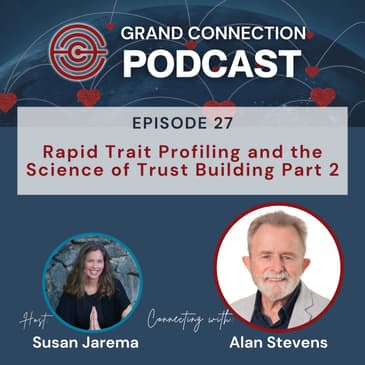
What helps collaborations thrive while others quietly fall apart? Susan Jarema continues the conversation with Alan Stevens as they explore the deeper human dynamics behind successful partnerships, emotional intelligence, trust, and long-term business relationships. Drawing from decades of experience studying human behavior and communication, Alan shares why values alignment, complementary strengths, and genuine curiosity create stronger outcomes than transactional networking.
Throughout the discussion, Susan Jarema and Alan Stevens examine the role of self-awareness in collaboration, how misunderstandings can either damage or strengthen relationships, and why psychological safety begins with being truly heard. The conversation highlighted practical ways to build trust, navigate conflict, and create meaningful growth through relationships rooted in generosity, understanding, and shared purpose.
What You’ll Hear:
- Strong collaborations are built on shared values, genuine trust, and a commitment to mutual success rather than short-term gain.
- The most effective partnerships often emerge when people bring different strengths to the table, creating balance through complementary skills and perspectives.
- Understanding human behavior requires looking beyond words to recognize emotions, motivations, and the context influencing someone's actions.
- Misunderstandings can become opportunities for stronger relationships when conversations focus on curiosity, clarification, and understanding rather than assumption.
- Psychological safety grows when people feel heard, respected, and supported through challenges rather than judged solely by their behavior.
- Meaningful communication begins with listening deeply, asking thoughtful questions, and making understanding the other person the primary goal.
Featured Guest: Alan Stevens
Alan Stevens is an International Profiling and Communications Specialist and the creator of the Rapid Trait Profiling (RTP) system. Recognised globally for his work in human behaviour and communication, Alan has worked with organisations including Disney Films, Gillette, law enforcement agencies, educators, business leaders, and media professionals. His work helps people better understand human behaviour, strengthen relationships, improve communication, and make more effective decisions in both business and personal environments. Alan is also the founder of The Campfire Project and co-founder of The Business Of Smiles charity, initiatives focused on inclusion, communication, and mental wellbeing.
Connect with Alan:
Website: https://alanstevens.com.au/
LinkedIn: https://www.linkedin.com/in/readingfaces
Facebook: https://www.facebook.com/CelebrityProfiler
Free Gift: https://store.alanstevens.com.au/free This free course introduces people to the foundations of Rapid Trait Profiling and how understanding human behaviour, which can improve communication, relationships, sales, negotiations, parenting, and business interactions. Participants learn practical techniques they can apply immediately to better understand personality styles, communication preferences, and decision-making patterns, helping them build stronger connections and communicate more effectively in everyday life.
Meet the Host: Susan Jarema
Susan Jarema is a marketing strategist, internetologist, and co-founder of The Grand Connection. She helps entrepreneurs grow through collaboration, smart strategy, and high-impact digital presence. Susan is also president of New Earth Marketing, where she builds brands, websites, and ecosystems designed for real growth.
Connect with Susan and the Grand Connection Community:
Website: https://grandconnection.ca/
Facebook Group: https://www.facebook.com/groups/grand.connection
Facebook: https://www.facebook.com/GrandConnectionCommunity
Instagram: https://www.instagram.com/grandconnection.ca/
LinkedIn: linkedin.com/company/66749100
Youtube: https://www.youtube.com/channel/UCxq03yde7nb57HKV1hhztYA
Access your Grand Growth Bundle and Free Guest Pass: https://grandconnection.ca/gifts
We are proud to have Grand Connection Podcast on the High Vibe Podcast Network. Grab your free gift from Susan in our Our High Vibe Gift Vault.
Love this show? Check out the other shows on the High Vibe Podcast Network.
Share the Love
✨ If this episode lit something up in you… tag us on Instagram @HighVibeLeaders and let us know your biggest takeaway!
🦋 Don’t forget to rate & review — it helps us reach more conscious rebels like you.
🔊 Listen & Subscribe
🎧 Spotify
Hello, this is Susan. Welcome back, everyone, to part two of our conversation with Alan Stevens. If you haven't listened to part one yet, make sure you go back and listen to it first, where we explored the hidden signals behind communication trust and why some people connect more naturally than others. Alan Stevens is an international profiling and communication specialist and creator of the Rapid Trait Profiling System, helping people better understand human behavior, communication, and relationships. Today we're diving into collaboration, emotional intelligence, self-awareness, and what creates stronger human relationships. Alan, welcome back.
Alan Stevens:Thank you very much.
Susan Jarema:Well, we learned a lot in our last episode, and I just want to kind of go on to it. If anybody just jumped in right now, feel free to go back to part one, and then we can continue on part two, or listen to us right now and then jump back to part one. Okay, so Alan, we were talking a lot about collaborations. You've used it a lot in your own business. You said that that's been 100% what's made you successful. Why do some collaborations work well while others don't?
Alan Stevens:Usually the intention of when they got started in the first place, a lot of people are looking at collaborations from the point of view of how fast can I grow my business, and so when you're doing that, you're focusing on yourself, and quite often the connections aren't genuine, whereas if you focus on the other person, because I'm, I'm in the in business for the long game, and I have to be that way, because, as you know, I'm in my 70, so therefore I'm in this for the long term, and so with that, I have to make sure that every relationship I create is strong, that will go in, as I say, go the test of time, and so with that, I'm always looking at how can I build a better relationship with somebody to create something that then works together. How can I truly collaborate with them? I've had some people who've said, well, we'd like to collaborate, and we started talking about it, and next thing you know, I've got a PDF talking about what my payment is going to be, and I go, that's not a collaboration, you're actually hiring me, or I'm hiring you, one of the, you know, that sort of thing. If I'm going to a collaboration, it's got to be a mutual win for everybody who's involved, and it's got to be something that everybody's passionate about, enjoys, and wants to do again, not just do it once, if that's the case, because there's a lot of work goes into creating it in the first place.
Susan Jarema:Well, I have my web design company, right, and I always get these emails or LinkedIn messages for people from SEO companies saying, hey, let's collaborate, right, but they just, they're just, and they send me their package, or their other web developers, let's collaborate on things. Oh, yeah, I find the clients, and then I get you to do the work, I'm already doing the same work, that's kind of, kind of funny, and it's somebody I do not know. To me, it comes across as just spam, right? I haven't, don't have a relationship with them.
Alan Stevens:Just on that point, if I may, and that I get a lot of them from people with Gmail accounts or Yahoo accounts or whatever. Talk about, I can improve my SEO. You haven't even got your own website. If you haven't got your own website, you haven't got a business web email address, then as far as I know, you could just be somebody who's looking to get my money and do absolutely nothing, or get into my website and then take control of it, and they're going to pay you to do that, so unless you've got, unless you're set up professionally, there's not much chance of being got a professional attitude, there's not much chance of any collaboration coming from it.
Susan Jarema:No, you need to trust a person who's going to have access to your, your digital platforms. That's actually, yeah, let's go back to what you know best, is people, human, and it's right there on your background, human pattern recognition. What patterns do highly collaborative people tend to have what do you, what do you notice.
Alan Stevens:Well, it's not so much the facial features, it's more, as I said, it's more back into the attitude. See, collaboration is quite often I'm looking at with somebody, if I'm with co-creating something, there's going to be somebody who's got completely different traits to me, because every trait we have has a high side and also a downside. The high side is where our strength is. The downside is where we're not, where we get triggered when we're under stress. I've got critical perception, which is really fantastic for finding errors in things, but then other people are more creative. I haven't got the creative skills, but I can then look at what they've put together and refine it, so I'm looking for people who are different to me, because that's how we make teams. Teams are made up of people of differences, not of similarities, because if I'm working with somebody who's very similar to me, we both want to do the same thing, and all that stuff that neither of us like doing is not going to get done, and so we're not going to be successful. All, so quite often I'm looking for who compliments me in what they do. The more that there is a compliment, the more that react, that's going to work, but also the intent behind the collaboration. Are they also the like-minded me? Do they want to build a long-term relationship, or are they just trying to make a quick buck?
Susan Jarema:Yeah, well, I noticed I have a great collaboration with Ray McCauley. She's the one teaching our self-mastery program, and I.. she doesn't want to do all of the technical stuff, and she doesn't want to do the marketing, and she doesn't want to get the bums and seats. She actually is doing really good on building relationships, and I get people interested in it, and then she creates some relationships, and then they find some value in it, and they want to be part of her course, and it's working really well as a collaboration. We totally have different skills, but we work so well together, and I could see doing something with you too sometimes. So, we've built a relationship over five years, I think I've known you probably for five years now, right?
Alan Stevens:We'd be pretty close to that, if not a little bit longer, actually. I think, yeah,
Susan Jarema:Yeah, early. You're one of the founding Grand Connection members at the very beginning. We've been around for six years, so that's been a while, and I've gotten the opportunity to meet you in person twice now, so that's super exciting. So I actually know you're real, you're not a boss, and we've done some smaller collaborations ourselves, so as you move along the collaboration journey, or the collaboration ladder, where you start moving up to, you know, maybe I might do a book, and maybe Alan would be one of the people in my book, for example, and Ray as well, like these are the people I would be thinking of partnering with, because we all have a good fit, our values are aligned, we've know, like, and trust each other for many years, and we know that one, what we do is going to all work together, and everybody is going to meet the expectations of the collaboration,
Alan Stevens:That's it, and you just hit the key word there, when you said values alignment, if we're not aligned, it's not going to work, and so first thing we need to work out is, do we have the same values, and if we've got the same values, then yes, that collaboration got a good chance of working,
Susan Jarema:So is there any way to tell quickly if our values are aligned, how do you know? And your expertise.
Alan Stevens:Well, first of all, I've got the advantage of looking at someone's face and knowing how to talk to them in the right way. So, straight away, I'm going to be able to make a very quick connection with them. Then, when I'm talking, I'm listening to their para language, how they're actually reacting to, or how they're responding to me. Are they looking in the right places? Are they if they're just looking at me, and they're not looking anywhere else, and I'm asking them questions and making them have to stop and think, and they're looking straight at me all the time. I know they're not thinking. This is something they've talked. It's a line they put together for everybody else. So I'm looking at the movements in the face, etc. the expressions, the movement of the eyes, where they're moving to, to know whether that person's actually listening to what I'm saying, and being involved in that conversation, are they also being truthful about what they're saying? So, where it might take this amount of time to for somebody else to pick somebody up and know where they're truthful or not, I can do it in that matter of time, so very short period,
Susan Jarema:You're going to be able to tell somebody's line a lot quicker than other people set right. We can learn your skill set, right?
Alan Stevens:It was not just if you know when I'm looking at them and understanding whether they're telling the truth or not, it's also understanding why they're not telling the truth. John prefer to look at understanding where they're not aligned with what they're talking about. Is there something emotionally going on? Are they deliberately trying to con, or are they there's something else happening? So it's working out if it's true, if it's somebody I don't want to be around, or it's something else going on, and can I help them. So the first thing I'm going to do is work out when I'm looking at the whether they're telling the truth or not, not as a lie detector, but as a truth seeker, a completely different approach, because now my focus is still on them. It's because when you look at somebody lying, you've already put the focus back on yourself and you're pulling away, the chances are it's just my other having a bad day, something else is happening in their life, and they're not focused, etc. and that's taking their mind elsewhere, and we see those body movements, etc. and we think, oh, they're not being truthful, they've been, they're distrust, they're not trustworthy, and then we realize, yes, their mind was elsewhere, but their mind is caught up on that, because that's a big problem in their life right now, it's not that you're not trustworthy, and so therefore I've then lost that relationship. I haven't been able to pick that up, and that person might have been the best collaborator into the future, and you've lost them because of that.
Susan Jarema:Jessica Koch talked about in her podcast working with different people that were affiliates and. Giving them a chance, because sometimes even though their score was low, they may actually be a great partner later on, and it was just a moment in time where they had something going on in their life, and they weren't able to, or as I added, some of them, their businesses grow, and they actually build their list, and they become amazing partners afterwards too, so you don't know where they're going to be at, so you're always keeping those relationships going. So I want you to share a collaboration story that really reflects our Connect, Create, Collaborate framework. You talked a bit about your what did you call it? It wasn't an accountability partner,
Alan Stevens:A profit partner.
Susan Jarema:You talked in the last episode about your profit partner. Do you, and that was a very great success story. Do you have another one where something came and turned into some sort of business opportunity for you?
Alan Stevens:You know, first of all, I'd like to explain when you mentioned about you going into a partnership with somebody or a collaboration, you get excited if I see somebody who's got a great potential and I get excited by it, I might put too much pressure on them as well. So, if I connect with someone I really like, and I think this is somebody who could be a great partner, I have a number of levels I take them through first, and the very first one is we look at whether we share each other's information, if they, if they're genuine, they're talking about. Yes, I want to be, you know, collaborate. I go, okay. Well, let's start out really easily. The posts that you're putting up, tag me in, or let me know when they're going up, and I'll share those. You share mine. If that works well, then I take to the next level, and then to the next level. So I work up from sharing information to then sharing each other's events, and I'm not sharing them with everybody's events anymore. I used to do that, and that's affected my database, as far as the number of people that are pulled back because it was too much information coming at them. So, I'm finding the best, and the value to do the find the best is start off at that lower level first, work up through those levels to where I go to, from profit share from sharing posts to sharing events, creating joint ventures where we might do a podcast or do a an event together, but then it's also then co-creating events or creating courses together, and the gentleman I mentioned earlier on, he and one of the other ladies who I mentioned earlier, when I talked about having, having supported some, or mentioned that somebody you know my name, and then how could I help them? The three of us got together and put together a course, and we, we co-created that, and we co-sharing that, and I'm doing that now with, and then from there I have what I call profit partners, those people that I'm really aligned with. First of
Alan Stevens:all, before them, I've got what I call super group partners. They're like a BNI, where you've got people who've got the same clients that you have, but all have a different service, and we get together once a month. And the idea there is, did you just do what you said you're going to do last month? So, in other words, connections, etc. What's your goals for this month? Who can I connect you with this month, and what's something I can do for you outside of that? In the profit partner is the next level up again, and I do that every week. So, my profit partner is never the same type of industry as I have in my super group, because if I had super group I'm talking to once a month and I got a profit partner who's the same industry, there's that one. Who am I going to give the jobs to, the one I'm talking to all the time. So, this is, I can have up to 60, you know, 70 people that I'm connected with doing joint things with on that level. And if they work up the scale, and at one point they no longer work at that, I don't get rid of them, I just bring them back to where they did work, and so that way I can have that connection with them, because I'm looking at every connection I go into. How can I make this long term without over burdening that person with extra work they got to do to try and get, because that will destroy the relationship.
Susan Jarema:Yeah,
Alan Stevens:So bring them up to where they feel comfortable,
Susan Jarema:Relationships and partnerships, and you can, you move them in and out, I heard some people talk about it as circles of influence, so you would have the different circles that you know you're getting connections with, and they all have a different role, and they might move into one and then move back into the other, you know, somebody could be going through a move or something else that's going on in their life or health challenge, and then later on they're doing a book and they call you up, and you guys get going out of another partnership again, right?
Alan Stevens:Because if you allow them to sort of come back and do that lower level, where they're comfortable and everything, they may be a great partner at a higher level later on. They just weren't ready for it now.
Susan Jarema:Yeah,
Alan Stevens:But in the further, you know, continue, you're building further trust with them as well, because if they haven't got the skills as well as you've got to be able to build a relationship and recognize whether it's a true relationship they may may need more time to test it for themselves before they go to that next level or feel comfortable they've got to be comfortable at every level that they're at if not bring them back a level where they are comfortable give it time you. Build on it, and then step them up when the time is right.
Susan Jarema:Can you name those levels again? I forget what they are. What
Alan Stevens:I had to do was actually put a training manual together that every time I partnership with somebody, I give them a copy of it, and I say, right, use this as a template to create your own to send me a copy of it as well, because in there it'll have a little bit of my background and the person we put down their background, what they, their, where their passions are, and everything goes, it'll then talk about it, explains to them the different levels of partnerships, it talks about what to listen for if they're in a given situation, and mine's an extensive one, simply because my skills fit into every area of life, as you know, working with corporate, smaller businesses, families, schools, you know, it works with everybody from newborns all the way up to the elderly, and in every situation of life. So, I'm saying, right, if you're talking to school teachers, for instance, this is what you're listening to, if they're saying these things, then this is how you can introduce me, suggest that they have a chat with me, and so I build around that. So it starts off first of all with just sharing content, responding on each other's posts, for a starter, and sharing each other's posts. And if you're comfortable with that, and the person's doing that on a regular basis, and you're doing it with them on a regular basis, then you go, okay, well, are you running events? Is there something else I can share of yours, and it's not so much just hitting the share button, but it's putting something in it that's telling everybody why you're sharing
Susan Jarema:Yeah
Alan Stevens:So people understand that it's not just, oh, original by so and so, it comes down to, yeah, and I'll talk about that person, I highlight them in there as well, so they also get it on their steps, they know it's been done, but people, they can click on, then I'm gonna get to their posts as well, even faster. And so then they'll go up to, from the sharing the content, going, okay, if you've got any events you're running, if they're running events, then I'll share their events, and they'll share my events. If I'm doing that, and quite often I don't usually set up my own events, I've got a.. I've been told I need to do that with I'm doing some parenting materials as well, so that'll be coming up shortly. But usually on other people's events, like Grand Connection, for instance, I will then promote that Grand Connection, and if somebody else, then I'll say to somebody else, if you promote this one for the Grand Connection and me, I'll promote yours as well.
Susan Jarema:Yeah, yeah,
Alan Stevens:And so it grows from there. Then we get up to, okay, we've got joint ventures that we're doing together, and we're looking then at co-creating. So might be a course, for instance, at the moment we were talking about AI earlier on. There's a company in America that uses videos from interviews and uses AI to honor to the voices, and then confirm, was that person really suited to that work, etc. What was their emotions at that particular time with the questions? Were they really telling the truth? They came to me, and they said, "Well, you read faces, etc. How could this work together? And I said, "Well, send me some of your videos, and I'll tell you what I'm seeing in there. They sent me 10 little short interview videos, different people. I looked at what they had got them, because it was going to be too much writing. I got them on a call, and I went, "Right, this is what I'm seeing. And they're looking at their notes and going, "That's what our AI is picking up. And I went, "Right, well, you want to take this to the next level. We can now look at the face itself. There's a out on the internet at the moment. There's a number of different platforms that look at what you've written about yourself in AI, in your LinkedIn profile, for instance, or websites, and it does an analysis and gives you different psychometric profiling results.
Susan Jarema:Yeah, I referral out to that right now. Yes,
Alan Stevens:The trouble with that is most people don't write their own. There's people out there teaching them how to do it or doing it for them, so you're not getting their personality, you're getting a mixture of personalities, but the face tells us everything we need to know. So now we're looking at, I said, "Well, look, I can actually profile the people on the videos and said, right, these are their personality styles, this is why this person might have been nervous at that particular point in time, when that question was asked, it doesn't really, you're thinking of where they're telling the truth or not. This is telling you the true situation. What was their emotions at the time? Was it a lack of true situation or just an impact because of their personality? And so now we're looking at creating an AI. We're just going through the agreements with it now. I've given a couple of traits to go and test with the AI to see if they can read the person's personality from their facial features in their websites and in their LinkedIn profiles. It then tells you exactly who that person is and how they need to be spoken to.
Susan Jarema:Now, what if somebody has an AI picture? I'm noticing a lot of people with pictures that I'm saying, those aren't real, they look too young,
Alan Stevens:Isn't that a mistake? So many people have, don't update their photos on the LinkedIn. I had to go and meet a woman I was mentioned by one of the banks that they introduced me to, she was running a charity group, but they were. Working with, and they wanted me to go and have a talk, and I looked at the website, and I saw this face, and the face had actually been pushed in on the hadn't been cropped properly, they'd been pushed in to fit the frame, but at the same time it was this younger woman, and I went, there's no way she could have this experience, when I walked through and met her, the woman was about 30 years older than the photograph. I'm really reserved when I meet people for the first. I'm always respectful. I just want to run over and give her a hug. I looked at the photo, I said, "Please go and fix that, because it's not doing you any favors. What I'm looking at here, I love your face is telling me everything I was told about you, you can do, and therefore straight away, if with the other one, I'm only here because I had to come here, but if I look at your face, I'm here now because I want to be here, and so if somebody has got one of those younger faces up there, and then you get on the call with them and you see them, there goes your trust straight away, and on dating
Susan Jarema:sites too. If anybody else is using, if anybody's using dating sites, have your real picture and your real age up there, don't fake it. Then you got a lot of lies to deal with later.
Alan Stevens:Oh, that's it. That's too big a job. There's actually a lesbian dating site over in London, and I met one of the two partners of it, two women who were in a relationship, and they wanted me to start looking at.. I thought, well, be great if I could then profile the faces of everybody who applied and really get their profile right, so we could match people with the right partners. Any problem they had at the time was it was a female lesbian dating site, and I had the wrong gender face for that, so
Susan Jarema:Yeah, yeah, yeah.
Alan Stevens:Then looking at, well, maybe we needed to train a female to actually take that role, and so she could do all the profiling for them, but now with AI we'll be able to do that anyway.
Susan Jarema:Yeah, so this AI tool is going to be able to catch the things that you know,
Alan Stevens:But again, it's going based on trying to look at the person, see them who they really are, which is the most respectful way we can treat anybody, because even though all those different profiling systems, Myers Briggs Disc, and everything goes, they put people in boxes with facial profiling, what we do is facial eating. We go and we actually take them out of the box and treat them as an individual. There are no two people on the planet with the same personality, and there are no two people on the planet with the same story, and that's one of the reasons why being able to read them and understand their personality, and then have the gift of being able to sit down, that the gratitude I've got for those people who then share their stories with me. As I said in the earlier session, we've, I've never had a boring conversation with people, no matter what their background was, and I learned from every last one of them.
Susan Jarema:I know, and I've had many great conversations with you. Now I'm just thinking about it, how do you make sure that somebody isn't using the skills that you teach for the wrong purposes? Because you are doing this for good, and you are out there helping make a better world, but this is like secret stuff, like it feels like it's, you know, ones that if you loot new skills like this, you can manipulate people,
Alan Stevens:That's it. All skills, you know, from everything that's on the planet, we.. there's two sides of the coin. There's a great side, there's a bad side. It says that upside or downside, inside and outside, you can't have one without the other. So, the tool itself, it's like money is not evil, it's the attitude towards the use of that money that becomes evil. Money is just a tool, and so it's the same thing with this as well, reading people's faces. It's just a tool, but it's the intent in which it's applied, and it's one of the reasons why my focus now is to create and train my competition, so that more people have the skills, and then those that try and manipulate are going to get caught out by the rest of the people who have the skills, but I'm also very selective in who I train. So, with creating and training my competition, they're passing an interview. First of all, most of them don't even know they're being interviewed, but it's in the conversation we have, because I'm working out how trustworthy they are, how genuine they are. When they talk about, they really want to help people, what's their whole body saying, not just their words, because I know there's a lot of argument about the percentages, like 7% of the words, 38% is the tone of voice, and 55% the body language. At the end of the day, communication is a total of all of them, they're all equally important, but there is far more information in the nonverbals, and so if they don't align with the words the person's using, straight away there's a level of mistrust, and most people can pick that up, but no, don't know why they're picking it up. How many times have you spoken to somebody, everything sounded absolutely fine, but you had that gut feeling something was wrong, and if you've got a gut feeling that something's wrong, you walk away. But with this, and it could be one of two things. Yes, they reminded they work somebody you needed to get away from, but there's also a good chance
Alan Stevens:there might be somebody whose face is just unconsciously reminded you of somebody who's done the wrong thing by you in the past, or even somebody you've seen on a movie somewhere that particular face, and they've played an evil part, and you just don't trust them because of that, that's why these schools come in, and then teach you, whether it's or show you is that person who, who you're really seeing, or is it your emotions, your biases that are getting in the way,
Susan Jarema:sSo you're having that awareness around it, and then you can make the right decisions from that, and the right responses,
Alan Stevens:That's it, you're gonna have two people who look very similar to each other. They'll both process information in a similar way, because personality is all about how you process and information and how you react and things. Character is all about why and the what, and so with that, when you're looking and talking to somebody's face, you're looking at their personality, but what we're judging them on is what we perceive their character to be, and so being able to recognize that two people look very similar to each other, one could be a saint, one could be a sinner, one's trying to figure out how to help everybody else, because that's their passion, and the other one's looking at, well, how can I use this to my game, regardless of what happens to anybody else,
Susan Jarema:So how do you not get tricked by somebody that's doing it for their gain that's not beneficial to you?
Alan Stevens:Well, the good thing is that because they say in NLP, we handle about 2 million bits of information that comes in every second, but we only process about 134 bits, in other words, about 115 1000 of the information that we actually come in, that we actually process, it's where our focus goes, and this is where a lot of people who would focus on trying to build their business and focus on getting a sale, they're missing everything that's coming from that other person, because their focus is over here, and what you don't focus on, you ignore, but if you're focused on really building that relationship, understanding who that person is, and if they're trying to sell to you, you'll pick up very quickly whether they're being genuine or not, your focus is right
Susan Jarema:Now, you do start getting attuned to it, the odd time in life. I mean, the older I get, the less I get taken up on things that I shouldn't have. I guess it's intuition or experience or wisdom, or whatever it is. But we are always learning, and oh my gosh, we're learning so much from you today. I want to talk about misunderstandings that can happen. How do misunderstandings damage partnerships and collaborations? And then, how can we repair them if they were a misunderstanding?
Alan Stevens:Well, one of the things is stopping, and as I said before, when you ask questions, when you're talking to somebody, you always ask all the possible questions you can. Then you ask that last one, which is from what you've been telling me, have I got this right. This is why I understand. Have I got it right? I'll give an example of how that actually worked. This is many years ago, about 2016 The only reason I remember that is because I went over to England shortly after this, but there was a continuation of this story. But there was a guy, I put a.. I don't know whether it's my post or his post or someone else's post, but I made a comment, and this guy had commented on it, and he, I looked at it and thought, "Hang on, he's taken offense to what I've said, but this looks like he's talking about the same thing I'm talking about. So, I put another little comment up just to test it, and yes, he responded with this guy's, you know, actually meaning the same thing as me, but hasn't realized what I'm saying. So, I said, my next comment was, 'Look, mate, I realized that I believe that you and I are saying the same thing, but let's have a.. let's not drag this out on the screen here. I've just sent you a friend request on Facebook. Let's have a chat. Well, we got on a call, started chatting, and then all of a sudden he went, 'Oh, you are talking about the same thing. End of problem, but whereas we were taught, he said everybody else challenges, but you didn't, why not? So I told him what I did, and everything else. Next thing you know, he said to me, I've got problems with my daughters at the moment. The two daughters, he said, can you profile them for me? So he paid me to profile his daughters, and the reason I remembered it was 2016 Shortly after that, Disney films in Gillette flew me to Pinewood Studios. We were doing a launch of the all the outfits and other things, and the expressions and the appearance of people as an event at Pinewood Studios.
Alan Stevens:So they flew me over to be interviewed by the World's Press, and by the way, that was a great gig. 10 day holiday business class flight everywhere, chauffeur driven everywhere for three hours work, and one of the highest fees I've ever paid in those days. And then realized later I could put another zero on it, but there you go. But it's only me all the time, because it had such an impact. But then, while I'm walking around some of the museums and looking around the place during the day in England. And it's nighttime over here. He's a renovator. He was building decks and kitchens and things for people. He kept on chasing me through his nighttime with my daytime. I'm walking around the libraries and the museums, and he's ringing me up and going, "When can I do your master course? So we actually signed up and did my master course. So, where I refuse to get into fights with people, it always works positively. By the way, sometimes I'm just in the mood, but I just don't care, and I will fight with, argue with that person just because I'm in that mood. But in most cases, I realize if I want to take this further, then I need to change the way I'm looking at it, and how can I build that relationship? And the best way to do it is, ask the person by saying, this is what I'm understanding from what you've been saying, have I got it right, or have I got it wrong? They're not being pointing the finger at them, you're pointing the finger back at yourself, and they're going, I want to say, then they won't come back as a challenge, they'll come back and say, yep, this is what I really meant by that. You go, oh, okay, and you're building the relationship.
Susan Jarema:Well, that's very wise for all of us to understand. And what about psychological safety in conversations? How do you help people feel safe through the skills you have.
Alan Stevens:Well, that's one of the areas I've been working in at the moment. Is last Christmas, before last, I did a lot of writing about coercive control and domestic violence, and I wrote about where the male was a victim and where the female was a victim. And in both cases, there were three parts. The first part was how both of them got caught up. Second one was what they could have noticed if they'd been aware of it, and the third one, the post was how they could have circumvented the whole problem. That I started getting a lot of calls from people saying, you've just, this has been my life story, this is what I've been through, and I realized that that was a major issue. We have the dark psychologies, we have the Machiavellians and narcissists, the sociopaths, and the psychopaths, and if you look at the extreme numbers that they talk about, the there's a certain range of so many psychopaths in the in society, so many sociopaths, etc. If you add them all up, the maximum is 16 out of 100 people fit into those profiles at different levels, and so when you look at that, we know that it's a volatile situation, but also in the workplace, a lot of stuff comes from misunderstandings, where arguments can bullies and things have bullying, and that happens, as I was saying before, with the campfire project that started because the men didn't know their role at home or at work, I realized talking to a lot of men, the frustrations that they had. Well, actually, ask them what was a word to which to describe your home life, and they said, well, frustrated, what about your work life? Confused and frustrated, they were the two words that kept on coming back all the time. Okay, tell us more about that. And they said, well, right at home, especially baby boomers, Gen X, we were told if we want to show our love to the family, we had to be absent. We had to go out, spend our time working away, bring the resources in. And so the men said, "Well, now
Alan Stevens:we're told that we're physically and emotionally absent. We can't be in two places at once. And that was causing such high levels of frustration and anger, to even to the point of some domestic violence, where it just got so tense in the workplace with gender equality and political correctness. The guys were always trying to do the right thing. They said, right, what we'd say today, tomorrow we'll get into trouble for, because I'll shift the goalposts, and I knew that instead, if somebody's going through that frustration, they're perpetrating in anger and bullying, and that sort of thing. Most bullies were created. They weren't born that way. The only of those dark psychologies that are created that way are psychopaths. They're wired differently to everybody else, but all the others, they go through events in their life that cause them to become that way. And so the more that we can let those people, the people talk and let the stuff out that they're feeling and know that they're genuinely being listened to, that somebody is interested in hearing their story, that reduces their pressure, that can also turn around and to prevent some of those people becoming that way, because now they know they're not alone, the people understand, so the frustration reduces, the confusion becomes less confusing, and so that's one way to do it at that point, so we're reducing it before you even go into the workplace and start looking at psychosocial safety, but then in the level of psychosocial safety, you can see what's going on in the organization, and you can work out, have you got somebody that fits into those dark psychologies, or is it somebody that's going through a lot of stress that's causing them to behave that certain way at work, because, and this is where psychometric profiling, like Disc and Myers Briggs, they are all situational in the moment, right now, with the way the person's feeling when they answer the questionnaire. You feel really happy one day, or you
Alan Stevens:feel really miserable the next, and you do the test, you'll get different results. There'll be variations because your emotions come into it, and so with that, we've been able to read someone's face.
Alan Stevens:I can see their emotions as well, that's there. So I can see their character, their personality, know exactly how they like to think and process. I know if I take them out of this situation and put them in this situation, how they will change. So we're with Myers Briggs and discs, and those profiling systems, where you say, right, this person is this at work, they might be commanding, and all the rest of it, but they might be doing it with bullying, because in their home life they're under pressure there, and they're actually be subservient to their partner, so when they come to work, they're trying to get some dominance and feel more, feel better about themselves, so they act out what's happening in another part of their life. This is the beautiful part of being able to read people and go, radio, I can see what part you would fill with in the workplace here, but I can see there's emotional stuff going on. Tell us a little bit more about, you know, your social life, your personal life, etc. And if even if you're talking, you find talk to other people, they say, oh yeah, they're having some problems with their partner, their husband, or their wife, etc. You can then go, okay, that's something I can now. How can I start a conversation with them around that to find out what's really going on? Because if I can help them there, they're going to behave differently at work, and you don't have to pressure them or sack them. You're able to help them through the stuff they're going through, and the situation has changed because we don't want to sack somebody if they're just going through tough times, but perpetrating things against others. After we've trained them and spent all that money, we can now look at it and go, radio, we can help them fix their problem. We've still got their gifts, and because they know you've supported them, they'll even become stronger in that organization in a positive way.
Susan Jarema:Wow, that's quite a skill to have. So, how do we learn how to do all this? Alan,
Alan Stevens:Well, as you know, I'm setting up to create and train my competition. I want to get to people in all different industries, people who are very passionate about helping other people. First of all, so I've had a lot of people who have come to me because I knock back more people than I train, and I've had people come to me and say, look, yeah, especially when they've got the great marketers, they're making a lot of money, and they want to pick these skills up, put them into theirs. I know why they want to put it, because they want to get in front of everybody to keep making more money. They're not the ones I want to train, but somebody who is really passionate about helping other people, generally you find they're looking after everybody else, they're not looking after themselves, so they're on the borderline as far as their finances go. So I thought, right, how can I help them? Because they're the ones I want to train. If they're passionate about their people, they're the ones I want ongoing relationships with. And so I thought, right, they can do my master course, but instead of paying for it over the three months that they do it, they got 12 months to pay for it on a subscription basis. The next nine months I know they're going to pay for it, because they're the ones that I'm working with now to develop those courses I talked about, where we're looking at negotiation skills. I brought a whole lot of different information together from Chris Vice, from Chase Hughes, from about nine other different people out in authorities, taking all their material from where they're doing the investigations and interrogations and completely reversed it for business and personal life to be able to build negotiations in business more effectively, improve sales in a genuine way, not just getting more sales but supporting people to get them become a problem solver, because you know, as you know, Steve Brossman is a good mate of mine, a member of the Grand
Alan Stevens:Connection, but Steve always says the ATM equals the ATM, so in other words, the ATM, being the money machine, is equal to how you help those people through their emotional outcomes, they're trying to get to, how you save them money, how you help them save them time, I should say. Then you help them save money or make money, depending on what they're doing with it, but you're also helping them to understand their problems, so you become a problem solver at the same time, removing their worry and stress. If you do all that, you never sell anything, but people buy from you all the time, and so that's the attitude I have to it. So I'm always looking at, well, how can I make that connection with somebody and understand that side. And so with those people, I'm training them on, we're developing these programs, they get to test that program and every other program I'm creating in the future.
Susan Jarema:Yeah,
Alan Stevens:To prove it in their business, to make it market ready, instead of me saying, I think everyone needs this, put a course out, nobody buys it. I'm proving it. They have results from their business. I'm dedicated to make sure they get great results, because their results then go to the university in Newcastle, where we're looking at doing empirical testing on the facial features. There's 17 different sciences that support facial features connected to personality, but there's nothing that has empirically proven it yet. All the other stuff I've done has been empirically proven. Once that's empirically proven, this thing makes it one of the leading, or the leading profiling system on the planet, and it will make all the other psychometric profiling and that redundant. And so you can see there's a collaboration, me, yeah.
Susan Jarema:Then you got either, there's lots of collaborations happening in that that conversation here about what you're doing with your masterclasses and if anybody's interested in learning more about your masterclass who this with you learning these skills to become better at communicating and understanding people how do they get in touch with you
Alan Stevens:Well that's going to be my website, where they can find out all about this. I can find out about that program, and it's Alan stevens.com.au Alan A L A N, and Stevens with a v.com.au for Australia.
Susan Jarema:And you have a gift,
Alan Stevens:Always. There's a free course in there. It only takes 28 minutes to go through. It is a lead magnet. It does talk about some of the people in the results they've got, but it'll give you a couple of traits that you can go and test for yourself, because until you've proven something to yourself, no matter how good a person talks about it, you don't know it works until you test it for yourself. And that's what that course is all about.
Susan Jarema:So, if people could improve on one communication skill right now to take away today. What would you recommend working on?
Alan Stevens:Stop and listen. Just remember that you've got two eyes, two ears, and one mouth, and focus on that when you're talking. Ask every possible question you can of the other person, and then add one more at the end. And that last one is always from what you've been telling me, this is what I understand. Have I got it right? Put your intention on understanding them, because once you do that, if you're trying to sell a product, you've got a better chance of being able to sell it, because you know exactly what they need.
Susan Jarema:Well, thank you so much, Alan. And anyone listening here, you can meet Alan at the Grand Connection, it will be at one of our Aussie friendly time events, so later in the day. For those on North America, thank you so much for joining us for this two-part conversation. And thank you, Alan, for sharing your wisdom with us. If you're joining us here in part two, make sure you've gone back to part one, where we explored a little bit more on the hidden signals behind communication and trust, and why some people connect more naturally than others. Behind every referral, collaboration, partnership, and community are human beings wanting to be seen, heard, and understood. At the Grand Connection, we believe meaningful business growth happens through our Connect Create Collaborate framework, if you enjoyed this episode, we'd love to invite you to grab a complimentary guest pass and experience the power of relationship first, networking, and collaboration. Go to Grand connection.ca and find the guest pass button at the bottom right corner. We also have a Grand Growth bundle at Grand connection.ca forward slash gifts, and here's one simple action for today. Okay, well, it's the same thing you said. Slow down and listen more deeply in your next conversation. Understanding creates the strongest connections. Until next time, keep connecting, keep creating, and collaborating