
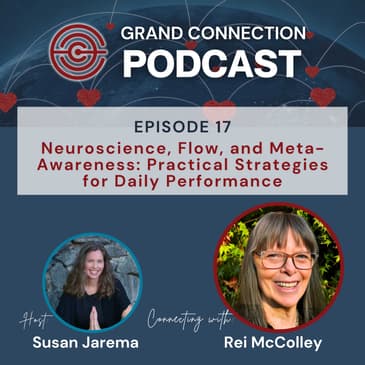
Awareness becomes more powerful when it can be accessed in real time rather than recognized after the fact. Susan Jarema and Rei McColley explore how brain network switching shapes everyday experiences, from moments of distraction to states of flow, and how simple practices can shift those patterns.
Through the Mindful Minute, Rei McColley demonstrates how consistent, small moments of pause build meta-awareness, supporting clearer thinking, calmer responses, and more intentional communication. The conversation reflects how inner awareness strengthens connection and collaboration, creating a more grounded and sustainable approach to leadership and growth.
What You’ll Hear:
- Awareness deepens when internal patterns are recognized without judgment, creating space for more intentional choices.
- The Mindful Minute offers a simple way to regulate the nervous system and return to clarity throughout the day.
- Autopilot behaviors reveal how easily the brain defaults to habit when awareness is not present.
- Meta-awareness allows a shift from reacting emotionally to responding with intention.
- Stress impacts decision-making quickly, influencing communication and leadership in subtle ways.
- Flow states emerge when attention, skill, and presence align without force.
- Slowing down during communication enhances connection, clarity, and meaningful engagement.
Featured Guest: Rei McColley
Rei McColley is a Certified NeuroCoach, Art and Movement Therapist, Master Certified in Ericksonian Hypnotherapy, and Certified in Neuro-Linguistic Programming. With 35 years studying human communication and seven years in neuroscience, Rei blends brain-based strategies, mindfulness, and creative expression to help people build clarity, confidence, and authentic connection in life and work.
Learn about our 2026 Self Mastery Program and watch recordings - The Neuroscience of Connection, our new transformational program that blends neuroscience, mindfulness, and community support to help you thrive in both life and business using the latest in brain network switching. https://community.grandconnection.ca/self-mastery-info
Meet the Host: Susan Jarema
Susan Jarema is a marketing strategist, internetologist, and co-founder of The Grand Connection. She helps entrepreneurs grow through collaboration, smart strategy, and high-impact digital presence. Susan is also president of New Earth Marketing, where she builds brands, websites, and ecosystems designed for real growth.
Connect with Susan and the Grand Connection Community:
Website: https://grandconnection.ca/
Facebook Group: https://www.facebook.com/groups/grand.connection
Facebook: https://www.facebook.com/GrandConnectionCommunity
Instagram: https://www.instagram.com/grandconnection.ca/
LinkedIn: linkedin.com/company/66749100
Youtube: https://www.youtube.com/channel/UCxq03yde7nb57HKV1hhztYA
Access your Grand Growth Bundle and Free Guest Pass: https://grandconnection.ca/gifts
We are proud to have Grand Connection Podcast on the High Vibe Podcast Network. Grab your free gift from Susan in our Our High Vibe Gift Vault.
Love this show? Check out the other shows on the High Vibe Podcast Network.
Share the Love
✨ If this episode lit something up in you… tag us on Instagram @HighVibeLeaders and let us know your biggest takeaway!
🦋 Don’t forget to rate & review — it helps us reach more conscious rebels like you.
🔊 Listen & Subscribe
🎧 Apple Podcasts
🎧 Spotify
🎧 Amazon Music
🎧High Vibe Podcast Network
Hello. This is Susan, and this is the grand connection Podcast. I'm very excited to share with you a follow up conversation with Rei McColley. If you listen to Ray's earlier three part series with Jeff Ostroff, you were introduced to the mindful minute and the practice of accessing and savoring a value. Those episodes help build awareness and inner regulation. We will review the mindful minutes in a few minutes for reference, and I will also recommend you go back and listen to episode four, five and six. Today, we're taking this foundation and making it real and very practical. This is a topic that's come up many times in the Self Mastery Course, we thought creating a podcast episode with real examples would be relevant for listeners and also for our class. This conversation is about brain network switching and how it shows up everyday life, driving, speaking, having conversations and running a business. This is especially relevant for entrepreneurs who are constantly shifting gears. If you recently jumped into our world and haven't met Ray yet, let me tell you a little bit about her. Ray McCauley is a certified neuro coach, art movement therapist, masters, certified in Ericksonian hypnotherapy and certified in neuro linguistic programming. With over 35 years studying human communication and seven years in neuroscience, Ray blends brain based strategies mindfulness and creative expression to help people build clarity, confidence and authentic connection in life and work. She's the lead trainer in our Self Mastery program the neuroscience of connection and host the grand neuro mindful circle here at the Grand connection. And I'm also most grateful to know and practice with Ray. So welcome Ray.
Rei:Hi Susan. I feel the same way about you. I'm so glad for our connection. Well, thank you.
Susan Jarema:And so is the community, everybody? I have to admit, there's groupies. There's Ray, groupies that show up at your circles. They can't wait to get a little bit centered and grounded every month so that they can practice better communications with people around them. So So Ray, for those who haven't listened to your three part series, okay, just briefly review, how does brain network switching build on the mindful minute and values work?
Rei:All right. So let's just take a moment to flesh out, you know, to to imagine a map, because when we have a map, we can navigate the territory more easily. So the first thing is a simple three net, three brain network map of how we perceive reality and interact with it. So the first one is focused attention. We're going to make this very simple. We the other classes we have go into detail, and our Self Mastery program does a deep dive into understanding all of this, but focus attention, decision making, imagination, strategy making, for those of you who are listening, just listening, I first put my hand on my forehead, and then I put my hand on the top of my Head. Strategy making meaning, making self talk, all right, then deeper down in the brain is the salience network, which does social connectedness, insights, intuition and deciding what's important, what's truly important to us. So we have these three networks. So the mindful minute, when you go through the whole arc of the mindful minute, you're switching those three brain networks. The big lesson in the mindful minute is that everyone who does it consistently and regularly, that means every single day develops more awareness.
Susan Jarema:Now, for those listening, if you wondering, what is this mindful minute, if you just popped in, a lot of us do it, run a regular basis now here at the Grand connection, but tell us what, how to do a mindful minute in. All right, very briefly
Rei:I'm going to very briefly say what it does for you so you have a buy in the brain likes to know what's in it for a beat, and so the mindful minute regulates the brain biologically. It cools it down, it increases cerebral spinal fluid flow, and by the time you're done with the mindful minute, you've soothed your nervous system, you've released neurochemicals that actually reduce stress, all right? So that's a lot biologically, right? And then, once again, embedded in that mindful minute is a moment of being aware that you're aware. That's a very powerful thing to learn. We in the science world, we call it meta. Awareness. So when we have meta awareness, we have the potential to consciously choose what we want to experience, not just doing something in the world, but our inner experience. So we can turn reacting into responding, we can become aware that we're in our imagination too much and choose to focus our attention on something else, thereby regulating perhaps a mood or anxiety or stress. So we have these choices and possibilities for antidoting something that isn't pleasant that we're experiencing and amplify more pleasure, curiosity and playfulness in our life.
Susan Jarema:So can I have an example of that? What's happening? Let's say that I get triggered by something somebody says that reminds me of something from my childhood or whatever. How would this meta awareness come into play?
Rei:Okay, so a component of meta awareness is non judgmental witnessing. So once again, as we get the habit of non judgmentally witnessing our own experience. We bypass any form of self judgment that would take us down a rabbit hole of, Oh, poor me, or I'm not enough, or I always do this. And instead, we have this neurological map of, oh, I'm in a hyperactive imagination center. It's doing a future projection that is negative, and it's upsetting me, because I'm buying into it.
Susan Jarema:So just by being able to name it and what's happening in your brain, you have this meta awareness, and now you can react forward
Rei:Exactly the brain loves to name things once it has a name for something, the part of the brain that makes strategy and decisions can begin organizing a strategy that we can feel good about doing. And when we switch through all three brain networks and we bring the salience network on board, not just decision making and strategy making, but what's truly important now we have a value laden strategy that can keep us motivated over a long period of time.
Susan Jarema:Well, that's that's very helpful. So we're now, let's go back to what the mindful minute is. Because, okay, I mentioned it at the beginning, and people probably wondering, well, how can I practice a mindful minute?
Rei:Thank you. I think our conversation is demonstrating what we call flow, yeah, yeah, where you can just kind of flow and morph. So the mindful minute is three, at least three very luxurious stretches and yawns, real yawns, where you open up your mouth. So we're gonna do it.
Susan Jarema:Yeah, we go. We got time for three yawns?
Rei:Okay, let's do three yawns.
Susan Jarema:Ready listening. So you would stretch and you yawn when no one's around, you can easily yawn and not cover your mouth. I'm in for my mouth
Rei:recorded so and Susan and I have been in focused attention, and you have too by listening. So this is a good time to reboot the brain, to reset the brain.
Susan Jarema:So just doing some stretches and yawns, and then doing some
Rei:Stretches and yawns, notice your breath. So a great way to notice your breath is breathing in and out through the nose. You can notice the difference in the temperature. Can notice how it feels and begin slowing down the meaning making the inner speech. Let that dialog slow down.
Susan Jarema:Now, if you're in a car, they'll they'll do this, yeah,
Rei:Don't do this. If you're in a car, you have to pull over.
Susan Jarema:If you're in a car, over if you're driving, it's very relaxing, and it soon, it soon becomes that you can do these in a weird second and just get tapped into very quickly with practice, which is why we have our Self Mastery program. It allows us to actually do the practice, learn and practice all the time, so that we create new habits,
Rei:We revisit the mindful men at every single class twice, so sometimes more and so, because you can't really do too many so then continue slowing down and do some form of self soothing. So if you can see me, I'm gently rubbing my arms, you control your fingertips too, but do it very slowly, like slow motion. The slower you go, the better you are, slowing everything down. So an entry into awareness is first focus, attention and then sensory awareness, slowing down and pause. Causing now in this process, as you slow down more and more and you stop the inner dialog, you'll notice a moment of stillness, and it can be kind of a more alive stillness. It's not a stillness that's devoid of everything. It's a very potent and alive stillness. When you arrive there, notice it now, as soon as you notice it, you're not in it anymore. But that's okay, because you've learning how to arrive there. So remember stretches and yawns, breathing, sensory awareness, slowing down and pausing, arriving at that moment of stillness. And then we ask for something that's important to us. It's ideal if it shows up as a single word. The word could be integrity, could be love, could be family, it could be anything, but generally speaking, it's something that has an important meaning to you. Like it matters.
Susan Jarema:For me, it's often connection, okay, connection. Some days it'll be family. You know, when I've had some stuff with my family where, yeah, connected to the family. So, yeah, it changes. And it's powerful to think about that too get an insight.
Rei:It really is. So those of you listening, you might want to just see if you can slow everything down enough to have that moment of stillness and ask for something that's important to you. If it takes a little while, that's okay. That's actually a good sign. If it takes a little while, sometimes they come instantly. Sometimes they take a while.
Susan Jarema:So that's the mind that's been it everybody this is, says practice. Well, how many times a day should we do this?
Rei:A minimum of four to six times a day, ideally, every hour. I want to add one more thing is, once you get your value word, savor it. You know, just like if you've had a yummy taste in your mouth or you were smelling a flower or scent that you really like, just take a moment to savor it. That savoring releases neurotransmitters, that antidote stress. Well, the whole process, antidote stressed also, but we want that neurotransmitter release at the end of the mindful minute, so that's the mindful minute.
Susan Jarema:And what I love in the class that we talk about is you say, this is Brain hygiene.
Rei:It's brain hygiene because you thermo regulate the brain so focused attention heats the brain up, like huge temperature, like you've got a terrible raging fever, but the brain actually heats up. So it thermo regulates the brain. It cools it down. It increases cerebral spinal fluid flow, which washes the brain All right, so it's really good, and the stretches and yawn inter interfere with the constant inner speech that goes on. And decision making around that strategy making, which gives the brain a break, it gives it the brain is very energy efficient. The part of the brain that makes decisions consumes a tremendous amount of energy. And so you give the brain a little reboot. You know, you give it a little energy respite,
Susan Jarema:Reset, get it all
Rei:Reset is probably a better word. Yeah, yeah.
Susan Jarema:Okay, so, so everybody, I hope you've gotten a chance to do that. Don if you're driving, if you're driving that, you got to pull over and do this, pause and get a reset and do this. You know, it gets faster too, like you can, I find that I can get into that state in in several seconds.
Rei:Now, yes, an interesting little neuro fact is that when you do a something repeatedly, the brain will store it as a habit, and it can become automatic. So there's a lot of people who are in the program that are reporting that when they feel stressed out, they automatically yawn. Now they don't have to say, I'm going to yawn. They find themselves yawning
Susan Jarema:And then everyone around you yawns too, because yawning so
Rei:it absolutely is
Susan Jarema:So I hope we've all gotten some yawns and stretches and you're feeling a little more centered right now, your brain's got some hygiene. It's reset. And now I want to go into some examples. So if we're going to be, you know, you'll be doing some thinking that thinking, Oh, wonder what's happening in my brain when this happens. So I told you this story in class, right about, you know, what I was driving. I'm from Winnipeg. I live in banking for now, and when I go home, I often have to, you know, drive somewhere. And I used to drive this one route to the university for four years straight. The same the same way all the time, right? And this last time, when I was there, I was driving, and I, you know, I'm not paying attention, I guess. And suddenly. I realized as halfway to the university, I was not going to downtown, which is where I had a lunch meeting, and I had suddenly go, Oh my gosh, I'm almost at the university. I really just went into my I'm guessing it's my default mode network. I was in Hamid.
Rei:That's exactly what happens.
Susan Jarema:And then I had to change force and go back, and I was a little bit late. I felt bad. So what's happening in my brain during all of this?
Rei:So what's happening in the brain is, when you do you describe doing a pattern again and again and again. You drove this route many times. So the brain, once again, is very energy efficient. It likes to it likes to do that. It doesn't want to expend energy if it doesn't have to. So all of that gets installed in what we call a bottom up process, part of the brain, it, which is largely unconscious, that is basically habit formation. It's basically a habit so it gets installed and it's automatic, so when we're doing something we've done many times, so like, you weren't on the same route, but you were driving a car,
Susan Jarema:yeah, so car is definitely we drive out of habit with our car, yeah, and you drove
Rei:Out of the same place that you drive out of, yeah, most likely went into mind wandering. When you go into mind wandering, the focus attention drops right. And the part of the brain that that, because the brain is saving energy, the part of the brain that's automatic habit, which has to do with movement, also go takes over. You're on autopilot, basically. So you were on autopilot. Okay? So then what happens is that goes on until the salience network kicks in and says, Wait a minute. We're going to be late. We're going the wrong way, you see. And then all of a sudden, we wake up. What? What did I just do? Well, that's what you did. You were, you were brain network switching without awareness. And choice, is what you well, it would have been
Susan Jarema:good if I brain network switched earlier before I made the wrong turn.
Rei:Yes, yes, yeah. Or so once again, that's where the meta awareness of being more and more we become aware of, oh, I'm in, I'm in the imagination center. This isn't a time for for me to be doing that. I'm taking a different route. I'm going to focus my attention on that route.
Susan Jarema:So what let's say, we know that we're we don't. Now, this has happened once before. I guess the next time I go, I'm going to be more aware of not making that mistake. Yes, so I would be so I would purposely not let myself go into default mode network.
Rei:It's generally a good habit, unless you especially when we're driving, to notice when we're in the default mode network, there's times when mind wandering is very useful. However, mind wandering can often go into what we call a negative bias, which is imagining things that are negative, that creates stress as soon just a few minutes of stress can derail the decision making and planning part of the brain, so we want to be aware of what network is dominant and do the switching often. Once again, it saves energy in the brain. It allows us to develop more awareness, which develops more of a sense of interconnectedness with the world around us. So we could assume that more interconnectedness with the world around you would notice that you're now in a different neighborhood than the place you want to be. You see,
Susan Jarema:I think if it was totally different, but it's something that I was so used to seeing for so many years that I didn't it didn't click in right away. Yeah, so now I know when I drive sometimes, like I drive a lot of long drives, two, three hours on a highway, and it's pretty boring, and I listen to podcasts. So I my definitely doing doing another task at the same time as drive. So totally have it, but if something car cuts me off, or a deer runs across the road, I I slam
Rei:Yes, and the brain's designed to do that. In other words, it's designed to be energy efficient, and you can mind bother while you're doing a task that you've done hundreds of times, but the salience network and the the bottom up processes of the brain will alert you when there's threat of any kind, it will alert you. And so we snap back. We've been mind monitoring, and suddenly we noticed the brake lights are on. The car ahead of us are on, and we put the brakes on automatically. Yeah. Yeah, so it works that way. You hope you're not on ice, and it's good. It's quite fascinating. So one of the things to keep in mind is, as we develop the mindful minute, along with the meta awareness that we everyone that does this starts to notice they're not judging themselves because we're practicing objective, non gentle, non judgmental observation, so we stopped beating ourselves up. So when we can kind of laugh at oh my gosh, look at that, it was on autopilot for the last 10 minutes, and it it worked. I wouldn't recommend trying to do that, but we don't have to be hard on ourselves if it happens, especially when we understand it's a normal thing. This is what brains do. This is the difference between neurology and psychology. We don't have to go into why did I do that. It's it becomes more interesting to understand how I did that, and to have more choice, to choose a different how
Susan Jarema:Well, and it feels like having, having worked with you for a while now, and being part of the Self Mastery program that that we're actually learning learning practices that make a difference quicker than psychology.
Rei:Yeah, yes. Write it very direct. It's very direct and very efficient. The first thing is understanding the map and gaining the the ability to recognize when a particular network is active. So the brain, the brain will shift and flicker. So when that one network lights up, the other networks tend to diminish their activity so but this happens at lightning fast pace, but generally speaking, like when we do minutes and minutes of mind wandering, there's one network that is, you know, kind of taking the center stage right so over time and With practice, and it is helpful to have mindful conversations with people and and coaching on this so that we get clear of which network is dominant in our experience. Like I'm doing a lot of focused attention now I'm spinning my wheels. It's time to take a salience network break. I'm going to stretch and yawn. I'm going to focus on maybe I'll go get a snack. I would take a little walk in nature. I need a break.
Susan Jarema:Well, I didn't take a take up. I'll do a mindful minute before a call or a zoom call. This is a networking and before I speak like I have to do a talk somewhere, just just get and center myself and be in a place and even partway through now, because we can do you learn to do the AWARE seconds. You can do that part way through your talks too. Yes.
Rei:So embedded in the mindful minute, remember is that aware second, and the science shows that aware seconds add up to the same thing as the mindful minute. However, the mindful minute does do that extra thing, developing more meta awareness. When you do the whole arc of the mindful minute, and you do it consistently and regularly throughout your day, everyone that does this develops more awareness that of their
Susan Jarema:What's this a healthier way to live.
Rei:It's completely a healthier way to live and key and once again, keep in mind that even a few minutes of stress can derail our decision making abilities, so we don't think rationally under stress. So think of all the impulsive decisions we've made when we're stressed out, or we get into an argument when we're stressed out, or we
Susan Jarema:Run that email we shouldn't have sent,
Rei:Yes, that email you shouldn't have sent.
Susan Jarema:I'd have to and do that. I either way, hit delete the draft, and I don't even put the email address into the top just in case it accidentally said, don't trust it. So it's a bit of a process of working through your thoughts, right? But I've not in it nowhere. Have any chance of sending it. I got a lot sending a background.
Rei:Self regulate first, and the mindful minute will help you. Self regulate. Definitely remember. It reduces stress. Definitely reduces stress, and once again, it releases neurotransmitters or chemicals. They're the same thing that actually antidote the neural chemicals of stress. It's an antidote. So you have your own little pharmacy in your brain, and you can choose to antidote a negative effect, as once we get stressed out, the neurotransmitters that get released can last for six hours or more. So it's nice to have another transmit, transmitter neurotransmitter that antidotes that right now,
Susan Jarema:Yeah, very powerful tool to use in your life and business. Now I want. And jump into flow because we talked. Oh, yes, yeah, this is a fun conversation. So you are a surfer, I'm a skier. Okay, we both get into these states of flow. And you told me this cool time where you and your friend were going back and forth on the longest wave ever. And yeah, you're doing your hang 10s, which, for those who don't know. I've learned this from Ray It's where your toes go. All 10 toes go over the front
Rei:of the board, right? Yes, you have to squat down to do it.
Susan Jarema:Well, I've not done it. I'm terrible surfer, but I do try a little better on the ski slope, so, but it's a similar feeling when you're in that state of flow. And I was asking you to share with everybody what is happening in the brain when I get into flow, when you're surfing or when I'm skiing, or borders. We'll let borders and part of this too.
Rei:We're going to give a short answer to this, and hopefully you'll all come to the our little monthly gathering, and we can ask these questions and answer them longer. So the quick answer to this is when we're in a situation where we're using motion, you know, we're skiing or surfing, and it's something we've done many times, and our skill level is matching or or the challenge level, or the challenge just as a little bit more than our skill enough to pull us forward all right, in into so it starts with focused attention, as far as we know, but keep in mind, this happens lightning fast, and then strategy making parts that notice things that are going on, and Then the salience network kicks in to notice and and and help the other parts of the brain anticipate what to do next. So there, there's this element of like, if you're, if you're a beginner skier, and you wind up on an advanced slope, you might probably not going to go into flow, because the the demand is above your skill. Yeah, the demand is above your skill I never served 40 foot waves. You know, that would have been beyond my skill level. I liked about five foot waves, you know, about as tall as I was and I am. So when we have that going, the brain just starts to it switches from that autopilot we talked about with driving, where parts of the brain are doing what they do, because we've done it so many times, and then the anticipation of what to do next kicks in. So there's this beautiful, lightning fast dialog in the brain between bottom up unconscious behavior and top down conscious choice, but happens very, very fast, and when we do this again and again, the brain releases this beautiful cocktail of neuro and transmitters that can take us all the way to Bliss. If we we can go from satisfaction to Bliss, and the parts of the brain that that, once again, make choice and guide, kind of diminish their activity. So people will often describe of, I wasn't thinking about it. I was
Rei:just doing it. I was just doing it. There was no thought going on. I wasn't saying, you know, like when my friend and I made those switches back and forth where we kept crossing each other's paths and making funny faces at each other and waving ways we did so we didn't decide to do that. It was just a natural outcome of the flow we were in. You see, when do you know when to kind of lean into a turn? You don't go, Oh, I'm going to lean into a turn right now when you're in flow, you might do that when you're learning, but you don't do it when you're in flow. In flow, it's automatic and lightning fast. But one, one of the things that lets you know you're in a state of flow is how good it feels. It seems like time slows down, the colors become brighter, the awareness expands. We have that feeling like almost, if we could articulate in that moment, which, if we did, we we drop out of flow, it would be like, Oh, I was born to do this. You know, there's, there's nothing better than this moment right now.
Susan Jarema:No, I can almost feel it now.
Rei:Do you describe it to everyone in our summery program? Yeah. And in the south Mastery program, we go into much deeper dive into flow, how to create flow, what flow is neurologically. So there's a deeper understanding of what's going on that we can't cover here right now.
Susan Jarema:You don't have to achieve flow only if you're skiing or surfing. There's many other places in your life where you can achieve flow, which includes when you're presenting or speaking to people
Rei:Exactly in a mindful conversation.
Susan Jarema:Yeah, and I've had many people say that, I say to somebody that talk was amazing, you know? It was a defined download. It just came what they don't know. You know? What? Happen. And then you say, Can you do it again? No, I can't do it again. Is there a recording? So some of this just happens, right? You get into this state when you're speaking, so I want you to go into speaking and presenting. Now, what's happening? Yes, so let's what, what changes in the brain when someone moves from you're preparing your talk, so you've got the talk. You prepare it, you're getting ready to do the talk, and then you deliver the talk.
Rei:So hopefully, when you're delivering your talk, you're going to understand some brain network switching and be able to do that. Because the difference between preparing the talk, and I can only say most likely, because every single human brain is different, is that when we're preparing a talk, we're thinking about our goals. We're thinking about what we want to have happen. We thinking about what we want to say. We might be thinking about the results we want to get. That's all largely the part of the brain that does focused attention, we tend to go fast, right? We're going fast. We're thinking and problem solving, right? And our attention narrows down to our subject matter and what we want to get done, what the goal is. I'm just saying all right now, ideally, we let go of that a bit, quite a bit. We can reference it. But if we are giving a talk and we want to connect with people and have them really take in what we're saying, we're going to shift from goals to awareness, start being aware of well, what do I look like if I'm on a zoom call or in person, what's my face look like? Do I have a little smile on my face, or am I frowning? You see, we have that moment of self awareness. We're doing interconnectedness with our networks, and we're looking at the listener. Is the listener paying attention, or are they obviously multitasking? There, you see, so we notice what's going on with them, and do we have their attention? Are we speaking to them? Are we engaging them with us so that they go into what's called neuro resonance with us? So instead of just focused attention, we're doing network switching, instead of those super fast responses, which without pausing, which fatigues the listener, it fatigues their brain. We go into reflective pauses, like the one I just did. And there I did another one and another one. So it gives your brain time to take in what I'm saying, instead of problem solving when I'm actually giving my talk, I go into meaning making
Rei:marketing research shows that if we can engage people's imagination in a meaning is something that's meaningful to them, we'll have a better connection with them is, let's say we want to establish a collaboration with someone. We want to have meaning making, rather than problem solving, and then, once again, that that narrow attention can have us missing all kinds of things. So in a more mindful presentation, we're opening our awareness, and we might miss a few points, but one of my mentors said, remember, when you're doing a performance of any kind, the audience doesn't have the script, so they don't know if you're missing a point. And as as our awareness increases, we learn, and we're our judge, non judgmental witnessing of ourselves and our own conversations we're okay with. I forgot what it was saying. Actually forgetting what you're saying is a sign of flow. So we just get what's more important making a bunch of points or connecting at Grand connections. That's one of the things I love about grand connections, is it's so obviously about connecting.
Susan Jarema:So now, what if you have a time limit? How do you manage that you don't want to get into slow and miss your time?
Rei:It's I would for me, it's trusting that less is more, and that, once again, the audience doesn't have the the agenda. So maybe we wanted to make six points, but we can trust that four is enough. The brain starts to fuzz out after four points. For after four salient points, the brain starts to go, Ah. So those of you out there, if you've been going into mind wandering, it's natural and normal. It's the brain's way of resetting itself, like I've paid attention enough, I need a little break now, because the guy who pays attention consumes the most energy in the brain. Okay, it's the biggest energy drain guy that there is in the brain, and it can derail rather quickly. Too interesting thing to be a human being, isn't it, that the part of the brain that makes all the decisions, that's why it's called Central Executive network, actually can derail the fastest.
Susan Jarema:Well, I find people connect better with stories. Yes, if you're talking and you're in your talk, you have a story. People, you'll I'll notice, because I watch the screens while it's going on, and yeah, and you see the story starts, and people suddenly, who were multitasking, you know, look up, and they're listening now,
Rei:yes, yes. And the brain likes concrete examples. So stories often have concrete exams. Examples like, if you say, this is a very important point I'm about to make, that's all abstract. But if I, if you say, Now, this is going to land like a rock, people, the brave boy, that's something
Susan Jarema:Well, one trick I had when I was teaching at university, because I take, and this is going to be on the exam, everybody started paying attention. So I know your guy, most of our listeners aren't doing doing classroom stuff with exams, but I guess because the exam was very important to everybody, when they heard the word exam, they suddenly woke up for whatever they were, mind wandering, and the central executive network would have taken over, right? This is important, definitely. Yeah. So another thing I noticed happens when people are talking is they start to rush, and they don't even realize it's happened. So now what? What's happening in our brain, and what can we do to minimize that?
Rei:So once again, we're going to reference, I would recommend developing the habit, once again, of the mindful minute. It teaches you to slow down. It teaches you to be okay with interruptions. We have a joke in the community that, in the neuro nerd community that if we're saying, I don't have time for a mindful minute, that's when we need it the most. So you get used to interrupting that runaway train in your brain, and you learn that, and you learn over time that, oh, I'm actually more productive if I do this. So you establish that. So that becomes a habit. So then, then when you need it in a more stressful situation or a more urgent situation, you know, time timelines can create stress. You got it, then when you need it, does that make sense?
Susan Jarema:So we're talking about, about how to slow down when you're speaking.
Rei:So once again, what I'm saying is, if you practice slowing down when you don't need it, you're more likely to be able to engage it when you do. So the best way to slow down is, once again, to become aware that you're speeding,
Susan Jarema:So you have the meta awareness during your talk. Oh, I'm going pretty fast. Yes, just
Rei:And, and because you've also been cultivating not judging yourself, you can very objectively switch gears. I'm going too fast, so I'm just going to slow down. I'm not doing enough pauses, so I'm going to install enough pauses. I'm not noticing my own face, so I'm going to glance every now and then and notice my face, yeah, so I can smile. Learning process. It's a learning it's a learning process. The exciting thing about it is it keeps developing. Everyone I know that's doing this every in the brain changes in 90 day cycles. More or less. It takes 90 days to grow the neurons that really hold that change. So as we do 90 days, we notice our growth, and then the next 90 days, people grow more, and the next 90 days, they grow even more. I have clients I've worked with for five or more years, and their growth is still happening. It's exciting. My growth is happening. It's exciting. There doesn't seem to be an end to what we can become aware of. And once again, the more aware we are, non judgmentally, I believe the more choice we have, and the more we know how to access the parts of the brain that aren't just focused on bigger, better, more, but on what's important, we start making value based strategies that feed us. They don't just feed our bank account. It feeds us.
Susan Jarema:Feeds your soul.
Rei:Yes, feeds I was gonna say that, Susan, we're in our brain. Our brains are sinking together, you see?
Susan Jarema:Well, this is very exciting, because I'm working on how to be a better communicator with. I do presentations and then I speak, and that meta awareness of things are going going too fast. Another technique I'd heard about, and I think you probably mentioned it too, is make your first word in a sentence a breath.
Rei:Oh, that's lovely.
Susan Jarema:So that that gives you a new habit to slow down before you start, especially when I'm presenting, because I can, I can become that runaway train very fast, with lots of squirrels that I notice all over the place, and then suddenly I've run out of time, and I didn't get to communicate what was meaningful, and I really wanted to make happen at that talk because I ran out of time. And another tip I've, I've I'm learning is to make my talk way less time than I think so having less information and gives me more space, more space of grace.
Rei:Yes, there's a whole process we're going to get into in our Self Mastery program this next month, called the creative process that absolutely allows us to have a very salience, which is value driven, reference for what we want to create.
Susan Jarema:Yeah, exciting, exciting. So anyone who is intrigued by this, the Self Mastery program, you can learn more. There'll be information in the show notes, and you can access and come to raise neuro neuroscience connection circle, which is a fabulous way to learn the mindful minute and meet ray in person. Those happen once a month, the grad connection.
Rei:And you can ask questions. You can ask questions if you have them.
Susan Jarema:And and the neuro, the neuroscience of connection, Self Mastery program, Ray, it, there's a new intake going to be coming up, and we always will have one. Can you tell everybody a little bit about that program, in case they're interested in learning more?
Rei:Yes, it's a year long program that is designed in 90 day increments, and it takes us, it will take us a trajectory we're already into, well into our first group that's doing this. It's going to really take you experientially through understanding the neurological map, particularly five key networks. And we we discussed three today, and there's two more we add in. In there, you really get a firm foundation in that and an experience of that. And so we spend a good amount of time doing that. Everybody is enjoying it. Everybody has smiles on their faces at the end of each class. So I think we're doing it well then then we're going to be going into how to, how to deal with, how to recognize and deal with procrastination and overwhelm and what to do, how to completely gain mastery over motivating ourselves. How to do habit change. Change a habit. If we have a bad habit we want to change or create a new habit that we want to have. We'll be doing that. We're going to take a deep dive into the neuroscience of communication, like a very deep dive, because there's, there's 12 to 14 key components to learn. That's a little bit so we take our time. We take a full 90 days and more to do that. There's a neuroscience of presentation, which involves how we're delivering what we want to say. We'll be doing lots of exercises on mindful communicating with one another mindfully and the difference it creates the connectedness we feel and how much more profound problem solving becomes. It shifts completely into a creative process where I'm going to bring in some cohorts of mine that have specialties. One is on how to reduce pain neurologically without taking a pain pill. You can bring your pain down from a level nine to a zero. She'll take us through how to do that. We have another cohort that I want to bring in that is an expert at creating safe communities, so we'll be teaching that. And the list just goes on and on and on,
Susan Jarema:I know, and one are always adding to it too. So it's, yeah, fabulous program, and we are very grateful to your contribution at the grad connection community Ray, it's helping us all become better communicators, more self aware ourselves, because when you understand yourself, you can understand and be able to communicate and connect with others more easily.
Rei:Yes, we can. One of the very important things we're we're doing in this program is we're not just educating you, we're actually taking you through experiences and supporting the formation of your changes. So it isn't just a class where you're going to take notes and learn and go I know that now you're where we really have the intention of creating embodiment in all of our members.
Susan Jarema:And change is a science to change too, and absolutely, our teaching is you only work with things that are vetted science, which
Rei:I love. Yes, it has to be pristine, vetted science. I'll use the word may or can if I'm not sure.
Susan Jarema:At edible, yeah. Well, that's theoretical, but if it works, it works.
Rei:And anecdotal evidence, you know, and anecdotes that matter. But fMRI, you know, based science really is one of the key so I think of it as platinum level research. It's one of the features that we have and the latest research.
Susan Jarema:So if you're a coach and you're working with clients, this is an opportunity to add on neuroscience into what you're doing. So the things you're already doing now, you can learn science behind it, which a lot of coaches in our community are enjoying, taking the program right now because they can, they can accelerate and make better their current, current strengths is
Rei:their offer or or if you're a team leader of any of any sort, this actually helps you to develop a team.
Susan Jarema:Yeah, no, it's been very powerful, and we're going to get you back again, Ray, I want to thank you for coming here and sharing a few, a few examples so that we can kind of understand what's happening in the brain. And again, another reminder of the importance of the mindful, minute and proper brain hygiene. Any last words you want to share with people as they take away? What can they what actions? Actions can they do today to continue on this journey?
Rei:If you have any kind of alarm. I don't want to use the word alarm if you have any kind of notification, and you set it for once an hour and do your best to do a mindful minute once an hour. It is life changing. It is a game changer. And if you're not clear on the mindful minute, there's lots of recordings, as Susan will post at the end of the podcast, where you can where I go through the mindful minute, so you can have two or three different ways to go through the mindful minute, because each is a little it's its own journey.
Susan Jarema:Thank you today, Ray for coming, and everybody that's listening. We look forward to seeing you at another grand connection event at Ray's mind neuro mindful circles. If you want to learn more about the Self Mastery program, we have a information package which includes a lot of recordings. There's a master class in there, a couple of other talks that Ray has done, and you can catch up on, on, on, more on what the neuroscience connection is all about in that form. There. It's all free, complimentary, so join us at Grand connection.ca. Grab a guest, pass the top, bottom right corner and come and see us at some events. Thank you very much, Ray, and we look forward to seeing you again soon, and everybody listening to come and join us at our next event.