
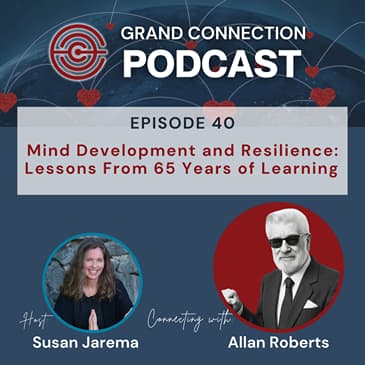
What becomes possible when a person stops treating an old limitation as a permanent definition of what can be achieved? Susan Jarema speaks with Allan Roberts, mindset master coach, author, mentor, and longtime Grand Connection member, about more than 65 years of studying mind development and putting those principles into practice through profound change.
Allan traces his journey from leaving school believing he was “too stupid to learn” to rediscovering a deep yearning for learning through goal setting, commitment, belief, and excellence. His experiences with sight loss, serious health challenges, writing, public service, and mentoring two young women show how resilience can involve adapting rather than simply pushing harder. Their connection through the Grand Connection also reflects the spirit of Connect, Create, Collaborate, where knowledge grows through trusted relationships and shared learning. Throughout the conversation, Susan and Allan explore awareness, curiosity, reflection, mentoring, and his A-to-G framework as grounded practices for continuing to move toward meaningful goals.
What You’ll Hear:
- Early messages about ability can shape an entire future, yet the right encouragement and evidence can reopen a person’s belief in what is possible.
- Goal setting becomes more meaningful when commitment, belief, and a standard of excellence are developed alongside the goal itself.
- Lifelong learning is presented not as a formal achievement, but as an ongoing habit of curiosity, reflection, and personal development.
- Resilience can mean changing direction when circumstances make the original path impossible, while continuing to contribute in a new way.
- Personal challenges can create opportunities for service, mentoring, writing, and community involvement rather than becoming the end of meaningful growth.
- Mentoring becomes a two-way relationship when the mentor remains open to learning from different generations, perspectives, and cultures.
- Greater awareness creates space to examine what sits underneath mistakes, habits, distractions, and repeated patterns.
- Curiosity keeps the mind active by encouraging deeper investigation instead of accepting things only at surface level.
- The Grand Connection’s Connect, Create, Collaborate philosophy comes to life through relationships where knowledge, encouragement, and opportunities are shared across generations.
Featured Guest: Allan Roberts
Allan Roberts is an inspirational speaker, author, mentor and mindset coach who has spent more than 65 years developing and sharing the principles of Mind Development.
Now 81, Allan has overcome significant personal, financial and health challenges, strengthening his belief in resilience, adaptability and never giving up.
He is the author of several books, including Wake Up, Don't Let the World Pass You By, The Great Bank Heist Mystery, Mountains and Rivers, and Rambling Wreck to Recognition: The Professional Speakers Handbook, as well as a co-author of several collaborative books.
Today, Allan is passionate about mentoring the next generation, helping young people discover their potential, and supporting charitable causes as he champions youth for a better tomorrow.
Connect with Allan Roberts:
Meet the Host: Susan Jarema
Susan Jarema is a marketing strategist, internetologist, and founder of The Grand Connection. She helps entrepreneurs grow through collaboration, smart strategy, and high-impact digital presence. Susan is also president of New Earth Marketing, where she builds brands, websites, and ecosystems designed for real growth.
Connect with Susan and the Grand Connection Community:
Website: https://grandconnection.ca/
Facebook Group: https://www.facebook.com/groups/grand.connection
Facebook: https://www.facebook.com/GrandConnectionCommunity
Instagram: https://www.instagram.com/grandconnection.ca/
LinkedIn: linkedin.com/company/66749100
Youtube: https://www.youtube.com/channel/UCxq03yde7nb57HKV1hhztYA
Lead Magnet Workbook https://grandconnection.ca/lead-magnets-guide-workbook/
Access your Grand Growth Bundle and Free Guest Pass: https://grandconnection.ca/gifts
We are proud to have Grand Connection Podcast on the High Vibe Podcast Network. Grab your free gift from Susan in our Our High Vibe Gift Vault.
Love this show? Check out the other shows on the High Vibe Podcast Network.
Share the Love
✨ If this episode lit something up in you… tag us on Instagram @HighVibeLeaders and let us know your biggest takeaway!
🦋 Don’t forget to rate & review — it helps us reach more conscious rebels like you.
🔊 Listen & Subscribe
🎧 Spotify
Welcome to the Grand Connection Podcast, your
Susan Jarema:home for grand growth through collaboration. This is your
Susan Jarema:space to connect, create, and collaborate in a community of
Susan Jarema:heart-centered entrepreneurs and change makers. Hosted by our
Susan Jarema:community, this podcast brings collaboration to life. You will
Susan Jarema:meet members who share their wisdom, offer insights and
Susan Jarema:practical tips, and even interview each other. If you're
Susan Jarema:ready for more clarity, stronger connections, and better results
Susan Jarema:in your business, you are in the right place. Listen in, connect
Susan Jarema:with us, and be part of something grand. Welcome to the
Susan Jarema:Grand Connection Podcast, where we explore grand growth through
Susan Jarema:connection, learning, and collaboration. Have you ever
Susan Jarema:been told you weren't capable of something and wondered how
Susan Jarema:different your life might be if you stopped believing it? Today,
Susan Jarema:we're exploring mind development and what 65 years of studying,
Susan Jarema:teaching, and practicing mindset can teach us about navigating
Susan Jarema:challenges, changing limiting beliefs, and continuing to move
Susan Jarema:forward. My guest today is Alan Roberts, and he's a mindset
Susan Jarema:master coach, speaker, author, mentor, and who has spent more
Susan Jarema:than 65 years studying and developing the power of mindset.
Susan Jarema:His mission today is to help young people discover their
Susan Jarema:potential, develop their inner strengths, and their dreams and
Susan Jarema:goals. Alan has certainly had to put his own mindset teachings
Susan Jarema:into practice through major personal, financial, and health
Susan Jarema:challenges, Including homelessness, and eventually
Susan Jarema:losing most of his sight, he continued to adapt, learn, and
Susan Jarema:move forward. Now 81, I think that's what it is now. Alan is
Susan Jarema:passionate about mentoring the next generation, supporting
Susan Jarema:charitable causes, and continuing to set some pretty
Susan Jarema:ambitious goals of his own, he's also a founding member of the
Susan Jarema:Grand Connection, and I had the pleasure of meeting Alan in
Susan Jarema:person a couple of years ago in the UK. His philosophy sums up
Susan Jarema:today's conversation beautifully: you may change
Susan Jarema:direction, you may slow down, but never give up. Alan, welcome
Susan Jarema:to the Grand Connection podcast.
Allan:Thank you, and it's my pleasure to be here.
Susan Jarema:Oh, it's my pleasure to have you here. We've
Susan Jarema:been planning this for a long time, Alan. So I want to start
Susan Jarema:where this all began. As a child, you fell behind in school
Susan Jarema:and were told you were, in your words, too stupid to learn. Then
Susan Jarema:your sisters help you discover that wasn't true and completely
Susan Jarema:changed the direction of your life. So, what did they help you
Susan Jarema:understand about your mind and your ability to learn at that
Susan Jarema:time?
Allan:Well, my my parents had taught me to read, write, and do
Allan:basic maths by time I was five years old and went to school,
Allan:but I had that encouragement when I went to school. The there
Allan:wasn't encouragement. They use you know it's a carrot and a
Allan:whip. Well, my parents use a carrot, the school use a whip.
Allan:It was alien to me, and I couldn't learn under those that
Allan:situation, so I started falling behind every time I made a
Allan:mistake. I got punished. I just couldn't do it, and I left
Allan:school at 15 with an education of less than a 10-year-old, and
Allan:I'd been told I was just too stupid to learn. Now my sisters
Allan:recognize what happened. They told me I wasn't too stupid. It
Allan:was only the school system, and so I had to believe what they
Allan:told me. So basically, they put me on a four-week program. They
Allan:told me to set myself a goal, which normally I couldn't have
Allan:achieved. I had to commit to to putting all my effort in to
Allan:achieve it. I had to believe I would I would achieve it. I was
Allan:capable of doing it, and I had to put in my very best effort.
Allan:Now, in today's language, that is goal setting, commitment,
Allan:belief, and excellence. Now, I had to journal every week what I
Allan:was doing, and every night I had to read my journal. That's for
Allan:four solid weeks.
Susan Jarema:So, how old were you then?
Allan:Um, I would have just turned 16.
Susan Jarema:Okay, so they were really inspirational in a good
Susan Jarema:part of your life, where it was very developmental.
Allan:I'd have been lost without them.
Susan Jarema:Ah, this experience that you had working
Susan Jarema:with them eventually led into what you call mind development.
Allan:Well, it had such an effect on me that I went from
Allan:expecting a life of menial jobs to high tech. I thought my my
Allan:plan at the time was to be a road sweeper because I thought,
Allan:well, I can re I can sweep a road, and that was my ambition,
Allan:but once they told me I was capable of doing things, and I
Allan:realized I was capable because I achieved that particular goal, I
Allan:thought, well, I can achieve more, and so I switched from
Allan:looking for a menial job to a high tech job, and I moved into
Allan:radio and television. It had such an effect on me that I
Allan:thought my next goal is not to achieve the technical training
Allan:and and get through it, but actually to become the top
Allan:student, and so that was my next goal, and I achieved top student
Allan:week after week, month after month, and year after year, and
Allan:got back what I call my yearning for learning, and I wanted more.
Susan Jarema:Oh, and that's what you're now trying to
Susan Jarema:inspire with young adults and youth in the world today.
Allan:Well, that's right because it had such an effect on
Allan:me. You know, you get excited about something, you want to
Allan:tell everybody, and I immediately started telling
Allan:fellow students and trying to put it across to them, and I
Allan:continued doing that alongside my engineering career for the
Allan:last 65 years.
Susan Jarema:Oh wow! And you've written a lot of books too,
Susan Jarema:haven't you? Along the way,
Allan:having lost my eyesight, you know this is where I was an
Allan:offline mindset, an offline business coach, and I lost my
Allan:eyesight all in space of less than 20 minutes. I went from
Allan:driving my car to being completely blind in in 20
Allan:minutes. So I had to change direction. I couldn't continue
Allan:being a business coach. I couldn't get to the clients. So
Allan:that was a change of direction. So I thought, well, what can I
Allan:do? And I thought, well, I started to get in World National
Allan:Institute for the Blind talking books, and one came through, and
Allan:it was asking for volunteers. Well, I listened to it, and
Allan:everything was for sighted people to go out and help the
Allan:blind people. But there was one thing I thought: well, nothing
Allan:to stop me, and that was public speaking to raise money for the
Allan:talking books. And I thought, well, there's nothing to stop me
Allan:doing that. And he said, you know, tell them this
Allan:information, and then add your own your own situation. What
Allan:what happened? So that's what I did, and that's where I took up
Allan:public speaking, and I expanded that and expanded it. I
Allan:introduced public speaking to my local high school, and I started
Allan:joining a local community. I became a town councilor. I
Allan:became a trustee for Age UK. I became a trustee for a local
Allan:community center. I started contacting carers because
Allan:carers, you know, care for the parents, the spouses, the
Allan:children, friends, neighbors, and relatives, but nobody cares
Allan:about the carer. So I started contacting the carers and
Allan:supporting them, and I did that for 15 years until I became, you
Allan:know, every week until I became ill myself. Now I also
Allan:volunteered at the Museum of Ancient Buildings one day a
Allan:week, and I started mentoring children that fall behind at
Allan:school because of bullying and abuse. So I kept myself really
Allan:busy, but I still needed a personal challenge. And when you
Allan:can't see to read or write, I thought, well, a good challenge
Allan:would be to write a book, so I went to Sight Concern. They
Allan:taught me to touch type. They taught me software for the
Allan:blind, so I could get back onto my computer, and I just started
Allan:typing. And I wrote a personal development book, and it's this
Allan:one here in fight.
Susan Jarema:There it is. Okay.
Allan:Both up.
Susan Jarema:Yeah.
Allan:Don't let the world pass you by.
Susan Jarema:Don't let the world pass you by. Okay.
Allan:I wrote that and two novels, and I had those both
Allan:published, or all three of them published in 2015. So. I
Allan:thought, well, I've done something, and then in 2016, I
Allan:had surgery on both eyes, which has given me enough sight to get
Allan:myself around, but it is extremely bad sight. So, you
Allan:know, I'm happy. I can move around. I'm independent Again
Allan:now, but I put the book onto my computer. I've got a pretty big
Allan:screen here, so I was able to read my book. And when you
Allan:listening to a book, you don't know the spelling. You don't
Allan:know. You don't always pick up the punctuation and things like
Allan:that, and I discovered that the publishers hadn't edited it at
Allan:all. Everything was wrong. I was listening and expecting my own
Allan:words, and I missed all the mistakes. It's only when I was
Allan:trying to read it with very large font, I was able to
Allan:identify it hadn't been edited. So in 2019, I had this book
Allan:republished. I kind of edited it myself, and then in 2021, I had
Allan:one of my novels, The Great Bank Heist Mystery. I had that
Allan:republished, but this year I thought, well, yeah, I've I've
Allan:been overwhelmed in a way because I've spent most of the
Allan:last 11 months either in or visiting daily the hospital, so
Allan:I I haven't been able to get onto the meetings and things
Allan:like that. So I focused on two things. One was writing the next
Allan:book, which was rumbling wreck to recognition, the professional
Allan:speaker's handbook. So I had that published in February, and
Allan:now next month I hope my life story will be published. And
Allan:I've already got 50,000 words for my next book already
Allan:written. I'm hoping I can get that done before Christmas. And
Allan:the other thing I focused on, I've been mentoring two young
Allan:girls, two young sisters in India, and I'd already started
Allan:mentoring them every week. So I focused on that, and I sent them
Allan:a new task week after week after week, regardless of the
Allan:problems, I kept on going, and we're into week some 60 odd
Allan:something now. But that's what I focused on because I knew I
Allan:could keep going and do those things.
Susan Jarema:Well, it really shows your goal setting, and for
Susan Jarema:everyone listening, Alan, you've been very sick. It's not just a
Susan Jarema:little sick. What's what's going on in your world? Well, I lost
Susan Jarema:my eyesight
Allan:originally because of diabetes, and that affects your
Allan:legs. So you don't get that link between the brain and the feet
Allan:to keep your balance, so I had to start using a walking stick
Allan:26 years ago, and it wasn't diagnosed originally. So I went
Allan:from my first symptoms to actually being diagnosed was 14
Allan:years, so that diabetes was able to get a really grip of me
Allan:before the doctor understood what the problem was. So, you
Allan:know, that's why I lost my eyesight. And then, I've always
Allan:been a keep tick fanatic, so I was training down at the gym a
Allan:couple of years ago, and I collapsed, and that was
Allan:diagnosed with a heart problem. So I've now got a heart monitor
Allan:implant in my chest. It monitors my heart 24 hours a day, keeps a
Allan:hospital up to date with what state I'm in, and then 11 months
Allan:ago, I had major problems with my back. I was in absolute
Allan:agony. It was kidney failure. Rushed into hospital, diagnosed
Allan:with bone marrow cancer, and so I've been on dialysis, which has
Allan:just stripped me of all my fat and my muscles, so I hadn't got
Allan:the strength to stand up. I didn't even have the strength in
Allan:my arms to to hold to wash my hair or comb my hair even, and
Allan:I've been reduced to a wheelchair over the last few
Allan:weeks. I've built enough strength just to kind of hold
Allan:myself up, so I'm now just trying to start walking. But
Allan:after 11 months, but basically I'm still stuck in a wheelchair
Allan:anytime I go outside. But I am making progress, and I know that
Allan:a few months, and I will be walking. The medical staff say
Allan:it's going to take me 12 months, but my life story will be at a
Allan:London book fair in March. So I want to be up and walking so
Allan:that I'm totally independent, so I can get down to the London
Allan:book first of all, and promote my own book.
Susan Jarema:Well, you are a testament to mindset and making
Susan Jarema:those goals and having that run and you know build your life.
Susan Jarema:It's it's amazing, and you're an inspiration to all of us in the
Susan Jarema:community when we see what you've been through and how you
Susan Jarema:still always have a smile on your face, you show up at the
Susan Jarema:meetings on Zoom and you are mentoring these two young women,
Susan Jarema:as well as working on getting out your 65 years of wisdom and
Susan Jarema:mindset over in your in your upcoming book. Now, where did
Susan Jarema:all of this come from like you you you you started off with
Susan Jarema:your sisters. Is there anything else like you have a lot of
Susan Jarema:books in your in your room right now? I can see them behind you.
Susan Jarema:I know you said there's a full wall. You've obviously done a
Susan Jarema:lot of reading through your life, and you've learned from
Susan Jarema:your sisters. Are there any other people in your world that
Susan Jarema:have helped inspire you too?
Allan:Other people aimed. I come across them all the time. I
Allan:once I got back that yearning for learning, I wanted to learn
Allan:everything. So it didn't matter what the subject was. I would
Allan:find information on it and learn. So, in the last 20 years
Allan:now, I've collected all of these books: 1000 on personal
Allan:interest, and here behind me, another 1000 on personal
Allan:development, and 220 plus specifically on how the mind
Allan:works. Now, I was without a computer for nine days a few
Allan:weeks ago, and instead of just sitting and twiddling my thumbs,
Allan:I thought, well, you know what can I do? So, although I can't
Allan:pick up a book and physically read it, I have a digital
Allan:reader. I put a book in front of the reader, press a button, and
Allan:the reader will read the book to me. So I thought, well, let's
Allan:make progress. So I simply picked a book from random, and
Allan:the book happened to be Secrets of Super Achievers. I put it in
Allan:front of the the reader. I can't read my own writing, but if I've
Allan:written it and I follow it up fairly soon afterwards, I can
Allan:figure out odd words and then I put them all together. So I
Allan:started just listening to the book, and I know you can't see,
Allan:but
Susan Jarema:you got some notes there. You've been writing notes
Susan Jarema:down.
Allan:Yeah, I'm writing those down. Which once the computer's
Allan:well, once the computer is back up and running, I can put those
Allan:on there and add to my overall knowledge. So I've read some of
Allan:these books 20 years ago, so it's a reminder. And I thought,
Allan:oh yeah, I've forgotten about that. So I put it into then
Allan:maybe the next task for the two girls or something like that. So
Allan:I'm always on the go. Now, a lot of mind development people say
Allan:it takes time to put into your subconscious. It doesn't. It can
Allan:be put into your subconscious in an instant. Now, 63 years, or as
Allan:a teenager, I used to attend a church youth club, and 63 years
Allan:ago, I was going down into the basement where the club was
Allan:held, and one of the other members approached me, and he
Allan:said, "Had I heard that J.F. Kennedy, your president or U.S.
Allan:president, had been shot and killed? Now that's 63 years ago.
Allan:Any time I hear of J.F. Kennedy, I automatically think of the
Allan:church and the youth club. There, any time I think of the
Allan:church or the youth club, I think of J.F. Kennedy. It was
Allan:put into my subconscious, and you know instantly, and it's
Allan:been there for 63 years, so it doesn't take time to train your
Allan:subconscious. But when I'm mentoring the two girls, I send
Allan:them the task. I tell them the benefits. I always include a
Allan:short personal story, and then I give them the steps to take,
Allan:questions, and I get them to journal about that that that
Allan:particular task, and then to read it every night for seven
Allan:days, but then to read the entire journal every month. Now
Allan:this is giving them time to put it into their subconscious, and
Allan:over a period of time that builds up, and they will get
Allan:similar mind to what I've got, which is always driving me
Allan:forward, I've always got a new project on the go. Something
Allan:new. I think, well, I can make progress with something there. I
Allan:can help somebody here. Whatever it is, you know, my brain is
Allan:always several steps ahead of me. I'm not pretty slow
Allan:nowadays, but those projects are there because my brain is saying
Allan:I can achieve this, I can achieve that, I can do something
Allan:else, I can do all these things, and nothing stops me.
Susan Jarema:Well, and you met those two girls at the Grand
Susan Jarema:Connection, didn't you?
Allan:I did indeed. Yes.
Susan Jarema:And how long have you been working with them?
Allan:Well, it must be like close to 18 months since they
Allan:came onto one of the subgroups, and I was so impressed that a 13
Allan:and a 15-year-old would come onto that subgroup. It could
Allan:have been coaching or something like that. I can't remember the
Allan:group. I thought, well, I would love to mentor them. They're
Allan:already switched on, so
Susan Jarema:they love learning. Yeah.
Allan:So I contacted them, and I said I would love to mentor
Allan:you. I said, talk to your parents, ask them if it's all
Allan:right, and if they agree, I will mentor you. And they came back.
Allan:Yeah, they'd love to be mentored, so I started sending
Allan:them initially things to help them learn because I've done
Allan:learning techniques and all sorts of things during my
Allan:career. So I started with them on a relatively low basis,
Allan:getting them to learn, understand how to learn. Most
Allan:students spend weeks studying and studying and studying, and
Allan:then they come to the exams and they fail because they haven't
Allan:learned how to learn. So I teach them these learning techniques.
Allan:Literally, in a couple of evenings, you can learn all all
Allan:sorts of things. But I I started with that, and then I've gone
Allan:various different directions, getting their mind To operate,
Allan:yeah, to think in different directions. This morning, I sent
Allan:them a very simple task, which is mistakes. Now, how many
Allan:people make mistakes? They make a mistake and they think, "Oh,
Allan:I'll move on, and they forget about it. Sometimes it is a
Allan:costly mistake, and they might think, "Oh, I will learn not to
Allan:do that again. But otherwise, they just switch off those
Allan:mistakes. Every mistake you ever make, you should analyze what
Allan:caused you to make the mistake? Have you a habit of making
Allan:mistakes? Is it something in your background that causes you
Allan:to move that direction? Is it distractions, or were you in a
Allan:hurry? Were you cutting corners? And all of these things add up.
Allan:Now, once you learn all those different reasons and you
Allan:analyze all the mistakes you've made, then your brain will
Allan:automatically identify these things when you're working in
Allan:the future, and you won't make those mistakes. And it's a way,
Allan:you know, it's a step forward, step to improve your overall
Allan:performance.
Susan Jarema:That that's interesting. In our self mastery
Susan Jarema:program, the neuroscience one that we run, you know, we learn
Susan Jarema:this what we call meta awareness, and by having that,
Susan Jarema:you're getting them to have meta awareness of the mistakes. So
Susan Jarema:analyze the mistakes and and not just the the mistake which is
Susan Jarema:the action but what was the what led up to that mistake so you
Susan Jarema:get that awareness oh I start to do these things when I'm rushing
Susan Jarema:or I do these things when I'm extra stressed or if I'm tired
Susan Jarema:and you may notice it and then you can start once you have meta
Susan Jarema:awareness you can make change to change that,
Allan:that's right. Yeah, the
Susan Jarema:underlying cause. Yeah, that's that's great. What
Susan Jarema:what other ones? What what did you start off with them? Like
Susan Jarema:you must have started off. You said with some easier tasks at
Susan Jarema:the beginning.
Allan:Well, I think the first real task was awareness.
Susan Jarema:Okay, so that's just what we're talking about.
Susan Jarema:That's what we learned pretty early on too. Is is developing
Susan Jarema:the skill of having that awareness,
Allan:but it's not just your awareness of what's around you
Allan:and things like that. I normally would use a mobility scooter,
Allan:and in England, I can do eight miles an hour on the road, and I
Allan:can do four miles an hour on the footpath. Now, on the footpath,
Allan:most people just slaughter along, and they're doing one to
Allan:two miles an hour. They're switched onto the telephone.
Allan:They're not aware of the surroundings. I come up behind
Allan:them, and it's a quiet scooter. But normally, you would hear me
Allan:coming. I blow the horn. I shout at them. I can't get to them
Allan:because they're totally oblivious to what's going on
Allan:around them, and it takes time to get through to them. Now, a
Allan:lot of them are women carrying a bag of shopping, and the purses
Allan:and the handbags are on the top. And it's so easy for somebody to
Allan:come up behind them, pick up the purse or the handbag. That woman
Allan:gets home and she thinks, "Where have I put my handbag? Where
Allan:have I put my purse? Totally oblivious to the surroundings,
Allan:and I see people parking cars, and they struggle backwards and
Allan:forwards trying to maneuver into a parking space. But if they
Allan:should, if they look into a shop window, they can see a
Allan:reflection of the entire car. They can identify how close they
Allan:are to the car behind, because some of them stop maybe six feet
Allan:short of the car behind because they can't tell how far away
Allan:they are. But it's observing themselves in a shop window
Allan:reflection. Well,
Susan Jarema:most cars now have a lovely camera in there, and
Susan Jarema:you can know where you are, and it gives you gives you the most
Susan Jarema:fun job. But back in the day when I learned to drive, that
Susan Jarema:didn't exist, and I had to learn to parallel park, and it was
Susan Jarema:quite a challenge to get that awareness. And then, if you
Susan Jarema:change cars, the car's bigger, right? It's it's got different
Susan Jarema:different the bumpers in a different place. You really have
Susan Jarema:to learn that awareness with your car too. So you're teaching
Susan Jarema:them, I guess, more of the mind awareness, right?
Allan:Well, it is general awareness. How many times? Well,
Allan:I've I've come across this personally. A woman with all her
Allan:shopping went into a car park, dug out her keys, bleeped the
Allan:car to unlock it, totally oblivious to who and was around
Allan:her. As soon as she unlocked the car, a man grabbed the keys,
Allan:pushed her over, ran it, jumped in the car, and drove off. She
Allan:was totally oblivious to what was around her. She wasn't, you
Allan:know, it's her own safety. But you know, these are things of of
Allan:awareness, and there's a whole range of them. So, you know
Allan:that's where I started, and so yeah, I I jump from one to
Allan:another to get their minds active. So yeah,
Susan Jarema:yeah, and you how many are there? There's 60 that
Susan Jarema:you've given them so far, and how many how many? I guess
Susan Jarema:you'll just keep adding to this list, right?
Allan:Well, I've identified 153 things to about the mindset that
Allan:I can send them tasks on so far, but occasionally I suddenly
Allan:think, ah, maybe we can do something in that direction. So
Allan:occasionally I will add that extra one, but at the moment I'm
Allan:on 163, so there's a long way to go yet.
Susan Jarema:Is it? Are these going to be in your wisdom book?
Allan:The ones that I achieve before it's printed will,
Allan:because I've got to delve into the others and. Create the
Allan:program that task. So I haven't done that yet, but I will be
Allan:working on each of those to create the task. And once the
Allan:tasks are complete, then they can go into the book.
Susan Jarema:And I know I was looking through your list. I
Susan Jarema:like the curiosity one. Have you given them a task on curiosity?
Allan:That was a fairly early one, yeah, and yeah, because
Allan:most people just don't investigate things. So have a
Allan:curious mind, and something you don't, you know. Something
Allan:instead of just picking something up and think, "Oh
Allan:yeah, that's a lot, pick it up and find out what it is. My, you
Allan:know, I, I'm an engineer, and because I'm an engineer, I pick
Allan:up something that normally other people would throw away, and I
Allan:say to myself, what can I create out of this rather than throw it
Allan:away? Now I might spend a week playing about with it, changing
Allan:it, cutting it up, whatever. I may not achieve anything, but
Allan:sometimes I achieve something which I think great. I've I've
Allan:developed my own mind a little bit more, developed my
Allan:engineering skills because I've created something, and it's all
Allan:because of that curiosity. What can I do with this rather than
Allan:just throw it away? So yeah, it's.
Susan Jarema:And I noticed you also had rest and relaxation on
Susan Jarema:this list. So, for someone as driven as you, why did that make
Susan Jarema:the list? I don't think you get enough rest, Alan. I, I'm always
Susan Jarema:telling you to go to bed.
Allan:For the last 50 years, I've slept two and a half to
Allan:three hours per night, I've never slept more than that per
Allan:night. I try to rest, but my mind is on the next task. So
Allan:I've learned to go without the sleep. But occasionally, I think
Allan:to myself, I would need to have a sit down and rest for half an
Allan:hour. I may not, you know, sleep for half an hour, but I'll rest.
Allan:And I just think I need the upbrake, and then I'll come back
Allan:to my computer and carry on working. I work normally 18
Allan:hours on my computer. It does create a strain on my eyes, so
Allan:that's really when I need a rest. But other than that, you
Allan:know, I'm on the go all the time, and so I understand for
Allan:other people they will need more rest, and they need to relax. So
Allan:I make a point of mentioning it to other people because I know
Allan:what will happen if they don't rest and relax.
Susan Jarema:Well, we all need rest, and you probably learned
Susan Jarema:how to take sort of short rests that that reinvigorate yourself,
Susan Jarema:right? Bring back some energy when you need it. Yeah, yeah. So
Susan Jarema:you've done that. You've been mentoring these two girls, and
Susan Jarema:have they helped you learn anything during this process?
Susan Jarema:Well, to
Allan:be honest, when they replied to me, I thought I'd
Allan:made a mistake. I thought I should be learning from them
Allan:because they were so positive and you know really switched on.
Susan Jarema:But
Allan:yes, I've learned a little bit more patience, a
Allan:little bit more understanding of you know how they work. After 65
Allan:years, they have become my top students, and they I learn from
Allan:them because the way they write is different, and and it's just
Allan:little things I learn simply because they are from India and
Allan:they do different things. You know, they're different culture,
Allan:so I'm constantly learning. I've when I became ill, their parents
Allan:are both natural medicine doctors. I don't know what the
Allan:term is, and and when they heard I got cancer, they sent me a
Allan:package from India of natural medicine to help me get better
Allan:because basically they want me to continue mentoring their
Allan:daughters because they see the value in the mentor. So you
Allan:know, I thought, well, there can't be a better compliment
Allan:than that. So yeah, I just I learn little things all the
Allan:time. Just you know, the the different culture, different
Allan:things. Well, yes, I'm always learning.
Susan Jarema:Well, and it also gives you it's inspiring too,
Susan Jarema:because I know that once you're doing working with somebody, and
Susan Jarema:this is how I am with a podcast: is I'm always listening, and oh,
Susan Jarema:that would be a good podcast interview. Oh, that book! I
Susan Jarema:should cover that book in my podcast, and then it it it
Susan Jarema:motivates me to learn a little bit more about that topic, so I
Susan Jarema:can prepare for the podcast. And you're doing that to prepare for
Susan Jarema:your lessons with these with these women, waffling between
Susan Jarema:women and girls because they're young ladies, they're teenagers
Susan Jarema:still, both of them, right?
Allan:One's now turned 14, the others turned 16.
Susan Jarema:Okay, so young ladies. So I think that's a
Susan Jarema:beautiful relationship, and it's lovely that you met them at the
Susan Jarema:Grand Connection because that's what we're all about-is finding
Susan Jarema:ways for people to connect, create, and collaborate. What
Susan Jarema:I'm curious about now-you've had 65 years of teaching mind
Susan Jarema:development. What are you still learning about your own mind?
Susan Jarema:We've talked a little bit about what the girls are teaching you,
Susan Jarema:but as you go through this, are you learning anything now that's
Susan Jarema:helping you understand your own self?
Allan:My mind now controls me. I never stop learning, but my
Allan:mind drives me forward, and I never stop and twiddle my
Allan:thumbs. I'm always doing something. I've always got the
Allan:projects on the go. I I want to learn more, so if I, you know, I
Allan:I can't get out at the moment. I I need one of my daughters to
Allan:push me in the wheelchair to get out. But when I'm out normally,
Allan:and I go past all the what you call junk shops or secondhand
Allan:shops, and I'll look at the books. And if there's something
Allan:there, I think I can learn from. I'll pick up that book, and I'll
Allan:buy it, and I'll bring it home, and I'll read it because I want
Allan:to continue learning. It doesn't matter the subject when I When I
Allan:did my first year of my sitting gills in radio and television, I
Allan:got a certificate at the end of the year, and it didn't say
Allan:past. It just said top student, maximum marks, and I'd never
Allan:achieved anything like that in my life before, and so I treated
Allan:that certificate like gold. And each year, I got another
Allan:certificate, and that was more gold, and another one, and
Allan:another one. And I then wanted I got this back my yearning for
Allan:learning, and I wanted a higher level of education, and that's
Allan:why I joined the army, because in the army I could get a degree
Allan:and an even higher level of technical training. Now the army
Allan:is ideal for going on other courses. There's always courses
Allan:you can go on, and so I did six years in the regular army and 20
Allan:years in the reserve or the territorial army. That's 26
Allan:years of military service, giving me absolutely every
Allan:opportunity to go on course after course after course. So
Allan:over my lifetime, I've actually received over 300 certificates
Allan:and qualifications, which has given me an exceptionally wide
Allan:range of information. And when I need it, I will try and recall
Allan:it or enough information to move on and possibly create a
Allan:conversation or something like that. But all of those, you
Allan:know, has driven me forward. Nowadays, on the internet, you
Allan:might do a course, but there's no certificates anymore. But it
Allan:doesn't matter. The certificate isn't what's important. is only
Allan:a piece of paper. The information you receive is
Allan:what's important. It broadens your horizons. It broadens your
Allan:knowledge and everything. So I never ever stop learning.
Susan Jarema:Yeah. Oh, that's a great skill to be inspiring in
Susan Jarema:young youth today. I know when I was my kids were young, I tried
Susan Jarema:to create an atmosphere where life learning was part of what
Susan Jarema:they wanted in their world too. And at the Grand Connection, we
Susan Jarema:call it Grand Learning. And I find that a lot of the people in
Susan Jarema:our community love learning. And that's why we're here. We learn
Susan Jarema:from each other. We keep moving forward. We share ideas. We
Susan Jarema:share books. We're doing. We're writing it in books. We're
Susan Jarema:reading each other's books, and we can all level up our our
Susan Jarema:learning together. It's fun. I'd like to just sort of end with
Susan Jarema:something practical. If someone listening here has had a setback
Susan Jarema:or is wondering whether they have another attempt left in
Susan Jarema:them. What would you tell them?
Allan:It doesn't matter what's happened in your life. Yesterday
Allan:no longer exists. It's nothing more than a memory. So you saw
Allan:it today and say, "I've got a problem. Let's see how I can
Allan:work through it. If you spend all your time saying, "Oh, I've
Allan:lost this, I've done this, and it's bad and whatever, you won't
Allan:make progress. You're living in the past, so you have to live in
Allan:the present day. Say, "I've got this problem. How can I solve
Allan:it? And that's where you should be starting solving any problems
Allan:that you've got at that particular time. But don't live
Allan:in the past because, well, you won't make any progress, and
Allan:you'll just go backwards.
Susan Jarema:Oh, ruminating on the past is a waste of energy. I
Susan Jarema:love that. I love Mondays. Actually, that's kind of weird
Susan Jarema:to say because a lot of people don't like Monday. But you know,
Susan Jarema:you have this week. The last week might have been a tough
Susan Jarema:week, right? But you have the weekend. You kind of refresh. I
Susan Jarema:always do a brain dump on the weekend to get reorganized for
Susan Jarema:the start of the new week, and it's a fresh week. I don't have
Susan Jarema:to worry. Let's say we didn't have enough people show up at
Susan Jarema:our big event, and I'm feeling bad about that for our speakers
Susan Jarema:on Monday. I'm starting fresh. It's a brand new, brand new day,
Susan Jarema:brand new week, new ideas with a fresh positive attitude. And I
Susan Jarema:guess you're learning that positive attitude a little bit
Susan Jarema:from Karen and Sharon, the two girls that you mentor.
Allan:That's right. But you're saying Monday, and I'm saying
Allan:every day.
Susan Jarema:Yeah, yeah, yeah. New day. Yeah, yeah. No, I'm
Susan Jarema:working on it. I find that mindset is a practice, and when
Susan Jarema:I talk to people like yourself, it always moves me up and
Susan Jarema:motivates me to to think a little bit more clearly about
Susan Jarema:how I'm using my mind to create my future. So, what's one final
Susan Jarema:practice that you think that people can work on this week?
Susan Jarema:Now, you talked about waking up every day. It's a new, fresh
Susan Jarema:day. Forget about the past. What's one other thing that we
Susan Jarema:can work on for the week? Give us a task.
Allan:I have got what I call my A to G, right, and so that is
Allan:awareness, belief, commitment, discipline, excellence, focus,
Allan:and goals. Now you may do them in a different order, but if you
Allan:can practice that seven tasks and keep those tasks in your
Allan:mind all the time and work on them, you'll improve your life.
Allan:Now, I've always aimed for excellence, so if you aim for
Allan:excellence in everything you do; it will change your life. But if
Allan:you set goals, then you have to commit to achieving them. You
Allan:have to focus on what you're doing to get to your goal. So
Allan:you have to be aware. You have to believe you can do it. You
Allan:know you commit and all of those things. So remember my A to G
Allan:awareness, belief, commitment, discipline, excellence, focus,
Allan:and goals.
Susan Jarema:Okay, and I'm going to put those in the show
Susan Jarema:notes so you guys can look back and and check it out and and
Susan Jarema:follow them and write it. Put them right on your post-it and
Susan Jarema:stick it up on the wall in front of you, so you can remember it
Susan Jarema:and think about it every day. Alan, thank you for sharing your
Susan Jarema:wisdom and these lessons that you've learned over 65 years of
Susan Jarema:mind development. I will be buying your book. I'm on the
Susan Jarema:list already. I hope for the wisdom one because I just can't
Susan Jarema:wait to get all of this wisdom in one book. I love it. One of
Susan Jarema:my biggest takeaways today is that never giving up doesn't
Susan Jarema:mean doing things the same way. We can adapt, change direction,
Susan Jarema:keep learning, and keep taking that next meaningful step. If
Susan Jarema:our listeners would like to connect with you or learn more
Susan Jarema:about your work. Where's the best place to reach you?
Allan:I get too many emails to be able to identify them all. I
Allan:I struggle with emails. I'm getting 200 a day, and I can't
Allan:cope with them. So. Direct message me on LinkedIn. If you
Allan:want to connect with me on LinkedIn, I can do that. I
Allan:always check LinkedIn every day. I always answer all the messages
Allan:on LinkedIn. So I haven't got my contact. That's okay.
Susan Jarema:We will put the LinkedIn link in the show notes,
Susan Jarema:and Alan Roberts is spelled A L L A N, and then Roberts R O B E
Susan Jarema:R T S. And for everybody that's listening today, don't forget to
Susan Jarema:grab your complimentary Grand Growth Bundle for resources to
Susan Jarema:help you grow, and grab a Grand Connection guest pass to
Susan Jarema:experience three events at the Grand Connection, and you will
Susan Jarema:get a chance to possibly meet Alan. And you can reach out to
Susan Jarema:any members in the community; they all know who Alan is, and
Susan Jarema:they can give you a connection to him as well. You'll find the
Susan Jarema:links to all of our gifts in the show notes. And I'm going to
Susan Jarema:just leave you with this today: maybe the lesson isn't simply
Susan Jarema:never give up. It's knowing that you can slow down, change
Susan Jarema:direction, ask for help, and still keep moving towards what
Susan Jarema:matters. Thank you all for joining us today. Thank you,
Susan Jarema:Alan, for joining us. I'm so grateful for your time. And
Susan Jarema:until next time, let's connect, create, collaborate.
Allan:Thank you.