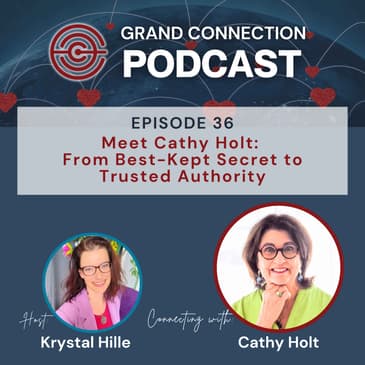
What changes when women stop downplaying their expertise and start positioning it with clarity? Krystal Hille speaks with Cathy Holt about visibility, influence, and the gap between being highly capable and being recognized for it.
Cathy shares how women can identify their strongest abilities, communicate accomplishments without feeling like they are bragging, and focus on their “zone of greatest influence.” The conversation also highlights collaboration as a practical leadership tool, reinforcing the Grand Connection belief that trusted relationships and shared opportunities create stronger, more sustainable growth.
What You’ll Hear:
- Recognizing personal strengths as genuine expertise can shift how women see their own leadership potential.
- Long-standing messages about modesty and ambition can influence how confidently women communicate their value.
- Small changes in positioning can reshape how expertise and authority are perceived.
- Focusing like a “laser beam” helps reduce scattered effort and strengthens clarity around the work that matters most.
- Visibility becomes more meaningful when achievements are communicated in a way that others can clearly recognize and understand.
- Collaboration creates opportunities to elevate other women, share visibility, and support growth without relying on competition.
Featured Guest: Cathy Holt
What if the reason women are being overlooked has nothing to do with their qualifications and everything to do with how others perceive them versus what they are actually capable of? Cathy Holt is a Women's Influence Strategist, international speaker, bestselling author, and host of Holt Talks the Lead. With 40 years across political campaigns, corporate boardrooms, DEI consulting, and the United Nations, her Zone of Greatest Influence™ she helps accomplished women close that gap so they stop being the best- kept secret and become the trusted authority others choose, champion, and pay.
Connect with Cathy:
Email: cathy@catherine-holt.com
Website: www.cathyholt.com
LinkedIn: https://www.linkedin.com/in/catherine-holt-hts/
Facebook: https://www.facebook.com/catherine.holt.56
Instagram: https://www.instagram.com/cathyhts/
Gift: "Why Is She Getting the Call and Not You? This original assessment identifies a leadership archetype and provides your audience an immediate, personalized insight they can't get anywhere else. In 3 minutes, each woman in the room discovers exactly which gap is keeping her visible but unchosen and leaves with a clear, concrete next step. catherine-holt.com/assessment
Meet the Host: Krystal Hille
Krystal Hille is a visionary book mentor, award-winning author, and founder of Hille House Publishing. She’s guided hundreds of leaders, coaches, and purpose-driven entrepreneurs to reclaim and integrate their lived experience, transforming fragmented insight into coherent expression and embodied thought leadership through writing. With 30 years in leadership, a BA (Hons) in English, and a background in theatre, NLP, transformational coaching and tantra, she helps clients turn their wisdom into impact.
Connect with Krystal:
Website: https://hillehouse.org/
LinkedIn: https://www.linkedin.com/in/krystal-hille/
Connect with Susan and the Grand Connection Community:
Website: https://grandconnection.ca/
Facebook Group: https://www.facebook.com/groups/grand.connection
Facebook: https://www.facebook.com/GrandConnectionCommunity
Instagram: https://www.instagram.com/grandconnection.ca/
LinkedIn: linkedin.com/company/66749100
Youtube: https://www.youtube.com/channel/UCxq03yde7nb57HKV1hhztYA
Lead Magnet Workbook https://grandconnection.ca/lead-magnets-guide-workbook/
Access your Grand Growth Bundle and Free Guest Pass: https://grandconnection.ca/gifts
We are proud to have Grand Connection Podcast on the High Vibe Podcast Network. Grab your free gift from Susan in our Our High Vibe Gift Vault.
Love this show? Check out the other shows on the High Vibe Podcast Network.
Share the Love
✨ If this episode lit something up in you… tag us on Instagram @HighVibeLeaders and let us know your biggest takeaway!
🦋 Don’t forget to rate & review — it helps us reach more conscious rebels like you.
🔊 Listen & Subscribe
🎧 Spotify
Welcome to the Grand Connection Podcast, your home for grand growth through collaboration. This is your space to connect, create, and collaborate in a community of heart-centered entrepreneurs and change makers. Hosted by our community, this podcast brings collaboration to life. You will meet members who share their wisdom, offer insights and practical tips, and even interview each other. If you're ready for more clarity, stronger connections, and better results in your business, you are in the right place. Listen in, connect with us, and be part of something grand.
Krystal Hille:And now and welcome to another Grand Connection podcast. My name is Krystal Hille. I am one of the members of the Grand Connection and help entrepreneurs write and publish their business books and transformational memoirs. And today I have with me the amazing Cathy Holt, who is a women's influence strategist, international speaker, bestselling author, and the host of the Holt Talks the Lead. With 40 years across political campaigns, corporate boardrooms, DEI consulting, and the United Nations, her Zone of Greatest Influence (TM), she helps accomplished women close the gap so they can stop being the best-kept secret and become the trusted authority that others choose to champion and pay. Kathy, welcome to this conversation. I'm excited to find out more.
Catherine Holt:Oh, thank you so much, Krystal. I I'm so thankful to be here with you, and I just I love being part of Grand Connections, and I've met so many really fantastic people, and now I'm meeting you, so I'm very excited.
Krystal Hille:Wonderful. Now I I know that you lead with a question because women's work is something that is very dear to my heart as well, and you ask, what if the reason women are being overlooked has nothing to do with their qualifications and everything to do with how others perceive them versus what they're actually capable of? And I'm sure there is a story behind that question that I would love you to share with us and unpack.
Catherine Holt:Yes, absolutely. I've like you just said, I've spent 40 years in a lot of different environments, spaces, many of them very testosterone-laced, and I've learned, you know, I've I've just seen so many women that have been passed over, ignored, you know, asked for their input and then then dismissed, and and they're always capable, very gifted women. And so, what I have learned is so many times we as women do not, we don't position ourselves as the experts we are. Just a little bit, just one thing I I often say because it's so true for so many women is, you know, I will meet a woman and I say, Oh my god, you're so good at that, and they go, It's nothing, you know, everybody does it, and you're like, No, you don't get it. That is a gift you have that that makes you a leader, and you need to share. And so, that's really where I have my focus is on one, helping women understand their strengths, and then secondly, positioning themselves so that everybody else knows about them so they're not like you said the best-kept secret.
Krystal Hille:Yeah, athy, why do you think it is that women always downplay their strengths? Men don't seem to do that. And so with your expertise and your experience, I'm curious if you've identified any patterns or why why women constantly underplay themselves.
Catherine Holt:Yeah, I taught women and gender studies at the university level for for quite a few years and, you know, so I have delved into this very deeply and throughout my 40 years, and I've really researched it to some extent. And I think there's a portion of it that's systems, and there's there's a portion of it that's us. And the portion of it that's systems is, you know, I tell the story of when I was 10 years old, I I told everybody I was going to be a neurosurgeon. I really didn't know what it was, but I was fascinated by the brain and I knew they worked with the brain. And so many times, I mean, I told everybody, neighbors, teachers, people in the grocery store, you know, and but everyone would go, Oh, that's so cute, honey, but that's not for girls. So we were getting those those messages that, and I I took it as, I'm not good enough. So we get those messages and they do affect us whether we really, you know, want to admit it or even acknowledge it. You know, it affected me because I went on to prove people that to people that, No, I am good enough. You know, and I went through so many different iterations of careers. So there's that part of it that's systems, those messages that we constantly get whether they're direct or just kind of in the air around us, we hear them. But then there's also the part of us where we allow those to become our limiting beliefs. You know, like one of the things I grew up with was, Girls don't brag. So, it was really hard for me to break out of that and say, I'm not bragging, I'm just telling people what I do and what I'm good at. That's not bragging, you know. And guys don't hear that. Guys never hear that. They never say, Oh, you're bragging, that's terrible. You know, I think there's there's a part of it that's the systems part of it, but there's also part of it that we've allowed ourselves to believe so that we keep perpetuating it.
Krystal Hille:Mm. Do you feel that there is a generational component that comes into this as well, like our generation or like the older generations have had that embedded more so than perhaps currently younger people in their 20s and 30s?
Catherine Holt:I do think it is somewhat generational, but I will have to say I have a daughter who's 40, and I know that there are times that even though it's not maybe as direct in the comments to her than what maybe they were for my generation, there it's still I mean, you just just look at advertisements. You look at especially nowadays with internet and everything like that and what you're supposed to do as a woman, what you're not supposed to be doing. You're supposed to be sexy, but you're also supposed to be a, you know, a CEO and, you know, they get these mixed messages. So I think some of it is still there. And then when I taught women in gender studies in the university, there were still they weren't as brainwashed as maybe we were in older generations, but you could still feel that tension between what am I supposed to be doing, how am I supposed to present, you know, am I supposed to look gorgeous, and, you know, but at the same time be brilliant. And so there was always that tension. It's still there. I don't think it's to the extent that, obviously, for my generation, I'm I'm much older than the the the students I taught, so, but I do think it's still subtly there. Yeah, and I I really resonate with: Am I meant to be pretty and sexy, or am I meant to be intelligent right now? Which one Which hat do I have to put on? It's almost like we have to split our identity into either being one or the other. So yeah, I I That makes a lot of sense to me. You know, and you know, at the university where I taught, that there were there were sororities and there were fraternities. And so that brought up a whole different dynamic of, you know, they might be brilliant in class, but then they had to go back to their their living situation and, you know, primp for parties, or, you know, so it still is a dichotomy that I But I do I do think there's some pressures there and some tension.
Krystal Hille:Now, you've once been told by a communications consultant that you were scary. What happened, Elle? What did that moment teach you about how women navigate power?
Catherine Holt:Well, yeah. You You refer to a time when I worked in politics in Texas and I I really worked a lot with the Medical Association on women's issues and patients rights. And they, since I was doing a lot of work in the legislature, they brought in a consultant, a communications consultant. And luckily, she was a woman, so she could really understand me better, I think. And after interviewing me and kind of following me around, she said, Oh, Kathy, do you really want to do this? And I said, Well, yeah. I wouldn't be here if I didn't want to have an impact and do this. And she says, Well, then you've got to learn a few things. And I went, Really? Okay, I'm I'm willing to learn. And she said That's when she said, You're scary. And I said, What? And she goes, Well, these were her words. You're tall, you're good-looking, you're articulate, you really know your stuff and talk about them, and that can be scary in this testosterone-laced world. And I went, Really? I never thought of me. You know, cuz I even was thinking, you know, I I was kind of low person on the on the the learning curve, I guess you could say, for this organization and and the lobbying and and advocacy I was doing, and I thought I don't feel scary. Sometimes I feel scared. So, but she told me that, and I went, Wow, I didn't know I that was so terrifying, those those traits. And so she gave me a She gave me a kind of a a lesson on how to present myself or position myself a little differently so I could be more effective and more influential. And she said And it was something simple, but I just never thought of it. She said, Sit down when you're talking to the legislators because when you're lobbying and in the in the middle of a, you know, the the Capitol, you're sometimes just meeting them and, you know, talking in the halls. And she said, No, have them sit down. Have them talk to you. That way you're eye to eye. There's no, you know, height differential. It softens and and
Catherine Holt:changes the power dynamic, so that that they don't feel I can't believe I said it. threatened. And I'm like, Okay, I won't threaten them. So I did that. I became so much more influential. I really had a much greater impact. That one little thing. But I have to say, I also learned that when somebody was not taking me seriously or dismissing my ideas, or not really recognizing what I brought to the table—the capabilities, the the information— I stood up and shifted that power dynamic back to me.
Krystal Hille:I love that. So how how do you see that applying to the women that you're working with now? Like women in business, how can they apply some of these principles that you've been taught into how they come across?
Catherine Holt:Well, I think what it what really it taught me was that it's all about how you position yourself, how you present. And the first thing I work with when I work with women is really recognizing their strength. Like I said just earlier, you know, oh, we we think everybody can do what we can do. Well, no. Those are gifts. And first we so we really talk about and hone in on their gifts and what they do best, what they're exceptional at. And then we start talking about and learn I help them learn about how to position themselves like me sitting down. I mean, sometimes it's that simple simple, sometimes it's not. Sometimes it's a little more complex. But how to position yourself so everybody knows exactly the brilliance you have and bring to the table, so that what people perceive is exactly who you are and what you do. Because sometimes there's a disconnect. You know, people might sort of know you, or they might sort of know your business. But once again, we don't brag so much. So, we're not always out there telling people what it is we're brilliant at. And once they have that, those two understandings, I really am so adamant, I guess you could say, about using that as your decision-making lens. Doing, I mean, making all your decisions around what do you do that is great, what transformation only you can provide, and staying with it and building on that, not doing more of these shiny little things all over the place that you grab at, but really focusing in on that. I say in in when I talk to women, it's kind of like this this analogy. A lot of women operate like a flashlight. You know, they kind of all over their their light goes to all different things that they do, and they do them well, but but it's just dispersed. But women who really are getting the opportunities, getting the clients, the premier clients, being paid what they worth, they operate like a laser beam. They know exactly what they're brilliant at, and they stick with it,
Catherine Holt:and that's what they provide their clients, and that's what they do the best, and that's where they get the results.
Krystal Hille:Yeah, we can, yeah, the shiny object, right, that that women constantly searching for, oh, maybe if I do this, because that woman does it, so I can do that, too. Maybe that, because it works for her, but it then doesn't actually work for us because we're not the same, haven't got the same strengths as that other woman. So, I love that. It's become the laser beam. So, you're crystal I like I use that word all the time. Crystal clear. So, you become crystal clear on what it is that you're good at, right? So, that's the first. Yes,
Catherine Holt:exactly. Exactly. And and owning it because like I said, you know, don't say, Oh yeah, everybody can do that. No, this is what you do exceptionally. So let's stay in that lane and build on that so that you're not because it's not about working more, it's about working in that zone. And I call it the zone of greatest influence, you know, where you're working on those things that that you're brilliant at.
Krystal Hille:What is your laser focus? What is your laser beam if you could put that in one sentence, and I'm putting you on the spot, but I would love to have an example. And
Catherine Holt:Well, my laser beam is really supporting women in that journey of becoming that laser beam. I mean, I've always said my mission is to create a a movement of women who can be very impactful in the world and they stop being the best kept secret in the room and they become the people that the women that that everybody wants to work with, that they're no longer ignored, they're no longer talked over, they're no longer dismissed, that they become the person that is known for the best thing they do and they go out there and they change the world. Yes. Yeah, absolutely. Now, you have worked in boardrooms,
Krystal Hille:legislative chambers, international UN meetings, and international businesses, and I'm just curious if there's one thing that you noticed is true for women, no matter what field they're in.
Catherine Holt:I'm trying to think how to put this because basically, in every place I've I've worked, I've just noticed the same thing about capable women not being acknowledged for how great they are, and so I think that one of the things that really I just really focus on is making sure that doesn't happen. Nobody should, no woman should be deniable. I mean, we're just there's just too much, too many capacities that we have. I mean, I talk to women, I say, Do you do your family scheduling? You know, if you have kids, you have a husband, you have everybody has their activities, and they go, Well, yeah, yeah. And I said, That's a leadership skill. Those are the skills that are needed today in this world. The leadership paradigm has changed. It's not the old curmudgeon in the office yelling and barking orders. It's the person that that can read the room, bring out the best in people, that can create teams that communicate well. Those are all things we're great at. And so, you know, throughout all these different places I've been, I just encourage women to to shine, to absolutely own it and step into it. That they're leaders. Yes,
Krystal Hille:and it's about owning the unrecognizable traits that we just take for granted because we just do it, but really thinking, well, hang on, what is the transferable skill here that this is teaching me that I can bring into my business? Because I work a lot I work with a lot of women who come from corporate and then they want to write a book, and they say, Oh, I've only done this for one year. I'm like, well, but you're bringing 30, 40 years of life experience into what you're doing now, so how do we how do we bring that out and communicate that? Right? And I think that's what you're sharing. It's like figure out, take some time to really find these intangible qualities that you're brilliant at, right?
Catherine Holt:Yeah, because, you know, I work with women in corporate, I work with entrepreneurs, and the the basic the the concepts and the tenets of what I work with are the same: that one, you know, you want to make sure people know what you're great at, and two, you position yourself so they really recognize that. And the the messaging might be different for corporate, because it might be the say it's the woman that's middle management and she does a really great job at what she does, and they say, Oh, she's good at that, so we're not going to put her over here or promote her, because they only know that part. You know, I I have a a a person I know, a woman I know who I've worked with, who she worked in corporate, and she was given she was really good with people, so she was a a an upper-level manager, and she was given given departments to run and did it very well. You know, really got the best out of her people, and they really produced. And she went up for a promotion as a senior VP. Let me backtrack a little bit. So she did so well, they gave her a department that wasn't performing well. It was in the negative, and within a year, she It wasn't the best department in the world, but she brought it from negative to positive and improved it significantly. But when she went up for the VP position, they they said, Well, your numbers aren't as good as they need to be. Yeah, I know that expression. And she was like Look, you
Krystal Hille:need to look at where she came from, right? Not where she is now.
Catherine Holt:Exactly. And so they gave it to to to the guy, and what they didn't take into account is what she did with that with that department that was failing, that was now doing very well. And what we find in corporate is that women are often—and this is in studies, this is just not my observation—that women are often evaluated on achievement, whereas men are evaluated on potential. And yeah, it was a McKinsey study that brought this out. And so, once again, we go back to that: some of it's systems, some of it's the person. She didn't know how to let them know what incredible achievements she had made with this department. So, you know, they they didn't take that into account. But that happens that happens in corporate, and so even working with women in corporate, it's how do you make sure everybody knows what you are doing so well that it your your strengths and your your brilliance is undeniable?
Krystal Hille:I can hear a lot of people in the listeners saying, Well, but how? I don't want to brag. Exactly what you were saying in the very beginning. You know, I I don't want to How do we as women What would be one tip that you can give of how can we as women position ourselves and calmly state our brilliance and our accomplishments in a way that it is understood and not being seen as scary?
Catherine Holt:Yeah, and that that is a that's a tightrope we have to walk. I'll be very honest with you because, once again, you know, if we talk too much about ourselves, then, you know, there's all kinds of words assigned to us in in all worlds. So, and you know, and that's really what I I work with women on achieving, because, and I think what what I say to women is, once you know your strengths, once you know what you're really good at, and what you're doing well, we can learn for you to present it in such a way that you're talking about achievements, you're talking about things that you've done, what you've accomplished, and there's a way to do that without saying, Oh, I'm the best at that because I did such and such. You know, that that's very different than than, you know, kind of me settling subtling sitting down versus standing up. So there's strategies to do that, and I think really, working in politics for as long as I did, I that's that's one of my sweet spots, is is absolutely. I have a client that I worked with in Africa, and she was brilliant, cause I work through the UN, United Nations, and through several NGOs with grassroots women's groups around the world, and this one woman, she was the go-to woman in her community. And so many grassroots women are confronting everyday problems that affect their lives, their livelihoods, their families, and finding solutions—brilliant, creative solutions. And she was doing that within the care economy. She created in her little village, you know, a whole maternity service, community and hospital, because women were either giving birth or dying, and their or their baby dying on the way to the hospital that was a couple miles away, And they couldn't get there because, you know, she saw one woman trying to get there in a wheelbarrow—her friends trying to get her there in a wheelbarrow. Yeah. So she created this whole thing at home, and she was she was just the go-to in that community because she was
Catherine Holt:a doer. She got it done. She was an implementer. And when I worked with her, we I showed her, and together we worked on how recognizing all those strengths, those skills, those things that she was doing really needed to be elevated so that they could get some funding, so that they, you know, could get an ambulance, which they did, so they could get support. But then we also took it a next level, because her knowledge and her experience, her lived experience, made her an expert in caregiving. And eventually we worked her way up through her, you know, her national, her regional, and even into the global stages. And she is now one of the go-to women, grassroots women, for the care economy and care services on the UN stages. She's invited constantly to speak about it because, you know, so that they can influence policy, so that they could their ideas can can make a difference on a global level. And, you know, that's what we need to do for women. We need to open those stages and and encourage them to step onto them because they're brilliant at so many things they do.
Krystal Hille:It's a great example that you're sharing. Thank you. And I'm inviting everybody listening to seeing, Well, where how does that apply to you, that example of, you know, what what do you actually do in your day-to-day life, in your day-to-day business, that you can elevate and talk about in a new way, so that you It's about a confidence, an inner confidence as well that we strengthen once we really see what we actually do, right? But I do want to go on to collaboration because we could talk about this forever. This is such a great
Catherine Holt:I know. I love You can tell I'm so passionate. But
Krystal Hille:I want to just because Grand Connection is all about collaboration, so I'm curious to hear: How does collaboration feature in the work that you're doing? And if there was one tip that you could leave people with of something that works really well for you and your business around collaboration, what would that be?
Catherine Holt:Well, I'm obviously, you know, that's key. Collaboration is key. No man, you know, that whole thing, no man is an island, no woman is an island, you know, we we definitely need to support each other and work with each other. And when we see an opening that maybe we can't fill, we bring in somebody that we know can. And you know, I give a just a small example, but it is sort of collaboration on a smaller scale. You know, many times I know women are in meetings where they'll say something, and it doesn't matter if you're working, you know, locally or, you know, in a corporation. They'll say something, and it just kind of like passed right over, and then somebody else will say it, usually a man, and everybody will go, Oh, that's such a good idea! Well, I have taught women, so many women, to saying, when that happens, saying, Oh, let's say John. John, that's so I'm just so thrilled that you agree with Greta about her idea, because it's that's collaboration. It's on a very small scale, but it's it's it's lifting up each other in what we do. And on a larger scale, just whenever we well, for me, for example, I meet so many women, and they might say, Oh, I really need to get my message out. They need more visibility. And you know, my saying is, visibility opens doors, but influence creates change. But you need that visibility portion. So they might say, Well, I I really need to get out and be able to talk about that this. So I'll say, Okay, let's look at some of the podcasts you can get on, like this. Let's look at some of the stages you can speak on. And so that we we help each other and work with each other in these collaborations, because there's plenty. It's not a zero-sum game. It's not like if I have a bigger piece of the pie, you have a lesser piece of the pie. There is plenty for everyone, and each of us have our unique experiences and are experts in those experiences, so that gives us a unique perspective, and all those
Catherine Holt:perspectives are needed. So that's where collaboration comes in, and it's essential, I think, to
Krystal Hille:Yes, thank you. So it's not about coming from that old paradigm of competition. It is about broadening the perspective that everyone has a unique contribution to make. Yes,
Catherine Holt:yeah. And I've been in a lot of collab like this book over here is actually a collaboration of 262 women who, you know, all have worked hard at making change, and it's called The Mission Accepted: 262 Women's Book, and it's got a much longer title, title, but that's kind of the essence of it. And, you know, I wrote the foreword, but I also met so many other women that contributed to it. Our saying is, collaboration, not competition, because there's plenty of work, there's plenty of change that we can make if we support each other. And we have supported each other through so many different activities, projects, summits, just because we know it's that old quote, and I always butcher it. But, you know, when one we we need to lift all boats at the same time, and that was totally butchered. But you know, you get the concept.
Krystal Hille:Oh, I wonder, yes, I haven't got it either.
Catherine Holt:I know JFK said it, but I don't remember the exact words.
Krystal Hille:Yes, yeah, they all right. We need to rise together. We lift each other up, right? Yeah, yes,
Catherine Holt:Exactly. Exactly.
Krystal Hille:Thank you, Cathy. Thank you so much for this conversation. If people are curious to learn more about the work that you're doing or get in touch with you to collaborate or work with you, how, what's the best way of them finding you?
Catherine Holt:The best way is really just either reaching out to me on my email, and I'm imagining you'll put that in the notes, or on my website. I'm very receptive and love to communicate with with people and women all over the world because I learn and I really get to expand my knowledge. So I did want to mention one thing about collaboration. One of the ways that I just kind of I guess signed on to in my life is to raise, to give women platforms and, you know, to collaborate and bring women in, is I'm executive producing a TV show. And it's on a streaming network, and it's called Holt Talks the Lead, and I'll just be interviewing women leaders for their stories, their challenges, how they have have navigated their worlds and what messages they can give other women to inspire them and motivate them. So once again, that's a collaboration. It's it's I'm learning a lot and doing a lot of work to move into this new world that I never imagined myself in, but it's so that I can bring other women in. Beautiful, yes. I'm sure you'll get some people saying, Can I be interviewed by you? I have a story to. Oh, I'd love it. Do reach out to me.
Krystal Hille:Wonderful. Well, thank you so much, Cathy. It's been such a great conversation. We could have talked for a lot longer, but people can reach out to you, and that is me signing off for the Grand Connection, and happy collaborating. Bye, everyone.
Catherine Holt:Thank you, Krystal.