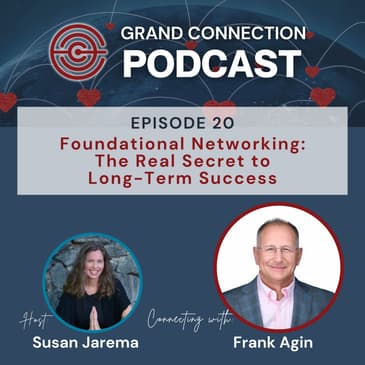
Business growth is built on relationships, not tactics. Susan Jarema continues the conversation with Frank Agin, exploring how presence, altruism, and integrity shape meaningful connections and create the foundation for lasting referrals.
Frank Agin emphasizes that trust is earned through consistent actions, generosity, and reliability over time. The discussion reflects the Connect, Create, Collaborate framework, highlighting that sustainable growth emerges from shared trust, thoughtful contribution, and relationships that are strengthened through intention rather than transaction.
What You’ll Hear:
- Relationship-driven networking shifts focus away from tactics and toward how people consistently show up over time.
- Trust is built through small, repeated actions that signal reliability rather than one-time impressions.
- Presence shapes how others experience someone before any business conversation begins.
- Altruism reflects a natural human tendency to support others and strengthens long-term connection.
- Integrity becomes the deciding factor in whether relationships translate into real collaboration.
- Generosity is most impactful when directed toward those who also support others.
Featured Guest: Frank Agin
Frank Agin is president of AmSpirit Business Connections, which empowers entrepreneurs, sales representatives, and professionals to become successful and gain more referrals through networking.
He also shares information and insights on professional relationships, business networking and best practices for generating referrals on his Networking Rx podcast and through various professional programs.
Finally, Frank is the author of several books, including Foundational Networking: Creating Know, Like & Trust For A Lifetime of Extraordinary Success and The Three Reasons You Don’t Get Referrals. See all his books and programs at frankagin.com.
Connect with Frank:
Website: www.frankagin.com
LinkedIn: https://www.linkedin.com/in/frankagin/
Meet the Host: Susan Jarema
Susan Jarema is a marketing strategist, internetologist, and co-founder of The Grand Connection. She helps entrepreneurs grow through collaboration, smart strategy, and high-impact digital presence. Susan is also president of New Earth Marketing, where she builds brands, websites, and ecosystems designed for real growth.
Connect with Susan and the Grand Connection Community:
Website: https://grandconnection.ca/
Facebook Group: https://www.facebook.com/groups/grand.connection
Facebook: https://www.facebook.com/GrandConnectionCommunity
Instagram: https://www.instagram.com/grandconnection.ca/
LinkedIn: linkedin.com/company/66749100
Youtube: https://www.youtube.com/channel/UCxq03yde7nb57HKV1hhztYA
Access your Grand Growth Bundle and Free Guest Pass: https://grandconnection.ca/gifts
We are proud to have Grand Connection Podcast on the High Vibe Podcast Network. Grab your free gift from Susan in our Our High Vibe Gift Vault.
Love this show? Check out the other shows on the High Vibe Podcast Network.
Share the Love
✨ If this episode lit something up in you… tag us on Instagram @HighVibeLeaders and let us know your biggest takeaway!
🦋 Don’t forget to rate & review — it helps us reach more conscious rebels like you.
🔊 Listen & Subscribe
🎧 Spotify
Hello everyone, and welcome back to the Grand Connection podcast. I'm your host today. Susan Jarema, today's conversation is one I'm especially excited about because the ideas we're discussing is so aligned with the values we talk about here at the Grand connection most people think networking success comes from mastering techniques, having the perfect elevator pitch, or learning clever strategies. But according to my guest today, the real secret is much simpler. It's about consistently building relationships based on know, like and trust. This episode is part two of my conversation with Frank Agin and for those of you who have not met Frank yet, he is the president of am spirit business connection, an organization that helps entrepreneurs and professionals grow their businesses through referrals and strong professional relationships. Frank is also the host of the networking RX podcast and the author of several books on networking and relationship building, including the three reasons you don't get referrals, that was what we did last week, and foundational networking, which we're going to talk about today, and I'm going to hold up right now for those watching the video, yay. In part one, we talked about Frank's book, the three reasons you don't get referrals, and explored some of the common mistakes people make when asking for referrals. If you haven't heard it yet, it's definitely worth going back and listening to part one of this conversation today. We're diving into another one of Frank's books, and one that I really love, foundational networking, building, know, like and trust to create a lifetime of extraordinary success, Frank, welcome back. Yeah, yeah. It's great to continue the conversation now, one of the things I really appreciate about your work is how these two books complement each other. In the three reasons you don't get referrals, you focus on the practical side of referrals and messaging, helping people
Susan Jarema:understand why their networks may not be referring them what's not working. And in foundational networking, you step back and focus on something even deeper, the relationships themselves and how consistently building know, like and trust creates the foundation that refers naturally, that referrals naturally grow from. This is also something that is very important to me. Personally, in the grand connection community, we've been exploring the neuroscience of connection through our Self Mastery program, looking at how trust, presence and awareness shape the way we build relationships and collaborate. So many of the ideas in your book align beautifully with that work, because at the end of the day, real business growth happens through human connection. How do you see these two books working together when it comes to building strong relationships and referrals.
Frank Agin:Well, the book we're going to talk about now foundational networking. That was my first professional development book, and it really kind of sets the, well, it's foundational, right? It's just you need to have a relationship. And so when you when you contrast that with the three reasons you don't get referrals, that's really the first pillar, the first reason why people don't get referrals, they don't have that relationship. Foundational networking is really expanding on that first reason. In fact, in three reasons you don't get referrals, I really kind of race through a summary of foundational networking and the things I talk about
Susan Jarema:in in the whole book. This is the one that's the relationship part of it all. Yeah, of course, the other one, relationships is important part. But you kind of this is, this is the deep dive. So you could almost say, start in the when you go to the first section of your other book, jump over foundational labor. Yeah, you're not getting relationships. Something needs to be worked on in this area.
Frank Agin:Yeah. Well, in the genesis of the book was, I've been in networking, probably for and when I say in networking, been out networking, been running what is now am spirit business connections for 10 years. And a lot of people suggested, need to read this. Need to read this. And there were a lot of there were a lot of books out there that were very, what I'll call tactical, with respect to networking. Go to an event. Go here, stand here, you know, firm handshake, all those things, and it's like, okay, okay. Those are, those are nice. But I know people who can do all those things, and they struggle, and then I know other people
Unknown:who are hor, are
Frank Agin:horrible with all those things, and they're doing really, really well, you know, what's the it? It can't be the it can't be the tactics and the strategies that matter. So I really thought about it for a couple of years, and it's like, yeah, it's, it's really all about the relationships, and that's, you know. So when people talk about networking, it's, you know, build your build those relationships, right? It's, that's what matters most. And know, like and trust is. That's not my terminology. That's, that's really kind of academic speak for, for networking, getting people to know like and trust you. And so that's what I really started to. Think about, okay, what is it that? What is it that gets people to like us? Yeah, what is it that gets people to or get to know us? I guess, what was taking people like us and then, you know, really diving into what trust is. It was the whole genesis.
Susan Jarema:We have a whole section on trust in our community, where I in part of, you know, our when I onboard people, when we in our program here, and building that trust isn't something that's going to happen overnight, once in a while, once in a while, somebody will do something amazing, and they just, there's sort of a very quick connection. Maybe you both grew up in the same town, and you got that connection, and you had, you know, there's somebody or somebody, what increases trust, I think, is if somebody you know like and trust refers someone else to you that they know like and trust in and there's you've already got that person validating you, which is why referrals are so so so powerful. Well, this book is, to me, a practice. It's like a life practice, really, when I read it and I look through it. And for those here, it's you put it together very nicely, like you, you've got the three, well, I'll get you to talk a little bit about the three elements. But under each element there are all the you've broken them down into there, and then you have little activities in there. You've got things we can think about like that. We can go away with after, after this chapter. Like I almost think you almost want to work on one thing at a time. Possibly, yeah,
Frank Agin:it's like, when I wrote the book, I took two years to write it. I would come into my office every Monday and turn off everything and sit and work on it, right? Some days it would be just one page. Some, some Monday, some it would be four or five, right? But over time, two years, I had it done was 360, pages. I put it in three ring binder and gave it to different people to look at. And there's a friend of mine, John millon, invited me to lunch. He had it. He had red ink over everything. He says, I really like you, Frank. I really do more or less I had to rewrite the whole thing. Not rewrite it. Well, you know, he just said, you know, you buried the lead because I would, I would start with stories, and then the last part, I would talk about the lesson. And he said, flip it around the lesson first, and then make the stories kind of a, you know, so he's really kind of the architect behind set it up this way. And at first, I'm like, Oh my gosh, I just spent two years. And he's like, won't take that long. It really won't take that long. And it didn't, but it did make it a better book.
Susan Jarema:Now with AI, you did this before
Frank Agin:AI, right? Oh, yeah, yeah, yeah, but, but I had a word processor so our computer, so it was horrible.
Susan Jarema:So the book has three elements that shape how people experience us. You want to tell
Frank Agin:us about them? Yeah, the three are presence, altruism and integrity. And really they align with, know, like and trust. You know our presence. That's where people determine whether they're going to you know how they know us. You know how we how we present ourselves to the world, and the the like and altruism, you know, are we predisposed to giving to the world around us? And that's really what people look at. And I really didn't know a ton about that until later on, and I talked about that in the three reasons you don't get referrals is that it's we are hardwired to help one another, which just it's part of, it's part of how we have evolved as humans. And then the last piece of it is integrity. And I look at integrity and reliability. There's a lot to integrity, yeah, so I really kind of delve into that. But if you know, if you have the first two, if you know you've got a strong people know you and like you, but they don't trust you, you're done. You're and there are people in my life that you know. I know them and I like them, right? Let's go have a beer. I want to do
Susan Jarema:business with you. They're good for going to the pub. That's it, yeah, that's it. You know, I don't, I can't make out some great stories and funny things that there's a lot, usually a lot of drama in there,
Frank Agin:yeah, yeah. So those people exist, you know, there certainly people we know that we don't like, but there are people we know and like. And you know what, I just don't trust that person so well.
Susan Jarema:And a lot of it stems to reliability in business, someone you know, can it show up and get the thing done on time that they say that they're going to do?
Frank Agin:Yeah, well, I tell people I talk about in the book, I say you take any number times zero, and it equals zero, and it's the same thing with reliability. It's like you you I don't care how. I don't care if you pulled 50 kids out of a burning bus, right? I mean, if you're just not reliable, then I've hammered this home with my kids. You're either 100% reliable or you're just not reliable. If you're 25% unreliable, I don't know when that 25% is going to rear its head. To rear its head, so it just goes to zero. And so reliability is huge,
Susan Jarema:yeah, no, it definitely isn't. It changes how you you engage with people. There might be certain things you can do with them, but you always have to have that black backup plan in place, right? Yes, yeah. So you also have. An assessment in there. I don't even know if you remember, but I liked it. Okay, yeah, so page 70 in here, there's an assessment. So that's another great way. Like, I like it because I'm I'm always trying to educate myself and for people, but assessments tell you where you're at. So I think that that's a really good idea for having it in there. So, you know, you ask questions like, you know, are you impatient or relaxed? On a scale of one to 10, one impatient on the one side, flexible or rigid, spontaneous or planned, introverted or extroverted? What do you mean by introverted? Because I know we have a lot of introverted people in our community. Does that make a difference? Is that just understanding yourself? I think it's more, it's
Frank Agin:it is more just understanding yourself. Susan, I'm an introvert. I will go home after this. I'll sit on the come my wife will be there. She's introverted too. We'll just kind of sit we'll hang out, we'll watch hockey or whatever. Introverts are people who recharge alone, right? Extroverts recharge around other people. That's a simplified definition of it.
Susan Jarema:So I don't know, like, I guess I'm kind of in the middle, because I definitely get exhausted after certain things. Like, I'll be just so tired. Yeah, no, but I do, I do get I do enjoy, like, when we have an event and I'm around all my community, it does energize me. If I come in there feeling a little down, I'll be around all of the people that I know, like and trust, and I just feel happy afterwards. Yeah, it does wake you up and stuff like that. But I thought that that assessment was a good one. I didn't read it all. Everybody listening, so you got to get the book if you want to finish the assessment. And another thing that Frank did really well is he put a summary at the end. You know, before the world of AI, where you could just ask AI to do the summary for you, there's a summary there, which is a really nice way that you could, I think, go through the summary and then go back and work on the chapters you want to work on in your life and do the assessment. It's kind of like a work workbook for yourself on how to become better with other people. And that's kind of what we do at our our neuroscience of connection course is really learning, well, in that one, it's a neuroscience course. So we're learning how the brain works, so that we can understand ourselves, the self mastery of the brain, so that you can be more able to regulate, self regulate yourself in communications. Because really, our world is about connecting with other people. That's how we do business. That's how we you know, we have a family. We go and do all the things you know, even going to the store, you're connecting with people all the time and and knowing how to be able to communicate in a better way helps us. So I really loved how this book resonated with me. I thought it was a very good book. Thank you. And you know, as again, people that are listening, you probably heard our Connect, create, collaborate. First, we connect and build relationships, then we create
Susan Jarema:value and trust opportunities, and eventually we collaborate through introductions, referrals. Frank is all about referrals and partnerships. And so when I read your book, it felt like there were strong parallels to this progression. I know we talked a little bit about this in the in the previous episode, based on your extensive experience in networking and referrals, what does the journey of building a strong professional relationship actually look like over time? So, just so people that are new to this, how would they feel it going through their time when they're
Frank Agin:Yeah, you know, it's, I talk to a lot of people about a lot of things, and it's, well, let me put it this way, God gave us one brain. He didn't give us a special brain to be in business. It's one brain, right? And so when people, you know, geez, I don't know how to operate in business, you know, it's like, Listen, you are a wonderful family man, or, you know, family woman or business woman, or however you want to put it, you're wonderful. You're wonderful with your family. It's the same thing. You know, you're building those relationships. And you know, I'll talk about dating, right? You didn't go out on a date and ask your wife to marry you? Did you? No, you know, we did. We dated for whatever, nine months, two years, you know, then here. Sometimes, yeah, yeah. I mean, yeah, right. It can be a long time. And business is the same way. It just it takes time. Sometimes it clicks, but it never clicks right away. And so it is. It's kind of getting a sense as to what the other person's about. We're testing each other in a very subtle sort of way. We talked about reliability. Is this person reliable? Are they not reliable? You know, I need, I need to know, and you're going to find those things out. And you know, we do test we do test each other. Okay, they're going to be at time for the are they gonna be had time for our call, right? You know, are they gonna, are they gonna show up? Are they gonna cancel last minute? Okay, things happen. Happens twice. You start to see a pattern. It's like, all right, it's, you know, I'm done with that person. Same thing, you know, dating world or the business world. So you're kind of, you know, moving through, you know, and you. You've connected, and you know, then you're kind of building that, you know, building that relationship, if you will. And then from there, you could using your term, okay, we can collaborate. I trust you enough to know that we can do this program together, and you're not going to try and
Frank Agin:outshine me or contradict me, or, you know, steal my clients, or whatever people worry about, yeah, yeah, yeah.
Susan Jarema:Well, especially, and with referral partners too, because sometimes people have overlapping areas. And, yeah, you've collaborated a lot in your life. I guess I've heard it on a podcast. There was a collaboration you did with Lewis, how, when you wrote a book called linked, linked working,
Frank Agin:Yep, yeah, that was years ago. That was technically my third book. I was, I was part of Toastmasters for a while, and he was too. We were in different clubs, and I was at a different club giving a speech, just practicing. And he happened to be there, and he came up to me afterwards, and we just had a nice conversation. He I played college football. He played college football. We had things in common, right? There was just kind of this bond. And as we were talking, and he shares this when he talks about it too, he had a piece of poppy seed cake in his hand. Now his arm was broken, so it was in a sling, and it was kind of propped up like he was a waiter, almost, right? It was the way it was held. It was really kind of odd. And I realized in that conversation that this guy was saving that poppy seed cake for later. He, you know, and I just say, Let's go have lunch, right? So he calls me his first mentor. I had no I had no idea what LinkedIn was at this time, and he got me out of LinkedIn, and he just showed me everything on LinkedIn, how to connect with people. And I pulled out a checkbook and I wrote him a check, because back when I carried a checkbook all the time, I wrote him a check for 100 bucks. He said, What are you doing? I'm like, there's value in this. You should be charging people for this stuff. And so we just start. We really struck up a friendship, if you will. At one point. He said, You I, at that point, I had written two novels and a professional development book, foundational networking. And he said, I want to write a book like, that's a great idea. You should he said, I want to write it on LinkedIn. That's a great idea. You, you know it. You're doing lots of great stuff on there. He's so I want to co author it with you. I'm like me. I just got on LinkedIn. He says, Yeah, but everything you talk about really dovetails with what I talk about. And so the book, which is not in circulation anymore, primarily because it's so outdated,
Frank Agin:LinkedIn, has changed so much, yeah, but the premise of it was, how you operate on LinkedIn, on social media is the same way you operate in the real world. You don't walk into a networking event, pound your chest and say, Hey, look at me. Everybody. Don't do it. Don't do it on LinkedIn, you know. And so that was the that was, we had different there were 10 different sections to the book. So we collaborated on that. I learned a lot from him. He was a prolific promoter, you know, we sold hundreds of books just going to events and, you know, signing and kissing babies. And it was a lot of fun. It was a
Susan Jarema:lot of fun. I he, but his podcast is called the Hall of greatness, the School of Greatness. The School of Greatness. Sorry, School of Greatness. I did one of the ones I follow, besides yours. Yeah, we've talked about you on it as being a great mentor.
Frank Agin:So it's, it's funny when he does. He was on, God, what was your he was on somebody's podcast, very well known. I should remember it, but he told the story, and when that came out, my phone just lit up.
Unknown:Is he talking about you? Is he talking about you?
Frank Agin:Talking about me? I didn't realize that there are people I've known, people I've known for like, five, six years, and they're like, it is you buried the lead you you should have said this right from the beginning. It's like, well, I don't know it's, you know,
Susan Jarema:well, that sounds like a very good collaboration, because he had a skill set that you didn't have, and you had one that he didn't have. And it made a great working relationship. And you were, you were aligned in other values. You had a common interest, sports, football. And you admit you met at a business community or as a business event, Toastmasters, which is, like, the world's largest, yeah, yeah. So you were there, so that you met in that context, and then then started working together. Have you done anything together since?
Frank Agin:No, we haven't. He's, he's big time. You know, he's, he's very genuine. I could probably pick up the phone and text him right now and I'd get a response. A response. You know, yeah, what I do kick myself with is he was suggesting I do a startup podcast all the way back in 2011 2012 like Louis, I don't have time for this, and I ultimately did then in 2018 I should have started sooner than I did, but oh well,
Susan Jarema:I started in 2025 Yeah, you you've been around. Your podcast has been around for like, a long time compared to most. Yeah, no, but I mean, his started so long ago that it's one of the great podcasts out there. It is. Yeah, listen to you talked a little bit about it in episode just before. This is about being of service to other people, and at the Grand connection. We call this grand giving, and for me, it means creating opportunities for others while building a community where everyone can thrive. That's sort of my value of grand giving, and it's generosity with intention and not giving until you're exhausted. So I, you know, I you kind of find that that balance and this kind of leads to Adam Grant's book, give and take I know you've talked about this on your podcast too before, and you know, it's surprising. You know, who are the people who are the least successful?
Frank Agin:Well, the least successful are the according to his book, are can be givers, can be the givers.
Susan Jarema:And then who are the people who are the most successful givers? Yeah, it's a giving stock. You know the answer because you talked Yeah, when I talked to it, when I bring this up in in talks that I do, most people don't know that. They're like, well, it must be the givers might are the do the best, and the takers are the bone are the least, right? And yeah, givers. So givers are people who look for ways to help each other, takers who try to get as much as they can for themselves. So those are the takers. And then there's matchers. And those are people who are trying to look for that even Steven. And you do run into a lot of people like that, although I find it, it's pretty hard to be always tracking, if you were to do that, it's, it's, yeah, kind of a weird way to be in the world that almost feels like, I think a lot of it
Frank Agin:is subconscious, because he says in the book that 80% of the people out there are are matchers, you know? So there, I think what it is is they're almost subconsciously measuring, yeah, do I want to talk with Susan? And you know, what's in it for me? Well, I've mentioned it before about, you know, people reaching out and wanting to talk. I only have 24 hours in a day. I have to have some sort of standard as to what I'm doing. And I want to really lean into the people who who helped me, who, you know, those are the people I want to support.
Susan Jarema:Well, I have to be careful with my calendar. I don't just post it everywhere. I otherwise it would be every moment of the day that had open would be full of people just wanting to meet for meet and greets, which are good, but then I don't have time for the strategic meetings that people have introduced me to people that could be partners, and I love to meet people. I try to send them to the events and get to know everybody, but there is only 24 hours in the day. It's really, really hard to do that. And I wanted to talk to you a little bit because you've been in this area for so long, and you are a giver. And I know we both know Bob Burke, who wrote the Go Giver, or the go every way. And you know, all of his books are about this, you know, being being generous in what you do. But how do you be successful as a giver? Because Adam Grant definitely said there are givers that are successful, and then those the ones that aren't.
Frank Agin:Well, you know, and I don't know that I have all the answers. I'm sure Bob will tell you the same thing, he doesn't have all the answers. You know you have to take chances out there, but the types of people that I want to give to and invest in are the people who are helping other people, not the people who are helping me, per se, but the people who are going to take what I have to offer them and give them to others. And when I try, when I try, when I explain it to people, I use it in this analogy. I use this metaphor or analogy, whatever. If you could dictate who would win the lottery, you can't win it. That's the rule. You can't win it. You have to anoint somebody else with that money. Can't be family. It's got to be somebody else. If you're going to annoy somebody with that money, and they're not going to give it, you know, you want to give it, you know, you want to give it to somebody who's going to not just squirrel it away. You're going to want to give it to somebody who's going to be, you know, I'm going to do lots of things for other people, and there's need in the world, you know, because when they do that, it's going to make its way back to you. And so you're, we want to look for the people who are generous, you know, to do this for it. It's the same thing with respect to referrals or helping people with podcasts. You know, I want people who are going to be helping other people I would. I don't ever keep score, right? I don't want to keep score other than I do keep score that, okay, that person is selfish. You know, if somebody's selfish. They want something for me, it's, I become a matcher, right? Hey, listen, you're, you're not going to share with other people. Then you're going to pay for whatever, some somehow,
Susan Jarema:yeah, so, um, what about boundaries? Like, you have to have some boundaries, right?
Frank Agin:Yeah, yeah. But you do. I don't know that they're hard and, you know, it just it depends. I mean, I know people. I know people who are like somebody's lost their job, right? They're a taker. They've lost their job. It's easy to be spiteful towards them, but they got a kid, they got family. You know, I can't I can't fault all of them. And you know what? I need to contribute to the world. I'm not perfect, so, you know, I'll help them. But I've run into people like that, and they're in their third round. It's like, you know, rich, come on, you know, we keep having this. This is like the movie Groundhog Day. We keep having the same story over and over and over again. I know, I'll change, you know?
Susan Jarema:Yeah, well, and that's why your founding. Traditional networking is a really good book to for them to go through those exercises, start learning how to be different in the world and how it will impact, you know, the way people see them. And they're like, Oh, it does, yeah, it does, yeah. So oh, this is like, I'm struggle on this area of being too much of a giver, because I only have so much time as well, and I, and I sometimes will get run down myself. And as a parent, you kind of go through that as well too, you know, because you just get and listening to your children, especially when they're young. And you have to have a time where you, you know, you do start setting a few boundaries. One of the ones I've done is my calendar. I control the calendar quite a bit now, and I block off times for me or for my family in there, that's been a big, a big difference. And then having the open calendar because it just would, you're you would be busy nine to five, all day long, it would just, yep, yep. Build up anything. What do you do? What do you do for your boundaries? Years ago, I know
Frank Agin:lots of people, right? And yeah,
Unknown:you know, you know 1000s of people I do.
Frank Agin:I know 1000s of people. That's not a brag or a flex, it's just reality I do. And I tell people, 99% of the people I run into, I can help, I can figure out some way, somehow I can help them. I'm not saying I'm going to change their life and there'll be millionaires. But, you know, even in small ways, big ways. But early on, what I would do is I'd be like, Oh, you need these types of connections. Let me give you 12, right? I would just overwhelm them with connections and sending emails to people making introductions. Susan, I want you to Meet Bob. Bob. Susan, you know, and put put some time into that. And it might take me an hour to do all 12 of those, and then I would talk to the person late. Yeah, I really appreciate that. I haven't had a chance to follow up on that. It's like, Ah, really? So now what I do, it's like, you know what? Yeah, I've got some connections. Let me just give you one or two good ones, and then we'll see what happens with it, you know? I'll see. Do they even say thank you, right? Do they follow up? What are they doing? Not that I'm looking for something in return, but everybody, every everybody has the ability to help somebody else. What are they doing? And I just kind of wait and see and let them present themselves to me.
Susan Jarema:Well, this kind of stems back to then the people in your book that that have followed through with they have the they have that integrity, right? And, yeah, the people you continue to work with more, yeah, yeah. That circles right back to the book. So out of your book, like, let's say, you meet somebody that you know is needs to work on their their own self, for becoming better at their presence in the world, presence, or any of the three areas. So it's presence, altruism, altruism and integrity. And each one has, I just want to say each one has. You broken it down to about 1010, facets within each that define and you give a lot of great stories and examples and exercises for each I think it's really like a chapter, three sections of the book. But each is each facet of these, presence and altruism is a different, different area of yourself you can work on with activity. So out of them, if you're just getting started, what would be the number one one to work on?
Frank Agin:Well, I think altruism, because I think, and that's the second section in the book. But in, you know, we just get smarter in time. I don't know if you've ever had a chance to meet Berta Medina. Bird is somebody's been on my pod. She's she's just a good person. She was on my podcast, and she told me a story. She told me a story of Margaret Mead. I share about this in in three reasons you don't get referrals. Margaret Mead was a famous anthropologist. She died in 1978 but she was teaching a class, and one of the students asked, What was the first sign of human civilization? And everyone's kind of going through trying to think, Okay, what is it? Is it clay pots? Is it weapons? What it? Is it? And her answer was, a healed femur. She said, In the animal world, you don't see animals with healed femurs. Now, the femur is the bone that connects the knee to the hip. Most animals have a femur of some sort, and when an animal has a broken femur, it's a death sentence. It can't move, it can't Forge, it can't anything. But we come across the remains of humans who had that bone broken and healed and they lived, because if they died, it would never heal. We knew somebody stayed behind. It takes about six to eight weeks without modern medical care for that bone to heal. And so when she told me that story, it just kind of put a send a chill down on my spine, because that was kind of the missing piece as to what this whole networking thing was about. And the reason I say that, and when I get out and talk to groups about it, I'll take two groups of four, right? Here's a group of four, here's another group of four. The one group, I'll say, okay, person one, you've broke your femur, you know, sit down. These three are leaving. They don't care about you. They are moving on, and you're going to die. And I'll turn to the other three, and I'll say, okay, one of you, you're dying now because. There's only three and not four of you, and then there's two and there's one.
Frank Agin:So eventually they're all gone. But the other group, I will say, Okay, you broke your femur. These people are staying behind. They don't exactly know why. They feel this affinity to you, you know, we call it love, we call it, you know, we call it whatever we call it, right? They had this affinity, they're going to stay and take care of you, and there's a lot to that, right? They're going to protect you. They're going to feed you. You know, we know what happens when people get fed. It's a mess, right? I mean, if you had kids, you get it right? So there's a, there's a huge commitment here for six to eight weeks. But when you move forward as a group of four, it's much stronger than three. And when you move forward with somebody who knows what you invested in them, they're going to do the same for you. So you have this group realizing, oh my gosh, you know what? We're better together. We're better caring about each other. The first group that gene pool is dead. It's gone. Yeah, you know, eventually, in time, 1000s of years ago, that all just disappeared. But it was the people who cared about one another, and that's the whole notion of giving. Is that, you know why I think it's the most important? Because when you take the time to give to others, and if you, if you reread the section on altruism, I never talk about, like giving money. It's, there's nothing material about this altruism. It's all about compassion and encouragement, just listening to people, you know, things, things like that. So we have the making introductions. I mean, that's huge, right?
Susan Jarema:The biggest thing we and it's not costly and it's not timely. These are little things.
Frank Agin:Yeah, these are little things. But as humans, we are looking for people, metaphorically speaking, that are willing to stay behind if we break our femur. We are looking for that. So if I see somebody out there and they're doing something for other people, I love it. No, it's not for me, but I love what they're doing, and I know that's just going to make the world a better place. And so, you know, that's where I don't keep score. You're doing something great. I'm glad I helped you. That's awesome. Let me help you some more, because I know you're going to do other things, and it's going to make things better. So you asked me the question, which I think is the most important? I think it's just being altruistic and really finding ways to add value to the world around you.
Susan Jarema:No, that that resonates very well with everything here at the Grand connection, you know, you gave me, as Carolyn called them, truth bumps happened thinking about that and, and, you know, we all break our legs. Yeah, I've broken an elbow, I've broken a wrist, I've broken an ankle. So it's been nice to have someone around to be able to help you get around and get some food and And, speaking of food, it's probably your dinner time now. And I want to thank you so much for for coming here and being part of two episodes, because our community is going to get so much value out of this. This has been wonderful. And can you let everybody know how they can connect with you?
Frank Agin:Yeah, the best way is you could find me through Frank eggin.com and you can find all my socials, my email, the books I've written, the pod, you can find the podcast. It's all kind of a central hub to find all things.
Susan Jarema:Frank agan. Frank agan and am spirits will be on there too, right? Yep. You want to learn a little bit more about having a referral based franchise in the United States. Yeah, Frank, that's a that's great way to get started in your local local communities. Frank, thank you again, so much for joining us and sharing your insights on networking referrals. You are a true expert in this space, and our community is very grateful for your wisdom and to our listeners, thank you for being part of the grand connection community where heart centered entrepreneurs come together. If you'd like to experience the community for yourself, you can grab a guest pass to attend at Grand connection.ca. At the bottom right corner, and while you're there, don't forget to grab your grand growth bundle designed to help you create your own grand plan for success through meaningful connections. Go to Grand connection.ca. Forward, slash gifts, and until then, let's connect, create and collaborate and of course, be part of something grand.