
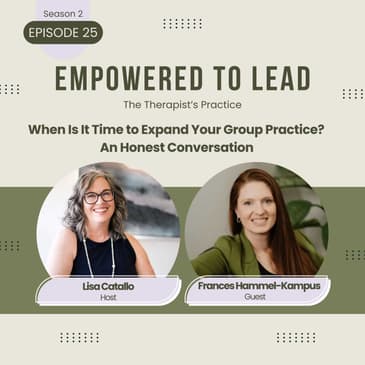
If you have ever wondered whether you are ready to grow, this conversation is for you. Frances of Moose Jaw Psychology shares how a solo practice she opened the month before the pandemic grew, almost accidentally, into a team of around sixteen clinicians, and the grounded, numbers-based thinking she used to decide when to take more space before she was ever fully ready.
What You’ll Hear:
- Why you are rarely ready to expand when you expand, and why taking the space before you fill it can still be the right call
- How to use your actual numbers to know when you have genuinely outgrown your space
- The Tetris of room scheduling, and why more clinicians does not always mean more rooms
- Why a plateau is not failure, and what that quieter season actually frees you to build
- The why question that will anchor you on the hard and lonely days of ownership
- Permission to change your mind, downsize, or stop growing without it meaning you did something wrong
Resources Mentioned on this Episode
- Moose Jaw Psychology: www.moosejawpsychology.ca
- GPO Network, the free Facebook group for Canadian group practice owners
- Group Practice Connection membership: Join here
Featured Guest:
Frances Kampus is a Registered Psychologist with the Saskatchewan College of Psychologists and a member of the Psychology Association of Saskatchewan. She holds an Authorized Practice Endorsement (APE), allowing her to diagnose psychological disorders, and has extensive experience providing evidence-based assessment and therapy services across both public and private sectors.
Frances is the founder and CEO of Moose Jaw Psychology Services, a rapidly growing private practice established in 2020 with a mission to help individuals and families create more balance, resilience, and fulfillment in their lives. The practice offers therapy and comprehensive psychological assessments for children, adolescents, and adults in a supportive and collaborative environment. Beyond the therapy room, she is passionate about leadership, mentorship, and the business side of private practice — navigating the many roles of clinician, CEO, supervisor, entrepreneur, and working mother.
Frances is also committed to strengthening the future of mental health care through clinical supervision and training opportunities for graduate students, interns, and provisionally registered psychologists. Her work is grounded in the belief that sustainable mental health care starts not only with helping clients thrive, but also with supporting and developing the professionals who serve them.
Connect with Frances:
Website: https://www.moosejawpsychology.ca/
Instagram: @moosejawpsychology / https://www.instagram.com/moosejawpsychology/
Facebook: Moose Jaw Psychology Services / https://www.facebook.com/moosejawpsychologyservices
Meet the Host: Lisa Catallo
Lisa is a Canadian psychotherapist, group practice owner, and business coach with over eight years of experience leading a thriving, values-driven practice. She works with therapists who are ready to step into their role as confident, ethical, and intentional leaders—without burning out or getting buried in the day-to-day.
Lisa’s coaching focuses on building sustainable group practices through efficient systems, effective leadership, and a deep respect for time and energy. Her approach is calm and encouraging, offering grounded guidance that helps therapists move from overwhelm to clarity—so they can lead with confidence and purpose.
Whether she’s supporting someone just starting to grow a team or helping a seasoned leader reclaim their role as CEO, Lisa brings a blend of insight, structure, and heart to everything she does.
When she’s not coaching or connecting with therapists, you’ll find her hanging out with her children and grandchildren, reading, walking by the water, or dreaming up new ways to make business feel a little lighter.
Connect with the Host:
Website: www.grouppracticenetwork.ca
Instagram: instagram.com/grouppracticenetwork
Facebook: facebook.com/grouppracticenetwork
LinkedIn:www.linkedin.com/in/lisa-catallo
Loved this episode? Let’s take it a step further.
Grab the free Time + Energy Audit for Group Practice Owners to get super clear on where your time is going—and what it’s actually worth.
And if you're ready for consistent support, connection, and access to done-for-you tools? Come join us inside Group Practice Connection—the membership designed to help Canadian group practice owners lead with clarity and confidence.
✨ You don’t have to do this alone. Check it out here
Empowered to Lead is proud to be on the High Vibe Podcast Network Check out (Host Name) Gift in the Vault https://highvibepodcastnetwork.com/gifts
Share the Love
✨ If this episode lit something up in you… tag us on Instagram @HighVibeLeaders and @grouppracticenetwork and let us know your biggest takeaway!
🦋 Don’t forget to rate & review — it helps us reach more conscious rebels like you.
Listen & Subscribe
🎧 Spotify
Hello, and welcome back to the Empowered to Lead podcast. I'm so glad that you're here and joining us in the summer. We are doing a series of just chatting with different group practice owners across Canada. We literally are going coast to coast and talking about specific pain points that group practice owners have identified, where maybe we have questions, and it's hard to get answers, or want to know what the real life experience is, and so today I'm very excited to be speaking with Frances, and she is based out of Saskatchewan, in Moose Jaw, and went through an expansion, so we'll be talking about her experience with that, and maybe at, well, not maybe, the goal is, as we're chatting, just to hear some of that learning experience, and to walk away with some considerations for that decision making process, but also what to expect through it, like sometimes there's emotions, sometimes there's stress, and yeah, walking through a lot of those different pieces, there we haven't had the conversation, so I can't tell you what it actually is going to hold, but I'm excited to have you here, Francis. And so, maybe just before we dig in, give a little description of who you are, your journey as a group practice owner, and then we'll dig in.
Lisa Catallo:Frances Hammel-Kampus: Yeah, well, thanks, Lisa, for having me. I'm so glad we're able to connect and have this conversation that I think, as group practice owners, it can be hard to come by some of the information around real lived experience. So, thanks for hosting that opportunity. So, my experience as a group practice owner has been a little bit interesting in that I never really set out to be a group practice owner, that was never really, you know, when I went into private practice, coming out of being more in the public sector, I never really saw myself as, you know, setting out to own a group practice, and so what started as a solo practitioner practice really kind of organically grew on its own, and so I guess you know, long story short, the overall process would be as a solo practitioner, which, by the way, I opened in February 2020 and so March 2020 right? We headed right into the pandemic isn't that interesting, and so I mean, right off the hop, really sort of forced into a lot of adjustment, right, and a lot of doing things differently, and so it's hard enough, right, when you're when you're going into into into business, and there's a lot of uncertainty with even starting that right, branching out from maybe like a secure employment kind of a predictable position into, you know, those very first steps around registering your business, finding a space, creating a website, you know, all of that is really kind of that overhead that gets you, that gets you started, and you can't really.. there's different ways to do it, but it's necessary to getting started, and so you're kind of already in it, and then you.. and none of this is familiar yet, because you haven't been doing it, and then the pandemic hits, and so it was kind of a really nice lesson, as much as it was hard at the time, it was a really nice lesson in what was sort of to come in the private practice journey, which would be you always have to be ready to adjust, right, and so
Lisa Catallo:right off the hop it was, you know, figuring out with everything around, you know, the regulations and the mandates, and you know, in person and virtual, and all of those pieces, and really having to figure that out pretty, pretty quickly, and so that's kind of how it all started, and it was just me on my own, and then we ended up over time having more referrals than my own individual schedule could handle, and what really sort of kind of woke me up to this idea of, okay, maybe you know, opening up to that group idea is is what's next for me was when I was sitting across from clients, and I would, you know, do my, my intro, and I'd say, you know, tell me a little bit about what brings you in, you know, when you, when you reached out, what was kind of going on for you, what made you reach out at the time that you did, and I was noticing I was getting responses that were kind of like, well, nine months ago when I first called,
Lisa Catallo:Oh
Lisa Catallo:Frances Hammel-Kampus: And this and this was going on, and so I thought, okay, because of course now people are being waitlisted, and I really went, you know, this isn't this just isn't as helpful as it possibly could be, and so that's where that organic, you know, you. Bringing on people who were able to also offer some similar services, because the demand was just such that there was opportunity for that, and so that started that really organic growth in the fall of 2022 So, since 2022 coming up on, I guess, four years coming up here in the fall of 2026 there's just been that really organic growth, and so kind of accidentally here we are with a group practice at present. I have about about 16 clinicians working alongside and with me. There's some admin staff, students, students from from time to time as part of the internship program, and so it's really kind of become its own, its own thing, and you know, we can get kind of more into the details of that, but it really, it really forces some interesting experiences as a business owner that maybe you don't anticipate when you are trained as, as, as a clinician.
Lisa Catallo:Yes, yeah, there's none of the none of this is taught in school. We don't get business courses or how do you lead kind of courses, so you're really learning on your own. That must have been like almost terrifying to leave your job, and now I'm going to go into private practice, and bam, here's a pandemic to get you, get your feet wet.
Lisa Catallo:Frances Hammel-Kampus: Yeah, no, for sure. And I think, honestly, when you're in it, and I don't know if others maybe find this as well, but when you're in it, you just kind of figure it out, you know? Like, you feel what you feel, but you also just kind of like fly the plane, right? You, yeah, you, you kind of take it in and problem solve, you know. I tend to be really task-oriented, so a stressor or a problem comes in and you kind of go, "Okay, what's next? And so I think sometimes that can be, that can be a benefit, because it just keeps us moving forward rather than getting stuck. But yeah, you know, when you stop and think about it, you know, it's not - it's not overly comfortable, for sure.
Lisa Catallo:Um I find it so interesting to talk to different group practice owners. I would say more often than not, this is accidental. This wasn't something that you had planned ahead of time. What has helped you? I'm going to ask you, how to define who you are as a leader, because usually I start with that question, but what has helped morph you into a leader? Were you a leader before you went into private practice, or has that been something you've stepped into?
Lisa Catallo:Frances Hammel-Kampus: So, I would say that my, like, my overall personality is has usually been the one to kind of take charge, you know, in school, if we're working on a group project, you know, I usually end up, you know, whether it's helpful or not, I end up being the person that's, you know, organizing who's doing what, and whatever, and so I think there's kind of that natural tendency there, but there's, it's kind of like, you know, you think about how all of the different pressures and temperatures that you experience as a leader do kind of morph you into into the way that you do end up leading, and so as a leader I would say that I've really had to, as most of us probably have, straddled that line between clinical and business, you know, how do we bridge between what we're doing clinically with our clients, who are, you know, essentially customers, and the business side, and when you think about the people aspect of it, our clinicians, who are working with us, they're also kind of like our customers, right, like we want to be of service in such a way that we can create sort of this this community or this container for awesome things to happen, whether it's for the clinicians as they're expanding themselves professionally, as they're showing up for their clients, and also from that clinical perspective, I mean, myself, I'm still in the clinical seat as a clinician, and so also showing up for for the clients, and so there's lots of opportunity there. I think, as a leader, to really balance, and I spend a lot of time thinking about balancing between the humanistic approach, about, like, okay, what does the human part of me kind of say about, about, you know, about a situation, or about something that that needs to be handled or managed or led through, what does what is the human side of me say about the people part of that, but then what does the business side of that need, because we also have to nurture the business, if there is no
Lisa Catallo:business, there is no clinic, if there is no clinic, there is no helping, you know, and so as much as it can be uncomfortable to be thinking about numbers or to be thinking about what's the process, what's the procedure, and sometimes that means that we have to say no, we can't do that, you know, and that can be really hard because we set out to help, but by way of how things things work to create that sustainable kind of business perspective, it kind of really does make you think about who. Sides of that, how am I helping, but also keeping the business side healthy enough that we can continue to do what we do in a way that does serve the people that we set out to serve, and so what kind of a leader am I? I feel like that's really hard, but really sort of forced into this understanding of there's so many different things to be thinking about, some more technical and like number-based, and others a little bit more like qualitative systems are helpful, gives you lots of guidelines. Systems are helpful, and it also forces us into lots of like innovation. I feel like I'm always creating how we're going to handle things, you know. You never do the same thing twice. It feels like, you know, every problem or every obstacle or every new situation really kind of pulls a different, a different way of thinking or a different kind of creativity. I think, you know, as as we're balancing how are we addressing the people and how are we also keeping the business side of things healthy?
Lisa Catallo:I would love to keep going down that road. I may have to have you come back anytime. I think just that mindset, a lot of us struggle in stepping into that. I'm a therapist, but now I'm a business owner, and how do I change my thinking so that I'm, I need to think of a different term, but CEO, I am the leader of this business, and so that is another. That's not why we're here today, but we'll have you back. One of the things that you said is you never do the same things twice, so you have done an expansion, and so walk me through. You did solo practice, and at some point you decided to expand. What was that trajectory like? First of all, and then I want to come back and ask, like, so you didn't, it wasn't a repeat, it's not like, oh, I've already done this, because you never do the same things twice exactly the same way, so you're in solo practice 2020 you bring on somebody in 2022 did you stay in that office, or was that a first expansion for you.
Lisa Catallo:Frances Hammel-Kampus: Yeah, so when I first started, and it was just me, I rented a suite that was a business suite. It had in it like a waiting room area, a bathroom, obviously a little kind of kitchen area, and then two office spaces. And so when it was just me, I kind of set out one space was the counseling office, the other space was psychological assessment for diagnostic assessments, and so made use of all of that. Now, at the time, there was another business across the hall from me occupying basically like an identical suite, but across the hall, and so it's so interesting, I think. How, how timing comes about, because in my experience, I was never ready to expand when I expanded, and it sounds a little bit counterintuitive in that, you know, we find ourselves often we're taking a leap before we're really ready, you know, like when when I started, and it was just me in that first suite, I knew I could see that my waitlist was getting bigger, I could see that I was getting into that situation where people were kind of saying, like, well, it's been a while ago since I first reached out, and so I kind of started thinking, like, man, like, I've.. there's got to be a better way to do this, right, to be helping the people that I set out to help, and so, timing wise, interestingly, the suite across the hall became available. It was vacant, I hadn't hired yet, you know, I didn't have people yet to fill it, but as opportunity goes, I felt like I was at a decision point of either I'm committing to staying exactly how I am or I'm allowing for a possibility of expansion, like I saw it as an opportunity of, you know, am I choosing to do maybe something different, as in bringing on people, or am I just really committing to staying the same? If I'm committing to staying the same, then I'm not going to pursue the space across the hall. If I'm open to possibly doing things differently, then I started to consider the space across the hall. Now I ultimately
Lisa Catallo:ended up taking over that space as well, so now I had kind of both sides, which now means I had like four individual offices within that, and so essentially doubled my footprint. Okay, so now I am not ready to hire yet. I haven't hired yet. You know, how do you write a job posting? Where do I post it? How do I find people you know all of these questions, but you know what? At the end of the day, I decided that I can always make a different decision. So, if I decide today I take the space, and let's just say that I, for whatever reason, don't hire, can't hire, I can always do something else with that space. You can always sublet it, you know. And not to say that none of these things are easy, but there's always another decision that you can make anyway. That ended up going fine. Hired, all of that was great. Okay, hired. Now it's full. Then, in I don't even know what year it is, maybe two two years later, I'm estimating I'd have to look at the years anyways. Okay, then in the same building, because I also know it's expensive to move and change addresses and set up phone lines and whatever. In the same building, a larger space downstairs became available, which is where I am now, which was again almost twice as many offices. So I went from like four offices within that, those two suites to seven office spaces within this one larger space. Again became available, and so again the question is, you know, if the opportunity is there, I can't, I can't hire anymore without space to put people, so if I don't have space to put people, I'm not open to hiring, but I can't hire fast enough to know if I have people to fill the space, so something has to go first, right? And so, again, same same kind of idea ended up taking the space before I was actually ready to fill it. Okay, now I think the important thing to think about is how do we know that that we're ready for more space, right? Like, at what point are we looking for more space?
Lisa Catallo:Because this is all well and good and exciting when you're expanding, right? This is very exciting. It's scary, but like, it's very exciting, right? Like, you're growing, and there's lots of momentum with that, and that's great from a business perspective, though. How can we afford that? Because we're not only doubling our square footage and doubling our possible opportunity, we're doubling our overhead or more, right, because our heating bill maybe goes up by more than two times, you know, whatever that might be. So, from a business perspective, on paper, I sort of figured out, you know, how many clinical hours, how many, how many client sessions, you know, at what point can I justify at what point have I outgrown this space, and so when I had my four offices on on that upper level, I really kind of thought about, you know, at what point are we maxed out? So, so really thinking about as I'm bringing on new people, because just because you have more people doesn't mean you need more space, it depends on the scheduling, right? So I don't know if you find this in your own practice, but not everybody works the same hours, right? You could potentially have three people cycling through one room, three clinicians cycling through one room, if one is daytime weekday, one is evening weekday, and one is maybe weekends, or whatever, right? And so you don't necessarily always need one room to one clinician, and so it's a little bit of like a game of Tetris, in thinking about, you know, what's the room availability, and for me it was okay. Once I maxed out room availability, as in, I set it as five days a week, you could calculate it on six days a week, running on average, you know, eight to 10 hours a day comfortably. Is that full enough? Right? How full is full? How many? How many clinician hours does it make sense to actually add on that overhead, because at some point you have to look at not only the opportunity and the overhead, but also like what is that ROI,
Lisa Catallo:right? Like, how are we just paying more because it's exciting, or are we actually at a place where it's time to, where it's time to move forward, it's time to expand, whether that's footprint or hiring, and so for me, for me, where I was able to find some certainty with all the uncertainty of maybe expanding and taking on more space, was this idea of okay, what is the base amount of service that needs to be happening within these walls to justify more space, right? Because you have to be able to afford it at the time.
Lisa Catallo:Am I maximizing what I currently have? Yeah, and then how does that translate into what I need and what that would look like in the new space too. Hey, so really looking at room use and maximizing space on both sides of things in there,
Lisa Catallo:Frances Hammel-Kampus: Because the uncertainty, I think, is, you know, is this is. A linear increase, you know, is it a constant increase in demand and in available qualified clinicians, right? And so you're thinking about both kinds of demands, and you don't know at that point, and so you have to go with what you know. Here's what I know. I know there's x number of, you know, clinician time, like service time, there's x number of maybe client hours coming through the door. I can do the math on that, and we can kind of go by based on current numbers. Here's what I know, here's what's sustainable, here's what's not sustainable, just to be fiscally responsible. And then you're right, the rest you don't know, so you kind of work with what you know, and then if that still works, and for me, I kind of made sense of it numerically that way, and went, okay, this still makes sense, even if nothing changes, and I'm just sitting in a bigger office, can I still sustain that office? Yes, I can. As of current numbers, it looks like that would be doable. It's going to be tighter than it was, but it's, it's going to be doable, and now there's room for growth, should that come down, right? So, again, you're always deciding, you know, am I capping it at where I'm at and staying where I am, or am I good enough to take on more with the opportunity for more growth in the future. That's the uncertainty part.
Lisa Catallo:One of the things that's standing that is spinning in my head as you're talking to is a lot of times we think our situation is unique, so maybe I'm at a small town, maybe I'm a big town, or a suburb, or all of those things, or I have a certain.. so I know I was talking with Caitlin, and she's in the Eastern provinces, and there's a certain qualification that you have to have in order to be there, and so what I like about what you're saying is, like, look at your actual numbers, make sure that you're maximizing where you are right now, and then do some projection, taking into consideration what kind of client inquiries are we having? What does what's who's our ideal client? What is this path forward? I would also say, like, whether you're an accidental group practice owner or not, knowing is this actually something that I want. So, when you're saying, like, I could grow. Do I want to grow, or am I turning away that that growth partism sounds like it's important for you? Like, where do I stretch myself? And knowing your tolerance level too. Yeah, so before we keep proceeding with that, I think it might actually be important. You're in Moose Jaw, you're not in downtown Toronto, so I looked up, and the population is like 35,000 You are psychologists, are everybody a psychologist? So, you've got
Lisa Catallo:Frances Hammel-Kampus: Not everyone on my team is a psychologist, so we do have some registered social workers, we've got a registered psychotherapist, Canadian certified counselor, we've got some psychometrists, you know, just a little bit of everything, but we do have a number of psychologists, yeah, as well, yeah.
Lisa Catallo:So you've got growth in, you know, some people might consider that a small town, it's, it's a fair amount when, as you think of, like, are we going to have enough clients coming through the door, as I grow, they're even just like not limiting in that way, and knowing this, yeah, these are the people that we serve, and how do we use that space to do that? So, sorry, little stop gap in there, but yeah, we didn't identify that at first, so you took that plunge, and you, and you got the space downstairs, so now you're at eight off seven offices,
Lisa Catallo:Frances Hammel-Kampus: Seven. Yeah,
Lisa Catallo:Okay
Lisa Catallo:Frances Hammel-Kampus: Yeah, yeah. And you know, it's so funny, because as I'm running the numbers, you know what, I never thought about, I never thought about how, like, the cost of cleaning stuff is going to go up. There's more square footage, you know, like there are lots of things to be, to be considering in there, and you're right, you know, it does come down to tolerance, and sometimes, honestly, I don't know, from, you know, from your experience or other group practice owners that you've talked to, but I think sometimes we don't know what our tolerance is, you know, we don't really know, like, I don't know what I was getting into, right, like, I didn't know, like, what does that mean to be a group practice owner, like, I don't know that we have a really clear idea about what are all the nuances of that, what are all of the experiences and the challenges that are going to go with that. You don't know it until, until you're in it. And so, as I say that, you know, I think it's important to also consider that, like I said before, we have to give ourselves grace that at any time we can make a different decision, you know. We can be growing and growing and growing, and at some point, you know, stop and go, like, okay
Lisa Catallo:It's not actually what I want, or yeah
Lisa Catallo:Frances Hammel-Kampus: Or Life changes, you know. Maybe priorities change, or I don't know, but like, as I get older, might my priorities start to shift a little bit, you know. As my kids get older, my priorities start to shift just a little bit, and so we have to also give ourselves grace, that you know, just because we expanded for the last three years, we don't have to, it doesn't have to continue, you know, where there's no obligation to that, you can at any point, you can choose to stay where you are, you can choose to, to downsize, you know, you, you, you really do have to know that even though you've got this really great momentum, there are times where it plateaus a little bit, and it forces us to think about, you know, like this isn't as exciting as it used to be, you know, like, because when we're in the growth, there's just so many things happening, right, it's just so exciting, there's always something to think about, and something new, and then there's going to be at least, at least in my experience, and I think you know it would make sense that it's probably a bit of a pattern. There's going to be a little bit of a of a plateau, you know, there's going to be a time where you're maybe not growing as rapidly, and, and honestly, you know, that's that's okay, because we have to catch our bearings at some time. And then for me, this is this is when you know things kind of settle, and now you just hit a little bit of a, of a routine, or get into a bit of a consistency, or a pattern, and now this is for me where I actually slowed down, and now I'm building the systems, I'm building the processes, you know, because before that you're kind of accumulating, right, and you're making decisions on the fly, and this seems to make sense, and so you kind of go with it, and now you just kind of like, you get a little bit wise in, you've got some learning now, you know, you've seen some things, you felt some things, you, you know what's important, you know
Lisa Catallo:what's not, you know what works, you know what doesn't work, as of, you know, up to this point, and then this is when we really kind of figure out what, what are my repeatable processes, what are my systems? What are the roles that need to be filled on my team, and I think those are all important to be thinking about when you are doing an expansion, because it's, it all, it all grows together. It's like growing pains, you know, you can't just grow one part of it, it all kind of forces shift,
Lisa Catallo:And as you're saying that, like, a lot of times, because we are entrepreneurs, we wouldn't have a group practice if we weren't entrepreneurial, that part of growth and stretch and imagining and making all these things happen, it is uncomfortable, but it's also exciting, and that keeps us going, and so when we get to the plateau part, that can feel like boring, or it can feel like, oh no, we're not growing, so I'm doing something wrong, but actually slow down and create those systems, buffer up what you've done so far, check in, is this how I want to keep moving forward, and then it almost gives you time to breathe and vision and solidify what you have. Sorry, grow that team, so that whether you decide to grow more or sustain, you now have a team that allows you to step into who you are as a leader and more of that vision, so plateau isn't negative, it doesn't have to be scary in the opposite way of growth is scary,
Lisa Catallo:Frances Hammel-Kampus: Yeah, yeah, yeah, but the discomfort, I think,
Lisa Catallo:Yes
Lisa Catallo:Frances Hammel-Kampus: Can be can trick us into thinking this is big and scary, and I need to do something different, but
Lisa Catallo:Yeah,
Lisa Catallo:Frances Hammel-Kampus: You're right, you know. Sometimes it just means that it's just different than it has been. If you've been on a path of growth, the plateau is going to feel uncomfortable, and sometimes we look to spice things up a little bit. You know, I got to do more. You know, does this mean that it's not working? A lot of that's, I think, when a lot of that mindset stuff really kicks in, because now you kind of have time and space to think and to see, and maybe to feel the things that you weren't feeling when you were so busy doing all the task-oriented things in a growth, a growth phase or an expansion phase.
Lisa Catallo:Yeah, what would you say to somebody who's considering expansion? What would you encourage them to consider before stepping into a growth period?
Lisa Catallo:Frances Hammel-Kampus: That's a really good question. That's a really good question. Fundamentally, I would go back to, you know, what is sustainable based on what you know so far. That's going to give you a bit of a baseline around, around just simple sustainability, you know. And I think number one, that is really important to consider, number two, it might be, you know, really considering what the growth is about. Growth, meaning, you know, just talking with other practice owners, there seems to be kind of different. Ways that people grow, sometimes we grow because we've just decided that we're going to grow, and it would just feel good, and it would be exciting, and there's a little bit of, like, maybe, like, like an identity, or like an ego push with that, which is, you know, not necessarily negative, but that's kind of one way of doing it's almost like more of a push, like a pushing force, you know, I've decided that I'm going to grow my business, and so we, you know, push for that. The other side of that is maybe, you know, or that organic side that that you're kind of talking about, you know, when people kind of accidentally grow a group practice, you know, or am I doing it because I'm looking to meet a need that's showing up on my doorstep, you know, and I think those are both very important, and there might be pieces of both, and I'm sure there's other different kinds. These are just the two that are coming to my mind, you know, pieces of each of those happening maybe at the same time, but I think it's important to, you know, kind of get get curious about like you why? What's my why for growing, you know, what's my why? Because on those hard days, or the days where it feels like everything's kind of, you know, falling in on you, that's really kind of what we're left with, like, why, why, why am I, why am I doing this, what is important about this, and I think those answers can just allow us to have a foundation that we can fall back on
Lisa Catallo:when things get hard, because not every day is super exciting. Yeah, some days can be, can be really challenging, and it can feel really lonely, because I mean, as a, as a business owner, who do you talk to? You know, you're surrounded by people, but as the leader, you just wear a different hat, that's not, unless you've kind of walked in it, it's really hard for anyone to understand, which is why I also think, like, having that community, so if you're going to go into group practice, I would say is, or any, you know, kind of business expansion, or you know, building a business, it's important to have a group of people or community who maybe understands a little bit around those nuances.
Lisa Catallo:Yeah,
Lisa Catallo:Frances Hammel-Kampus: Because if you haven't done it, it's hard to really understand what that, what that means, you know? Yeah, when, when things are, are coming up,
Lisa Catallo:Yeah. So, I'll put a little plug in. So, we have a free Facebook group for group practice owners, GPO Network, and also have the group practice connection for that purpose. Is why I created that membership, is to know that you're not alone, and also to check some of these things, like, hey, I'm thinking about growing, what do I need to consider, but also a reminder of, like, why am I doing this, and I was gonna say to Francis, like, sometimes that why is because everybody else, in quotes, that I see has a huge group practice, and so I'm supposed to do that if I have a group practice. Do I actually want growth? And does growth mean numbers? Does it mean finances, or does it mean I want to step more into growth as a leader, so growth doesn't just have to be now I'm adding five offices and coming down to that. Why, what's driving me? What's the purpose? Who am I going to serve in that growth period? Yeah, yeah, there's a lot of new, a lot of different ways that this has could have gone, like the logistics of it, but I love that we're talking about, like, yeah, really coming down to determining why you're doing this, and that it's you, you don't have to do it forever, or permission to kind of do a 180 at some point, too, if, if you find out that actually isn't working or isn't actually where you wanted to go, just because you've started down a path doesn't mean that's your forever.
Lisa Catallo:Frances Hammel-Kampus: Yeah, I think we have to give ourselves that grace, because there's so many unknowns, right? Like I said, you jump before you're ready to jump, you take the space before you're ready to fill it, and that can be really scary, and if we keep ourselves to the uncertainty, and you know our brain is going to go to all the all the not so great things that could happen, you know, all those big scary what ifs, sometimes that is kind of paralyzing in itself, and so we just want to make sure that we're not limiting ourselves. Let's say if taking that space is going to be a good thing for us, we don't want to let fear stand in the way. We want to ground ourselves in like what's actually happening right now, what's important to me, because it's not just about taking on more space, right? There's lots of things that. That that go into that, yeah. So I just think, yeah, I just think it's important to give yourself that that flexibility.
Lisa Catallo:Awesome. Well, thank you so much for taking time to connect and to share part of the story, and I'm sure there's lots more details of what all that looked like, but I really appreciate your perspective on leadership and making some of those decisions in expansion. If somebody wanted to check out your practice to see all the things that you're doing, how would they find you?
Lisa Catallo:Frances Hammel-Kampus: So, we do have a pretty detailed website, you can check it out at www dot moose jaw psychology.ca We have lots of information on there about about what we do, how we operate as a practice. Contact information is there as well. If anyone wants to connect, that's great. Feel free to fill out our contact form, send us an email, or give us a call, and I'm always happy to connect with people if there's anything that that can be helpful.
Lisa Catallo:Awesome, thank you. And your website and information will be in the show notes if anybody is looking for that. Thank you so much for taking the time today, Frances. It was good to meet you and to hear a bit of your story, be watching and seeing how your business continues to develop and grow over time. Yeah, and to our listeners, thank you so much for tuning in and coming back and visit us next week and hear another story from a group practice owner in some of these realms of growth, and just the nuances of being a GPO, and have a great day.