
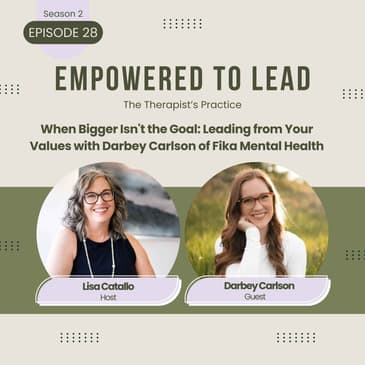
Not every growth story ends with growing. Darbey Carlson of Fika Mental Health shares how her practice expanded to seventeen people almost entirely by accident, the moment she paused to ask how it all actually felt, and why choosing to slow down can be the most values-aligned decision a group practice owner makes.
What You’ll Hear:
- How a practice can grow to 17 people almost by accident, and the moment that finally prompts a pause
- The 10 to 12 therapist shift, where the culture changes and how to catch up to it
- Detaching from hustle culture and the quiet belief that you are always supposed to want more
- Being told she was too available, and what guarding your energy actually protects
- Why naming your why and your values keeps your decisions from running on autopilot
Resources Mentioned on this Episode
- Fika Mental Health on Instagram: @fikamentalhealth
- Fika Mental Health website: www.fikamentalhealth.com
- GPO Network, the free Facebook group for Canadian group practice owners: Join here
- Group Practice Connection membership: Join here
Featured Guest: Darbey Carlson
I’m a Registered Psychotherapist and Yoga Teacher who blends mind body approaches through additional training and experience in EMDR, ADHD, trauma, somatic work, and attachment based therapy. I founded Fika Mental Health around the idea of intentionally carving out space to pause, reconnect, and care for ourselves through therapy and wellness. My work focuses on creating spaces where people can drop the mask, feel more grounded in their nervous systems, better understand their attachment patterns, and settle into their human experience with greater self understanding.
Connect with Darbey:
Website: www.fikamentalhealth.com
Social Media: @fikamentalhealth
Meet the Host: Lisa Catallo
Lisa is a Canadian psychotherapist, group practice owner, and business coach with over eight years of experience leading a thriving, values-driven practice. She works with therapists who are ready to step into their role as confident, ethical, and intentional leaders—without burning out or getting buried in the day-to-day.
Lisa’s coaching focuses on building sustainable group practices through efficient systems, effective leadership, and a deep respect for time and energy. Her approach is calm and encouraging, offering grounded guidance that helps therapists move from overwhelm to clarity—so they can lead with confidence and purpose.
Whether she’s supporting someone just starting to grow a team or helping a seasoned leader reclaim their role as CEO, Lisa brings a blend of insight, structure, and heart to everything she does.
When she’s not coaching or connecting with therapists, you’ll find her hanging out with her children and grandchildren, reading, walking by the water, or dreaming up new ways to make business feel a little lighter.
Connect with the Host:
Website: www.grouppracticenetwork.ca
Instagram: instagram.com/grouppracticenetwork
Facebook: facebook.com/grouppracticenetwork
LinkedIn:www.linkedin.com/in/lisa-catallo
Loved this episode? Let’s take it a step further.
Grab the free Time + Energy Audit for Group Practice Owners to get super clear on where your time is going—and what it’s actually worth.
And if you're ready for consistent support, connection, and access to done-for-you tools? Come join us inside Group Practice Connection—the membership designed to help Canadian group practice owners lead with clarity and confidence.
✨ You don’t have to do this alone. Check it out here
Empowered to Lead is proud to be on the High Vibe Podcast Network Check out (Host Name) Gift in the Vault https://highvibepodcastnetwork.com/gifts
Share the Love
✨ If this episode lit something up in you… tag us on Instagram @HighVibeLeaders and @grouppracticenetwork and let us know your biggest takeaway!
🦋 Don’t forget to rate & review — it helps us reach more conscious rebels like you.
Listen & Subscribe
🎧 Spotify
You're listening to Empowered to Lead, the therapist practice. I'm Lisa Catallo, therapist, business coach, and your go-to for all things leadership and sustainable practice growth. This is your space for real talk, smart strategies, and grounded support to help you lead with confidence, work with intention, and build a business that actually works for you. Let's dive in.
Lisa Catallo:Welcome back to the Empowered to Lead podcast. I am so glad that you're here. I'm looking forward to the conversation that we're going to have today with Darbey Carlson. This summer we are spending time with real group practice owners. Not that I ever talked to fake ones, but just getting the story behind different people's experiences. And what I took was some of the pain points or some of the topics that I'm hearing group practice owners talk about, and let's spend the summer just really connecting and getting. How did you do this? Or here's somebody else's take on it. And so today we're talking to Darby, talking about different ways of growing your group practice and what her experience has been with that, so welcome, Darbey. I'm looking forward to our conversation today. I'm so glad that you took some time out of your schedule to share a bit of your story.
Darbey Carlson:Yeah, thank you for having me. I'm super excited to be here. A little nervous, but I think that's also super normal. And yeah, happy to kind of talk about what my experience has been. Yeah, so I want to hear a little bit about your journey as a group practice owner. But always the first question that I ask is, how would you describe yourself as a leader? Yeah. So when I was thinking about this question, the first thing I did was actually ask some of the people on my team because I was like, I don't. I mean, I guess I lead myself, but I was curious to see what they would say. Because I think when I think about how I might describe myself, I really try to be someone who is values driven, and I really try to bring in like my own authenticity. And so when I was getting some of those messages back, those themes were really resonating, which was really huge for me. Just because I think it did reflect that the way that I'm trying to lead or kind of exist in the spaces where I'm like a participant in my practice was and has been coming through. So there was some words around authentic and human and patient, and it was just interesting to kind of see the relationships through the lens of the individuals that I do work alongside or have come to know. So I think just blending that a little bit. Any surprises as you went through that? I mean, I think it's maybe not giving myself enough credit sometimes because I'm kind of in that imposter syndrome space a little bit where I'm like, oh, like this is what I say I'm going to do. Am I doing it? So I think it was like a nice surprise and maybe like a little bit of a point of reflection as well, where I can give myself again like that. I said that credit of like, oh, you're doing a good job in the spaces that you're trying to exist within,
Lisa Catallo:yeah. And when authenticity is one of your core values, to hear it related back to you, hey, like, oh, that yeah, that feels good.
Darbey Carlson:I did share with my dad. He was like, look at these all these nice messages they got, and he was like, "Oh, you're going to be happy for like a week now, aren't you?
Darbey Carlson:Probably.
Lisa Catallo:I when I did my practicum, our supervisor gave us a box to put cards in or notes from clients. This was before COVID, and everything is electronic, but you should print some of those off and put it into a box somewhere for some of the hard days to just get. I am good. Yeah, yeah. Gotta go back to and use as an anchor, like print it and put it on the wall in front of you. Yeah, I just imagine if you're having a difficult conversation, pointing C. Yeah, like actually, there's the evidence. Awesome. So tell me a little bit about your journey to starting a group practice and what it's been like to be an owner.
Darbey Carlson:Yeah. So my journey, I feel like I describe it as a little bit non traditional, just in the sense that I didn't plan to be where I am. So when I was in solo practice, I found that I was just missing out on sharing space when it came to like learning with other people and getting to kind of maybe debrief or be more vulnerable. And so I started to notice that, and then. Found a couple individuals that I thought were really cool fits and just really connected with me, and so that started a few years ago. And then from there, I had someone ask like, "Oh, like, can you take a student on? And I was kind of just like, "Sure, why not? Because that's very much who I've been for a long time. I'm like, "Yeah, I could probably handle that. So things that look like opportunities to try something new or just again support somebody in something that they're trying to achieve, and then from there, most of our growth has been from students choosing to stay on, which is always like a really awesome compliment. But then I also kind of got into the space of going, okay, so like here is the next student onboarding, and then like I'll find two more, and like each season I'm bringing on more students, and I never really stopped to go. Okay, like there's a lot of people on our team. How is the ceiling for me? So we've grown to this point, and like everyone on our team is really awesome. Some of the growth also came from just noticing a couple different gaps in maybe how services are provided publicly as well, and wanting to create something that clients could connect with. We do have a couple other team members, like a dietitian and some nurse practitioners. But it's been this very like organic, gradual expansion that's happened. Yes, it's been really natural, but again, I've never been someone to sit down and like create a business plan or really connect with my numbers or have like growth goals or numbers-based goals. So I think like I've kind of joked in
Darbey Carlson:other spaces before where like other business owners might look at me and roll their eyes and I'm like, I don't know, I'm just here. But it's it's worked and like systems have developed as we've moved along, and and it's kind of that like pause and connecting with myself and going, okay, like how does this feel right now? Is this something that feels sustainable? And then trying to reorient to that, which is kind of where I am today. But yeah, just all that to be said. I got here and I didn't think too much about it, which is where I now am trying to do more of that,
Lisa Catallo:Of thinking about it.
Darbey Carlson:Yeah, that blueprint idea.
Lisa Catallo:Okay, yeah, yeah. We were joking before we recorded that that's opposite of what I tell everybody. Yeah,
Darbey Carlson:I am sorry in advance.
Lisa Catallo:So people are probably wondering, like, how big is your group? Because you you said like you just keep adding people. Where are you at now?
Darbey Carlson:Yeah, so we are 17. Yeah, it's a big group of us, and I've decided that with the onboarding that I've done more recently, I'm actually going to maybe slow down or pause my student program, so that would be pausing growth, which I'm really comfortable with, just because I find that the bigger the scaling goes, the less time that maybe I have to connect with pieces that really feel valuable to me, and really not wanting to lose that, so that could be something like like relationships and making sure that we're still like creating opportunities to learn and to train together or to connect. So really being people oriented in something that feels like again one of my values and balancing that because I think that that feels more important to me right now than, again, continuing to grow because then I really lose on lose out on what feels really rewarding, and then even like some of those connections that I was talking about, like being able to ask questions, like, hey, like how would you describe me as a leader? Where that might be something really vulnerable or requires some honesty, like always making sure that that is still something that we get to connect with.
Lisa Catallo:Yeah, there's something that happens at like maybe you can confirm if this happened for you, but around 10 to 12 therapists where the dynamic changes and you're managing so many people that it's you have to either adjust what your culture or your expectation of the culture is, or how you can show up in order to keep the culture that you originally really loved. Has that been a hard thing?
Darbey Carlson:Yeah, and I think that that number sounds right because like I was kind of saying, like you start to notice that maybe the ways that you're really trying to be intentional, you just don't have the same type of energy for it. The more people that there are, and I don't want anyone to come into our space and feel like that's the case too, because again, like it's really important to create the sense of of support, and then also just like connectness, especially when you're like mostly virtual, which is what our practice is. So wanting to yeah, like notice that like the 1012, and then that shift, and then trying to catch up to that shift too. I think is something as well where you're going like, oh, this is just the thing we're doing, the thing we're doing, and then going, why does it feel different?
Darbey Carlson:Like how long does it take us to notice that, and then reflect back? So it's I think a lot of that like pausing and going. If I'm scaling past this point, like what is my why and how I want to feel?
Lisa Catallo:Yeah, yeah. How I want to feel. How I want to show up as a leader. What is this? Is this train go in the actual direction that I wanted to? Even if I didn't set the track to start with, there wasn't that blueprint to start with. But now it maybe feels like let's let's slow down and and choose new as opposed to be dragged, not dragged, because you're not saying that in a negative way. But it's driving the train. We've got this program. We we keep bringing students in. That's just what we do. And now, where do I have choice? Yeah, kind of thing.
Darbey Carlson:Yeah, and I think too, there's a lot of that external noise that can be like still very well intentioned that might you might hear from like friends or family or just like the online kind of spaces where we've been taught I think from a young age too to go okay like be really grateful for what you have but also you're always supposed to want more and so when we're not stopping to go okay I'm in autopilot. Do I think I'm supposed to keep growing because that's what someone else is telling me? Like, am I allowed to just be happy with what I have? Like, what feels again? Like, what feels important? Like, can I get off of this train and try a different one?
Lisa Catallo:Yeah.
Darbey Carlson:Instead of just like riding the wave, because again, it's something we think we should do, or hustle culture exists around it, or something is being sold to us somehow. Getting to come back into self,
Lisa Catallo:Yeah. Just kind of sitting with that for a minute, because a lot of times we are looking. I actually had a coaching session this morning, and somebody was like, "Well, the group practice down the road, like it looks like they're doing awesome. What am I doing wrong? So yeah, it's not necessarily comparison. It is like, is this how I want it to be? And a lot of times, the culture and the how you get to show up as a leader matters more than the money of growing to 25 therapists instead of 17. How did you? What helped you slow that down or make that decision that I'm probably not going to bring on more students and just kind of slow down right now, or or focus a little differently.
Darbey Carlson:Yeah, I I did start to notice. I think, like I mentioned, that kind of idea of friction within my own body, just like a really big shift in how I was experiencing my own energy, and still to this day, I'm kind of grappling with that a little bit. But there can be so much pressure that comes with like onboarding students and trying to fill caseloads, and it's not something that has to feel negative because again, like the people that we are connecting with are are really awesome. But as a group practice owner, sometimes we take on a lot more than again maybe being sold to us online or just that idea of like comparison or inner critic going like, oh well, you should want more and more and more, and it looks like this, but we don't really notice how it feels, or we think that we're the only one that feels this way or feel this way. And if the next thing is that perfect thing, then it'll stop feeling like that. But again, that's more kind of working towards an idea rather than like what is the reality of how I'm experiencing this and like what feels supportive. Yeah, what do you have in your corner to help you do that? I have a lot of other group practice owners. So sometimes I'm yeah I'll send a message and just be like I need to ground myself into into something. Like am I the only one that feels this way? And it's always no. But just seeking support and sometimes like sharing resources and like sharing ideas with other people who are experiencing that has been really helpful. Yeah, and like allowing that space for being vulnerable and like building trust. I think too, it's been yeah, super invaluable, and even like groups and stuff like like your Facebook group, where it's sometimes nice to see other people ask questions and like learn from their experiences, or even just that like really silent acknowledgement of like, oh, okay, like I'm not the only one. Yeah, those those spaces are really important. Yeah, did you work to develop
Darbey Carlson:those spaces, or did they exist before you got into this role? I would say that they were things that I kind of worked to develop. I'm just thinking, like, just in the sense of like learning to rely on other people can be really scary. Yeah, learning to integrate different ideas can be really scary. But I feel like that's all part of the processes. Well, so it's maybe being curious about like how it might feel to exist in a group before you participate it participate in it. Just thinking again, like talking about like your Facebook group or even like the idea of coaching. But no, it was something that I did have to like build into being more comfortable around, and that takes time.
Lisa Catallo:Okay, what were some of the biggest challenges or turning points for you along the way?
Darbey Carlson:Yeah, so like I was kind of talking about, like that idea of where I am feeling comfortable and being really okay with that, versus it feeling like I need to keep growing and growing and growing, or doing more and more and more. So I think that was something that really became present within the last year or so, just around like how I was feeling and how I was experiencing the business and my ability to be in that space of presence and like again relationship. And it was something that took me a while to sit with and like sit in that discomfort of like what might this mean for me or what am I like kind of deciding it means and then thinking too about that idea of like future self and how I'd like to feel and so I think just being like accepting of okay this is like where we're comfortable, or even like if the team were to become smaller, like I would still be comfortable with that too. Kind of just releasing some fears out into the abyss, but that has been, yeah, it's been, I guess that friction, that word again. I'll use that because where we see everything online, and then where we actually feel how we feel, like those things can be different places, and coming back into that self, and then detaching from external pressures or detaching from the things that we see and that we read, that I feel like has just been a turning point and has felt a lot more rewarding.
Lisa Catallo:Okay, if someone were to come to you and say, "I'm stuck and feeling overwhelmed. I'm not really sure where to go next. What would you say to them?
Darbey Carlson:I feel like I would probably want to ask them, like, what they're noticing about where they are in relation to where they would like to be, but coming from that space of how they want things to feel. So if it if it is like, oh, I'm feeling like overwhelmed, or I'm feeling stuck, like let's untangle that. Like what is underneath that overwhelm? Like where do you feel that stuckness? And I just feel like I sound like a therapist right now. But like, really, like digging in and going, okay, like what is out of alignment for you? Do you know what is important to you? And like, maybe those things have changed since that last season of life or that last season of growing your business. And like, can that be okay? Where do we feel like we have some choice? And where do we feel like maybe something doesn't feel like it's in our control, and like, can there be discomfort there that we sit with? But really, just taking that arm's length, like, what do we see when we shift our perspective, and where do we want to go from that spot? Because I think too, like, my brain thinks in systems all the time, and like there's so much more than just like us in this little container in these four walls, and maybe just putting words to that too. Like there are other things that'll come out and be a part of our system that do impact us, and so again, like what feels important, so that we can move from that place of value.
Lisa Catallo:Do you think it requires naming those things. Like I'm curious because you said like at the beginning didn't have the blueprint, didn't like just kind of go with it. Is there? And I'm hearing you say name some of these things, whether it's emotion or what you actually want. What is like if you have spent any time slowing down and saying, "What is it that I want? Does it help you to name it to write it down? What helps you connect with? Okay, this is where I want to go or how I want to move forward.
Darbey Carlson:Yeah, I do a lot of writing down. I do a lot of verbal processing, so again, I think like not feeling like you have to figure these things out by yourself is something that can be really helpful. So whether that's like I said, like talking to a coach like yourself, or like doing therapy, or just like some people really love that meditation piece, journaling so you can see what it is, verbalizing it out loud. Even though we all tend to laugh when we're like, "Oh, I was talking to myself, but like you can process that way. But putting into words what it is, yeah, for sure that can be helpful. And then if that the structure piece is really something that I will acknowledge, yes, most people have that blueprint. I didn't. But
Lisa Catallo:No, I would say most people don't have the blueprint. Yeah, like it's one of the reasons I call it a blueprint rather than business plan because as soon as somebody hears business plan, their eyes glaze over and check out. But yeah, kind of a I would say almost every not everyone, but a lot of people that I work with, it's like well, I've never, I've never said where I want to go. I I have never named why I do this. I'm an accidental group practice owner again, so it can be painful to start with when we start coaching because you want to move forward and grow, and I'm saying slow down and name these things because I think, like you said, like writing it down or just naming it. Now, oh, okay, so I can check these decisions against that intention or that what culture I'm trying to create, as opposed to okay, well, another student wants to join, and so we'll just make that happen, kind of thing.
Darbey Carlson:Yeah, yeah, it's like that idea of what's your why, and for a lot of people, I don't know if they've connected with that before, and like, there's so much there too, where you can kind of peel back those layers around, like you said, like, oh, am I just doing this because I'm I'm doing it, or is there something here that is really important to me that I'm trying to embody, or maybe it is out of alignment? And then how do I shift?
Lisa Catallo:Yeah, yeah, I could go down so many routes because there's a part of that, like okay, the people pleaser in me, so everybody, we have all these students. Yeah, yeah. Well, they like me, and it feels good.
Darbey Carlson:I like them, so good surprise.
Lisa Catallo:Awesome.
Darbey Carlson:Is there anything that you now that you look well? Anything you do differently now, and how you lead or structure your time or run your business that you wish you'd done sooner. Yeah, I think the first thing that comes to mind is maybe allowing support earlier on. It's made a world of difference and just given me a lot of my energy back and like being able to go. Okay, like I don't have to do everything by myself. That's been really great, and just surrounding myself with those people that I do really trust and like have taught me that people can be reliable and trying to create. And I don't necessarily know if balance is even the right word because I don't know if I believe in balance right now. But just guarding your energy a little bit more, there is not this urgency that we tend to internalize when we see things again online or just the way that we've been brought up. So detaching from that as soon as you possibly can, the sky will not fall. Things will still go well. I think that that's something that I've been trying to carry with me for sure, and I wish I'd started that a little bit earlier, but
Lisa Catallo:One of the things that you said before too is like, and there's a belief that you weren't always available, or that that wasn't you doing everything that that meant you weren't a good leader.
Darbey Carlson:Yeah, yeah, and I used to. Well, I still do, but again, I'm trying to reorient my my time so they can do this properly. But I would do check-ins with my students after the first six weeks or so. One of the questions I would ask was around, like, is there anything you would change around our communication or like my being available? And someone told me that I was too available, so
Lisa Catallo:Yeah, yeah. I found out in one of my conversations with my team is like with me responding right away, which is important to me. I actually put pressure on them because they were going to be in session, or you know they had things outside of the business, and so maybe I'm letting Lisa down if I don't reply right away. That wasn't what I was trying to communicate, but yeah. So it sounds like you're really good at asking for and receiving feedback, and then making some adjustments based on that, hey?
Darbey Carlson:Yeah, I do try, and I I like that you use that example because there's some people too where I've interacted with them, and like I've said, like you don't have to respond in a stirred way, but I guess like again, knowing the way my brain works, if something pops up, then I'm like, oh, I should answer. So I think too, like that's like kind of where that self awareness or like that, taking a beat exists because I'm like knowing this person because again that relationship is important. If I text them right now, are they going to respond to me immediately? So maybe I'll just put it on like a note and wait till tomorrow, and I think that that's been good too.
Lisa Catallo:Learning to use that schedule send button on email. Is a huge learning curve for me, but also so effective. Those guys in our phone app now, not on my phone, but you can schedule texts to send too. So when you're saying like, then you don't have to save the note. You can just schedule that to send. Yeah,
Darbey Carlson:I've also done like if um if I know again someone's gonna respond to me straight away, then I'll email them because I know that they're not gonna look at their work email, but
Lisa Catallo:Yeah,
Darbey Carlson:They'll kind of keep that space.
Lisa Catallo:Yeah, and so the last question I've got for you is knowing that with all the people that I support, there is not a one size fits all approach. There isn't like I don't think follow this recipe and you will get what you want because I've worked with like over 400 group practice owners. I would say there's over 400 ways to do a group practice. Something that I'm hearing from you is like that reflection, or that knowing your team is something that may be unique to you as a group practice owner or to your culture. What's something that you would say is makes your practice uniquely yours, or reflects your values in a standout way,
Darbey Carlson:Yeah, and like thinking about that question, I always had such a hard time because I'm like, I don't want to be seen. I'm not different. I'm just like everyone else. They're all doing a great job, but I do feel like that human aspect maybe does like create some form of a unique offering, just because I know we talk about being human in the therapy space, but it's been really valuable in being able to just build like something that not only feels good from the business side and like for our team, but also for clients. Just being authentic and like allowing that part of you that is real to shine through. I think that we do a really good job of that within like the the realm of like ethics and what is appropriate. But yeah, just being really human,
Lisa Catallo:Which allows you to either choose to grow or to slow down and say, "Hey, we're gonna pause for a moment and grow our community as opposed to grow in numbers. And so, being real with that is important too. I think.
Darbey Carlson:Yeah, yeah. I mean that is what keeps me especially grounded in like allowing the work to feel like I get to participate in it, and it's not just something I'm going to do.
Lisa Catallo:Yeah, thank you so much for sharing your story. It's been cool to get to know a little bit about you and just that authenticity and your, the, yeah, your trajectory and how you've grown and I'm looking forward to watching as you slow down and grow internally and if you choose to, because you said you might still bring on students. If somebody wanted to reach out to something resonated in here, and maybe they wanted to connect. How would they find you?
Darbey Carlson:Yeah, so we're on Instagram at Vika Mental Health, or you can go onto our website. I'm always open to a chat if you send me a DM on Instagram, and those are the only spaces that I'm active because social media is not my favorite place, so it's it's pretty yeah the normal places
Lisa Catallo:Yeah awesome and those will be in the show notes so if anybody was looking to connect with Darby that is available down there so thank you so much again for taking the time to show up here Darby and for you who are listening in thank you for taking time out of your day. If there's something in here that you it piqued your interest, or you'd like to learn more either about the services that I provide or about Darby's team, I would love to hear from you and connect. And until next week, thank you.
Lisa Catallo:Thanks for hanging out with me on Empowered to Lead, the therapist practice. I hope you're walking away with something that you can put into action, because leadership isn't about doing more; it's about leading with purpose. If you're ready for deeper support, I'd love to see you inside the Group Practice Connection, my monthly membership where Canadian therapists like you get coaching, community, and the tools to build a business that actually supports your life. You can check it out at GroupPracticeNetwork.ca. The links in the show notes. And hey, don't forget to hit follow so you don't miss what's coming next. We're building something great here, and I'm so glad you're a part of
Unknown:it.