
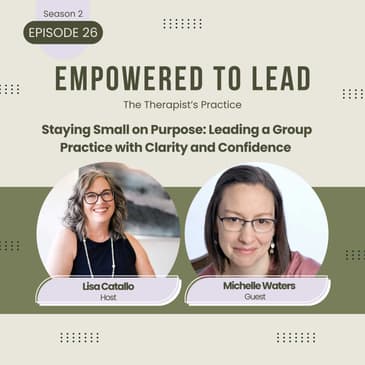
What does it really mean to be a group practice owner when your practice is small, or when you intentionally choose not to grow? In this episode, Lisa sits down with Michelle Waters of Pacific Waters Counselling to talk honestly about the realities of owning a small group practice, navigating contractors coming and going, and making grounded leadership decisions that align with your energy, values, and ideal client.
This conversation explores identity, imposter syndrome, burnout, and the quiet confidence that comes from knowing what you do and do not want as a leader.
What You’ll Hear:
- What it’s actually like to run a small group practice, including the emotional and logistical learning curves
- How contractor turnover can impact confidence, energy, and leadership identity
- Why having one contractor still makes you a group practice owner
- The role of clarity around brand, ideal client, and scope of practice
- Making values-aligned decisions, even when good candidates come along
- Letting go of growth for growth’s sake and choosing sustainability instead
Resources Mentioned on this Episode
- Ambition Alliance which is now Group Practice Launchpad with Lisa Catallo
- Pacific Waters Counselling
- Trauma-focused modalities including Lifespan Integration, Somatic Experiencing, and EMDR
Featured Guest:
Michelle Waters is a trauma therapist and owner of Pacific Waters Counselling in Surrey, BC. She specializes in DID and eating disorders. She gets curious about how people connect both internally and externally and what holds them back.
Connect with Michelle:
Website: https://www.pacificwaterscounselling.com/
Instagram: https://www.instagram.com/pacificwaterscounselling/
Meet the Host: Lisa Catallo
Lisa is a Canadian psychotherapist, group practice owner, and business coach with over eight years of experience leading a thriving, values-driven practice. She works with therapists who are ready to step into their role as confident, ethical, and intentional leaders—without burning out or getting buried in the day-to-day.
Lisa’s coaching focuses on building sustainable group practices through efficient systems, effective leadership, and a deep respect for time and energy. Her approach is calm and encouraging, offering grounded guidance that helps therapists move from overwhelm to clarity—so they can lead with confidence and purpose.
Whether she’s supporting someone just starting to grow a team or helping a seasoned leader reclaim their role as CEO, Lisa brings a blend of insight, structure, and heart to everything she does.
When she’s not coaching or connecting with therapists, you’ll find her hanging out with her children and grandchildren, reading, walking by the water, or dreaming up new ways to make business feel a little lighter.
Connect with the Host:
Website: www.grouppracticenetwork.ca
Instagram: instagram.com/grouppracticenetwork
Facebook: facebook.com/grouppracticenetwork
LinkedIn:www.linkedin.com/in/lisa-catallo
Loved this episode? Let’s take it a step further.
Grab the free Time + Energy Audit for Group Practice Owners to get super clear on where your time is going—and what it’s actually worth.
And if you're ready for consistent support, connection, and access to done-for-you tools? Come join us inside Group Practice Connection—the membership designed to help Canadian group practice owners lead with clarity and confidence.
✨ You don’t have to do this alone. Check it out here
Empowered to Lead is proud to be on the High Vibe Podcast Network Check out (Host Name) Gift in the Vault https://highvibepodcastnetwork.com/gifts
Share the Love
✨ If this episode lit something up in you… tag us on Instagram @HighVibeLeaders and @grouppracticenetwork and let us know your biggest takeaway!
🦋 Don’t forget to rate & review — it helps us reach more conscious rebels like you.
Listen & Subscribe
🎧 Spotify
Welcome back to the Empowered to Lead podcast. I'm so glad that you are here this week. Today I am talking with Michelle Waters, and she has a small group practice in the Vancouver, BC area. And I'm looking forward to this conversation. It's different because usually I am on a screen with somebody, and we're gonna do this live in person, both of us. And so I think even more just a conversation between Michelle and I. And one of the things we're going to talk about is what it's like to have a small group practice, and some of the things that some of the learning curves and how that translates into who Michelle is as a group practice owner. So I usually dig in right away with who are you as a leader, and I forget to ask what's your group practice and tell us a little bit
Michelle Waters:So Lisa. So my group practice is Pacific Waters Counseling. I have in-person space for myself here within Lisa's office. I'm Panorama Wellness, and then I have one single contractor who is online, and I have a billing coordinator who happens to be one of my daughters, and we focus on trauma. So that includes DAD and eating disorders, and really focus on making sure that we're using the latest research-based methods. So I use lifespan integration, and the other therapist working with me uses SCP. It's not sensory motor. Somatic experiencing. She uses somatic experiencing and EMDR. So that is what we do. So how would you describe yourself as a leader? I strive to be very clear in my communication and consistent. Super important to me that I don't say something and do something else, and and kind, and that I want to make sure that I am doing the things, and you know, like if I think that writing is important, that I'm doing the writing, and if I think that having a certain conversation with clients is important, that I'm doing that, you know, in addition to asking her to do
Lisa Catallo:Okay, then I ask her to do it. You have to be with him to do it. Yeah,
Michelle Waters:Yeah. That I, yeah. That I take steps, and
Lisa Catallo:As a leader, you're also a modeler.
Michelle Waters:A modeler,
Lisa Catallo:sure. Yes,
Michelle Waters:Called a modeler. Never thought of myself as a model, but okay, just
Lisa Catallo:Not the friend wig. No model.
Michelle Waters:But yeah, like authentic and yeah, conscientious and yeah.
Lisa Catallo:Okay,
Michelle Waters:yeah.
Lisa Catallo:So walk me through what it's been like to be a group practice owner?
Michelle Waters:Okay, so when did I say? Oh, so spring of 2022 I took your Emission Alliance course, and I needed to make more money, and I thought that I needed to have a team and would need to build a team. And so I took Ambition Alliance with you, and that was super important to help me understand what questions to ask and what what answers do I need to have and what what things do I need to start thinking about? And I read some of the books, you know, about running a basic business and things like that. Okay, and started to figure out my branding and such. And so by the end of 2022, I brought on two contractors at the same time, and they were very different humans from one another, with very different niches, but still fitting within the brand of what we do. Yeah, and it was a slow build and super scary. And one of those two left within three months, and came to me. Yeah, yeah. So should we pause there for? Yeah, should we pause there?
Lisa Catallo:Ah, that was an interesting time, and I was gonna say too. You had an issue with your name. You wanted your group practice. Just to be a certain name, so even some of those logistics that we don't think about.
Michelle Waters:Yes,
Lisa Catallo:hat was hard for you to be like. No, I wanted it to be this, and now I have to work through all Pacific waters instead.
Michelle Waters:It's true.
Lisa Catallo:Yeah,
Michelle Waters:it's true. Yep.
Lisa Catallo:So then jump forward. Naming people. Yes. Then we. have somebody who joined you first.
Michelle Waters:Yep.
Lisa Catallo:And then came and joined me, and we had a
Michelle Waters:Yeah. So we knew each other at that point. I wasn't yet renting from you. We didn't see as much of each other. We didn't have the relationship then that we do now. But yeah, so I was like, okay, I need to talk to Lisa, and I think Lisa's a person I can talk to. Yeah. So you were putting out that good, healthy vibe there. I forget that that was that was really like very close to the beginning of our relationship, so that is still a part of our relationship. But but so yeah, so I was like, so Lisa, this thing happened, and um, and you let me know what that was like on your side of things, and that helped me feel a lot better about you and about what had happened and how it had happened, but but yeah,
Lisa Catallo:I remember bracing for that call. Oh yeah, okay, deep breath. But I think that's one of the things. Like a lot of times when I'm talking to other group practice owners, is it okay for my contractor to work somewhere else, or what if I know that group practice owner? How do I navigate that? And so, for us to have that conversation, yes, contractors are supposed to work somewhere else, but what the hell?
Michelle Waters:And they're supposed to fulfill their contracts, and okay,
Lisa Catallo:And I know this person, and how do we navigate? Because we're both we're both trauma informed, and yeah, and so having that conversation, I think, just kind of helped me know who you were. We're not actually competing with each other, but now we've got this person who is like trying to figure out the best for themselves?
Michelle Waters:So it did all work out for the best. Yes, and and it it did all work out for the best. But yeah, it it gets messy. Yeah, but it's it's it's navigable. Yes, in in a lot of cases, in a lot of cases, it's applicable. So yeah, so then eventually there were two other people at separate times that I brought on, who also only lasted for three months for different reasons. And gosh, it really sucks to say that on camera. Like, yeah, there's three people that I brought on that only lasted for three months, all for somewhat different reasons.
Lisa Catallo:Yeah.
Michelle Waters:One of the people was coming from agency and was really struggling to wrap her mind around what is private practice.
Lisa Catallo:Yeah.
Michelle Waters:And and that was really getting in the way of her being able to take on clients, and and there were some other extraneous factors that were really beyond anyone's control. And the third person, she did take on like two things at one time, and the other one just fully exploded. Could have been more than full time, and she just had to make a hard choice. So yeah, just navigated all of that as well as we could.
Lisa Catallo:Did you ever feel like giving up on having a group practice or trying to make a group practice work.
Michelle Waters:I have asked myself that question a number of times, for sure, for sure, and I think it's an important question to ask. And yeah, what else was I? Yes, the short answer is yes.
Lisa Catallo:And I think one of one of the conversations over multiple times that you and I have had is, can you call yourself a group practice only and only have one person? And I think I'm putting words in your mouth, so correct me if I'm wrong. A little bit of like imposter syndrome, like when we think of at least for me, quite often when when I'm feeling like imposter syndrome is like, oh, there's these people that have these huge group practices, and I got one. In person, can I? Am I a group practice owner? Yeah,
Michelle Waters:Lisa, you've never made me feel that way. You have never made me feel like my practice is too small. That I'm not a group practice owner. Here I am, friends with like the leader of the group practice network, and I've got one one contractor, and I think that's huge in me having my identity as a group practice owner. Like we have our own self concept from how we are reflected and mirrored from those around us. That that is how that is shaped, and so so that is just huge for me to just be able to like, nope, this is me, and this is where I'm at. So you are very good at just noticing where I'm at, where where other people are at, and not calling me to be somewhere else, and similarly, there are other areas of my life that you know that I might equivocate on, and you're like, no, no, no, no, whatever. You're still walking that one, and and so so that's part of that, and I think another thing that that happened along the way through the the few years that I've been at this was being honest with myself that I don't enjoy most of the tasks in running a business. Okay, I can enjoy ish doing that for a few hours a week and a month, and here's this task that I do once a month, and here's these that I do here and there. But my real heart and love is that I want to spend time with clients. And initially, another reason I started a group practice is that I was like, "Oh, I'm a trauma therapist, and I can't do this 20 hours a week, so I'm gonna have to shift some of where the money comes from,
Lisa Catallo:Yeah,
Michelle Waters:And do some of that work instead. And now I'm like, no, I I want to do this at least 20. I want to be sitting with clients at least 20 hours a week, and owning and running the business doesn't give me life.
Lisa Catallo:Okay,
Michelle Waters:I'm proud of it. Super proud that I learned the business things. I'm not all the business things, but I learned a lot of business things. I can use QuickBooks more or less, especially if my daughter's like holding my hand. I'm proud of understanding a lot of those things, but it. it, I, I, I figured out. I made the shift. Like that's not what's going to give me life. That's not where I need to invest a lot of my time.
Lisa Catallo:One of the things that we were talking about before we started recording is that it doesn't actually matter if you have one person or 20. You still have to know how to run a business if you're going to have somebody working for you. Yes, yes. So you are a group practice owner because you're not just figuring that out for you. So what's what's what do you notice that you're still doing as a group practice owner, or maybe yeah. Let's go with that.
Michelle Waters:Because I only have one person in it, it's somewhat self-sustaining. Most of that was on the front end, kind of the first year. Was was thinking about the business and thinking like, okay, if the numbers are falling off, I need to to get into my business owner hat and I need to do the business owner things and make time for that. I need to think about what is my brand and and really build the brand and hone the brand and the messaging needs to follow through that. And if and when I bring on another clinician, she has to fit the brand, and just so yeah. There's tax things I had to figure out. There's you know contractor versus employee. What do I ask? What do I not ask? How do we have those conversations? Those those sorts of things. More of that was on the front end.
Lisa Catallo:Yeah, and I guess because I watch you and I'm listening to what you're saying, or some of the challenges you meet with your contractor on a regular basis. You're regularly looking at how many clients does she have? Does she need more? No,
Michelle Waters:These are all just so intrinsic now. They're just like part of the thing. So yes, you're right. I meet with her once a month, which is more than most. Group practice learners meet with all of their clinicians, but I have one, and and a super core piece is that I I do still want us to feel like a group and wants to feel connected, and so sometimes we're just chatting about like cases or things that we're reading or new trainings that we're taking, and sometimes it's okay. So I need you to write a blog, and how are we going to do that? And what's that? You know, like let's let let's support you to support you. Like and yes, running the numbers and things like that
Lisa Catallo:One of the things was it like a year ago where you really sat down and got her. Well, okay, back up a little bit, in that process of your different contractors coming and going, yeah, you also you're using the word brand, but you also articulated who the ideal client is for Pacific Waters, and what kind of clients were coming because of you and because of how you're branding yourself, but also how do you serve those people? And some of those contractors didn't actually fit well for that ideal client. And then last year, you really helped your contractor hone in on. It's true. Who are you trying to attract? Who do you do your best work with?
Michelle Waters:Okay, so I do more things as a business owner than you're right. You're right, and I I really encouraged my contractor to rewrite her bio, and that really shaped her retention. And yeah, yeah, you're right.
Lisa Catallo:So, because I am big on identifying your ideal client,
Michelle Waters:I think part of it comes with with confidence and feeling more confident to make those decisions. Some of the maturity of saying I don't have to serve every client who comes to me. Not every client is mine, and for that client, like really caring about all the clients who come to us for an initial contact, and caring that they have a really good experience. And for this client and this client, that's not me, and and really taking a caring approach, but I think there's like some courage and some confidence in saying this isn't my client.
Lisa Catallo:Yeah,
Michelle Waters:Yeah. As as a result of having some of those conversations with her and redoing some bios and things like that. Like we do have some better client retention and some people that are really digging in and doing some longer work. And yeah, that's been pretty neat. There was also another contractor who was a fabulous candidate that I didn't bring on, and so that person fell into my lap just as the third person had just left, and I was like, "Oh, cool! Like I want someone. And this person looks really good. Like she's she's really good. She comes highly recommended. She looks just like highly ethical, very well trained. I sat down and had a talk with her, and I was like, "Oh, she can talk circles around me. I thought about it. I was like, "Okay, so she she was a new grad, and and highly and well trained, and yet she didn't have one of the trauma processing therapy tools that I and my my colleague have. And I was like, you know, so of the clients that I've gotten in the last two months, like who would I have actually sent to her? And yeah, I was like, actually, I think she's probably fabulous and would be great to work with. And I don't think she's actually quite fitting our brand. She's not actually quite fitting the clients that we're bringing in and the clients that we want to be bringing in. Yeah, and so that. it felt. I hesitate to use the word powerful. There was a way in which it felt powerful to make that decision. I hesitate to use the word powerful because she's a dear human, and so I don't want there to be like some power in saying no. To some dear human,
Lisa Catallo:So this podcast is the empowered leader.
Michelle Waters:It's the empowered leader,
Lisa Catallo:Empowered rather than powered.
Michelle Waters:It was the whatever whatever their word is. It felt really solid in myself to make that call for my business. Yes, and I am sure that that human is going to find some very good other humans to practice with, and it's going to do very good work. I have all the esteem for that human in the world. Yeah. But but really, really, like no, it's okay if I just have one contractor. It's okay that I just stick to my brand, and also recognizing that like I had just like poured into two new people over six months. One for three months, she left. Another one comes for three months. I was burned out and resentful that I had put in all that time to try to get some people up on their feet, only for them to just leave and have nothing come out of it. And so I didn't have the right energy to pour into someone else, no matter how good of a candidate they were. My energy wasn't right at that time. Yeah.
Lisa Catallo:So some people could take that and go, Katie. Now, once I'm energized, there's good candidates out there. Maybe I can stretch, or maybe I can serve other people. Almost one of the ways, the terms that I would use is like shiny object syndrome. Oh yeah, right. Like, ooh, that person sounds really good. Maybe I can just bring them on and I can stretch myself.
Michelle Waters:Oh, they do couples and we don't do couples and I can expand my practice. And
Lisa Catallo:What's helped you stick to no? I actually want to be small for now. I want one person. What's helped you stay with that?
Michelle Waters:Just I. I don't know Lisa I don't know just just being focused maybe the remembrance of the resentment and the you know the energy that it takes I don't know just just being clear about like this is where just being. being clear about my focus. So at this point, I would bring someone else on if they used lifespan integration, which I use because those are the referrals that I have. Because those are that that is where I could, where it would be easier for my practice to grow, yeah. And outside of that, yeah, I'm just, I'm, I'm just not interested in in all of that work. And I think kind of because I know that work. Like, okay, so I was like, you know, if I said, oh, there's a lot of demand for couples therapists. I'll take on a couples therapist, and then they'll just fill up. And gee, wouldn't that be easy? And I, so maybe one of the reasons I don't do that is because I know, like, my SEO isn't set up for couples. Google isn't really sending me couples. Like, it takes a while, you know, to be known as oh, Pacific Waters Counseling. Oh, I can send them couples too, right? Like our referral sources just think we send them trauma clients. We send them, you know, a physio sends us the people that they don't really know what to do with. Yeah, cool. Send us that person. It takes time and a lot of energy to build that connection with the new path, and I'm not interested.
Lisa Catallo:And I think that's so huge because there's a bunch of people that I can think of right now that are feeling like I don't know if this is worth it. I don't know if I want to keep going, and so even just to identify what do I love doing, how much of this do I actually want to do? Do I want to learn how to attract couples when I really only work with individuals? Do I want to build new referral sources? And some of us are like, yeah,
Michelle Waters:Cool. Do that. Build that business, and build that business because we have therapists who need to work for you. Yes. Yeah. And they're very happy for you to do that work, and and there are clients that will be served, and
Lisa Catallo:ool. But that doesn't have to be me.
Michelle Waters:That it's it's not me. It's not me.
Lisa Catallo:Yeah,
Michelle Waters:And that's okay. I'm enthused about other things.
Lisa Catallo:Yeah, I am so glad that you joined me on here.
Michelle Waters:Thank you,
Lisa Catallo:And shared some of your story. I think that it's going to help a bunch of people that are wondering: Can I call myself a group practice owner if I only have one person? Is it okay to downsize and or to stay small? Do I have FOMO of all these other things, and then I stretch myself and I resent everybody around me, kind of thing? So know your strengths, know what your goals are, know who your ideal client is, have difficult conversations, and you are still a group practice owner.
Michelle Waters:Thank you,
Lisa Catallo:And so Michelle is Pacific Waters Counseling in Surrey in this office, and is working hard at a bunch of different things, but different facets. You've got different goals and seeing a bunch of shit happen in your life. And so, yeah, thank you for joining us. Thank you, Lisa. And I hope you'll come back and listen in next week we'll follow up a little bit on like what does it mean to call yourself a group practice owner, and how do you stick to those ideals and those values that you have? Have a great week.