
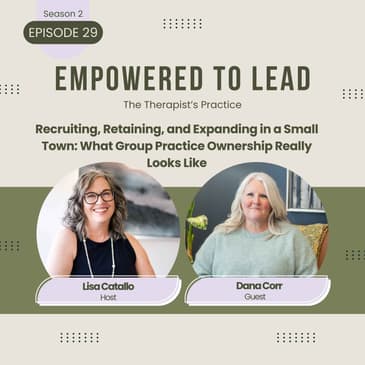
Dana Corr runs a thriving group practice in a Manitoba town of fewer than 700 people, and her journey has been full of honest lessons about hiring, expansion, boundaries, and what servant leadership actually looks like when you're the one carrying the business. If you're navigating growth in a smaller community or wondering whether your needs matter as much as everyone else's, this conversation is for you.
What You’ll Hear:
- What recruiting and retaining therapists looks like when your talent pool is a small rural community, and how Dana built most of her team through practicum students
- The honest cost of hiring out of generosity rather than fit, and what she would do differently
- Why Dana moved from a contractor model to employees, and how that decision connects to retention, expectations, and leadership clarity
- What the expansion into a five-office building taught her about marketing, caseload management, and the scarcity mindset that creeps in when the space isn't full
- How servant leadership can slide into people-pleasing, and why getting clear on your own needs is part of leading well
- Practical advice for anyone considering an expansion, including what financial buffers and a business development plan need to look like before you sign anything
Resources Mentioned on this Episode
- Valley Art Therapy — Dana's practice in Manitoba
- Time + Energy Audit for Group Practice Owners
- Group Practice Connection membership
Featured Guest:
Dana Corr is a Canadian Certified Counsellor, Registered Canadian Art Therapist, and Somatic Experiencing Practitioner, and the owner/director of Valley Art Therapy, a group practice based in rural Manitoba. She has grown the practice from a solo caseload into a multi-location team, navigating the realities of building and leading a business in a small community. Valley Art Therapy is a trauma-focused practice grounded in healing beyond words alone, integrating approaches like art and play-based therapy, somatic work, and EMDR. The practice is committed to increasing access to care in rural communities through multiple locations and strong community partnerships, while also creating a model of care that supports clinicians in doing meaningful, sustainable work.
Connect with Dana:
@valleyarttherapy
https://www.valleyarttherapy.com/
https://www.instagram.com/valleyarttherapy/
https://www.facebook.com/ValleyArtTherapy/
Meet the Host: Lisa Catallo
Lisa is a Canadian psychotherapist, group practice owner, and business coach with over eight years of experience leading a thriving, values-driven practice. She works with therapists who are ready to step into their role as confident, ethical, and intentional leaders—without burning out or getting buried in the day-to-day.
Lisa’s coaching focuses on building sustainable group practices through efficient systems, effective leadership, and a deep respect for time and energy. Her approach is calm and encouraging, offering grounded guidance that helps therapists move from overwhelm to clarity—so they can lead with confidence and purpose.
Whether she’s supporting someone just starting to grow a team or helping a seasoned leader reclaim their role as CEO, Lisa brings a blend of insight, structure, and heart to everything she does.
When she’s not coaching or connecting with therapists, you’ll find her hanging out with her children and grandchildren, reading, walking by the water, or dreaming up new ways to make business feel a little lighter.
Connect with the Host:
Website: www.grouppracticenetwork.ca
Instagram: instagram.com/grouppracticenetwork
Facebook: facebook.com/grouppracticenetwork
LinkedIn:www.linkedin.com/in/lisa-catallo
Loved this episode? Let’s take it a step further.
Grab the free Time + Energy Audit for Group Practice Owners to get super clear on where your time is going—and what it’s actually worth.
And if you're ready for consistent support, connection, and access to done-for-you tools? Come join us inside Group Practice Connection—the membership designed to help Canadian group practice owners lead with clarity and confidence.
✨ You don’t have to do this alone. Check it out here
Empowered to Lead is proud to be on the High Vibe Podcast Network Check out (Host Name) Gift in the Vault https://highvibepodcastnetwork.com/gifts
Share the Love
✨ If this episode lit something up in you… tag us on Instagram @HighVibeLeaders and @grouppracticenetwork and let us know your biggest takeaway!
🦋 Don’t forget to rate & review — it helps us reach more conscious rebels like you.
Listen & Subscribe
🎧 Spotify
Welcome back to the Empowered to Lead podcast. And so this summer we are talking to a variety of group practice owners, and really just speaking to the topics that I have heard you asking about. And so today I'm so excited to have Dana Corr come and join us. She is from Manitoba, and we're going to be talking about what it's like to recruit and retain therapists in a small town environment, and also what expansion looks like. What her experience has been with that. So Dana is a certified Canadian Canadian certified counselor. I always mix up those words for the CCC. An art therapist, a somatic experiencing practitioner, and the reason she's on here, the owner and director of Valley Art Therapy. And Dana and I have worked together for a while. I didn't even look to see how long has been has been a bit since we connected, but just watching your journey and seeing you grow as a leader and your pursuit of knowledge and the skills to lead well has just really impressed me. So I'm so happy to have you on here and share some of your story with people. Maybe introduce yourself a little more fully than I did, and then we'll dig into some of the questions.
Dana Corr:Sure. Thanks so much for having me. I feel like this is a a gift just to be able to have this little pocket of your of time with you. So always feel like a better human after talking with you. Thank you. So I am all of those things: a counselor, group practice owner. I am well. I'm more of a ranch wife than my husband. Cattle ranches. My husband and my son. So we live. We live in the sticks in a teeny tiny town. I actually googled our population. So the town I live in, we're right close to the Saskatchewan border. It has like 625 to 675 people, depending. So we're small, and I I came into counseling and therapy from education, and had spent most of my like a long career in as a teacher and a school counselor and a principal, and then made the terrifying jump into solo practice, and then things have just sort of evolved and grown from there. Did you ever think
Lisa Catallo:You would have a group practice that, like, even imagine that we would be sitting here and you're sharing your experience in this role?
Dana Corr:Not for a second. The group, like, so my practice, I actually purchased from one of my mentors. She had started Valley Art Therapy. I think it was 2003, and then in 2008, I started working with her part time alongside my full time teaching job. And then 2017, she was, you know, her partner was retiring from farming, and they were moving away. So she asked if I wanted to buy her business, and she had other. There was myself and another associate that both worked with her, and I'm like, yeah, I I think I will do this, but I'm not taking on other people. So, like, there was, and I didn't really think about that until I was, you know, looking back, getting kind of ready for our talk, and I'm like, oh yeah, I was really not going to be a group practice owner because I could have just stepped in and had somebody else that worked with me.
Lisa Catallo:Yeah,
Dana Corr:And I was like not having that. And now, where is your group practice at? Not nine years later. So it's sort of been like this narrowing, and then we had this kind of big expansion, and now it's almost narrowing again. So currently, I have myself and two full-time therapists, and one part-time, and one part-time person that will be onboarding in the summer.
Lisa Catallo:Okay. So, so you have seen a range. What was the largest your group was at at 1.9?
Dana Corr:We had nine, mostly mostly part time people. Okay, but there were nine nine therapists or clinicians at in the thick of it.
Lisa Catallo:Yeah, there's so many questions I have. I want to make sure that I ask the one question that I ask everybody: How would you describe yourself as a leader? And then I want to come back to some of that.
Dana Corr:This question really reminded me of the importance of knowing the answer to this question, right? Like that. That really. What my foundation is, and like what my beliefs are about leadership, are what guides my daily actions or the directions or my decisions. So it was really helpful to kind of consider that. So I think servant leadership really is where I ground myself in, and I think partly that maybe comes partly from having some really great mentors that that were leaders in my work life, and also some really bad ones. And so I think from that mix, I just think it's that importance of being of service to people and how we create this environment where people can feel safe and supported and connected in ways that they get to do their best work.
Lisa Catallo:Yeah,
Dana Corr:and so just being able to prioritize well-being For people, and I think the better that we can take care of clinicians, the better they are able to take care of clients. I think it just really impacts all areas. I think it's that sense of helping people to be empowered, that they get to create the work life, the work that actually integrates with their life, right? In really healthy and sustainable ways, that I can show up in this really authentic and ethical. way, yes, and just understanding people first, supporting them in their strengths, seeing where there is challenges or stressors, and then how we can work together to remove those barriers, so I think that
Lisa Catallo:I love that definition. I just joined a cohort of leaders, and we've been talking about what servant leadership is, because I think a lot of times us as group practice owners, we started as therapists, and everybody comes first in a lot of the mindset, or even why we started being a therapist because we care for people, we want them to grow. But I think as a group practice owner, what I hear quite a bit is now I become a doormat or I'm a people pleaser, and that's what I think servant leadership. What they think servant leadership is, but it's actually empowering people. It's and it's leading. It's not letting them take the lead or walk over us or whatever that happens. So I love the way that you describe that, like empowering them, empowered to lead. Yeah, yeah, just helping them to thrive under your leadership, hey.
Dana Corr:And I think that definitely my growth edge has been around like boundaries, and that my needs and the business needs actually matter. Also, yes. But and I think it's just from that place of service, I can feel less resentful when things are going a bit sideways, right? Because I think if if I'm getting that sense of resentment because certain because my needs aren't being met in that, right? Then that lands on me to be like, what am I not putting in place, or what? Where are my decisions coming from? Because if I'm of service to people and I'm considering my needs and the business needs, right? Then we should be able to navigate through whatever challenges arise.
Lisa Catallo:Yeah, because both of our needs matter equally, not one over the other. I think that's huge.
Dana Corr:Yeah,
Lisa Catallo:I love that. We could just stop right there, and people would walk away with a lot. Yeah,
Dana Corr:and I think, and in that, I think I am really trying to get better at clear expectations and Communication, right? Like just that, because that's maybe part of the structure.
Lisa Catallo:Yeah,
Dana Corr:that servant leadership has to fit into.
Lisa Catallo:So that could lead us into that question of like being in a small town. I know when we have worked together, I had to wrap my mind around the fact that you had to go off-site to different neighborhoods on different towns in order to meet people's needs. I live in a suburb, and every like people come to me, and so even in that struggle or. Yeah, let's talk a little bit about how you have attracted, hired, and then retained therapists in the middle of a very small playing field, for lack of better term.
Dana Corr:And I think, like, when you live in rural areas, Your access to care is different, and so I think one of our priorities is really how do we increase access for people so they don't have to drive two, four, or more hours to find the kind of care that we we We provide,
Lisa Catallo:yeah,
Dana Corr:and so often we will partner with agencies or community groups so that we will travel to their place and see their people, just so that it kind of reduces some of those barriers. So I think in terms of like building a team, I think that's sort of maybe where things started. Almost that need to grow is because I can only go so many places. Yes, right there. I can only do see so many clients.
Lisa Catallo:And when you're saying like driving two or four hours, if you are the only one doing that, that is exhausting,
Dana Corr:Right? And and normally we would drive like maybe might be anywhere from 45 minutes to an hour and a half, right? Like we were in that circle. But so we did. We just had this teeny tiny office in in this apartment building, and so I started in 2017, and then by 2018, I took on my first practicum student, and so that was sort of how hiring began. And then we would each have our offsite location where we would go to see clients, and we would have our in-office days. We shared it was like a one therapist office. Okay, and so really, most of my hiring has been through practicum students. I think between 2018 and 2020 25, I've had nine practicum students throughout that time. Most most have stayed on post graduation for at least some time. Not all, but most have. Okay, because I think one of the challenges in in smaller communities is you need certain qualifications and experience to be able to do this work.
Lisa Catallo:Okay,
Dana Corr:So not you know not a ton of people have masters in counseling degrees, right?
Lisa Catallo:In a small town.
Dana Corr:In a small town, right? Yeah. And when because we are such a small community, you know, it has to be a certain kind of person that is going to leave a larger center to move out to the sticks, right? That's that's not also not for everybody.
Lisa Catallo:So you wanted in person, not just virtual, too.
Dana Corr:Yeah,
Lisa Catallo:Yeah,
Dana Corr:yeah. We we are primarily in person. We are doing a little bit more online now.
Lisa Catallo:Okay,
Dana Corr:But in person is our primary thing.
Lisa Catallo:Okay, so you're having students. So even though you're not drawing from, oh, we've got all these therapists who are already trained in here. How do you find those students then? Are they starting to go from your community, or people moving To you,
Dana Corr:Most have been close. So I did have one student. I for she would drove a long way. Like it was probably close to a two-hour drive for her to come. But but also practicum placements can be tricky.
Lisa Catallo:Yes.
Dana Corr:So so with the one, the students that I currently, the students that are currently employees now, are local. Like they live relatively close. This, this, you know, they're sticking around for a longer time.
Lisa Catallo:Yeah,
Dana Corr:I think just in terms of hiring challenges, that has definitely been where I've, you know, made some not great decisions because the student needed a practicum placement, so I took them on. Not necessarily because that's what I needed or what the business needed, but it helped. It like they needed it, so it wasn't always the right fit. People
Lisa Catallo:Was that out of scarcity mindset, or is that out of oh, somebody needs it. I want to be kind and provide a space for them.
Dana Corr:It's probably a combination of things. I think a little bit of that, like this person's needs, like oh, let's just forget about the ones that I have. This person thing, I think, in and client need, right? Like the if we have students, then we can provide support for more people.
Lisa Catallo:Yeah,
Dana Corr:Often at a lower rate. So yeah, there was a lot of other people's needs considered in that decision, and and sometimes it worked great, and sometimes it did it didn't. But it came at it came at my own cost, right? So like just personal, like stress wise, or trying to to function,
Lisa Catallo:yeah.
Dana Corr:So there was some learning that happened through that for sure.
Lisa Catallo:So that leads to what you were saying before, like my needs, my business needs need to matter as much as everyone else, and we're not going down necessarily that road, but that is a messy learning, I imagine. Hey,
Dana Corr:Well, and one that I parent apparently have to repeatedly learn, and I and I think maybe that comes from a little bit of that, you know, visionary brain or the all seeing all of the potential of things,
Lisa Catallo:yeah.
Dana Corr:Rather than just focusing on, oh, what is actually the thing I'm working on right now, and does this bright shiny possibility actually match right now? So yeah.
Lisa Catallo:So you start with a lot of your people, you've started with them as students, and all have come on in some shape or form for some length of time or other. And you don't have nine people now, so not everybody has lasted forever. I and we don't know all the choices in there. There's also a piece in there that you said employee, and I forgot that you had switched your model over to employee. Why is that part of retention, and or is that part of my business matters? Where was that decision made?
Dana Corr:Partially, probably from some hard feelings when some contractors left.
Lisa Catallo:Okay,
Dana Corr:And thinking about how can I create this space where people are supported and I can provide. Maybe, or maybe I have a little bit more say in how we operate as a team.
Lisa Catallo:Yeah,
Dana Corr:Partially retention too, right? If I can have this person as an employee and get their commitment to Valley Art Therapy, that they're here for the long term, and maybe a little bit of fear about CRA coming to find me to say that actually these contractors you have are employees. So I think all of those kind of came together. And I had hired three. I think when when we moved into like because we moved into our new building, and I had hired three people that were a little bit outside of my practice, and which never really like for different reasons. I think really never got off the ground very much. So as people were starting to like reconfigure and shift, I think at that point I'm like, okay, this is I need to step into the fact that I oh yes, actually you are a business owner, and this you need to like set things up and step really into that. So I think that that was part of the employee decision, also,
Lisa Catallo:Yeah, and a lot of times that's identifying who do I want to be as a leader, how do I want to lead, and yeah, sure, there's fear of CRA and stuff like that, but even identifying like what's our setting, even in that, like I want you to drive, I want you to be in person, and so being employee gives a little more say in this is the these are the expectations in order to work at Valley Art Therapy. Yeah, yeah, okay. Tell me a little bit about the expansion. I remember that being a journey. Yeah. How was that for you to make the decision to expand out of out of the one office and go through that process?
Dana Corr:Well, the I had been looking. For a different space for some time, and my my husband would be like, no, because I just had so almost like this vision of like, well, we'll buy a house and it'll be this little homey place. And my husband was like, like, you don't want that house, no, you don't want that one. And then finally, the bank in our town closed, and he said, "Like actually, that's a good building. Like that's a good building to move into. So we had, I think, must have been 2023. At the end of 2023, we purchased the building. Um, I think in October we got possession, and then january. 1, we were moved in, renovated, and moved in and ready to go. So this space has five five offices and a large kind of a large open area. So we have different like groups or workshops or yoga classes, some things like that that can take place in that space. Okay, I think the one thing that you know, hindsight, or you know, what I know now that I maybe didn't really know then, was just not being really clear on creating that funnel of oh now we have all of these space and all of these people, what am I doing as the business owner to bring the funnel of clients to get this full? How am I marketing? How am I, you know, advertising? Like I feel like I was still doing a little more solo practice mindset,
Lisa Catallo:Yeah,
Dana Corr:With this larger group of people and more space. So,
Lisa Catallo:Did the space make you realize that? Like, oh my goodness, I have to fill five offices now.
Dana Corr:I think so, but I didn't do a very good job of it
Lisa Catallo:Okay,
Dana Corr:or I wasn't-I maybe wasn't using the data well enough to inform those decisions.
Lisa Catallo:Okay,
Dana Corr:Like in terms of where my energy was going for marketing.
Lisa Catallo:Okay. Did you know who? So this is something that I talk about quite a bit. Like, did you know who your group practice ideal client was at that point? Is that what you're saying? Like that wasn't clear.
Dana Corr:Well, I think I think that was okay.
Lisa Catallo:Okay,
Dana Corr:But I don't know how what how I was trying to reach them, whether that was really working,
Lisa Catallo:okay,
Dana Corr:Or finding what ways to bring them in, and I think just how how things have changed over time. Like when I started,
Lisa Catallo:Yes,
Dana Corr:Like you didn't have to do anything; people just found you when you were full and you did your thing, and and now like it's a different climate, yeah, in in the field. So, yeah, just maybe I wished I had been more intentional about that piece of it
Lisa Catallo:So, if somebody were to say, "Hey, I'm considering an expansion, When would I need to be intentional about reaching out to those people before we're in the new space, as we're moving, or once we're in there? What would be your advice?
Dana Corr:I think it would be really getting clear on what your priority is and what you need, right? So, if like I probably wasn't doing a lot of business development work in those days, right? Where that likely would have been really helpful, right? Or to be get really clear on, okay, are we? How are we doing Google Ads?
Lisa Catallo:Yeah.
Dana Corr:Are we, you know, using social media marketing? Like, what what is the thing, and how are we tracking it, and is it working?
Lisa Catallo:Yes. And not that you have to do all the things, right? Let Let's do one one or two of them well, and like you said and track it, so I know what what it's doing. Yeah.
Dana Corr:So I so you would do
Lisa Catallo:that before the move.
Dana Corr:Likely, it would be great to actually plan an expansion because I feel like mine just kind of happened. Like it was sort of an unexpected move in terms of a space this big for sure.
Lisa Catallo:Okay,
Dana Corr:But it's also like it's in a teeny tiny town. It's not like you know real estate is it isn't quite the same as as it is in larger centers. So we we can have. Our space not really utilized, and not it's not it's not the same kind of cost.
Lisa Catallo:Okay, yeah, as
Dana Corr:In bigger areas for sure. So yeah, I think it would be preparing for like what what finances do you have in place? Like what kind of buck, like safety accounts, or what you like that that buffers? That's the word that you have in place to kind of sustain you through those extra expenses, and then maybe that marketing or business development plan, and making those priorities right. Like that, this is the thing I'm working on, and so that becomes where my time and energy go first. Yeah.
Lisa Catallo:Are you glad you expanded, or is that a trick question?
Dana Corr:Yeah, the space is the space is lovely. I think, and my my, I think the other piece of hiring, kind of going back, I think the hiring of like support staff and the learning that I've done through that, also, I think I was always searching for the unicorn, right-the person that would just come and do all the things, and I could just relinquish responsibility because they would just do it, and so I think I had a few attempts at those kind of hires that that weren't that, and so more recently I've been able to identify this. I need this this task done, and I can hire this person for this small amount of time. Who knows how to do that? Which has really been much more cost effective and just a better return.
Lisa Catallo:Almost like permission to be creative in how you get your needs met. Then hey, it's not that it has to be this admin that I have 20 hours a week because that's what everybody does, or that's the expectation. I have this need to be met. How is that need going to be met?
Dana Corr:Right. So I had like so I had tried Google Ads. I had you know had somebody that was doing them, and then I actually hired an ad agency, and surprisingly, the results are different, right? Like it has been much more effective. So if I hadn't done that initially, I would have saved a lot of time and money.
Lisa Catallo:Yeah,
Dana Corr:By just hiring the qualified, maybe more expensive at the start, but not in the long run.
Lisa Catallo:Imagine that somebody who specializes does better than we
Dana Corr:Weird, so so surprising,
Lisa Catallo:and it frees you up to do what you do well, right? If you're sitting there going, "I now I've got this space with five offices, I need to figure out how to market that, and I'm spending so much time trying to learn this. I'm not actually filling up the space or pouring into being a leader because this drains me and takes me away. So let's hire out accordingly.
Dana Corr:Yeah,
Lisa Catallo:yeah.
Dana Corr:I think the other thing I was also doing was seeing way too many clients. Like I was having a full time caseload and shifting into this expansion.
Lisa Catallo:Yeah,
Dana Corr:because the fear of like my my caseload has to pay bills.
Lisa Catallo:Yes, right.
Dana Corr:So then I'm also not in this space of leadership and business development to make things like that happen, either. So that was it. Just took me a little bit of time to shift out of that.
Lisa Catallo:What would be one of your tips for somebody who's in that spot? There's somebody else that I'm working with, and she just did a pretty big expansion in Ontario, and we've been working through that scarcity or that fear mindset. That now I've expanded. I have to see all these clients, or I need to start seeing more again because otherwise bills aren't going to be paid. And I know the costs are different, like you said, small town person, but it's still you come into that office and there's five offices and there can be oh crap we need to fill these spaces. What? How would you encourage somebody in that in that time?
Dana Corr:I think if that is well, first of all, is that true? Like, what are the numbers really saying?
Lisa Catallo:Yes.
Dana Corr:And what would be the minimum that you would need to see to be sure your bills are paid?
Lisa Catallo:Yeah.
Dana Corr:Because I think sometimes it's that that fear makes it feel like I need to see this many, but maybe that's not. I haven't done the math to
Lisa Catallo:know that.
Dana Corr:Yeah,
Lisa Catallo:yeah.
Dana Corr:That maybe that can be the case, but it's time limited.
Lisa Catallo:Yes,
Dana Corr:right. Like like it's just not sustainable. In if you're going to be healthy and okay, yes, because it's just a lot,
Lisa Catallo:yeah.
Dana Corr:And I think another piece that I would often do is I would have my budget, and then I would have my like catastrophe budget, like what, what do we, what are the actual basic like these have to be no matter what, and what are the extras that we maybe let go of?
Lisa Catallo:Yeah, that's a good point. Hey, so if I think I have to see all these clients in order to make the bills paid, where can I cut back on some of the extras or the not the things that don't help me lead? But I'm thinking like all the things in the waiting room, or all the treats that we do, or all the nice to haves, and then doing that math on how many sessions do I need people to see so that we can start building back to that. Is that what you mean by that?
Dana Corr:Yeah,
Lisa Catallo:yeah.
Dana Corr:Another piece that we I haven't done, but it's on my upcoming list is, and this has maybe happened a little bit with reducing the number of therapists that we have is looking at renting out space,
Lisa Catallo:yeah,
Dana Corr:or you know whether that's community, other professionals, so that there's some of that revenue that comes to maybe eases up the pressure a little bit,
Lisa Catallo:Yeah, and that doesn't have to be permanent. Even when you were saying, like, how, what do I need in order to meet those needs so that I can lead well? I think a lot of times we shy away from having renters come in or finding a different way to bring in income because that's not that's not the path that I'm wanting to go, and maybe people are going to think that's who we are. Whereas, yeah, if that helps you, if that frees you up a bit or removes some of that stress, for most rental situations, it's a year, or you can even make it six months with somebody, and so we all know that this is not a permanent thing, and it's helping meet needs.
Dana Corr:Right, right. Yeah, I think that financial pressure is definitely like it's very stressful. So ways to mitigate that, or like, Yeah, it can be for a tricky time.
Lisa Catallo:We're gonna start wrapping up, but even when we talk about that, like that expansion side of things, doing some of that math before you do that, I hear a lot of people saying, "Oh, like, should I have five offices? Should I have three offices? Well, what are your goals? What are you wanting your group practice to look like? What are the finances around that? Like, really dig in. What are the actual costs between those? And then I think too for me, when the office that we had that had five offices in the times that that wasn't full, the emotional and mental pressure that I felt walking in there, going, "Oh crap! There's not enough therapists. There's empty spaces. I'm not good enough. I'm not whatever the messages that we tell ourselves. Knowing how that feels too, if you think of three, five, or whatever size of office that you're is the next for you,
Dana Corr:right? And we're just not making our best decisions when that's the space that we're in.
Lisa Catallo:Yeah,
Dana Corr:like it's just really difficult.
Lisa Catallo:Yeah,
Dana Corr:I think over the last year, I've sort of had two goals: like work less, and clinicians have full caseloads. And I think that that has been helpful, just in terms of maximizing space. So because there's so many ideas, and there's there's, and I think in that middle of that expansion. Was like let's do all of these things, like these groups and this thing, and so we're just like throwing things out there without actually having a really solid plan and implementation.
Unknown:Yeah,
Dana Corr:and yeah, like one thing at a time.
Lisa Catallo:And is this shiny object syndrome, or is this actually in alignment with what we're wanting to do? Am I feeling stressed, so I'm bringing this on, or is this actually in alignment? Maybe I'm stretching a little bit, and I don't like that. And it is in alignment. So having some of those checkpoints in there,
Dana Corr:yeah,
Lisa Catallo:eah. Thank you so much for being here, Dana. I always love talking with you, and just some of your experience. And when we were talking before, I'm pretty sure I'm going to have you back because you have lots of learnings and gleanings from being an owner and doing that well, being a good leader. And so I so appreciate you taking time to share your story. If you want to connect with Dana or see where she is in that little town above Saskatchewan, no, in Manitoba, the link to her website will be on the show notes, and hopefully, as you've been listening, if you're connecting with some of what she has talked about, if you're in a small town, or and or if you're thinking of expansion, some of her stories and learnings help you as you're making some of those decisions. So, thank you again, Dana, and we'll talk. We'll check in with everybody next week.
Dana Corr:Thanks, Lisa.