
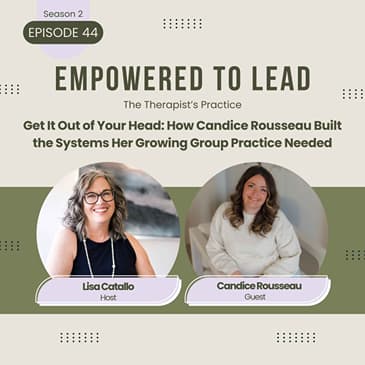
Candice Rousseau never planned on a group practice. She was full within months of opening, kept hiring so she wouldn't have to turn people away, and two and a half years later leads a team of 10 in Ontario. She shares the moment she realized she'd had the same conversation seven times, how a policies and procedures manual and quarterly stats meetings changed the way she leads, and why writing things down has freed up so much of her time.
What You’ll Hear:
- Why systems weren't on her radar beyond a strong contract, and the moment before hiring her ninth person when she realized she'd repeated the same thing seven times
- Her quarterly meetings with each clinician: stats, retention rates, and what they'd like to grow into, like workshops and speaking engagements
- Where to start if you're on your own: get your procedures into a document so they're not stored in your head, especially with decision fatigue
- The questions she used to answer on repeat (Jane payments, scheduling, and tagging), and why Lisa says Jane at your practice isn't Jane at someone else's
- Why documenting matters for long-time team members too, when processes change as you grow
- Building processes that work for both neurodivergent and neurotypical brains, and how Group Practice Connection shaped Candice's team meetings, quarterly check-ins, and manual
Resources Mentioned on this Episode
- Reflect Renew Therapy Services, Candice's group practice in Ontario, supporting individuals 12 and up, couples, and families: https://reflectresetrenewtherapyservices.com/
- Jane App, the practice management system Candice's team uses: www.jane.app
- Group Practice Connection, Lisa's membership for Canadian group practice owners, where Candice found the structure for her quarterly meetings and her policies and procedures manual (details below)
Reflection Prompts for the Week
- Which questions are you answering on repeat, and where could the answer live instead of in your head?
- If you weren't reachable for a week, would your team know how to handle a double-charged credit card or a refund?
- Does your onboarding teach new clinicians how your practice uses your EMR, or does it assume they already know?
- Are long-time team members still doing things the old way because the new way isn't written down?
- What could you hand off today if the process was documented?
- What would you do with the time you'd get back?
Featured Guest:
Candice Rousseau, BA, BSW, MSW, RSW Founder, Clinical Director & Therapist | Reflect Reset Renew Therapy Services Candice Rousseau is a Registered Social Worker with 15 years of experience across various social service settings. Two and a half years ago, she founded Reflect Reset Renew Therapy Services in Welland, Ontario, which quickly grew from a solo practice into a thriving group practice with a team of ten.
As the practice expanded, Candice found herself navigating the transition from clinician to business owner, learning firsthand the challenges of leadership, delegation, and implementing sustainable systems while simultaneously growing a business. Much of her journey has involved learning through trial and error, refining processes, and finding ways to create a practice that can thrive without requiring her involvement in every aspect of its day-to-day operations.
At the heart of Candice's approach is a commitment to authenticity, human connection, collaboration, and community. She believes that building a successful practice is about more than growth and numbers. It's about fostering meaningful relationships, creating a supportive team culture, and building an environment where both clinicians and the business can grow and thrive.
With a long-term vision of expanding into a multidisciplinary women's health and wellness centre, Candice continues to balance her clinical work with business development, focusing on intentional growth, sustainability, and strengthening the systems that support her team. She brings an authentic, down-to-earth perspective to the realities of group practice ownership, embracing both the successes and inevitable growing pains along the way.
Connect with Candice:
Website: https://reflectresetrenewtherapyservices.com/
Instagram: https://www.instagram.com/rrrtherapyservices/?hl=en
Facebook: https://www.facebook.com/profile.php?id=61559858724854
LinkedIn: https://www.linkedin.com/in/candice-rousseau-5b8572290/
Meet the Host: Lisa Catallo
Lisa is a Canadian psychotherapist, group practice owner, and business coach with over eight years of experience leading a thriving, values-driven practice. She works with therapists who are ready to step into their role as confident, ethical, and intentional leaders—without burning out or getting buried in the day-to-day.
Lisa’s coaching focuses on building sustainable group practices through efficient systems, effective leadership, and a deep respect for time and energy. Her approach is calm and encouraging, offering grounded guidance that helps therapists move from overwhelm to clarity—so they can lead with confidence and purpose.
Whether she’s supporting someone just starting to grow a team or helping a seasoned leader reclaim their role as CEO, Lisa brings a blend of insight, structure, and heart to everything she does.
When she’s not coaching or connecting with therapists, you’ll find her hanging out with her children and grandchildren, reading, walking by the water, or dreaming up new ways to make business feel a little lighter.
Connect with the Host:
Website: www.grouppracticenetwork.ca
Instagram: instagram.com/grouppracticenetwork
Facebook: facebook.com/grouppracticenetwork
LinkedIn:www.linkedin.com/in/lisa-catallo
Loved this episode? Let’s take it a step further.
Grab the free Time + Energy Audit for Group Practice Owners to get super clear on where your time is going—and what it’s actually worth.
And if you're ready for consistent support, connection, and access to done-for-you tools? Come join us inside Group Practice Connection—the membership designed to help Canadian group practice owners lead with clarity and confidence.
✨ You don’t have to do this alone. Check it out here
Empowered to Lead is proud to be on the High Vibe Podcast Network Check out Lisa's Gift in the Vault https://highvibepodcastnetwork.com/gifts
Share the Love
✨ If this episode lit something up in you… tag us on Instagram @HighVibeLeaders and @grouppracticenetwork and let us know your biggest takeaway!
🦋 Don’t forget to rate & review — it helps us reach more conscious rebels like you.
Listen & Subscribe
🎧 Spotify
Hello and welcome back to the Empowered to Lead podcast. Today I have a guest, Candice Rousseau, who joins us from Ontario. I'm going to let you introduce yourself and your group practice a little bit, but excited to have you share a little bit of your experience with systems and how that has helped you, or and how they have formed your experience as a leader. I think that's something that you'll hear a lot from me. That I think is so important to make this sustainable, to make it so that our businesses can thrive. And so I'm excited to hear Candace's story. So maybe just start with a little introduction to you, your group practice, and a little bit about you.
Candice Rousseau:Sure, sure. So first of all, thanks for having me. I'm excited to be here. So a little bit about me. My background is social work. I've been a social worker for over 15 years now, and I have worked in a variety of different settings, including municipal government, the hospital system, long-term care, to name a few. I recently opened. I guess it's not recent anymore. Two and a half years ago, I opened my practice, and although I still work at the hospital because it does provide a bit of a different challenge, a bit of a different lens of social work, I'm predominantly 99.5% in my in my practice. So the practice that I have here in Ontario has a team. We're a team of 10. So there is eight therapists, fully regulated therapists between psychotherapists and social workers, and then I have one student who's doing her master's in social work, who's offering low cost and pro bono services to folks in our community. And then we have an operations slash admin manager who is virtual, who helps support with things on the back end. So our team supports people right across the lifespan, as young as 12, going up, we support couples, families, and we do a lot of workshops, speaking engagements. It's kind of something that we're growing into right now. Yeah, something that sums it up.
Lisa Catallo:Awesome. That sounds like a fairly decent-sized team. Did you always know that you wanted to have a group practice.
Candice Rousseau:Honestly, no, no. I I initially kind of wanted to go into private practice. I was working at the hospital part time at the time, and I took on a student. I love doing kind of mentorship. That's a passion of mine. I took on a student, and I thought, okay, well, I'll open my practice, and you know, I can slowly kind of get into things and learn as I go along, and you know, slowly grow my practice and seeing kind of people's experiences online. I thought, okay, it might take a year to get you know maybe three quarters of a caseload. So I took on a student, and within a few months of opening the practice, I no longer had capacity to take on clients. So to be quite honest, I was kind of like, oh my gosh, I I don't want to turn people away. So I was like, maybe I'll just hire someone, and I contacted someone I went to school with, and she's she was like, yeah, I'm on board. So we we went ahead and did that. My primary focus is on couples, relationships, and communication. Then again, at full capacity for couples, and I thought, oh my gosh! Well, I don't want to turn people away. So then I hired a couples therapist, and that was probably within the first four months of opening the practice. And then once I was done with the student, my commitment with the student at the hospital, I then dropped down to casual, and then came to the practice full time, filled my caseload, and then just slowly kind of built the team from there. But it was always on the premise of you know of oh my goodness I don't want to turn people away we better hire someone else so yeah then the intention was never a group practice because I really thought that you know it would take a while to gain momentum and build the practice but the experience was different.
Lisa Catallo:One of the questions that I like to ask is how would you describe yourself as a leader.
Candice Rousseau:It's funny. I asked a couple people on the team kind of what their thoughts were, just to kind of see if they kind of aligned, and and then I kind of reflected on to me what a good leader is, and kind of base my answer on those things. So I remember. I feel like I have to to shout out the individual who's inspired me to be the leader that I am. Her name is Miranda, and I know none of you know who she is, but she's fantastic. She was a manager that I had a long while ago, and she was just she's a phenomenal human. She's a phenomenal human, and I just was very inspired by how she led. She's very authentic, real human, and I really valued that about her. I felt safe and comfortable talking to her when I had any challenges or needed any help or support with something, so that kind of formed the foundation of who I wanted to be as a leader. My team basically they had said, "You're a go getter. You're ambitious. You you are always looking for the next thing and always wanting to grow." So I would definitely agree with that. I would say that I really value authenticity again, and being human, recognizing that I'm not the person who knows everything in the room. I like to bring my team in on making decisions and seeing and getting their input and seeing what their thoughts are. And although I don't always necessarily implement what they suggest, I really do value their opinion and what their thoughts are because at the end of the day they're using the practice they're in the rooms they're kind of working with their clients and we all have an experience that can contribute to the decisions that are being made here that will impact everyone and ultimately the culture. Yeah, I think that would sum it up. So collaborative, authentic, human, real. You know, definitely not the smartest person in the room. Always willing to learn.
Lisa Catallo:It's funny how like different people just really stand out. Hey, like my first boss, she was like, "I'm gonna tell." I was 17 or 18. Like my first real job, she was like, "I'm going to teach you things. I'm going to tell you twice, and if you haven't got it by then, then you're going to have to just go figure it out on your own." And that really shaped who I was. And like, oh, I need to, you know, it didn't help my perfectionism at all, but being a good leader, like she was a good leader, she had high expectations and she fed in a lot of what you were saying too. But certain things stand out and shape us and inform who we want to be or don't want to be as we have our businesses too. Hey,
Candice Rousseau:yeah, I've had leaders before who are not approachable. Who are you know you're you're fearful, you're scared. Oh, if I make a mistake, you know what is that going to look like? And I that's far from how I wanted to be. I want people to feel comfortable and safe. And of course, we want our clinicians to stay ultimately.
Unknown:Yes. Right.
Lisa Catallo:Yeah.
Candice Rousseau:Most importantly, I mean, we celebrate them if they want to move on, of course. Yes, but you know, ultimately, we want them to stay.
Lisa Catallo:Yeah. So we were going to chat about systems. When you think about that word, is that something that is natural to you? Like you love to have systems in place, or I was talking to one person on another episode, and she was like, "Yeah, that that has not been my love, but now I see why it's helpful." What's your relationship with systems and structure?
Candice Rousseau:I would say my my relationship aligns with the individual that you just because I thought that the business was going to take time to build my thought process as well. I got time; I can learn it. Like there's no rush, right? It's just me. You know, I have time. Well, that worked against me very quickly because I didn't know how to hire. I didn't know the questions to ask. I didn't even know the first thing about putting up a job posting, yes. So I'm still learning and growing in that aspect, and kind of refining the interview process, and kind of determining. And I think we've talked a lot about this, like the culture that that I'm trying to kind of facilitate here of it being very community oriented and kind of relationship oriented between myself and the folks that work here, so yeah, systems were not even on my radar. Like I did, I did hire a lawyer in the beginning to put together like a really strong contract. So that is definitely something that I prioritized based on a previous experience at a group practice. So that was really and truly the only kind of thing that was systemic, like a system in nature. I guess structure, yeah. But everything else, yeah. I just kind of learned as I went, and then probably about like eight months ago, maybe 10 months ago, I was getting ready to hire the ninth person, and I thought, oh my goodness, I've repeated the same thing seven times. I can't remember who I told what to. Yes, I'm constantly having the same conversation. Things are changing. People are making suggestions, and there's nothing documented in terms of how to navigate some of these processes. And the more people that got here, it was it was completely necessary. And I remember sitting right here in my office and thinking, "Oh my gosh, Candace, like you need to get your beep together, or like you're just gonna unravel, and that's kind of when I think I sought you out at that point in time, looking for someone to help me
Candice Rousseau:understand. Kind of first of all, what are even systems that would be put in a group practice? What would even be necessary? And then from there, I implemented like a policies and procedure manual that I think it's like 100 pages, and it kind of overviews everything in the clinic from kind of the simple little things on how to turn the TV on to kind of the bigger the bigger things with following up with clients and things like that when they haven't rebooked. Another system that I put into place is meeting regularly with the team, so meeting with everybody together and then. Doing quarterly meetings with everybody where we look at where we look at stats. We look at retention rates. We look at kind of all the numbers that are impacting the clinic and impacting their work. We also talk about you know what what is it you'd like to do? Is there is there anything? Would you like to do speaking engagements? Do you want to engage in workshops? You know, can I can I help facilitate that? Can I advertise you? Can I share with people? These are your areas of expertise, and you're willing to provide, you know, that service to organizations or whomever is looking for them. So that has been really helpful. But one thing I can tell you, and I'm going to have to follow up with you on this personally at some point, is we just hired someone to do Google Ads, which is fantastic. And from what I understand, they're great. You know, they just started like three days ago, so we don't have any kind of metrics or anything yet. Is how to measure some of those things a little bit more effectively. Because although Jane is great and offers a lot of reports, I find they're not detailed enough to be able to give really specific metrics. So my operations manager has been; she's brilliant, she's wonderful.
Candice Rousseau:She kind of goes into AI and she puts this kind of report in and that report in, and then she kind of merges the reports and then kind of asks AI to kind of to pump something out that gives a little bit more detail, but still isn't refined enough to give as much detail as we're looking for, especially when you're paying what you're paying for Google Ads. You want to make sure that like you're on point with that. The retention rates are good. You know, people are keeping keeping their clients, and then doing that coaching if they're not right. So those are some of the systems that I have in place so far. I know that there's likely more that I can put in place, but I'm not quite sure what those are yet. So it's it's we're always evolving, we're always growing, always looking at implementing anything that can help the practice flow better. And most importantly, there's so many things that I want to do out there that are kind of like a spinoff from the group practice, and I want to be able to know that I can kind of step away from the group practice a little bit, and that it can function on its own. And if something is needed, there's a policy for that, there's a procedure for that, or there's someone who knows how to navigate that when I'm not accessible, and kind of handing over some of those responsibilities to someone else, so I can really focus on the things that I'm excited and passionate about, which is ultimately building community and connecting with community, but that's hard to do when you're running a group practice and doing your own clinical work too.
Lisa Catallo:When when you're the only one that knows all the answers or how we do things too, hey, I think even when you were saying like, for if you want to step away or or get busier on other things, other people know how to do it. I think it's also just as important for our team. Like so, thinking of admin for her to keep up the systems and the procedures or the procedures manual, because if she's off sick or takes off, and I have to step in. That's a little bit of a beep show too, because I that's not top of mind. It's not my skill set anymore, and so it can go both ways.
Candice Rousseau:I mean, I'd have to argue that it's never been my skill set. Honest, woman isn't my thing.
Unknown:Yeah, you
Candice Rousseau:have to wear that hat in the beginning, right? Until you have the capacity from a financial perspective to hire someone to help support you with those things.
Lisa Catallo:Yeah. What has made what's what has the implementation of systems and naming your procedures? What kind of difference has that made for you as a leader to clarify those things that you have so far?
Candice Rousseau:It's really freed up a lot of my time. So when you know it took a little while, but the staff would always come to me for, oh, this client needs this payment, or you know they need this or that, or whatever the case may be from an administrative lens, and now I, you know, I just refer them to the operations manager, and then if she is like, well, that's kind of documented in the policy manual, she might just refer them back to kind of looking at the policy manual. So it's resulted in my ability to be able to delegate more and and kind of have faith and and clarity in terms of what to delegate, kind of putting those processes and things in place, kind of gave me clarity and organization of okay, yeah, no, this isn't me that does this. This is kind of this role, so I'm just going to kind of pass that on. And now we've gotten to a point because I think our operations manager has been with us, I think, for six months now. Now, you know I rarely get emails from from the therapists.
Lisa Catallo:Yeah, it all goes. Hopefully, she's getting minimal ones too. If if they know what to do, hey. Um. So I would say if you're starting out, um. With systems and structure, walking through what your ideal client experience is, or what your client experience is from acquisition through retention, what your therapist experience is, and then fleshing that out to be a little more particular in certain areas from there. When you got to last year, and you're bringing someone on, and you said like, "I'm answering the same questions. I need to clarify some of these things." Which one did you start with? Because somebody might be listening and going, "Yeah, Kay, I have nothing, and it sounds like I need everything. But where do I even start
Candice Rousseau:in terms of implementing systems?
Lisa Catallo:Yeah, even just like, well, maybe rewording of like which one has been the most important now that it's clarified. What's what's made the most impact on your business structure or how things run. Put it that way, maybe.
Candice Rousseau:I would say hiring an operations manager.
Lisa Catallo:Okay,
Candice Rousseau:and delegating.
Lisa Catallo:Okay, if you think somebody is just on their own and they want to get started with naming systems, these are the procedures in our business, so that they don't everybody doesn't have to keep coming to them. Other than hiring somebody, which one would you suggest they start with?
Candice Rousseau:I would say probably like the policies or standard reading standard operating procedures, because in that way there's a document, right? You don't have to store that in your head. You can look at a document. You can forward a document. You can remind yourself what's on that document versus having it stored in your mind and hoping that you know you got all the information correct. Just being able to reference something tangible that exists for guidance. There's enough stuff going on in there. There's a lot of decisions. As entrepreneurs, like we get decision making fatigue a lot, right? So it's nice to just put that on paper and put that aside.
Lisa Catallo:When you think about the questions that people used to ask you the most, which questions were you answering on repeat? Do you remember?
Candice Rousseau:That's a good question. A lot around how to use Jane.
Lisa Catallo:Okay.
Candice Rousseau:Kind of implementing payments. There's some folks here that are good with technology, and there's some that are who are self-identified, not good at technology.
Lisa Catallo:Yes.
Candice Rousseau:So there was a lot of questions around kind of technology, we recently also implemented implemented Halcyon.
Lisa Catallo:Okay, yeah.
Candice Rousseau:So yeah, again, like we have to build some procedures and policies around that because there are some additional steps. Putting together maybe some videos so people can watch videos and kind of look at how that process is done because everybody's a different learner. So we want to be mindful of that too, and putting those together so we can just forward them to people instead of having to meet with six different people and kind of going through a tutorial or going through direction on how to do that. So yeah, I think probably mostly around payment and oh, another thing too. Oh gosh, this was a nightmare. Is tagging on Jane?
Lisa Catallo:Yeah, yeah,
Candice Rousseau:that was a bit of a nightmare for us for a bit, but it's good now. But yeah, that that's another one that people are always asking questions about, and I personally don't use it because I just it can complicate things and it can make a mess. So it isn't something that I knew to know too much about. I kind of avoid it if I can. Let Michelle, the operations manager, handle it. Yes, but yeah, I'd have to say kind of the the functionality of Jane between payments and kind of scheduling.
Lisa Catallo:I think that's like something that we miss in onboarding quite often too. So you bring somebody on; they've been at another practice or they've got their own group practice, and they use the same system as you, Jane Owl, or whatever. And we make assumptions that they know how to use it in your practice. Yeah, but Jane is not the same at Panorama as it is at your business, or it's the same tool, but we use it differently, and it's almost like remember those books that were like woodworking for dummies kind of thing. Yes, the yellow and black books, kind of like Jane for dummies. And not that anybody's dumb, but dumb it down, really simplify it, and make sure that they actually know how we use it here. How to take payment. Who takes certain payments? When do you charge for no shows and cancelations, and when do you waive that? How do you make that decision if you're not sure? And spelling that out in a document is can be part of systems, but also okay when. We onboard you. That's one of our onboarding meetings. Is saying this is how we use Jane. This is how you make that decision on these different nuances, taking payments and stuff. So, at least for me, not just go read this or watch a video. I'm gonna tell you, and then if you ask again, kind of like what my manager, I guess, was saying, like, okay, the second time you ask, you get the video or the document. Next time, you need to figure that out, kind of thing. But having it written down just backs up all of that. I think also when you have something written down as a leader, it's easy to go and refer to it when you're trying to teach somebody how to do it. You're not having to, you know, maybe did I tell somebody the same thing? Is this the same procedure? Maybe that's just me, but I forget some of those things in between too,
Candice Rousseau:yeah. Same.
Lisa Catallo:What would you tell somebody who is, you know, five or 10 people in and haven't really articulated systems? What would you say? Here's a case for putting some structure into your business. This is why I think this would be important.
Candice Rousseau:Well, I mean, I think kind of going back to my own experience when I was hiring that ninth person of, you know, if there's not a strong foundation here, what's going to happen if something gets shaken? There's nothing to refer to. There's nothing to access. You know, what happens if? I mean, God forbid, knock on wood. You know, something were to happen, and I'm not accessible, right? If there's, you know, say for example, we double charge a credit card, and someone has a limitation on their credit card, and they need to be refunded, right? And I'm not accessible, you know, something along those lines. You know, we're we're able to know how to deal with that, right? Yeah. So I would say that you know if I had to rewind, I mean I'm not one for regret, so I can't really say that. But if I was, I would have probably implemented like a policy and procedure manual a heck of a lot sooner, because it has been so incredibly helpful. Even it was even helpful just writing it, like sitting down myself and thinking, okay, what are all the things that need to be put in a process that have steps that can be followed, right? And then you know we allow people to bring their dogs in, right? Like, what does the process look for that look like for that? You know, from the small things to the big things, and just sitting down, it's like you look at it and you're like, oh my goodness, wow! Like, there's a lot of things that like need to be a well-oiled machine around here that I wasn't even like wasn't even on my radar, right? So yeah,
Lisa Catallo:because by the time you get to eight or nine therapists, it is a well-oiled machine, and so it can be hard to be like, how do I spell that out? Or we don't need to spell that. It just happens. But as you bring people on, they don't know that language yet, and so yeah, yeah,
Candice Rousseau:absolutely. And I mean, then you have therapists that have been here for two years, or who have started with me, who are used to doing things one way, but we've had to evolve and change because there has been additional people that have been added, and that needs to look different now. There's also that too, right? Is now this is kind of documented. You know, it's not real unless it's documented. You know, for them to kind of have to switch over to maybe whatever the new process is to help kind of the the clinic function
Lisa Catallo:clarity for everybody.
Candice Rousseau:Yeah,
Lisa Catallo:yeah. You joined the group practice connection. How has that helped you? I didn't ask you this at the beginning or before we joined. How has that helped with systems and procedures to be? It is helping
Candice Rousseau:so actually so many ways. I would say the systems that I actually have implemented were a result of the meetings we've had of the online platform. You know how I structure my team meetings now, right? That that has changed a little bit to make sure that I'm incorporating all the conversation that needs to happen. The quarterly meetings, like I went online and I utilized kind of your structure and your format for the quarterly meetings in terms of kind of what stats to look at, what conversations to have, you know, what that coaching looks like. If there's some, you know, things in the numbers that need to be talked about, the policy and procedures, right? Like even just that in itself. I, you know, I'm going to call myself out. Like, I didn't even think. Like, it's kind of embarrassing, but I didn't even think to like have this this document, this very big document in place until I kind of heard you speak and say, like, "Okay, this is important." Like, you know, and yeah, so it's been tremendously helpful. One thing that I want to give you kudos for, which I kind of sing your praises all the time, is, you know, I've disclosed before in the meetings that I have ADHD and my brain. We know our ADHD brains work differently than you know someone who's not neurodivergent, and some of the processes were challenging to kind of wrap my ADHD brain around, but I want to like thank you and give you kudos because you like didn't miss a beat. You're like, okay, what do we do? What do we do to change this process to make it kind of helpful for the ADHD brain and for the non neurodivergent brain? So I just you know I don't think I've ever expressed my gratitude in that, but here we are today, me expressing my gratitude that it's nice that you're all able to kind of change that up on the fly and recognize that oh, there's other perspectives here, and how can we how can we do this in a way that feels good to you and works for your brain? So thank you.
Lisa Catallo:Welcome. That's nice to hear. I'm glad that it was it worked. Thank you so much for taking time out of your day to share your experience with systems, and I think it's been a really good conversation. I am so like I need systems and structure that is like day one, so it's good for me to talk to people who are like, no, I never even thought of that, and just even to hear that it can make a difference. Even to hear you say like it freed up my time, right? It gives you more capacity to do other things that fill your tank. And so, if somebody's listening and you're finding you're resenting answering those questions at the 10,000,000th time, write it down. Give them somewhere else to go other than your brain, and just encourage people to find systems, articulate them, and make it so that it works for your team and you. Thank you, Candice, for joining us. It was great to chat with you, and for the people who are listening in, thanks for joining us, and look forward to connecting again next week.