
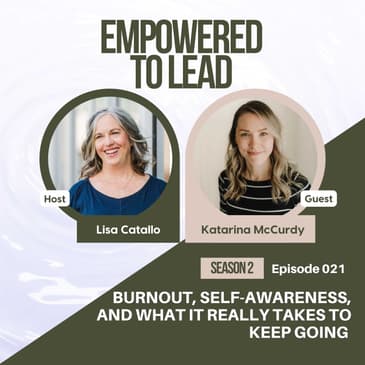
What does burnout actually feel like from the inside — and how do you know you're in it before it's too late? In this conversation, Lisa sits down with Katarina McCurdy, a therapist, clinical supervisor, workshop facilitator, and podcast host, to talk about the hidden emotional cost of keeping all the plates spinning, and what it really takes to slow down before your body does it for you.
What You’ll Hear:
- How Katarina went from frontline trauma work to private practice, clinical supervision, and launching her own podcast, and what she learned about pacing herself along the way
- Why burnout sneaks up on us like a lobster in slowly boiling water, and what the early signs actually look like in hindsight
- The difference between knowing what self-care is and actually practicing it on yourself
- Why slowing down is a skill, not just a suggestion, and how distress tolerance plays a bigger role in prevention than most people realize
- How to assess your expectations of yourself heading into a slower season, and why perfectionism and shame love to live in that space
- What congruence has to do with authentic leadership and why it matters more than performance
- The three things Kat would encourage group practice owners to consider if they are heading into burnout
Resources Mentioned
- Katarina's podcast: Advantage — available wherever you listen to podcasts
- Advantage Podcast on Instagram: @advantage.podcast
- Katarina's private practice website: vantagecounseling.com
Featured Guest: Katarina McCurdy
With just under 10 years of experience as a Registered Clinical Counsellor (RCC), training facilitator, practicum clinical supervisor, and podcast host, Katarina is passionate about helping people overcome trauma, anxiety, stress, and burnout. She supports individuals and teams in achieving personal and professional growth while maintaining strong mental and emotional well-being. Katarina holds a Master of Arts in Counselling Psychology and multiple certifications in trauma-informed therapies. Alongside running her private practice as an RCC, specializing in first responders, youth, and adults, she also designs and facilitates workshops for front-line workers and professionals on burnout prevention, resilience, leadership support, and crisis debriefing.
Meet the Host: Lisa Catallo
Lisa is a Canadian psychotherapist, group practice owner, and business coach with over eight years of experience leading a thriving, values-driven practice. She works with therapists who are ready to step into their role as confident, ethical, and intentional leaders—without burning out or getting buried in the day-to-day.
Lisa’s coaching focuses on building sustainable group practices through efficient systems, effective leadership, and a deep respect for time and energy. Her approach is calm and encouraging, offering grounded guidance that helps therapists move from overwhelm to clarity—so they can lead with confidence and purpose.
Whether she’s supporting someone just starting to grow a team or helping a seasoned leader reclaim their role as CEO, Lisa brings a blend of insight, structure, and heart to everything she does.
When she’s not coaching or connecting with therapists, you’ll find her hanging out with her children and grandchildren, reading, walking by the water, or dreaming up new ways to make business feel a little lighter.
Connect with the Host:
Website: www.grouppracticenetwork.ca
Instagram: instagram.com/grouppracticenetwork
Facebook: facebook.com/grouppracticenetwork
LinkedIn:www.linkedin.com/in/lisa-catallo
Loved this episode? Let’s take it a step further.
Grab the free Time + Energy Audit for Group Practice Owners to get super clear on where your time is going—and what it’s actually worth.
And if you're ready for consistent support, connection, and access to done-for-you tools? Come join us inside Group Practice Connection—the membership designed to help Canadian group practice owners lead with clarity and confidence.
✨ You don’t have to do this alone. Check it out here
Empowered to Lead is proud to be on the High Vibe Podcast Network Check out (Host Name) Gift in the Vault https://highvibepodcastnetwork.com/gifts
Share the Love
✨ If this episode lit something up in you… tag us on Instagram @HighVibeLeaders and @grouppracticenetwork and let us know your biggest takeaway!
🦋 Don’t forget to rate & review — it helps us reach more conscious rebels like you.
Listen & Subscribe
🎧 Spotify
[00:00:05] You're listening to Empowered to Lead, the therapist's practice. I'm Lisa Catallo, therapist, business coach, and your go-to for all things leadership and sustainable practice growth. This is your space for real talk, smart strategies, and grounded support to help you lead with confidence, work with intention, and build a business that actually works for you. Let's dive in.
[00:00:32] Welcome back to the Empowered to Lead podcast. I'm so glad that you're here. I'm really looking forward to this conversation. So I have Katarina McCurdy on here. It sounds really weird to call your whole full name. So Katarina, Kat, you'll hear me slip in too, but we have been through school together. We've been alongside each other's journeys for 10 years now, which just seems like a huge number.
[00:01:01] But I'm really looking forward to this conversation because I think that some of your passions and what you have really honed the end on in your work is something that we all need to hear. So let's start with a little bit of your journey. So I just mentioned we went to school together. We'll come to the question that I always ask, but let's hear what your journey has been with being a therapist and to where you are today.
[00:01:30] Well, thank you for having me. It is wild to think that 10 years later, here we are sitting on couch, having this conversation, which is really exciting and to celebrate each other's journeys and successes along the way. So this is really cool. Thank you.
[00:01:47] So, yeah. So we did school together. Long story short, I always love to start with the fact that I entered into therapy because I worked in a heavily trauma-informed field working as a frontline worker. So that's what brought me into the love of trauma and diving deep with people and being able to explore these different pieces.
[00:02:13] So I started private practice right off the bat with you. Yeah. Or I guess we technically joined a practice. Yes. That was how we started and kind of getting our feet wet and also not having any clue. Oh, my word. What are you doing? And I remember it was a little bit like bringing a kid home for the first time. You're thinking, nobody should trust me. Like, I don't know what I'm doing.
[00:02:42] Anyway, lots has happened since then, of course. But I started private practice right away, which was not the original goal for me. So that took me by surprise. Okay. But very grateful for having the opportunity to learn so much about what it means to run a business, how to run a practice, how to market yourself, how to gain clients. That was a huge learning curve. Along the way, I had two kids. So there's, you know, some time off here and there.
[00:03:10] And because I had kids, I felt like I bounced around a lot from office to office, different rentals, working in different spaces, learning to just appreciate what I had, even if it wasn't what I had always imagined it would be. So that was very humbling as well. But I've essentially been doing private practice for just under nine years or however long it's been since we started. Yeah.
[00:03:38] Along the way, I did do some contract work for a physiotherapy clinic. And I worked with a multidisciplinary team. And that was such a valuable learning opportunity for me. I loved working with different professionals from fields and coming together and kind of having this holistic approach to care. At the same time, it wasn't the greatest fit. So I ended my time there with my second pregnancy.
[00:04:06] And then I just came back to private practice where I would say in the last couple of years, I focused more on running workshops, trainings for frontline workers, business owners, or anybody like a working professional who's managing burnout, stress. That has been incredibly life-giving because burnout is so big, so round. So I do a lot of that for organizations.
[00:04:34] And then just less than a year ago, I launched my own podcast. Yeah. So just called Advantage. And it's all about shifting from stress to strategy. So learning tools, strategies for managing chronic stress to prevent burnout. But the bigger picture, my overall goal in starting this podcast was wanting to help people connect more deeply with themselves.
[00:05:02] So my passion is going below the surface because there are so many tools out there on what people can do, what they can use. And that's great. But our tools are only as valuable as our self-awareness.
[00:05:21] So really wanting to help people understand themselves and what drives their stress and their burnout, like our expectations, our beliefs, how we perceive ourselves. And at the end of the day, what we yearn for. Yeah. Right? And I believe that that ultimately drives everything above our feelings, how we cope. And it's like, well, I'm passionate about helping people experience sustainable change.
[00:05:51] And in order to create sustainable change, we have to dig a little bit deeper. So that's been the fun part. But I think that's kind of my snapshot, my time for when I started to, I guess, where I'm at now. You have a bunch of different roles even or opportunities. What are all the things that you do right now? You've got private practice. You've got a podcast. You're doing supervision, practicum students.
[00:06:21] You do these workshops. That's right. I also forgot to mention that during the school year, I've picked up another contract job, which is another passion of mine. I promise I'm not working for the sake of working. I feel like I'm over that season of life. But yeah, I'm a clinical supervisor at a university and a master's program.
[00:06:44] And so, yeah, I get to support students who are going into the field of counseling and supervise them as they meet with clients and teach them kind of like the basics and the foundations of therapy. And that's been really cool. Yes. Sorry. I don't know if I'm answering your question, but. You totally answered the question. Different hats. That's what's fun for me because I like change. Yeah. I like variety.
[00:07:12] And so, this is my way of kind of dipping my toes into different things and getting to experience and grow myself. I'm driven by wanting to understand what I'm capable of. Like, what are my own limitations? Like, there's a curiosity there for me. Yeah. And so, there's only one way to find out, which is to try. Try a pull the best. What am I good at?
[00:07:41] And what's, yeah, what are my limitations? So, that's a big driving force. I have so many questions that have come out of just what you have shared here. But, so, the reason why I highlighted all the hats that you wear is because a lot of times, well, this, my podcast is for clinic owners. And what I hear a lot is all those hats that we wear. And so, you're not a clinic owner. You're not a group practice owner.
[00:08:11] And you get the piece of you're juggling all of these different roles as we're talking here today. When you were saying you have all of those things in place and then kind of like seeing where you go or what you're capable of, does that help prevent burnout for you? Like having variety in there? That's actually a really good question.
[00:08:40] I know that it gives me purpose. I can say that for sure. I do believe that when we have a sense of purpose, I think that can mitigate some burnout in the sense that we have reason to pursue what we pursue. But it doesn't, I think it does both.
[00:09:09] Okay. It keeps me going. It gives me, gives me a reason to do what I do. But it doesn't always prevent me from experiencing chronic stress. Okay. And I think, I actually truly believe this is a bit of a personality thing too. Part of my personality is that when I get excited about something, I tend to have this all or nothing mentality. Really? I don't know what that's like.
[00:09:39] You're sure not alone. So when I send that mentality and I give something my all. Yeah. Not that I believe that that's a wrong in and of itself, but there's lots to be cautious about in that. Yeah. And when I give my all, I forget that I have these other hats that I still need to wear along the way. Like you and mom, right? Being a wife or being a friend.
[00:10:07] And so that doesn't necessarily always prevent burnout. Okay. It just more allows me to kind of have this momentum to carry forward and be excited about what I'm doing. Show up in the best way that I can. So, again, bunch of questions coming up. We are not sticking to the questions. Right now, anyway.
[00:10:34] So, I talk a lot about shiny object syndrome and coming back to your why and where are you wanting to go kind of thing. So, it sounds like you are saying if there's purpose in some of these choices that you're making of where you spend your energy, if there's balance of remembering, okay, this is super exciting and I have these other things in place.
[00:11:04] So, yeah, how do you make sure it's not shiny object syndrome that you're like, oh, that sounds fun. Let's do a podcast or, you know, that workshop sounds great. How do you keep that in line and make sure that that's actually part of your purpose, part of the value that you need to keep going?
[00:11:27] I, before I started the podcast, here's another part of my personality is that when I get excited, I want to start things right away. And so, with this podcast, I really pushed myself to take time to think about what I was doing. I had conversations with other people that I respect and that I know believe in me. And so, I was very intentional and selective of who I reached out to. Saying, hey, here's my idea.
[00:11:57] Here's what I'm excited about. Here's where I think this could go. And then allow them to also come alongside me and speak into this part of my life. And I received nothing but encouragement, which was really validating. That was actually quite emotional for me. And at the same time, it allowed, it's kind of like forcing myself to slow down enough to go. Yeah. Like, am I sure? Can I really commit to this?
[00:12:25] Even though it seems like just a fun idea at first. So, that was the initial part before starting. It was more, let's not be reactive. Let's actually talk this through and what is it going to look like. But I'll be very honest with you. Along the way, I have had some very honest moments with myself where I've lost some of my motivation and drive. Like, not because I don't believe in the podcast, not because I don't believe in what I'm doing.
[00:12:58] But it's made me nervous because I'm like, oh, am I treating this like object syndrome? Like, did I just get really excited about something and now I don't want to do it anymore? So, even there, instead of just moving on, it's allowed me to really focus back in on myself and reflect on, okay, what's the barrier? Like, why am I losing steam? Is it that I'm overwhelmed?
[00:13:26] Is it that I've put too much into it too quickly? I'm not pacing myself. What is it? And it's asking those questions. Yeah. And then it's having this pep talk with myself and going, hey, don't give up. It's so meaningful. And this might be where you typically lose steam and you are tempted to just kind of walk away. Yeah. But this is bigger than that.
[00:13:52] And then again, to some of those people, I think support has been huge in allowing other people to also reflect back and go, hey, here's what I see. And here's what I know about you. And so, here's what I want to encourage in you. And so, does that? Yeah. Yeah, that's a great answer. Yeah. Yeah. I want to make sure I don't miss the question that I ask everybody.
[00:14:18] It's kind of a, feels like a little bit of a sidetrack, but we'll come back to all of this. So, this is Empowered to Lead is the name of the podcast. So, most people who are listening are leaders. So, my question for you is, how would you describe yourself as a leader?
[00:14:37] I'll start off with a very honest answer, which is that for the majority of my life, despite being in leadership positions, I've actually, I never viewed myself as a leader. Like, I think I've had somebody ask me that question before and I was like, I'm not really a leader. I'm more like a, we're like a follower. Or, and then anyway, I feel like that's been challenged in my life recently because I'm like, oh, that's not true.
[00:15:04] I know everybody is a leader in some capacity and I have had some bigger leadership roles recently. So, it's been really neat to reflect on that question. But I would say as a leader, wholeheartedly, I take on much more of a collaborative approach with the people that I work with. And I would say that a lot of my focus is, it's strength-based.
[00:15:30] So, not that I believe that everybody has the answers already because there's lots to learn. But I believe that each individual has the resources internally that they need to succeed. And my goal as a leader is to help people tap into that within themselves. Okay. Okay, what are my resources? And do that in a collaborative way where it is bi-directional, right?
[00:15:58] Where, yeah, they're able to reflect eternally and I can support them in that. I have a big emphasis on wanting to create an environment where people feel safe with me. Where they can grow and trust in me and my ability to lead them. And I think a big factor in that and a big value for me is congruence.
[00:16:26] So, another word for that is just living in alignment. What I'm experiencing internally matches with what I'm presenting or what I'm expressing. That's been a huge learning curve for me. But I do believe that that's where authenticity comes from. Yeah. Especially as a leader. And if I want people to trust me, that's how I need to show up. That's my experience for myself is that I take the time that I need to and connect inwardly first and go, okay, where am I at?
[00:16:56] What am I at the table? What am I bringing into my environment, into the room that I'm in when I'm leading other people or supporting others? Because I believe that others can see that or feel that. You can't name it for me. Yeah. And it projects. Yeah. If I don't have a handle or at least some sense of what's going on for me, then I'm not modeling that healthy attack. Yeah.
[00:17:27] And as you're saying that, thinking of like group practice owners, a lot of times we get hurt when somebody leaves or they're pushing back on things. And so even as you're saying, when you started the podcast, you had these people to go to. When things have been hard, you've gone back to some of those people. And so having some of those reminders, why am I doing this? Who's in my corner so that as I step in and lead, I can be authentic.
[00:17:57] I can still be butthurt and talk about it to somebody else. But maybe I can acknowledge that in a different way because, yeah, I'm taking care of me so that I can lead you well and do that with integrity and authenticity. Yeah. And I think it clears up the boundary or the line of whose is what. Yeah. Right. When I think that can get so muddled sometimes. Yeah.
[00:18:24] And there can be a lot of blaming, even unintentionally of, well, who went wrong where and. Yes. Right. That I'm sure that happens a lot. And so a part of authenticity is being able to take ownership of what's yours, but you can't do that without the self-awareness for, okay, what's my own process? What's coming up for me? Yeah. So, yeah. Yeah. I agree. Yeah. I think it serves a lot of value in those dynamics and relationships. Yeah.
[00:18:51] One of the reasons why I wanted you on this time is because as we head into the summer, I am pre-recording episodes with people. But really speaking to some of the pain points that I've heard group practice owners talk about. Yeah. And some of the theme of what I've heard over the last, it feels like it's increased over the last six months to a year. I don't know if I can keep going.
[00:19:21] How do I keep, like, it feels like I'm burning out or it feels like, is this actually worth it? And so really wanting people to hear their story and other people through some of the episodes that'll be happening over the summer. But I wanted to start with you because how do we, like, that burnout piece, recognizing some of that in ourselves and how to take care of us.
[00:19:47] So even when you're saying, like, having that support and that kind of thing. So if we look back, if you look back, it is tied to the burnout piece. But for you, what have been some of the biggest challenges or turning points as you have gone through this journey over the last nine years? Yeah. Oh, there's been a lot of challenges.
[00:20:14] Maybe not always a lot, but just some really big ones that seem almost repetitive. And I think life, the more I do my own therapy, I'm learning that life has a way of just bringing things back to the surface that had never been fully processed or dealt with. Those have been my greatest challenges. So much of my past has continued to haunt me.
[00:20:41] But I have to choose to see it in such a way where I'm like, this is an opportunity for me versus it being just like a downfall or a failure. I would say one of the greater challenges that I've had to navigate is navigating priorities. Okay. Family. Like I was saying earlier, I have a tendency to do all or nothing at times.
[00:21:08] And I can get really excited about something and pour all that energy. And then with unintentionally neglect these other areas of my life. And so prioritizing time, not that there is a perfect balance. You and I on a different episode talked about, you mentioned a teeter-totter duck in my head. It's so tritual. It's exactly what it is. There's no actual balance. It's just about weighing out kind of the priorities and what's needed.
[00:21:36] So in that, I have struggled to slow down enough to notice myself and notice the people around me and not just show up as in take up space. How do I want to say that?
[00:21:56] Like not just step into the role of mom and wife where I'm physically around and I'm doing all the things and I'm checking stuff off my list. But emotionally, like really connecting with myself and slowing down and connecting with my kids and taking time to notice even just what my husband needs from me.
[00:22:21] That has been a huge challenge in prioritizing my energy, my effort and where my time is spent. Yeah, giving, learning how to give back to myself while also helping my business grow. That's probably the most common challenge for a lot of people. Like how do you do both? Well, we can't do both equally. And so when and how do we pour energy and time into each one?
[00:22:51] Yeah, that's a huge, yeah, quandary. I was going to say balance, but yeah, question as you go through some of those. How do I take care of me? And I really want to emphasize like for me on an emotional level, not just self-care, not just like am I getting enough sleep?
[00:23:12] But emotionally, am I self-aware enough to be able to say, oh, like here's what I'm feeling. Here's why I'm anxious. Here's why I feel disconnected or even just the fact that I am disconnected from myself. And what does that mean? Anyway, I feel like I've had to learn so many of those things along the way. And we teach people that every day. Right.
[00:23:40] And so, yeah, it sounds like, well, we're therapists, so we should know that. It feels different when it applies to us and actually practicing what you're teaching other people. Oh, my goodness. It feels like night and day when you reflect on yourself. It's a whole other region of your brain. Yeah. You need to have that knowledge and awareness for other people, but then to be able to have that insight for yourself.
[00:24:10] I have this, it's a journal about burnout. So helping people come out of burnout. And it's a journal where you can write into it every single day for an entire year. Oh, okay. Really well written. I can pass it on to you later. I bought it from Chapters or Indigo a little while ago. And it's this author who the whole journal is based on, I think there's like four or five pillars of well-being.
[00:24:38] And each day or each month, she focuses on a different pillar and strengthening these pillars for our own well-being. I don't remember all of them, but I did run a workshop on it not long ago. One of them is insight. So do we have the ability to recognize where our stuff is rooted in? Yeah. Where is it connected to? Our struggle, our expectations, the things that have caused us to burn out. Where is our anxiety rooted?
[00:25:06] And then self-awareness, which is the ability to name what's going on for you in real time and go, how do I want to act differently? Yeah. Okay. So this is an expectation that I likely grew up with. Is it working for me? Is it necessary? Is it honoring of my reality right now? So there's that. And then connection. Is it another pillar? Our ability to have healthy, safe, trusting connections with other people in our lives.
[00:25:35] Where we know that we're not alone. So those have all been really fundamental. Oh, cool. Yeah. So one of the questions was what kind of support or guidance has made the biggest difference for you? It sounds like that has been part of it, paying attention to each of those areas. My own therapy. That's it. Long answer short. My own therapy. It's been huge.
[00:26:04] That's my, that's where I get to go. And cultivate that self-awareness. Yeah. Because the reality is that the people in your life don't always have the capacity to help you get there. And you don't know how to get there yourself. And nor is it their responsibility. I think this is where I believe that ownership and responsibility is such a vital thing.
[00:26:28] And it's such an empowering piece is to learn how to take responsibility for yourself, for your own actions, for your own emotions. These are mine. Yeah. So I have to find my outlet, my place that is going to allow me to go and connect that and recognize what's going on for me. So yeah, doing my own work. It's been huge. I think we talked about this on your podcast, but I've said it a bunch of times.
[00:26:57] And when we were in our ethics class and our master's program, and we had a project to do about ethics as a private practice or as a clinician. And I think there was like three people that did something on self-care. I'm like, that's not ethics, but it is. And it's so essential to counseling, supervision, connections with other people, all those pieces.
[00:27:23] What would you say to someone who's in the thick of it right now? So group practice owners, maybe they're feeling overwhelmed or stuck or uncertain, wondering if they're heading into burnout. What would you say to them? As I'm about to say this, I always preface with how easy it is for me to say it than to really do it. Yeah.
[00:27:50] But it would be truly to slow down enough to hear the people around you. If you cannot hear yourself, which is extremely common when we are at the stage of burnout. And we don't know. Here's something that I've learned along the way is that we don't know that we're in burnout until we're in burnout. Is that what you've heard? Yes.
[00:28:19] Oh, and every conversation I've heard. And I even had someone else describe burnout as cooking a lobster. I'm like, that's exactly it. So the lobster is essentially alive and it doesn't realize it's being cooked until it's in boiling water. Yeah. So burnout is very much the same thing. Everybody wants to know what were like the initial signs of burning out.
[00:28:47] And I still ask that question because I think there's a lot of value in like maybe what were the initial stages. Or the hot back. But for the most part, we don't know that we are until we're in it. Which is why I say this is easier said than done. And so we can't always hear ourselves. I can't always see and hear myself when I am living in my head. When I am just all consumed by the work that I'm doing. I think I'm fine.
[00:29:17] I don't think anything's wrong with me. I don't feel that stressed. And if I do, well, I must be fine because I can still keep going and do all the things. Yeah. So we have these blinders on unintentionally. But then I find in a lot of my conversations and in my personal life, it's been the people around me. Yes. That have shown up and said, hey, like I need more of you.
[00:29:42] Or I need you in a way that you're not able to give to me. I specifically refer to my husband. And probably make this. So it is really hard to accept that and to hear that when we, until we're able to slow down. But then the second piece is put your defenses down. Because I know for me, I get really defensive.
[00:30:12] And I go, I'm fine. What are you talking about? Or. It's your point of your mind. Listen, I'm doing my best. Can't you just see that I'm doing my best here? And then I unintentionally take on this victim role. Again, I'm missing the point. I'm missing the point, which is that those around me, my own family, they need something from me. But I can't give to them until I can connect with myself first. Yeah.
[00:30:39] So this idea of slowing down is not just about like don't move as quickly as you have been before. Or I mean, slow down just enough that you can actually hear what the people around you are saying. Yeah, I don't think I've heard it put that way. So no, even like. Yeah. Yeah. Because you hear a lot of people say slow down. You know, even like, why are you doing this? What are you doing this for?
[00:31:08] But when you can hear, I've actually listened to what other people are saying. As you're saying that, like for me, when it felt like I was in burnout, I didn't have any words for it until somebody else said, I think you're burnt out or I think you're burning out. But I was at a retreat, removed from, you know, regular life.
[00:31:35] When that person said that, I don't know if I could have heard it the same way or trusted that. Because in that goal, right? We just get stuff done. Trust is a key word too. It's trusting that when others are coming to you and saying, here's what I need. Here's what I need from you or here's what I'm noticing. It's trusting that they're in your corner.
[00:32:04] And that you might not get that trust from everybody. That's natural. But for those that do care, that have a place in your life, it's choosing. And I always remind people that choice is not a feeling. And it's so easy to get caught up. Well, I don't feel like I can trust them. Well, it's not a feeling in the first place. It's an action. It's a decision that we make. We choose to trust. Same way that we choose to love. So we choose to trust the people and go, okay, I have to actively choose to trust that you are in my corner.
[00:32:34] And that when what you're saying is you saying, okay, I care about you enough to actually tell you how I'm experiencing you or what I'm seeing in you. And to be aware enough to ask that question. Because a lot of times when you come through something really hard, those people who are close to you will say, oh, yeah, I saw that. Well, I didn't say something then.
[00:33:02] But, you know, then you're other people like, nah, like, let's say you marry the wrong person. Yeah, I had people saying that at the time. But I was so blinded or so this is the direction I'm going to go that I didn't actually hear them. I wasn't actually listening to you care about me. You have a voice in my life.
[00:33:28] Sometimes when you are running a business or you're, you know, all these things sound really good. To slow down and say, okay, I trust you. Do you see something? Am I missing anything? As I take this on or I'm excited about this. Like you're saying even with the podcast. Listening to other people before you even jump into that. Yeah, yeah.
[00:33:57] And maybe even just like letting other people in. And if there, I think that if there is a challenge in trusting other people, I know a lot of people struggle with trust. Then that's worth exploring too. It's like, okay, well, what's the barrier in you being able to trust other people? Because we know that on a neurological level, we're wired for connection, social connection. That's part of our survival. So we're built for it.
[00:34:23] So the excuse is not that, well, a lot of people have trust issues. So, you know, you can't trust everybody. Fair. And we have to learn to trust other people. And if that feels like a challenge, then I wholeheartedly from a very compassionate place, I say that is worth doing your own work and being curious, not judgmental, but being curious about where that's rooted in. Going back to those pillars of well-being.
[00:34:51] Can we recognize why some things feel really hard for us? Why is it hard to slow down? What's driving? What's the motive behind just keeping going? What happens when we slow down? What are we hearing in our own head? And what are we confronting? What feels so distressing and uncomfortable when we do slow down? I think there's lots of reasons for why we don't.
[00:35:16] And I generally assume that most people's intentions are good. Yeah. They're not trying to be malicious or any of those things. I think we have very personal, real reasons for why slowing down is hard. Trusting hard.
[00:35:35] But we also need to take accountability in doing our work and working through it because that's where we experience a sense of empowerment. I have agency. I have choice in my life. Yeah. As long as I choose to believe that it's because of other people what others have done for me, how I've given that power to other people. Yeah. So I don't know if I'm going down a different rabbit hole, but yeah, I just, I'm passionate about this.
[00:36:06] I could talk for a long time. Is there anything you would do differently now? So as we talk about like looking back or, you know, everybody says hindsight is 20-20. Any of the avenues that you've taken, would you do anything different? Yes. Yes.
[00:36:27] And it's not too much different from what I've already been talking about, but in an ideal world, if I could have done things differently, I would have spent less time in my head. I have ruptured some really important relationships in my life because of that. And there's been beautiful repair.
[00:36:51] So I'm not saying that as in these are people I no longer have in my life, but I've created, I've caused a lot of hurt by selfishly spending so much time stuck in my own head. And disconnected from myself, which has then again caused a disconnection with others. So living in my head, being so preoccupied about, am I doing this right? Is it perfect? What are others going to think? Am I capable of this?
[00:37:20] So I think in that, like, of course, if I could exercise more self-compassion, have more coincidence in myself, that could have made a difference.
[00:37:34] But if I could do it all again and have understood what it meant to be more congruent, more in line with myself along the way, I think I would have experienced a more authentic version of myself. And maybe the pacing in which I do things could look different. Yeah. Makes sense. But yeah, I think that's a big one. Okay.
[00:38:02] We didn't talk about this question ahead of time. So you can take a second if you need to. If somebody is looking ahead at their summer and they're kind of feeling burnt out or wondering if they are, from your experience, from who you've talked with and everything, what would be three things that you would encourage them to consider? Or some of them tend to slow down for us.
[00:38:28] Yes, there can be a time to reflect or set some intentions for the call. It might involve some of that or it might not. I'm curious, from your perspective, what would be something that they could do? The first one that comes to mind is assess your expectations of yourself and I guess mostly of yourself.
[00:38:54] I believe, and this is again, a majority of my conversations with other people, is a big, I think what leads people to burnout quickly is unmet, unrealistic expectations of themselves. And there's a lot of room for perfectionism to live in that. That's where shame loves to also live and the shits. I have to.
[00:39:24] And so, it's possible that you can be prepared on some level for life slowing down and still feel disappointed by the lack of success or business or finances or caseload or whatever that might be. And so, taking time to just curiously reflect on as I head into summer, as I head into this next season, what are my expectations of myself?
[00:39:54] What are my expectations of my business? What are my expectations of others? And gently assess whether or not, again, those are realistic. Are they honoring of your capacity if you're already feeling burnt out? Yeah. And that can be really hard to do without judgment, but that would be my biggest encouragement.
[00:40:18] Self-compassion doesn't have to look like validating yourself over and over or saying all these really kind things. I think self-compassion is just making space for what's there. I think self-compassion looks like trying to remove the emotional weight from our expectations of ourselves instead of like, oh, I should have been able to or why didn't I see that coming going to?
[00:40:49] It didn't work out the way that I want it to. You know what? I think I feel a little disappointed. Yeah. And I'm learning. I'm trying to figure this out. I'm trying to do things differently. Yeah. So for me, there's a little bit more of a neutral, like it doesn't have to swing from negative to overly positive. It's just, can I just be honest with myself? Yeah. In a way that is true to where I'm at. So there's expectations.
[00:41:21] Also, I think this is a life skill that we could all benefit from in general, especially for those that are, how do I call it? Like high-performing professionals who are good at the busy, the go, go, go, you know, doing all the time. Because slowing down can be distressing. It can be uncomfortable.
[00:41:47] Just practicing being in that headspace where you are not filling every minute of your day or of your schedule. And I'm not saying sitting in this awful silence with yourself for the sake of it. I don't think that's productive in any way. I think it's doing it with intention. Yeah. And that can look like trying to show up with a sense of curiosity.
[00:42:16] Okay, what happens when I slow down? Like, what do I notice? I know what happens when I slow down. I get more ideas. I remember as you're saying this, I'm like, yeah, the last one of the times that I had a massage, I went for lunch after. And bang, bang, bang, bang, bang, bang. Okay, so that's what happens. That's hilarious. That's like your best ideas, Gavin. You slow down and relax and then you get to work more.
[00:42:45] I mean, that's possible. And this is kind of a new thought for me, but I've heard some people say, in my sense of boredom is where I'm my most creative. Yes. And I'm like, ah, see, even boredom plays a really valuable role. And we run from boredom. I hate being bored. But in that stillness, it's amazing what can come up, right? Yeah. But the idea behind this is, which is probably not an unfamiliar term for a lot of therapists, is distress tolerance.
[00:43:15] So learning to become tolerant to the distress, the discomfort around just being. Yeah. I think it has a lot to say about our sense of self. And I think that's where a lot of, anyway, it's different for everybody, but I think that's a big root there. But showing up with curiosity and maybe it's having a journal on hand or even just your phone to write notes and kind of just noting like, okay, what are the reoccurring thoughts?
[00:43:45] What keeps me so busy in my head? And taking time just to take note of that and reflect, okay, is that how important is that for me? Why does this feel so uncomfortable for me? Like getting to know yourself a little bit. But increasing your tolerance to just be, even when it feels uncomfortable. Because at some point we have to slow down because if we don't, we know that our body will do that for us. Yes. And that's even worse. Yeah.
[00:44:14] But it forces us to slow down and then we feel trapped. And it's like, now I'm not well, I have to take time off, I'm so sick or my body hurts or whatever that is. Yeah. Then we're still trying to distract because that's an uncomfortable place. So if we do it with intention before we get to that point, it's like a life skill. Yeah. It's a muscle that we grow. It becomes a little bit easier over time. Maybe we don't have to be so afraid of ourselves. Mm-hmm. Right?
[00:44:44] Or maybe that means sitting with a therapist or a friend that can just help us reflect and be compassionately curious about what feels so hard about the stillness. What am I not getting from it that I'm seeking? Yeah. Tons of things. So that's two, not three. Right? Another two. Those are good. Yeah. Hey, thank you. This has been a really good conversation.
[00:45:13] And I think important for us as group practice owners, clinic owners, leaders, whatever role we're in, slow down, listen to others, listen to yourself, be curious. If people wanted to know more about you and what you offer, how do they find you?
[00:45:35] Well, I do have an Instagram for my podcast where I periodically offer just extra resources, information. I always upload when new episodes are coming out. And so that would be at advantage.podcast. But then I also have a website for my private practice, which is vantagecounseling.com. Yeah. Awesome. Thank you for taking time to be here today, Kat. We could talk forever.
[00:46:05] And I hope that those that are listening today have really just heard one thing, at least to walk away with, do how to take care of yourself as a leader and keep being able to show up in the way that you want to. So thank you very much. Thanks for hanging out with me on Empowered to Lead, the therapist practice.
[00:46:30] I hope you're walking away with something that you can put into action because leadership isn't about doing more. It's about leading with purpose. If you're ready for deeper support, I'd love to see you inside the Group Practice Connection, my monthly membership where Canadian therapists like you get coaching, community and the tools to build a business that actually supports your life. You can check it out at grouppractisenetwork.ca. The link's in the show notes. And hey, don't forget to hit follow so you don't miss what's coming next.
[00:47:00] We're building something great here, and I'm so glad you're a part of it.

