
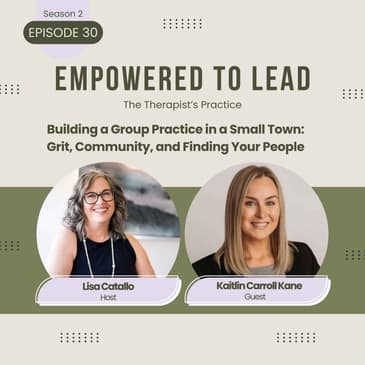
What does it look like to launch a group practice from scratch in a small bilingual city of 30,000 people, while pregnant, with no local peer network and a regulated province making recruitment even harder? In this conversation, Lisa sits down with Kaitlin Carroll Kane, founder of New Tide Counseling and Consulting in Miramichi, New Brunswick, to talk about the realities of building in a rural market, why relationships are everything, and what has kept her going through the hard seasons.
What You’ll Hear:
- The specific recruitment challenges of building in a regulated province with a small population and strong competition from public sector jobs
- Why supporting student internships has become her most reliable pipeline for hiring, and what it looks like when someone stays on after completing their placement
- How the bilingual landscape and Indigenous communities surrounding Miramichi shape the way she builds her team and assigns referrals
- What she would say to any group practice owner who is in the thick of it right now
- Why marketing in mental health is its own unique challenge, and why relationships and community presence matter more than ever
Resources Mentioned on this Episode
- New Tide Counseling and Consulting website: newtide.ca
- New Tide on Instagram: @newtide1
- New Tide on Facebook: New Tide Counseling and Consulting
- Group Practice Connection: Lisa's membership community for group practice owners across Canada www.grouppracticenetwork.ca/the-group-practice-connection
Featured Guest:
Kaitlin Kane is the owner of New Tide Counselling & Consulting, a group private practice in New Brunswick. Kaitlin is many things, but most proudly, the wife of Andy, and a mom and bonus mom of their 4 beautiful children. Kaitlin has lived and worked in many places from coast to coast, but settled back in her hometown of Miramichi, New Brunswick in 2017. Kaitlin's career has given her opportunities to work in a vast array of fields including mental health, addiction, housing, project management, teaching, and much more before her group private practice and consulting business in 2023.
Connect with Kaitlin:
Website: www.newtide.ca
Social Media: @newtide1/ New Tide Counselling & Consulting on facebook
Meet the Host: Lisa Catallo
Lisa is a Canadian psychotherapist, group practice owner, and business coach with over eight years of experience leading a thriving, values-driven practice. She works with therapists who are ready to step into their role as confident, ethical, and intentional leaders—without burning out or getting buried in the day-to-day.
Lisa’s coaching focuses on building sustainable group practices through efficient systems, effective leadership, and a deep respect for time and energy. Her approach is calm and encouraging, offering grounded guidance that helps therapists move from overwhelm to clarity—so they can lead with confidence and purpose.
Whether she’s supporting someone just starting to grow a team or helping a seasoned leader reclaim their role as CEO, Lisa brings a blend of insight, structure, and heart to everything she does.
When she’s not coaching or connecting with therapists, you’ll find her hanging out with her children and grandchildren, reading, walking by the water, or dreaming up new ways to make business feel a little lighter.
Connect with the Host:
Website: www.grouppracticenetwork.ca
Instagram: instagram.com/grouppracticenetwork
Facebook: facebook.com/grouppracticenetwork
LinkedIn:www.linkedin.com/in/lisa-catallo
Loved this episode? Let’s take it a step further.
Grab the free Time + Energy Audit for Group Practice Owners to get super clear on where your time is going—and what it’s actually worth.
And if you're ready for consistent support, connection, and access to done-for-you tools? Come join us inside Group Practice Connection—the membership designed to help Canadian group practice owners lead with clarity and confidence.
✨ You don’t have to do this alone. Check it out here
Empowered to Lead is proud to be on the High Vibe Podcast Network Check out (Host Name) Gift in the Vault https://highvibepodcastnetwork.com/gifts
Share the Love
✨ If this episode lit something up in you… tag us on Instagram @HighVibeLeaders and @grouppracticenetwork and let us know your biggest takeaway!
🦋 Don’t forget to rate & review — it helps us reach more conscious rebels like you.
Listen & Subscribe
🎧 Spotify
Welcome back to the Empowered to Lead podcast. I'm so glad that you're here again this week. Today we are talking with Kaitlin Carroll. Kaitlin Kane, your name says on there, I should have checked with you before, and I'm so excited to have her on the podcast. One of the things that we're doing in the summer episodes or the summer series is really just having some real stories about what it's like to be a group practice owner and facing different struggles that some of you have named. And so I asked Kaitlin to come on. She's got a great group practice in a small area and has faced some struggles in trying to get people on the team and just the uniqueness of you. Like I think we all as group practice owners have something unique to us and what we're trying to build, and then you've got added challenges of how to grow that. So we'll get into that a little bit, but Kaitlin, maybe just introduce yourself, where you are, and a little bit about your group practice.
Lisa Catallo:Kaitlin Carroll Kane: Well, thank you for having me on today, Lisa. So I'm Kaitlin Carroll Kane. One of the changes in the last three years of being open is that I have gotten married and expanded my family as well as expanding a group practice. So I am. My background is social work. I've been a social worker for 13 or 14 years now and worked across Canada. My career brought me out to Alberta and brought me back to the East Coast, where I am born and raised. So East Coaster, I was born in Miramichi, New Brunswick, where I currently am raising my family. And Miramichi is a really beautiful place on the East Coast. If you ever get the opportunity to come visit, please do. But it's it's unique. It is when I was growing up here, it was a bunch of small townships that in the 90s were amalgamated into a city. So we're approximately 30,000 if you include some of the outlying areas. And because of the nature of being a bunch of different townships, we are spread over a large area with a river in the middle. And some of the dynamics, we're a bilingual province, lots of French outlying communities, so having bilingual services is really important. We also have a a number of indigenous communities surrounding the the Miramichi area. And and so I'm getting a little bit ahead of myself talking about the region. Who the heck am I? So Caitlin, who am I? I'm a social worker. I'm also a wife and mother of four beautiful children and bonus children, and we, with the support of of my wonderful, supportive husband, took a big leap. Like I said, my career was in social work, and I worked in the non-profit sector, I worked in the government sector, worked in addictions and mental health, community addictions, inpatient treatment, a number of different areas that sort of led me down this path where I eventually decided that I wanted to open my own private practice. Was that a hard switch? Like being a social worker and being in the agencies to private practice? Huge.
Lisa Catallo:Huge difference. In a lot of ways, it's it's changed my lifestyle a lot, right? Like now I own my own business and I'm not an employee of you know, a government agency, but with that comes a shifting of responsibility and pressure and risk that I didn't have before. But one thing that I've always found interesting and challenging is being a social worker who owns a for-profit corporation felt a little bit almost in opposition to one another of my you know, values. And so I've I've really intentionally created New Tide to be value-driven and focused on being as accessible as possible through partnerships with agencies so that we are able to provide our services to folks that may not otherwise be able to access private practice services. Okay. I'm able to find some balance there, but yeah. It's been an interesting new shift in from from, you know, a social work background into owning a corporation.
Lisa Catallo:Yeah. Did you always want to have a group practice, or would you Like, some people call themselves an accidental group practice owner. And this is one
Lisa Catallo:Kaitlin Carroll Kane: Of those things you said, you know, you don't have to necessarily have have done it correctly. I went straight into group, so
Lisa Catallo:Okay.
Lisa Catallo:Kaitlin Carroll Kane: Yeah, like I said, I had done I had been a mental health practitioner and and had worked in the area, had lots of great relationships, and I felt that my experience and my reputation was going to lend itself well to being able to market a group practice in the region. And from some of the market research I had done, I felt that there was a need in the area, and I had never seen myself as just being a therapist only,
Lisa Catallo:Okay.
Lisa Catallo:Kaitlin Carroll Kane: And I didn't see myself working alone. And so then that led me down the path of thinking about doing group instead of solo. Now, did I maybe bite off a little more than I could chew at first? Probably. But it has worked. We're three years old now, and it has the pieces have fallen together through grit and determination and bravery and maybe some fear. But you know, it it yeah no, I I saw myself doing group right out of the gate, yeah.
Lisa Catallo:And even that is a switch. So you didn't even just go from agency to private practice to now group practice. It's bam, almost a 180, hey? From employee to owner.
Lisa Catallo:Kaitlin Carroll Kane: Yeah. Luckily, I had I had done some frontline clinician work, but I had also done clinical coordination and management roles. So, although I didn't necessarily hold the whole bag when it came to, you know, the financial risk because of my programs being funded by the government, I did know how to run a clinic. I had I had managed teams of mental health clinicians, sometimes up to 20, 15, 20 clinicians on my team, with referrals coming in, and managing administration tasks, and monitoring wait lists. So, I I knew what it took to run a clinic. I didn't know what that felt like with having the weight of the entire business being on your shoulders. And, and that's a different feeling, for sure.
Lisa Catallo:Mm. There's so many questions I have, and I want to stick to the topic that we had said. So, I might table the questions that keep coming up. The one question that I ask everybody on here is, how would you describe yourself as a leader?
Lisa Catallo:Kaitlin Carroll Kane: Yeah. And I, I, I, I've thought about this a lot. Mm. I have had the absolute privilege of being led by some really amazing leaders. One of whom I was a frontline clinician, and her motto was really that everything hinges on relationships. Like if you don't have a relationship to do, like the work doesn't happen unless there's trust and relationship. So I really lean into being relational and genuine and you know, tra- transparency with with my team members, and I think that that lends itself well to finding people who you know, are able to feel supported by that. And I also had another wonderful director that I worked under, and she always said, What's good for the goose is good for the gander. She was really led by fairness, and so Right. really always trying to lead with transparency and fairness and yeah, genuineness and relational, relational leadership is important to me.
Lisa Catallo:And transparency and fairness as an owner can be something to really learn, too, hey? Like, what does it mean to be authentic and transparent and caring, while also protecting the business and saying like, This is something that needs to happen in order to keep the business going. It's It's got All of these have nuances, hey?
Lisa Catallo:Kaitlin Carroll Kane: And that's actually been something that's been really helpful connecting with you and and folks in Group Practice Connection because being able to frame it in that way, right? That I I equally hold the responsibility of having a a stable business that we can all work in, and sometimes balancing those decisions and protecting the business also is protecting us as our as our
Lisa Catallo:group
Lisa Catallo:Kaitlin Carroll Kane: practice, right? Yeah. It's It's It's an interesting balance to strike, and and framing it in that way both allowed me to understand how important it is sometimes to make some of those tough decisions, and it allows me to feel more comfortable stepping into those kind of tough decisions. But, it's That's a That was you who framed it that way for me, Mm. say like, you know, this is something that's also it's your responsibility to protect the business. And that makes it so that you are able to have a business that your team can work in. So yeah.
Lisa Catallo:Yeah. Cause if you're not doing, okay, there isn't a business to work at.
Lisa Catallo:Kaitlin Carroll Kane: That's right.
Lisa Catallo:Yeah, and
Lisa Catallo:Kaitlin Carroll Kane: it's my responsibility, really. Yeah.
Lisa Catallo:Mm-hmm. One of the reasons I asked you to be on here is the challenges that you face being in a small area. So you were describing I forget how how to pronounce your area, but 30,000 people spread over quite a range. How long do people drive to get to you? So, sometimes like being in the in the suburbs, that's I was talking with my daughter, she's like, It's 45 minutes to anywhere. and so curious in your realm, how far do people have to drive in order to access services?
Lisa Catallo:Kaitlin Carroll Kane: Well, my office We We actually have two offices right now. One is in one of the downtown cores. It's a funny little city with sort of two downtowns. Okay. But it's kind of a busy, bustling spot where a lot of folks in their transit transit through. So, I strategically chose this location to make it as accessible as possible. And also in our value of being accessible, we do have clinicians that will travel, especially out to our indigenous the indigenous communities that are surrounding Miramichi, so that we can bring our service to them. But in general, there could be folks that are traveling in for, you know, 45 minutes to an hour, depending on where they're coming from. Okay. And another point of accessibility in or quite early, actually, in year early year two, we opened a satellite office in a a community that's 45 minutes north of here, similar size as the the Miramichi area, but maybe even fewer resources, so we felt there was an opportunity there both to add services in that community and also expand our practice in that area, so. But previous to that, there may have been people traveling in from that community to access services in Miramichi. So, we have a an office here in Miramichi and an office in Bathurst, New Brunswick, which is about 45 minutes away as well.
Lisa Catallo:Yeah. Okay. What are maybe the top two or three challenges that you find that you face being in a in New Brunswick, cause I know you there are certain qualifications for therapists that you need, and being in that small area, small population?
Lisa Catallo:Kaitlin Carroll Kane: Mm-hmm. Yeah. Recruiting and and hiring staff has been challenging. And partly, we we do have like I came from the government sector, the the the public sector. There are We have We have a lot of therapy, social work positions available in the government. The majority of new grads or or or graduates professionals in the mental health area are opting for government jobs, secure salary, benefits, pensions, etc. And it is it is challenging match or to compare or to compete with some of the, you know, the pension top ups and stuff. And so, and and there are, sometimes I'm having lots of conversations with some of my colleagues who are like, Oh, I wish I wish I could I I wish I could make the leap to private. It is a desire of theirs, but they feel a little bit of the, you know, being chained to the golden handcuffs of, you know, of, and maybe they really do have a lot of you know, there's a sense of security that comes from from being in those roles. So it is hard to hard to compete with with that. So that would be the the probably primary, building building our team, having a need to add more people to the team as we are getting busier. And not and not not always being able to find. There's lots of folks who maybe want to do a little bit of part-time, you know, in the evening or the weekends. And I'm like, I need a full-time. I need for looking for folks that that want to come on full-time, but it's hard to match maybe what they may already have in a a public sector job.
Lisa Catallo:Right. And
Lisa Catallo:Kaitlin Carroll Kane: and it's interesting, right? Because I it's not to say that we it wouldn't match it because, you know, especially when you have fee splits, like there may actually be a higher income potential if you're if you come and work 40 hours a week for me or and have the flexibility and whatnot. That you actually may make more money, Yes. but less secure, and it feels risky, and that's that is challenging for folks to to make the jump from security to what feels like risk.
Lisa Catallo:Do you think that that's something more prevalent in a small town area or like the smaller size of community, that desire for security versus the willingness to risk?
Lisa Catallo:Kaitlin Carroll Kane: Mm. Yeah. Maybe. And historically, our region has been one that has gone through some pretty significant, like, economic recessions.
Lisa Catallo:Mm.
Lisa Catallo:Kaitlin Carroll Kane: In our area, for example, you know, I I recall, you know, early 90s, we were once a booming military town, and then the base was gone, and all of a sudden, you know, businesses that were once booming were no longer thriving. We were also really dependent on the logging industry and had pulp and paper mills that eventually closed, and we saw a lot of families go through economic recession. And those are that's the generation that, you know, maybe are my parents, and so, you know, I grew up in a blue collar family who, you know, really encouraged me to find security, find stability, lock in, get that pension, get that, you know, so, because they witnessed or experienced firsthand what it feels like to have your income become precarious or, you know, economic tides turn. so yeah, I think that that's felt still in our community, where we have gone through some pretty significant recent economic downturn.
Lisa Catallo:Okay.
Lisa Catallo:Kaitlin Carroll Kane: Yeah, I think that's relevant.
Lisa Catallo:How do you then find people? So you're facing some of those things Remind me, because I think from one of our coaching sessions, there's also specific qualifications that you have to search for, too, right? It's not like here in BC up until next year it's like the Wild West and you can you can have I mean we look for master's level, most of us, but there's so many ranges of people that can provide counseling, from what I remember. Like there's a specific route that you choose to or have to go in your area.
Lisa Catallo:Kaitlin Carroll Kane: Yeah, there's there's so we are a regulated province, and so you know, the there's the there's sort of three routes in to, and it's either social work route, but like I said, a lot of my social work colleagues have really great jobs that are feeling very comfortable and secure in in where they're at. I'm often trying to convince some of my pals to come home. Then psychologists in New Brunswick are rather scarce. There's been some changes over the years in what's the requirements to become a registered psychologist in in the province. And so it seems as though more and more folks are opting for the counseling psychology route, which is regulated in the province. So folks become licensed counsel licensed counseling therapist candidates. And that candidacy period continues for a minimum of two years. And like I mentioned earlier, my my clinic does a lot of services in community in our in Indigenous communities around the area, and licensed counseling therapist candidates are unable to get billing numbers for non-insured health benefits that Indigenous folks use in order to access therapy services.
Lisa Catallo:Oh wow!
Lisa Catallo:Kaitlin Carroll Kane: So more and more, I'd say the most common profession or route towards becoming private practice therapists are these folks that are coming out with LCTCs. But I have a lot of work in Indigenous communities that I would love to assign folks, and they're not able to do it for me. Yeah. So it's tricky because I and and I I really value and feel very privileged to be trusted to be working in our neighboring communities and the Indigenous communities around here, but it is hard for me to find folks on my team that are able to do so. So it's it's just a couple specifics around New Brunswick being a regulated province for the act of psychotherapy that has created a little bit of a barrier there for me. Yeah. How
Lisa Catallo:are you finding people then? So you've got the barrier. Yeah. Cuz you have recently got a couple people and after a bit of a dry season, how how does that work for you?
Lisa Catallo:Kaitlin Carroll Kane: The most it is not the quickest way, but it has been the most solid way of vetting and supporting and finding people to join my team has been supporting people's internships. And, and it's nice because we get to work very closely for a length of time where I become, they become aware of and comfortable with the clinic and how we practice here and our values and and get to learn whether it aligns for them. And I also get to learn a lot about and support their practice. And we have our last three interns, the last two interns and our current intern have decided to stay on. Like have seen the way that the clinic operates and our values and see the potential and have just decided to stay. One of whom left a provincial government job to stay. So
Lisa Catallo:Okay. It is doable. It is doable. And you
Lisa Catallo:Kaitlin Carroll Kane: know, that person we supported that person through their internship. They loved it, wanted to stay, and decided to take the take the leap.
Lisa Catallo:And that's a commitment on your part then, hey? Because the internship is two years then. Am I hearing that right?
Lisa Catallo:Kaitlin Carroll Kane: No, oh, sorry. That's their candidacy phase. That's after they're fully licensed. Yeah.
Lisa Catallo:Okay. So they have like a year-long internship or six months or whatever that is, and then another two years. So if they join you, how do you handle that part with your team?
Lisa Catallo:Kaitlin Carroll Kane: Yeah, it's it's strategically assigning who, you know, when there's requests for service that are specific to a certain discipline, you know, I'm really strategic in which cases go to which folks, right? So if there's a request for service for an Indigenous person who has NIHB coverage, then I know that that's automatically going to one of my social workers. Right now, I have four of us on our team, so we're very intentional about kind of keeping enough space available so
Unknown:that those
Unknown:Kaitlin Carroll Kane: can accommodate certain referrals, and other referrals go in other directions. It's tricky. It's a balancing act. I feel like I'm kind of like doing a dance as I'm referring, making sure that I refer in the right direction.
Lisa Catallo:Mm.
Lisa Catallo:Kaitlin Carroll Kane: Yeah, it's challenging.
Lisa Catallo:So you have had your group practice for three years now. You have people who So you might not know this answer yet, but maybe if they come to you as a new therapist and they've got those two years of candidacy, does that tend, or do you hope that that tends to help with people staying, like longevity of commitment to New Tide, because once you're there two years, like you really know the flow and you've got your clients and and all of that. Are you hoping that that trickles into they stay forever kind of thing? Yes. I hope We both laugh because forever in
Lisa Catallo:Kaitlin Carroll Kane: that way. But, yeah, you know, and that's that's part of my goal is that, you know, we that folks really do feel a sense of, you know, being part of a team and the value of what it is to be part of a group practice. Like, I'm always I'm learning from the folks in our network how to support and make group practices the desirable place as opposed to just being a stepping stone into folks own private practice, that this is that this is a desirable place to learn and be supported and continue to be part of a team and that that's that that's valuable to people. But yeah, but that's that is the hope.
Lisa Catallo:Okay.
Lisa Catallo:Kaitlin Carroll Kane: Yeah.
Lisa Catallo:When you think about somebody, another group practice owner, if they came to you and said, Hey, I'm in the thick of it. Like this is hard stuff. What would you say to them?
Lisa Catallo:Kaitlin Carroll Kane: I I see you. I hear you. It is hard. And I think for myself, there have been My family is a blessing in that it allows it it forces me to have some pretty strict boundaries with work, and that is a blessing. I think it is a saving grace that I I I really do close my laptop at 4:30 and go home. And sometimes that means that my to-do list gets a little longer and and whatnot, but I think it's important to hold some boundaries with work and that it doesn't, you know, dominate your life. But also find people that can support you or that you feel heard. Like being part of Group Practice Connection has been really helpful because finally, I had some Before, you know, I'd always have lots of questions rolling around in my brain, but no one really to ask it to or people with the experience to answer. And so find a network. Find a a find people who you can talk to and be supported by. Also, hire an admin. Yes. Few hours. I know sometimes that's a really big block for folks. My goodness, I did that earlier than later because just well, I found myself pregnant in my first year of group practice ownership, and I needed I could not physically, mentally keep up with the phone calls and the, you know, the client outreach and the payment processing and whatnot. So I hired an admin, and I immediately felt, yes, it was more expensive, you know, I had to I had to make sure that the numbers worked out, but the amount of mental load that took off of me, and to have somebody who I could say, Hey, here's a thing that I need. Can you do this for me?
Lisa Catallo:Yes. While I saw clients and did the work that I needed to do to make my practice successful and grow, as opposed to bog down. So yeah, I think that's one of the pieces that people forget when they think about paying for an admin is yes, it adds a cost, but it frees you up to cover that cost. So, if you aren't doing all of the intake, you've got time to do some marketing or to see another client, kind of thing when you're starting out. And yeah, my I call her my Melissa. She comes back from mat leave in July, so like she will already have been back at work by the time this episode airs. I can't wait. Having that admin support is huge. And I used to, like when I was young, I was secretary, they called it then. Nobody told me how important I was to their business and to their operations. And so if you have an admin and you're listening to this, tell them how amazing they are. But it just makes such a huge difference to have somebody who can take some of that stuff off your plate and free you up to be a leader, to be a business owner. So that's a little sidetrack there, but I think more of us need to take that plunge earlier than we think.
Lisa Catallo:Kaitlin Carroll Kane: Yeah. And I'm so I feel very lucky. My my husband like I said, I worked through the through my career in government, but my husband was an entrepreneur for a long time, a business owner prior to me becoming one. And so, some of these lessons came from him encouraging me to say like, You know, you sometimes you have to spend money to make money. And like walked me through how you make those decisions, like, You know, what would you pay an admin? You know? And in that hour of you trying to process payments and calling insurance companies, you could have spent an hour making your therapist rate. You know? And helping me really map that out when I might have been afraid to take a what I felt was a financial risk, he helped me see that it was an investment and that I got time back, and I could use that time to make actually more money. So, Yes. you know, it was yeah, he was helpful. He was my unofficial business coach in the in the beginning, and still now, but yeah, it that's an important to kind of reframe in that way. To see it as an investment.
Lisa Catallo:That actually leads to one of the questions that I had given you, too, is like, what if you look back, what's one thing that you would do different?
Lisa Catallo:Kaitlin Carroll Kane: Mm. Mm-hmm. I think that's one thing I did right, because I brought on my admin quite early on. What would I do different? Don't even recall what my answer when I was thinking of these questions was. You
Lisa Catallo:said, that you are gradually cutting back on different tasks, outsourcing, delegating, being more intentional about your time.
Lisa Catallo:Kaitlin Carroll Kane: Yeah. And, you know, I think that I wish I could have done some of these things earlier. And maybe I could have. You know, sometimes you hang on to tasks a little longer than you need to because you're you think you're most efficient at it. I'm the only
Lisa Catallo:one who knows how to do this. Yeah.
Lisa Catallo:Kaitlin Carroll Kane: But I'm getting better at delegating and really trying to figure out what tasks need to be me and what tasks can be someone else's. Yeah. So that I can be more strategic around my time. And part of that for me is my clinical work, and I do I do love my clinical work, but, I sometimes it pulls me in a, you know, in a different direction when I could be spending more time on the business or, you know, working on a proposal that's on my the side of my desk that, you know, could be, you know, growing my business or So even building out my team has allowed me the space and time to re-delegate or reassign certain things to other folks. So I I almost think that that answer is a little bit of what I wish I could have done earlier. Okay. Yeah. And, and yeah, it it is it is challenging. And like there have been times when like when I said that I may have bitten off more than I could chew, and maybe that is an- there's some truth to that. Like I started off, you know, I had a big building with five offices, and it was just me and one other person in the very beginning. And, you know, there have been times in the last three years where I thought, should I have started smaller, you know? Like, should should I have done solo first and then gone from there? Like, I have, but I I don't actually regret it, you know, when I really when I really walk myself through that. It's just given me more momentum and more motivation to continue to grow and and get to where we are today. It just, at times, it made me sit back and go, oh.
Lisa Catallo:What have I done? Now you laugh. Yeah,
Lisa Catallo:Kaitlin Carroll Kane: Now I can laugh.
Lisa Catallo:Yes. Yeah. Yeah. And some of that balance, like part pieces of what we've talked about here today is, so who's in your corner? So when it feels deep or it feels like, did I make the right choice? Am I doing the right thing? Having people in your corner, you've named your husband, you've named colleagues, you've named group practice connection, Yeah. Different people in there, to help kind of buoy you up as you kind of get through the mucky part and still see the vision, but it's harder sllogging at times, hey?
Lisa Catallo:Kaitlin Carroll Kane: It really is. And like, this is a part, like having people in your corner and having, you know, people support you is so important. Like you said, to let to, you know, shout out to my admin. So, Gloria has been with me. She was the admin that I hired, pretty early on. And what was so funny, we still laugh about this, like I was like, I just need somebody to answer the phone and keep the lights on and make it busy busy in here. Cause I was like, massively pregnant and just waddling my way around like having, you you you know what that's like. But, you know, during this time, she completed her Master's in Counseling Psychology, she completed her internship here, and is now staying on as a full-time therapist and is one of those people that have been, you know, saw the vision and really believed in it, and like, you know, is a, you know, one of those people to that I have in my corner, and, you know, it I think it's really, important to find find people, that see your vision and believe in it
Lisa Catallo:too. Yeah. Yeah. Mm-hmm. Yeah. I'm just writing down a note there because when you're talking about like the importance of admin and how to foster that relationship, cause when you were saying like, I told her it's going to be answering the phone. So when Melissa started with me, I'm like, I think I can give you 5 hours a week, but we're going to grow that. It very quickly grows when you've got somebody like that where you're like, Oh, you can handle a little bit more. Let's have a conversation about what that looks like. And, now she when when we were having a conversation about her coming back, I'm like, Okay, so here's the duties, and she's like, So, that's probably for the first month, and then if I know you, there's going to be more projects. And, but to have somebody that gets it and can walk alongside you with that, it takes a lot of trust, from you to them, and conversations, and it's, yeah, it's a relationship. And such an, yeah, such a huge support, right? We were We were talking about small area. We've ended up talking about small area and admin here today. Mm.
Lisa Catallo:Kaitlin Carroll Kane: Yeah, small area, you know, I think another challenge, too, I think, we have noticed, especially in the last little while, there are a lot of therapists that are graduating. And as I mentioned, that LCTC, there's a lot of, there's a lot of licensed counseling therapist candidates that are coming out of grad school, and there's it it appears that there's fewer government positions for those folks, so they tend to be opening a small private practice, or joining a private practice, or it but what it does is it kind of saturates the market a little bit, especially in a smaller area, and so that's been maybe a bit of a challenge and just requires a bit of strategy in marketing and outreach and building relationships with organizations and community partners so that we are top of mind when folks are reaching out for for support. And so marketing is another area that I always find interesting, like there's a lot of marketing professionals that market themselves as, you know, the silver bullet, and that's been challenging to weed through finding the right fit. And I don't know if you've found this, Lisa, but marketing for private marketing for mental health is an interesting niche.
Unknown:In
Unknown:Kaitlin Carroll Kane: the same way that like if I found like a digital marketing specialist, they don't have the mental health expertise, and so then I felt that it required more oversight than I wanted to give always, so then I felt like I found somebody that had a mental health specialty, but not the digital marketing specialty, then it maybe wasn't as effective as I wanted it to be.
Lisa Catallo:Yeah. But
Lisa Catallo:Kaitlin Carroll Kane: finding a niche marketing specialist with that mental health specialty, there's none locally, so they weren't here that and they couldn't film, you know, local content for me. I always felt like I was missing a piece of the puzzle. I'm still trying to, you know, figure it out. Yeah.
Lisa Catallo:I've got a great team that helps support, and we we film our own content, and we have Allison here working on our our marketing, but you know, that that's a niche that I think is hard to find, somebody who can do all of it.
Lisa Catallo:Yes. Yeah, definitely. And just like so many pieces of group practice ownership, marketing feels like it's a recipe that you keep tweaking, and different elements. And the further away we get from COVID, the more we go back to what what it actually means to market and network. I think now, we're more you have to be boots on the ground, and just like when you hear people applying for jobs, it's like who you know, not what you know. I think that we really need to start looking at relationships and fostering those again, as opposed to being secluded in our office, and maybe we do a Zoom call kind of thing, or we just rely on Google Ads, cause that was amazing for a few years. We have to go back to the things that worked before that, for sure.
Lisa Catallo:Kaitlin Carroll Kane: Absolutely, yeah, and we're That's one thing, maybe a big bonus of a rural area where I had a career prior to this is that I have I have fostered a lot of really great relationships in a lot of different agencies in the field.
Lisa Catallo:And so,
Lisa Catallo:Kaitlin Carroll Kane: So, you know, when I'm doing that that networking or outreach, you know, I'm saying, hey, it's Caitlin Carroll, and let's let's chat about how my you know that how New Tide is able to help support you know, some of the that you're seeing with your clients, and you know, finding finding partnerships in in lots of cool places that way.
Lisa Catallo:Yeah.
Lisa Catallo:Kaitlin Carroll Kane: Yeah.
Lisa Catallo:I'm just looking at the time. We I told you we could chat for a long time. I have so appreciated you being on here and sharing some of your story. I what I'm gleaning from there is that, yes, there are nuances of being in a smaller area. And a lot of the same struggles that we face in a bigger, more densely populated area. But for those who are listening that are in a small town or feel like you've got some of these things that Caitlin has been facing and navigated, if they wanted to follow along with New Tide or you know, maybe they hear something that they really resonated with you, how would they find you and New Tide, Caitlin?
Lisa Catallo:Kaitlin Carroll Kane: Yeah, we just had a beautiful new website design, so you can find all about our locations and our services at www.newtide.ca. And we are on Instagram, it's @newtide1 and New Tide Counseling & Consulting on Facebook. So we we're happy to connect with anyone, even folks who have questions and and you know, comments about anything they heard today, or yeah, we love we love connecting with folks.
Lisa Catallo:Yeah. Awesome. Well, thank you so much. And one of the things that I will draw a little bit of attention to, Caitlin has talked about Group Practice Connection in here a few times, and I created that for this purpose: to know that you are not alone, to be able to glean from other people's experiences like we are here on the podcast, and just so there's resources, templates, there's calls, there's a Voxer chat, all of those things to know that you are not alone. And it is coast to coast. So, I'm BC, Caitlin is New Brunswick, and we've got people all in between. So, would love to have you come and join us on there, and thank you for listening today. Thank you again, Caitlin, for taking time out of your schedule and to share some of your story. I really appreciate it.
Lisa Catallo:Kaitlin Carroll Kane: Thank you, Lisa. Take care.
Lisa Catallo:All right.