
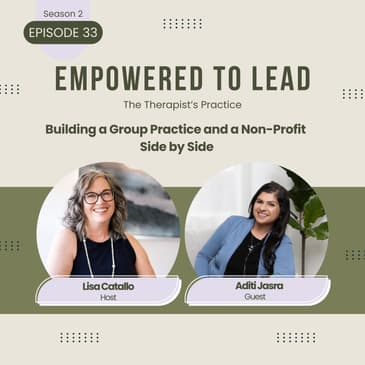
What happens when the need in your community outgrows what a private practice can offer? Aditi Jasra, who leads a Tri-Cities group practice and co-founded the New Wellness North Foundation, shares why she built a nonprofit alongside her business, what the first year of that learning curve actually demands, and how knowing your why carries you through when grants get tight and the work gets hard.
What You’ll Hear:
- Why Aditi launched a nonprofit alongside her group practice, and the specific gap it was built to fill
- How she leads as a compassionate team player while still holding clear standards
- The realities of nonprofit funding right now, and why grants are harder than ever to come by
- What it actually takes to build a board and sustain the commitment a nonprofit requires
- Why your why is the thing that carries you when the work gets hard and quitting feels easy
- Loneliness as its own kind of pandemic, and the healing that happens through connection
Resources Mentioned on this Episode
New Wellness North Foundation - https://www.newwellnessnorthfoundation.org/
- GPO Network, the free Facebook group for Canadian group practice owners
- Group Practice Connection membership: Join here
Featured Guest:
Aditi Jasra is a registered clinical counsellor, group practice owner, and yoga practitioner based in the Tri-Cities area of British Columbia, with a head office in Port Coquitlam and a second location in Surrey. Her practice is made up largely of South Asian women and other diverse practitioners, offering somatic and attachment-based work across relationships, anxiety, and trauma, with most of her clinicians EMDR trained. As a learning site, her practice also supports interns building toward registration. In October 2024, Aditi and several colleagues founded the New Wellness North Foundation, a nonprofit providing free and pay-what-you-can counselling and building community connection for those who cannot otherwise access support.
Connect with Aditi:
Email: info@wellnessnorth.ca
Instagram: https://www.instagram.com/wellnessnorthcounselling/
Website: https://wellnessnorth.ca/
Meet the Host: Lisa Catallo
Lisa is a Canadian psychotherapist, group practice owner, and business coach with over eight years of experience leading a thriving, values-driven practice. She works with therapists who are ready to step into their role as confident, ethical, and intentional leaders—without burning out or getting buried in the day-to-day.
Lisa’s coaching focuses on building sustainable group practices through efficient systems, effective leadership, and a deep respect for time and energy. Her approach is calm and encouraging, offering grounded guidance that helps therapists move from overwhelm to clarity—so they can lead with confidence and purpose.
Whether she’s supporting someone just starting to grow a team or helping a seasoned leader reclaim their role as CEO, Lisa brings a blend of insight, structure, and heart to everything she does.
When she’s not coaching or connecting with therapists, you’ll find her hanging out with her children and grandchildren, reading, walking by the water, or dreaming up new ways to make business feel a little lighter.
Connect with the Host:
Website: www.grouppracticenetwork.ca
Instagram: instagram.com/grouppracticenetwork
Facebook: facebook.com/grouppracticenetwork
LinkedIn:www.linkedin.com/in/lisa-catallo
Loved this episode? Let’s take it a step further.
Grab the free Time + Energy Audit for Group Practice Owners to get super clear on where your time is going—and what it’s actually worth.
And if you're ready for consistent support, connection, and access to done-for-you tools? Come join us inside Group Practice Connection—the membership designed to help Canadian group practice owners lead with clarity and confidence.
✨ You don’t have to do this alone. Check it out here
Empowered to Lead is proud to be on the High Vibe Podcast Network Check out (Host Name) Gift in the Vault https://highvibepodcastnetwork.com/gifts
Share the Love
✨ If this episode lit something up in you… tag us on Instagram @HighVibeLeaders and @grouppracticenetwork and let us know your biggest takeaway!
🦋 Don’t forget to rate & review — it helps us reach more conscious rebels like you.
Listen & Subscribe
🎧 Spotify
Welcome back to the Empowered to Lead podcast. I'm so glad that you're here. We have been working through a summer of talking to different group practice owners with unique needs and things that they have worked through and brought their business through. And so today, we're talking to Aditi Jasra and she is in the lower mainland in BC, and I'm looking forward to just hearing a bit more about your practice and what who you are as a leader. So, maybe let's just start off with where are you located? What does your group practice look like right now?
Aditi Jasra:Yeah, thank you so much, Lisa, for having me. Delighted to be here and share my experiences and my perspective with the listeners. So, our head office is in Port Coquitlam. So, we are based out of Tri-Cities area, so Coquitlam, Port Moody, Port Coquitlam. We have folks who come and see us from Pitt Meadows, Maple Ridge, so this side of Fraser River, and then we do have office in Surrey as well. We are primarily a group of South Asian women mainly, but we do have, you know, minorities, other diverse practitioners in our practice as well. So, mainly, we have somatic approaches, attachment-based lens. We work with relationships, anxiety, trauma. Most of my clinicians are EMDR trained, so we do a lot of trauma processing work as well, and we are a learning site. So, we do support interns who want to join private practice, or a group private practice, or who just want to get their Registered Clinical Counselor license and, you know, then go and serve the community. I also have a non-profit with some of my colleagues and it's called NEW Wellness North Foundation, which also operates like a group practice, but it's more of a non-profit where we try to see where we can get resources, funding, grants from, and how can we support folks who are struggling with mental health challenges and who don't have finances or resources to go and get help.
Lisa Catallo:Yeah. You have a wide range of offerings. One of the questions that I always ask, because I've got lots of questions for you just from what you shared there, but one question that I always ask is, how would you describe yourself as a leader?
Aditi Jasra:Compassionate. I try to be as authentic as I can. I share my lived-life experiences with my team. When things get tough, I share it with them. Very transparent as well. So collaborative approach definitely, like as much as I'm the owner of the practice, I consider myself as a team player, right? And when I first started in 2020, I got really busy really fast, and I'm like all these people are reaching out and I cannot, you know, support them. So I need a team, and I've always been like, you know, in spaces where it was a team. Like I'm also a yoga practitioner, and it's, you know, even when leading a class where there is always need to connect with other practitioners. So that's why I'm like I need to create a team where, you know, we can share our experiences, we can debrief with each other, we can support each other, we can talk about cases. So, you know, so as a leader, very collaborative, compassionate, a lot of autonomy, authority to my practitioners so that they feel supported. That's why in my one-on-ones, I'm like, you know, are you full? Do you need more clients? Do you need less clients, right? And everyone sets their own, you know, hours. So there is a lot of flexibility and fluidity, because I think, you know, we are driving the bus, but at sometimes I'm the co-driver. I'm like if someone else wants to take the lead on this project, you know, fair enough, go ahead, do it. Yeah.
Lisa Catallo:Yeah. So you're driving the bus, but every now and then you're in the passenger seat.
Aditi Jasra:Absolutely. Absolutely. And we're all learning from each other too, so yeah. Right.
Lisa Catallo:Yeah. One of of the questions I have is like around your nonprofit. So I know in talking to group practice owners, there I mean, we got into this business to help people, and sometimes that is hard to do if they can't pay the full rate or full fee. And then in our economy right now, that can also be a struggle. And sometimes that ends up being now our clinicians are seeing too many reduced rates, and so the business isn't making the money that it needs to in order to succeed. What made you decide to start a nonprofit and the mindset around that?
Aditi Jasra:Yeah, so initially, Lisa, when I started, I was by myself. Then I had other practitioners join me, and then a lot of times people would reach out asking for low cost, right? And I can only give so many reduced-cost slots, so that's why I hired interns, that they can offer. But again, there was need for folks to see free counseling, right? And people who actually need counseling could not afford it, so that's why we thought, okay, let's, you know, open a nonprofit where we are connecting with the community, we are seeking out to government agencies, we are seeking to other nonprofits, doing collaborative work, doing creating visibility from one end as a nonprofit, but also serving the need where there are interns who want to get their hours, but people cannot afford their services, they are not even willing to pay, you know, $40 to $60, right? So we are like, okay, free counseling, come, or pay what you can. So that's why a nonprofit idea, but also to have other funding sources, like we'll do a lot of fundraising or asking businesses for donations, right? And again, it's a matter of connecting with the community, because I truly believe that there is so much healing potential when there is social connectivity. And when we traumatize, when we are stressed, we feel we are the only ones, and the world doesn't understand me. So even through some of our events, it's about networking and connecting as a business owner, you know, one person talking to someone else, and those conversations can lead to new doors opening for folks. Yeah.
Lisa Catallo:When did you start the nonprofit? So you started your group practice in 2020, and then
Aditi Jasra:And the nonprofit started in October of 2024. Okay. Yeah.
Lisa Catallo:What that It's complicated. Like how did you work through getting that started as part of what you offer?
Aditi Jasra:So I was talking to few of my colleagues and they felt that yes, we want to do more work. We are in this profession because we genuinely want to help people, but again, running private practice, we have to keep our costs down and it's a business at the end of the day. But as a nonprofit, you know, like we have support from government, let's say for substance use, they are giving grants, or like local neighborhood grants, right, where we can offer something to the community, maybe bringing moms together, single moms together, or we run you know, picnics for seniors, so stuff like that where we are gathering funds to offer free counseling to the folks, but also bringing community together where they are forming connections, and that social connectivity, that loneliness is decreasing. And you know loneliness in itself is a pandemic.
Lisa Catallo:Yes. Yeah. That sounds like a lot. Do you have a team with you to manage that? Yeah.
Aditi Jasra:Yes. As a nonprofit, we have a board, so I work with a colleague of mine who's also an RCC, then I work with an OT who is part of our board, and then we have accounting experts, financial experts, and some other folks who are volunteers, board members, and supporting us through the cause that we truly believe in, that is, you know, reducing isolation and supporting people through mental health. And mental health, you know, it's like so invisible. Someone's heart could be hurting, and it's same as knee hurting, and knee, you go to a practitioner like, you know, physio, and they can see it, but with your heart hurting emotionally, no one can. So conversations, connections, that becomes important. Okay. Yeah, so definitely have a team in my nonprofit, and do have a team like, you know, wonderful practitioners with me, you know, who are looking for support, growing their own practice, or just having space where they can practice out of. So yeah, so definitely you can't do it all alone, so you definitely need a team. So I truly believe in delegation, right, like our admin team is great, my practitioners are good. And again, it has to work for everyone, right? So what can I offer as a leader, as group practice founder, and then what they are bringing to the table, and how we can work in a way that is mutually beneficial.
Lisa Catallo:Do you find you show up differently as a leader, whether it's the group practice hat or the nonprofit hat?
Aditi Jasra:No, I try to be my authentic self, right? Like you can't put a mask on. You have to be your true authentic self and lead with the heart, lead with compassion. I believe like, you know, what strengths can you pull in in the role that you're showing up as, right? Like as a team lead, have conversation. I believe in transparency, right? Like in both roles, like you have to be transparent. Running a practice is hard. People think a lot of money is going in our pockets, but that is not true. The admin cost, the system cost, the rent cost, everything adds up, right? So, shoot them the numbers, you know, then they realize that yes, it takes a lot to run a practice. So, yeah, so transparency I think is a huge part, and then being your authentic self. But again, sometimes you have to put your foot down or talk from your experience or being assertive at times, right? So having certain standards, for instance. So as much as I'm about autonomy, but if someone is continuously not showing up, not updating their calendars, that's the conversation that needs to happen, right? So, yeah. Yeah. So it's it's a, you know, tough, but it's like who you are and how you want to show up, and what skills are you going to bring to each role.
Lisa Catallo:Yeah. I have a couple questions around the nonprofit, so let's go there cuz I know in talking to other group practice owners, that's a consideration. If you could go back, would you do it again? Would you create a nonprofit, given where you're at and what you've been through with it?
Aditi Jasra:Why Why Why not? Yeah, totally. Be having more conversations around right people, because I did ask my friends, and now they are considering opening a nonprofit, right? But they see the success; they don't see all the work that goes into it. I would definitely open it again, but again, what is the reason? Why do we want to do it, right? So, that is really important, because I'm totally invested, right? Like when you know that this is your calling, like as even as a somatic practitioner, yoga practitioner, I've always worked with communities, with, you know, nonprofits in different roles. So, even learning from that, like that experience has been beneficial, right? So, and learning because I've not been in the operations side of a nonprofit, so we're still learning, still growing, you know, figuring out the ropes. So, we have applied for our, you know, nonprofit designation from CRA, but it requires a lot, right? Like having the CPA and getting all those pieces put into place is, yeah.
Lisa Catallo:Yeah. What's the What has been the hardest thing in starting a non-profit? So, is it figuring out all all of those pieces that you weren't aware of?
Aditi Jasra:Information is there. It's having the execution. Because everyone who is involved is not getting paid. When it's a job, Mm. you know, you show up. You know you're going to get a paycheck, but when we are doing something out of our heart, you know, it's a commitment to a cause, right? Like it's something to just believe in. So, execution sometimes becomes challenging, or like people who is going to do what? Like we had a really good fundraiser at SFU last September, September of 25, and that was a learning curve, right? Like as owners, as founders, you know, as board, we end up doing a lot of work together, and community supported us, no doubt, but and you know, there were you know, sometimes the balls are falling. It's like, who's gonna pick up that ball? So,
Lisa Catallo:Yeah.
Aditi Jasra:and then putting our personal feelings aside, right? Like, who are we working with? In what capacity? Are people going to step up and show up? Because everyone is busy, right? So, it's like who is going to commit to do this piece, this portion, right? So,
Lisa Catallo:I sat on the board of one group practice that was starting a non-profit, and that learning curve in that first year is huge, and just all the nuances. Has it been hard? Because a lot of what non-profits rely on are grants, and you've mentioned that. So, events, grants, fundraisers, there's a bunch of different things that go in there. But grants used to be a big money something non-profits relied on, but it sounds like that's getting harder to get.
Aditi Jasra:It's harder. We go and talk to, you know, government representatives, local MLAs, mayor, and they're like, our hands are tied. Like we had a conversation with Jennifer Blatherwick. She's MLA for Coquitlam region, and she's like, you know, The funding for gender-based equity and diversion portfolio, I have 400 people before you. You would be 401. And we're like,
Lisa Catallo:400!
Aditi Jasra:Absolutely. There are so many people, so many, you know, organizations that are looking for funds to run their operations. So, those conversations are happening, but we also know from the representatives that it's becoming harder and harder, right? So,
Lisa Catallo:Yes.
Aditi Jasra:But I think there is still hope. We are all you know, women of color trying to run this,
Lisa Catallo:Mm.
Aditi Jasra:in majority, and like going into spaces where there is less support, whether it's domestic violence, whether it's single parents, whether it's, you know, neurodiverse kids. So, looking at different projects and seeing how we can offer support, yeah. But primarily what we are doing right now is depending on donations of the donations from the community, running panels, gathering sponsorships, you know, and getting the visibility, because we are still only a couple years old compared to folks who have been 20, 30, 40 years, right? Like, Yes. Yeah. And kind of comes back to also
Lisa Catallo:the team, who you're connecting with, how you get known in the community. A lot of things that are similar in a group practice and nuanced too, hey? Like you're asking different things of the community to be involved, or you're networking in a different way, but a lot of the same skills that maybe you already developed in a group practice. One of the things I think I'm struck by both in what you're saying and looking back at the other one that I was involved in is also like knowing the people who are with you in that board and the skills and abilities, and learning along the way. So, you make, well, which one surprised you the most of like getting community support or having to do events? Like was there something in that component either that paid off differently than you thought it would, or the work that it took to develop those relationships?
Aditi Jasra:It's definitely challenging, and people want to help, but it's the commitment of time, right? Someone might say, I only have an hour to dedicate to this, or, you know, a couple hours, right? But it's the consistency, right? If we want some involvement, we want consistent involvement as opposed to sporadic. Yes. And then, numbers guy, you know, it's a it's a numbers game at the end of the day because non-profit is also a business. It's business of selling hope, and maybe we're not charging the community for services, but those services are being paid in some shape, way, or form, right? So bridging that gap is really important, and then finding folks who are able to help us in bridging that gap, right? We are like, we'll do the groundwork, right? But we need support, we need help, and we want folks to come and join us, know who we are and what we do, what we stand for.
Lisa Catallo:Yeah. And the structure is different even when you're talking about like having a board and having volunteers and who's going to manage each of those elements too.
Aditi Jasra:Yes, yeah. We have volunteers reaching out all the time, but we can't give them any public-facing roles. For example, if they want to do counseling, right? Like unless you are a licensed professional, registered, someone who's trained, we cannot just say someone is reaching out for counseling and we'll let you talk to them, right? So it's like, how do we streamline our processes?
Lisa Catallo:If somebody were to come to you and say what's one thing I need to know before I start a nonprofit, what would you tell them?
Aditi Jasra:Cross your t's, dot your i's, know what you're getting into, do you have time, and what is your why? Why do you want to start this?
Lisa Catallo:Yes.
Aditi Jasra:Like that is a huge We felt that, you know, the work that we are trying to do, yes, there is space for private practitioners, people have insurance, we have funding through different, you know, channels. But then there is need in the society for help and support, and there is so much stigma. So let's make having a conversation with a qualified professional normal.
Lisa Catallo:Yeah. Right?
Aditi Jasra:So that's that was the why, that let's People who want help, let's get them help and let's figure out how are we going to get them help that they need.
Lisa Catallo:Yeah. That why, hey, knowing your why is so important with any leadership role or business role, because when things get hard or you hit a wall Easy to quit.
Aditi Jasra:Absolutely. Yeah.
Lisa Catallo:Yeah. Yeah.
Aditi Jasra:It's the passion, right? Like it's the drive, it's the passion. It's like, you know, you're meant to do this work, right? And how can we in a best possible way do something like this?
Lisa Catallo:Yeah. Thank you for sharing that. It's always a curiosity. Not everybody is curious about that, but there's enough people that I think some of the information that you've shared today will be helpful. If somebody wanted to reach out or to know more about your foundation, how would they find out more?
Aditi Jasra:Well, so we have a website, New Wellness North Foundation, so they can reach out through that. We have a Facebook page, so they can reach out through that. They can email us, nwnnewwellnessnorth.foundation@gmail.com, so that is always, you know, it gets checked periodically by few of us. So that is an option. So, Yeah.
Lisa Catallo:And we'll include include that in the show notes as well. And yeah, if anybody listening to this this lines up with something that you're passionate about and you live in the Coquitlam area, the Tri-Cities area, you might be able to sign up as a volunteer and help make that happen. And so thank you, Aditi, for taking the time out of your schedule to share some of this information with us. And yeah, I look forward to seeing more of that growth and where this all takes you.
Aditi Jasra:Yes, absolutely.
Lisa Catallo:Thanks.