
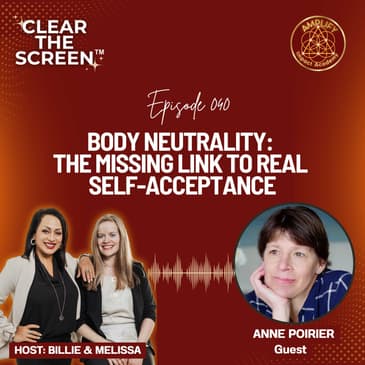
What if the voice in your head… isn’t actually you?
In this deeply transformative episode, Anne Poirier shares her 40-year journey from body shame and eating disorders to true healing and self-acceptance. What began with seemingly innocent childhood labels evolved into decades of disordered eating, harsh self-criticism, and a painful cycle of trying to “fix” her body.
Her breakthrough came when everything stopped—forcing her to finally listen within.
Anne reveals the powerful shift that changed everything: separating her identity from the inner critic by naming it, questioning it, and choosing curiosity over judgment.
We also explore the concept of body neutrality—a grounded, accessible path to healing that moves beyond the pressure of “self-love” and instead focuses on respecting and appreciating what your body does, not how it looks.
Now, through her work and books, Anne is helping both adults and the next generation break free from the cycle of shame and step into a new relationship with themselves.
Healing begins the moment you realize… you are not your inner critic.
Featured Guest: Anne Poirier
Anne Poirier, CSCS, is a nationally recognized Body Image Expert, Certified Intuitive Eating Counselor, and author of The Body Joyful: My Journey from Self-Loathing to Self-Acceptance. With a degree in Exercise Science and over 30 years in health and wellness, Anne has turned her own recovery from eating disorders and body shame into a mission to help others find freedom and peace with food, movement, and themselves.
A pioneer in the body neutrality movement, Anne’s insights have been featured in Shape, Women’s Health, The New York Times, Washington Post, HuffPost, ABC, FOX, CBS, and NPR.
Her major accomplishments include publishing The Body Joyful, Not a Fat Annie and The Body Neutrality Playbook, and partnering with researcher Kayla Nuss on the NoWeigh app. She also served on the National Eating Disorders Association (NEDA) Lived Experience Task Force and leads Shaping Perspectives… A Woman’s Way to Joy.
Contacts:
Email: anne@thebodyjoyful.com
Shaping perspectives website. https://shapingperspectives.com/
LinkTree: https://linktr.ee/annepoirier11
Instagram https://www.instagram.com/annepoirier11/
Linked In https://www.linkedin.com/in/anne-poirier-72b66344/
YouTube https://www.youtube.com/@annepoirier114
Meet the Hosts: Billie & Melissa
Billie Aadmi and Melissa Deally are the dynamic co-founders of Amplify Impact Academy, a global hub for personal transformation, leadership development, and high-frequency living. Together, they empower people to release unconscious limitations, align with their soul’s truth, and amplify their impact in the world.
Billie’s journey spans from saving lives to healing souls — a single mom, seasoned Police Officer since 2005, real estate investor, international speaker, and best-selling author. As the visionary CEO of Go Mindspire Inc., Billie blends her background in Education, Human Kinetics and Metaphysical Science with deep transformational work, helping clients elevate their mindset for lifelong success.
Melissa is an award-winning Integrative Mind-Body Health Practitioner, international speaker, and five-time best-selling author. As host of the globally ranked “Don’t Wait For Your Wake-Up Call!” podcast, she inspires thousands to take charge of their health and life. She also leads Girls Matter, her non-profit dedicated to keeping girls in school in Uganda and Kenya.
Both Billie and Melissa are highly skilled Master Trainers of Hypnotherapy, Trainers of NLP, Time Line Therapy®, NLP Results Coaching and Magnified Healing®. They passionately teach advanced mindset, healing, and personal transformation modalities, equipping clients and students with tools to create lasting breakthroughs. Through their trainings, retreats, and mentorship programs, they deliver powerful experiences that create ripple effects of transformation — helping people everywhere live happy, healthy, wealthy, and free.
Connect with the Hosts:
Website: https://amplifyimpactacademy.com
Socials:
Facebook: amplifyimpactacademy
Instagram: amplifyimpactacademy
LinkedIn: amplifyimpactacademyYoutube: amplifyimpactacademy
Melissa:
Facebook: https://www.facebook.com/melissa.deally
LinkedIn: https://www.linkedin.com/in/melissadeally/
Instagram: https://www.instagram.com/guidedhealthjourney/
Youtube: https://www.youtube.com/c/MelissaDeally
Billie:
Facebook: https://www.facebook.com/billie.aad
LinkedIn: https://www.linkedin.com/in/billie-aadmi-54063521/
Instagram: https://www.instagram.com/billie.irei/
TikTok: @gomindspire
Take The Next Step:
Apply to be a demo subject on our show:
https://app.amplifyimpactacademy.com/widget/form/wq0e6mbQTEpRoghU8Hlo
The Light Circle Membership:
https://amplifyimpactacademy.com/thelightcircle-aligned-core
CLEAR THE SCREEN™: https://amplifyimpactacademy.com/clearthescreen
Quantum Life Mastery School: https://amplifyimpactacademy.com/90-day-q3
Introduction video about Girls Matter:
https://drive.google.com/file/d/1R3-xqzJLZW14om1PhFClcU_oRSZ8zgip/view
Join our FREE Workshop: Meet Your Unconscious Mind Workshop. Discover a path to peace in just 2 hours by learning the tools that will quiet the noise in your head: https://amplifyimpactacademy.com/um
Amplify Impact Academy is proud to be on the High Vibe Podcast Network. Check out Billie & Melissa’s Gift in the Vault https://highvibepodcastnetwork.com/gifts
Share the Love
✨ If this episode lit something up in you… tag us on Instagram @HighVibeLeaders and let us know your biggest takeaway!
🦋 Don’t forget to rate & review — it helps us reach more conscious rebels like you.
Listen & Subscribe
🎧 Spotify
Welcome back to another episode of the Clear the Screen podcast. I am Melissa Deeley,
Billie:And I am Billy Admi. And this is where anxiety ends and abundance begins. We are very excited to welcome Miss Anne Poirier to the show. I hope I spelled that, pronounced that right, Poirier.
Anne Poirie:Yeah, Pourier, yes, Fourier. All right.
Billie:Welcome Anne Pourier to the show. We're so excited to have you.
Anne Poirie:Thank you so much for the both of you for being here. I'm excited to share my story and talk to you both as well.
Melissa Deally:And I just want to introduce you a little bit to the audience first from your bio, and then we will dive into your story, and Poirier CSCS is a nationally recognized body image expert, certified intuitive eating counselor, and author of The Body Joyful: My Journey from Self-Loathing to Self-Acceptance, with a degree in exercise science and over 30 years in health and wellness, and has turned her own recovery from eating disorders and body shame into a mission to help others find freedom and peace with food movement and themselves, and there's so much more to that, including being featured in magazines and numerous newspapers and TV shows, and we will talk all about that as we go through this episode here. So, yes, welcome to the show. And
Anne Poirie:Thank you so much. Excited to share a little bit about my own journey, and I know that I am not alone in struggling with food and eating and exercise. So, would you like me to just kind of dive in?
Billie:I love that you said your journey from self-loathing to self-acceptance, as we call, you know, your journey from victim island to solution city. So, please begin with excited to hear all about it
Anne Poirie:Yes, you know, there's a little story around the total, the title too, because the publisher wanted it to be from self loathing to self love, and there was a real specific reason that I didn't want it to be from self loathing to self love, because love can be really hard for people if they've spent a lifetime, it feels like a lifetime in a place of loathing, especially body and cell, and so acceptance is a much more forgiving way of entering into a space of making, you know, starting to love our bodies or love ourselves, but it doesn't happen right away. And to be honest, when I was writing the book, I had made some great healing progress, but I wasn't really ready to say love for myself at that point either. So, it's an interesting.. you know, the title speaks clearly about how hard it can be to change once you live in one particular place for a really long time, so go ahead.
Melissa Deally:Yeah, I was just gonna say absolutely, and the words that we use are so important, right? They speak to us, and our unconscious mind is always listening, and we teach this in our trainings, and it has to resonate, because if we're using words that don't resonate, it will stop that healing journey, because when the unconscious mind doesn't believe that to be true, we can't continue that that healing journey process.
Anne Poirie:Absolutely, and I think that's why the words matter so much.
Melissa Deally:Yes,
Anne Poirie:And you know, the start of my journey was all surrounded by words, you know, words from my parents' description of me being a chubby little baby and stocky and sturdy and a bull in a china shop, and all those kind of wonderful terms that parents use to describe their young ones unknowingly,
Melissa Deally:Rght? Yeah, doing the best they can with the resources they have, and you know, a chubby little baby is often said as a term of endearment, really,
Anne Poirie:Absolutely right. And to be stocky and sturdy, sturdy was strong, right, and capable. So it's just the way that we interpret some of those words, and that's that was where I kind of interpreted those words in a different way, which was negative, unfortunately. And then, because of that, just that start of some of those terms, those, some of that terminology, and then my brother lovingly giving me a nickname, you know. As a kid, I was a little bit of a tomboy. I always wanted to play with the boys, and so I was always trying to play football with them or do things with them, and they just started a little chant, my brother and his friends, and they called me Annie Fanny Farmer, and when I look back on it, it's like I have a cute little name, little Lady Fanny Farmer Farmer, but all I heard was you can't play with us and Fanny because I'd heard chubby little baby, stocky and sturdy, you know, this big girl that doesn't. Look like the other kids, and so that nickname became a way of starting my own loathing of my, my body, because my body didn't look like the other kids. I had really short hair, and I didn't fit into the same types of clothes, and so I can track back very easily the seeds of beliefs, the belief systems around my body, and then the self-talk that followed all of that, which I believed even more, just gave me more proof that I was right, and that's how you know I, I went on a 40 year journey of just really beating my body up and trying to change it in order to fit in and be accepted and look like I'm supposed to look, I use little air quotes there, right? I'm supposed to look a certain way,
Melissa Deally:So says the media, right?
Anne Poirie:Yes,
Melissa Deally:And that's what we're fed day in and day out for 40 plus years, you know, our entire lives, and so again, this is all unconscious, right? You become conscious of that inner dialog and the way that you're talking to yourself. However, it starts off unconsciously, and as you said at the very start of this episode, you're not the only one that has gone through this journey, and you know, there can be listeners hearing this now, going through this journey, and there's no point in the blame game.
Anne Poirie:No, this, this is
Melissa Deally:Actually happening to teach us something, so that we can move forward.
Billie:And do we teach, you know, it's the key is to be able to hear the lessons, right? What did you need to learn, and you know, we say that, you know, those of us that have had the hardest, toughest lives to, you know, have the biggest missions to do in the world, right? And so your story really resonates, and because you know, my parents, you know, in my culture, women are not really, you know, encouraged to do business or, you know, really be powerful or strong or anything like that, right. And so I had this core limiting belief that I was powerless, and then I became a cop, right, even though it wasn't something I ever thought of as a kid, that, hey, I want to be a cop when I grow up, however, my soul needed that, that feet, that need of power. As soon as I released that, like, as Melissa said, you know, it was out of my awareness, I went back to my first love, which I went to school for, which was teaching, right? I'm teaching again, and so I'd love for you to speak to, you know, where, when, when did you start becoming conscious, because again, as we say, a lot of this is unconscious. When did you start becoming conscious of the meaning that you put behind what was really just an innocent, you know, loving, you know, term that was given to you, and just like my parents, I know they didn't want me to grow up feeling powerless. It's just that's the way our culture was. So, when, when did you start? When did that start coming to your awareness? And then, what was the process through that?
Anne Poirie:You know, I didn't become aware, but till I started doing my own inner healing.
Billie:Yeah,
Anne Poirie:And you know, I suffered from an eating disorder when I was a 12 year old. So, from 12 to about 15, I don't really remember much of of my schooling during that period of time, as I look back, because I was so addicted in a disordered relationship with food and my body, I did end up in the hospital for a while, and I got well enough to get better from that, but unfortunately I didn't have the healing, the inner healing, and I didn't really understand the how the self-talk was really impacting how I felt about my myself and my self-esteem and my self-confidence, and so I, I relapsed a couple more times, once in my 20s and then once again in my 40s, so it really wasn't until my body just broke down and I was forced to sit and be with myself, and that's when I started to do some journaling, and with through the journaling, I joke that I got sick of hearing myself, you know, journaling the same thing over and over and over again, and from from what my mom would say, shit or get off the pot, that's what I felt like. That's where I came to that space where I have to do something. I'm doing the same thing over and over and over again. I still hate myself. I don't. I'm uncomfortable in my own skin, and so that's what what changed things for me, and I went back to school, and it was education, research, understanding the science behind dieting and restriction, and really getting angry at media and angry at, you know, our culture, and that's what started to. Push me towards the healing of myself, and then just how much I didn't want, like, our next generations to go through decades of beating themselves up and starving themselves, or binging and shame and guilt, and all of the things that go with it. How can we help prevent and start to get our next generations to feel better in their bodies by healing ourselves first, so that we can role model a different way of being in our bodies?
Billie:Yeah, I love that. And, and it really does start with yourself, right? And that's what we preach in our school, is that you have to go through your own healing, you have to find your own magnificence before you can even see someone else's magnificence, right, and whether it's, you know, through eating disorders or abuse or whatever people have gone through, it's such a similar story, isn't it, that we're, you know, like it, we just were talking about this this morning, that you know, the pain means pay attention. The problem is a lot of us wait till the pain gets so bad that we're like, okay, fine, like, like you said, share, get off the pot, like, come on, like it's a definition of incentive, doing the same thing over and over again, which is why we love this work that we do, is that really identifying what was that core limiting belief, that core wound, you know, like I said, from for me was that powerless, and I had no idea, and no idea it was driving my life, right? And once you can identify that, that's when the true healing happens, because we have to heal ourselves before we can even think to heal someone else, because as much as we can, you know, I love that you said this, and, like, yeah, we can journal, and we can do the affirmations, and we can do all this stuff, but except the program is still there. If the core limiting belief is still there, it doesn't matter, it will constantly override the system, right? So, I would love to hear more, but how do you help others? You know, we say we can't fix anyone, no one's broken, or how do you help guide others to really, you know, show them the value of doing their inner work, because I think a lot of world doesn't understand that, first of all, it's within us that we don't - it's there's nothing external that we - we have everything that we need to heal, and how do you guide your clients into really finding, you know their true magnificence.
Anne Poirie:Well, you said it beautifully when we talked, when you talked about the core beliefs, Billy, because that's really where the work starts, is questioning those beliefs. You know, I think about it, I use my hands a lot when I talk, and I think, like, we were given all these beliefs, like, here you go, believe this about bodies, and believe this about food, and believe it's about exercise. These are these are your truths. And then we just go, oh, okay, I'll believe that. And then I, you know, I learned to hate my body, which means I can unlearn that. You know, babies aren't born hating their bodies, they love their bodies. And so if there's a, if there's a learning I learned due to these belief systems, so it is this, this willingness to question some of our beliefs about ourselves and about the different ways we see ourselves, and what are those words that we say to ourselves, you know, filling in the I am, you know, I am what, and where did that come from, and Whose voice is that? I, you know, question, Whose whose voice is in your head? Oh, hi.
Billie:I love that you called it like we can unlearn it, right? We call it rewiring, right? Your brain was wired this way because of the limiting belief that was put in, and the great thing is it's a computer, and we can upgrade it, and we can rewire it, and reprogram it, and I love that you use that terminology, it's so good,
Anne Poirie:It's just, it's a very, just a little different way of looking at it. Yeah, and it is kind of just like, how, how do I start to see myself differently if food isn't good, bad, right, wrong, clean, dirty, as our society tells us, and gives a puts a lot of morality on food, and if bodies are all different sizes, and then I know lots of people in larger bodies that are healthy and unhealthy, and I know lots of people in smaller bodies who are healthy and unhealthy. So, what does that mean about bodies? That means that bodies are going to be all different sizes and shapes, and they, that we aren't all going to fit into the look of what we see every single day in the magazines or on TV, and advertisements, and you know, in my day it was, you know, 17, and and all the all the magazines that I was looking at. Now it's 24/7 social media, you know, always with filtered images, and you don't even know what's real. It was done back. Done. Just not as well as it's done now. Now you can't tell anything
Billie:Airbrushing before. Yes. Now, like, there's not a little divot of cellulite on anybody that you see online.
Anne Poirie:Yeah. And is that how true is that in real life, right? And that those are the questioning. That's where we start, is questioning some of those belief systems, trying to figure out where some of those beliefs were. I call them seeds, right, planted in our, a lot of times in our childhood, and with the messages around us. And for no, there's no, we're not placing blame on anyone. Everybody is doing the best that they can, and that's the, that's where we start, and then trying to meet the person wherever they are on that journey,
Billie:And I love what you said there, Anne, that Whose voice was that, right? Because this is something that we teach when we teach strategies, is we break down, like, you know, how did this strategy run, when you have this trigger, then you get this, you know, internal representation of this movie, and then it create and then you hear this voice inside of you and then it creates this emotion and then it creates the behavior and you know that negative voice is never us I love that you said that it's never us right we don't body shame ourselves we don't naturally become racist we don't naturally you know look at people and and think you know guilt or shame, it's given to us. So, I love that. So, I want to ask you, like, was there was there one moment when you realized that those voices in your head were not yours, and that those belief systems, like, I want to talk about your specific moment, that breakthrough that you uncovered it unconsciously.
Anne Poirie:There's that's such a good question, and I have to give credit to, so I'm on my second marriage, and just choices and decisions into my first marriage around a lot of different things for me, but it was, it was a question he asked, is that, is that eight year old Annie is what he asked me when I had, I had reacted a certain way, and this is when we were dating, and I, it made me pause, because I was still, when we started dating, I was still, I was in this healing process, you know, I was like, my body and food is off the table, it's my business, we're not going to talk anything about that, because I needed to figure out what my journey was with both food and body, and I don't know, we must have been getting, I must have gotten for getting prostrate, frustrated with him around something, and he says, "Is this eight year old Annie? And I think I put my hands on my hips, and I said, "Yes, it is, yeah, like that, the the the little rebellion person inside of me, and then through my own, my journaling, through my therapy, right, and working around all of that to heal myself, I discovered a whole slew of people in my head, you know, coming from coaches, yes, parents, but you know, other other people in my life who had, I had thought anything that they said was right, and this was to be taken as who I am and what I'm all about, and that must be true about me, if they say that, that must be true about me, and that's where those, a lot of those, that dialog comes in. So, during the writing of my book, I actually named a lot of my inner voices just to help me pull them out of my own head and separate them, and so I have Stupid Sally, I have Clumsy Carla, I have Messy Mel, like, like
Melissa Deally:That's great names, I love them.
Anne Poirie:Yeah, Captain Criticism, one of my favorites. So, just all of those people, though, and, and once I started to name some of my own voices, I was able to start to shift and change some of their narrative, even by just lowering the tone or quieting them down, and then being able to question with curiosity, not with judgment, and that's how that started. So that was a great question. So, thank you for asking that,
Melissa Deally:And I love that answer, and especially how you've turned it into curiosity instead of judgment, and how, by naming them, you could separate them out from yourself to understand that those aren't all your own voices. Those, like the beliefs that have been given to you, those voices have been given to you at a time when you were a child, and you were just, you know, absorbing and learning so much that you didn't realize that they were just coming in and you made them all your own and in your healing process you could then start to undo that and separate them out, so I absolutely love this story, it's so empowering, Annie, to hear you talk about where you were and where you've come. From and to where you are today, and I also want to bring into this, because I know that you raised your own children through this process, and I would love for you to talk about how you going through this journey has positively impacted your children as the adults that they are today.
Anne Poirie:It is a positive impact now, and it wasn't always right. So, I was still when I had my kids. I will tell you, the I have two girls. Being pregnant was the first time I was free from the voices in my head around food.
Melissa Deally:Interesting
Anne Poirie:Very interesting period of time with both of the pregnancies. Just like, oh, okay, I can, I can relax a little bit, because I'm, I'm growing a human. It was a very, you know, it is definitely.. I look back, it was a disorder, disordered way of thinking, but
Billie:Because you weren't eating for you, and you were eating for your baby. Wow, wow.
Anne Poirie:So there was freedom in my body. It was like, oh, oh, this is great, like this is great. It was, it was very interesting, but the second that I, I delivered my baby, my first Alyssa, my first daughter, you know, people don't tell you you still look pregnant when you're after you deliver, and I, and like, I was horrified, and then I would write back at it with punishing myself, so even as my daughters were young, like, I missed some of their life due to my own obsession, although as I, as I healed, they were getting older. I unfortunately say I did not do a really good job role modeling when they were younger, but I am doing a much better job role modeling now, and we learn from each other a ton, they are both young adults now, both married and grandchildren, and it they have a much healthier relationship with food in their bodies than I ever did, and so it's wonderful to see that with them, but unfortunately, you know, I think some of the times we don't realize the things we miss until we look back, and you know, not eating the cake at the birthday party, or being too tired to get on the floor and play a game, because I just, you know, I pushed myself too hard to try to burn off calories that I ate the night before, or whatever, you know, all that counting and calculating, and you know that was over consuming my life for up until my mid 40s, until I started to say something's gotta give, and you know
Billie:We say in our, in our school that everything happens when it's meant to happen, and you know your daughters picked you as their mom for a reason, and you know you picked your daughters for a reason, and we all pick the experiences that we're meant to learn, and you know, then we, we can heal not just the past, you know, now we're healing the future as well, right? And so you came into this, you know, now healing that part of you didn't matter when it happened, right? I mean, I got into this work in my late 40s, I just turned 50, and I was like, you know what, I needed to be a cop for 20 years, I needed to build my resilience and my strength, I needed to feel all those feelings, and then learn from them, so that now I can be strong enough, really, for me, I felt like I needed to be strong enough in order for me to do this, like, level of healing that I needed to do from my childhood abuse, that you know, I had shoved down for the rest of my entire life. And then I finally brought it to the surface, because I knew at that point, once I had these tools, because, again, you don't have, when you don't have the tools, it just feels uncomfortable, and right, triggers you, you push away because you don't feel them, whereas now, like, we celebrate triggers in this work, we're like, oh, that means you're ready to heal it, and now we have these beautiful tools that you know you don't have to go to therapy for years and years and years, you can heal trauma without talking about it, we can just heal it by learning the lessons, and now my daughter doesn't have to go through it, right, and that's what's so empowering and beautiful, about you know, when you heal yourself, you're healing it both ways, right? In the past, the present, and the future, and so I love that you don't, you, you now get to do this work and speak from it, from a place of been there, done that, got the T-shirt, learn from my lessons, and now you don't have to do that, right?
Anne Poirie:Right, you know, I hear from people who read, who read my book, that for many of them they read their own story. I could have written that book, I could have written that part. I had the exact same situation, you know. And so it's this understanding that we're not alone in this, and I think a lot of times. Times that's how we feel when we're when we're feeling uncomfortable in our own skin, and we're making choices and decisions that we know are probably not the best for us, and yet we can't help it because of some of those belief systems that we just assume are are right for us. Yeah, and so it's it's all of these steps that we have to kind of move through to help ourselves step forward, but we can't do it until we're ready to say yes, right? Wanting something and being willing to do some of the work are to completely two completely different things,
Billie:Because it's uncomfortable, right? Well, healing is not comfortable, and we tell our students all the time, like, get comfortable with being uncomfortable and celebrate it, because that means you're growing right. And I know when we talk about our four core wounds, right, that we work with in timeline therapy is unlovable, unworthy, not good enough, and powerless. And you know, we talk about that to people, everyone's like, oh my gosh, yep, yep, yep, yep, yep, I feel that too. Yep, check, check, check, check, check. Right. And we all feel the same wounds. It's not - doesn't matter what you went through. And you know, a lot of.. there's a lot of talk out there about big T trauma, and I always say trauma is trauma is trauma, right? Whether you know you were physically abused or whether your mom just looked at you bad and you know gave you a mean look, and you feel like you weren't loved anymore, it's still trauma, right, and what's happening is we're operating from that place of trauma, and it's so prevalent in the world right now, where people are operating from that place of feeling unloved, that place of powerlessness, that place of not feeling good enough, right, and it shows in our behavior, and now I mean, I can see it in you, and like your beautiful soul, and your light is shining, and it's like, yeah, I've been through these horrible things, and now we've learned from it, and now what can we do with that, and now help humanity in it as well. So, I want to ask you, Anne, you know, how are you? You know, obviously we're called Amplify Impact Academy. How now are you amplifying your impact in the world, what does that mean to you?
Anne Poirie:I am amplifying it, and so that the company I'm kind of a little bit in rebranding right now, but the company that I started with this work was called Shaping Perspectives, because it is all about shifting the way we see things, right? It is questioning those beliefs and shifting some of the the ways we thought about ourselves, and when you were talking, I was thinking about how it becomes our identity, like all those all those wounds that we, we move through it, just we just take it on as this is who I am, and that's that's where some of those baseline I'm not good enough comes from it's because, well, this is me, I'm not good enough. And then we believe it, and we continue to do things to prove it to ourselves, and until we take a few moments of space. I heard this the other day, and I thought it was really brilliant. I said the quote was the answers to all the struggles are in the silence that we avoid, and I thought, isn't that interesting? How, if we could just slow down and be quiet with ourselves and actually question and be curious, there's that perspective shifting, right? Then all of a sudden, that's when answers come, and that's where we can start to shift the way we see things and change the way we see things, so there's that space, and for me, the writing of my own story prompted me writing a story for eight to 12 year old girls around bullying and body shaming and weight stigma, because it was like I was writing to my 10 year old me that needed that healing, and to give young people the understanding and the knowledge that there is power in their own words, and how do they change the way that they're speaking to themselves, and what does that look like, and so in the work that I do now, and the way that I want to change the way I want to change the way people see themselves is starts with these, our early generations, because this is a generational problem, this is passed down, I think, especially around bodies and women's bodies. I
Anne Poirie:think there's a lot, even now, there's, there's more for everybody, all bodies, but, but in my, in my generation, so many women, 50s, 60s, 70s, 80s, feeling bad about their bodies, and their whole life spent trying to change their body, and we don't want that for our, our children, yeah, to have to think that they're not good enough right out of the gate because their body looks to. Different, yeah, so that's that's where I want to empower people in my age group, so that our generations to follow have different role models, that I think is a key, right? We learn from what we see, so if we can create some different role models, then maybe we can create some different ways of thinking for our next generations.
Billie:I love that you love that book to your, to your younger self, and imagine you know if you wrote it to any Fannie Farmer, and it became something that was loving, as opposed to something negative, right? Because we create our stories, and so you know, we shift that, you know, well, the way that my mother treated me was because she wanted this for me, because this happened. It was for me to learn this right, and it wasn't. It's always about the stories that we create for ourselves, right?
Anne Poirie:I know all those people up there,
Billie:All those people up there, but all your names that you gave, I love it. That's beautiful.
Melissa Deally:Well, and I love that too, Annie, recognizing that it is passed down generationally, and recognizing that if we shift it for ourselves, we shift it for our children moving forward, and a lot of people aren't even at a point where they understand that their beliefs are given to them, or that they can be passed down generationally, and so they spend a lot of time without any clarity as to why they're behaving the way that they're behaving, and to your point, you spend a lot of time there yourself just cycling until it came to a loud enough awareness that you chose to do something about it, and so just by being on this very podcast, every time you share your story, every time someone reads your book for adults or your book for kids, that's where you're bringing people to awareness, that may be the first time that they go, "Oh my goodness, this is me"
Melissa Deally:And so that is such a huge impact that you are having in the world by sharing your story in such a powerful way, and you may never know how many lives you touch as a result, and just
Billie:Opening up possibilities,
Melissa Deally:Exactly
Billie:Others to jump on that healing journey as well,
Anne Poirie:Or to hear their own voice or their own story in someone else makes it feel like it's, it's not just you.
Melissa Deally:Yes,
Anne Poirie:and then when, when there's someone else there, it opens the door to be able to talk about it and you know, I think it is, it is, yeah. It in that conversation, you know, I think that Brene Brown talks about opening up shame in the light, right, bringing it out to the light, and I think that can be a beautiful thing. So, for someone to know that they're not alone, and then to be able to sit and talk with someone who goes, yeah, I know I did that too, or yeah, I get that, I understand that. It just, it eases a lot of that shame, and it, and it begins that open like that little crack door, you can open the door a little bit, see a different perspective. And I think that's what this work is all about. I use this phrase that we, I feel that we sometimes are in a prison of our own perspective, and the door's been open like all our whole lives, we just haven't seen it, because we've only been looking one way, and the doors are over there are locked, right. And then, but the door over here is open, and it's been open. We just have to start turning around and looking at things differently, and starting that different language for ourselves,
Melissa Deally:Exactly shifting the perspective, and the other piece to it is that they may be in that closed door thinking I'm always going to be this way, there is no hope for me, this is just who I am, and this is how I show up, and I'm going to say cancel, cancel, cancel to all of that, them seeing that you have overcome this, that you have been where they were, and now you're over here. You know, we call a victim island to Solution City, right? For them to see you over here on Solution City opens the door for the possibility that they can get there too, and that gives them a new belief that it's possible, right? And I love that quote, whether you think you can or you think you can't, you're right. Yes, you've just given them that belief of I think I can, because she's done it, so if she can do it, I can do it, versus before, where they were just looking at the locked, closed door, they didn't even know that it was possible, so the thinking was, I can't, cancel, cancel, cancel, so yes. Love your story, and love how you're, you know, helping other adults of your generation overcome this, while also helping support the tweens and teens, so that they don't even have to go down that path. It's a very powerful. Full, you know, duo pathway that you're helping support people, and so kudos to you for doing so. Because this is no easy journey, and as you've said, you're not the only one that's gone down it, and yet you're now helping people find the path out in a much easier way than even your path, so thank you for the work that you do. It's very powerful.
Anne Poirie:Yeah, and learning tools, all always, you know, I learned a lot of tools that helped me heal, and I continue to learn more and more tools to help people that I work with, and as well as myself. You know, continuing to grow and learn how to help ourselves regulate our emotions better, you know, manage what's happening within our environments better. What does that look like, and how much that impacts is, as you said, Melissa, like it's that ripple effect, right? Like one person and just hearing something similar and going, oh, I never thought of it like that shifts away somebody else might think, and then they might act differently around somebody else, and so it's just a real interesting way it gets, gets spread in a, in a fun way,
Melissa Deally:It's, it's beautiful, and if someone listening to this podcast right now is going, "Oh my god, that's me, or "Oh my god, I know someone and that's them. How can people get hold of you? What is the best way for them to be able to reach out to you?
Anne Poirie:Well, I tend to send people to Linktree, so my name and Poirier, the number 11 angel number at Linktree, because that has all my books. It has a free ebook guide there, and that's the best place to kind of get in touch with me and learn about my work, and people can always reach out to me at Anne at The Body joyful.com so they'll understand my story if they read my first book, The Body Joyful, and then if you have a tween, the second book's not a fat Annie, and then I continue to do this work to help people, and so my third book is The Body Neutrality Playbook, I One of the things that really helped me in my, in my, the healing of my body, my body image, and the way I felt about my body was this concept called body neutrality, because it wasn't that I had to love my body, it wasn't that I had to think positive of my body all the time, it was just that I can start to shift my focus, and we've talked about that, right? Shift my focus from my appearance to all the wonderful things that my body does, so from appearance to function, and by doing that switch, it changed the way I saw my body, the way I appreciated my body, how grateful I was to my body, and that shift in focus changed everything around how I felt about myself, and so that my, my latest book just came out this year, is the Body Neutrality Playbook, and it's all kinds of mindset shift work, questioning belief work, and then a series of tools to help heal your relationship with your body and even your relationship with food and eating and exercise, it's all, it's all part of the equation. I had to use tools from all different places in order to heal myself, and so that's what that's the work I try to help with, with other people using whatever tools sit best with them to start.
Melissa Deally:I love that, and again, the body neutrality in it all comes down to words again, right.
Anne Poirie:Absolutely
Melissa Deally:The very beginning of the of the podcast, and for you to come to that realization that I'm not yet ready to love my body, however I can be neutral about it, and I can be grateful for all that it does for me, each and every single day, and to put your focus there, as opposed to hating it,
Anne Poirie:Right? Cuz hating it, you know, think about how our words impact how we feel about ourselves, it's going to impact our, our behavior, and so it doesn't matter anyway. I don't care what I eat, or what I don't, it doesn't matter anyway. I should just beat myself up more, so it just impacts the behavior set, and so understanding that I, that hating my body hasn't been helping me. I don't feel like I can love my body, but I can hang out here in the middle in this body neutrality space and just start to respect my body, and then as soon as, as soon as that word respect comes in, it alters the way you think about food and eating, it alters the way you take care of yourself, it alters the way you think about movement, you know, and what are. Are the things that feel good to you, so it really shifts a lot of other behavior just by changing the word to can I respect and appreciate this body, and what does it need, and how can I talk to it in a kinder, more respectful way. Doesn't have to be all lovey-dovey, it could be a little bit more neutral, little bit more curious, right, a little bit more grounding. So, and that's really what helped me.
Melissa Deally:I love that. And again, the way we talk to ourselves, I often say to people, if you talk to other people the way that you talk to yourself, would you even have any friends, right? And the answer is, oh my god, no. And if we can start to shift that into talking to our body with respect, with gratitude, with appreciation, that shifts our energy as well, and instead of wasting energy over here in this place of hatred and dislike, and all the energy that's going into that to shift it into the positive, and as you said, shift our focus, and we know that we get what we focus on. So now we're focusing on all that positivity, and that's what's coming into our lives, and that's all part of this beautiful healing process.
Anne Poirie:Lovely, beautifully said. I don't know what else to say to that.
Melissa Deally:What I would love to say is, thank you again so much for coming onto this podcast, for sharing your story, for putting your work out there to help so many other millions of women and young girls to navigate their path to body neutrality in a much more graceful way than the journey that you had to go through. However, knowing that the journey that you had to go through was so that you could learn the lessons to get you to where you are now, so that you could help others in this profound and meaningful way. So, thank you so much for being on the show,
Billie:And for being brave, and you know, you brought up Brene Brown, right? And it takes a lot of courage to share such a vulnerable part of your life, right? Because no one wants to go around saying, "Yeah, I felt powerless my whole life, that's why I became a cop. However, it's the truth, and if somebody can benefit from that truth, it takes that courage and that vulnerability, so thank you for doing, you know, being courageous enough, and having, you know, bravery to be out there sharing your story and coming on podcasts and stuff, and sharing it, because it really does, does make a difference. So, thank you.
Anne Poirie:Yeah, you know, it's interesting that you say that, because when anybody comes to me and says, "Oh, I read your book. I go, "Oh, like that's that, like, oh really? Oh, you know a lot about me now. It just take a deep breath, and it's so interesting. Yes, yeah, and it, you know, it's.. I'm so happy that I did. It was such a healing process for me, and it all starts with something you said, Melissa. It's awareness, right? We have to become aware that we're spinning our wheels, or we're stuck in a pattern, or we're, we're doing that, the activities that are keeping us in that definition of insanity. And once we're aware of that, then we have to be willing to say, okay, am I willing to step out of this and try something new that will be uncomfortable and unfamiliar, and I'm not sure I'm gonna like it, but it's either that or staying stuck and spinning in the same
Melissa Deally:The same old, same old, expecting a different result.
Anne Poirie:You got
Billie:Right?
Anne Poirie:Yeah
Melissa Deally:So to the audience as well, if you know someone that needs to hear this podcast, please share it with them, because Annie is living proof that you can put your eating disorder lifestyle behind you and shift into, at the very least, body neutrality, where you can live a powerful, joyful life and talk nicely to yourself each and every day.
Billie:Thank you for being here Anne
Anne Poirie:Thank you both so much.
Unknown:Bye.