
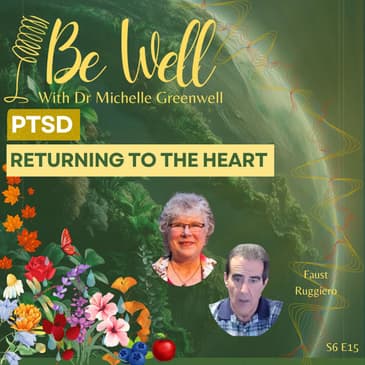
Trauma changes us—but it does not define us.
In this heartfelt conversation, Dr. Michelle Greenwell welcomes internationally recognized author and self-help expert Faust Ruggiero, M.S. to explore the many faces of Post-Traumatic Stress Disorder (PTSD) and the path toward healing.
Drawing from over forty years of professional experience and his book, "The Fix Your PTSD Handbook", Faust explains how trauma affects the body, mind, and emotions, why PTSD exists on a spectrum rather than as a single diagnosis, and what practical steps can help people begin reconnecting with themselves and others.
Together, they explore:
🌿 Understanding the five types of PTSD
🌿 How unresolved trauma affects the nervous system and emotional wellbeing
🌿 Why healing involves the whole person—not just the mind
🌿 Rebuilding trust after trauma
🌿 The importance of connection, hope, and compassionate support
Dr. Greenwell also introduces a BioEnergetic Wellness perspective through the Five Element Wheel, offering a holistic way to understand how trauma can affect fear, grief, joy, grounding, and our sense of direction in life.
Tea Ritual
Before the conversation begins, we pause with "SoulTEA Harbour" from the Cape Breton Tea Company.
Featuring soothing Licorice Root and mineral-rich Stinging Nettle, this nourishing herbal blend reminds us to slow down, breathe deeply, and reconnect with our hearts.
Today's affirmation:
"Balance and Flow is possible when we open to be present for our true heart's desires. Come home to your heart."
We invite you to make a cup of tea and join us in creating a moment of calm before listening.
Learn More About Faust Ruggiero
Discover more about Faust's work and his upcoming book, "The Fix Your PTSD Handbook", by visiting:
https://www.faustruggiero.com
Continue Your Healing Journey
If this conversation resonates with you, we invite you to explore our "Emotions & Healing" podcast series, where experts share practical tools for emotional wellbeing, nervous system regulation, resilience, and personal transformation.
You may also enjoy the programs available through the Greenwell Center for Holistic Health, where movement, mindfulness, BioEnergetic Wellness, and creative expression come together to support whole-person healing.
Looking for an immersive experience? Join us for the Artfilled Wellness Retreat in beautiful Cape Breton, where movement, music, nature, art, tea rituals, and community create powerful opportunities for restoration and flourishing.
🌐 Learn more:
https://www.greenwellcenter.com
If this episode encouraged you, please:
👍 Like the video
💬 Share your thoughts in the comments
🔔 Subscribe to Be Well with Dr. Michelle Greenwell for more conversations exploring the connection between movement, mindfulness, creativity, and meaningful living.
Until next time—
Keep moving, keep breathing, and keep coming home to yourself.
#PTSDRecovery #TraumaHealing #EmotionalHealing #BioEnergeticWellness #BeWellWithDrMichelleGreenwell
Each episode of the Be Well with Dr. Michelle Greenwell podcast includes the BioEnergetic Wellness Formula. That means that you have the opportunity to have a healing session while you listen based on the way the content is laid out and the activities we participate in. Before listening you can create a goal or an intention of where you would like to be heading with an activity or in your life, then make your cup of tea, engage in the activities and celebrate at the end.
Are you looking for more resources? The best way to find all the resources in one location is by visiting https://linktr.ee/greenwellcenter. Become a regular listener of the podcast and purchase your own tea blends to assist you in transformation while you listen. Our podcast is designed to bring balance and flow to your day, week, month, and year. Thanks for sharing us with others who could also benefit. Please send us your feedback and a review.
Dr. Michelle Greenwell, BA Psych, MSc CAM, Ph. D CIH (Complementary and Integrative Health). Striving to support the public to choose self-care and well-being options that create ease and flow in their lives, Michelle specializes in using movement to heal the body. Her BioEnergetic Formula for Success provides a means for everyone to set their intentions and create support and action for flow and ease to the goals. Learn more at www.greenwellcenter.com. Follow her YouTube channel and specialty playlists. Find her full resource list here. She highlights her Tea Company: The Cape Breton Tea Company which you can find at www.capebretontea.ca. Included is the specialty line of Tea with Intention, Harmony Blends and Coaster, and the focus on high quality organic black, green, herbal, rooibos, and honeybush tea. Including tea with your podcast listening is a unique way to explore tea, create healthy habits, and have great conversations with friends and colleagues.
[00:00:06] Hi, this is the Be Well with Dr. Michelle Greenwell podcast. Our heartwarming conversation is designed to lift you on your wellness journey. Grab your cup of tea and enjoy the podcast.
[00:00:26] Welcome to Be Well with Dr. Michelle Greenwell, where we're going to explore the connection between movement, mindfulness and meaningful living today through a special episode about post-traumatic stress disorder or PTSD. And we're going to look at how it lives in the body, the mind, the emotions and how we can begin to move towards healing and reconnection.
[00:00:49] I am joined today by the incredible Faust Ruggiero, an award-winning author and one of the most interviewed self-help experts in the world, whose upcoming book, The Fix Your PTSD Handbook, offers a practical and empowering understanding of trauma and recovery. So welcome today. Oh, thanks so much for inviting me, Michelle. It's a pleasure to be spending time with you.
[00:01:16] I'm just going to give a little bit of background about PTSD from the five element wheel perspective. And that's an area that we'll be spending a lot of time this season exploring what that means. And so before we dive into some of the concepts that Faust is working with, I just wanted to shine a light this way. So PTSD isn't simply a memory. It is a physiological and energetic imprint.
[00:01:42] And it occurs when the body does not return to balance after a traumatic event. The nervous system remains in a heightened state, often reliving the experience through flashbacks, anxiety, emotional overwhelm, you know, freezing in the body. And from five element perspective, we can see how the trauma affects the whole system. And that's what I want to shine a light on today. As you see some of the other topics we explore in season six.
[00:02:09] So water element, which is the kidneys and the bladder that holds fear and survival instincts and trauma can deplete this reserve, leaving us feeling unsafe and exhausted. And a lot of people notice that as anxiety or fear. Then we have the wood element for the liver and the gallbladder governs flow and direction and trauma may create frustration, anger or a sense of being stuck.
[00:02:37] And when we have those kinds of almost outbursts, then, you know, that's where the challenge might be sitting. We're looking at the fire element. We have the heart and the small intestine. And this is where joy, connection and spirit lives. And PTSD can disrupt this leading to the anxiety, disconnection or emotional volatility that I described already. If we look at the earth element, we have spleen and stomach.
[00:03:07] And that's where we have grounding and nourishment. And trauma may create overthinking, worry or difficulty feeling supported. It may show up as indigestion, some cramping. And this is a way for you to notice. In the metal element, we have lungs and large intestine, letting go and grief. And trauma often anchors unresolved grief and making releasing difficult.
[00:03:34] When we view PTSD through this lens, we see that healing is not just about the mind. It's not what we can overcome or overpower. It is about restoring flow across all the systems. Before we dive into all the incredible richness that Faust is going to bring to our conversation, we need to have a cup of tea. We need to find out what herbs we can look at today. And we invite you, the listener, for your healing session while you listen,
[00:04:03] to either bring some water to you that you can infuse with what we're going to talk about here with intentions. And maybe you have your own cup of tea or a cup of coffee. But a little time to sit back, relax and listen. So Faust, what have you got in your cup today? You know, Michelle, I am a tea drinker and it's always herbal tea. So and it's, you know, depending on where my body is that day, then the various herbs go in. But I always start my day with light green tea.
[00:04:32] No, not much in the way of caffeine. Chamomile and spearmint. That's usually my morning kind of brew. I'm not one of these people that needs the caffeine in the morning. If you do what your body and your mind and your spirit wants you to do, you keep yourself in balance. You shouldn't need to have to, you know, jumpstart your day. So when people will say to me, chamomile in the morning, aren't you? No, no. If I do that, I'll be up all night.
[00:05:02] So, you know, that's my morning ritual. That's beautiful. And it's so important because particularly for people who have had some kind of trauma that hasn't been resolved, caffeine is a go-to. And I enjoy getting out of bed in the morning and just wondering what will I choose rather than what do I need? So there's that shift that can happen.
[00:05:27] But for the listeners, I also just want to bring to attention that a black tea can calm the body, open the mind, but calm the body, if you don't add the milk. If you add the milk, then it's going to give you that jolting kind of peace. And so it's a great way to think about how your tea ritual goes. And the same with that green tea. See, as you were saying, too, green tea is a nice, light, calming piece.
[00:05:55] And it blends beautifully with chamomile, which people very often don't put together. So I have a couple of blends that I have which are similar to what you described. So I didn't choose those herbs today to talk about. But I'm going to share a tea that comes from my company, the Cape Breton Tea Company, which is called Salty Harbor. And I wanted to highlight today licorice root and stinging nettle. So a little bit different perspective.
[00:06:23] So licorice root is known for soothing, harmonizing qualities, for helping us to regulate our stress responses and support adrenal balance. So when we're in that high drive all the time, those adrenals, they're working hard for us. And so this is a great way to be able to calm that. And then stinging nettle. Now, if anybody's ever fallen into a patch of stinging nettle, it is not a nice adventure.
[00:06:50] But the nourishment that comes from this plant is incredible. So it's well worth having in the garden. It's rich in minerals, supports the nervous system, and then helps the body rebuild after stress. So this is a great combination to put together. The affirmation that comes with the salty harbor is balance and flow is possible when we open to be present to our true heart's desires. Come home to your heart. And that's what we're talking about today.
[00:07:18] So I thank you very much for joining me on this journey. And cheers. Okay. And I can smell it today. I can really smell the licorice. It's coming right up. So as you are listening to this podcast, please take deep breaths.
[00:07:40] Sip slowly and allow yourself time to arrive into this moment and to be able to receive the information that Faust has. He's just got such a wealth of information. And so to be able to take it in and to be able to come back to this podcast and listen again. Because you'll hear some things once. And the next time around, you'll be in a different place. And you're going to hear some different pieces. And I encourage you to take time with this podcast. All right. Welcome.
[00:08:07] I want to introduce a little bit of who you are so people will know. You have 40 years of professional experience and award-winning author of the Fix Yourself Empowerment Series. And you are one of the most interviewed self-help authors in the world, which I am so grateful to have you on my show. So thank you for being here. The Fix Your PTSD Handbook is coming out very soon.
[00:08:32] And it offers a compassionate and structured approach to understanding trauma and then reclaiming control. As we dive in, it's an honor to have you here to talk about this topic. But your work also brings clarity to something that can feel really overwhelming and confusing for so many people.
[00:08:51] So I'd like to begin our conversation with the foundational question of how do you define PTSD in a way that helps people truly understand what's happening with inside them? You know, it's the right place to start, Michelle. I'm going to read a quick definition, but I want to read it because it's the traditional one that everyone uses.
[00:09:16] But I want to read it because I'm going to point out the piece, the one word in there that is misguiding to everyone. And what it does is it puts us in a position to mistreat our people with PTSD. This is how it reads. Post-traumatic stress disorder is defined as a mental health condition that can develop after experiencing or witnessing a traumatic event that leads to a persistent distressing symptoms like intrusive memories.
[00:09:46] Those are flashbacks and nightmares. Avoidance of reminders, negative mood changes, and hyperarousal. And can disrupt our work life, our family life, our social life. That's what they talk about with that. And the one word that misguides us, I'm sure you picked it out, is mental health. It's not a solely mental health condition.
[00:10:09] And, you know, for a person like myself, when I treat people, I operate on what I call the four attributes that I tell people must stay in balance. Physical, intellectual, emotional, and spiritual. And we don't think about that. But when you have a great day, everything in your life seems balanced. You're not over-emoting. Your thoughts are clear and concise. Your body remains calm. And you feel connected inside.
[00:10:38] When we experience trauma and PTSD, it's like an implosion on the inside, which affects every part of our body. You went through all the concepts before. It affects all the various body parts. And we have to finally get to the point that we understand that our brain and our body are the same. They're connected. They work together. So you can't have a mental health condition without having an all-body condition.
[00:11:09] That's a great way to put it. I love that. When people, too, when they try to solve things, they would try to solve it from the same place. And so I appreciate, Ben, that when we're leaving the mind and where are we going to go and how do we get to that physical space? And how do those emotions come into there? All of that's working as one.
[00:11:34] So can you share what actually happens internally when trauma is not resolved? What does that feel like? You know, when we talk about trauma, there are two key elements. One is trauma hits. We witness something. Something happens to us. Someone does something to us. And we work through that. And our body goes back to baseline. Maybe it takes a day or a week or whatever. But we go back.
[00:12:02] And then there's the second type of trauma, which for some reason we can't reset. The emotions wrap around it. The mind keeps replaying it. The body goes into hyperarousal mode. And we just can't seem to get past that. The first type of trauma we all get. People will say, no, I've never been traumatized. And I say, yes, you have. Of course you have. You know, it may be something very small. Maybe something a little longer. You don't think it was trauma because you got through it. That's trauma.
[00:12:32] That you were able to reset on. The second type is the one that can lead to PTSD. That's where the body, the mind, the spirit, the emotions don't reset. And what they do is they, it's almost like someone says, here, here's trauma. Carry on and make this part of your life. And we go do it. But we can't stop it. That's the key. We can't stop it. Exactly. Mm-hmm. Exactly. And I'm just trying to think of people who try to think about, I'll do it by the willpower.
[00:13:01] My brain should be able to handle that. And from the inside, brain and body work differently than we think. And they do. And they work synergistically. You know, they're connected. And, you know, when people come to me and they say, this trauma happened or whatever's going on in their life, I say, how do you feel physically? Because I always go physical first. When we do that, then we take the constant, the focus, if you will, off the mind. And my mind must work through this.
[00:13:31] Because if you can't calm your body down, you're not going to realize you're doing things with your mind that keep the body accelerated. You're focused. So, again, it's important to know that you don't want your mind to work against your body. And when you're forcing yourself to try to do something, to try to think through something, and your emotions are wrapped around it and you can't put those aside, you're actually accelerating all those body processes.
[00:13:59] That fight or flight response then stays constant. And then you're accelerated. And now you're pressing to solve a problem that, you know, that you can't, your mind's just not going to make it go away. It's just not going to happen. Mm-hmm. Mm-hmm. Now, you've outlined five distinct types of PTSD in your book.
[00:14:20] And I think it would be helpful for our audience to see maybe if they're thinking they have had some traumatic experience that might be stuck, how they might fit within these. Do you want to walk us through those five types? Well, there are actually three types. PTSD, like trauma, in the early stages, if it's treated, you know, it's really bad. Much easier to deal with.
[00:14:47] What we look at are the three types that are concerned. The first one is what we call uncomplicated PTSD. And what it really is is one something hits, one item hits. I got bullied at school. I'm going through a horrible divorce. There's one thing. And then we can focus on that one thing. It may connect, it almost always does, to other past things. That's the other fallacy.
[00:15:17] Well, you know, it's just that one thing. Well, the timeline doesn't stop and then gets filed away somewhere. It keeps on going. So it connects with that. So even uncomplicated, even one traumatic experience can connect throughout a person's body and mind and emotions. The second type is what's called complex PTSD. That's when there can be several things happening, two or more.
[00:15:47] You know, I'm in a bad marriage and I'm getting abused. But my father abused me. And when I went to school, they did that to me, too. And then I was in this horrible car accident and maybe I lost a very close friend. A lot of things happening. So that complex PTSD is a whole different animal. Now we have to unwrap that and look at all the individual traumas and how they connect to each other.
[00:16:15] And the last one they call, they call carmobit. Let me say, let me say that again. Carmobit personality. And what it really is, trauma, is what it really is, is it's something with mental health already established. So now I'm a person who has high anxiety. I have a bipolar condition. I have depression.
[00:16:41] And now trauma hits me and PTSD starts. I've already got the foundation for a horrible situation. And my mental health will come and complicate this. When we treat people, we look for that. Is there just one item? And are you experiencing difficulty before? Are there two? And again, were you experiencing some difficulties?
[00:17:09] Are you already seeing a psychiatrist? Are you already at these huge mental health concerns? Well, we want to look at that because that's, again, a whole different animal. And I'm just thinking about how people try to package things. I guess that's the way I was trying to figure out how to say it. And they've already packaged it and put it away thinking they're done with it.
[00:17:36] And what you're saying is we're never really done. It's just a matter of what comes up that signals that part that's been packaged away to come back again. And you might not recognize it's come back because you didn't know you packaged it away, but that it does bring itself in and supports, complicates what's going forward. It does. I call these the undercurrents.
[00:18:05] You know, they're in our life all the time. If something happened to you, you were traumatized early, you went to counseling. You worked through it. Any good counselor will say, you know, we're going to pull that cure word out of it. We didn't cure you of this. We helped you develop a position in your life where now it doesn't bother you anymore. You learn from it. Coping devices are there. You may even become, you know, wiser about how you live your life.
[00:18:34] But if something happens and connects to it, just one little piece, it's like a string that pulls it back up to the top. And here we are again. That doesn't mean it comes back full force. It just means that there may be a part of this that you didn't unpackage before. And now that's the vulnerable part that's going to come up again. And so you may just have to go back and tweak it a little bit.
[00:18:58] But it can be the type of thing that makes the PTSD you're experiencing now that much worse. And I'm just thinking about how we sometimes describe it as peeling the onion. There are so many layers. And I just want for the listeners to think about it doesn't necessarily mean you've gone right back to the beginning. Because if you've worked through many, many layers, it's just a layer. And that layer has some other things it can share with us.
[00:19:28] And so it doesn't mean it has to go back to the trauma and the experience that might have been at your worst. But you do now have so much more experience, knowledge, and expertise to be able to bring it forward in a different way. You know, Michelle, you brought up a real important point. As I'm counseling people with PTSD, you know, we'll start moving through things and they start to make progress.
[00:19:56] Then they slip back and they say, why did I slip back? I thought we were doing well. I said, because you just did something you've never done before. You faced it. So we're moving forward and you're not using defenses and, you know, those coping things that push, you know, little skills that you learned to push things aside or isolate or not face it. Now you said, I'm going forward. I'm going to face it. And then we face that one. And well, guess what? Now the next one, which is a little more difficult, came along. And you face that again.
[00:20:26] So it's not regression. It's just a movement backward enough for you to regroup, put a foundation under that part of it and move forward. So, you know, that's the thing about counseling. If it's working well, I always tell people you shouldn't be running out of it. Counselor is always saying, great, this was so good. You should be saying, oh my goodness, where did that come from? But I'm going to beat it. That's the framework. That's what works.
[00:20:54] I just want to go back to one other thing you said, which I think is also really important for people to realize is you said mental health. And mental health being, you know, there was a list of things that went with it. So there's mental health, which is going to have some diagnoses with it of what's going on. But then there's mental wellness. And so I just wanted to bring that forward. Did you want to comment about that? Absolutely. You know, I'm glad you brought that up.
[00:21:23] It's something that I talked about a lot. If I say to you, how's your mental health? You know where most people go first? Well, I have depression. I have anxiety. I said, what's the mental health? You went. We've actually coined this phrase, which has people thinking about what they're not doing right or what's not feeling good. Mental wellness. Okay. Much better. That's what we're really talking about here. So, you know, again, it's a mental health condition. No, it's a full body condition.
[00:21:52] And our goal is to get you to mental wellness. But along with emotional wellness and physical wellness, and if you are willing to be a person of faith or at least willing to dive a little deeper and get connected to that spiritual part of yourself, we want that to come up too. Exactly. Perfect. Thank you for saying that. Now, we know that each person's situation is a unique one.
[00:22:20] So they're going to have their experiences that have come along, but also the way they've handled things or not been able to handle things. And it can be like being on a spectrum in some cases. So from your perspective, what would you say would be the biggest misconceptions people might have about PTSD? Well, you said the first one, that we can treat everyone the same with it. No go on that one.
[00:22:49] If we're good clinicians, if we're good diagnosticians, we are going to take time and really delve into that past. You know, you can come in and say, well, you know, I was a soldier in the war and I came back and I've got this. but the other person came back and experienced the same thing and didn't get what you get. Well, you're different. So what we have to know that individual differences are key in both diagnosis and treatment. That's the first thing.
[00:23:19] And as I say, I wrote the book and I lay it all out in elaborate terms, but I also say no book is going to save you. You've got to go get help. That's the second thing about PTSD. You are not going to do this alone. Because when it happened and the trauma hit, all those processes you need to work through this have been compromised.
[00:23:43] So you need a network of at least one or two people in your life, friends, family, whatever. And you need your special person, your clinician, your counselor, who knows about PTSD to help you through it. Third point is who knows. Not all counselors know how to deal with PTSD. That's just the way it is.
[00:24:07] So if you're going to get help, you want to make sure that the person that you're asking to help you is an expert in the field. And you do that by asking them questions about how they're going to treat your PTSD. They should have answers for you. Beautiful. Beautiful. If we look at, as you were describing, somebody who's come a long ways down the road,
[00:24:37] they're going along and then something happens and they have that setback, the ability to trust that everything's going to be okay, that they can keep going forward is really difficult to hold on to. Do you want to talk a little bit about that trust piece? And then as you just finished saying too, about going back into that isolation and making sure you have that team to take you forward. It's a great question.
[00:25:03] You know, and I do two consecutive chapters that deal with just that subject. The last seven chapters are the roadmap, so to speak. This is what you're going to do to get better. And by the way, the book was published. We published last Saturday, so it is available. Perfect. But the chapters delve into the notion that moving forward, as I said before,
[00:25:30] will have you challenging yourself, which you protected yourself from doing before, and rightfully so. You didn't have a network. You didn't have a counselor. You didn't have the skills to do that. So you protected yourself. Our minds do that for us. But now when you hit what seems to be a roadblock, all it's telling you is that now you need to
[00:25:53] take, you know, just take a little break and allow yourself to go back and define what the roadblock is about. Don't react to it emotionally. It's not, oh my God, it failed. I went back, which is what you did before, understandably. If you got to a point where you kind of hit a wall, what it tells you are two things. A, we're not done working on the previous thing we were working on, number one.
[00:26:21] And number two, you might not have taken, you might not have disclosed everything we needed to know. So now we have to put more information into the picture. When that happens, the advice is simply say, I'm stuck. Don't react. Say, I'm kind of stuck here. I don't know. I feel like I went back a little bit. But then your counselor can say, let's define what happened. You know, this all that, the trust is really about forming a trusting relationship with your counselor first.
[00:26:51] So when it happens, you can say, all right, they have my back. They have me. They got me. And I can go back and I can, as soon as I'm feeling it, I can say, I'm feeling this. One of the things we see with people going through counseling is they want the counselors to firmly believe they're making progress. We know you're going to get stuck. Sometimes, you know, we're going to kind of stick our leg out and trip you a little bit because you're going too fast. We may do that.
[00:27:17] Our goal is to get you to expand and understand everything going on in your life. So as soon as it is starting, that's when you talk about it. Don't hold on to it like you did before. Mm-hmm.
[00:27:36] I'm just thinking about what about some of those people who repeat a process that keeps them kind of stuck. So if they did come back from doing service work and they're kind of participating in life a little bit,
[00:28:00] but they keep doing things like play the computer games that put them back into similar scenes, or they do activities that give them that high-energy rush of the adrenaline that they had while they were doing their service duties. Is there a kind of a replay that happens with that? You're talking about as we're going through the counseling now. Yeah. Yeah. Yeah.
[00:28:29] You know, the mind continually replays. You know, we can go to a social event and walk out and replay what we said to people and how well we did that. In PTSD, the mind doesn't stop replaying. What we want to do is disconnect all the negative energy. That's what we want to do, or as much of it as we can. So it's going to replay.
[00:28:54] We just want to change the movie, if you will. We want to change what the mind is seeing and also help the person to say, when it starts to replay, we want to give them the skills and the power to say, I could stop this. You know, it's going back. Here's what happens. You know, and as you, I'm sure you know, the, our mind is, is a continuous learning machine for us.
[00:29:22] And it continues to process and reprocess, but it doesn't forget. It doesn't. Okay. We process that C around. We'll go over here. That's all in the memory bank. So as we keep going, it keeps learning and it learned all the negative stuff. It learned the fear and it learned, um, how to, how to feel, uh, in, like you're in danger all the time and, and how to be in a dark place. It learned all those things.
[00:29:51] And when it learns, it normalizes. And when it normalizes, it becomes the way we do it all the time. If you go going through counseling and redoing this in conscious way, in a conscious fashion. Now we're retraining the brain. That's what we're doing so that those automatic processes are, are, are, uh, you know, linked to positive feelings and thoughts. That's what we're doing.
[00:30:17] So when it goes back, all you're saying is, okay, went back to the old book. I got to get in the new book. That's what we're doing. It's a normal process again. And I always tell people, they say, I can't do this. And I say, well, let me offer you the proof. You did it once, but you did it with the negative stuff. That means your brain's learning. So if you did it that way, absolutely. You can do it with new information. That's all we're giving you. New information, new skills. I love that.
[00:30:46] That's a great way to rephrase. Um, all right, let's, um, let's just talk about connection a little bit because you did talk about having a couple of people within your life that's present as well as somebody who can be there for you on a professional level. So what kind of team is a good one to gather around you? The first thing I tell you, you start with just, are they, are they positive people who really want to help you are interested and are going to listen to you?
[00:31:16] Start there. Try not to go to the emotional people who try to get, get you through it fast. Uh, the people who want to keep giving you advice because that's not what you need. They are support people. That's what you're talking about. Now I'm here for you. Yes. I'll listen to you. Ask them if they are willing to learn about PTSD. Cause if they do, and I have a chapter in the book, if you're going to help someone, don't do these things, do these things.
[00:31:45] So we want them to be able to be people who are supports, not counselors, not, uh, people who are, you know, the, come on, get over it type. Oh, come on. You can do this. No, that's, you know, tell me what you're feeling. I don't have answers for you, but I'm here for you. I'm here to help you walk through this.
[00:32:04] Um, and then if they're willing and you're willing, take them to a counseling session, let them see what's going on in there because counseling, you know, might be an hour a week or two hours a week, depending on what you can afford and what your counselor wants to do. But then the rest of the time is yours and you have to go make it work. So having that support system out there to help you is really just a wonderful way to do things. You're not going to depend on them.
[00:32:33] They're just there for you. And, you know, and you may socialize with them. You may do things, you know, at home with them or just talk to them. That's fine. Get a support group. If you can, there are PTSD support groups, some local, some will be online. Join one so that you've got, so that you can see that you're not, there's nothing wrong with your brain. Other people are going through the same things. Yeah. You're not unique.
[00:33:01] You're just, you just need to find your tribe. Exactly. Oh, beautiful. Is there anything that we haven't covered that you wanted to make sure people got as a message? Yeah. Just one simple thing. You had trauma. You now have PTSD. Your mind is spinning. You're dreaming. There are flashbacks. You're isolating or you're getting angry. Your hyper arousal is there all the time.
[00:33:31] It's there. As I said, A, you can't do this alone. Get help. But don't think about getting help. Make the call. I give ways to do that. If you're saying, I don't know who in my area deals with PTSD, a wonderful source online is Psychology Today. They list counselors everywhere across the country. They give you their degrees.
[00:33:57] They give you their specifications and what their expertises are. They give you everything you need. It's a good place to start. If you're in a serious place with PTSD, the crisis lines are there. I have those in the book also. Call. I need help. Get me somewhere. But make the call. Stop thinking you're not worthy. Stop thinking that this is never going to happen. Make the call and get the process started.
[00:34:26] And then be willing to stick with it. Beautiful. Thank you so much for shining the light. And I know you've got bigger projects ahead. So I'm excited about what you'll be able to shine the light on for getting people to the right place. So we can be talking about mental wellness to go with our body wellness, which would be fabulous. Absolutely. Yeah.
[00:34:53] As we take in Faust's insights, let's return to the body for a moment. Trauma may hold us in patterns of protection. Healing begins when we start to create those safe spaces for release and reconnection. And through movement, breath, nourishment, and support, we begin to restore. Flow, where there was once stagnation. Calm, where there was activation. Connection, where there was isolation.
[00:35:21] And just like with the five elements, healing is not a linear journey. It is a cyclical, evolving, and deeply personal one. And as you come through, just as you were saying, Faust, just about you go forward, you might come a little bit back, but you're always coming back with the skills that you didn't have the last time you were there. And you're stepping forward in a new way. So I would like you to return to your tea, or maybe you infused your water.
[00:35:49] Notice the warmth that it may have. Notice how it grounds you. Both of us, as we were describing our herbs, they have specific meanings for us, and it's really important. This gentle support can offer more to your system as well. And I just want to repeat, balance and flow is possible when we open to be present for our true heart's desires, and to come home to our hearts.
[00:36:13] And for those who do have PST that is a part of your life, then taking that time to find that heart space and coming back to it. PTSD is not our identity. It's an experience. It's your system has carried this and one that can be transformed with time, support, and awareness. Thank you, Faust, for showing your wisdom, and for the incredible work you're doing to support individuals on their healing journey. To learn more...
[00:36:43] Sorry, go ahead. I thought it's been a pleasure. Thanks for inviting me. To learn more about Faust and his upcoming book, The Fix Your PTSD Handbook, I should say the book that is now released, which is great, you can visit his website, which is faust, F-A-U-S-T, R-U-G-G-I-E-R-O dot com.
[00:37:10] And you'll be able to find all the information about his book there and any upcoming projects. I'll say it that way so people will stay tuned. And thank you for joining me today with Be Well with Dr. Michelle Greenwell. And until next time, keep moving, keep breathing, and keep coming home to yourself. Thanks so much. Thank you for listening to Be Well with Dr. Michelle Greenwell.
[00:37:38] There are a couple of resources I want to just point out. When you go to the website greenwellcenter.com, you'll have a pop-up window. That pop-up gives you the top eight easy stress releasers that you can use every day. That's something you can put beside your computer, the bathroom mirror, beside the bedside table. A great resource. Also, my YouTube channel.
[00:38:02] It is full of playlists with all kinds of different ways that you can activate energy and bring vitality into your day. You can find that when you go to YouTube at Michelle Greenwell. And last, if you're a Linktree person, Linktree, L-I-N-K-T-R dot E-E slash Greenwell Centre. That has all my resources in one spot.
[00:38:29] Those are for intricate little things that you can't get everywhere. And it's a wonderful way for me to be able to share all the different aspects of the kind of work I do. So thank you for listening. Be sure to drink that tea. And if you want to have the tea blend that was shared in the podcast today, then be sure to check out kbrettontea.ca. Have a wonderful day.