
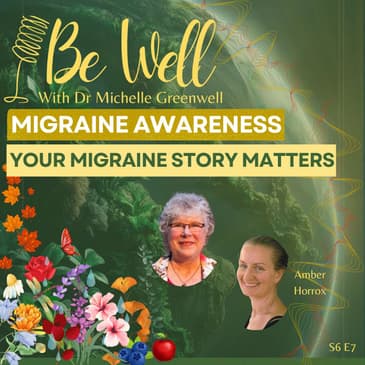
Welcome back to our special Migraine Awareness Month series on Be Well with Dr. Michelle Greenwell, where we explore healing through movement, mindfulness, bioenergetic wellness, and the wisdom already living within us.
In this powerful episode, Dr. Michelle Greenwell is joined by Amber Horrox—author, migraine educator, advocate, and host of the Your Migraine Story Matters podcast.
Amber shares her deeply personal journey of living with migraine for nearly 20 years before experiencing full-time disability in 2018. Through writing, storytelling, self-advocacy, and community, she found a pathway back to herself—and now helps others do the same through her work, publications, and educational programs.
This conversation explores what happens when pain becomes a messenger, when silence gives way to self-trust, and when reclaiming your voice becomes part of reclaiming your health.
In This Episode
✨ Amber's migraine journey from invisibility to advocacy
✨ Living with chronic migraine and disability
✨ The healing power of storytelling and self-expression
✨ Why your migraine story matters
✨ Writing as a pathway to self-discovery and empowerment
✨ The role of community in healing chronic illness
✨ Moving from control to creation
✨ Finding joy and identity beyond pain
✨ Wellness practices to support nervous system regulation and recovery
Featured Tea Ritual: 1909 First Flight on Baddeck Bay
Before our conversation, we share a tea ritual inspired by the historic first flight of the Silver Dart in Baddeck, Nova Scotia—a reminder that healing often requires preparation, belief, and collaboration.
Today's featured blend combines:
🍃 Pu-erh Tea – representing grounding, transformation, patience, and integration
🍃 Lemon Verbena – offering clarity, nervous system support, emotional softening, and lightness
Together they invite us to steady the body while lifting the spirit.
Affirmation:
"Preparation, belief, and collaboration provide an aerial focus for success."
Migraine Wellness Tools Featured
Dr. Michelle shares several gentle practices to support nervous system regulation and migraine recovery:
🌿 Seated Don Yu
🌿 Connecting Heaven and Earth
🌿 Lung Meridian Tapping
🌿 Breath Awareness
🌿 Mindful Movement for Energy Restoration
These practices are not intended as medical treatment but as supportive tools that may help the body feel safer, softer, and more regulated.
Connect with Amber Horrox
🌿 Warrior Within
Warrior Within Substack
🌿 LinkedIn
Amber Horrox on LinkedIn
🌿 Podcast: Your Migraine Story Matters
Connect with Dr. Michelle Greenwell
🌿 Greenwell Center for Holistic Health
🌿 Cape Breton Tea Company
📷 Instagram: @michellebgreenwell
📷 Instagram: @capebretonteacompany
Reflection Question
What part of your story is waiting to be heard?
Sometimes healing begins with a new treatment.
Sometimes it begins with a new perspective.
And sometimes it begins with telling the truth about your experience and allowing yourself to be witnessed.
If this conversation resonated with you:
👍 Like
💬 Comment
🔔 Subscribe
📤 Share with someone living with migraine or chronic illness
Together, we can create greater awareness, compassion, and support for everyone navigating the migraine journey.
#MigraineAwarenessMonth #YourMigraineStoryMatters #AmberHorrox #ChronicMigraine #MigraineRecovery #MigraineSupport #WarriorWithin #StorytellingForHealing #HealingJourney #NervousSystemRegulation #Mindfulness #BioEnergeticWellness #TeaRitual #BeWellWithDrMichelleGreenwell #ChronicIllnessAwareness #WomenWithMigraine #MigraineAdvocate #HolisticHealth #WellnessPodcast #HealingThroughStory
Each episode of the Be Well with Dr. Michelle Greenwell podcast includes the BioEnergetic Wellness Formula. That means that you have the opportunity to have a healing session while you listen based on the way the content is laid out and the activities we participate in. Before listening you can create a goal or an intention of where you would like to be heading with an activity or in your life, then make your cup of tea, engage in the activities and celebrate at the end.
Are you looking for more resources? The best way to find all the resources in one location is by visiting https://linktr.ee/greenwellcenter. Become a regular listener of the podcast and purchase your own tea blends to assist you in transformation while you listen. Our podcast is designed to bring balance and flow to your day, week, month, and year. Thanks for sharing us with others who could also benefit. Please send us your feedback and a review.
Dr. Michelle Greenwell, BA Psych, MSc CAM, Ph. D CIH (Complementary and Integrative Health). Striving to support the public to choose self-care and well-being options that create ease and flow in their lives, Michelle specializes in using movement to heal the body. Her BioEnergetic Formula for Success provides a means for everyone to set their intentions and create support and action for flow and ease to the goals. Learn more at www.greenwellcenter.com. Follow her YouTube channel and specialty playlists. Find her full resource list here. She highlights her Tea Company: The Cape Breton Tea Company which you can find at www.capebretontea.ca. Included is the specialty line of Tea with Intention, Harmony Blends and Coaster, and the focus on high quality organic black, green, herbal, rooibos, and honeybush tea. Including tea with your podcast listening is a unique way to explore tea, create healthy habits, and have great conversations with friends and colleagues.
[00:00:06] Hi, this is the Be Well with Dr. Michelle Greenwell podcast. Our heartwarming conversation is designed to lift you on your wellness journey. Grab your cup of tea and enjoy the podcast.
[00:00:26] Welcome to Be Well with Dr. Michelle Greenwell, where we explore the pathways to healing through movement, mindfulness, bioenergetic wellness, and the wisdom already living within us. Today we're going to open the conversation around migraines, not simply as a headache, but as one of the most common and most misunderstood neurological conditions in our world.
[00:00:50] Migraine is often reduced to pain, but for those living with it, migraines are so much more, and it can affect your vision, speech, digestion, balance, mood, cognition, and nervous system regulation. It is deeply personal, often invisible, and frequently misunderstood. I shouldn't, frequently I think is even the wrong word.
[00:01:14] For many, the journey to diagnosis is long. Research shows it can take years, sometimes over a decade or more for people living with migraines to receive accurate diagnosis and effective support, especially when symptoms are complex, episodic, or misunderstood with conventional care models. The migraine is not just a headache disorder. It is a neurological condition with layered triggers.
[00:01:43] It can have fluctuating symptoms and can be highly individualized in the way that it presents itself, which is one of the reasons a diagnosis for it can be delayed and treatment can be very complicated. Perhaps one of the greatest challenges for those living with migraines is that the pain is often invisible and life changes. It creates. We just can't even describe.
[00:02:11] And for lots of people around who are a part of that person's life, it is an invisible piece because life does go on and you just have to push through. Today's guest knows this journey intimately. Today I have Ann Smets with me. Ann Smets, how are you? Hi, Michelle. I'm really well and I'm glad to be here. Thank you so much. That was a beautiful introduction.
[00:02:38] So thank you for sharing a bit more about the complexity and the level of misunderstanding and why some of that is around migraine. And I really appreciate that. Mm hmm. Mm hmm. Mm hmm. It's it's one of those pieces to where more women suffer from migraines and it's one of those areas that the research is just not being spent. And so it gets mixed in with other things and it just becomes such a complicated piece. But let's share a little bit about you.
[00:03:09] Amber is an author, a migraine educator and an advocate for women living with chronic migraines. She's the creator of the five pathways to authorship, host of the Your Migraine Story Matters podcast and the voice behind Warrior Within. And here she writes with honesty, courage and insight about living with chronic migraines, reclaiming identity and returning to the self after years of silence.
[00:03:39] That's a that's a big journey. And massive. And I love the way you put that so beautifully. Thank you. It's yeah, isn't it? It's a lot. And yeah, it's huge. It's a huge journey to be on. I remember spent 20 years living quietly with migraines before waking to a full time disability in 2018.
[00:04:02] And what followed was not only a journey through illness, but a profound return to her voice, authorship and to empowerment. Through writing, storytelling and advocacy, she began to reclaim the parts of herself that pain had silenced. And in doing so has helped others begin that same kind of journey.
[00:04:23] Ann Smets spoken openly about moving from control to creation, sharing how self advocacy community and story become part of the healing path. Hmm. Yeah, that's that's just a lot just even to say that in and to let people just soak in. Hmm. Hmm. Hmm. The enormity of being able to pull yourself out of pain and to be able to find your way through. And I did it in a different way.
[00:04:53] It came through, you know, feet that didn't want to function in a body that couldn't walk. Well, but I had mental faculties to be able to work with. It's a lot different when you can't think clearly. The fatigue means that, you know, the decision making process is not as strong as it could be. And then you still managed to get yourself out of there. So. So especially when you're expected to stay there.
[00:05:17] I mean, I think that the enormity of the challenge, it has to be said, comes from that place. You're expected to stay there. You're not expected to be able to move through it. And you're not even supported or encouraged or celebrated for finding a way it feels sometimes anyway. So, yeah, thank you for that. Mm hmm. Mm hmm.
[00:05:41] And even to you come through it and then it kind of just gets swept away because then it's no longer part of the conversation. Although without talking about it, it means that more people go without being noticed in their capacities. Yeah. Yeah. And all those years of silence, two decades in total for me, you know, 20 years of silence.
[00:06:04] I had no idea in that level of suffering that actually there were many millions more also suffering in silence. You know, I just thought it was just me. Yeah. And I've actually found it, you know, shockingly common. Yeah, exactly.
[00:06:26] So before we dive into our conversation, we want to make you the listener, have the opportunity to take some healing in while you're listening. And so I always ask for what kind of tea do you have in your teacup? So, Amber, what have you put into yours today? Oh, today I bought licorice root and my love for licorice was born out of just the box standard kind of peppermint and licorice tea bags.
[00:06:53] I forget which brands they are, but I've bought some. I was in Wales just early this year, actually, a few months ago. And there were some kind of loosely kind of teas and one of them was licorice root. And I adore it. I love it. I'm a huge fan. It's just gorgeous. I really love the taste. My dad always would stop to buy black licorice when we were on trips and I hated it. I couldn't understand it.
[00:07:23] And now my palate is to the place where it can really understand and appreciate licorice. And it's just gorgeous. So in the tea mug, it's just such a beautiful addition. Yeah. Yeah. So for those people that are listening, you're not seeing Amber who's hugging her mug and the excitement of her face. I'm just warm with my hands around her. I just love it because that's what drinking a cup of tea should be like, right?
[00:07:52] It's an experience of joy. Yeah. And sometimes I've learned that probably the hard way, but yeah. Yes. I've learned so many people are going to lean over and just pick up their mug and sip, and they're not really even going to be cognizant of what's in the mug or what it means or the support that it's going to provide. And you're not doing that. You're definitely you're completely connected to what does that mean to you? So thank you for that. Yeah.
[00:08:21] Um, what I have in my cup is I was trying to think, what do I bring to a migraine conversation? Um, that's going to open things up. And so I was thinking about migraines. I was thinking about the stillness. And then what came forward was the first flight, first flight forward.
[00:08:42] And that led me to the tea I produced for the Cape Breton tea company, which is the first flight of the deck Bay, uh, which was in 1909. So it's known as the 1909 T. That's how I usually refer to it, which was a historic moment in Canada because that's when the silver dart did the very first flight. They had flown in the U S they had shipped, um, the, uh, plane up, built it.
[00:09:08] And then just down from where I am on the deck Bay, Alexander Graham Bell, uh, had the silver dart flight. And during that flight, his wife was preparing, uh, raspberry lemon shrub, which is, um, like a vinegar to make a drink for everybody afterwards for the celebration. And it was in February. So I'm not sure if it was a cold drink, which is how they would have it in the summertime.
[00:09:37] So what I did is I put that in with a prayer black tea. And so I'm saying all this, um, not because I, you know, I want to highlight that tea per se, come and purchase the tea. I'm saying all that because when we bring that into the mug, there's so much of the story that's inside the mug. And that's what I want to bring up for you, Amber, because as you're telling your story and what the licorice root means to you, that same story.
[00:10:04] So for people listening so much that you can add to that cup. So as we go forward, we've got migraine recovery. So that's going to be part of it. We have preparation. We have belief and collaboration, which is a part of this tea blend. Preparation is going to ask us to listen. Where have we not been listening? Belief is asking us to trust the wisdom within. We have everything we need inside of us. We just have to listen.
[00:10:33] I was told that on the start of my journey as well. It took me a few years actually to connect with that as an insight about three years into kind of the very deep end of the healing journey. And it did come through to me one day that actually everything I need, I attract at the time that I need it. And it was very grounding and felt very comforting to realize. Yeah. I like that one. You're not alone. Yeah.
[00:11:03] Yeah. And that leads me to the third part, which is collaboration, which is asking us to receive support. Whether that comes from nature, comes from our community, or it comes from within. And so that's what I wanted to bring forward today with this tea. So I'm going to talk about two ingredients. And I always try to do that so that we can have the herbs bring the energy into the conversation.
[00:11:28] And also for people to just learn a little bit more of the spiritual essence of herbs rather than their medicinal responsibilities is sometimes how we put it. So the Pu'erh is a tea that helps us to ground and transform. It's aged, it's fermented, it's deeply rooted, similar to what you chose. It teaches us that time changes everything.
[00:11:52] Spiritually, Pu'erh invites us to be in steadiness, to improve our digestion and integration. And it reminds us that healing is not rushed. It is metabolized. And sometimes we would just like to be on the other side and be done. But our journey is never done. Lemon verbena brings light to the blend and it is soothing to the nervous system. It uplifts the spirit.
[00:12:20] It's associated with clarity, ease and emotional softening, which is also important when we're on these journeys. Where Pu'erh is going to give us the roots, lemon verbena allows us to lift. So now you can see where that first flight comes in. So they're going to invite us to steady the body, lighten the mind.
[00:12:43] And the affirmation, preparation, belief and collaboration provide an aerial focus for success. Helps us to rise above. So Amber, thank you for coming to the conversation today. I'm bringing your team and cheers. So as we settle in, I want you to think about preparation is going to soften our fear.
[00:13:09] Fear around getting well, fear around solving some of those challenges. Belief is going to restore our possibility. Collaboration is going to awaken our healing. The innate healing potential. As soon as we connect with someone, it's going to wake right up. As you sip slowly on your tea, feel the warmth in your hands. Notice your breath. Allow your body to receive support. And as we begin this conversation, consider what within you is ready to be heard.
[00:13:39] What truth has been waiting for space? I like that. And what healing becomes possible when we begin to listen. With that, I get to dive in with you, Amber. There's so much that I'm sure our listeners are going to be able to resonate with. And as they're thinking about some of the reasons why they're listening to us today, it's an opportunity for us to really shine a light in a different way from what they might be thinking.
[00:14:09] So do you want to take us back to, I guess, probably 2018 is the best place to start where you kind of ignored all the signals leading up to that, which is how we all do it. And then it's like you can't ignore it anymore. It's just a life. It's not functioning. Can you take us back to that time? Yeah, that was the full collapse of my life. I'd been severely ill and disabled by every single migraine attack from 1998.
[00:14:39] So, you know, 22 decade period. From 2015 onwards, my life began to kind of have that feeling as though it was falling apart at the seams. It was kind of coming in from all angles. My dad announced he had an aggressive form of cancer. Me and who I kind of perceived as the love of my life at that time went through a relationship breakdown unexpectedly the week of Christmas. I moved to a new city where I didn't know anyone.
[00:15:08] So I could be near a work. Work problems ensued. My mental health took, you know, also severe downturn. Migraine attacks increased in frequency and duration around this time. And for three years, it was just a downward decline until my dad died in 2018 in March.
[00:15:36] He's 60th or just, you know, just around his, just before his 61st birthday rather. And within three months, the entirety of my life collapsed. And the wake up signal for me had to come from being no longer able to drag myself out of bed in the way that I had been doing for the years prior. And it had to come at the cost of my career, my job, my income.
[00:16:06] And yeah, that, that, that for me was the collapse, but also the catalyst for change. So it's very difficult now to sit between that being the worst year of my life, but also the making of what was to come. Mm hmm. Mm hmm. Yeah, it's, it's interesting because we fear that. We fear that, that complete breakdown, right? And we ignore the signals yet.
[00:16:35] We fear what the result is going to be. I did. Yeah. Faced with that piece. Then you have that fear of how will you ever get through it? And then you have, now I got through it, but then it's the fear of how do I move forward? So it's like, you just keep going around and around in a circle and, and it's hard to, to come back out of it. Yeah. Mm hmm.
[00:16:55] And so what would you say, what was the catalyst or was there something inside you that just said, okay, this, this has to be different, or there's only one, one way for me to go, which is up. And how am I going to do that? So in 2016, I had a full mental health breakdown and nearly took my own life. I was, I'd been suicidal for quite some time, um, for the second time in my life.
[00:17:26] And, um, you know, it sounds a bit cliche to say it, particularly if you're struggling in that place, but that breakdown became the breakthrough in respect of that. I found my voice for the first time in my life. I ended up confiding in my boyfriend and telling him that I was desperate to speak to somebody. And he turned around and said, well, my friend's partner is a counselor. Do you want me to see if he'll speak to you?
[00:17:55] And that was what really came from voicing for the first time, a, how I felt, but be what I needed. And so fast forward 18 months, I'd been a senior counselor regularly and consistently. And although I was still very, very depressed and highly anxious, my mental strength was improving. I was no longer suicidal.
[00:18:23] And he'd recommended my counselor had recommended that I start a journaling practice. And unbeknown to me, the light was on. Nobody was home. Um, so I were right, was writing all these inspiring things in my quote, in my journal, like quotes, you know, motivational statements, listening to Ted talks, taking notes, trying to keep myself.
[00:18:51] Saying really, you know, in a world that was crumbling around me. So although my mental strength improved somewhat, I was still very mentally unwell and physically my health continued deteriorating further and further. Um, when it got to 2018 and my dad had died three months earlier, um, and I entered what is called status migranosis. That is where the severe pain element of an attack exceeds beyond 72 hours.
[00:19:20] And it was five days at the highest level of pain, being unable to eat, speak, drink, move. And that was my normal, but the duration had increased, you know, to, to such a staggering extent. And it was about two o'clock in the morning. I wrote in my journal, I didn't, you know, I wasn't consciously aware of this. Well, something was tapped in, but I wasn't consciously aware of this.
[00:19:47] But until later when I look back at my journal, but at two o'clock in the morning, um, as I moved into, um, I say recovery, I wasn't able to recover between attacks at that point. You know, I was the severe pain element was ending and moving into what is known as stage four of a migraine attack or status migranosis. But I was being taken under by the next one. So there wasn't really space for recovery, but it was in between those.
[00:20:16] Um, and I wrote for the first time in my life, I matter, my health matters. I know change is what is needed and I know it is going to take me a long time. Um, and I had no idea about connecting with spirit. I wasn't someone who identified in that way or was consciously aware that was connecting in that way. But I ended up writing, um, words that I could hear my dad saying, even though he died three months earlier.
[00:20:42] And he was saying, you know what you're doing, Amber, keep doing it. And it was from that place really that I found a different kind of strength. I'd been praised all my life for being the strong one. Um, you know, told how highly capable I was, high achiever, high performer, people pleaser, perfectionist, all these things that we're all starting to kind of wake up to and connect with and realize is an adaptation of ours.
[00:21:11] Um, and it, it, it, uh, what I said, you know, what was essentially being praised as strength, I now realize was survival. Um, and actually this was a strength of a different sort. It was learning to drown out the noise and tune into that kind of deeper inner knowing and receive support from a different place.
[00:21:37] And in turn become some of my own support along the way in the absence of it coming around me kind of externally and physically. Wow. So, okay. I'm not sure where to unpack that. It's a lot, isn't it? It's a lot. I'm so thankful now for that awake, what I see as an awakening. I did not realize what the hell was going on at the time as you don't when your life has been ripped from beneath you.
[00:22:03] Um, but I am so supremely thankful now that at that time of collapse, that awakening, that level of awakening, um, happened simultaneously, you know, forever thankful, supremely grateful. Mm hmm. Mm hmm. So I think one, one thing that's, um, comes out is, is an activity where you can notice change. So yours was within writing. Mm hmm. Because physically it would be impossible, right?
[00:22:31] Because if, if, if you're in that pain, you're going to be blocking anything else. Because you don't want to feel anything else because that's so all consuming. So the writing was a catalyst for you to be able to notice that there was going to be change. I describe it as a tool that saved my life. You know, when my, my counselor in the first session, he said, I would encourage you to journal.
[00:22:54] I went out the next day and I bought a purple journal and unbeknown to me embossed on it was the, were the words new era, N U E R A. And again, I didn't notice that for a long time. I was just a desperate. Yeah, I do. I don't say that lightly. I describe it as a practice that saved my life. Mm hmm. Mm hmm.
[00:23:15] So for those people listening, some way to measure that there's a change, some way to be aware how something has shifted, because like you said, you wrote all those things, but you still weren't in the place where you're going to be able to notice it. It wasn't until later that you could go back and then realize, okay, that that change had been made. Now, what could you do? And I do that in movement. So I usually indicate where are we at before we start?
[00:23:44] Where are we when we finish? How much change did we make? But a lot of people don't really live their life where they're making those kinds of shifts or changes. Maybe fill up. Well, we fear it, don't we? It's like you mentioned before, we fear wellness getting well. We fear the collapse and we fear change. Yeah. Yeah. Someone said to me today, people really like to live in the muck. And I thought, that's pretty good. Yes.
[00:24:13] Let's turn it into fertilizer, please. Oh, my goodness. All right. So, so one, one piece too, that's coming out is, is the, into that depth of that inner knowing, is that trust inside that you could trust you to be the catalyst, but you could also trust you to know what was going to be needed. Yes.
[00:24:42] Oh, my goodness. Yes. I often say to people, I know you'll have to relate, Michelle, that you can only appreciate the level of trust when you and bringing that in for the first time when you have nothing else left, when you feel like there is no other option, then my friend, you will trust.
[00:25:05] And then to, to, you know, because we like to live in the muck, and because we will often choose things that are sabotaging for us. And because we ignore so much thinking that, you know, our body is just going to follow along with our head. Mm hmm.
[00:25:21] There's that, that piece of, of, of trying to find, trying to find that inner peace that says I can move you into a different way, instead of all those things that we've been doing that way. Mm hmm. And, uh, do it because it's easy. Now we're doing it because it's hard, but we still can trust the process. It's just such an interesting place to be, um, and to be able to find the power behind it.
[00:25:51] Mm hmm. Yeah. Okay. So into the writing you went, and after you, you were starting to make some changes and things were starting to shift, what did you notice by writing? What was that journey like for you? I mean, for, for, for a few years, it didn't feel like I was just writing every few days. So I'd sit down with my journal every few days.
[00:26:20] It wasn't a daily practice in the early years. And I would literally kind of brain dump, I suppose. I've come to see it as now. I would just write down, um, like little catch ups of what was happening in my day to day. But when I look back, I was actually writing down insights without even being aware or realizing as well as like I say, quotes.
[00:26:42] And I, at the back of, I started, I remember coming across a, like a 50 things for wellbeing, 50 practices for wellbeing. And the ones that stood out to me were write a letter to yourself as though you're writing to your best friend. And I did that, um, which was difficult to get into at first, but once I found my flow and then I read and reread and read over and over again,
[00:27:06] that letter to myself until I could really start to like receive it and hear it on a deeper level and start to believe some of the things that I was writing kindly about myself. Another one was to make a note of compliments that you receive. So at the back of my journal, I started writing down compliments that people were saying to me. And each time I would receive a new one, I would go and put that at the back of my journal. Blogs. I didn't know this at the time.
[00:27:33] Again, it was when I looked back on this one, cause I didn't reread this particular one. Um, but there was a blog that I read on self belief and the part that that plays, um, in positioning us with hope and, um, what's possible versus feeling hopeless and, um, helpless. Um, which became a big interest of mine and has stayed with me on this journey.
[00:28:00] What role does, you know, do our beliefs play in our wellness or, or lack thereof? Um, and yeah, yeah, there were a lot of practices in the back of my journal actually.
[00:28:13] And this book that I'm on with publishing at the moment, migraine, I wrote the first draft from, um, as a journal from my selection of journals over the years and, and recorded in a book so that I can share it with other people, the path and the journey that that took me on. And the practices that I did to help me find my ground, to help me build my best, to help me bring my support.
[00:28:42] And essentially, I guess is what I'm saying. Mm hmm. Mm hmm. Yeah. Um, it's just when I think, you know, cause some people start a journal, then they leave it blank. They may have three or four of those. Then they, and then, um, you know, they, some people record the events that happen in the community. Right. So there's no investment in that except for historical, which is important.
[00:29:10] Um, and some of us are lucky enough to read those kinds of journals now, but the, the piece of being able to go back like you did and read it with different lens. Oh, it was difficult to do that by the way I was guided to, but it took me a long while to do that because I knew how dark a place I was in. So there was a part of me resisting that too, and not wanting to go back. But when I did, my goodness, I couldn't believe what I was reading.
[00:29:39] Um, because I was also recording how I was feeling as well and starting to wake up to all this resentment, you know, from childhood, from moving, from doing things in life that I didn't want to do. Um, that we're out of alignment, really. We're not congruent to what I wanted and what, what, you know, a dream way of being. And, um, yeah, I couldn't, I couldn't believe it when I look back, but yeah, it did take, it did take me quite a long time to, to do that.
[00:30:08] But fear again, you know, fear of what I might find and fear of what I might uncover and how dark it was. But actually I was very surprised to find, as I said, that actually the light was on and I couldn't believe the connections that I was making and what I knew to be true and, and how, not right. I don't really like using that word, but how there was another part of me, that knowing part, that intuitive part.
[00:30:35] And she really did know what she was doing as I believe exists in each and every one of us. I certainly am not anyone, um, you know, kind of more special or more qualified or anything like that than anyone else. I believe that part exists in us all. And like you shared, there's a way for us to, um, create that change. Um, and it might often be writing, but it doesn't always have to be writing.
[00:31:02] It can be through movement, connecting in nature, art therapy, lots of different ways and means. Mm-hmm. Mm-hmm. Exactly. I'm just thinking how lucky you are though, to have those words, to be able to look at them. Um, and I just, I want to just, for the listeners to think about when we're in a certain state, our lens is going to be of a certain way. And when we've shifted, our lens shifts.
[00:31:32] And it's that going back, but as you were saying about the fear, yeah, it's really hard to go back and read it. And there's lots of things none of us really want to go back and ever have to look at again. However, the lens is different. And as you were saying, the insights that were, that were being revealed within there. And so to realize that we can, it's like reading a book. You can read a book and get one part of the story. But when you go back and read it, you'll have a different lens the next time.
[00:32:00] And you'll be picking up all different kinds of information. You're also looking for different information. And that lens keeps shifting. So I want to bring that idea forward because our, we often think of our lens as always just a static way that we're going to look at things. And it's not. And that lens can be really important to how much growth happens. Because you could have not gone back to look at all of those writings. And you could be moving forward.
[00:32:30] But it probably would have been a much slower process. Because you wouldn't have had the insights that you'd already discovered showing up yet. And so, well, now I've been, I've been guided to actually create a deck of cards, deck of cards from those insights. And up until that time of looking, I often thought to myself, gosh, I wish I was like someone like Anne Frank, you know, who just had this diary that she could then turn into a book.
[00:32:57] Never knowing that my journals contained information and enough to create a book from, never mind a deck of cards. So, yeah. Yeah. It's a great book out of that. And the lens, and for anyone who hasn't reached that point yet where they're looking through a different lens around this time, it's funny you should mention that.
[00:33:23] Yes, you know, I was kind of about three years into the deeper end of the journey, as I say. It was 2021. The collapse had happened in 2018. But I kid you not, one day I woke up and I literally felt like I could see differently. I felt like I had a new pair of glasses. I remember that moment so vividly that I literally felt like I could see everything differently.
[00:33:53] The world differently, myself differently, my health differently. Everything. Mm-hmm. Beautiful. I was just reflecting on, you know, when we're looking at things, we've got emotions, we've got the physical, we've got the energy, we've got spiritual.
[00:34:17] And so sometimes we're looking for the change to be in the physical because we're not realizing that emotional piece, how that transition might be able to affect the physical. Or how, like you were saying, that spiritual piece of being able to connect to your dad in a way you probably hadn't been connecting and then to have those insights come in. And then all of a sudden the spiritual aspects of yourself can come forward.
[00:34:47] And again, that's a catalyst for what the physical can have changed. So I just wanted to bring that forward because as you're talking and describing all these pieces, you're weaving these layers into the conversation that some people that maybe are trying to do that linear journey. It's just like, you know, I just want to be better with this. And it's like, it isn't. It isn't a straight arrow. And there are layers and it weaves and it has ebbs and flows.
[00:35:16] And we like to go in the muck. And so sometimes we get out of the muck, but we end up back in the muck because you didn't learn anything the first time or you didn't learn enough. And you go back to the old habits and then pretty soon you're back in the same place. I just say that from experience. And it's cyclical, right? So like we move in cycles, we move in seasons.
[00:35:39] And, you know, I ended up having a mild, yes, but a mild relapse a couple of months before Christmas. And it was my first mild relapse in 2023. That as I was going into it, I was aware one hell of a big up level was coming. What I didn't realize was it's going to be a three month downturn first. And it was going to be a bit rubbish, I say, with the mild side of things, obviously much more severe beforehand.
[00:36:10] And then, you know, that's happened just before Christmas or much milder again and only a couple of months. But then the up level comes afterwards. And I always find that I always find there's a bit of a downward turn before things improve. I don't know if you've come to recognize that in your own journey, Michelle. Oh, yes. Over and over again. Over and over again.
[00:36:37] And I'm thinking, you know, now how am I back here again? How did I get back here? Because I'm doing lots of the right things. But, you know, but again, it's not that physically I'm doing more things on my feet. It's emotionally, it's spiritually, it's psychologically, it's socially. There's just so many layers that can play.
[00:37:02] And the one thing that helped me, actually, so this might help listeners too, is I learned through my migraine research, through my migraine world, something that actually relapse is all part of the journey. And what I wouldn't have given to have understood that the first time, because that was massive relapse the first time in 2020, just as we were going into the second lockdown. And I didn't know that relapse was all part of the journey. It felt like the end of the world.
[00:37:29] So when I learned, I think it was 2021, that relapse was all part of the journey. By the time my second one came kind of later that year, as I entered that relapse, I was able to affirm to myself, this is a relapse and it's a small one at that. And yeah, it was still very severe. But as opposed to the six month massive one, the year before this was a three month one. So that for me has personally helped. And if it helps any listeners too, then to understand that relapse is all part of the journey.
[00:37:58] That is through the world's kind of leading neurologists and headache specialists who have come to understand that and share that level of insight with us. Mm-hmm. Mm-hmm. And then to be able to keep track of exactly what you just said, that before it was six months, now it's three. Before it was, can't lift the head off the pillow.
[00:38:28] Now you can, the lights can still be on. Yes. All those little changes, but to record not the pain side of that, but the progressive side of it so that you can realize how, again, those layers have changed that you can actually add more into it and be more cognizant within it. And to celebrate those wins is an absolute must. Like it really is.
[00:38:56] So I learned, again, there was a lot happened in that year 2021 for me. But again, going back to that year, I remember that things were changing. Things were improving. Yes, I was still severely ill two weeks of the month, but there were improvements outside of that. And I realized for the first time, my gosh, there is nobody celebrating me. Nobody is recognizing the work that I'm doing. Yet here I am. I'm the one with improving health.
[00:39:25] And that is when I really learned to celebrate myself and to celebrate all those wins. And now I've come to see them as huge wins. You know, I know they're easy to dismiss. They might feel really small. But actually, we need to celebrate that person who does get out of bed on a more, well, whatever time of day it is, whether it's morning or afternoon. So, you know, we need to celebrate that as a success and see that as a win. Yeah. Yeah, absolutely. Absolutely.
[00:39:56] Okay. So we've talked about healing isn't linear. So I just want to bring that forward again for those people trying to take that trajectory and that you've got to look for the ways that the changes are happening. And then noticing, making the noticing less physical information, more into emotional, mental, spiritual, energetic, vitality could be in that area too.
[00:40:26] And we sometimes lose track of that. Can you share a little bit about all of those pieces are part of wholeness? So how you were drawn in your journey to find that place of wholeness, how did you get to there? Again, it was that magical year for me, 2021, three years after the collapse. That was the first time I ever realized that I was already whole as I was. I wasn't broken. I didn't need fixing. I was already whole as I was.
[00:40:56] And for me, that's the first time the question came up of who am I? I mean, it's come up quite a few times since. And I'm like, I've come to the conclusion that I simply don't know because each version of me that I meet year on year on year for me. Yes, there's been the relapse. Yes, there's been the dark period. Yes, there's been the dark nights of the soul. But year on year, there has been that incremental improvement, even with all that in between.
[00:41:25] So each year, I'm now having to ask myself, who am I? Because I have never met this version of me before. I feel like I've just walked through the door to live in a symptom-free life. I'm only ill a couple of days a month. The symptoms are very mild. I've been in remission for probably a couple of years. What's cost medically as remission for a couple of years. The symptoms are very mild now. A couple of days a month. Three last month because I'm going through another little dip before the up.
[00:41:55] But, yeah, I'm having to sit with that question, who am I? Because I have never been a well person. Although the severity of it only started in 1998, in complete and utter agony, and anything less than that, I actually didn't count as pain. I didn't know there was a hole. I didn't know mild pain would never have felt like pain to me.
[00:42:23] So I didn't understand anything less than severe agony being painful. I didn't understand that I was living with dozens of symptoms. And now I've been able to trace back to when I was younger because I've never actually been a well person. I applied for my medical records as guided and I learned that I'd been dropped on the head as a baby at three and a half months old and also fallen downstairs to the point of passing, you know, blacking out, vomiting, bleeding.
[00:42:53] And now I can understand and appreciate that I never was a well person. So for, I'd say, especially, well, the last two to four years, I've never experienced this level of wellness in my adult life. And now where I'm at is that, you know, I've just never experienced this in my entire life. So each season, each year, I am meeting this new version of me. And I haven't met her before. And she's actually a lot more fun and a great person to be around than I thought.
[00:43:23] My friends knew it, but I could not see it. I didn't know that until the last few years. Actually, I'm pretty good company and I'm pretty fun to be around. And I'm someone that you want around and in your life because I felt very much like I was a lovable. And I certainly didn't show myself the love and care and attention that I've learned to do now. Wow. So hence that starting that you did to put at the back of your journal,
[00:43:53] all of those compliments, how important that was. Isn't that something? I have a friend. Go ahead. I went on to do the same with my writing. So because I knew I was going to be writing a book and that I was going to be quite solitary and could come up against some obstacles, I wrote a list of compliments that people gave me on my writing to keep me encouraged and motivated.
[00:44:18] I then did the same when I started my podcast, Your Migraine Story Matters, because like many other people, I find it difficult to hear my voice and look at videos. And so I wrote and I got different lists of compliments. I love it. I love it. They really help. They really help. They really help you see you in a light that is often so overlooked and can be quite challenging for us to see ourselves in.
[00:44:46] And they help us open up to receiving as well. That's another part of the journey I've been on, which I'm sure you can relate to. So, you know, this ability to receive, oh, there was the bat. Oh, I like your dress. It's from Tesco. Five pounds. You know, like we're very ready to deflect it, aren't we? You know, whereas now I've learned to say thank you. Yeah. Yeah. And not just say thank you and then move the conversation to something else because that's still a deflection. Yes.
[00:45:14] But actually sit in it for a moment and thank you and then sit with it and not say anything, which is really hard to do. But, yeah. But then you can actually be truly present with a compliment. Yeah. Yeah. Isn't that funny? Yeah. We just, if we could see ourselves through other people's eyes.
[00:45:36] I have a friend that reminds in workshops we do, he's always reminding people of that because we just lose perspective. And how important. Okay. I want to move us over to the joy. So, the first moments of joy that you started to feel as that pain was lifting. Can you describe some of that? Oh, the first moments of joy.
[00:46:05] I was in a privileged position where... Oh, that's your voice. Oh, that might be me covering up the microphone. Here we go. I was really in a very privileged position when all this happened in my life.
[00:46:20] And I owned a property in my own name that I was unable to go and sell so that I could find a different way to live that would enable me to continue prioritizing my health above absolutely everything. And I ended up living in a caravan.
[00:47:07] That was when a lot more joy started to flood in. And I actually have to caveat that and say it actually became much harder to do work, by the way, because I'd freed a lot of the weight. And my health was improving to such an extent that to continue. So, it doesn't make any logical sense at all. But we do need to talk about it. I feel we do anyway.
[00:47:33] It was easier to keep going and do the work once everything had been lifted, which I appreciate does not in any way at all sound logical. Especially when we're talking about joy. And there was a lot of freedom coming in there and a lot of joy. But it was also a time where I learned to really what I see now as a mask. And I have to say that's the hardest thing I've ever done in my entire life.
[00:48:01] And I guess it's been quite challenging to let the fun come in as well and the joy. I'm an eldest child. I was the responsible one. I was the good girl. I looked after all my brothers and sister. Yeah. But I did find that gratitude is a key to joy. And it was through some time before moving into the caravan. It was through this nightly practice of gratitude.
[00:48:32] Writing down a few things in my journal before I went to sleep that I did find to open the door. Yeah. To joy. Beautiful. I was just thinking about getting into the caravan and then your connection to the... You have a couple of things going on because you've got the connection to nature and earth, which you would be more closer to than you would be if you'd stayed in a flat and lived in the city and on cement and that kind of stuff.
[00:49:00] But you're also with a group of people who have a different view of life. Oh, it's a different vibe there, I tell you. They have given themselves permission to rest because the moment they enter the gates, they're on holiday. And that is a very different energy. Yeah. I was very, very blessed with that. Yeah. And that piece of community is significantly different than you can pass all the people on the street you want. And they might nod at you, maybe acknowledge you.
[00:49:30] But most, if you're in the cityscapes, they're not really seeing you. They're wrapped up in who they are and what's going on in their lives. But this gives you the opportunity to come into community. So as we talked about at the beginning, innate healing potential engages when you have a conversation with someone else with the intention to heal. And you're in a community like that.
[00:49:54] Yeah, I actually wrote a gorgeous chapter from a book called Frozen Pipe Dream because that Christmas, it was one of the most freezing for us in the UK. We are not used to consistently sub-zero temperatures. And that December, we had consistent sub-zero temperatures. And I ended up with frozen pipes. So I couldn't wash any clothes. I couldn't run any water.
[00:50:19] And I had to reach out to the community around me and ask for things like buckets of water so that I could flush the loo and clean my teeth and use of a shower. And it was a real step up for me actually reaching out to community and asking for help because that was something that I hadn't learned to do. Or I didn't even believe I could being so fiercely independent as I had been for the rest of my life.
[00:50:48] And I think that's also a really good point because you did describe you were the oldest. You took care of. So that was something they would have, your siblings would have been looking to you in that direction. They're looking at you to take care. And then that ability to ask. So for those people listening again, thinking about what role do you play in relationships? And how have you set things up?
[00:51:16] And is that the truth that you've been living with? And is it true? And it might have been true for part of your life, but it might not. Still living there. Yeah. Yeah. Absolutely. Yeah. Okay. What would you say? For those people who are living with migraines currently, can't see their way out.
[00:51:44] What is it you'd like them to know that might be that catalyst that can get them on that road? That there is hope. Yeah, there is hope. I think for so many of us, we are told there is no hope. There's nothing we can do. Don't make any changes.
[00:52:00] Or if we are all the changes made about a certain thing, for example, the numbers on a scale or on a blood pressure monitor, which I'm not in any way disregarding or suggesting doesn't matter. But you matter and your health matters. Mm-hmm. Mm-hmm. Mm-hmm. Perfect.
[00:52:21] And I'm also hoping that as people are listening and thinking about how they might want to make a change to remember that when we are approaching the medical model and they can't find anything or here's the diagnosis. And for them, it's going to stay that way unless something happens, right? But they don't know what that's going to be. That's not part of their purview of what they do.
[00:52:49] So it's outside of that and being able to step outside and realize there are so many other avenues, so many other ways. So that's not the be-all and end-all of the conversation, just to bring that forward. Absolutely. Do you believe in the medical model? Absolutely. You know, I did all of my research through Migraine World Summit to understand the level of complexity and what I was living with all this time. It was a very important part of my journey.
[00:53:17] But I do, and I talk about this in my book, I do believe that we need to be integrating that, not just relying solely on that, but also bringing in, like, bridging, really. You know, the science with the spirit, the medical with the holistic and finding ways to integrate more of what we do know and understand rather than focusing on where research, for example, might be lacking our funding. Mm-hmm. Mm-hmm.
[00:53:46] And that, you know, when you've got an appointment or you're waiting for an appointment or as it is here in Canada, lots of people don't have a doctor. Mm-hmm.
[00:54:26] But then you're also empowered to continue that journey of growth and then be supported by what they can offer on the other end. Ooh, absolutely. Yeah. I just know here it's, I don't know if it's the same in the UK, but here it's just been so hard for people who end up with these kinds of debilitating illnesses to get that first appointment. That's the challenge. Oh, it took me 20 years.
[00:54:56] It took 20 years for them to allow me to see a neurologist. Yeah. So I appreciate the wait times. And then even when you get there, you know, you're waiting however many months longer before you can see them or see them again. Mm-hmm. And then you're squished into a little five, 10-minute appointment. Yeah. Yeah. All right.
[00:55:22] What do you hope that people will have got from our conversation today? that there is hope um some insight into the healing journey um we don't have to have it all figured out you and i neither of us none of us we don't have it all figured out we don't have any guarantees when we take the next step we take the next step and that's where we bring in trust
[00:55:48] and we know that we're not alone you're not alone um and that i i believe so much in the power of sharing our story um i do believe personally that that is what will lead to the greatest change and we're here we believe you um yeah exactly
[00:56:11] as we close the conversation today um we wanted to leave everybody with a couple of ideas of things that they could do so we have talked about a lot of things across the conversation that you were able to discover and play with and i wanted to bring some movement-based activities in because for a lot a lot of times when you're suffering from a migraine you're up in a curled up
[00:56:37] in a ball and you're just trying to keep the pain from going anywhere further but then you also end up with you're curled up in a ball so then you have these muscles that are tight and you have shoulder seams and hip seams that are closed and that creates other problems so i was trying to think of today what was a great way for us to be able to give some movement-based ideas that people could easily do
[00:57:05] on their own um so do you have anything that you want to share in that capacity yeah i'd love to because this um what came to me through um at one time was what i call the love shower breath and you know as i mentioned before severe pain for me looked like being unable to eat speak drink or move
[00:57:31] and if i tried to share that with anybody about how i could not drink water because i would just continue vomiting people would just simply say to me you can't go that long without drinking water because this was 72 hours at a time frequently for a very long time um but actually the question we need to be asking is how much person you know how much pain is this person in um and what i found was
[00:57:56] the one thing that i could access the one thing that i did have available to me even during those times was my breath and um i started with the practice of my love shower breath so yeah you can take us through that if you'd like that would be great super okay so yeah i like to do a little wiggle just to like really get myself comfy in my seat but we can do this seated or lying down
[00:58:24] and we'll start by connecting with our breath so perhaps taking not necessarily a long sleep deep slow in here or anything like that but perhaps breathing meeting our breath as it is in this moment just connecting with our breath gentle breath in gentle breath out feeling that seat beneath us
[00:58:47] and or any support behind us holding us supporting us meeting our physical body as we gently stay with our breath and perhaps begin to breathe into our heart space into the chest region of our body
[00:59:15] again very gently breathing in gently breathing out knowing that we're not trying to fix anything we're not trying to rush anything there is no right way or wrong way of doing this there is only your way
[00:59:42] and perhaps if it feels comforting or good for you placing one hand on your heart space on your chest and feeling the rise of your breath as you breathe in breathing out setting the intention to breathe love on each inhale
[01:00:09] and continuing to gently breathe out breathing in love on each inhale and then when you're ready and only when you're ready following each breath in of love breathing in love out on each exhale imagining or visualizing that from the top of your head
[01:00:39] showering your body from your head to your toes breathing in love on each breath in showering your body in the energy of love on each breath out breathing in love showering out the energy of love all of your being as you breathe out
[01:01:11] breathing in love showering out the energy of love on each exhale from your head down to your toes and perhaps doing that a few more gentle times in your own pace for your own breath breathing in love
[01:01:43] breathing out love on each exhale showering your body in the energy of love and then coming back to that seat beneath you or support holding you
[01:02:11] behind you and using your breath to come back to your body returning to a natural way that your body would like to breathe as you gently come back into the room and back into the space well that was lovely thank you that shower that just felt so beautiful
[01:02:42] for me always the um you know breathe in for four hold for four breathe out for four hold for four and box breathing it aggravates me because I have to count I don't want to count same same same I never and it's the most commonly recognized you know it's the most commonly encouraged one and I I just exactly the same it was the whole counting thing so yeah
[01:03:14] and I wonder if it's quite a masculine approach whereas the love shower energy is very feminine um and very gentle so yeah I'm yeah I'm sure a lot of listeners can resonate with that as well it just felt so beautiful and just feel that that whole shower and I was thinking how simple that was but I never actually you know breathe the love in I think about it you know but um
[01:03:43] or heart center think about heart center there's lots of ways that we think about love but actually delivering it and then it's now I reflect yeah it's only now I reflect back that I realize that that was the very start of my self-love practice connecting with love in my heart space and showering myself in an energy that I'd never shown myself before oh okay that was really beautiful so
[01:04:13] that that changed the ideas of what I wanted to do what I will say to those listening is one of the tools that is really really helpful is the seated don you which you can find on my youtube channel under the tai chi wellness playlist it's called a seated don you and it can be just you moving the hands but I don't want to do that here because what I really want to do is connecting heaven and earth and
[01:04:43] what I realized as you were talking about the love piece I was thinking oh my gosh connecting heaven and earth if we bring our hands together and bring them in front of the chest so for those people who are listening to this podcast maybe driving you can't use your hands yet but but I'm just taking my hands into like a prayer position so my palms are together and they're just in front of my chest but bringing trust in so when those hands come together you're
[01:05:13] you're bringing the parts of yourself and trusting who you are but then we have how do we fit in this world so this is connecting heaven and earth and that's a languaging that comes from tai chi but if you take your right hand and put a palm up to the heavens so that be connecting heaven and your left hand is going to be turning and going down towards the ground we're going to connect to the earth
[01:05:43] so we are positioned between heaven and earth and our left hand which is down towards the ground is bringing the energy in from the ground and we're anything we don't need can go up to the universe and then we take our hands and bring them back into that prayer position in the middle so we bring that trust back in every as you said today as we were talking everything you need to know is already inside you everything you need to heal is there too
[01:06:13] and then if you take your left hand this time put it up to the heavens now you're going to be bringing the energy in from the top and we're going to let the right hand go down to the ground and let it go out into the earth where it can be refreshed and renewed right so when we bring that back into the center I'll just do each one once more so the the right hand is going to the heavens left hand is going to the earth this one we can
[01:06:43] find that space in our spine softness in the center of the body we're going to bring the hands back together we can let go of tension with this so left hand is now going up to the heavens right hand is going down to the earth we can improve that breath capacity especially after a love breath and then restore a sense of orientation where the migraine sometimes can that can all disappear and you're not sure where you are
[01:07:13] and this brings us back to center if we bring the hands back to the center and that gives us an opportunity to take that love breath and figure out where we are in space and how we connect to nature but how we also connect in community and sometimes that's an important step too is to take that step out of the bedroom where you're suffering and out into the world where people can be there to help you and I would love to add to that that for many
[01:07:43] of us movement is so limited like it sounds like it was for you as well Michelle movement is so limited and actually in 2018 I was an avid exerciser running five miles for fun doing lots of HIIT classes boot camp outdoors in all seasons I was considered to be very fit and healthy until I wasn't and in 2018 actually any form of exercise was triggering an attack so for me what's beautiful
[01:08:12] about these practices like the heaven and earth and even the breath is that that is movement that might help some of us who are more challenged with our mobility meet ourselves where we're at and incorporate some gentle movement that does support and nourish the body in a way that opens up to me can be very little pockets of space depending on how severely ill you are but create pockets of space nevertheless
[01:08:43] to in the long term move toward you know open up enough space for us to recover and so I think that's worth mentioning with some of these practices as well that it's a shift in exercise from the traditional sense and incorporating movement that we can do and that does help support us in more ways than again just the physical like you were talking about earlier that actually supports us energetically spiritually it can help us emotionally
[01:09:12] as well as mentally so and then you've got all those layers to work together yeah yeah beautiful okay so Amber how can they locate you find you have access to your resources can you share that information yes please come find me on warrior within substack platform warrior within reclaim and rise I share all my writing on there for free embodiment practices meditations your migraine
[01:09:42] story matters podcast a new let's talk about life series on there you can also find me on linkedin I love making new connections and hearing from you please share your story with me if you feel drawn to and would like to and ask me anything I've become an open book on this journey and I love questions beautiful and if you're thinking about it as you're listening and you're thinking well I should do that but there's that hesitancy
[01:10:12] piece there it's you know to be able to talk to somebody who's walked the journey and who can just give you that one piece that's going to move you to the next place Amber's words may be the words that make that happen so rather than going I should do that as you leave this podcast go check it out and go see and make a connection and even if it's just asking Amber on LinkedIn to just have a connection
[01:10:41] that could be the start and then you're going to have also the information that she distributes through LinkedIn that may lead you to some other resources as well yeah yes please beautiful all right the season six conversations I'm really trying to dive deeper into where we're going and what we're doing and tools and tips that can get you on that journey
[01:11:11] but that can help you right now today and we're hoping with all that we shared today that that's a possibility for you in upcoming episodes we're going to continue to healing energetic restoration herbal allies of course because the tea rituals are there and offering more ways to reconnect with the body's innate healing intelligence because healing is not only about symptom relief it's about remembering who we
[01:11:41] are beneath the pain and Amber I so appreciate you know your journey from three months old people don't realize that that journey sets everything up and to be able to discover that and to be able to now go back and remember who you were before that time and that you have everything there that's just so important so sometimes our first step forwards in healing is not where we think it's going to be but there's people ready
[01:12:11] to listen there's people ready to hear you and to see you and to acknowledge that what you're experiencing is real and present and then we have the trust and belief that we can move forward so amber thank you for the conversation today and it has been a delight and I wish you well as you continue to shine a light on this topic and reach more people with your message thank you so much it's been amazing
[01:12:40] for everyone listening have another sip of your tea and we wish you well take care thank you for listening to be well with dr. michelle greenwell there are a couple of resources i want to just point out when you go to the website greenwellcenter.com you'll have a pop-up window that pop-up gives you the top eight easy stress releasers that you can use every day that's something you can put beside your computer bathroom mirror beside the bedside
[01:13:10] table a great resource also my youtube channel it is full of playlists with all kinds of different ways that you can activate energy and bring vitality into your day you can find that when you go to youtube at michelle greenwell and last if you're a link tree person link tree l-i-n-k t-r dot ee slash greenwell center that has all my resources
[01:13:40] in one spot those are for intricate little things that you can't get everywhere and it's a wonderful way for me to be able to share all the different aspects of the kind of work I today then be sure to check out capebrettontea.ca have a wonderful day