
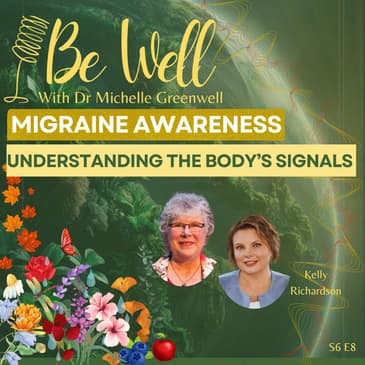
Migraine is more than pain.
It can affect vision, digestion, concentration, mood, energy, relationships, work, confidence, and the dreams we quietly place on hold while trying to manage the next episode.
During this special Migraine Awareness Month conversation, Dr. Michelle Greenwell welcomes Kelly Richardson, bioenergetic wellness professional, educator, speaker, and founder of the Richardson Center for Learning & Wellness, to explore a different perspective on migraine healing.
What if the goal is not only symptom suppression?
What if healing begins by understanding what the body is prioritizing—and what life you are ready to reclaim?
In this episode we explore:
✨ Why migraine can become more than a physical condition
✨ How muscle monitoring and biofeedback help identify body priorities
✨ The connection between stress, trauma, emotional patterns, inflammation, nutrition, and migraine experiences
✨ How the body may respond to physical, chemical, mental, emotional, electrical, and energetic stressors
✨ Why addressing the wrong priority may delay progress
✨ Specialized kinesiology and bioenergetic wellness approaches
✨ How Touch for Health can empower self-awareness and healing
✨ Why your future goals matter in the healing process
Kelly Richardson combines kinesiology, neuroscience-informed wellness approaches, trauma awareness, energy work, and education to help individuals move from overwhelm into clarity, resilience, and wellbeing.
Connect with Kelly Richardson:
🌐 https://richardsonedu.com/
📘 https://www.facebook.com/richardsoncenter
📸 https://www.instagram.com/richardsoncenter/
Connect with Dr. Michelle Greenwell & Greenwell Center:
🌿 www.greenwellcenter.com
Download the FREE Top 8 Stress Releasers
Sign up for the blog
Explore events, courses, and wellness programs
Cape Breton Tea Company
🍵 www.capebretontea.ca
Today’s featured tea:
Mintal ClariTEA
A beautiful herbal blend supporting clarity, focus, and whole-body harmony.
Featured herbal allies:
Peppermint • Turmeric • Calendula
Affirmation:
“When we know where we are going, the path clears and we can focus on the little things that matter most.”
Follow Michelle:
Instagram:
https://www.instagram.com/michellebgreenwell/
https://www.instagram.com/capebretonteacompany/
Facebook:
Greenwell Center
Cape Breton Tea Company
TikTok:
Michelle Greenwell
Cape Breton Tea Company
LinkedIn:
Dr. Michelle Greenwell
✨ Subscribe for more conversations on wellness, healing, resilience, movement, energy medicine, and self-care.
#MigraineAwarenessMonth #MigraineRelief #Biofeedback #Kinesiology #TouchForHealth #TraumaHealing #StressRelief #ChronicMigraine #HolisticHealth #FunctionalWellness #EnergyHealing #GreenwellCenter #CapeBretonTeaCompany #BeWellPodcast
Each episode of the Be Well with Dr. Michelle Greenwell podcast includes the BioEnergetic Wellness Formula. That means that you have the opportunity to have a healing session while you listen based on the way the content is laid out and the activities we participate in. Before listening you can create a goal or an intention of where you would like to be heading with an activity or in your life, then make your cup of tea, engage in the activities and celebrate at the end.
Are you looking for more resources? The best way to find all the resources in one location is by visiting https://linktr.ee/greenwellcenter. Become a regular listener of the podcast and purchase your own tea blends to assist you in transformation while you listen. Our podcast is designed to bring balance and flow to your day, week, month, and year. Thanks for sharing us with others who could also benefit. Please send us your feedback and a review.
Dr. Michelle Greenwell, BA Psych, MSc CAM, Ph. D CIH (Complementary and Integrative Health). Striving to support the public to choose self-care and well-being options that create ease and flow in their lives, Michelle specializes in using movement to heal the body. Her BioEnergetic Formula for Success provides a means for everyone to set their intentions and create support and action for flow and ease to the goals. Learn more at www.greenwellcenter.com. Follow her YouTube channel and specialty playlists. Find her full resource list here. She highlights her Tea Company: The Cape Breton Tea Company which you can find at www.capebretontea.ca. Included is the specialty line of Tea with Intention, Harmony Blends and Coaster, and the focus on high quality organic black, green, herbal, rooibos, and honeybush tea. Including tea with your podcast listening is a unique way to explore tea, create healthy habits, and have great conversations with friends and colleagues.
[00:00:06] Hi, this is the Be Well with Dr. Michelle Greenwell podcast. Our heartwarming conversation is designed to lift you on your wellness journey. Grab your cup of tea and enjoy the podcast.
[00:00:27] Hello everyone and welcome to Be Well with Dr. Michelle Greenwell, where we explore the tools, insights and conversations that empower you to live with greater vitality, resilience and wellbeing. June is recognized internationally as Migraine Awareness Month, a time to bring visibility, compassion and deeper understanding to the millions of people living with migraines.
[00:00:50] And if you're one of those people, you likely already know this journey can be long, can be frustrating and often incredibly isolating. For many, migraines become a story of trial and error. It might be trying medication after medication, changing the foods that come out, what you're eating and when, adjusting your sleep, testing for hormones, watching your stress levels, seeking specialists, and then of course searching for answers.
[00:01:19] And yet, even after all those years, many people will still find themselves asking, why is this happening? And migraines is often approached from the perspective of symptom suppression. But what if the body's actually trying to communicate something a little bit deeper? What if the migraine's not the problem itself, but really the messenger? And what if there were ways to listen to the body more clearly?
[00:01:45] Today, we're going to explore a fascinating perspective through the lens of biofeedback, muscle monitoring and bioenergetic wellness. This is an approach that can help identify the body's priority stressors and reveal clues that may otherwise be overlooked. And these approaches don't replace medical care, but they can offer another layer of insight into how the body responds physically, chemically, emotionally, mentally, electrically, nutritionally, and even spiritually.
[00:02:16] Because healing often begins when we stop asking this question, how do I make this go away? And we begin shifting over to what does my body need me to understand? That's when the real learning begins. And that's where the shifts can happen. So today, I'm so excited to have my colleague here. I have Kelly Richardson. And Kelly, thank you so much for coming to share this topic today. Thank you for having me.
[00:02:46] I'm really excited to be here with you. Kelly is a bioenergetic wellness professional, business consultant, educator, and speaker with over 15 years of experience helping people address stress, trauma, concussions, chronic pain, and energetic imbalance. She's the founder of the Richardson Center for Learning and Wellness and owns multiple successful businesses focused on wellness, education, consulting, and recovery.
[00:03:11] Combining biofeedback through muscle response testing, neuroscience-informed approaches, energy work, and practical business strategies, Kelly helps individuals and organizations move from their overwhelm to clarity, resilience, and growth. She's also an international instructor, course creator, and a passionate advocate for empowering others through education, healing, and innovation.
[00:03:38] So as we get into this conversation, Kelly, I always ask what you've brought in your teacup that you can share for today. What have you packed with you? Hang on just a minute. It's in my kitchen. I always love this part of the conversation. And for those that are new to the podcast, we do this because this sets us up for the intentions that are going to happen so you can have a healing session while you're listening to this podcast so you're learning and healing.
[00:04:08] What have you got there, Kelly? Actually, I think it's yours. Perfect. It is. Cape Breton Tea Company. Time and Passage. Passages. Yep. It has time, eucalyptus, fennel, holy basil, clove, cardamom, black pepper, mullein flower, alfalfa, licorice root, ginger, cassie. So this is what I'm drinking today.
[00:04:36] And what's the affirmation on the front of that one? The metal element creates an expansion of breath to clear the mind and envision new opportunities. Awesome. This was just by happenstance. I was not planning it this way. That's okay. I will take that. So for those people, again, if you're listening for the first time, that comes from our Tea with Intention series.
[00:05:04] And that is for the metal element, which is the long and large intestines. And that helps with grief, guilt, and regret. Some of those basic emotions. There's other ones too, but that's a basic one. Which is as you're sipping on that tea and that combination, it helps to release some of the stressors around those things. And open up the breath. Kelly's got a beautiful bright blue mug. Is that a favorite? I have a whole set of these. They're all in different colors.
[00:05:33] There's green, yellow, blue, and red. Beautiful. Okay. So we've introduced the Cape Breton Tea Company. And one of the things about all of the teas is they do have intentions on the side. And I brought with me mental clarity today. I was trying to find something that I could also focus on migraines with. So now we have two from the company that you can think about.
[00:05:57] So this blend is supporting clarity, focus, and energetic harmony. And what I love is the way the herbal wellness is. We're not trying to ask one herb to fix us. But we ask a combination of herbs to come together to have a conversation. And in that, they will help lift us up. And we can engage with them. So healing is not usually one magic ingredient. It's about a synergy. It's about relationship.
[00:06:27] It's about the way different botanicals can support the whole system together. And I'm going to highlight a couple of herbs so you've got them in your mind. So peppermint. Peppermint brings freshness, circulation, cooling, and clarity. Traditionally, it's been used to support digestion, calm tension, and awaken the senses. What I'm going to remind people about is peppermint can do those things if that's the priority.
[00:06:56] And as we're talking today about priorities, it might not be the priority. So we may choose peppermint to solve something, and then we go, well, it didn't really work. And that's because it might not have been the priority for the body. Peppermint reminds us that we exude graciousness in all that we do. And this is a great way to sit back and think about how can I be supportive to others? How can I be present? We're going to look at turmeric.
[00:07:23] Turmeric is a long-honored supporter of inflammation, balancing, circulation, gaining vitality, and then creating immune resiliency. Energetically, it carries warmth, movement, and empowerment, and reminds us that healing requires motion. And I'll say that with my background. But our motion is not forced. It's not a struggle. It's just the opportunity to expand and be present.
[00:07:51] And the last I wanted to bring forward is the calendula petals. Calendula brings soothing support. Traditionally associated with tissue healing, lymphatic flow, restoration, it offers a gentleness. And its spiritual essence is one of protection, nurturing, and emotional warmth. It also reminds us that healing does not have to be harsh. As we're talking about migraines, we bring those three together with the affirmation,
[00:08:19] when we know where we're going, the path clears, and we can focus on the little things that matter most. As we're thinking about migraines, we're often trying to get rid of the migraine. But in this case, where do you want to go? When the migraine's not there, what are the things you want to be doing? What's something you put to the side you haven't been able to get to yet? And then we're going to be able to focus on the little things that will get us to that goal, rather than just trying to clear out that migraine. All right.
[00:08:49] I invite you to have a little sniff. Let the flavors come up and fill you. And as they do that, that connects the motor system with the limbic system. And then cheers. Thank you, Kelly, for being here. All right. Oh, my. All right. Today's conversation is about learning to listen.
[00:09:17] And so we're going to dive into some questions that we hope will shine a light on the way you might have been thinking about migraines, but also responding. Kelly, for those who've been unfamiliar with the term biofeedback, muscle monitoring, muscle response testing, we'll use all those different terms. Can you explain what it is and how it helps us understand what the body's trying to communicate? Sure.
[00:09:46] It's the biggest reason we use muscle monitoring or muscle response testing is because that gives us a vehicle to listen to the body. If we learn how to ask the proper questions to the body, we can learn how to get the proper answers for the body. The body already knows what it needs to bring it back into a regulated state. We just need to learn how to listen to it.
[00:10:16] Perfect. And so when I'm thinking about migraines, we're looking at people often think about those triggers. So we've got hormones. We've got you and I were talking before we hit the record button about menopause, perimenopausal, premenopause, lots of things going on with hormones there. They might have food sensitivities. They may be living in highly stressful situations or have resulted in stress because of the migraines.
[00:10:46] There may have been a trauma that may have brought about. It could have been, in your case, you work with a lot of people with concussions. So some kind of trauma that has led to migraines. There might be environmental factors. It could be sleep. It could be injuries, emotional overwhelm. So with those ideas in mind, people just want to solve getting rid of this headache. How does muscle monitoring help to identify the priority issue for the body?
[00:11:14] Can you just talk in terms of some of those issues they might have? Sure. We have a vehicle that we can utilize in our field to communicate with the body. And we do this through the muscle monitoring, but we also have hand modes that we can utilize. And the hand modes give a different signal or a different question to the body. And one of them is priority.
[00:11:37] So we can put on priority mode or hand modes that will help us decipher the journey that we have to go on with that person to re-regulate the body and bring it back into balance. So I use a lot of hand modes and it's just questioning the body. And you can decipher what it really needs as the priority before you even start working on them.
[00:12:05] So as people are listening and they're thinking about the trial and error approach, which is somebody says, I've had, I've done this for my migraine and I've done this for my migraine. And you try those things, they don't work. Nothing seems to be helping. Then what you're saying is by going to the body and letting it respond to our questions, we can get right down to what it needs us to do first rather than one approach,
[00:12:35] which might help a little bit in some situations. And then another approach that works in other situations. Correct. Yep. Because everybody is different, right? And what may trigger a migraine for me may not be what's triggering a migraine for you. And just it being a trigger doesn't mean that it's the root cause of the issue. So yeah, we may be triggered by grandma's perfume, but that might not be the true source of the issue.
[00:13:03] And we need to find the priority or we need to find the root cause of the issue. Beautiful. Thank you for that. So if we're looking beyond symptom suppression, many migraine sufferers will spend years making the pain stop. But in this kind of work, we're shifting from that symptom elimination towards understanding a healing goal.
[00:13:29] And that's why I said being able to look beyond the migraine and what is it people want to be doing. You want to talk about how we use goals and intention in our work? Sure. So we can bring in a goal to help us reach where that client actually wants to be at the end. Most people will say things like, I want to be pain free, or I don't want to be in pain. But the body doesn't understand when we use words like that.
[00:13:58] So I usually have to help them restructure a goal saying, like we have a goal statement and we have to restructure it in a positive way. So I usually say, well, what do you want? What do you want? Not what do you want to be without, but what do you want to gain from this experience? For me, it was, you know, I was missing out on family events.
[00:14:24] I missed out on my daughter's prom because I had a debilitating migraine at that particular moment. So a lot of people will be like, I don't want to miss out on family events. Well, but what do you want? You're telling me what you don't want. What do you actually want? So it's teaching them to walk through a thought process that will help them obtain their goals.
[00:14:50] Like I want to be fully functional all day from morning till night, no matter what my cycle is, you know? So it, you, you have to refine it for the actual person because it has to be specific for each individual. And every, everybody is a little bit different on what their goals are actually trying to accomplish within their bodies.
[00:15:15] So once we can use muscle monitoring, we can get it more specific to that person. Perfect. And so making that goal statement. So I'm just thinking about those people that go to affirmations and they'll find the affirmation that they say every single day and they repeat it. So the body's already familiar with it and comfortable with it.
[00:15:41] So what this provides the opportunity of is beyond that, beyond that. I think that I want this to, I want this, but also here's how I'll feel doing that. And the body's able to actually embrace that full piece of it through the monitor. When we're setting up a goal, we actually find a goal that it brings a little bit of stress
[00:16:09] onto the body because we know that that's pushing them a little further outside their comfort zone. So if we can find a goal that will actually give us an indicator change of stress on the body, then we can work through that stress so that that no longer inhibits them and they can actually reach their goal. So I try to push them a little bit outside their own comfort zone and that tends to work really well.
[00:16:39] And sometimes the goals that they have in mind are stressful, which is why they end up stuck because they would like to do it, but the body reacts in a negative way instead of a positive way. So you flip that switch. Yeah. Yeah. Beautiful. Okay. So if we look at the origin story of a migraine pattern, one thing that happens is that the
[00:17:06] migraine responses can become learned body patterns. Can you explain how that original trigger may differ from what keeps the migraine cycle going later on? Sure. Um, I actually had a student that I used as a demo model in one of my classes recently. She had, uh, had, she had like 20 years ago had had a concussion by falling down the stairs
[00:17:34] and it actually made an indent in her head and it changed her personality. It, it rearranged her life in a way that was a little bit more destructive by us working through her goals and everything. And even looking at this chronic migraine pain, we were able to bring her not only out of the migraine, but it brought her to more of a calmness in her body.
[00:18:04] She was very energetic, but more of a people pleaser. And this allowed her to settle back into herself, her true self and not make decisions based on other people. And in the process, she even went to one of my colleagues who's in myofascial release. And she noticed that the divot in her head had popped back out after we had worked on her. So we actually saw structural changes.
[00:18:33] We saw behavioral changes and it totally changed her life in just a matter of a few dates. It was really fascinating. Wow. Yeah. And so interesting too, that people don't think about what happens to the skull can have that much impact and that it can be reversed. Yeah. It's phenomenal. Wow. Okay.
[00:19:01] So if trauma is part of this story, how can, how might someone address that in the work? I know you talked about there, but it might be some other kinds of traumas that people have. Can you share a little bit more about that? Sure. So trauma is a big part of what I do. And I know for me personally, I've had experiences with trauma that reared its ugly face when I least expected it.
[00:19:30] An example was I was in Rome with my family and we climbed up the dome of the Vatican. And all of a sudden I'm climbing up these really small staircase with tons of people in front of me and tons behind me. And I went into a panic state of claustrophobia. I haven't experienced claustrophobia since I was a child.
[00:19:54] And that comes from experiences with my bigger brothers, because I was surrounded by a lot of older brothers that would wrestle me and smother me with beanbag chairs and whatnot. So I had my own trauma, but I had thought I had dealt with all of that until I was climbing up those stairs at the Vatican. And I got to the top and I'm like, oh my gosh, I have to come down those stairs. How am I going to get myself down?
[00:20:21] And, you know, all my kids and my husband were coming up with solutions. And I'm like, wait, I know what I can do. And I worked on myself. One of them was a simple technique of emotional stress release, where you just put your two fingers on your forehead and that I used the emotional stress release. And then a few other techniques that I had developed. And I was able just to bop down those stairs. Like I had no issues, no worries in the world.
[00:20:50] So sometimes trauma rears its ugly face when you least expect it. And in the most inconvenient times. So when we can equip people with simple things like emotional stress release that they can utilize in a situation like that, you empower them to care for themselves as well as coming to you if they need it.
[00:21:13] But giving them the tools they need to care for themselves is a complete game changer for many people with trauma. I'm just thinking about, I just spent, you know, several days with my family and there were lots of things that happened. And my dad fell down some stairs and hit his head. And that's exactly, I just immediately go into the modes of what do I need in order to remove this trauma from the system right now.
[00:21:42] Exactly. And I don't panic because it happens and I'm not, you know, rushed down to emergency. It's let's look at this and see what we have going on and what can we change and then look at what do we need to do. And exactly just as you're saying, I use injury recall technique and that immediately released all the tension in his body and no bruises, no stiffness, no anything.
[00:22:11] And amazing. So which leads to that, that next part that I did want to talk about is that opportunity that we have with the work that we do to provide these little educational tools to our clients. And then as students too, if they are coming to take classes like Touch for Health with us.
[00:22:33] So can you share a little bit about the idea that we have when we're checking out for those priorities? I was just thinking about physical stressors or electrical imbalances, some of the things that we teach in those most basic levels, how we're able to look at those layers. Can you try to light on what that picture looks like in our work? Sure.
[00:22:58] So with my students, what I use are techniques from Touch for Health as well as GEMS kinesiology. And I bring them together and give them those tools to use. And one of them is hand modes. So we have hand modes that we can use that mean different things that send an electrical question to the body. And those questions are things like, is this migraine structural? Is it chemical?
[00:23:26] Is it emotional? Is it electrical or is it environmental? And when you can start whittling it down, you get all sorts of answers that you may not have assumed to be the true issue if you know how to listen to the body. So I use a lot of hand modes for that to get me to be able to ask the proper questions to the body to get to the root. Does that make sense? It does.
[00:23:56] It's perfect. And I really wanted people to hear again that, you know, when you're thinking migraine, you're thinking it's a, it could be hormonal. They'll be thinking that, but it's, it's a physical pain and everybody identifies with the physicalness of it. But it may have nothing to do with physical. It just shows up that way because it's the only way our body can signal us.
[00:24:20] And so that mental overload or emotional stress takes it to the height that it shows up as physical. But now we have an opportunity to say, hey, it's emotional. Let's look at it. Exactly. And if you look at, it could be more than one, right?
[00:24:37] But if we start with priority and work with the first one and work through it in a prioritized manner, it starts put, it starts the electrical signal and it will help the body start to be able to flow easier. So like structural, it could be neck. It could be things, you know, that we weren't even thinking like the Atlas or maybe your TMJ.
[00:25:05] People don't even think of that or visual issues or even cardiovascular or medical issues. These are things that we need to know because maybe it's not something for me to deal with, but I can point them in the proper direction. Like, hey, you need to go see, you know, like a chiropractor or you need to go see a cardiologist because there's some issue going on that needs to be addressed.
[00:25:32] And if we start with priority, we can help coach them through where they need to go to get the help that they need. But you also have like nutritional. It could be their diet, like MSG intake. Artificial sweeteners are a big one. Nitrates, you know, they want to drink their wines. Red wine triggers a lot of women, especially sugar issues.
[00:25:56] Caffeine plus no protein will set off a migraine. Potassium deficiencies, a drop in your estrogen levels, a birth control. You know, if you change your birth control, that could also play into this. Symptoms closely related to your period cycle, maybe another one or a histamine reaction.
[00:26:20] So it's good to know what if it's a nutritional priority, we can start asking more specific questions of where. Another one is the emotional. Is it stress, anxiety, hypervigilance? A lot of people that have PTSD, they're stuck in a hypervigilant state that may need to be addressed. They could, you know, the nervous system could be dysregulated.
[00:26:46] You know, you have anxiety, which, you know, also anxiety, a migraine, light, sound, smell sensitivity. You know, this is all the nervous system dysregulation. So we can identify that. If it's an electrical issues, it could be something like improper salt intake, sleep issues, electrolyte imbalances, low magnesium or sodium, or even potassium will set it off as well.
[00:27:14] So some clues for that would be like muscle tightness. Your calves are really tight or your shoulders are really tight. You have eye twitches. That's always one that I get. Why is my eye twitching so much? Well, then we know probably where we need to start asking the body questions. With environmental, everybody thinks of, you know, mold in the home. But it could also be as simple as fluorescent lights in the classroom.
[00:27:39] Could be, you know, help set off a migraine for some students. Loud environmental noises does it. Busy visual patterns, like on grocery store floors, can set off one of my clients. And he would have to wear sunglasses whenever he went grocery shopping because of the floor in that grocery store, which I found interesting. You have the barometric pressure.
[00:28:09] You know when a storm is coming in and then all of a sudden you're having to deal with migraines. These are all environmental factors. So by asking the body these questions, we can, you know, chisel down what we need to work on first. And then the body will walk us through the journey of balancing itself. And it's quite magical, but very specific. We don't have to just throw stuff up against the wall and see what sticks anymore or try this prescription or that prescription.
[00:28:39] A lot of times with the prescriptions, you know, it's when there's not an isolated case that might be like the pure medication based approach often underperforms long term. So if we can help with other ways, it could make the medications more effective as well. So that's just what I found in my work.
[00:29:07] And it helps it get to the bottom of it a lot quicker than what we're traditionally used to having to experience. And I, you know, as people often think about medical model alternative and they separate them. But what you just said was really interesting is we don't realize that we can have a medication that can be working and doing its job,
[00:29:32] but we keep sabotaging it with these other things that are trying to be heard. And so the ineffectiveness of the medication, we can resolve some of that, make it last and work stronger. So another way to think about it. So that's that rather than thinking alternative, you're thinking complementary because they go hand in hand. Yeah. Yeah. In my office, we have a nurse practitioner as well.
[00:30:00] So if there is a medication side that's needed, we can utilize her. And she's very familiar and trained in what we do with bioenergetics. So we marry the two together so they can work in tandem and partnership to be much more effective than if you did one or the other. Because sometimes you need to bring them together to be the most effective use of both resources. Mm hmm. Mm hmm.
[00:30:30] So this leads us to this next question, which we've kind of moved around, which is self-empowerment and education. So if you're listening to the podcast and you're thinking about how do I get started? How do we look for a bioenergetic wellness professional? In Canada, we refer to it as a bioenergetic wellness professional because we use that terminology. You're in the United States.
[00:30:56] So you use specialized kinesiology, which we find around the world as well. Or we might hear of an applied kinesiologist. What are some other ways that they might be able to search in their country? I use bioenergetic kinesiologist. It's the body's electrician. That's all we are.
[00:31:18] So I go more by that because kinesiology in the U.S. is now in the collegiate form. It's something different than what we actually do. So, yeah, 50 years ago, we were all kinesiologists. Right. But now kinesiologists in the United States, they just more deal with the study of movement rather than the energetic or the bioenergetic portion of it.
[00:31:47] So we add bioenergetic kinesiologists and that differentiates between the two. And so in Canada, we're bioenergetic wellness. So we don't use the kinesiology title at all. So just if people are looking and you want to find that, then that's an opportunity for you to look.
[00:32:09] Can we talk a little bit about the importance of the relationship between sometimes we use the word practitioner. I use facilitator because I really do like to educate and send out people empowered. Practitioner being more of they do the work on you and then send you out the door.
[00:32:30] So if you're a practitioner or facilitator working with clients, can you talk a little bit about the safety and trust that these tools can work and how they can show up for people? Sure. Yeah.
[00:32:46] With the safety and trust, I just had a class this last week or two weekends ago, and we were talking about consent and how important it is to get verbal consent from that individual. They're like, well, they just walked in the door. But what if you had a mother with a child and the child is there but doesn't understand what they're there for?
[00:33:13] Sometimes you have to slow down a little bit and educate them and show them what you're going to be doing. And is it OK if you do it? And if I don't get consent from the person that I'm working on, I don't work on them because there's a respect for them. And usually when you educate them, they're able to give you that consent.
[00:33:35] But not only do I get consent from the person that I'm working on, I also get consent from the body because I've had times where permission to work, safe to work. Those are two of the first things that I always ask. And the body may be like, no, not safe to work, not with what you're going to be doing. So I have to go into and figure out why. And sometimes it's, oh, they're in a position that would cause injury, but they didn't know it.
[00:34:05] And I didn't know it. But if you slow down and ask the body those questions, you'll understand why they're saying no. And then you can change accordingly what you're doing so that it won't harm them and that it will be more effective. So for me, it's very important consent of the person, the body that you're working on, everything. And usually it goes a lot quicker when you do that.
[00:34:32] And I know when you've got that, yes, I'm ready to go forward, even just that acknowledgement, then as you move into that goal statement and getting everything to come into balance and flow, it feels much better. And it's such an important part. We don't ask that question when we go to the doctor. We don't ask of ourselves, what does our body want before we've gone? And we just go because that's how we function.
[00:35:01] But then to be able to stop and say, what is it I really need? How can I do that? And feel good about the action that you've chosen to take. It's about common respect for one another. And you're not looked at the all-knowing and it's only one-sided, but you're also integrating them to participate and inviting them to participate in the balance session. Which is super important to me anyway, when I'm working on people.
[00:35:33] So let's go to migraine misunderstanding. What do you think one of the biggest misunderstandings is there about migraines? That it's only one thing. A lot of times I find that it's many things. Or they go with the most common things. Like, oh, well, you're in menopause. So therefore, it's going to just be hormonal.
[00:35:57] When it could be that, you know, I have a neck injury from a car accident that I need to get fixed. So it just depends on what you're dealing with. But I find that people assume it's always just one thing, right? And if you listen to the body, no, it's usually about two or three things. And you have to bring a balance to all three in order for it to hold and not come back.
[00:36:27] So, yeah, they may be like, oh, that helped for a little while. But it came back. This is why. Because it's more than just one thing. It's multiple things. And you have to address it in a particular order as well. And so if they've had a session or two, the migraines have started to disappear. Then to be aware that it's not that they're coming back.
[00:36:53] It's that the body's using that as the signal for the next piece of information. Perfect explanation of that. Absolutely. Yep. That's exactly what happens. And slowly they'll become less and less and less and not as intense. In my own case, I thought I had a structural issue. And, you know, so I would have my husband rub my shoulders and rub my feet. And, you know, oh, yeah, maybe I didn't eat enough protein.
[00:37:22] And that's why the headache, you know, flared up on me. And what it turned out to be when I learned how to ask the body the proper questions, what it truly was, is it was chemical. And then I went into the chemical. And then I went into the chemical. And it was, I had an estrogen drop. So once I was able to identify that, I could go to the proper practitioner, which was our nurse practitioner. And she would prescribe me estradiol patches for my body.
[00:37:52] I was able to use my body. I was able to utilize that. And that took a majority of the migraines down to maybe one every other month. And I was dealing with it every other week. Like, they were so debilitating. And so then the next time I come in, then I would have to deal with the next thing. All right, now we have to deal with the diet or the chemical side of things.
[00:38:16] So now I may get a migraine once a year, maybe once every six months, if it's really being, you know, flaring up on me. But I hardly get any migraines. And this used to be a chronic thing in my life where it would debilitate me where I couldn't participate in my life. So I am so grateful I learned the protocol to be able to identify these things so that I could
[00:38:46] deal with it by listening to my body. Wow. Wow. Okay. So I'm just thinking, Kelly, you do work also with concussions. And we were talking before about how concussions and migraines often go hand in hand. You just want to talk a little bit about your experience in the clinic with that. Sure. Yeah. I work a lot with concussions.
[00:39:16] And again, by asking the body certain questions, you can get to the root of the issue. But with concussions, there's a specific protocol that you have to follow. And it's quite extensive. It takes quite a few hours to get through it. But then when you're through it, by asking the body these questions, it usually will take care of the migraines for them as well. And, you know, fluorescent lights, like I was talking before, you have in all the schools
[00:39:45] here in America, they have fluorescent lights in all the classrooms. And if you are a student that has just had a football concussion injury and you are having to sit in these classrooms all day, it's unbearable. You can't even go to school anymore. So in order to get the kids to be able to go back to school and function, we have to deal
[00:40:13] with their environment and you can't take all the fluorescent lights out of their environment. So you have to slowly balance the body to the fluorescent lights so that they can go back to school and learn what they need to learn. So that's one way that we deal with the concussions is the visual, the balance.
[00:40:35] And with concussions and migraines, we also need to look at the structure, right? If they have a head injury, especially, is there any structural damage? You know, is their jaw misaligned? Is their atlas out of place? Is there a divot in their head now from it?
[00:40:58] So these are all questions that we have to ask the body in order to know how to best help them and help them get back to their maximum potential. Wow. Wow. Okay. Pretty cool stuff. But it is. It's a concussion. You can recover completely from a concussion. I mean, obviously, you're eight times more likely to get a second concussion and it goes
[00:41:28] up exponentially from there, but we can bring you back. I had one, one wrestler. I brought him back eight times and I, I'm like, you've got to stop this. I can't tell you to stop, but I don't know that I'm going to be able to help you much longer. But he was, he was working at like national champion levels. So there was a reason why he was doing this, but he, he slowly did stop wrestling, unfortunately,
[00:41:57] but you know, he went into the medical field and he still has all of his faculties about him. So that was important to me. Yeah. Yeah. And, and I love too, that, you know, you can recover from concussion because so many people I've had a concussion and then that becomes the answer for why they can't do certain things. And to realize that might not be true, might be the truth you've been operating under, but
[00:42:27] it might not actually be true. And you can change your story. But just so maybe you don't come all the way back. These are brain injuries we're talking about, but there's significant improvement that we can bring to you. So it's, you know, so some people have to be more realistic, especially like, um, my stroke victims. You know, I had one guy that was so angry. He comes in in a wheelchair.
[00:42:53] And after I worked on him a couple of times, he was walking in with a cane and he's like, well, I'm not, I'm not without my cane. And I'm like, yeah, but you came in in a wheelchair. You couldn't walk. You couldn't do common functions and now you're able to do all the common functions, but yes, you are still wary. You know, you still have to hold onto that cane. I'm sorry. I'm not perfect. So it's also realistic expectations, right?
[00:43:21] Um, we can do dramatic changes and dramatic improvements in your life, but you also had a brain injury. So be aware of that when you're thinking through this. So I don't want to be like miracle worker, but I've been able to help all but two people in 15 years. So two people say that it didn't help, but everybody else says, oh, there's dramatic improvements. So I'll take that as a win.
[00:43:48] And what I find too, in this work, because we're working with priority, there are things that were underlying. They didn't realize we're stuck and they just accepted it as normal everyday stuff because it's always been there. And then all of a sudden it's gone and they don't realize it left or they realize it left. And now they're doing things that they never imagined they could do. And so those are some of the changes that happened to where you're least likely to be looking, but are personally surprised.
[00:44:18] Yeah, I had a high-end baseball player, basketball player, baseball player. He, he did both. And he always had to wear glasses, always had glasses on. And when I was done with him, he didn't need the glasses anymore. And they were like, well, that's a nice side effect from all of this. So even things that you're not expecting can be. Beautiful. Thank you so much for sharing your wisdom and also for the work that you do, because you're
[00:44:46] working in a field that is so desperately needed with concussions and migraines, but also you're supporting people that likely didn't find resolution in other ways and such important work. So thank you, Kelly. You're welcome. Yeah, I'm usually their, you know, last ditch effort to try to do something. And I'm fine with that because I know it's a little different, but I can speak from years and years of experience. This stuff works.
[00:45:16] You don't have to live with this pain all the time. We can get to the bottom of it. You may have to be a little patient with it, but we can get there. How can people find you? I can be found on the internet. I have a few different websites. If you need a class with me, I would go to richardsonedu.com. Or we have my website, which is kellyrichardson.com.
[00:45:47] Kellyrichardsonus.com. Or you can just call the office at 1 for the United States, 608-563-5202. Or we can be reached on Facebook all the time. Just message us there and I will get right back to you. That's beautiful. Thank you. So migraines are often misunderstood. They can be invisible, complex. They can be deeply personal.
[00:46:13] And yet when we begin to explore the body's messages with curiosity instead of fear, we can have new possibilities emerge. And sometimes the migraine is not simply something to fight, but it's a way to look at information, a way to look at a signal. It's an invitation, a call to listen differently. And when we focus only on suppressing symptoms without understanding why the body chose that response,
[00:46:40] we can stay trapped inside a cycle of temporary fixes and ongoing complications. So it's when we begin to understand the body's priorities, its patterns, its protective strategies, healing becomes more personalized, and the person becomes empowered. So Kelly has shared how you can connect with her. I just wanted to bring forward, when you go to thegreenwellcenter.com, which is my site,
[00:47:08] there's the top eight stress releasers there. ESRs are there, which is what Kelly had mentioned. And you can easily download that and use it. And if you enjoyed both of us sharing our teas today, where we have katebrettontea.ca is where you can find our teas listed. I'm happy to share those with you. If this conversation resonates, please share this episode with someone who's navigating migraines. And remember, your body is always communicating.
[00:47:37] The question is, how are we choosing to listen? Thanks so much for being here. Be well, everyone. Thank you, Kelly. You're welcome. Thank you for listening to Be Well with Dr. Michelle Greenwell. There are a couple of resources I want to just point out. When you go to the website, greenwellcenter.com, you'll have a pop-up window.
[00:48:02] That pop-up gives you the top eight easy stress releasers that you can use every day. That's something you can put beside your computer, the bathroom mirror, beside the bedside table. A great resource. Also, my YouTube channel. It is full of playlists with all kinds of different ways that you can activate energy and bring vitality into your day. You can find that when you go to YouTube at Michelle Greenwell.
[00:48:30] And last, if you're a Linktree person, Linktree, L-I-N-K-T-R dot E-E slash Greenwell Centre. That has all my resources in one spot. Those are for intricate little things that you can't get everywhere. And it's a wonderful way for me to be able to share all the different aspects of the kind of work I do. So thank you for listening. Be sure to drink that tea.
[00:48:58] And if you want to have the tea blend that was shared in the podcast today, then be sure to check out kbrettontea.ca. Have a wonderful day.