
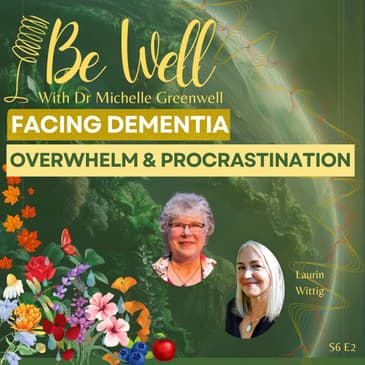
Facing Dementia: Episode 7
What if overwhelm isn’t the problem… but the message?
In this heartfelt and insightful episode of "Facing Dementia", Dr. Michelle Greenwell welcomes intuitive transformation mentor, author, and podcast host Laurin Wittig for a conversation that reframes overwhelm and procrastination through the lens of whole-person wellness.
So often, we label ourselves as procrastinators, lazy, overwhelmed, or incapable of getting things done. But what if those experiences are actually signals from the body, mind, emotions, and energetic systems asking us to pause, listen, and restore balance?
In this episode, we explore:
✨ Why overwhelm is a whole-system stress response
✨ How procrastination may be a signal—not a flaw
✨ The “Joy Calendar” and why scheduling joy first matters
✨ The difference between forcing action and moving in alignment with timing
✨ BioEnergetic Wellness tools to regulate stress and restore clarity
✨ Tea rituals for emotional support, focus, and energetic movement
✨ Why caregivers and those facing cognitive stress need compassionate self-care
🍵 **Featured Tea Ritual: Mintal ClariTEA – Harmony Blend**
This beautiful tea ritual supports clarity, calm, and forward movement with:
🌿 Peppermint – for momentum, focus, and energetic movement
🌼 Calendula – for clarity, healing, and emotional lightness
🍊 Orange Flowers – for optimism, calm, and gentle uplift
At the Greenwell Center, tea is more than a beverage—it’s a wellness ritual.
💚 Ready for more tools to support stress relief and whole-person wellness?
Visit www.greenwellcenter.com
✔ Download your FREE Top 8 Stress Releasers
✔ Sign up for the Greenwell Center wellness blog
✔ Explore holistic health programs, events, and resources
📲 Follow Dr. Michelle Greenwell for daily wellness inspiration:
Instagram: https://www.instagram.com/michellebgreenwell
Facebook: Greenwell Center for Holistic Health and Cape Breton Tea Company
LinkedIn: https://www.linkedin.com/in/michellegreenwell
TikTok: Michelle Greenwell, Cape Breton Tea Company
🎧 If this episode resonates with you:
👍 Like this video
💬 Leave a comment: What helps you move through overwhelm?
🔔 Subscribe for more conversations on wellness, resilience, and empowerment
#FacingDementia #Overwhelm #Procrastination #StressRelief #BioEnergeticWellness #HolisticHealth #TeaRitual #CaregiverSupport #MindBodyWellness #DrMichelleGreenwell #LaurinWittig #DementiaSupport
Each episode of the Be Well with Dr. Michelle Greenwell podcast includes the BioEnergetic Wellness Formula. That means that you have the opportunity to have a healing session while you listen based on the way the content is laid out and the activities we participate in. Before listening you can create a goal or an intention of where you would like to be heading with an activity or in your life, then make your cup of tea, engage in the activities and celebrate at the end.
Are you looking for more resources? The best way to find all the resources in one location is by visiting https://linktr.ee/greenwellcenter. Become a regular listener of the podcast and purchase your own tea blends to assist you in transformation while you listen. Our podcast is designed to bring balance and flow to your day, week, month, and year. Thanks for sharing us with others who could also benefit. Please send us your feedback and a review.
Dr. Michelle Greenwell, BA Psych, MSc CAM, Ph. D CIH (Complementary and Integrative Health). Striving to support the public to choose self-care and well-being options that create ease and flow in their lives, Michelle specializes in using movement to heal the body. Her BioEnergetic Formula for Success provides a means for everyone to set their intentions and create support and action for flow and ease to the goals. Learn more at www.greenwellcenter.com. Follow her YouTube channel and specialty playlists. Find her full resource list here. She highlights her Tea Company: The Cape Breton Tea Company which you can find at www.capebretontea.ca. Included is the specialty line of Tea with Intention, Harmony Blends and Coaster, and the focus on high quality organic black, green, herbal, rooibos, and honeybush tea. Including tea with your podcast listening is a unique way to explore tea, create healthy habits, and have great conversations with friends and colleagues.
[00:00:06] Hi, this is the Be Well with Michelle Greenwell podcast. Our heartwarming conversation is designed to lift you on your wellness journey. Grab your cup of tea and enjoy the podcast.
[00:00:26] Welcome back to Facing Dementia. I'm Dr. Michelle Greenwell and I'm here again with Lauren Wittig as we continue this journey of awareness, empowerment and healing. And today we're talking about something many people experience but don't always understand.
[00:00:42] Okay, procrastination and overwhelm. These are two good words to put together. They're often seen as mindset problems, something we should either push through or figure out. But what if overwhelm is actually not the problem? What if it's a signal? And a signal that something in the system, body, mind, emotions, energy is out of balance.
[00:01:06] Because when overwhelm sets in, the mind begins to loop. And just like the monkey mind, it keeps circling the same thoughts. And here's the truth. You can't solve a problem from inside the problem. So today we explore how to step out of that loop and get into balance.
[00:01:27] First, let me share a little bit of background about Lauren. So if you are finding this podcast for the first time, then you can realize the experience that Lauren is bringing to our conversation. What I didn't do was say hello, Lauren. I should do that. We said hello before we hit record. It's always lovely to have you here. So thank you for being here. It's my pleasure.
[00:01:54] Lauren is an intuitive transformation mentor. She's an award-winning author and the founder of Heartlight Wellness and the Heartlight Women's Circles. She's also the host of the Curiously Wise Practical Spirituality in Action podcast, where she's explored grounded, accessible ways to live with greater awareness, connection, and purpose. With a background that includes a degree in epitomology, which we have dove into our conversations here.
[00:02:24] Lauren brings a unique blend of scientific understanding and intuitive insights to her work. She's passionate about helping women reconnect with their inner wisdom, reclaiming their sovereignty, and then stepping fully into their power as conscious creators of their lives. Lauren offers a variety of pathways for transformation, including women's circles, intuitive mentoring, and energy-based healing practices.
[00:02:49] Her work focuses on clearing emotional and energetic blocks so the body can return to a natural state of balance and well-being. Now, as an award-winning novelist, Lauren also weaves themes of strength, resilience, and deep connection into her stories, often inspired by historical settings and the enduring wisdom of the past. Currently, Lauren is courageously exploring her own journey following a diagnosis of precursors to dementia.
[00:03:18] And through this experience, she's deepening her commitment to living with presence, curiosity, and empowerment, and sharing that journey to inspire others facing health challenges to discover new possibilities for healing and thriving. So with that, Lauren, I know you've got a cup of tea ready to go. What is in your cup? We do. Today, I have Tulsi Sweet Rose. Ooh. Yes.
[00:03:46] It's one of these that I really, it's just very, it's a very soft tea to me. So I was in the mood for it today. It includes, because I know you're going to ask. It includes a blend of holy basil, chamomile, rose, lemon myrtle, and a little bit of stevia. Bring that sweetness out. Mm. That is beautiful. That is like the ultimate nurturing blend.
[00:04:16] Mm-hmm. Yeah. Yeah. Beautiful. And I went on a similar line today because I chose the mental clarity tea from the Harmony Blend series with the Cape Breton Tea Company. And its message is when we know where we are going, the path clears and we can focus on the little things that matter most. Which I would, it's just your journey. And it's like this signature. Mm-hmm.
[00:04:56] Mm-hmm. And they hold their fragrance so incredibly for years. Mm-hmm. So I've got in this one Calendula petals, which are very similar in that the brightness that they bring to a blend, when it's mixing, you can see the vibrancy of color. And that, for me, when I'm mixing, that's just so empowering in its efforts.
[00:05:24] But Calendula supports clarity and healing. And I'm saying Calendula, but it's also Calendula. I'm just realizing, depending on who's talking. Yeah. So if people are thinking. This helps us bring light into areas of confusion or overwhelm. So I wanted to bring that forward today because we don't usually think about those petals. And then there's orange flowers.
[00:05:50] These uplift the spirit, easing anxiety and inviting gentle optimism and emotional balance. So as we were talking about overwhelm being something where the systems are out of balance, this is a great way to bring that into balance. And then we have peppermint. Peppermint, often people go too quickly to calm their stomach if they've got a stomach upset after a meal to help with digestion. But peppermint actually refreshes the mind.
[00:06:18] It clears mental fog and it stimulates focus and forward movement. Peppermint. And sometimes when, especially if you get into those mental loops, you get stuck in the loop. Peppermint is the way that you actually move forward. And so great to have on a conversation. If you're one of those people who likes to tell stories but never moves forward. Peppermint is a great addition because then you'll move out of your storytelling into the problem solving,
[00:06:45] which is moving you forward and getting a new direction. So when we put these. Oh, go ahead. That one is great information for me. I have some peppermint tea in my cupboard downstairs. I will be pulling it out. Okay. And now to know, okay, it's walking me forward. Yeah. Yeah. Because we were talking about the overwhelm before we started the podcast. So together, when we put these three pieces together, there's more in the blend,
[00:07:14] but they create a harmony of clarity, calm and direction. So as part of the tea ritual, I invite you now, if you are in the possession of a cup of tea beside you while you're listening, or you've got some water, we're going to infuse it with energy. If you're driving and happen to have something beside you, just know that we'll be infusing it. So take a moment, hold your cup if you can, and then just take in the aroma and see what the combination brings you.
[00:07:45] And then let your shoulders soften, let your mind settle. And then we know that this is where your clarity is going to begin. So cheers. Cheers. Cheers. I have my students now, when I arrive anywhere, they say, what tea did you bring today? I can hardly wait.
[00:08:10] It's lovely as just the ritual to know that that's where everybody knows, oh, this is where we're going to start. Yeah. Yeah. All right. Let's look at understanding overwhelm. Let's dive into this first. So overwhelm, I'm just going to give a little bit of a background. So overwhelm is often treated as a mental issue, but in reality, it's a whole system response. When the body is stressed, the nervous system will become dysregulated.
[00:08:39] Electrical system loses its coordination. And with things traveling at the speed of light, losing coordination is a big deal because things just don't match up. Then we have the emotional system, which becomes reactive. So overwhelm is, it could be anger or irritation can come out. And then the mind tries to compensate all of this by thinking harder. And then that's when we enter the loop. Thinking, stress, more thinking, more stress.
[00:09:09] And then the procrastination starts, not because we're lazy, but because the system is so overloaded, it doesn't know how to begin. And you and I are both thinking peppermint. Then if we look at procrastination, procrastination is a symptom. So procrastination is often misunderstood. It's not avoidance for no reason.
[00:09:34] It's the system saying, I don't have the capacity to move forward right now. But here's where it becomes a cycle. Same thing. Avoidance creates stress. Stress creates the overwhelm. Overwhelm increases the avoidance. And then we are stuck. So as we dive into this, Lauren, what have you noticing about overwhelm showing up in your life right now?
[00:10:03] Well, I have become very aware when I'm overwhelmed. Partly because I am so focused on minimizing stress. And so that's helped me to understand that I'm stressed and to think, why am I stressed? Nine times out of ten, I'm stressing myself. But it is this overwhelm of too many things, too many moving parts.
[00:10:32] Somebody wants a decision too fast. And I do shut down. I mean, it's like I just get to where I'm going to go sit on the couch and mindlessly watch YouTube or something. I do try to find uplifting things on doing that that aren't going to cause more stress. But I have really become aware of it. And I have become much more gentle with myself about it.
[00:11:00] I was often called lazy as a kid. And I often feel like I'm being lazy. And I have a husband who's like, he's just busy all the time. So the contrast is quite strong. But I have realized as part of this journey, this journey I've been on for over a year now,
[00:11:23] I've learned to just honor that as a, if what I need to do is shut down, I'm going to shut down for a while. And do something that will keep my brain from that loop. So sometimes that's crocheting. Sometimes it's playing little games, you know, puzzle games on my iPad. And sometimes it's watching something on TV. Sometimes it's taking my dog for a walk. You know how I like to be out in nature. So it gets me out of the house.
[00:11:52] And I also find I've been avoiding this seat that I'm in today. Because this is where my work computer is. Not my writing computer. That's over by my meditation chair. And I realize that a lot of times there's just some residual stress from before I retired that is in this place. So I've been kind of beating myself up for not, like, keeping up with my email and doing this kind of stuff.
[00:12:22] And I finally went, you know what? I need to either rearrange this room so that it's not all in the same place it was. Or I need to smudge it or probably both. Have I acted on that yet? No. But it is a way where I can say it's okay to not want to sit there. Now, when I'm talking with you, I'm having a blast. When I'm in the women's circle that you are part of, I'm having a blast.
[00:12:48] I don't get that sort of spiral going. But if it's just, you know, day-to-day mundane things, I don't want to do that. So I have been noticing. That's the main thing is I've been noticing. And then I've been allowing for that shutdown time is what I call it. That overwhelm. I just need to sit and be quiet for a while. Forget about the dishes. Forget about, you know, the clothes that haven't been folded yet.
[00:13:16] Or the, you know, whatever chore it is that has not been addressed yet. Yeah, so that's where I am right now is understanding that I'm feeling overwhelmed, which I think has come out of our initial conversation about what to talk about here. And just recognizing when that feeling, it's actually a physical feeling for me now that I'm aware. It's a heaviness. And I always call that being tired.
[00:13:47] And my husband's like, what do you mean your brain is tired? It's like, my brain is tired. It can't do anything else right now. But there's actually a heaviness that I've started to notice in my body. Getting up and moving around helps with that. But not getting up and moving around to do chores or to come check my email. It's getting up to move around just to move my body. And that's where the dog comes in.
[00:14:17] Take me outside. Exactly. Yeah. Yeah. So that's kind of where I am with this process right now. That's a great description of the heaviness. Because I think, because you've been able to, you are retired and you have this space to be focused on wellness. Many people don't have that. So they get out of bed in the morning and that heaviness can be registered as something different.
[00:14:46] But for you to be able to actually isolate that and feel that overwhelm is bringing me down. And it's not in a grounding way. No. It's in a heavy anchored way. Yeah. Yeah. Yeah. And as we were talking about the peppermint, that anchored means you can't go anywhere. It is just stuck. So what I would bring to the conversation here for people, which I believe we talked about in a previous episode,
[00:15:16] was the movement of the shoulder seams and the hip seams is what feeds the brain. So when that heaviness does set in, and like you said, it's easy to go sit in one spot. But that's because that's all the brain can handle. But that walk with the dog does provide you with the movement of the shoulders and the hips. And that's the forward motion piece. Peppermint might be needed before the dog goes for the walk.
[00:15:46] But I'm just bringing that forward for people as they're thinking they experience the same things. They don't have the luxury of maybe sitting down and doing a puzzle or crocheting. But they need to do something. So that's where simple movements to just get those moving means the brain's going to be activated. So I just want to bring that in. And then the awareness that you have of this heaviness is really important.
[00:16:16] And so then people can start to think about what do I attribute to my heaviness? Is it truly fatigue? Yeah. Because I stayed up too late last night. And is it laziness? You know, to some degree, that's where I associate laziness is when I just thought, I just need to be a lump for a while. Yeah. When in fact, it is almost always overwhelm and the stress that comes from that. Yeah. And I'm thinking about the language of that, right?
[00:16:44] Because then it gets the label that was given to you, you know, way back when. And the one we try to run from, we don't want to be accused of being lazy. But no one ever says, this is the time when I just want to be with me. And it's like, that's valid. That's valid. That's valid. And how many of us spend time with themselves in the day? Probably zero.
[00:17:11] Unless they have a really dedicated commitment in some way. Because they may have a commitment to a yoga class. They may have a commitment to meditating. But just sitting with yourself. Not in meditation, but just sitting. Mm-hmm. And that might be important too. I'm really good at that. I love that. But I keep filling it up. I think I'm more like your husband. Yeah. Yeah.
[00:17:39] Well, I'm a, I am a, in the Myers-Briggs, you know, wording, I'm a huge introvert. I mean, it's like I am, there's not much extrovert to me. I can do it, but then I got to go to what I call my cave time. This is my cave. And, and I will go and I put the sign on the, on the door so my husband doesn't bother me. And it usually says meditating or writing on it, you know.
[00:18:06] And so it's, for me, it's quite easy to, to take that time and just sit and be. But I also have that space in my, in my days because I don't have to work anymore. Yeah. So it's not that I don't have things going on. I will tell you one of the sources of my overwhelm is my calendar. I don't like to see it full. I don't like to see it full. It really bothers me. It gets out.
[00:18:32] I get nervous when it's very full that I've got too many commitments and I'm going to have to be places or have to do things. And I don't like living that way anymore. So I have, I have, that's one of the things I've been doing for myself is to clear things off of my calendar that are not something that either brings me joy, helps me move more, or that I just have to do like a doctor's appointment or that.
[00:19:00] So that's one of the, the things that I've noticed as I was thinking, what's overwhelming me? That calendar, which is part of this setup that I'm sitting in this morning, is one of the things that causes a lot of stress for me. And I, I kind of dug into that and I don't, this may be a little off. No. Okay. But I dug into it because why is it that when I have commitments, time related commitments
[00:19:27] specifically, I get, I get stressed just looking at them and they can be things I want to do with people I love to be with. But somehow having all of those different things on there really stresses me out. And I, so I, I started digging into my past. You know, my dad was brought up by a, by his father who would be very, very angry if anybody was late for anything. And he was a very abusive man.
[00:19:55] My dad, therefore, would get very, very angry when anybody was late. My mother's was always late. He, he was not explosively abusive or anything like that. He's just loud. And so for me, I learned very early that it was dangerous to be late for anything. And so I get very, very stressed with the obligation I have, I have set myself to be on time.
[00:20:24] And I know that's where I was set earlier. I've been stressing myself more than anything else. So I take those things I don't need to have on there. Like the to-do list that I used to put on, do this on Friday. It's like, eh, it can get done on Monday. It's no big deal. You know? So I've been, I have been noticing that a lot and it really has helped to actually take things off of my calendar that are not going to bring me joy, make me healthier, or I just can't, you know, I have to do. Yeah. Yeah.
[00:20:54] So I'm thinking about the listeners who likely are nodding their heads of, you know, what came before us. How did our parents fill out the calendar? Lists. My sister is color coded, put a flag beside it, extra stickies. That would stress me out. So I didn't do that. And I also didn't do a list because it would stress me if I didn't complete the list.
[00:21:22] Cause I'm a, you know, I'm headstrong in to get everything done, make sure I thought of every possible angle. That's my dance choreographer background of think of all the 100 heads, where are they going? What will they need? And so that would be me trying to finish. Um, so I got away from lists so that I wouldn't have that stress too. So as people are going, Oh, that's me. Or that's me.
[00:21:49] As they're listening to us, one way to support the overwhelm in case that's what it's bringing up for everyone is to put your fingertips on your forehead and just let those fingertips calm. And it takes the blood from the back of the head, which is all your survival, um, hardware. I'll say it that way. And brings it forward to the front where you can problem solve.
[00:22:16] And so you might not have to problem solve the calendar or problem solve the list that's there, but you can definitely calm the emotions of I'm too lazy. I'm not good enough. I didn't meet my parents' expectations or three generations back because they were all such hard workers. But then the fingertips on the forehead can create that calmness and the mind resolves, um,
[00:22:45] something that you didn't know needed resolving. So hopefully that's helpful. Yeah. Yeah. That, that was, that felt good too. That just feels good. Hmm. Yeah. And especially when we're talking about these things that come from generations before us, we don't need to carry that baggage. It's a really long line of suitcases that we could drag behind us. So if we can just drop it off, put the fingertips on the forehead and say, okay, I'm letting go
[00:23:12] of all those suitcases, the expectations of everyone else. It's just me. It's just me. And I'm here on my own. And what, what brings me pleasure. And I was thinking, as you were saying, the calendar that's next to your desk over the calendar that might be next to where you're writing and you're working on characters or you're working on the plots and writing into that kind of thing is a, is a joyful piece. Who has a joy calendar?
[00:23:42] No one has a joy calendar. I think that's what mine's turning into because for the most part now it is, it is my writing group that my accountability group in the morning, which is five days a week and, um, the pickleball, because I just have so much fun doing that and it's outdoors. It gets me moving. But the group of people that I play with is just hilarious. So we're laughing constantly.
[00:24:10] Um, my line dancing, um, class that I love, uh, occasional, I have it. I have a couple of clients from before I retired who wanted to continue working with me. So every once in a while they'll pop up and I'm like, Ooh, I get to see this person today. Um, and this kind of thing, you know, talking with you or the, the crone circle that we, we are in, um, those are joyful.
[00:24:35] And other than the occasional doctor's appointment, there's really nothing else I have to do on any given day. So mine is turning into, I hadn't thought about it, but that's what I'm going to call it now. It's my joy calendar. Yeah. Yeah. I like that. I was thinking about the list that I have for today and there isn't much gap back to back, which isn't great, but that's just the way it's stacked up for today.
[00:25:04] But then thinking about, I get to do this and this and this, and that shifts from, I have to do this and this and this. So there's that phrasing for people listening, watch the words that come out of your mouth and how you've phrased it or how you've evaluated it. And can we shift to the joy calendar? I mean, there's nothing more joyful than going past my family calendar, which is whose
[00:25:34] birthdays, whose birthdays do we have this month? And then I always put on that calendar. There's activities for the family to do. We did more of that during the pandemic, um, than we do now, but sometimes I go past and go, Oh yeah. Photos of animals or photos when it was winter photos of, um, snowmen. And then it's like, Oh yeah. Let me go and take a picture of that right now. And then I've got it for the calendar for next year.
[00:26:04] Um, so just some ways of rethinking what we're doing and what you write it with. You write it with a black pen. You write it with blue, pink, purple, you know, do you put stickers next to it? Maybe that's helpful. Yeah. Mine is on my computer. Yeah. But it's all different colors depending on what it is I'm doing. So it is, I do have some of that going on. Yeah.
[00:26:28] Um, is that also in those colors all mean something and those colors also bring frequency in. So when we're stuck, colors can be a big, a big deal. So, okay. So that's part of overwhelm. Awesome. I always love where we go and what, what pops in and then. We know what's going to come through my mind. What's going to happen with that. So, well, and then we have all the herbs we brought to the table today too, because they're bringing their voices in.
[00:26:59] So what does procrastination feel like in your body now that we've looked at overwhelm? Um, I think for me, it's a lot of, I have a lot of shame around it, which is from being a kid and being called lazy and, you know, and it's always procrastination. Um, so it feels like emotionally it's hard.
[00:27:25] So it's, it doesn't give my brain a rest actually when I procrastinate, I'm not necessarily doing the loop still, but my brain is going, you know, you really should go fold that laundry or, you know, you gotta go get groceries or you should do this. You should do that. The shoulds, the shoulds in there are busy. And that's where things like crocheting, it kind of gives me a sense of doing something, but it's very meditative.
[00:27:54] It's very, you know, I'm, I'm working on a blanket right now for my dog. You know, it's, it's very simple. It's, I don't have to think hard about it at all. Um, but procrastination is one of those things I've always dreaded somebody calling me lazy. Um, I think I have finally convinced my husband that it's not being lazy. It's taking care of myself. Um, and so there, there's that. And I have also learned from procrastination.
[00:28:24] There's two ways out of it for me. One is there's something I need to get up and do. You know, it's like, I've got to be, I got to be in this place and I can't reschedule it and whatever, that'll get me out of it because now I'm focused on a single thing. What is it I need to do, you know, in 10 minutes? Um, I've also found that a lot of times when I'm procrastinating,
[00:28:50] it's because it's not the right time to do whatever it is I'm procrastinating about. And I have really over my years of, of working with the spiritual part of myself and really connecting with my spirit guides. I know not everybody believes in that, but they're always with me. I have learned to go, oh, oh, okay. I can stop beating myself up for not doing this now because when it feels right,
[00:29:20] when it feels good to sit down and do this, or when the procrastination and overwhelm is not there anymore for around this, whatever it is, then I can sit down and get it done very quickly and easily. That's the key.
[00:30:01] Sometimes I'll get into that beating myself up a little bit and then I'll go, wait, wait, wait, I know better than this, you know? Um, so I, obviously anybody who's listened to me at all knows there's a lot of self-talk going on all the time inside my head. Um, but I have really learned to honor the procrastination around things. Um, and many, many times, obviously not every time I don't remember, but, um, I particularly
[00:30:30] have noticed that with, we've still got things we want to get done around the house that require me to call contractors and, and to get estimates and to schedule stuff. And when, you know, that, that will overwhelm me really fast. Um, but I have learned that when the time is right, I'll go, you know, I'm going to call them today and it'll all be perfectly aligned and timed and everything. And so it's, um, I just have to remember that. And when I do remember it, it's like, oh, this is just a time of rest.
[00:31:00] I need to rest. This isn't procrastinating. This is resting. And when it's time for that to happen, some, something will trigger me to go do that. And my husband doesn't understand that, but he has learned that he's just got to let me do things in my own time. Um, so that's, that is again, that I am very good at seeing patterns in myself and in others and in things around me. It's one of my skills.
[00:31:29] And so recognizing the pattern of, wow, I really procrastinated that for like three months, but then all of a sudden I felt like calling them and they come the next day, you know, um, cause they had, you know, something fell through and they had an opening, you know, it's like, okay, I see that pattern. I've seen that pattern before. I need to remember the pattern so that when I get that, you should be doing, you should be calling, you should be. I can go, wait a minute. It's not time yet.
[00:31:58] And I particularly like to use the word ripe, R-I-P-E. So when the time is ripe, it will get done. And, um, and that has helped me a lot with the, with the, the shaming of procrastination. Reframe it as I'm not procrastinating. I'm resting or I'm waiting for the right time.
[00:32:23] And then I can go, okay, I'm just going to sit here for a while and do whatever I want to do or not do whatever I don't want to do. Um, and it takes away that shame, that loop of, I should, I should, I should, I should. And it shuts up that voice. Um, because I know better. I just forget that I know better. Mm-hmm. Mm-hmm. Mm-hmm. So, you know, I would say for the people listening, maybe, um, look at your own patterns. If you're procrastinating, is it, is it really resting?
[00:32:53] Is it really taking care of yourself? Does it really matter if whatever you're procrastinating, it's not the right time to do that? And then trust your body to know when it's the right time. Mm-hmm. Something to play with. Mm-hmm. I was thinking about, um, I'm so glad you, you brought the conversation in this way because
[00:33:18] I, I don't look at procrastination anymore because I always know when the timing is right, it'll just all go through. And some things move on my list on the calendar. It didn't get done. Then I just move it. Mm-hmm. It might happen here. And then I put a little square around it because I know I haven't done it yet, but it was not ready.
[00:33:43] And, um, so I'm thinking, you know, that, uh, divine timing list rather than the procrastination list could be valuable. Yeah. But also we started the podcast by using the affirmation that went with the T. So when you bring a goal into flow, then you can trust that all the pieces that are going to need to fall into place for you to easily do the task will happen. Mm-hmm.
[00:34:12] And so we did that by setting that goal at the beginning, stating the intention. And then we've been sipping on the T and engaged with the herbs. That's one way of doing it. And for those people who want to learn more season five, episode one, I talked about that in depth. So I'll just draw attention to that, but that takes away all of the, the guilting and the shaming and the everything else.
[00:34:39] Because now you know that if you want to renovate the house and those pieces that need to happen, you have, I want the house to fill in the blank. And then you just bring that into a flow. And you might think it's paint the outside walls first, but all of a sudden you realize, no, there's an indoor task that has to happen before the outdoor task can happen.
[00:35:04] But if you painted the walls, it wouldn't have been enough funds left for the part inside that was going to need attention. So that divine guidance piece is then being open to the space of that. Yeah. Yeah. I love that. So then we look at procrastination and is it procrastination or is it really, it's the residue of our past? Mm-hmm. Yeah. Yeah.
[00:35:33] It's, and, and it's the, the result of the overwhelm. So it actually is a lovely signal like you were talking about when you realize I'm procrastinating. Wait, maybe I'm overwhelmed. Okay. So am I overwhelmed because I'm pushing myself to do things that it's really not the right time to do? Um, or, you know, this, I've got the should loop going on in my, in my head. I should, I should, I should.
[00:35:58] Um, and what, you know, can I let that go until the time is ripe? And what can I do to help myself get out of that loop? And that resting and reframing, I think it's really powerful. Mm-hmm. Mm-hmm. We're not allowed to rest much in, in, at least in the American culture. Or it's, you're supposed to be busy all the time, which is stupid.
[00:36:27] When I was talking, a colleague was sharing at a conference, um, they were about how they set their year up and they take nine weeks vacation and it's blocked. Mm-hmm. I was, I was saying to my husband, nine weeks vacation. First, I've never taken nine weeks in one year. Mm-hmm. Mm-hmm. The second is, how would I take nine weeks? I can't even comprehend what that would look like. Mm-hmm.
[00:36:53] And if you took nine weeks, you wouldn't have a business left in North America because everybody wants it now. Mm-hmm. And they can forgive you for a week, but usually not past the week. Yeah. So, um, so yeah, in North America, we have a very different view of what resting, it should look like, it should be instantaneous. Yeah. Yeah.
[00:37:18] I mean, whenever I think about that, it's, I go back to, um, uh, May of last year, actually, it's just a year ago now. My husband and I spent a couple of weeks in France. And, uh, we, every day for lunch, we would find a cafe with outdoor tables. We would have their formula lunch, which is three, three, you know, courses and it's a good, a good price and you get wine with it, you know, kind of thing.
[00:37:44] We would sit there and have this wonderful, slow lunch in a beautiful surrounding with fabulous food and interesting things going on around because you got, you know, languages from all over Europe going on for one thing.
[00:38:01] But, um, it was so restorative to take that time to be in a beautiful place, to eat good food and not think, ah, I got 20 minutes before my next call. You know, um, it was, and now we were on vacation. That helps. You know, husband's a small business owner, very tiny business. So there's no, he can't be gone a long time usually.
[00:38:29] But to take that every day for two weeks, first of all, we had some of the best meals we've ever had. Um, but it just, it, it helped us to relax. It, even though we were on vacation, we wanted to see this. We wanted to do that. We had to figure out this. We had, you know, we just, we just enjoyed being together and over a good meal at a leisurely pace. You can't do that here. You just can't. It's not part of the culture at all.
[00:38:56] You go out to lunch, they want you to get out of the table so they can make more tips on somebody else because they don't get paid enough. You know? Yes. So it's, it is very much a cultural thing to be busy, busy, busy, busy, busy. Yeah. And how many we make things up to be busy with, you know, so I don't look lazy. Yeah. Yeah. And it's a, it's a work lunch, um, or work through lunch.
[00:39:24] And you might work through lunch because you need to be leaving early because you've got another list of things that need to be accomplished. Mm-hmm. Mm-hmm. Um, and, and that, um, not taking time with the food. So that whole not nourishing the self, not being aware of what do I need in the middle of the day in order for me to finish the rest of the work day. Mm-hmm.
[00:39:47] It means that at the end of the day, when you think, oh, I've, I'm finishing early because I skipped lunch and I didn't take any breaks so that I could finish half an hour, an hour earlier so that I could leave. And then you go home and you're so overwhelmed, you collapse on the couch and then you binge watch TV for the evening because you can't comprehend anything further. Yeah. And probably eat whatever is quick and easy, not necessarily nutritious and satiating. You know, so.
[00:40:17] And as I was describing, when I'm mixing the tea and I've got my hands in those herbs or I'm out picking the rose petals and getting them dried, I'm cultivating. And that's the kind of cooking that nourishes us is that cultivation within the food and playing with the food and making something that the rest of the family can enjoy. We don't have that when it came out of the box. You threw it in the crock pot.
[00:40:41] You might smell it while it's cooking, but it doesn't have that same connection. You don't get to bring the herbs alive. You don't get to really reflect on that chicken that gave its life for you to have chicken for dinner. Yeah. Yeah. It's just such a, yeah, it's such a fast, mindless way of living. Yeah. And I want to, you know, rebel.
[00:41:13] I'm with you. I'm going to start a new trend after today. Okay. Enjoy calendar. Enjoy eating, you know, and have good food. Of course, that's a little hard to do with our food culture here anyway. But, and just get off your own back. If you need to rest, rest. If you need to just go take a walk, go take a walk. It's not the end of the world if you're 10 minutes late to something in most cases, you know? Yeah.
[00:41:44] So, yeah. It's the time thing that I have to still work on. Yeah. Yeah. And then the thoughts from the past, the judgments that we carry forward, the wording that we use. So, we've reframed a fair bit today. I'm looking forward to, hmm, while I'm at the market and if it's quiet tonight, I'm not sure it's early for us here in the season for a market, but to be able to sit there and think about some of these ideas.
[00:42:13] And then how can I change and reframe what I'm doing? How can I create that new calendar? And let me block my lunch. Yeah. Instead of fitting it in. Yeah. Yeah. Yeah. Okay. Well, now that we've solved all the problems of the world. If only. The place where I wanted to go next is about the catch that happens. You can't think your way out.
[00:42:43] So, this is an important piece because for so many of us, when you hit that overwhelm, then you get stuck. You don't know how to get the hamster wheel, how to get out of that. So, one of the biggest insights I have from the bioenergetic wellness modality that I work within is that the mind can't regulate the system when the system is out of balance.
[00:43:08] We have to, when we're trying to think our way out of overwhelm, it's like trying to calm waves in the ocean by telling them to stop. So, instead of that, we need to regulate the body, balance the systems, and restore flow. And I know I said that quickly, but it's because it is a bit of a process. Not that it's a time-consuming process. It's just that you have to stop and act. And then the mind is going to follow.
[00:43:36] Rather than thinking about the mind is going to do all of it, and the body is just going to have to come along for the ride. It's the body. The body is this vessel that we came here to explore. And so, we need to nurture it and provide it everything it needs. And it will return to us this great value of providing us with a mind that can do what we need. So, I did mention before the bioenergetic wellness formula where we use a goal and an intention.
[00:44:05] That is getting our compass set. So, instead of reacting, we're moving forward in direction. We're sipping on peppermint. And when that happens, tasks are no longer going to be overwhelming. They're going to be part of a flow. Momentum builds naturally. And then this is where we can have procrastination dissolving because the system is going to be in an alignment. Okay, we've already talked about the tea ritual that we used. Holding the cup. Take a breath.
[00:44:36] Smell the blend. Have your intention set. You could be asking yourself, what is one thing that will keep my energy flowing today? Okay. And then it doesn't have to be everything. It's just one thing. And then this will create the movement. And the movement is going to create the momentum. The momentum is going to reduce that overwhelm. Okay. So, do you want to add anything to that kind of ritual piece?
[00:45:05] Anything else that we haven't talked about? Well, for me, and this has just been in the last week, really, it's been brought to my attention during meditation. I have stopped grounding myself. And so, one of the things that I've been really focused on for the last maybe five or six days is consciously visualizing.
[00:45:32] For me, I visualize tree roots going down to the core of the Mother Earth. That's how I ground. And I did it. I just did it habitually for a long time, but somehow it's gotten lost. And so, I've been really focusing on that. And one of the things I did with the tea ritual is I also visualized myself grounding while we were doing that. So, that's the only thing I would add to what you said.
[00:45:59] Because for me, being ungrounded just makes everything else work worse. And so, it's part of that honoring myself first as opposed to what the culture wants me to do. Grounding is a piece of that. How do I honor myself if I'm not even connected to anything?
[00:46:23] For those people, too, that are wearing rubber shoes all day, that is a disconnect from the ground. We don't realize it. We think we're walking on the ground. But we have this insulation between us. And for those people that like to wear a crock, which is all plastic. There isn't any leather around it or anything. That can be something that keeps us from finding that grounding and that opportunity to move forward then.
[00:46:52] Because we'll be stuck in that place. Yeah, I was suggesting at a workshop I did last night of putting a big rock underneath your desk and then taking your shoes off and putting your feet on the rock. And that can be a great way to ground. Yeah. I know your face even lit up when I said that. Yeah. I have a big rock that I brought home from Maine a few years ago that was in our lake at Maine.
[00:47:18] So that's one of the easiest places for me to ground is up there by the lake. And I'm thinking, that would probably help this area. I brought a home. It's kind of like a rock. It's kind of sand, but it's been over years compacted. So you can see the waves of the ocean on the rock.
[00:47:43] And I had that in front of the fireplace here behind me, just on the floor. But little feet easily step on it and break it. So it's been moved. But it was one of the pieces that I really enjoyed having out because that just reminded me of the ocean being right there but in the rock. Yeah. And even just thinking about it and being able to just put my feet on top of that, what would it feel like to be affected like that?
[00:48:11] Now when you think about going to write or being at the computer working on projects, what does that then mean for how does the body feel as we're doing that? And that comfort within the body means the mind has much more power to be open. Yeah. Yeah. All right. That's a perfect practice for people to consider.
[00:48:36] So we've also shared a couple of tools as we've come through this conversation today. And one of the things that we've tried to do with this conversation, one, new ways of framing things, but two, activities that you can do to start to change things. And this becomes your toolbox.
[00:48:53] So on the calendar of joy, to be able to put the wellness toolbox and then start to list all the things that you can do to nourish yourself, this can be a great thing to then go back to and go, I need something. And then you can have a peek and see what's there. So I wanted to share the neuro lymphatic and hand rub.
[00:49:18] And I did this because over the last couple of weeks, this has really become a predominant exercise that my students have really enjoyed adding to the Tai Chi practice. It's not part of Tai Chi, although we do massage it when we're doing Tai Chi, but you kind of have to draw awareness to the fact because then it'll light up a bit. So I'm going to just ask everyone to indulge. Indulge us for a moment.
[00:49:46] I'll try to describe what we're going to do. But the neuro lymphatic rub connects the electrical system to the nervous system. So sometimes we think of, I know a lot of people just think the nervous system is the electrical system. But there are actually two different things. And the nervous system operates slower than the electrical. Electrical is going at the speed of light. It doesn't require us to have any mental thought about it. It's doing its job.
[00:50:13] But it can be inspired by just rubbing points on the body. So there are points that go from the top of the neck all the way to the base of the spine. And it's just rubbing up and down along the spine from top to bottom. Now, that's a little bit difficult to do on ourselves. But if you have somebody who could do that for you, that's great. Or a back scratcher. So for us today, if we do at the base of the skull and if we just rub back there.
[00:50:42] So I'm going to go on either side of the spine and rub there first. And that's for central system. That one is for nurturing. So if you're a little bit overwhelmed, this can be really helpful. And then if you go up and down along the spine. And you're at the top of the neck. So starting at the base of the skull and you're going up the top of the neck. And rubbing right down to the base of the neck.
[00:51:10] So for some people, that might be a bigger bump back there than they want. But this will actually inspire that also to find better alignment. And then we can reach as far down the back as we can get. And that'll solve us for now. We can come around to the backside by rubbing up and down on the spine, tailbone, and up as high as we can reach. And it's just staying up and down along the spine.
[00:51:38] And I know when I'm working with clients and I end up rubbing a point for something that we're working on, they always say, oh, just keep going. It feels so lovely. Okay. Also at the back, in the lower part of the back, it's like a triangle of like a flat spot in the back. You just take your knuckles and just rub back there. And that'll be across both sides. That's where L5, lumbar 5, is located.
[00:52:09] And while you're back there, the kidneys might decide they want to have a little bit of love too. So if your hands migrate up a little further, that's okay. Our adrenals are above the kidneys and any nurturing we can send their way for de-stressing is beautiful. Yeah. Wow. Okay. So we have that. That's the backside.
[00:52:32] Now, if we can get all the way up and down the back, we would have hit every connection out to the organ systems and to the muscles. But we can also get them from the front. So in the front, if you go along the collarbone, starting in the center of the body at the collarbone, if you rub right there first. And then, and you can spend about 10 seconds at each spot. It's firm pressure when you're rubbing.
[00:53:01] So now if you migrate out along the collarbone a little bit wider about the width of where your head is and rub there. And you can do one hand at a time. And for those people listening, we're just doing two hands at this moment. And then we're going to go to the shoulder seam. So rubbing up and down along the shoulder seam on the body, not on the arm yet. This is also for central system.
[00:53:29] This is also great for nurturing and connecting. You'll notice the breath will start to deepen and that's going to be really valuable. And we can go on to the arm and the arm would be at the shoulder, just inside from the shoulder towards the body, just rubbing in there where my microphone is before I've covered it up. Okay.
[00:53:58] And then we're going to go just down along the arm, the bicep. And then you've got the humerus. You've got the bicep. If you just go to the top of it, that'll be along the outside edge of the arm. If you're thinking about your arms just being beside you. Trying to make my description for those people listening. Okay. And if we do the same on the other side. So we're rubbing inside the shoulder.
[00:54:27] That'll be a little circle. And then we're going to go up and down along where the bicep and the bone is. Okay. And then we can go to the center of the chest and rub in between the ribs. So just in the center of the chest. I'm going to try to do this without hitting that microphone.
[00:54:53] And then really good for breathing is to rub up and down on the sternum. So right in the center of the chest, that bone that's right at the top of the chest, rubbing up and down there. Perfect. Okay. Okay. Then we can go to along the ribs. For women, it would be where a guide wire on a bra would be. For men, you'll just have to imagine.
[00:55:21] But we're going to rub just along the ribs. And then if we go to underneath the ribs, this is for quadriceps. This is great for helping people to go up and down in the garden, up and down the stairs. Okay. So that gets a little bit of the front. And there's three little buttons.
[00:55:47] So if we go to the belly button and you go up two finger widths and out two finger widths, that'll give us our starting point. And you're going to rub those points firmly. So it's above the belly button, two finger widths and then out. And then if you go beside the belly button, go two finger widths out on each side, right there. And then below the belly button, two finger widths and out.
[00:56:16] There's our three buttons. Okay. That is a way to activate all the muscles in the body. It supports detoxing pathways and helps improve communication between systems. And then it also is the connector for the electrical to the nervous system. So for overwhelm, this is a way to activate everything and that forward motion. Or have peppermint.
[00:56:48] Okay. So how do you feel after doing that rub, Lauren? I feel really relaxed. It just feels like everything went, ah. Yeah. Yeah. And particularly on the back, I was able to get up to just where the bra strap would be. And there was a spot there on the spine that just felt delicious. So I stayed with that for a little bit longer. Awesome. Awesome. Yeah.
[00:57:18] No, that's really nice. And then getting to know just exactly what you did. There were some spots that wanted more attention than others. And then to be aware of that. And then that might be the go-to spot. Because if you know that you've got overwhelmed and you go, okay, well, I know if I start rubbing my spine, that's going to help. And to go right to that spot. Because maybe that is the indicator spot at which system is having more challenge than others. Yeah. Yeah. Beautiful. Beautiful.
[00:57:45] So that neurolymphatic rub I started playing with before I got out of bed in the morning, I would do that rub. And that just completely changed. My breath was nice and deep. Instead of that, okay, I'm up, off, let's go. What's the first thing I need to do? Then I just kind of laid back. But then when I got to the kitchen, I was looking for breakfast. Instead of I'll have breakfast a little bit later. I'll do this before I have breakfast. Kind of do that procrastination of that.
[00:58:15] Instead it was like I'm here and what do I want to nourish myself? So that changed my mental outlook in the morning. So if that's helpful for people. Yeah. And then we have this other one. We have lots of bullies that can happen inside our body where one area will take over and it'll shut other areas down. And that's where overwhelm happens.
[00:58:41] Because again, that's that overwhelming one piece that's shutting down the other pieces. And now you don't have everything as resource to pull in. So this one can be very helpful as well. And I have the Feet First System foot rub on the YouTube channel. If you want to go see the full thing on the feet. But we're going to do it on the hands. Because that's nice and simple and easy to do at your desk. Or if you're sitting and taking a break, it's great to put in.
[00:59:08] So you're going to put your thumb into the palm of the other hand. And then you're going to wrap that hand with the thumb that you've put in place. The fingers are going to go around the hand to be able to rub up and down between the bones of the fingers. So right now I'm on between pinky and fourth finger. Rubbing up and down. And then I'm going to go between third and fourth. And then I'm going to be between second and third.
[00:59:36] And then to get to the outside edge, I can go by the knuckle for the pointer finger. And the knuckle for the pinky finger. And I can rub both at the same time. Just by rubbing up and down on either side with my hand. And that one can take that area that's got too much. And shift it to where it's going to be distributed better. So if we go to the other hand, we're going to put the thumb into the palm.
[01:00:04] Wrap the hand around. And then you're going to wrap up and down between fourth and pinky. And then up and down between third and fourth. And up and down between second and third. For anybody that's driving and can't do this, this is great to do once you've stopped.
[01:00:25] But also, if you're one of those people who grips the steering wheel too hard and puts some tension into the shoulders and the neck or the hands, this can be really great for that. I just say that from experience. Okay. But we've got a side, so we're getting the knuckles. And what I found was the combination between the neurolymphatic rub and the hand rub created the best results for me. So I do them together.
[01:00:51] So now that we've done that, you can squeeze the hands and you'll probably notice they feel quite good. If there's any stiff fingers that you've had, that might feel better. This can release blocked behavior patterns, reduce internal bullying-like responses, and restore energetic flow. And when we put the two together, we're strengthening the nervous system, improving the electrical communication, and creating clarity and confidence.
[01:01:19] And that brings us back to not being able to move forward. So it might be the way to move forward. If we don't have a dog that we can take for a walk, we're going to be able to do that. Okay. Awesome. Do you notice anything now that we've done the hand rub as well? I noticed that my breathing got a lot deeper. And I wasn't thinking about it. It just naturally, it reminds me of yoga class.
[01:01:46] I get into the flow and the breathing really gets better. So, yeah, I really like the hand one. And you said you could do that on the foot as well? Yeah. It actually originates from the foot, but got substituted up to the hands. All right. Yeah. And then the foot feels lovely. Yeah. So you've got your thumb on the arch of the foot, and then your fingers wrap around to get into the bones on the top of the foot. Okay. Yeah. I'm going to do that one for sure.
[01:02:13] And everybody will go, they'll put their thumb into the arch and start rubbing the arch of the foot. But that's not what we're doing. Although that feels very good, you can do that too. But just to know that, because sometimes people don't realize they just start rubbing the arch and it feels so darn good that they forget about the rest. But it's the rubbing on the top engages what we call the gates, which is how we move forward, backwards, or sideways. How we can move up and down.
[01:02:40] And it coordinates how we swing our arms and our legs for proper movement. So that forward action of getting out of overwhelm, this is a great way to bring that patterning back if it's been stuck. So, great. Yeah. Okay. We went through a lot of ideas. I have a whole new awareness for procrastination and overwhelm now. This is really cool.
[01:03:08] So is there anything that resonated the most with you that we've talked about? Well, all of it. I think the idea of reframing what the lingo is, and for me, particularly with a calendar, to think of it as my joy calendar, as opposed to my to-do calendar. Or my have-to-do calendar.
[01:03:38] Which is, I think, really how I, it's more than a to-do. It's like, you should be doing this now at the calendar. Yeah. Yeah. So I love that act of reframing. Just because for me, that's a particular source of stress. So, and I'm getting goosebumps as I say. Making it my joy calendar totally changes how I interact or how I perceive that tool. Mm-hmm. Mm-hmm. I know.
[01:04:07] Just as you're saying it, I'm thinking my whole day, which was I have all these meetings stacked up, is now I get to do these things. Mm-hmm. Because they were choices I made. Yeah. And I chose them because I wanted to do them. But yeah, how different. Mm-hmm. How different. So that takes that overwhelm from languaging. Yeah. Yeah.
[01:04:32] In fact, I'm going to go in and change the names on some of my different colored calendars so that they always reflect something fun or joyful instead of, you know, the daily thing. Mm-hmm. Mm-hmm. And as we're doing that, what have you noticed that's shifted in your body as a result? I feel a lot grounded, a lot more grounded than I have in a while.
[01:05:01] And I think it was that deeper breathing for one thing. Mm-hmm. But also just making sense. Because I always learn things in our conversations that I know but don't consciously know. So, you know, just putting, reframing a lot of things and naming them, like naming the heaviness that when I get overwhelmed and start procrastinating, it's a heaviness, a tiredness. When really it's just a need for a rest. Mm-hmm.
[01:05:30] You know, that kind of reframing for me is always very powerful. Mm-hmm. So that's, I think that's the number one thing. If you notice you're stressed, try to figure out maybe what the trigger is and how can you reframe that so that it doesn't, of itself, just the knowledge of it, you know, doesn't stress you out. Mm-hmm. Mm-hmm. And for me, of course, always remembering the, when the time is ripe, things will happen. Yeah.
[01:05:59] And that's when I go back to again and again, reminding myself, I don't have to do this today. It doesn't feel right. Mm-hmm. Yeah. And it does take some practice to learn to trust that feeling of now doesn't feel like the right time. You know, so. Yeah. I was just thinking, we did a list for the house. We talked through all the things we would like to do in the house. Our house is 200 years old, so it has lots of things that we could be touching.
[01:06:30] And I put that, we made the list. I just put it aside. Never brought it back out again. And piece by piece, we've kind of been working at things what we feel needs to be that next bit. But when I went back to the list and I found it, I was cleaning up one day and it was like, look what was on the list. It was like, I think we've accomplished like three quarters of what was there. And the little pieces that were left were, you know, minute ones, but they're still there ready to come.
[01:06:58] And it was beautiful to know we did that in our own time. Yeah. And we did it as we felt comfortable. And it all got done. Yeah. So, yeah. Yeah. And that's my experience is the things that need to get done will get done, but I'm not going to push them. You know, just accept that the time will be right.
[01:07:22] So now you talked about that one point on your back that brought more joy as you were rubbing. Is there anything else that you've noticed of the stress you were holding that's kind of released? Any other parts of your body that might be sharing they found joy? Hmm. I have to feel into that one. Well, my brain is quite peaceful, I will say.
[01:07:50] So I think that's been something that I have not tuned into enough is my brain feels quite nice right now. Okay. And maybe not everybody knows how to feel your brain. I just do. I'm so introspective that I can feel the difference between when it's tired and when it's angry and when it's, you know, and when it's at peace. And it's very peaceful. I'm feeling very relaxed. The whole body, though.
[01:08:19] So I think for me, that's... I woke up this morning with my legs tensed. I was all balled up because I was kind of cold. And I feel like I'm probably if I stood up, I'd probably feel taller just from relaxing everything. Wow. Yeah. That's sweet. Okay. So you've already shared some of the things that you think you'll integrate and getting your calendar ready.
[01:08:48] Is there anything else that popped in that might be something you're going to add this week or play with some more? I'm going to add the massages that you just took us through for sure. I know I've seen those in your Tai Chi class before, but it didn't really stick with me. But I particularly like the hand one, and I want to try it on my feet because I've got a little bit of arthritis starting in one of my toes. So maybe I can go and help that.
[01:09:19] But I find myself rubbing my thumb and my palm a lot when I get stressed. And it's just out of instinct, I guess. The other thing that I find a lot these days is I grab my thumb with my other hand. And I don't know exactly what that does, but I find myself doing that when I'm... It's usually when I'm in a little bit of an uncomfortable situation. So it must be like sucking your thumb when you're a baby.
[01:09:49] I don't think I did, but I do find myself doing that periodically now. Yeah. I do the same. My hands because of doing those hand rubs so much different workshops and presentations. I rub them a lot. I rub them while I'm talking to people or on different meetings. And I do the same thing, that thumb going into the palm and just holding. The thumb is for lung meridian.
[01:10:18] That's what I wanted to say. Metal element, grief, guilt, and regret. Oh. So if you tend to hold one finger over another, it is supporting a system. And that's great if you happen to do that. So good. Yeah. Yeah. That's the instinct. That's the instinct. Yeah. We often have that. The same as the fingertips on the forehead. You know, when my husband is stressed, he rubs his forehead.
[01:10:47] That's the signal when I know he's over the edge and I've got to, you know, stop and do something dinner wise and get him to sit down at the table and everything just to bring that down. But that's that instinct of going to those emotional stress release points and engaging them. So if that's what people do, just know you can go there ahead of time, hold them really lightly. And then you don't have to do that under duress.
[01:11:15] You can do it to just calm and move yourself forward, which is great. Lovely. Beautiful. Well, as always, Lauren, we come up with new pieces and it's just so, so much fun to have these conversations. So thank you. Yeah, I love these conversations. I always learn something from you, but I also learn something from myself, which is really interesting to me.
[01:11:40] So, yeah, I'm so glad that you invited me to do this because it really is. It's very healing for me and joyful because I get to share what I'm learning with others. So helpful. And for those people listening, community is really important when you're trying to heal. You can't heal by yourself. It's not going to happen. You need some interaction that engages your innate healing potential.
[01:12:08] And these conversations, both of us have worked in the field of health and wellness and supporting people on their journeys of self-care. And we've used these tools, but it's not until we bring it in a framework that they come out in new ways. And so as we're introducing these ideas to you, we hope that then you have the opportunity to go and play. But don't keep it to yourself.
[01:12:32] Share it with someone else because those conversations are going to be enriched and you're going to find out more about those tools as well. Yeah, and if I can just add, you don't know who needs to know these things. So share it widely because you never know when you're going to hit on somebody who goes, that's exactly what I need to do or this, I didn't know I could do that for myself or my mom needs this.
[01:12:56] Or, you know, so it's not just with this project of learning about how to avoid dementia kicking in. It's about the caretakers who are taking care of people like that or any other chronic illness or even an acute illness. Because somebody's going to need these things that we're sharing and learning. And so I just think it's really a gift that you and I are giving of ourselves,
[01:13:25] but also it's a gift that those who are listening or watching could give to themselves and to others. So pay it forward. Thank you for that. That's great. As we close today, remember this. Overwhelm is not failure and procrastination is not a weakness. They are just signals. Signals asking us to go back to balance, finding space and support.
[01:13:53] And when we listen to the signals and respond with care, we move from stress into flow. Whereas today we felt nice relaxation. I invite you to take a final sip of your infused water, tea, whatever you happen to have there. Feel the clarity, feel the calm and remember when you know where you're going, the path is clear. And with that, be well everyone.
[01:14:22] Take care. Thank you for listening to Be Well with Dr. Michelle Greenwell. There are a couple of resources I want to just point out. When you go to the website, greenwellcenter.com, you'll have a pop-up window. That pop-up gives you the top eight easy stress releasers that you can use every day. That's something you can put beside your computer, the bathroom mirror, beside the bedside table. A great resource.
[01:14:52] Also, my YouTube channel. It is full of playlists with all kinds of different ways that you can activate energy and bring vitality into your day. You can find that when you go to YouTube at Michelle Greenwell. And last, if you're a Linktree person, Linktree, L-I-N-K-T-R dot E-E slash Greenwell Center. That has all my resources in one spot.
[01:15:21] Those are for intricate little things that you can't get everywhere. And it's a wonderful way for me to be able to share all the different aspects of the kind of work I do. So thank you for listening. Be sure to drink that tea. And if you want to have the tea blend that was shared in the podcast today, then be sure to check out kbrettontea.ca. Have a wonderful day.