How do joy, love, passion, and emotional connection influence your health?
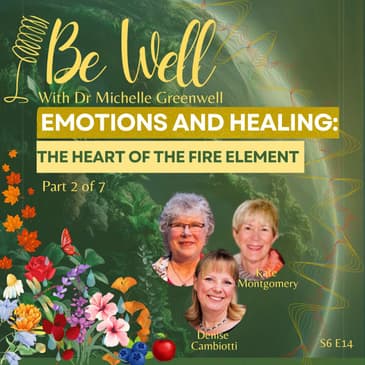
In Episode 2 of Emotions & Healing, Dr. Michelle Greenwell welcomes Kate Montgomery, HHP, ND, and Denise Cambiotti, HCD, CIH BioEW, as they explore the Fire Element through the wisdom of the Five Element Theory, Touch for Health, and the BioEnergetic Wellness Formula.
The Heart and Small Intestine meridians do far more than support circulation and digestion—they influence our ability to experience joy, develop meaningful relationships, make clear decisions, and remain emotionally resilient. When these systems become imbalanced, we may experience burnout, scattered thinking, emotional overwhelm, sleep disturbances, digestive challenges, or a loss of passion for the things we once loved.
Together we explore:
❤️ The Fire Element and its role in emotional wellbeing
❤️ The Heart and Small Intestine meridians
❤️ Joy, love, passion, and emotional discernment
❤️ How emotional balance influences memory, focus, and relationships
❤️ Why burnout is often a sign of energetic imbalance
❤️ Simple Touch for Health tools that support heart-centered wellbeing
❤️ Practical strategies for restoring vitality and emotional resilience
Tea with Intentions
Today's featured blend from the Cape Breton Tea Company is **Apple Passion**, a heart-centered tea selected to support the Fire Element.
Featured herbs include:
Cinnamon – inspiring courage, warmth, vitality, and joyful action.
Cloves – supporting emotional strength, integrity, and heart coherence.
Vanilla – inviting harmony, kindness, and the gentle reminder that joy can be received as well as created.
Affirmation: "I embrace the opportunities that I have been given and allow them to bring joy to my life."
Prepare your favourite cup of tea, take a deep breath, and join us as we explore how cultivating joy can transform both body and mind.
Continue Your Wellness Journey
Contact Denise through www.muscletuners.ca
Contact Kate through katemontgomery@me.com
Experience the Artfilled Wellness Retreat
Learn Touch for Health Level 1
Discover the Movement Mastery Program
Explore courses, podcasts, wellness resources, and events through the Greenwell Center for Holistic Health.
If this episode inspired you, please:
👍 Like the video
💬 Leave a comment and share your reflections
🔔 Subscribe for future episodes
📤 Share this conversation with someone who could benefit from bringing more joy and balance into their life.
Healing begins with awareness.
Awareness inspires intention.
Intention leads to action.
Action practiced consistently becomes resilience, balance, and a lifetime of living well.
#EmotionsAndHealing #FireElement #FiveElementTheory #HeartMeridian #SmallIntestineMeridian #TouchForHealth #BioEnergeticWellness #EmotionalBalance #Joy #EmotionalResilience #TeaWithIntentions #ApplePassionTea #HolisticHealth #MovementMastery #DrMichelleGreenwell #KateMontgomery #DeniseCambiotti
Each episode of the Be Well with Dr. Michelle Greenwell podcast includes the BioEnergetic Wellness Formula. That means that you have the opportunity to have a healing session while you listen based on the way the content is laid out and the activities we participate in. Before listening you can create a goal or an intention of where you would like to be heading with an activity or in your life, then make your cup of tea, engage in the activities and celebrate at the end.
Are you looking for more resources? The best way to find all the resources in one location is by visiting https://linktr.ee/greenwellcenter. Become a regular listener of the podcast and purchase your own tea blends to assist you in transformation while you listen. Our podcast is designed to bring balance and flow to your day, week, month, and year. Thanks for sharing us with others who could also benefit. Please send us your feedback and a review.
Dr. Michelle Greenwell, BA Psych, MSc CAM, Ph. D CIH (Complementary and Integrative Health). Striving to support the public to choose self-care and well-being options that create ease and flow in their lives, Michelle specializes in using movement to heal the body. Her BioEnergetic Formula for Success provides a means for everyone to set their intentions and create support and action for flow and ease to the goals. Learn more at www.greenwellcenter.com. Follow her YouTube channel and specialty playlists. Find her full resource list here. She highlights her Tea Company: The Cape Breton Tea Company which you can find at www.capebretontea.ca. Included is the specialty line of Tea with Intention, Harmony Blends and Coaster, and the focus on high quality organic black, green, herbal, rooibos, and honeybush tea. Including tea with your podcast listening is a unique way to explore tea, create healthy habits, and have great conversations with friends and colleagues.
[00:00:06] Hi, this is the Be Well with Dr. Michelle Greenwell podcast. Our heartwarming conversation is designed to lift you on your wellness journey. Grab your cup of tea and enjoy the podcast.
[00:00:27] Hello and welcome back to Emotions and Healing. And in this special eight part series, we're doing an ongoing explanation on how emotions are not just feelings, but energetic signals that shape our health
[00:00:43] posture, performance, relationships and vitality. And in our first episode, we laid the foundation for understanding emotions through the five element wheel and how imbalances show up physically before they ever become symptoms. And we also explored the central vessel and the governing meridians. Today, we move into the sovereign fire element, the realm of heart and small intestine.
[00:01:13] And this is where the emotional spectrum of joy, love, passion, hatred, scattered energy and emotional discernment happens. Fire is the element of connection. It governs how we relate to ourselves, to others, to purpose and to life itself.
[00:01:32] And when fire is the element of connection. And when fire is balanced, we experience warmth, enthusiasm, clarity. We have a sense of presence. And when it's excessive or deficient, we can feel scattered, burnt out, cold, disconnected, and emotionally overwhelmed. A few things that might be happening in the new year for people.
[00:01:53] As we're recording this, as we're recording this, as we're recording this at the beginning of January. This episode invites us to ask a few questions. Where is my fire strong? Where might it be depleted? Where might I be burning myself out or dimming my light?
[00:02:10] And to join me are my two wonderful colleagues that bring such wealth of knowledge and experience to these conversations. Kate Montgomery. Welcome, Kate. Hello. Welcome. Thank you very much. Nice to be back. Happy New Year.
[00:02:29] Thank you.
[00:02:59] Thank you.
[00:03:30] Thank you.
[00:04:02] Thank you. Thank you. Thank you. Thank you. Thank you. Thank you. Thank you. Thank you.
[00:04:30] Thank you.
[00:05:04] Thank you. Thank you. Thank you.
[00:05:38] Thank you. Thank you. Thank you. Thank you. Thank you.
[00:06:27] Thank you.
[00:06:56] Thank you. Thank you. Thank you. Thank you.
[00:07:05] Thank you.
[00:07:35] Thank you.
[00:08:08] Thank you.
[00:08:36] Thank you.
[00:09:30] Thank you. Thank you.
[00:10:04] Thank you.
[00:10:35] Thank you. Thank you.
[00:11:15] Thank you. Thank you.
[00:11:41] Thank you.
[00:12:40] Thank you. Thank you.
[00:13:17] Thank you. Thank you. Thank you. Thank you.
[00:13:57] When fire.
[00:14:27] And you're in the containment, the quadriceps, so you know those, the upper thigh. So this is for direction,
[00:14:53] movement, going forward, and a drive in life. And the abdominals, your core support, digestion, and emotional processing. So these muscles, if they're not used, overused, they can create imbalance within that system. And we just want you to be aware of how they're related to our conversation today. Anybody who's not been out shoveling snow, they're going to know their
[00:15:20] quadriceps, their abdominals, and several back muscles from all of the snow. And here we've had in Cape Breton, we've had a lot of heavy snow, so it has been heavy lifting. So that's an area where then we could easily put the fire element out of balance. So let's dive into some questions so we can find out the meat of what's happening. And I wanted to start with Denise. So Denise, can you,
[00:15:49] from your clinical experience, so the time you've spent with your clients, what do you notice when someone has a lot of fire in the belly for life, their career, their sports, their family, but maybe burning their energy reserves? What do you notice comes to you in that case? Denise. So this is an interesting question because there are your everyday people who get up every day
[00:16:17] and go to work and come home. And there are people I work with that are nut bar factor 50 for sport. And we're not talking about just getting their daily exercise. We're talking four hours a day or more. And
[00:16:41] the lift they get from exercising, they get all the adrenaline rush, they get the dopamine hits, they get all that stuff. I see Kate nodding her head. When you get that runner's high, it feels really great and it can be addictive. And so there are people, I've known people who are
[00:17:07] runners, who even though they're bone on bone on their knees and told back off your surgery, repair isn't going to be for another four to six months, they cannot stop running. And they're further damaging the joint. And so an excess of, so the reason I'm talking about
[00:17:32] knees is because the quadricep muscle is part of the small heart, no, sorry, small intestine meridian. And its function at stabilizing the knee joint is so critical. And there are a number of people who, as we go in the world right now, so many people are on this diet or the other diet,
[00:17:58] they avoid this, that, or the other thing. For example, gluten has been recognized to create a lot of inflammation. And if you're not aware of this, just try it out. Stay off of everything gluten in it. Go ahead, people, go look at the labels. It's really challenging. If it's in a package, it's probably got gluten. If it's pre-prepared, it's probably got gluten. You've got to really go back to
[00:18:26] just living a little bit like a caveman. Just the vegetables, the meats, a couple of grains, if you can tolerate grains, stay away from. There's so many things like barley's got gluten in it. So it's quite an education. But the people who do do that, who have inflammation, and I'm not a registered nutrition or anything, I'm a nutritionist. I'm just saying this is what
[00:18:52] I'm seeing in the world. This is what my experience is. This is what I'm reading. Stay away from it, and a lot of inflammation will go away. So if you're not annoying your small intestine with substances, for example, like gluten, or things that you're uniquely sensitive to, it could be... I had somebody once, I was like, what's going on with... Oh, it was a weird
[00:19:22] paprika. Like her body was like, because I have scan substances, and she's going, well, yeah, I put paprika in everything from every meal. I'm going, even breakfast? She goes, absolutely got to have paprika on the eggs. And paprika, paprika, paprika. And I says, your body is saying, stop with the paprika. And she was like, wow. And life-changing for her because now she's not
[00:19:47] irritating her small intestine and not irritating her joints, like the knees, the hips, because the quadriceps muscles come up here on the iliac crest to get where they originate from. So I've babbled on a little bit about all of that, of when people are in excess fire energy, they tend to do things
[00:20:16] excessively. They can't find moderation. And also with the heart, the muscle for that's under the shoulder blade, and it helps with shoulder rotation. It's one of the keystone muscles for rotator cuff. So if you're irritating that muscle with an action that your body doesn't like, if the
[00:20:40] muscle is not firing properly, and you're trying to throw a baseball repetitively as a pitcher, and I've had that, it's life-changing when you actually switch the muscle on. I've had somebody's career cut short because an injury that just wouldn't repair. And several years down the road, I'm going,
[00:21:04] oh, just do this. And he's able to do the full range of motion, whereas before all he could do was this, and it took this long to switch the muscle on. So back to the people who are really driven. That's like, to me, fire is about people that are driven. They're going to be successful. They want to do all that stuff. And emotionally, the heart's always been associated with love, right? But it's also connected
[00:21:32] with the flip side. If you have unresolved hate, a little seed of hate from some point in your life, there was somebody when I was really young, I hated her. She was such not a nice girl. And there are very few people that I could say I've hated in my life, but I'm human. And I have had that. And, you know, it's nice to recognize that does that matter anymore? Do I need to carry a feeling like that for that person
[00:22:01] that's not even in my life anymore? Like, like, let that flow through. Anger is often associated with liver, but it's also associated with the heart and feeling secure versus feeling insecure and feeling self-worth rather than self-doubt. These are some of the emotions because we're talking about emotions today in relation to the meridians. So if this speaks to you, obviously the heart is connected with
[00:22:28] forgiveness and compassion as well. So the small intestine has everything to do with feeling fully alive and feeling grateful versus ungrateful and feeling appreciated versus unappreciated. And the small intestine is actually where we process shock, some of the sorrow and sadness.
[00:22:55] It's interesting how the meridians work with one another. A lot of people believe, oh, I've heard according to the Chinese that all the sadness is connected with the metal element in the lungs. Yeah, but guess what controls that? Ultimately, the small intestine has a connection to that. So we are multifaceted. And when I see people come in, I think you would also like to know besides,
[00:23:22] how do they present in their personality and their behaviors? Which I think is what the, most of your listeners would be interested in saying, do I resonate with any of that? What can I do to change if I'm a little too much fire? Do I need to calm that down a little bit so that I won't be at risk for injury or at risk for having imbalanced, what we might call negative emotions? It's like, it's really not a positive
[00:23:51] or negative. It's how our behavior is. A little lecture, sorry, standing on my soapbox. There's good love and there's sick love in the world, right? There's, oh, dangerous, damaging anger. But there's also good anger about, hey, stop doing that. Do you have any idea of the repercussions or what that behavior you're doing, what it's doing to me? Like, stop it already. You know, without throwing a punch,
[00:24:20] people will go, I had no idea. Thank you for expressing your displeasure. Makes a huge difference in your life if you employ that emotion appropriately. Now, physically, as I alluded to with the sub-stabularis associated with the heart breathing under the shoulder blade, you can have all kinds of shoulder issues and many, many, many muscles. I just did an athlete the other day for shoulder
[00:24:49] issues. Many muscles connect here in this general area. They all can switch off. And if they're not working properly, technically, there's often a tendency to slump forward. It's not that often with fire element meridian muscles that you tend to stand up too straight. It never seems to be a problem for
[00:25:15] people. And then, as I was mentioning, the knee issues. So many knee issues connected to, and they're saying I can't climb stairs anymore. It's hard to get out of my easy boy. Can't get out of bed and stand up. It takes me a few minutes to stand and get stable so I don't fall before I walk to the bathroom and
[00:25:40] first thing in the morning. So these are the types of signals. And I'll just, I know I've been lecturing for way too long, but one of the most interesting comments I had with an instructor who assessed me to become a Touch for Health instructor, he mentioned that there was a study, and I haven't gone to find the study. Doctors used to think if you had arthritis, eventually your quadricep muscles would weaken.
[00:26:07] It's just natural. This is just what to expect once you've got arthritis of the knee. Turns out, they went, oh, what if we flip that around and the quadricep isn't functioning right? It isn't anchoring and stabilizing the kneecap. The kneecap is squirming around like that. Would that be causing inflammation in and around the knee joint?
[00:26:34] Hmm. And that comment back in, I remember it was something like 1999, was like, wow. So I leave that message for listeners to pay attention to if your muscles aren't working properly, take care of them sooner rather than later before real damage takes root.
[00:27:05] It's interesting that we came from the Highland Splendor Tea, where changing your perspective from an overview, what can you see? And that idea of some of the ways we've been thinking about the body might not necessarily be true. Yet, we buy into phrasing, like, I just have bad knees. Oh, I have arthritis in my knees. Not paying attention to what are those muscles doing? Have you got them
[00:27:31] fired up? Are they turned on? I know you gave us a lot to think about with different scenarios that people might be in. And that's great because we want people to think about, oh, is that me? Do I do those things? Do you want to just add a little bit more about the overextension emotionally or energetically? Because I know people get on the to-do list, especially in January when they've got those
[00:27:59] resolutions or the new start and they're ready to go, but they overextend. Can you just talk about the impact emotionally that that has? I am so sorry to be giggling and laughing, but you totally set up that what we normally see when you've used up all your fire, it's literally burnout. When you've overextended, you're burning the candle
[00:28:27] at both ends. There's a lot of fire going on, lots of activity. You may feel super productive or not. Eventually, if you keep going that way, it expresses as burnout. Is that a little bit of what you were looking for? And that's my experience. And then we get to that place again of now we label it as burnout. Is it burnout? You know, because then burnout is, oh, I suffer from burnout. Then you
[00:28:57] might hold that title. Is that true? Or do you just need to change your focus and perspective and look back at how you're living and go, hmm, yeah, I am overextending. Yes, I have small intestine that is trying to deal with all that gluten. You know, just there is other ways that we could be looking at the scenario. Yeah. I'm just going to extend that thought just a little bit further because at the beginning of this
[00:29:23] conversation, you were talking about the function of the heart for, obviously, everybody knows it's connected to the circulatory system and the functions of moving blood. And that means oxygen is getting to every cell of the body. Nutrition is reaching every cell of the body. You need the blood to flow freely. You want it to, the pressure to be correct. You don't want to have high blood pressure where the
[00:29:49] arteries are narrowed, you know, all that stuff. When you're in balance, it's your heart just works easily. Same thing with the intestine and all the physical functions of the intestine, which is about absorption, assimilation, utilization of the fuel you put into your body. But it's more than the physical.
[00:30:15] There's the metaphysical. There's the metaphorical. How is circulation working in your life? Are you in flow or are you stuck? How are you digesting things going on in your world? Is too much coming at you? Thoughts, ideas, opportunities. So,
[00:30:38] this conversation is more than just physical. Absolutely. And it's more than just emotional. This conversation is also about how it affects our entire energy field and how when organs are functioning properly, when we allow emotions to be, to flow through us and not get stuck
[00:31:03] in us. All these other subtle things are happening. And I affectionately call people who haven't have a background yet have a background yet with the magic of the work that we do. And I know that I was told a long time ago, don't use the word magic. It really puts off like all the religious people and all that. But sorry, it's magical seeming for sure. And so when people haven't been introduced to this,
[00:31:32] I kind of call them muggles because my kids read Harry Potter and I heard the term of muggles. They have no idea this magic is happening in the world around them. So, I'm inviting this conversation for people who thought, oh, I'm just going to hear, I've heard about the term of elements and meridians and Rochelle's podcast is finally talking about this. This, it's a big,
[00:31:56] beautiful subject. And I'll give you and Kate a chance to have a conversation. Awesome. Awesome. Okay. That's a great start. So Kate, if we turn our attention to the expertise you have in the clinical setting, you've worked with elite athletes, professional performers.
[00:32:21] What happens when people no longer have a passion for what they're doing? Because that happens a lot. They get down that road and then they realize this, I'm tired of this, or this isn't what I bargained it was going to be. And then they're stuck in it. Can you talk a little bit about how that changes the fire in them and what happens?
[00:32:48] Well, that scenario applies to a lot of different occupations, not just athletes or performers. It's, you know, my career executives or the person who chooses a career that they think that's what they're going to stay in for a while, but then they realize five, 10 years down the road that this isn't what I want to do anymore. And so that, that's where you start searching. I did that because I did
[00:33:16] respiratory therapy for 14 years and realized due to circumstances and things that occurred in, within the hospital, and I didn't want to do this anymore. And so I started hunting and I never knew that that's what I would end up in, in massage therapy. I never thought that that's the genre
[00:33:39] that I would head toward, but it took seven years to find it. And once I did, it was like, I went full steam. And then I started accumulating the techniques and the knowledge of different things like touch for health and what happens with acupuncture, you know, and looking into that
[00:34:01] and looking at all the different energetic parts that could help heal the body. And so, you know, people go through stages. Everybody goes through a stage where you decide this is what you want to do for your life. And then you reach a spot and you're bored and you don't really care. You become
[00:34:25] complacent. Maybe you don't do the job as well. And, and that's a time to get out. That's a time to really sit down with yourself and have a good talk and look, uh, what, what would turn you on? What's your passion? What would be a hobby or something? What would it be? And when that happens, the body goes
[00:34:48] through transitions itself, biochemically, as well as bioenergetically. And when you don't feel the passion anymore, the body and the heart and the small intestine turns down the fire because you don't know what you want to do. And so you go into a slow fire, slow ebb, and that's where depression
[00:35:13] hits in. And that's when a lot of other things hit in, but it also changes you biochemically. Your minerals and absorption through the small intestine don't work as well. And so this is where your nervous system goes into maybe a shutdown, doesn't fire as well. You get a tummy ache or you get nausea. Those are all part of the biochemical that starts up here. So the brain is putting forth an emotion
[00:35:44] that you're not really thinking about. And yet the rest of your body is. So the fire changes, the digestive system changes, but also when you look at the elements. So one of the things that happens with that is that you don't sleep well. And if you don't sleep, well, you look at day and
[00:36:07] night. So we have a positive and a negative of yin and yang. So then my yin and yang get disrupted. My circadian rhythms get disrupted. My absorption of minerals gets disrupted. Maybe I have skin breakouts. Maybe my hair starts falling out. My thyroid doesn't work as well. My adrenals, I just don't
[00:36:29] have the energy to do anything. Those are all part of that shutdown, that burnout. And so, you know, you don't really realize all that stuff's happening at the same time and working its way through the stage of however long it could be. And sometimes it takes a while because until you
[00:36:53] decide and figure out what you want to do and who you want to be, then the body stays in limbo. And you don't always feel so good. You sleep a lot, maybe, or you don't have the energy to walk out the door, or you don't want to face anybody. You don't take a shower. You don't do your hair. You know, it's like there's a whole lot of things that come with that. And there's a lot of people like that. And especially in today's world, you know, we have a lot of people with mixed emotions that's
[00:37:22] going on right now. And that's part of them deciding, well, my job or not, you know, do I do this or do I do that? And it's a lot. It's a lot. So looking at how the biochemical is working, if it's not,
[00:37:45] then you're going to have a lot of health issues pop up that you were surprised. I never had high blood pressure before or too low blood pressure. I never had circulation problems, but I do now because I'm not exercising. I'm not out walking out the door either. I'm not doing range of motion or stretching or anything like that. I'm not getting a massage or I'm not getting acupuncture
[00:38:13] anymore, or I'm not getting a muscle tuner balance. You know, so the all these things reflect all the way down through the system. It's one long scale all the way down. It reverberates. And, you know, everything that Denise said is great to know, but she, but I'm sure there's a lot of people listening
[00:38:38] to this that are laying on that couch thinking, should I get up and go to work? What's happened to me? I don't feel like it. You know, um, is there a depression? Do I have a job? Did I get laid off? Um, how do I start over? Um, do I have the money to do anything? These all change your own biochemistry,
[00:39:04] changes your mental outlook. And that's all about what's going on in the sympathetic and parasympathetic nervous system. So you're either overwhelmed or underwhelmed. Okay. Or over relaxed and too much, you know, and so you don't know how to get rid of the stress and your mind's going a mile a minute.
[00:39:27] Um, that's hard. It's a hard place to be, but through what we are talking about, which is a lot of about body maintenance and self care through what Denise offers and Michelle offers doing Tai Chi all over the internet right now, there's Tai Chi walking, doing all these things with Tai Chi right now,
[00:39:53] but also through breathing, learning just to sit and breathe, listen to your body, get a sense of pulling up the air in your body to get it to start circulating again. I think that's what's going on with a lot of people right now. I'm going through it. It's a new year.
[00:40:17] And so, you know, do what do we do, but taking the steps that we have all talked about, about rubbing neuro lymphatics and getting the body to start to work again. You can do this. Um, when I first started my sports touch business, my slogan was health at your fingertips.
[00:40:42] Everything's in these, all you got to do is rub a point. You rub a point, it starts a reaction and that reaction turns on a muscle. It strengthens it. It starts a biochemical reaction and it's a mental one at the same time because I don't have pain anymore. So if my quadriceps hurting, I'm going to rub underneath my rib cage for the neuro lymphatic for
[00:41:10] my quad to turn on that, but also to help my, my small intestine get normalized again, calm down the nervous system a bit. Same thing goes with the subscapularis for the heart. If I'm in overwhelm or burnout, whichever one, I'm going to rub up here on the intercostal space of the third intercostal and get that muscle to start working right. Turn it on. Just like Denise
[00:41:38] said, all you're going to take it took this much time to turn a muscle on and that person could throw a ball. Wow. I have done this so many times with people just out and about and they're having trouble. Oh, I've got a pain here. Well, this is where the latissimus dorsi anchors. So I'll rub the neural lymphatic on the, on the left side and then they hold and there's pain not there anymore.
[00:42:05] And then they could do this and it's amazing. And they just sort of look at you with, Oh, how did you do that? And there's magic. There's the magic right there. The magic is, is that everybody has a trigger point, a space, a point, and every person can switch it on.
[00:42:28] That's the good thing is that it's not just for us as practitioners, but it's the people that we have as clients that we teach this stuff to that can turn on their own bodies and get it to work again and start doing the chemistry, the energetics again. And it happens so quickly. Um, I threw up my hip
[00:42:56] and so I got my blocks out and I blocked myself and Whoa, magic. Oh, my long leg, short leg went away and I started feeling better almost right away. And then I started rubbing my quads and my, my T band for my glutes and then my, in, in my hamstrings. So inner thighs, I started rubbing all my
[00:43:21] points doing the things. And I woke up this morning full of energy. My legs didn't hurt anymore. Um, just by spending yesterday blocking like every couple hours, I was blocking myself to get everything right. But these are things that you can do yourself. I didn't need a chiropractor to do that for me. You can turn yourself on just to know that's what we're all talking about today.
[00:43:49] Turn on. So if we take what you've said, and we think about the quad, if, uh, people that are listening, if you have the space where you are to be able to just do some leg lifts, just lifting up the knees, marching, notice what it feels like. Now, if you're driving in a car, you might have to do this later, but at least you can put this in the back of your mind as a really great tool.
[00:44:15] Because once you figure out how much effort it takes to do that little march, then just to take your fingertips and rub underneath the ribs and just rub all the way from the side, all the way up to the center, rub those points, go back to that march. See if the march has changed. I know for a lot of my seniors going up and down the stairs is a challenge. And if it is a challenge, then standing at the
[00:44:42] bottom of the stairs, rub the ribs first and then start up the stairs. What a difference. Instead of trying to pull yourself up, you're actually able to, to, uh, use the power of the leg. Thank you, Denise. So Denise has stood up and, uh, she's rubbing underneath the ribs so you can see. I was going to say, when you rub points though, this is not a light touch. This is a firm touch.
[00:45:10] Because if you just do something really light, you're not accomplishing anything. This is not an injury. This is not a swollen finger. This is where you're doing a deep lymphatic massage. So you rub firmly, not to hurt yourself, but it's like going like this, but you don't hurt or bruise yourself, but put some depth into it because otherwise you don't make a difference.
[00:45:35] Mm-hmm. So now if we take the second part, um, subscapularis, so that is that ability. I like to call it the scarecrow, you know, your hands come up and then your hands are going to drop down. So you've got a high, high 10 and then a low 10 if I'm working with dancers. Um, but if you take those hands and they aren't rotating quite where you want them to rotate, or you don't feel you've got your
[00:46:03] power to be able to go down and pick up the grocery bags, then it's nothing to take those fingertips and rub right into the center of the chest and go right up to the sternum. And just with that firm pressure that Kate is talking about, put that firm pressure in there and then notice how much easier it's going to be to pick up those grocery bags or to make that action. So Denise is standing up and
[00:46:28] she's sharing what that muscle looks like when it's rotating and that just keeps you. And no squealing with the shoulder, everything nice and relaxed. The only action is at the elbow. Right. Right. And I do this online all the time with people. I have make the motion notice it feels a little heavier
[00:46:52] or rusty or hard, or they can't quite this side like great. And this side's like not so great. And we simply rub these points for firmly for about 30 seconds. And then they were like, we, we, it's again, magical. So I'm thinking Kate about, um, um, musicians and dancers. Cause I know when they're in a very busy schedule, especially if
[00:47:21] they're doing a lot of touring, it gets hard to get up on that stage some days, especially if they're the ones managing what's going on the whole rest of the day before they even get to their sound check and then get onto the stage. So if they're not feeling the performance by rubbing these points, is that going to bring that fire back into what they're doing?
[00:47:46] Yes. Um, one of the things is, is, um, one of my clients, well, this is very long time ago, but, um, was not feeling like she wanted to get up out there, get out there and her legs were not feeling as good. So I had a table with me and put her on the table and we just did some monitoring real quickly to see the response of the muscles and turned them all back on. And she goes,
[00:48:13] I feel so much better. And then I just fuzzy dusted her and ran the meridians real quick and rubbed all the neuro lymphatics and off she went. And it was the best performance because she had control of the muscles and they did exactly what she wanted them to do. So, and it didn't take that much time. I think we all had a five minutes or so to do all this.
[00:48:37] And, and that's the thing is people, you know, when you work with performers or musicians or athletes, it's gotta be quick because usually I'm out on a field doing stuff like this. I had a, um, high jumper one time and she couldn't do it. She couldn't get, she couldn't get over the pole. And I was watching her and I was noticing the difference in the legs. So I went over to her
[00:49:07] later down on the field and started testing really fast. And, um, she went right over that pole as soon as we did what we did. And it was just a matter of turning it all back on again. The muscles were tired. They were out of sync a little bit. And, and she, cause she's practicing, she's getting ready for a pre Olympic trial. And the coach watched me do this. It was interesting too. And she walked
[00:49:33] up to me, she says, what did you do? Magic. No, I didn't say that, but, but she, so I explained to her, you know, what this was and, and my background and everything. And then she had me do everybody in the team. So I went through the group, you know, it didn't take long, you know, um, I wasn't doing a full checkup or anything. I just did whatever I had to do. And, and they all went out
[00:50:01] on the field and did so much better and they all felt it immediately. That's the biggest thing is that they felt the strength come back into the body. Um, it was like somebody just poured liquid gold into them and, and they just had power. And I watched it all day, you know, with that. And so they'd come see me, what do we do? What do we do? And then I would tell them, rub this point, rub this point. And they were out there on the fields, rubbing points before they ran or jumped or did anything.
[00:50:30] And that's what you want to do. And, and that's my goal was always, my goal was to get people to do it for themselves and to understand the repercussion. What is going to happen? Well, you gain so much because you can do it yourself. You save time, you save money, you save energy. And it happens like
[00:50:56] that just happens. And that's, that's the best feeling is to watch somebody like that, do it and know that you accomplished what you meant to do, which was my goal always to teach self-care. And it, and I want people to take it themselves, just do it. It works. And there's no really right way or wrong way. Most of the time, just rub those points firmly. That's it.
[00:51:23] I, uh, I so appreciate, um, looking at going through each of these elements and looking at what they really mean. What do they mean by the muscles? What do they mean by the way we react to our lives? To think about someone not feeling like doing something and able to just rub a couple of
[00:51:47] points and all of a sudden they change. And I'm thinking about, um, my grandson on the weekend, it was, it's after Christmas, lots of chocolate, lots of play time, no, you know, uh, regular schedule things. And my son was commenting that he went to teach dance and nobody wanted to be there. Everybody still wanted to be back at home, playing with their toys, eating their chocolate and on holidays.
[00:52:15] And my grandson had soccer and he said, I don't want to play. Now, how different would it have been if instead of the argument that ensued for why you better get out onto that field and look at all the fun they're having. And he's standing there saying, but I don't want to do that. But what if you'd been able to rub a few points, trace a few lines, put some fingertips on the forehead and calm the emotions
[00:52:43] down from, I want to play with my toys to, oh yeah, those are my friends out on the field. I do like doing that and just really transform. So we've talked about adults doing their different activities, but this goes all the way through. And as we talk about each of us really is, uh, we love to share these tools and, and empower people. And it's right down to those little itty bitty people and helping them because they're out of
[00:53:12] balance too. They didn't sleep the way they've been, you know, in their regular sleeping schedule and they've been eating different kinds of foods. They got lots of extra candy and then they have so many toys to play with. And so they're sitting sometimes so focused on those new toys. They haven't moved either. So they've got this imbalance that's also come through. So we hope we're, we're
[00:53:35] shining a picture on how much power you have when you understand these components and can look at life differently and also respond differently. So Denise, I'm going to move to you. And I know we've talked a little bit into the small intestine and what it means physically and emotionally. How about if we look
[00:53:57] at when people stuff their emotions in and they don't let them process through and then that overload that happens? And we talked a little bit about it, but I'm sure you've got some experiences you could share. Oh, absolutely. So I have a bubble thought bubble in my head. I want to get out. We talked about
[00:54:22] athletes. We talked about executives. We've talked about the average adult. We talked about the littles. I also want to talk about mature adults who want to age with grace and feel safe. And the quadricep muscle is so critically important to them aging in place at home that they feel secure and they
[00:54:43] don't fall down. And so that's a real important thing for me to, to suggest that if you're working in a nursing home, we can do muscle tuning for the group on a Zoom with a TV screen for the group to follow along. We could have a muscle tuner going into your facility for an hour once a week to support the
[00:55:10] wellness. And it was always my vision when I started my company. I'm thinking about big companies like, I could pull a name out of my, out of a hat, let's say Home Depot. Okay. So we have one of these massive, huge hardware warehouse type stores in almost every city in Canada and the U S I believe. I had this idea because I used to work in a safety and training department and I'm going,
[00:55:39] what would it save if your employees weren't getting injured? So for example, when I go to Home Depot, I see there are certain people are wearing the belts so that they don't strain their back. So they have tools, they have equipment to support them. But what would it be like if they had a muscle tuner show up every Monday at this, you know, location on Wednesdays at the next location
[00:56:05] and they cycle through to prevent injuries like on a commercial level, nevermind preventing injuries when you're working with teams. And I know somebody who's got flown to India to work with top level cricket teams, right? To give them that extra edge and to prevent the injuries because they don't want their star players that they're paying, you know, millions of dollars for to sit on the sidelines.
[00:56:34] So I wanted to finish that thought bubble that things as simple as the quadricep muscles are so important to freedom. Okay. And the abdominals also on the small intestine, because if your abdominals aren't working, you're going to get a lower back injury. Chip that in there too. How many millions of, like you go on the internet and you research and the number keeps going up and up and up. How many people complaining of low back off work because of
[00:57:03] low back? And it's not the low back. It's the abdominals that aren't carrying their share of the load. Okay. Off the soapbox. Back to the question you had, huh? The heart energy and over energy and unprocessing emotions, not unprocessed emotions. So one of the cool things that I have learned through thousands of hours of training, there are a couple of,
[00:57:36] there are only a couple of modalities in my world that work with over-energized muscles specifically, not accidentally. So touch for health, brilliant. When you support the under-energized muscles, the ones that aren't working properly, it draws the excess energy. But the troublemakers, the ones that are in pain, where the pain doesn't go away, those are the ones that are unrecognized.
[00:58:05] And I have found at least 95% of the time that this is related to unresolved emotions that can be drained. And these unresolved emotions cause muscles to like hold on to it. I got to hold it together. And now they don't have the flexibility of movement anymore. And you're at
[00:58:30] more risk of back to the injury piece. I see it often. People are completely oblivious. People that do do muscle testing and do a great job of muscle testing often haven't been introduced to just because a muscle tests and it locks and it looks okay, doesn't mean it's actually happy.
[00:58:56] It's locking because it's going, I have to do this job because my neighbors aren't doing it. And I'm doing my job and the neighbor's job. And so this sets up all kinds of imbalances. And when that's happening, it can be a challenge to let go. So, so many people are running around doing anxiety these days and excuse the phrase I've got introduced to it. What do you mean doing anxiety? You have
[00:59:23] anxiety, don't you? No, no. Something in your brain says, this is, this is, should make me anxious. And you go into this behavior of doing anxiety. But what if the muscles that are related to those emotions, if they're not firing, you could go to all the therapists in the world. I do appreciate talk therapists
[00:59:49] very much. They are incredible. The thing is, if you cannot resolve the emotion, the body is going to stay stuck. And you could go for massage, you can go for chiropractic, you can do for all that. And in a past issue, I have fallen into that going, oh, I've got a stubborn thing in my back. And I go to my chiropractor who almost always has me fixed in that single session. I'm out the door
[01:00:17] back to function. And when it doesn't, it's my signal to go, oh, is it a stuck emotion in that tissue? And I come home, I give myself a few minutes treatment time in my own clinic. And I find out, yeah, it's a stuck emotion in a specific muscle. And then that muscle is not working. This joint or this part of my spine or something is that's why it's not working.
[01:00:46] So yeah, if you're not introduced to the body work that we do in muscle tuning and in touch for health, which also supports and identifying emotions that have been unresolved and have to go, gee, I never even thought that could be a stuck emotion somewhere. And then we do the thing that seems like magic and you feel like a million bucks after. You need that. And if that's not your cup of
[01:01:10] tea, sorry, let's use that little analogy. That's not quite your cup of tea. You need to find ways to process emotions, whether that's meditation, whether it's talk therapy, get at it in some way. You'll get there. It might not be as fast as what some of us here on this panel are talking about, but you can get there. And I encourage you to deal with those stuck emotions or learn at least
[01:01:39] basic muscle testing to identify an emotion that's active in the moment. And then learn some of these techniques that we talk about, like emotional stress release, and just focus on that one emotion. And in 30 seconds to three minutes, you can resolve a lot of the stress yourself. Health in your fingertips, just like Kate mentioned.
[01:02:04] So I'm hoping people are recognizing the idea that just because you're experiencing an emotion, and it's maybe an overwhelming one, it doesn't necessarily mean that that's a true thing. It just means there's an imbalance. So yes, you may suffer from some kind of doing anxiety, and you may suffer
[01:02:28] from depression or sadness, but to really look at it and find out, is it actually holding you hostage? And can you shift it? And have you been adopting it, thinking that you needed to keep it? And if you know that you can then let it go, my goodness, how freeing that is to be able to do that.
[01:02:55] Okay, so Kate, let's move over to how movement can support emotional clarity and heart health. So what have you noticed about people who use movement? What is the shift that happens for them? Yes, movement. Movement. Exercise, movement, no matter what we want to call it. Tai Chi,
[01:03:25] soft, easy, soft, easy movement. So our joints don't get all messed up. And it's an easy thing to try to see if we can get range of motion. Chigong movement. There are so many different types and forms of movement. Lifting your pinky is movement. I used to say, I used to say
[01:03:52] that everyone is an athlete. If you move your big toe, if you move your finger, you're an athlete. Any movement means that you have flexibility, that you can move from one side to the other. Doesn't mean it may be the most greatest thing that you can do, but you moved. And that's really
[01:04:15] the key here for the new year is to get up and move, especially in seniors. Because longevity is about not sitting still because you lose it. What is the old saying? If you don't use it, you lose it. And that is so true. When I look at people walking, I'm a very big observer. I just sit there and watch.
[01:04:42] When Denise was talking about seniors in the older group is that, yes, our quads are necessary and important thing. But also look at the psoas muscle. One of the things that I see, because it's a core, and one of the things that I see is I see a lot of shuffling. And that's because the psoas isn't
[01:05:06] working well, and the quad is secondary to that. And then they both fail. So if my psoas muscle isn't lifting, which is a hip flexor, then my quads come in next. And then we all shuffle. Those are the things. I see a lot of that actually, when I walk. And so one of the things in movement is to tell somebody, you know, we have these chair exercises that you see in Instagram and stuff. And, you know,
[01:05:34] sit in a chair and just lift your legs, just lift them so that you can activate that psoas muscle, but you also activate the quad. And then rub the points for the psoas and the quads, which the psoas is one inch out from the navel and one inch up off the midline in your abdomen, and then the quads underneath the rib cage. Just do those. Rub the diaphragm at the same time because the psoas,
[01:06:04] the diaphragm, and quadratus lumborum, along with those in the back, also help your core. And so if you strengthen core, those are going to help you move easier. Just rub those points. So when I also look at people and we talk about, you know, emotions, there's an emotion. I always look at things as an emotional tag. Everybody has one. If you muscle test or muscle response,
[01:06:31] then you go, oh, what's holding us back now? And so we, so I usually ask my clients, when they come, what are 10 things you want to deal with? You know, so we'll, we get a checklist and we'll go through the muscle testing, you know, see what all the response is. And then, and then I'll test certain muscles and then I'll say, okay, which one of these do we need to do?
[01:06:57] So I'll muscle test through the emotions and say, okay, we're going to put this tag on this part of the session. And then we'll go through clear that by holding ESRs on the forehead. Doing, I have a little NLP sequence that I go through and, and we, we get rid of it. And then I retest and everybody's strong. Yay. Everybody's strong again. And then we start a new, new emotion
[01:07:24] and we'll see what everybody, so the person will say the emotion and then we'll go through the muscle testing and boom. Oh, nothing's working again. So you have to clear the emotions. There's also the book out on emotional coding, which is really interesting. Um, I have a dear friend that's really good at it and she did my grandson. So, wow, what a change. It was unbelievable.
[01:07:49] And, and so there's lots of avenues between touch for health and PKP and Beardall's work. Everything has about emotions. Everything in emotion is attached to the physical. You have to clear both. You can't just do one and let it go. And that's where you step outside that box again. And you say, okay,
[01:08:15] you have to think about stuff like this. And a lot of practitioners don't always do the emotions. Um, they'll do the muscle testing. They'll get the response, rub some points or whatever they have to do and go on. Uh, there is a lot left out if you don't fix that other part. Um, the person comes back with the same problem. You don't want that. You don't want to see a repeat. You know, why didn't
[01:08:43] this work? Well, it's because you didn't work up here. You've got to clear the files in the computer. That's my analogy. So once we clear, start clearing the files, then it's like, wham, everything changes and you feel it instantaneously when that file's gone. It's like, you feel free,
[01:09:07] you feel clean, clear. It's like lighter. You're just lighter. Uh, that's what happened to my grandson. He just, when he did the first one, he just went, Oh, I asked him how he was doing. And he says, I've, I just felt like something dropped away. And he just felt clear and I'm, I'm going, yes,
[01:09:29] good. You know? And so, you know, between me working on him and her, it was, it was interesting to watch everything shift so quickly because he was ready. That's the thing is too, is everybody ready in the world today. I think a lot of people starting the new are ready for a change,
[01:09:54] are ready for becoming who they want to be. And that's, that's what we offer. Do you want that? And I think a lot of people, it's interesting. I don't understand Gen X or the names we give different decades of who people are, but every age group is going through a lot.
[01:10:19] And the young people from the twenties to the thirties, thirties to the forties, they're ready for something to help them get through to the next level. And I think that's what we can offer them with the things that we talk about. Um, I think of tools that are easy to do, um, that, you know, I, I sit down with my clients and I, first thing I want to know,
[01:10:50] breathe. I want to watch you breathe. And a stressed person breathes up here in the chest. So you watch them and there's no movement in the belly. So they're going like this, but they don't know how to come down here because they've never been taught to diaphragmatically breathe. And it takes a little bit to turn it back on. And then once you get it, but you watch them roller coaster up the thing,
[01:11:17] they just roller coaster is what I call it. And once they get that down, blood pressure changes, circadian rhythms change, oxygen changes to your brain. You start seeing everything and their skin changes, the color of their skin changes. They pinks up, their eyes glisten, they cry because they can now do something that they didn't know they couldn't do.
[01:11:45] They were supposed to be able to do. I always say, have you ever seen a baby breathe when they're born? Or when they're what a little one's walking around, they're all breathing from their belly. That's diaphragmatic breathing. They don't know stress yet. They don't know stress. And so once you get that going, it changes the positive and the negative in the cell.
[01:12:07] The cells, electrolytes change. They become more oxygenated. They start to work in unison like they're supposed to. That's that biochemistry. And that's all just from taking a deep diaphragmatic breath and flooding your brain and your organs and your muscles and everything with your oxygen.
[01:12:32] That's the important thing to change the chemistry on all levels. So that's, that's what we can give them. That's what I hope we give them. Perfect. Denise, I'm wondering if you would be able to take us through a heart meridian trace so we can show people how simple it could be. We've talked about rubbing neurolymphatic points,
[01:12:58] but what does it mean to rub or trace a meridian line? Sure. So Chinese acupuncture theory works with meridians. We can work with meridians without needing needles. One of the ways we can work with meridians is to recognize that it has a beginning point and an end point. And then somehow the magic of the body takes the energy from that point and goes
[01:13:28] to the next meridian, flows it in the correct direction and it continues. I call it like an energy baton, like a relay race. So the energy continues flowing through the whole body. Now, the heart is so primary. It is so deep. It is like one of the most female of the organs. Obviously,
[01:13:52] there's, and I don't mean to offend anybody, but these old phrases, they kind of connect for people. A woman's work is never done, right? She says, I'm going to bed and she's putting the cat out for the night and she's making the sandwiches for kids' school tomorrow and she's chucking to make sure the laundry's been switched out of the washing machine and she switches off the lights and she's doing this, that. And then she goes to bed and her husband's like, said you're going to bed 20 minutes
[01:14:21] ago. It's always something going on. And so the heart can't not work for more than, you know, short period of time where there's damage, right? So how wonderful to learn a technique to support our heart energy. And it is super simple. The meridian begins in the armpit. So you can actually touch or
[01:14:46] point to the armpit. And now you don't even need to touch the body. In fact, it's encouraged you don't. The meridian flows along the inside of the arm to the baby finger. And I learned it like it's the protected side of the thing. You wouldn't want to bruise your heart when you bang your baby finger somewhere in the world. It's on this side of the fingernail. So if you just point to your armpit
[01:15:12] and draw quite quickly and don't draw, do not draw back and forth, back and forth because you're erasing the work you just did. So if you can watch and you can follow along, point at your armpit, move your hand quite quickly to the baby finger and just kind of sweep, sweep and come around and do it again three,
[01:15:36] four, five times. And then what's good on one side is good for the other. The meridians are on both sides of the body. So how simple is that movement, right? And just doing this movement, the electrical magnetic energy that is in our body is exuding from our fingertips just a little bit. And by doing that, it's like acting like a magnet to all that energy all the way through the meridian. If there were any
[01:16:05] blocks to help push the blocks out of the way and get that flow going, get everybody else in the neighborhood. Oh my goodness. Did you freeze or did I freeze? There we go. I think we're back. I think he said feed that last thing in the neighborhood. Support the heart because she's
[01:16:35] supporting everybody else in the neighborhood. Beautiful. Beautiful. Okay. So there's one tip. So you've had lots of different tips today. So we've rubbed different points. We've traced the meridian line. We've brought in herbs that can go with the fire element. Kate, is there anything you would
[01:16:59] want to add based on the harmony between heart and small intestine when people get really emotional? Is there anything that you'd like to add as a tool? Well, one of this is you become ungrounded when both of them become overwhelmed or underwhelmed. So you need to get grounded. Lots of ways to do that is breathing is one of them. Breathing
[01:17:27] diaphragmatically. Walk out and put your feet in the grass. Probably not right now, but whenever you can, get down your feet on the earth because you absorb all the earth's energy and electromagnetics and minerals. Another way to do that is I do nasal breathing. So this is to help with stress. So you can basically close off one, breathe through the right nostril and out through the other nostril.
[01:17:55] So you're closing the, you're changing where you're closing the valve. Yes. You close the nostril on one and breathe up through one and then you exhale through the other. So you're going in and out, in and out. And what you're doing is you're going through the sympathetic and parasympathetic nervous systems from right to left. And what that's doing is that it's centering you and helping de-stress you. It helps with lowering your blood pressure. It helps relax you,
[01:18:25] everything. So doing nostril breathing is a very important one that you do. I do it all the time. And so it's a way to just bring everything in and balance and especially balance both nervous systems, both side, one that's the stress one and one is the rest side, parasympathetic. And you want to start with that and the breathing, get your diaphragmatic breathing going, flood your body
[01:18:51] with oxygen, you know, and it calms the brain, centers the body and you're ready to go. Beautiful. Beautiful. All right. So we have lots of tips for you today that you can apply and play with. And as we go through this series, we have eight weeks for you to really explore and add to your
[01:19:14] toolbox. I'm going to mention here in the, in the show notes, you do have the links where you can find Denise and where you can find Kate and their programs. But I will also recommend that if you want to go to canbewell.org on the main page, there are two books there that we have written. And one is the bioenergetic essentials, and it has some tools very similar to what we've just shared,
[01:19:43] but then you can read it and see some pictures. So that can be helpful and you can just download it. And the other one that is there is from world mental health day, where we did mental health in the workplace. And that book has all the different presentations that were given, and there are some tools in there as well. So I'm just going to invite you to check those out because it's a great way for you to have, if you're looking for a paper copy of something, or you want to be able to find that
[01:20:11] tangible piece, you'll have it there. And then just start a list with what we've shared today. And as we go through this series, you're going to see how this list is going to start to grow and how empowered you're going to be by the suggestions that we've been able to offer. All right. So fire reminds us that joy is not excess. It is your nourishment. And when we learn to regulate passion rather than suppress it, and when we listen to emotional signals rather than trying
[01:20:40] to override them and push everything through, the body can respond with some clarity, with resilience, and with warmth. Pain, fatigue, digestion, digestive issues, emotional volatility are not failures. They are feedback for you. The system is not functioning well, and it needs your support. Denise, how can people learn from you and expand their education? Do you want to give us your
[01:21:10] contact information? Sure. Just go check my website, which is muscletuners.ca. So M-U-S-C-L-E-T-U-N-E-R-S.ca. There's opportunities there to learn free tips. There are opportunities to join live coaching that I do.
[01:21:32] I have regularly scheduled. I've started a six-week learn tips. I watch you. Make sure you're doing it. Great. We come back every week. We get feedback. Wow. Is that ever working? Learn a couple more. So I have ways for anybody. You do not need to be a wellness professional, and you do not need a science degree or anything like that if you want to become a muscle tuner. We take people from
[01:22:02] being secretaries wherever you're at in the world. And I, you know, I'm just saying secretaries because I started there like about a million years ago. Anybody can learn this, and they just have to have a desire to support others in feeling better and to apply that energy and techniques to themselves so that you make a difference in your community. So just go check the website or email me,
[01:22:31] Denise, at muscletuners.ca. Perfect. Thank you. And Kate, you have two books that are available. You've talked about some of the tools that are in the book. There's lots more plus the experiences. Can you tell us where we can find those two books and their titles? Sports Touch for the Serious Athlete. But remember, everybody's an athlete. So that's on Amazon.com.
[01:23:00] It is a paperback. And then there's Indoor Carpal Tunnel Pain Without Surgery, also on Amazon. It's also at lulu.com. If anybody wants to talk to me or ask questions about the books, they can go to katementgummeryatme.com. Perfect. Thank you. Thank you both for all that you bring in the wealth of knowledge.
[01:23:24] But it is so delightful to have a conversation and look at the stories and experiences we've had and how many people have been affected by the tools that we've shared and how many more can be reached. Thank you so much for being here. Thank you. You're welcome. So this episode is part of our Expanding Emotions and Healing series, where we explore each element and its emotional landscape.
[01:23:53] In our next episode, we're going to move to the earth element, which is the stomach and the spleen. We'll be exploring digestion, which we talked a little bit about today, because there is a relationship with the fire element. So until then, notice where your fire feels strong. Notice where you might need to tend to it.
[01:24:22] And remember, balance isn't necessarily about doing more, but about doing what really nourishes you. Thank you for joining us. Please like, subscribe, share, comment, and help us continue this journey with others so that they can learn too. Be well, everyone. Take care. Bye-bye, everyone. Thank you for listening to Be Well with Dr. Michelle Greenwell.
[01:24:52] There are a couple of resources I want to just point out. When you go to the website, greenwellcenter.com, you'll have a pop-up window. That pop-up gives you the top eight easy stress releasers that you can use every day. That's something you can put beside your computer, the bathroom mirror, beside the bedside table. A great resource. Also, my YouTube channel.
[01:25:15] It is full of playlists with all kinds of different ways that you can activate energy and bring vitality into your day. You can find that when you go to YouTube at Michelle Greenwell. And last, if you're a Linktree person, Linktree, L-I-N-K-T-R dot E-E slash Greenwell Centre. That has all my resources in one spot.
[01:25:42] Those are for intricate little things that you can't get everywhere. And it's a wonderful way for me to be able to share all the different aspects of the kind of work I do. So thank you for listening. Be sure to drink that tea. And if you want to have the tea blend that was shared in the podcast today, then be sure to check out kbrettontea.ca. Have a wonderful day.