What happens when fear is no longer something we need to fight—but information we can learn to understand?
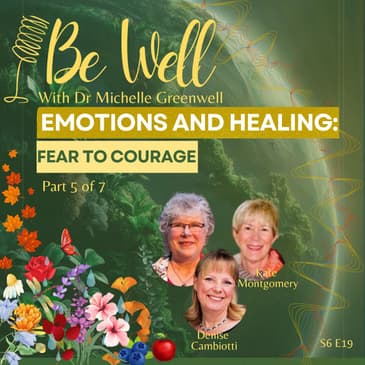
In Episode 5 of Emotions & Healing, Dr. Michelle Greenwell is joined by Kate Montgomery, HHP, ND, and Denise Cambiotti, HCD, CIH BioEW, as we continue around the Five Element Wheel and explore the wisdom of the Water Element.
Through the lens of Five Element Theory, Touch for Health®, and BioEnergetic Wellness, we explore the Kidney and Bladder meridians and their relationship with fear, anxiety, courage, resilience, trust, and our ability to move forward when life feels uncertain.
Fear has an important purpose. It can alert us, protect us, and help us recognize when something requires our attention. But what happens when fear continues after the immediate challenge has passed? What happens when worry or anxiety begins influencing our choices, movement, posture, breathing, energy, or confidence?
Instead of judging the emotion, we can become curious about the information it may be offering.
In This Conversation We Explore:
💙 The Water Element within the Five Element Theory
💙 The Kidney and Bladder meridians
💙 Fear and anxiety as information rather than emotions we need to suppress
💙 The relationship between fear, courage, trust, and resilience
💙 How our bodies may respond when we feel uncertain or unsafe
💙 The influence of posture, movement, muscles, and emotional patterns
💙 Practical Touch for Health® and BioEnergetic Wellness tools that can support awareness and organization
💙 How small changes can help us recognize new choices and possibilities
The Water Element reminds us that courage does not necessarily mean being without fear.
Sometimes courage is recognizing fear, listening to what it has to say, and discovering that we still have choices about what happens next.
Tea with Intentions
As with every conversation in the Emotions & Healing series, we begin with a mindful pause and our Tea with Intentions.
Our tea ritual gives us an opportunity to engage the senses, become present, establish an intention, and notice what changes before we begin exploring the Water Element.
Prepare your own cup of tea, take a moment to notice your breath, and consider:
What might become possible if I could acknowledge fear while still trusting myself to move forward?
Building Your Emotional Wellness Toolbox
One of the goals of this series is to help you develop simple skills you can return to in everyday life.
You don't need to wait until emotions become overwhelming.
By learning to notice subtle changes in breath, posture, movement, tension, energy, and emotional responses, we can begin developing greater awareness of what our bodies are communicating.
That awareness gives us somewhere to begin.
Continue Your Wellness Journey
If this conversation sparks your curiosity, explore the Movement Mastery Program under the Wellness Training tab at GreenwellCenter.com. Discover how integrated movement assessment can help you recognize patterns in posture, organization, and movement while developing practical skills for greater self-awareness.
You can also experience these ideas through the Artfilled Wellness Retreat, where movement, music, nature, creativity, Tea with Intentions, and BioEnergetic Wellness create opportunities to explore balance and possibility through experience.
Or begin developing foundational skills through Touch for Health® Level 1, where accessible techniques involving muscle monitoring, meridians, movement, goal setting, and emotional balance provide practical tools for yourself, your family, and your wellness journey.
Follow the complete Emotions & Healing series as Kate, Denise, and Michelle continue exploring the Five Elements and the many ways our emotions can inform our wellbeing.
Like this episode if it inspires a new perspective.
Join the conversation: When fear appears, what helps you reconnect with courage and trust?
Subscribe so you don't miss the next episode.
📤 Share this conversation with someone who may benefit from discovering a different relationship with fear and anxiety.
**Fear can ask us to stop.**
**Awareness gives us an opportunity to listen.**
**Courage helps us discover what might be possible next.**
#EmotionsAndHealing #WaterElement #FiveElementTheory #KidneyMeridian #BladderMeridian #TouchForHealth #BioEnergeticWellness #EmotionalWellbeing #Fear #Anxiety #Courage #Resilience #Trust #TeaWithIntentions #MovementMasteryProgram #ArtfilledWellnessRetreat #GreenwellCenter #KateMontgomery #DeniseCambiotti
Each episode of the Be Well with Dr. Michelle Greenwell podcast includes the BioEnergetic Wellness Formula. That means that you have the opportunity to have a healing session while you listen based on the way the content is laid out and the activities we participate in. Before listening you can create a goal or an intention of where you would like to be heading with an activity or in your life, then make your cup of tea, engage in the activities and celebrate at the end.
Are you looking for more resources? The best way to find all the resources in one location is by visiting https://linktr.ee/greenwellcenter. Become a regular listener of the podcast and purchase your own tea blends to assist you in transformation while you listen. Our podcast is designed to bring balance and flow to your day, week, month, and year. Thanks for sharing us with others who could also benefit. Please send us your feedback and a review.
Dr. Michelle Greenwell, BA Psych, MSc CAM, Ph. D CIH (Complementary and Integrative Health). Striving to support the public to choose self-care and well-being options that create ease and flow in their lives, Michelle specializes in using movement to heal the body. Her BioEnergetic Formula for Success provides a means for everyone to set their intentions and create support and action for flow and ease to the goals. Learn more at www.greenwellcenter.com. Follow her YouTube channel and specialty playlists. Find her full resource list here. She highlights her Tea Company: The Cape Breton Tea Company which you can find at www.capebretontea.ca. Included is the specialty line of Tea with Intention, Harmony Blends and Coaster, and the focus on high quality organic black, green, herbal, rooibos, and honeybush tea. Including tea with your podcast listening is a unique way to explore tea, create healthy habits, and have great conversations with friends and colleagues.
[00:00:06] Hi, this is the Be Well with Dr. Michelle Greenwell podcast. Our heartwarming conversation is designed to lift you on your wellness journey. Grab your cup of tea and enjoy the podcast.
[00:00:26] Welcome everyone to another episode. It's going to be on emotions. And this is the Be Well with Dr. Michelle Greenwell podcast. And I'm thrilled today to have in this beautiful set whole section that we're working on with emotions. Kate Montgomery and Denise Cambiotti. Welcome back. Hi everybody.
[00:00:50] All right. We're we're chuckling because this episode has had a life of its own and you're finally going to hear this episode because we've had several challenges trying to put it together, which meant the timing needed to be perfect for this episode to come forward. This is part of our emotional alchemy series. And with that, we're exploring this time fear and anxiety as it comes through the water element from Chinese medicine.
[00:01:18] We're also looking at it through the lens of touch for health, which does have that basis in Chinese medicine, but links us back to the muscles, the organ systems, and into the elements. So that's what you're going to hear us talk about today. And fear and anxiety is really misunderstood.
[00:01:34] And we want to bring that forward today because deep inside of us in our survival wiring, we have the kidneys, the bladder, the adrenals, and that ripples out to the fascia, musculature, the breath, memory, and the subtle energy field.
[00:01:51] And when the water element is in overwhelm, we see classic patterns. So we'll see muscle weaknesses or collapsing. We'll see memory freezing or looping thoughts. I know all of us can identify. A sense of not being safe, feeling stuck, maybe some shakiness out of control. There's trouble resting and trusting a process.
[00:02:16] And when the water element is nourished, we can gain courage, calm, clarity, intuitive knowing, and the ability to flow into life. So to bring this conversation together, we need the expertise of these two wonderful ladies. So I'm going to give you their mini bios if you have not tuned into any of the podcast episodes so far. Denise is the CEO of Muscle Tuners International.
[00:02:44] She's also a seasoned touch for health professional and a bioenergetic wellness professional as well. So we have the two different titles we work with. She has a deep background along working with physiotherapists, massage therapists, occupational therapists, bringing in the support for people who are working to help others build better mobility.
[00:03:11] She's worked for more than two decades, specializing in helping clients understand how emotions influence posture, muscle coordination, and pain patterns. And I know she goes further than two decades as I'm saying that, but her focus has come in since she's been working with muscle tuners. Denise has a gift for translating the wisdom of the five element wheel into practical tools and to calm the nervous system and restore physical balance.
[00:03:37] And her integrative approach makes her sought after by many practitioners who want to understand the emotional drivers behind muscle tension and movement challenges. So Denise, as always, it's lovely to have your abilities here. And then Kate. Kate began as a respiratory therapist, evolved her wellness practice into the touch for health world.
[00:04:03] And she went off to get her doctorate in naturopathic medicine. She is a holistic health practitioner. So a lot of background comes with her knowledge. Her expertise grants her the opportunity to work with performers and athletes on the elite skill level. She has helped countless performers navigate things like stage fright, memory freezing, burnout, and the emotional pressures of competition.
[00:04:30] And with a compassionate presence and a keen understanding, she looks at how anxiety shows up in the body and then empowers her clients to build emotional resiliency, enhance performance quality, and rediscover confidence.
[00:04:51] And her work highlights the essential connection between emotional stability, hydration, nervous system regulation, and peak performance. And now to get the podcast into the place for you, the listener, to be able to have a healing session while you listen to this podcast. We want to find out what kind of herbs have come along for the ride because they're going to help to lift us up today. So Kate, what have you put in your mug?
[00:05:21] Well, I'm a green tea person. So I'm doing green tea and ginger because the weather around here is very cold. I like the warming part of ginger. And I also add coconut oil. So it helps my brain give me all my omega oils. And so that's what I do in the morning is have that kind of a drink. So that's my tea today. Beautiful. Awesome. And Denise, what have you got?
[00:05:49] Today, I've got your beautiful Cape Breton Tea Company blend called Kitchen Party. And I just chose it because the name is fun. And I kind of remember having this in the past. I just opened a new package. And I went, yeah, let's have a party in my mouth because the blend is so interesting. Blue pea flower, rose petals, there's green tea, there's honeybush.
[00:06:16] There's just a number of different herbs and flowers and things in there. Just have no idea how that works with the topic of today. But having a lightness, I think, helps us all in moving forward. Beautiful. Beautiful. Yeah. And that's also a green tea opportunity, Kitchen Party. So we're bringing the antioxidants that come out of the green tea.
[00:06:41] I always find I get a lift up, but it's a nice, calm kind of a lift when it's a green tea. And that's important for our conversation today because emotions of fear and anxiety can certainly run high. So let's bring what I've got in my mug today, which is Rising Tides, which is part of the Tea with Intentions series. And then this one is the Water Aligned Blend.
[00:07:06] So we brought together kidney and bladder for the water element. I'm going to highlight white mistletoe today, which is known as the sacred soother. So white mistletoe, it goes back a long ways in European herb craft as the protector of the spirit, helping to soften shock, dissolve fear held in the heart and quiet the nervous system.
[00:07:34] It's an energetic gift in calming anybody who might be hyper vigilant and creating an internal sanctuary. So white mistletoe can just be so, so important. And as I started to look at is the history of how long some of these herbs have been on the earth and us being able to access that ancient history. White mistletoe is one of those. Then we have birch leaf. This is the tree of new beginnings.
[00:08:03] Birch carries the frequency of renewal and gentle resilience. It helps the body release emotional rigidity, self-doubt, old fear that might have imprinted and stayed, creating space for courage, trust, and forward movement. And together, bringing these two herbs in with the rest of the herbs in the blend, this is a potential for inner strength, fluidity, deep listening, and restoration.
[00:08:33] The affirmation for this blend. So I'm just going to read this phrase, the water element supports us by a nourishing wave of power that sifts into each cell to allow unspoken dreams to be touched. And as we look at releasing the stronghold on whether we are an anxious person or we're full of fear, but that is just a being of how the imbalance is showing itself.
[00:08:59] This brings us into those dreams become so important because we can move forward. Okay. Okay. With that, I invite you then to bring your glass up. I'm going to say sludge from Cape Breton Island. And cheers. Cheers. Cheers.
[00:09:22] And it's called Suzette Porter, pay for your emotional health care.古 Teddy, when I say thousand years for theラ Toros? That's what James Caung O'opり said in the Rocco Place, a recipe that lże, dry enough, for this counselor is created by a pawnba-ban from Mauricchio for theолотis and fellow-trains two.
[00:09:50] I'm going to invite you to share a little bit of that and the wisdom and deep intuition that can happen when we can let go of fear. Well, soon some weird things lately. Hopefully I'm displaying the correct graphic. Yes? Yes. Yeah. Great. So we had started with the fire element some couple episodes back. We moved to earth element, the metal element, and here we are at water.
[00:10:18] And if this is the first time seeing this, do you notice that there are arrows that are saying that energy is moving from one element to the next, to the next, to the next in a clockwise fashion? And how water also directs energy towards fire. So in our world, we know that water puts out fire. And if fire is really going, it can melt metal. And the thing with metal is it can be formed into chopped wood with an axe.
[00:10:48] And how wood controls the earth by putting its roots down, stabilizing the banks so that the earth doesn't wash away. And then earth can control water when there are, say, dikes that are keeping a river from overflowing its banks. So there's a very deep symbolism in Chinese metaphorical five element theory.
[00:11:15] And here we are at water and the element of water. So a lot of people have heard, oh, I've heard of elements, you know, there's fire, earth, metal, water, wood. And today here we land on water and the meridian pathways of the body that the Chinese acupuncturists stimulate with needles and other bioenergetic wellness practitioners can affect with acupressure, sound, and other therapies.
[00:11:40] So we're working with the bladder, which is a sac that contains urine. And it works a few times a day or hopefully several times a day. And the kidney meridian and the kidney as an organ can never go off the job and take a holiday, not even for five minutes. You'll get quite ill.
[00:12:00] So it's an interesting pairing from the physical components of the kidney has to filter your blood continuously. It has, it's your body chemist. It is doing its very best at balancing all your electrolytes, all your minerals, just so many things are going on. So think about a chemist. They don't just work with one or two things.
[00:12:30] They are masters at balancing the environment. So that's a little bit about what we're talking on the background on a physical level today, but also on the emotional level. A lot of people will say, oh yeah, I get it. I've heard that if your kidney or bladder elements are out of, meridians are out of balance or the water elements are out of balance, there can be an imbalance of fear, anxiety, dread, terror, panic.
[00:13:00] Woo, big, big, heavy emotions, right? But when it's in alignment, when it's in balance, you have inner direction, you have confidence, you have courage, you have a feeling of being on top. There's adequacy. I could look at a list. There's just so many things that flip from one thing to the other.
[00:13:21] But moving away from fear, anxiety, and moving to courage, this is something no matter what stage of life you're at, whether you're a kidlit going to elementary school and needing to be brave to meet a new friend or do a presentation to anybody at any age through midlife and into aging with grace. So that's a little bit about where we're at in the series now.
[00:13:49] I hope that covered what you needed to hear. So then the value of being hydrated is important. As you were describing how the kidney's functioning, it can't do its job if it doesn't have any fluids with it. So hydration becomes so important. Is there any tip you want to give for people about hydration? Well, I see people come in with pain. And when I ask them, how much water are you drinking?
[00:14:19] And they're going, well, yeah, I drank some. Oh, that's a signal already. And I have learned that if you don't have enough water and there's all these formulas and I'm not sure if I agree with it, because depending on how many vegetables you're having, you have bio water available to you. There's all that. But a good, clean glass of filtered water, especially these days with a high level of chlorination chemicals and things, it's really important.
[00:14:48] So when I find out people are not drinking much water and I say, perhaps you could drink an extra glass or two a day. And maybe bump that up to, you know, try for at least six glasses a day. Could you do that? And they're like, oh, absolutely not. And I says, oh, why not? And they go, because I've got to get up and go to the bathroom all the time. And it hurts too much to get out of my easy boy chair.
[00:15:15] So ironically, the solution to the pain is drinking more water and drinking the water causes them pain and getting up and moving down the hall. So the trick is to sip a little bit. I also, there's some pretty high end people, executives and stuff that I see, they don't drink enough water in a day and they go, oh, I've got to drink water.
[00:15:36] And then they sit and they'll drink three or four glasses back to back to back to back, which is hard on the kidneys, which is getting a whole lot of water and it's diluting its processes. So that's not good either. So my tip is just sip a little bit. Keep a glass nearby you. Sip a little bit through the day. I like to have a pitcher in the kitchen on the table. And every time I pass by, I fill up my glass and I make sure I move.
[00:16:05] It's also an excuse to move a little bit every day. And that way, I know when that pitcher is empty or two of those a day that I've had an adequate amount of water in the day. Because otherwise you forget, how many did I have? So those are more than one tip. Just sip. Because if you do too much at once, it's going to wash over all your cells. Like the water, that rain that comes to the desert, it causes a flash flood.
[00:16:36] That's not really good. It's not getting into the earth. The earth is so dry, it can't accept the water. And anybody that's gardening might see this in the early summer. If we've had a hot, hot spring and you start working the soil, it's not absorbing the water the same as when you've been tending it regularly. So that would be my tip. Drink a little bit often. And eventually, even if it's frustrating to go to the bathroom often, when you're consistent,
[00:17:06] eventually you won't have the urge to go to the bathroom as soon as you've had a glass of water. It does balance out. It does normalize. So keep with it. Because without water, you're going to stay in pain. And your body's just not going to function well. You're going to get ill. And you're not going to be able to deal with emotions well either. Because the kidney is a big controller of emotions in our body. So, oops. I'll stop there. No, I think that's really, really important.
[00:17:35] And when I wasn't drinking enough water as a dance studio owner and teaching and teaching long hours, and I would have the water bottle there, but I never got to it. That was the pain in my feet in a lot of times because the end of the kidney meridian is right where you're jumping on your foot. And so it was impacting there. So I actually started doing, every time I went to the bathroom, it meant a drink of water.
[00:18:04] And I just made that my habit. So I was always replacing it. And that was how I kind of got started to make sure I was there. But people just don't realize that the pain, the stiffness in the joints, all those pieces can just be the hydration. Those kidney and bladder, they're trying to do their jobs and we're not helping. We're getting in the way. Yeah. Beautiful. Thank you for that, Denise.
[00:18:31] And I just wanted to just bring the idea of the fear forward and some of the things that you might see also on that regard when people come in for sessions with you. When they bring those emotions of the fear and anxiety forward, is there usually something that comes back based on that hydration as well? Hmm.
[00:19:02] I'm thinking of a collection of people I've seen over the years. And all I know is when people are stuck in an emotion, and it could be fear. It could be anxiety. And you look around the world these days, and you could have been looking around the world for the last, say, 20, 25 years. Our children are growing up in a state of change. Of course, there's anxiety. I think about my mother, and never mind my grandmother.
[00:19:32] The world is changing so fast, they wouldn't be able to believe the changes that are going on and how we can communicate instantly across the world through this thing called the cloud. Right? And just when people come in with anxiety, they're often not doing self-care. And self-care relates to water. And I do find hydration imbalances.
[00:20:01] And the way I'm trained is I look deeper. And so in Touch for Health, we look to see if people are hydrated adequately enough for a session. And often it looks okay when we do the bioenergetic muscle testing. It looks okay. But if you go deeper, there can be switching at the survival level of the body. And let me tell you, if you've got survival issues going on, whether you recognize it or you don't. But your body is going, I'm scared.
[00:20:30] I might die. And it can be completely perceived. It doesn't have to be in reality that there is a monster under the bed for real. It can be perceived. It has the same effect on the body. And that causes anxiety. And so in a very roundabout way, there are people that say, I do anxiety.
[00:20:57] And I use that language on purpose because it's almost a choice to do it. It's a pattern you choose to repeat. You might not think so, but at the subconscious level, you've chosen. You've just decided, if I do it, I'll survive. I'll act like crazy for a little while, but I'll survive. So the pattern is, stop it. If it's not serving you. And for other people that have this low-level tension, they don't know where it's coming from,
[00:21:25] it's time to look at emotions. It's time to go to a healer. It's time to go to a talk therapist. It is time to sit and learn meditation and ask for, what do I need to release? How do I release it? What, you know, do something. Because without taking care of that, you're losing a lot of energy. And when your kidneys aren't working well, your energy levels are lower and lower,
[00:21:55] and you feel like doing less and less. And do you want to be like that five years down the road? If you keep going the way you're going, do you want to be like that? So when people come in, I often don't find hydration issues in the clear, which I think is what you were hoping, I would say. I definitely find it on some people. And not always just with people who do anxiety.
[00:22:23] It's just a very broad subject. Sorry I couldn't answer. No, it's a very good answer. Because we're talking about things that a lot of people won't have thought about. And it seems common to us because we talk about it all the time. But for the general person who hasn't heard this kind of conversation, or even the discussion about what kind of water and why would it be important,
[00:22:51] it's just important to look at it. And then to realize our habits do create what we're living. So that pain that we might be coming in with is a result of those patterns. So how can we deal with them? So that's beautiful, Denise. Thank you. All right, Kate. I know you want to dive into a little bit about the different muscles that are a part of kidney and bladder.
[00:23:20] Do you want to dive into a little bit of explaining what that is and what it means for people in the movement? Well, this is an interesting element. Water. And so with water, you can look at this in different ways. I was looking at the wheel, the elemental wheel. And we talked about metal. And we looked at quadratus lumborum and supraspinatus.
[00:23:49] And we're looking at large intestine. And then we go through all of them diaphragm. What I looked at it as, wow, we just covered the core muscles. How sweet. Because when you get out Grey's Anatomy, you can look at and see that the diaphragm comes down and anchors in that lower area. And then you have the quadratus lumborum, which anchors the back and down also into the pelvis, as well as the psoas iliacus.
[00:24:17] And it comes down and anchors that whole foundation of the base. And when the base is balanced, your core is balanced. So we talk about water. But it's interesting you bring up urination. When I have to drink a lot of water, I got to go pee. But that could be a lot of reasons. It isn't just about, you know, whatever. It can be a lot of other things, which we don't need to talk about.
[00:24:44] But the thing is, is that water is about detoxification. And so is the kidneys and the urinary bladder. And you look at all of the muscles that encompass that core. And so unless everything is balanced all the way up through the spine, which is where the sacral spinalis and the urinary bladder is,
[00:25:08] then you will have percentages of energetic imbalance. And so, you know, if you look at the body as an electrical fixture, which we do when we monitor muscles and organs and everything else that goes along with it, there's an electrical current there.
[00:25:28] And if any one vertebra or any one muscle or any nerve is in the wrong position and pulling on an organ or the structure or muscles, then you have electrical imbalance. So when we actually go in and monitor and test these muscles, we can see where that imbalance is.
[00:25:52] And so when you look at every kind of client I've ever had, you know, the reason they come is because one pain, stress is usually another. And you talk about anxiety and all these other stress-related emotions is that it all comes down to an electrical imbalance. Every single one of them is. It isn't just about how much water I drink.
[00:26:21] And yes, you need to drink water. But if we're 70 to 80 percent water, which is what the Mayo Clinic says and the CDC says, is that you're a walking fountain. And if you don't have enough water in all those little cells, flushing out all the waste products and the toxins that accumulate over time when we eat food and everything else or we exercise, then you're going to have stress on that electrical system and specific organs.
[00:26:52] When we look at the meridians of this, so you look at the urinary bladder, well, the urinary bladder starts right here in the corner of my eye. And then it comes up over the head, bifurcates through the brain and comes down the spine, through the gluteal and all the way down to the outside of your leg and to the little toe on the outside of that toenail, which is a pain point. So if you ever have pain, hit urinary bladder 67 because it really helps.
[00:27:22] And you'll find that it gets really sore if you're in pain. So that's one pain point, little tip. And throw that in there. Throw it in, it's perfect, yep. But another interesting thing about the urinary bladder, if you look at it in my nice Chinese energy books, which I do, I love this. This is the longest meridian in the body. It encompasses the back shoe points.
[00:27:47] And the back shoe points are points along those meridian points of the bifurcation that relate to all the organs. So right in the center of your back between the scapula, that's the heart. And then as you come down, you're going to hit the kidneys. And so anytime you have a vertebrae out in any of those things, well, maybe those organs are being reduced in energy. Their percentage goes down.
[00:28:16] And so if, you know, you look at your low back, well, that's psoas and quadratus and diaphragm. So if I have somebody that's having low back pain, well, then I'm going to test and monitor those muscles along with sacral spinalis and see who's out of balance. Most of the time, that quadratus shows up all the time. So we look at large intestine.
[00:28:40] And so I love it that we have a toolbox here that points to every little thing that could be energetically out of balance. And you can explain that to them as you look at your chart on the wall that has the touch for health of all the connections. And you can point to that and say, well, see, here's this one or the trigger point chart. That's another great chart to look at because it really shows all the muscles.
[00:29:10] And you can see exactly why you're having a problem, why you have pain. Every athlete that I've ever worked with, I always start with my core muscles because that's really what's going to power them through that finish line. You know, if you have and then your secondary muscles come in like your quads and your hamstrings and abdominals, but you got to get your core straight so that the secondary muscles don't fall.
[00:29:39] You know, they can't take you if your psoas is a hip flexor and it's not moving your leg up and down and the quads try to drag you along. It doesn't kind of work that way. So and that's all intestines. So you have hamstrings or small intestine, large intestine with both quads and quadriceps and the small intestine. So you're always looking at nutrition, too. You're looking at the water. You're looking at what you put in to hydrate and nourish the body so that your electrical system is in balance.
[00:30:08] That's all your electrolytes. So water carries electrolytes, not bad water. You got to look at clean water as much as you can. That doesn't have all the, as Denise said, all the chlorination and the chlorine and the fluorides and all the other stuff they decide they want to add to water these days. I have two water filters on mine. I use one on the sink and then I use one in a pitcher so I can pull things out.
[00:30:38] And I end up with a 99% 9.9 clear water and it tastes better. And I feed that to my plants. I do not give up chlorinated water. So those are the things that you want to be aware of when you're taking care of yourself. It isn't just about all our bioenergetic stuff and finding a practitioner, but what you can do for yourself.
[00:31:00] So I always go back in and say, well, let's rub neurolymphatic reflex points, which push out the lymphatics for every muscle, organ and gland. And, and so when you look at urinary bladder and stuff, well, those points are on the, on the pubic bone in the front and then on the back where you, where your kidneys are. So you just rub the lower back. Those things will get the urinary bladder.
[00:31:27] Psoas is one inch out from the navel and on both sides of the navel and deep. And you rub deep, you rub firm, you don't rub soft because otherwise you won't do anything. And, and so, and of course the diaphragm, our favorite one up and down the sternum, you know, just rub those. Those are your core muscles and they will take care of your balance within the pelvis itself.
[00:31:51] Um, doing things like rocking on your sacrum, removing the body so that you get range of motion and everything and see where you are. You know, you can do so much for yourself to put everything back in balance and then look for somebody that can assist you, teach you things that you can do. And hopefully we're trying to do that here, give you some ideas. But those are the things that I wrote about. They're all in my book and I talk about them also.
[00:32:21] But, you know, the essence of health. And it's funny, I wrote down the breath of life. Breath of life. That's my diaphragm. That's my breathing. That's taking a deep breath. That's what we covered in metal. Now we have the breath of fluid. That's water. And water sustains us through every chemical process we have in the body. If you don't drink water, kind of shrivel up.
[00:32:51] This is where dehydration comes in. And if you take a piece of meat, if you've ever witnessed a piece of meat that hasn't been hydrated and soaked, it shrivels because the fascia just sort of takes it in the meat, shrivels up. And you got beef jerky. That's basically it. You don't want to become beef jerky. Thank you for that visual. Well, Denise has such good ones. I got to throw one in there. Anyway.
[00:33:17] But water keeps you hydrated so that your muscles are squishy, so that they have flexibility, that the joints have synovial fluid and everything moves. So if you don't want pain, drink water. That's really what it is. There's just, again, rub points. Rub neurolymphatic reflex points. Do everything that you can do to self. And self-massage yourself. That's the other side to this.
[00:33:46] You know, always massage toward the heart so that you drain through the lymphatic nodes. Get a book. Get a massage book. Get a massage. Do things that help move lymph. But push those toxins out of there so you empty your cells and then replenish with a good glass of clean water. Yeah. I'm going to jump in. You're going to have it. There's a couple of things.
[00:34:13] I just want to come back to that that you have said. Good. So I would like to go back to you were describing the meridian. So the bladder meridian coming from between the eyebrows. Going over the top of the head is a single line. But then it gets to the shoulders and it splits. And I know you were using language that for describing. But I just wanted to bring that visual back to those people who know nothing about meridians. Meridians.
[00:34:42] So we have these two energy lines that come along the shoulder and then they come down either side of the back to two lines on each side of the back, which goes down to just below the bum. And then they merge again to go down the leg. So I just wanted to bring that little visual in because it was so beautiful what you said about that connection that it has to the kidney because it's passing right along that.
[00:35:08] And I don't think we really often think about how the electricity coming through that bladder meridian is affecting the organ that's sitting there for the kidney because it's right next to it, as well as the adrenals because they're also there. So I just wanted to bring that little piece forward as people were trying to picture something they might not have seen before. Um, and then now I go ahead.
[00:35:37] Just one other extra thing I didn't say was, you know, when you look at the meridians and stuff and, and Denise touched on this a little bit is the kidney, the kidney in is the kidney and the thyroid. Okay. So the kidney and the thyroid, that's your battery and your spark plugs. And so when we look at these two glands that regulate, you know, an organ and a gland and the adrenals, they regulate your hormones.
[00:36:06] So if you don't have enough water going on with the kidneys, which affects the adrenals and then it affects the thyroid. When I do a hair analysis on someone, I can see who's actually working the hardest. The kidney, the adrenals, which is a kidney also, and then the thyroid. One of them is going to be doing a lot more work than the other. And that's what we look in long-term health is that who's, who's really keeping you going? Is there a balance?
[00:36:35] And, and looking at those things so that you can put it all together and create that balance. And water is obviously part of it, but balance and all that electrical system will also balance all of your organs and glands as well as the muscles. So that's the important thing is balance here. We are talking because we've all been touched for health people. We've all taught it. I don't teach anymore, but I did.
[00:37:04] But the thing is, is that if you look at balance through the whole structure, look at this body as an electrical engineering design. I mean, it's incredible. And look at your structure as the house. And if your structure is built solid, then everything else and everything's lined up. Then your muscles, ligaments, tendons, they're all in the right position too.
[00:37:32] Then the electrical current goes through those little orifices and just weaves itself through the spine and the joints. And you get 100% power. Anytime you have pain, it's not just lack of water. It's because there's an imbalance in the structure. So you really want to make sure that you find competent people to help you put yourself back in position. And then you follow up with your self-care. Mm-hmm.
[00:38:03] One of the things on the weekend, I had an event and I left my water bottle in the car. And when I got home from that event, I had an hour and a half drive home afterwards. And I could hardly get out of the car because the joints had seized up so much from the lack of water just based on the way that my schedule went. And I got in the house and I was cursing myself for knowing better and knowing what I should have done.
[00:38:33] And then having to take the whole evening to make sure I hydrated. And I could just feel it was like being the tin man and just like putting oil into the joints. And it was like as the evening progressed, all of a sudden I could move my joints again and everything came on board. So I'm hoping as I'm describing that and people are listening, they might recognize that same piece. And then realizing it's not necessarily arthritis that's got you stiff.
[00:39:00] You just didn't have enough water today or it's chronic and you need to do something there. I want to go ahead, Denise. You wanted to take it. I need to jump in because I had a similar experience yesterday. I showed up for a class and I got partway through the morning and I go, my brain's not working very good.
[00:39:23] Oh, I left my water bottle in the car and, you know, not having had much water all morning, just for the morning, as much as I'm used to. It really affected how I could focus. And I talked to people that water is not just important to flush stuff out.
[00:39:46] But chemically, what's happening is every biometabolic process going on in your body needs a water molecule to initiate. It's like a spark that gets the next step of the biochemical breakdown process happening. So you need enough water to get that started. And now you've got things broken down. Now you need the water to move it out of your tissues or it's just going to move to a new location.
[00:40:13] This is if you need a reason to drink more water, not just because it's good for you. Oh, and I've heard it will help with health. Think about your kitchen garbage breaking down a little bit, getting a little bit smelly by the end of the day. You go, I got to take that out before I go to bed or tomorrow morning. It's going to be pretty smelly. Imagine that might be happening in your body.
[00:40:40] And you're not getting the water to push that garbage through and flow it out of your body. It's not a pretty picture. And I also want to say that there are some people that just are so addicted to coffee. And my body doesn't tolerate it. I don't really understand it. But there are people that just they can't start the day without coffee. They can't go through the day without five or six cups of coffee. And the worst pain I have ever seen anybody.
[00:41:09] I said, how much water do you drink? Well, none. Well, I drink it in my coffee. OK, well, how much coffee are you drinking? He says, well, it's only about two pots a day. So hello. So now the other thing is, is when you're having that much coffee, it is absolutely stealing water from your tissues. So if you're going to drink and enjoy your coffee, go ahead.
[00:41:35] Just make sure you drink in an extra glass or two to replace what that coffee stole from you. And then you still got to drink your regular amount of water. And before I forget, can I share a tip about the kidney and the psoas muscle? Oh, yeah. OK, so how many people are side sleepers and sleep like crunched up? Now knees up to your chest.
[00:42:02] There's someone in our world that said people that do that are typically subconsciously balancing their psoas muscle and supporting their kidney meridian while they sleep. Because putting the psoas muscle in a position of contraction, while it's not actively lifting anything, you're laying in bed. There's a there's a blanket of weight a little bit. You're supported by the mattress and the muscles contracted a little bit.
[00:42:31] But it's going, oh, isn't that nice? It's like I'm working, but I'm not. And it's actually doing a neurological resetting. And you can do this on purpose for yourself with a stretching activity you might know about to say, oh, let's help our hip. Well, guess what? I'm just going to back up here.
[00:42:53] What would happen if you picked up the lower part of your thigh and hold it so your knee is aiming to your opposite shoulder? So not straight up. We want it going across and you just support it. And you say, OK, everybody, you're on a holiday. Go take a one minute break, a two minute, three minute break.
[00:43:16] Like the longer that you're doing the support here while the muscles contracted, you are doing phenomenal work at releasing a tight psoas. So imagine if you're doing this on purpose. Let's say standing up. How many people do I see walking up and down my lane, walking like this? They're leaning forward. Right. It might not be that dramatic, but I see it.
[00:43:42] And I see it on myself sometimes when I'm walking and I go, oh, I better go and release that. So if this is tight, your hips are tight. Now, I better do the other side so it's even because, you know, Kate was saying, remember, there's balance. So do that on both sides. And I really recommend that you do that. And if you're not strong enough to hold it, and this is typically easier to do when you're lying in bed or lying on the floor.
[00:44:12] But if you're not strong enough to do that, then use an aid, use a towel, use something so that you can use different muscles. If a towel is stretched across here and you're just holding it, right? And you brace your elbows, whatever it takes. And literally doing it with intention for one to three minutes can be life changing. And to do it regularly. And I know that you're going to probably ask me this question.
[00:44:38] What do I notice when people's psoas muscle, this muscle is connected to the kidney meridian. And it comes and it attaches up in here. And technically, it was one of those core muscles called the diaphragm from another element. What happens? People get up off the table and they look like they're standing taller. And I'll ask them, how do you feel just standing there? And they'll go, I feel taller. That's weird.
[00:45:08] Get that all the time when you release that psoas. Because they're not like, psychologically, even if they're not leaning forward that much, just that little bit, their whole nervous system is getting the signal. I can stand straight again. I am taller. Even if it's by a millimeter, it takes a lot of pressure off all your internal organs. So that's my tip of the day. Just do that purposeful.
[00:45:36] It looks like you're stretching the back part of your buttock or whatever. But you're also putting the front part into this contracted, relaxed state. And you're saying, look, I'm carrying the load. You don't have to work for a few minutes. And it will love you for it. I want to add to that. I want to add to this. One of the things that you're doing, Denise, is that when you see people hunched over,
[00:46:04] and then you release the psoas, the way you're showing, and take pressure off and allow that person to sit up straight or stand up straight. When somebody's bent over, they've got their quadratus lumborum on a stretch. You also have a crunch on the diaphragm, which is the other core muscle. When you release the psoas, you're allowing it to straighten back up, takes the quadratus back with less tension in the muscles,
[00:46:32] and also releases the diaphragm. So all three core muscles then get released because of the psoas. So that takes a lot of stress and pain out through the abdominal core and down through the pelvis itself. So it does so many things to release these three muscles. But yes, the psoas is really important, but it also takes strain off your kidneys themselves and also the adrenals.
[00:47:01] So it's a very good tip. I so love having this conversation with you too. There's so much beautiful knowledge here. I was just thinking about what that means from the spiritual aspects of our living. And when all of that is tight and held, and just exactly as you described it, we don't have the ability to think in the higher levels.
[00:47:30] So we're thinking in a more mundane level, which means when you're trying to get work done, you can get the menial tasks done maybe. Maybe as you're looking at your list, you're trying to check off, but you're not going to have insights coming in or the ability to be creative into new ideas. And so this restriction that's happening in your body changes the way that you're going to be thinking and how you're going to be producing some of the work that you're hoping to produce. And that's when you say,
[00:48:00] I didn't get a thing done all day. Or, you know, as I was working on that, I just couldn't find my mojo on it, you know? And that's part of the piece is it's holding you back. And so that could be a really important piece. Yeah. How beautiful. This is so cool. The other thing I wanted to bring forward too, Kate, you were describing what were the primary muscles and what were the secondary muscles. And as you said them, I was laughing because I was thinking
[00:48:29] when you said the quad is a secondary muscle, and I was thinking there's going to be a lot of people who go to do workouts, who think it's a primary muscle, but not in relationship to how we're describing here and what this really means for your living. Yeah. Exactly. I mean, you can go into a gym and you can watch people doing leg extensions and hamstring curls and everything, but nobody's doing anything for the big muscles in the core like they should be.
[00:48:59] And when those three core muscles are strong, then it's really easy to sit down at a machine and do those leg extensions and curls and hamstring curls because there's restriction taken off the core itself. Nobody thinks of the inner versus the outer. And so the secondary muscles, you know, I watch, when you watch somebody walk, you know, Denise is saying
[00:49:27] she sees how clients are bent over like this, but you also have to say, how often are they coming and shuffling? So if they're shuffling their feet, you know, well, that's your quads, but they also can't lift their leg because the psoas isn't functioning. So if they can't lift the leg, then the quad takes over and the only thing that's happening is they're shuffling. So that's really, when you see that, you can see that the core muscles
[00:49:56] are not really functioning. And that's a hint because then we talk about the meridians and the elements, and then we know what organs and glands and muscle, you know, aren't working to give us that full electrical power. So what vertebra is out of alignment that's squishing on a, you know, on a nerve that's causing that electrical short. So I don't have 100% power. And I'm a big fascinated person about watching people.
[00:50:26] When I used to do races and things with the team, with the massage team, it's like my whole thing was to watch people run. And I'm always amazed at how they could run bit into the positions that they were running. I mean, it's sheer adrenaline high when you're running like that and you're determined to make the finish line, but your posture is awful. You see the muscles compensating so much
[00:50:54] in order to propel you forward. That's got to be such a strain. And I hurt thinking about it, you know, and then when I go to work on people and I go deep into getting rid of trigger points and releasing the psoas and the quadratus and the diaphragm so that their whole body then elongates and you see the tension drop immediately. And I hope through the conversation that we're having today that people will look in the mirror and say,
[00:51:24] what's my posture like? Am I hunched over? Am I in pain? Is it not just water? Is there an electrical imbalance? Is there a structural imbalance? Those are very important, you know, so that when you do drink water, you know, we're putting the breath of fluid into your system to try to detox you. But when you're also, and I'm going to use the word crooked, if there's a crooked thing here, it's going like this. It's shaking.
[00:51:55] There's a block here. And so maybe you're not able to detox as well, you know, and nothing is getting, and then incontinence comes. There's an issue with the lower back and the vertebra and the 4-5. And so if my structure is out of alignment here in this pelvic floor and everything, well, then it's going to make me pee more too. Maybe I can't hold my urine like I used to. One other tip too on water, and I thought about this
[00:52:25] when Denise was talking, is that when you go to the bathroom, what does your urine smell like? If it's really yellow and it has an odor to it, you're not drinking enough water. So that could be something to look at. I mean, there's other reasons, but a lot of times if you haven't been drinking water, you'll see that your urine is a bright yellow versus a clear, and maybe there's an odor depending on what you ate too. But the thing is, is that that's a little tip to look at. The other thing
[00:52:55] I was going to say, and I'm trying to remember what Denise said, but, oh, coffee. Good old thing on coffee, Denise. Thank you for bringing that up. Your pH. When you drink coffee, it's very acidic. One of the things, the body is supposed to be alkaline. If you drink, one cup's okay, but if you drink a gallon of it through the day, they say you keep going. Number one, it affects your adrenals and your kidneys
[00:53:24] as far as getting going. It actually makes it worse. But you change the pH of your body to where you are more susceptible to getting sick. The body thrives on an alkaline pH. It does not thrive on an acidic pH. Every bug will follow you. And so, you know, watch what you eat. Any type of acidic foods, you know, too much
[00:53:53] will make your pH. You can buy alkaline strips in a drugstore, in a health food store. Monitor your pH, your saliva pH. You know, you should be around 6.8 to 7.2, somewhere in that vicinity. Stay there, you know, and then you'll stay healthy and you won't let a bug find you. I love it. Thank you for that. And I noticed with chocolate, particularly not good chocolate.
[00:54:23] Another one. right? And you go for that chocolate fix. That's when the acid starts into the stomach and it just churns right up right away. So, another indicator and some people think, oh, you know, I have a stomach complaint. Well, just check what you had maybe half an hour ago because that could definitely be an indicator of that pH switch that has also come in. Yeah. I've got one more thing to add.
[00:54:52] How many people eat dinner or whatever a meal whenever it is and they go, oh, I'm still hungry and they'll keep eating or they'll get, oh, I feel like having a snack. So, maybe you've not heard the memo on this but often you confuse your hunger signal with a thirst signal. So, for those people who are looking to let go of some weight, water will help you metabolize things, wash them out
[00:55:22] of your body. Water will also fill you up in a way that maybe, oh, it was a water signal not a food signal so you've automatically saved, you know, probably 300, 400 calories right there by drinking water instead of getting into one or two cookies that turn into half a bag of cookies or whatever it is. But the other thing that's really interesting when you're really well hydrated, you don't tend to have cravings for other fluids.
[00:55:52] This could be a coffee, it could also be alcohol. So, if that's a tip for somebody who says, yeah, you know, I have no problem having one, two, three glasses of wine at night or starting, I'm retired now, I can start my happy hour at two and go until I go to bed. You might not have that much of a habit for alcohol if you were better hydrated. And I noticed the first time I had an acupuncture treatment
[00:56:21] a long time ago, I was tending to drink a glass or two of wine every night. And after the acupuncture treatment, I had zero, zero inclination to go open a bottle of wine. I was perfectly happy just drinking water and I thought this is really weird because that was a little bit of my introduction into energy work and having your meridians in balance and having your body tell you
[00:56:51] what it needs naturally. And it was like, oh, I'm thirsty, I have water, I don't feel like having wine. So when you're properly hydrated, so many systems are working properly, maybe some bad habits will dissolve without willpower. Is that the word I'm looking for? So keep that. I need to say one last thing. Great thing, Denise. But the other thing I found,
[00:57:22] water fills you up. So before you eat, have a glass of water. It'll fill you up so that you don't have to eat as much as you normally would sit in this stuff. water. But the other side is that don't drink with your meals. Because when you drink with your meals, you dilute the chemical processes of hydrochloric acid and pepsin that come in naturally to say, oh, we need to do this so
[00:57:51] that we can dissolve this. The other thing is when you eat, I mean, I changed this a long time ago and I tell my clients to do this, is that eat your protein first. it takes four to five hours to digest protein. If you eat a salad first, which is what we do in this country, it's all water. So now you're hydrating yourself with water and then when you eat your meat, on top of that, it takes forever to digest because you've
[00:58:21] been diluting all your stomach acids. So think about drinking with your meals. Sip it. You can have a sip of water. That's it. But don't try to sit and drink, even with alcohol. It's the same thing. Don't change the pH of your body. Keep your meal so that it's simple and allow the chemical processes of your body to do its job. And then you won't have any bloat or gas and you won't have a tummy ache later
[00:58:51] and feel really full all night before you go to bed. Hi, Denise. did you have any clue this is where the conversation was going to go? I just knew I knew that this conversation we kept trying to have it and it wasn't happening but obviously it was more about water which is really interesting because we have such incredible muscles that are related to these systems
[00:59:21] but they just can't function without water so how crucial it is and then when we take that back to emotions thinking about I'm hoping as people are thinking are these emotions your emotions that you're experiencing or is this really just your body signaling its imbalance through emotion because it's the only way that you're going to listen and so if some of these things are coming up and you say I've had this my whole life well it could be a really simple pattern that needs
[00:59:51] to be adjusted so it's beautiful because this is what we wanted to shine the light on is there's other ways of looking at how our body is signaling and functioning but also the ways in which we are living our lives and those patterns that we've adopted that they worked they worked but is it what keeps you safe is it what keeps you where you need to be yeah so no I didn't expect where we're going but it's delightful
[01:00:22] you said Kate because I know based on the seniors that I work with that community incontinence is such a big issue and you had commented about the lumbar region and some of that area do you want to just dive a little bit deeper into that because this brings us back again to the tightness of the pelvis and how those core primary muscles are functioning that are coming out of this element
[01:00:52] so well oh so much to say about this actually the pelvic floor is very important as we get older so that our pelvic floor muscles and there's a bunch of little ones and I'm not going to say a bunch of names but you when you look at your core muscles that actually come through the pelvic floor and when the core muscles are strong and your lumbar vertebra are in alignment it's not putting pressure on
[01:01:22] the sciatic nerve and it's not triggering a response so one of the things is the sacrum if the sacrum is in alignment between the two pelvic bones then that also helps because the sciatic nerve comes down through the sacrum down through the back of your leg so you know one of the tips here's another one is that rock on your sacrum it's like reposition the ligaments and stuff
[01:01:51] that hold that sacrum in position between so in my book I'm gonna say this you rock you just go back and forth like this then you go side to side on the floor you can put your hands behind you your feet up and just rock back and forth you always end this way I always tease my clients and I said you are not Mae West you don't end with a wiggle this way sideways finish front and back for those people that
[01:02:21] are listening not watching so if you so if you think about it you know when Mae West would walk her big thing was to really swivel back and side and use those hips but you don't walk like that you really want to make sure that you end your sacral rock back and forth and you can do this as often as you want you know and then take your legs over and stretch the other way and then stretch back and open up that low back lay back on your
[01:02:51] back if you can lay and pull your legs up to your chest that's going to stretch out your low back also but can you do a kegel do you know what kegels are you go in and you squeeze those little intrinsic muscles within the uterus themselves and those and the same thing with the anal muscles squeeze those because you want to do the pelvic floor as much as you can I mean there's a lot of devices out there that help you actually you can take a ball
[01:03:21] and put it between your knees and squeeze it and even up to the upper thighs and just squeeze it squeeze it and try to do that the other thing that happens I found this with soccer players long legs short legs so when you have a problem it's like sometimes the muscles the psoas and the quadratus they do this they go like this parallel
[01:03:50] but off to the side yeah well not off I'm trying to show in my window here it's like you have a long leg short leg and have a long leg short leg you can feel that one foot is hitting the ground harder than the other foot because there's maybe a callus there could be a callus on the sole of your foot and also little corns on the side of the big toe that's caused by the psoas getting stretched one side and one side
[01:04:20] shorter you can do this by rocking on your sacrum the other thing to help stretch is sit on the floor and how do I describe this it's just move forward it's just like going forward back and forth back and forth so pretty much walking on your bum bones thank you walk on your bum and move that sacrum it stretches out those muscles of the glutes but it also helps to recenter them and go backwards too forward and backwards five or six times
[01:04:49] that's another little thing that you can do but squeezing and trying to get those muscles together one of the things in soccer players I found was that with them is that they kick usually there's a dominant foot that kicks when you plant one leg and kick with the other the upper leg that's kicking becomes longer so one of the tips that I found I was working with soccer players and I found every single one of them had a long leg short
[01:05:19] leg but when I did the stretch or the isometric stretch so I found the pubic synthesis ligament which is when we have two hip bones we have a little pubis right here well there's a teeny weeny little ligament right here and so it's between the two bones so Kate's got her hands up fingertips going towards each other so there's a little ligament here in the middle and when you have a long leg short leg it stretches
[01:05:49] that ligament and pulls it so then you end up so ways to fix that is you sit on your sacrum you squeeze your knees together bring your knees up feet on the floor squeeze your legs together as you try to pull them apart that's an isometric contraction and so you're squeezing and pulling and that's strengthening that ligament the pubic synthesis ligament and it pulls the pelvis back into
[01:06:18] position and the long leg short leg goes away and rub this neural lymphatics for the psoas and the quadratus and those work really well I saw it on every single soccer player so which points are those for those people that don't know for the psoas what's the neural lymphatics is Denise stand up navel go one inch out one inch up and you rub deep into the
[01:06:47] abdominal wall and rub firmly and deeply so that's one quadratus lumborum is on the back and so you just rub on the back turn around Denise and then you are you talking about these guys in a triangle yes there you go and and she can do those and then the other one is to rub on the pubic senseless ligament down in the pubis itself where there's a bone and there's both sides okay that gets other muscles too like glute medias too
[01:07:16] abdominals and that and so that alone and you'll find them sore if you find them sore that tells you that the energy is blocked in those muscles that you need to rub more and don't be afraid it's a little pain maybe but it'll go away quickly beautiful thank you for sharing all those pieces because now that's an indicator of what we've been trying to say is you can do all these things for yourself so when you know which points to rub then you know how to bring that back into alignment
[01:07:46] and I just want to add for those people that aren't sure about some of the stretches or movement patterns in Tai Chi we would do Danyu arms only and we could do seated Danyu and that's going to go back and forth giving you that rocking action and so the seated to standing Danyu will give you a little bit more and that's another exercise that you could add in there and that one you can find on my YouTube channel under the Tai Chi
[01:08:16] wellness playlist so I just wanted to bring that forward if people were looking for something that could be demonstrated okay I think we've talked about a whole bunch of things we didn't go into stage fright or memory freezing and performance but I think what people are going to realize from this conversation is all of those symptoms I'm going to call them that things that happen in your life that have the fear and the anxiety with them all bringing that back to how are your muscles functioning in this series
[01:08:45] and how are you hydrating and if that is in check you might have a completely different experience and then how you are performing in some of the things you want to do you might notice things really shift Denise did you want to add something else there I do this conversation got kind of deep and got kind of wide and it did a couple loop and some of the things that we spoke about might sound complicated
[01:09:15] let's face it yeah they did sound complicated because we live in this every day but the message I want to send out to people is that there are simple processes you can do for yourself that bring you more into alignment every day and that you don't need a deep understanding that this muscle is connected to that muscle and that affects this element that affects that element truly
[01:09:44] start somewhere when you get one area happier remember the I put the graphic away but remember that flow of the five elements and how they send energy one to the other to the other when you give love and attention to any one part of your body the general message to the rest of the body is share and it goes
[01:10:14] around in this beautiful cycle every single day and even if you don't know how to do all of it do some of it rub some of the neuro lymphatics that Kate's mentioning do some of the stretches that were mentioned today listen to the rest of the episodes and pick out a couple of those tips because those were shared because they are little gems beautiful little gems and
[01:10:44] to do some of those for yourself that literally could take as little as 30 seconds to two minutes of your day you can do a lot for yourself so yeah if what we talked about sounded a little too in-depth for you today just whatever attracted your attention do all of that okay perfect thank you for bringing that succinctly around I love it okay so
[01:11:14] let's close this off and from here when we visit with you next time we will be taking you into a deeper dive I'm coming back to we have a full series that we're doing in this one and we have also done about pain already so please go back to some of the trilogies that we did and
[01:11:43] start to really dive into this material and find the nuggets that are going to be appreciative from your body's perspective and to go from there anything you want to when I wrote sports touch I had to write in a third person because I wanted to make sure that the individual who wasn't me who didn't
[01:12:13] have to know about the anatomy and physiology and all those terms I talked to talk to the lay person I wanted to talk to the athlete or the lawyer or the doctor believe it or not and talk to them so that they could see
[01:12:43] that there is a connection simple real simple to reset the mechanism and so don't be afraid to touch I think that's the big thing don't be afraid to touch you know pain is a symptom of something out of you're going to die or anything else it just means that we're sick it just means there's the body says help me help me you know that's all it is and
[01:13:13] you going in and exploring and touching the psoas neuro lymphatic or the quadratus lumborums you know you might be surprised that you like Denise said I stood up taller you know those are the things that will just befuddle you I know when I first started in this career it was like I was just captivated by all the shifts and changes in myself that happened and so now I
[01:13:55] help you identify things so between Michelle Denise and I we're telling you look at this it's very simple I don't look at the body as complicated even though we have big words and we know this stuff it's not complicated when I started in it hey you know just rub here just rub here and I did and so that's what you get to do you get to start on that ground
[01:14:25] and find it and get rid of your pain spots that's all so good luck to you and happy rubbing and I was I'm just looking at my notes here and I have beside that neuro reflex points it helps clear the body of cortisol and adrenaline and that's what clear that water element pathway so as people are listening to those words being said in other capacities this is one way of clearing that the other
[01:14:54] important to clear cortisol and adrenaline because lay people don't know those terms they don't know their hormones that relate to what that's your adrenals when you have cortisol stress let's just talk stress stress let's talk stress stress is makes your muscles tight makes them really tight and that means that your cortisol levels which is a hormone that
[01:15:24] your adrenals help produce that if it's out to help move that muscle get flow before I could actually massage them so but cortisol yeah everybody that's being told your cortisol levels are out of balance if you're
[01:15:54] under stress or you can't lose weight because of the cortisol it's a word to people but you can manage it with information from this podcast yes you can you can manage it little tip too this is what I've been doing I know Michelle is going oh god here's another tip so I started looking online and I have a tuning fork and so I
[01:16:40] very good where's mine anyway so the computer tells you some meetings can be stressed right I have my tuning fork where did I put it oh it is holding up her tuning fork I know but I bought one with a crystal on the end which was really
[01:17:10] behind the ear no it's like right the bone behind you and you hit your jaws and then you do the manubrium on the chest right here come up higher higher higher higher higher that is my manubrium honey I'm out of balance since I had a little fall and then you
[01:17:40] right there center of the chest yep and then you do the end of the crack of your sacrum so if you
[01:18:10] it works to reduce your stress wonderful so the thing I was going to say as my closing piece now that you've said that is a little hydration habit to think about so fear dries the body up anxiety tightens the tissues it's water and electrolytes that restore the flow and for those people that are
[01:18:40] looking for electrolyte replacement if you go to the recipes on greenwell center dot com going into tea and going to the recipes then you make it home and I just keep mine in the fridge all the time we sip away at it so that's my extra tip to add on to today's conversation thank you both for being here again
[01:19:09] and bringing so much wealth of knowledge forward and thank you the thank you for listening to be well with dr. michelle greenwell there are a couple of resources i want to just point out
[01:19:39] when you go to the website greenwell center dot com you'll have a pop up window that pop up gives you of playlists with all kinds of different ways that you can activate energy and bring vitality into your day you can find that
[01:20:09] when you go to youtube at michelle greenwell and last if you're a link tree person link tree l-i-n-k t-r dot e-e slash greenwell center that has all my resources in one spot those are for intricate little things that you can't get everywhere and it's a wonderful way for me to be able to share all the different aspects of the kind of work I do so thank you for
[01:20:38] listening be sure to drink that tea and if you want to have the tea blend that was shared in