
What are you taking in each day—and are you giving yourself the nourishment you truly need?
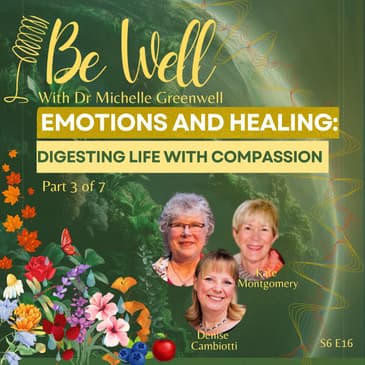
In Episode 3 of Emotions & Healing, Dr. Michelle Greenwell welcomes Kate Montgomery, HHP, ND, and Denise Cambiotti, HCD, CIH BioEW, to explore the Earth Element through the wisdom of the Five Element Theory, Touch for Health, and the BioEnergetic Wellness Formula.
The Stomach and Spleen meridians do much more than digest food. They help us process experiences, build resilience, strengthen immunity, and transform emotional overwhelm into grounded compassion. When the Earth Element is out of balance, we may become overly critical, worried, depleted, or feel responsible for everyone else's wellbeing while neglecting our own.
Together we explore:
🌎 The Earth Element and emotional balance
🌾 The Stomach and Spleen meridians
💛 Digestion, immunity, and whole-person wellness
💛 Empathy, compassion, and healthy emotional boundaries
💛 The connection between posture, movement, muscles, and emotional health
💛 Practical Touch for Health techniques that support emotional resilience
💛 Everyday strategies for restoring balance, energy, and wellbeing
Tea with Intentions
Today's featured blend from the Cape Breton Tea Company is Symphony of the Earth, thoughtfully selected to support the Earth Element and encourage emotional nourishment.
Featured herbs include:
🌿 Peppermint – bringing clarity, gentle movement, and relief while supporting healthy digestion and helping emotions flow rather than becoming stuck.
🌺 Hibiscus – encouraging renewal, resilience, and the willingness to receive support as readily as we offer it to others.
Affirmation:
"The Earth Element reaches my soul's calling. The synergy of this blend gently persuades me to shift perspective and receive nourishment."
Prepare your favourite cup of tea, take a deep breath, and join us as we explore how caring for yourself creates the foundation for caring well for others.
Continue Your Wellness Journey
🌿 Experience the Artfilled Wellness Retreat
🌿 Learn Touch for Health Level 1
🌿 Explore the Movement Mastery Program under the Wellness Training tab at GreenwellCenter.com
🌿 Discover courses, podcasts, wellness resources, and upcoming events through the Greenwell Center for Holistic Health.
If this episode inspired you:
👍 Like this video
💬 Share your thoughts in the comments
🔔 Subscribe for future episodes
📤 Share this conversation with someone who is learning the importance of nourishing themselves while caring for others.
Healing begins with awareness.
Awareness inspires intention.
Intention leads to action.
Action practiced consistently becomes resilience, balance, and a lifetime of living well.
#EmotionsAndHealing #EarthElement #FiveElementTheory #StomachMeridian #SpleenMeridian #TouchForHealth #BioEnergeticWellness #EmotionalBalance #Compassion #Immunity #Digestion #TeaWithIntentions #SymphonyOfTheEarth #HolisticHealth #MovementMasteryProgram #ArtfilledWellnessRetreat #DrMichelleGreenwell #KateMontgomery #DeniseCambiotti
Each episode of the Be Well with Dr. Michelle Greenwell podcast includes the BioEnergetic Wellness Formula. That means that you have the opportunity to have a healing session while you listen based on the way the content is laid out and the activities we participate in. Before listening you can create a goal or an intention of where you would like to be heading with an activity or in your life, then make your cup of tea, engage in the activities and celebrate at the end.
Are you looking for more resources? The best way to find all the resources in one location is by visiting https://linktr.ee/greenwellcenter. Become a regular listener of the podcast and purchase your own tea blends to assist you in transformation while you listen. Our podcast is designed to bring balance and flow to your day, week, month, and year. Thanks for sharing us with others who could also benefit. Please send us your feedback and a review.
Dr. Michelle Greenwell, BA Psych, MSc CAM, Ph. D CIH (Complementary and Integrative Health). Striving to support the public to choose self-care and well-being options that create ease and flow in their lives, Michelle specializes in using movement to heal the body. Her BioEnergetic Formula for Success provides a means for everyone to set their intentions and create support and action for flow and ease to the goals. Learn more at www.greenwellcenter.com. Follow her YouTube channel and specialty playlists. Find her full resource list here. She highlights her Tea Company: The Cape Breton Tea Company which you can find at www.capebretontea.ca. Included is the specialty line of Tea with Intention, Harmony Blends and Coaster, and the focus on high quality organic black, green, herbal, rooibos, and honeybush tea. Including tea with your podcast listening is a unique way to explore tea, create healthy habits, and have great conversations with friends and colleagues.
[00:00:06] Hi, this is the Be Well with Dr. Michelle Greenwell podcast. Our heartwarming conversation is designed to lift you on your wellness journey. Grab your cup of tea and enjoy the podcast.
[00:00:27] Welcome everyone to the third episode in Emotions and Healing. And today we're looking at the earth element, digestion and life with compassion. This is about the stomach, the spleen, digestion, immunity and emotional balance. As part of this series, we're looking at how emotions are not something to manage or suppress, but signals that guide us towards balance, resiliency and well-being.
[00:00:56] In episode one, we laid the groundwork for understanding emotions through the five element wheel. And then we went to episode two, which helped us explore the fire element, heart, passion, joy and emotional connection. Today, as we move into the earth element, we're looking at being governed by stomach and spleen, the systems responsible for digestion, nourishment, grounding and immune resiliency.
[00:01:23] Earth teaches us how to receive, process and assimilate, not just food, but experiences, emotions and expectations. And when the earth is balanced, we feel steady, supported, empathic and nourished. When the earth is out of balance, emotions such as envy and criticism can arise.
[00:01:48] And often we mask things like depletion, overwhelm and over-responsibility. Our work today is to explore how these emotions can mature into empathy and sympathy. And that's often expressed as compassion in action. And doing this without taking an emotional or energetic load from others. So today, I have Kate Montgomery. Welcome back, Kate.
[00:02:17] Oh, nice to be here. Kate is a holistic health practitioner, certified sports massage therapist, a naturopathic doctor, a bioenergetic wellness professional and an author. With a foundation in respiratory therapy and decades of experience working with elite athletes, musicians and performers, Kate Bridges Western science and bioenergetic wellness.
[00:02:43] She specializes in supporting emotional resilience, digestion, nervous system regulation and performance under pressure, helping clients transform anxiety, burnout and emotional overload into clarity and confidence. And Denise. Denise, thank you for coming and joining us again. You're so great to have these conversations.
[00:03:09] Denise is a bioenergetic wellness educator and the founder of Muscle Tuners International. She specializes in touch for health, muscle monitoring, meridian balancing, neurolymphatic techniques. She works closely with physiotherapists, massage therapists, movement specialists, and she helps clients understand how emotional stress, posture and muscular imbalance affect the immunity, digestion and long term well being.
[00:03:38] All right. To dive into this podcast, we always want you, the listener, to have a healing session while you listen and are gaining new insights and ideas. So today our tea is Symphony of the Earth. This comes from the Cape Breton Tea Company. And I'm going to ask what Kate and Denise put into their tea cups, and then we'll bring in with Symphony of the Earth. So, Kate, what have you got today?
[00:04:08] Well, I went back to the butterfly tea, which is for memory. It's also for vision, mostly vision. And air pilots in World War II used to drink this flower in order to help their vision. So I'm into my butterfly tea. It's blue, but it's very dark. But I also always add ginger.
[00:04:30] And because it's two degrees outside right now, I want to add my immunity and put my ginger in there to keep me nice and warm and go down into my stomach, which will help soothe it. So here's my butterfly tea. Awesome. Awesome. Thank you for that. And Denise, what did you bring? Well, lately, I've also been drinking cups and cups of ginger and nice quart of lemon, nice yellow. That's the color of the earth element.
[00:05:00] Today, though, I am bringing also Cape Breton tea. It is a green tea that has calendula in it and sunflower, which is earthy. So cheers. Cheers. Beautiful. Awesome. Okay. And Symphony of the Earth. This one, we're going to highlight peppermint and hibiscus. Peppermint people often go to to help to soothe the stomach. It is for clarity, movement and relief.
[00:05:30] Peppermint supports digestion, clears mental fog. So two things you said already, Kate, and helps emotions move through rather than stagnating. And hibiscus is for nourishment and renewal. Hibiscus supports circulation, reminds us to receive support rather than constantly giving it away. We all, I know, have a challenge with that, that part of receiving. As we sip, there's an affirmation we can bring in.
[00:06:00] So if you're holding on to a glass of water, you can infuse that water with our intentions, what we have today. And if you've got a cup of tea, you have the intentions of the herbs that you chose. And for us, this is going to be the earth element reaching out for your soul's calling. The synergy of this blend is going to persuade you to shift perspective and receive nourishment. So welcome to the show, everyone. Cheers. Cheers. Cheers.
[00:06:34] Oh, that's good. Okay. So as that settles into the belly, and you notice how your breath changes, usually there's a nice big sigh. You know that you have a sense that you're being supported. And in this context of our conversation today, we are supporting you and providing you with some new insights into how you can look at the stomach and the spleen. So I want to give you a little bit of background on some ideas that you might not have thought about.
[00:07:03] So in Chinese medicine, the earth element has these two organ systems that are considered in the same house. And they need to be conversing with each other, and they also need to be working together. The stomach, doing the digestion, transformation, and initiating nourishment, works with the spleen, which is assimilating, distributing, and building resilience and immunity.
[00:07:29] So emotionally, these systems can help us decide what are you going to take in? What do you want to keep? What do you want to let go of? But when the earth is overwhelmed, emotions become repetitive, critical, and comparative. We all know about those little words in our head that keep coming around, or how you're critiquing what somebody has told you they've been doing and you're critiquing with what would you have done.
[00:07:56] When earth is supported, we move away from that criticizing piece, and we move more into empathy, where we can care with others rather than just for them, and not at the cost of ourselves. So when there's an imbalance, we're giving away too much of ourselves to help others, but we find a balance when this is imbalance.
[00:08:18] I want to bring a little bit of perspective to some of the muscles that are in relationship with these organ systems. Now this comes from the work of Dr. George Goodhart back in the 1960s, and then brought forward by Dr. John Thee, who instigated the Touch for Health system, as well as many others who came along as well.
[00:08:45] George Goodhart was able to bring together the element with the meridians to the organ systems, and then the muscles that linked up to those systems. So this knowledge is really powerful. And I want to bring attention to the way that we're going to look at emotions today and how Kate and Denise are going to talk about their work that they do and their experience with these muscles and how the body functions and our emotions.
[00:09:13] So I'm going to draw attention to pectoralis major clavicular, which is part of the stomach meridian. And this one is a muscle on the front of the chest that many of us are familiar with. The pecs, where, you know, they close and open for us. Sometimes they're really tight if we spend a lot of time at the computer or driving the car.
[00:09:33] And that is stomach meridian, but we go to spleen, and that is latissimus dorsi, a beautiful muscle, one of my favorites, that comes up the back, comes underneath the shoulder blades, but it has influence out to underneath the arm, and that influences all the way to the end of the pinky finger, which will bring in what Kate's going to talk about. And then it also is influenced down into the cartilage in the lower part of the spine and into the sacrum.
[00:10:00] And there's a link there that takes all the way across the hip and down into the knee. So we have these two muscles that can interact with each other, which help stomach and spleen to talk to each other. And when they do, they're talking about clarity, visionary goals, and they're talking about how we can come from our higher self, spirituality, and bring that down into our everyday life. So we have this connection.
[00:10:28] And they connect on a little part of the spine called T5, which is in the middle of the shoulder blades. Now, this might not mean too much to you, but you'll see as we go into the conversation how it's going to evolve. The second part is we have some other muscles that are part of the same system. So there's the neck muscles, which allow you to move your head forward and move your head back.
[00:10:52] All right. And that one is connected right at the base of the skull. So C2. And that's part of the stomach meridian. So sometimes when the neck muscles are really tight, we're not digesting our emotions and we're holding on to things. So usually you have a stomachache, but you also have a tight neck at the same time. Then we have the second part, which is the opponents. And these are muscles in the hand. And this comes with the spleen.
[00:11:22] So now we have this beautiful hand-neck connection that is happening. And the opponents connect into the spine at C4. So I wanted to bring attention to that because when these two muscles work together, they're supporting the earth element and they're creating a conversation between stomach and spleen. But this conversation, instead of being from a higher spiritual self down into the daily activities,
[00:11:50] this actually goes from daily activities back up to spiritual. So it has a way of connecting us from heaven to earth, which we often do in Tai Chi, and then from earth back up to heaven. And part of the connection of this part is a level of forgiveness. And it could be for ourselves and it could be for others in allowing us to get from our daily mundane pieces back up into that higher level. And that's usually where people do gratitude.
[00:12:18] So now that I've shared a little bit of that and some of the muscles that are related within there, I would like to move over to Kate. And Kate is going to bring some connections in that have to do with those hand muscles and share what she's noticed from the athletes and musicians that she'd worked with around their emotions and some of those muscles. Thanks, Kate, for bringing this conversation forward. Thank you for having me again. This has been fun.
[00:12:48] When I looked at the muscles that we're talking about today, it took me back to my book on carpal tunnel. So we're looking at upper body. And so repetitive strain injury is about the upper body and from the neck all the way down to the hands. So we have the brachial radialis. We also have the opponent's polygus. And so you're looking at the connection of these muscles when it comes to a physical problem.
[00:13:17] So one of the things is, it doesn't necessarily have to be an athlete. You can be a senior sitting there knitting, crocheting, doing your housework or anything, and you're using your hands. So what's your grip strength like? Because opponent's polygus and your thumb is all about taking the hand and pulling it together and the thumb and little finger close in over the fingers. And that's your grip. What's your grip like?
[00:13:46] And so when those muscles aren't functioning as well as they can be, and so you want to say, oh, okay, maybe I'm not eating right. Maybe I'm upset. I have a tummy ache. Those things all reflect a physical issue. And so those are the things that I do. One of our other podcasts, I showed the chart of Touch for Health.
[00:14:12] And there's an inner relationship to not only the muscles, the organs, the glands, but the emotions that go with it. And so when we look at these, then when people would come in, I would say, how's your day going? Oh, I feel crappy. My tummy hurts. Or, you know, I'm just out of sorts. And maybe they're nervous and there's tension. And when I would touch their arms, it would go, oh, that hurts.
[00:14:41] And then you go in and you touch up around. So I'm going to see if I can get into the picture here. But when I come up here at the part of the brachioradialis that anchors into the elbow, and now I'm flexing this here. And so the muscle, if we come up here and we rub and we go across the muscle, is it ropey? So if that hurts, maybe you have trigger points in there, but it affects the angle of this muscle and joint.
[00:15:08] And so now when I go to put it out, okay, so does that hurt? And then that muscle comes all the way down into my hand and wrist. Those all reflect a physical problem. But we have to look at the whole picture. And that's what we're trying to talk about today is how do I navigate this? Well, you can do massage therapy. You can do acupuncture.
[00:15:36] You can learn about the muscles themselves. But you can sit and work on yourself. Take something and rub your muscles. Massage your forearms. Massage your hands. And those things would just rig it up right away. It's always about, can I grip something? Am I gripping something? I don't have purple tunnel.
[00:16:03] I have a muscular skeletal nerve issue, impingement. Please understand that. And then the other thing I want to say is there's no cure. I want to put that one out. So even if you went and you decided to have surgery, that doesn't fix anything because you're not dealing with root cause.
[00:16:22] When you don't deal with root cause, which is the alignment issue of the joint as well as the tension within the muscle itself that's causing the joint to move out of alignment, then you're not dealing with what has to be done. And then, of course, the emotional side of it. Relax. Take a breath. Are you breathing? Have a cup of tea.
[00:16:47] Sit and relax your body because all of that is part of grounding with the earth so that you can relieve the tension in your arms and your hands so that you can function. So I'm just here to say, one, I really want to emphasize the no cure thing because you see this a lot. Well, I go have carpal tunnel surgery and I'm fine.
[00:17:16] Then you got six to three months because I just had one of my clients was told they wanted to do surgery. Three months. Three months. Who has three months to waste and sit around not using their hands? That's kind of bizarre. Well, if you do the things that we all talk about and correct yourself and your alignment and the joints themselves and massage muscles, you don't have three months.
[00:17:44] You can do this in a day, maybe a week, you know, and you start working on this. One of my clients yesterday, an old musician, not old, but he's a guitarist. And I was talking to him and he says, yeah, I'm having trouble again. I'm not. And he's one that they wanted to do surgery on too. And he didn't do it. Got better. And then yesterday when I talked to him, he said, yeah, my hands are swollen up again.
[00:18:12] And I said, well, how many hours a day are you practicing? Oh, about six to eight. I go, well, what do you think? You think your muscles are overworked? Then you have to think about how you hold a guitar. So you're bending that elbow. There's that brachioradialis and it's up here strumming on the neck. And then you've got the left hand strumming and we're bent down again. So I've gotten all these joints are getting really stressed. That's going to impinge a nerve.
[00:18:41] Then we're going to have, and then so when his hands swell, then we have circulation issues. And that's that impingement again. So, you know, understand that there's a reason for what's going on. And there's a way to get out of it very quickly. If you understand the relationships of the skeleton and the muscles and the nervous system, they all link and then add the emotion that you now are like, oh, I can't move my hands.
[00:19:11] Oh, what am I going to do? Oh, they hurt. Oh my gosh. And then you tense up even more. So take a breath. There is a way out of this. We all three know how to do this. And so just know that there don't give up. Don't walk away and say, I'm going to just get cut. Don't do it because you will add more trauma to yourself. We're all here to help you and give you insights to things. And that's what we were trying to do today.
[00:19:41] So bless you all for listening to this one and have a great day. So Cage is bringing in the idea that as we hold, just as those people who aren't watching the video version, that when we're holding those muscles in a contraction, then that tightness comes in. And it's that tension that continues to hold and hold and hold.
[00:20:05] And if you have the same emotions holding and you're holding those in your stomach, that's the same idea as the muscles holding. And so this opportunity of being able to let go, which I know people are going, how? How are we going to do that? But let's move to Denise because she wanted to bring in some of these key emotions and what that means to posture. So we're going to add more to the conversation. Denise, do you want to weigh in here now?
[00:20:34] Well, sure. And first of all, I just want to set the map. Oh, dear. Are you looking at the five element emotions here for? Yes. That was not the one I intended on showing. Are we now looking at the five element model? Yes. Yay. Zoom settings have changed lately. You can't pick a specific thing. Okay. So the model is right now we're here in the earth element.
[00:21:03] As you mentioned that we're working with spleen energy and stomach energy and how there's various muscles. And I just want to show that this element in isolation that we're talking about today anchors a lot. It's bringing energy through from fire, passing it down to metal. And it's technically when we're in balance. This energy continues flowing to the other elements, the other muscles.
[00:21:31] And there's all these deep interconnected sections here that what I really want to share is when a doctor says, your constipation or arthritis or your headaches have nothing to do with X, Y, or Z.
[00:21:57] Because from a Western approach, yeah, the lungs and the large intestine aren't directly connected at all. And the spleen as an organ isn't connected to the stomach at all. And yet they all work in partnerships. And the whole system works in partnerships. So this is why it's so important to talk about the earth element.
[00:22:27] Because this is where so much of our energy springs from. So start there. And the question you asked, I'm a little bit off, is about the muscles and how the emotions support that. Yeah. And you had wanted to talk a little bit about some of those key emotions like worry and faith. How can you bring that into the conversation?
[00:22:52] I briefly brought up that the five element emotions chart. And you saw there was like a plethora, there's a big word, of a lot of emotions. And the Chinese have observed this. Other body workers have observed this. That when emotions aren't really fully processed, they can get stuck in our tissues. And that's really important to know.
[00:23:20] And you don't even need to know specifically what the emotion is. You go to somebody trained like us and we can help fine-tune it and go, gee, how is consideration of and togetherness having anything to do with you these days? And they'll go, oh, whole family story behind that. And you go, oh. And when did that start? And when did your physical discomfort start?
[00:23:50] And they often match up. So it's fascinating to work in the world of energy as we do. And I see a lot of imbalances with spleen muscles. When people come in, the spleen meridian, this is one of the little weird ones. It also, the spleen and the pancreas are very close to one another. And they actually share one electrical circuit.
[00:24:18] So your favorite muscle, the latissimus dorsi, the big muscle of the back, it's like the largest muscle in the body. And how it connects and anchors the shoulders. That one really connects to pancreas. And in case you don't know this, it's about how your blood sugar is doing. And if you're having blood sugar imbalances, like just about every North American these days,
[00:24:46] it is important to listen to the content of this conversation very carefully. Because it is not just the poor organ or the pancreas has both an organ function and a hormone function. So glandular. It's not just about that poor organ. It's about how it fits in with the whole scheme of everything. And that comes back to the key emotions where I see on my list,
[00:25:16] it was marked out as anxiety about the future. Well, what is that really? That's worry. A lot of people worry. People learn to worry from their family members when they were young. A lot of people have gone through challenges, you know. Right now we're going through one of these, but there's always a roller coaster in financial, the economy,
[00:25:43] job security, satisfaction, all these things. They affect our pancreas and how it works. And it affects the spleen. Now, you named a number of the spleen muscles. And when I find every one of them are unlocked when I muscle test them, the middle traps, the lower traps, the triceps, the brachioradialis,
[00:26:12] the spleen muscles, the spleen muscles, the ponens, polysis, longus, and the hands, when they are all found to be unlocked, is it really a muscular problem that they're all having? Or is it an emotional problem that it's just blowing the circuit breaker? And if you've blown a circuit breaker, you've got no electricity running through that circuit. The lights aren't coming on. And then the muscles can't do their jobs right. And when they can't do their jobs right,
[00:26:41] it's feedback loop back to the poor old spleen. And then the spleen can't do its job right. And that leaves you at risk of picking up a bug or not fighting off something that your body's creating. It's your immune system. So I see this a lot. And when we wake up these muscles,
[00:27:06] the flare of vitality and energy is amazing and so fun to watch. And I'll never forget a physiotherapist who was agreeable to me doing a short little demonstration with her. And I said, I noticed you have one shoulder higher than the other. That might indicate that the latissimus dorsi on this side is not doing its job of holding the shoulder in place. And she's going, okay.
[00:27:37] And I go, can I just show you something real quick and see if we can get that to change? And she's going, yeah, try it. Check the thing, right? As she kind of crosses her arms, not literally, but you could see the, you're going to show me something in just a couple of minutes. So I did the muscle test for latissimus dorsi on the side where the shoulder was the normal height and it locked on the other side. I mean, I can take my baby finger and pull that muscle away. So when we say we muscle test,
[00:28:05] it has nothing to do with muscle strength. When we do bioenergetic muscle testing, which arose from the physiotherapy type. So here I'm talking to a physiotherapist that's used to pulling with really hard, heavy pressure. Then you resist. Well, okay, now you're testing muscle strength, but if you do it lightly the way we all do here on this podcast, you're testing how a nervous system is doing talking to that muscle. How is a nervous system doing talking to the gland? Would that be kind of important?
[00:28:36] Right? How's the system even communicating to your body? How's your body telling your brain, hey, something's wrong here? So I showed her the muscles unlocked. I activated one little reflex. It took about 30 seconds. And I'm saying, yeah, activate reflexes. She says, oh, so do we. And I'm going, yes, I know. And we have different reflexes. Oh, I've studied all the reflexes. And I'm going, yeah, I'm sure you've studied all reflexes. They taught you at school.
[00:29:05] And there's more. And these ones connect to the lymphatic system of the body. The one that I'm activating right now. So if this muscle isn't getting its optimum flow of lymphatic fluid to do what lymph does, your muscle's going to struggle. Okay, she says. So then I retested her muscle and it locked. And I said, feel your shoulders.
[00:29:31] And instead of it being like out of canter, it level. And she said, well, that's very interesting. So that whole demonstration with the talking and teaching may be a minute and a half. So we keep chatting a little bit. I was there with a friend who was introducing me. And we were talking about my friend's challenging car accident injury for her neck.
[00:29:56] And all of a sudden, the physiotherapist blurts out and described it perfectly. She says, what's happening? I says, tell me, what do you mean? And she's going, I feel this surge of energy. I feel absolute, like this, like vitality. But I'm calm. It's not like I've just had a cup of, like I have energy like I've had a cup of coffee. But I'm calm.
[00:30:25] What is happening? So that's why I love demonstrating to the public. Because most people in North America will have a latissimus dorsi imbalance. Or they may have a bit of a blood sugar imbalance. The muscle test can reveal that. They might have a structural imbalance because of an injury. And I've seen that with insurance executives. And I'm going, oh, have you ever noticed that?
[00:30:55] And they go, yeah. And I do the same thing. I demonstrate it, fix it. And they're wild. They're going, I've had years of physiotherapy and it didn't take this away. And yes, physiotherapy does so much good. But when you're not getting to resolve the whole thing, it's time to look at another tool. So when you have those types of cases, when you're not rehabilitating to the degree you want to be able to open jars in the kitchen again.
[00:31:23] Or to lift and pull and do things. It's time to look at the work we do. So I kind of went all over the track and around the bend. And I'm hoping to come back to anchor that our muscles are connected to our organs and our glands.
[00:31:41] And when we know that there's an imbalance with either the organ gland or with a muscle, that there is something we can do that reboots the communication and gets it working. And whatever we do for that affects everything in the body, which is why it's so fabulous for general wellness. And there's my big lecture of the day. And then the stuck emotions.
[00:32:09] If you're stuck with worry, it gets stuck in your tissues. And you need to recognize, oh, maybe I am worrying. Do I need to worry about that or can I just put that aside and wait for it to jump up again when it needs to? But what's the purpose of worrying? We all know that worry is really unproductive. It's just a habit.
[00:32:38] But the flip side is faith in the future. And I love to point people in the direction of something positive to say, and as a result of us working together today, can you imagine having faith in your future when you go out that door and go back into your world? Can you go back with having a little more faith? Things will be okay. And people go, oh, wouldn't that be amazing?
[00:33:05] Well, stop and take a minute and think about it and think of at least one thing today that will show you, oh, I do have a little bit more faith in how things will turn out. And do that every day. And you'll see that you can keep your body in greater balance and in tune with everything. So there, I'll hand it back to you now. It's perfect.
[00:33:30] So we've heard about muscles that end up contracted, that 90 degree angle of elbow, how tension within can create emotional imbalance. And then we've talked about how emotions like worry can sit there and fester and then wreak havoc all over the body. And this brings about a change in how we operate.
[00:34:00] And I'd like to move towards that change because we've talked about the muscles, we've talked about the emotions. But let's look at Kate's experience with athletes because they're going to, they'll be thinking at that high level. And, you know, we've got to train every day, we've got to get through these things.
[00:34:20] But I think a key piece that we all brought to the table was having that energy and vitality when things function correctly and the calmness that comes with that. Yes. And so often athletes, musicians, executives, somebody who's working in somewhere where they've got an assembly of things happening. It's not going right, that tension that builds up.
[00:34:46] So bringing things back into balance allows for that flow and that calm. Kate, have you got a few examples of... Oh, I do. I was just thinking about them. That's a good point to bring up. And an athlete, I mean, they are so different from us.
[00:35:08] When you look at an elite athlete, I was very fortunate when I lived in San Diego, where a lot of people trained and lived, to meet them. And so, you know, they are just... They're like us, but they're not.
[00:35:26] They have this innate sense and ability to adjust to overcome anything, to win or to get where they want to go. But at the same time, when you think about that, when I first started, I thought, wow, you know, this is really good. They'll be strong. They'll be... But you know what? They aren't.
[00:35:50] It's like you start muscle testing and then you find out that they work so hard, they don't stop. You know, they may not, because of money back then, get a massage or get an acupuncture, do the maintenance stuff that needs to get done for this type of... Whatever they're doing, they're training eight hours a day or more. And the mental kind of gets forgotten.
[00:36:16] You know, they're just staying focused right on what they have to do. So, one time I went, and I'm thinking of this one athlete in particular, I went to the tryouts in San Jose for the Olympics and met a 400-meter hurdler. And, you know, everybody there is just watching them, you know, and she just goes and goes and goes.
[00:36:45] And I was part of a group of massage therapists that set up their tables and then they would come over to us after the events. And I was surprised when I started doing my thing, and I only had so much time, how the muscles didn't gel. It's like the conductivity with the nervous system wasn't there.
[00:37:12] You know, most of the muscles were, I want to use the word weak, but not connecting. So, I was like, wow, this is interesting, you know. And then you start finding all the things that are really out of sync. And this one athlete, I don't know how she did what she did. I really don't. But I went to her hotel room that night, and I worked on her, not doing massage, because you can't do that before an event.
[00:37:38] But resetting every single muscle that I could find and rubbing the neurolymphatic reflex points and doing emotional work and getting her ready to go the next day to qualify. And then I left, and that's it. And so I was watching her run. Now, one of the characteristics is that she would hold her breath through the run, through the tryouts.
[00:38:07] And then her thing was, and every athlete knew this, was she'd throw up because she held her breath. But in this particular instance, when she took off, this lady ran like she was flying. And she breathed, everything worked, and it scared her because she'd never run that fast before. She qualified. She took second, but she qualified. But she slowed up because it scared her.
[00:38:33] And then she came over to me, and so did everybody else, and said, what did you do? And the energy that she had to feeling weightless, to feeling like everything was in sync, was mesmerizing to watch this woman go over those hurdles as fast as she did.
[00:38:52] And she qualified and made the team to go to the Pan Am Games, which then, because she lived in San Diego, I followed her to the Pan Am Games in 87. And she took third that year, you know, and so, you know, when you can reset all these muscles, you give them so much power that they never even knew they had. That is amazing in itself.
[00:39:20] It's, it's, you cry because you just gave somebody the way to win. And, and that was my goal with every athlete that I ever worked on, to watch them turn around and fly. And so, but the other thing to that with everybody is that when you do this, you take the pain away. You take the worry away.
[00:39:47] You take the fear away because that isn't part of the focus anymore. They don't have to think about one leg's working different than the left leg and, you know, this thing. They are all in sync. Everybody's running like they should. When you take away the emotional target, the little focus that could be sitting back here playing a tape while they're trying to run their best time, that takes time away from that run.
[00:40:15] They don't, they don't achieve that faster rate. So when you can do all that by sinking the whole body, gelling it so that the muscles, the nerves, the spine, everything's aligned. And they got so much energy. They don't even know what to do. It's like a rocket taken off.
[00:40:36] And I saw that in every single athlete that I ever worked with is to achieve their personal best, but with joy, without pain and to recover faster than they'd ever done before. That was evident in the Ironman when we did that. And we helped those athletes give them something that no one else could because we did all this stuff.
[00:41:04] I feel so grateful that I was able to be there when I did. One of the things that I also wanted to say is that one of the tips, I want to give a tip right now. So one of the things I did was jinsen jitsu. And jinsen jitsu is you look at the hands. And we go back to the hands and opponents and grip strength and the brachialis.
[00:41:29] And so we're looking at, you know, the emotions that go with that and the tension in the muscles. But in jinsen jitsu, you want to focus on your breathing. But you take fingers. Now, so if we go to the thumb and we hold on the thumb, we want to breathe deeply diaphragmatically and just hold the thumb. And you want to breathe into this. And this is worry.
[00:41:57] And so if you breathe into this and feel the pulse come into the thumb and you want that pulse to really sink. And it takes time sometimes if you haven't done this. But you can pull the energy and the circulation down to this where you feel that pulse going. And you don't do both sides. That's worry. And it's basically just say, I don't worry anymore or I am calm.
[00:42:27] I am peaceful. And you say those things over and over again as you try to pull that energy into your thumb to release worry. And then your index finger is fear. And so we have fear here. And we're doing the same thing again on both sides. Middle fingers, anger. Next one's grief. And then we go through this thing.
[00:42:54] And each time you do that, you release an emotion in the muscle, in the brain, in the body so that you can calm. And you're doing it with those deep diaphragmatic breaths. So I wanted to give that quick tip. Because that relates to the stomach. It relates to everything that we're feeling in our emotions.
[00:43:20] And if you can release them just by breathing and holding these points on the hands, on the fingers, then you have done something very simple that you can lay in bed and do first thing in the morning. You can do it anywhere.
[00:44:04] Move that energy. That's a perfect tip. And I think people will probably, as they're reflecting, find that they do hold their hands in certain ways. Yes. And very often they are holding on to one of the digits while they're sitting. And it's a way that they may have already intuitively known that they could bring calm in.
[00:44:25] I think what's interesting about this conversation is that whole idea that even though emotions can ramp up, just like the sun keeps ramping up and coming through the blinds that I have over the window, those emotions can ramp up. But when we have everything back in balance, then it's calm. And that's where normal sits.
[00:44:48] And so to realize that if something is being more weighted in some way, so if it's worry, if it's a fear, then to think about, I need to do something to bring things back into balance. And I thought I would bring to attention here is when we do Tai Chi, we're working towards no effort. It starts with effort because we have to learn it. And it has effort because we're moving.
[00:45:17] But as the systems start to go into balance and the time that we are spending on the movements, eventually we get to that place where the arms just float. The air is underneath the arms and everything is so light. And that's what you were describing, Kate, is what you can accomplish with holding those digits. We can accomplish that in the movement patterns as well. And when somebody realizes how light everything can be, you don't want to go back.
[00:45:46] Who wants to live with a heavy day? You want to live with a light day. And so this is another way that you might be able to think about how can you bring those systems into balance and look at some of the Tai Chi moves that can provide that or movement sequences in dance or somatic movement that can bring that around. Okay, let's bring you back into the conversation, Denise.
[00:46:09] And let's talk a little bit about posture in relation to stomach and spleen and how the body sets itself up to show us that there's stress in those systems. Perfect. So the muscles we're working with, for example, middle and lower traps that are on the spleen gridding are in the back of the body.
[00:46:33] And when they're not doing their job of holding you erect, you slump. How many of us see everybody? Well, it's not just the tech's neck from holding the phone and looking down. It's the upper body as well is slumping. And I remember my mother almost yelling at me as a child.
[00:47:01] So, and I would do it. For a few moments. But as soon as my attention was off it, I was back to the bad posture. I've seen this in office workers all the time. I see it in seniors a lot.
[00:47:23] And what's also interesting is then we have the stomach muscle, the pectoralis major clavicular, which it's a part of the main pec muscle. And the pec minor, which is also on the stomach element, stomach meridian. When they're not working, the shoulders slump forward.
[00:47:46] So, if we've got the stomach meridian muscles not working here and the spleen muscles in the back not working, you have no real control about where your body is in space. You see your sack of bones that's collapsing. And so, this is what we often notice when that whole earth element is out of balance.
[00:48:10] There's this tendency to slump, which is really terrible for your digestion. Because now you're putting pressure on your gut. But it's not designed to do that. To try to work with all the weight of your body collapsed on top of it. Well, not all the weight, but more weight than it ought to have. So, these are common what we see. Also, imbalance in the neck muscles.
[00:48:37] So, people who can't hold their head up straight. Who cannot bring their head up over their shoulders. Their head forward posture is very common. People also, as a symptom, have headaches when these muscles are not carrying a share of the load. And a lot of the tension between the back is because it's trying to hold you up when this is not.
[00:49:06] So, there's all these imbalances that eventually left unaddressed, lead to pain. And a classic example was a fellow that came to my office two weeks ago. And his shoulders were in great pain. Got him tuned up. He was, the range of motion increased in like almost 100% range of motion from almost nothing. In an hour and 15 minute session.
[00:49:33] And the pain reduced from 30 out of 10 to about 2 out of 10. So, that's what we accomplished in one session. And he went home. He was happy. I chatted with him about four or five days later because we were at a meeting together. And he says, how's it going? He says, I am in pain again. The range of motion still, I've got range of motion. But when I move and I get near normal range of motion, I'm in pain.
[00:50:03] And I go, huh, get back in here. So, that is a signal then that we have reactive muscles. And just think about being reactive. Somebody's pushed your buttons. And the body does this too. So, I muscle tested and I found out there was not one pair of muscles that was reacting to one another. There were five.
[00:50:28] So, in a single session, easily able to identify which pairs of muscles were not working. And get them to stop fighting with one another. And the pain went completely gone. I followed up with him about five days later. How's it going? He says, absolutely delighted, pain-free. And guess what muscles? Those all were attached to his shoulders.
[00:50:56] They were those that he mentioned at the top of the show. The latissimus dorsi, the pec major clavicular, the middle traps, the lower traps. All of those muscles were fighting with one another along with the muscle between the shoulder blade that's on the liver meridian. Which, interestingly, if your pancreas is not managing your blood sugar properly, the liver tries to help.
[00:51:22] And they're like next-door neighbors that borrow a cup of sugar from one another at dinnertime. They often try to help one another. So, when one's in trouble, the other one's often in trouble. So, I was so delighted that something so basic. And I go in with a complete neutral attitude. I wonder what muscles are fighting with one another. Including a muscle that supports spinal energy.
[00:51:50] That connects in to the... All of them connected to the shoulder in some way except one. One was a hip muscle. And here we go again. If you're a therapist, you're only going to look at the shoulders. And you're going to try to get the pain out of the shoulders. So, what if every time you take a step forward and your opposite arm is supposed to move forward and you've got an argument there, you're going to have pain.
[00:52:19] So, that is an example of posture and pain signals that you might find when the earth element is out of balance. Perfect. So, we've talked around about ways that you can make changes. So, we've given you a couple of tips and tools as we've been talking.
[00:52:42] We've helped you identify when emotions are where they shouldn't be or heightened to a place where you can't find calm. Then you know things are out of balance. And we've talked about sessions. So, going and visiting with someone who does bioenergetic wellness, which is what we call it in Canada. Or specialized kinesiology, which is what we call it elsewhere in the world.
[00:53:05] And going and being able to find someone who can find those priority pieces that need to be addressed so that you can have harmony coming back into the system. So, if you want to find Kate and you want to learn more about some of the things that she's doing, you can email her at katemontgomery at me.com. And Kate will be happy to answer any of those questions.
[00:53:31] And for Denise, Denise you can find at Muscle Tuners International. And it's muscletuners.ca. Is that right, Denise? That's correct. And Denise will be able to either work with you one-on-one, put you into a course that she's offering, or provide you with training. If you're looking at you want to advance some of the skills that you have and start to use these tools every day. I talked a little bit about Tai Chi. So, I teach online and in person.
[00:54:01] And I provide the insights into these different systems through movement patterns. And so, this could give you another way where you would be able to start to learn more about how the body functions. Further to that, you might want to do a Touch for Health class or a Muscle Tuners class. So, those are ways that you can start to learn these techniques. Muscle Tuners, you'll find on Denise's website.
[00:54:29] And if you're looking at my website, you'll see my Touch for Health courses offered there. But you can also go to canbewell.org. And at Can Be Well, we also have a list of other people who are teaching the Touch for Health courses. So, then maybe you can find someone in your community so that you could do it in person or you can do it online. So, I wanted to give you that background because as you're thinking about, well, how do I get into this and how can I learn about it? We have lots of different ways.
[00:54:57] That sun is just going to continue to shine and make me turn into a beam here. Okay. So, with that, I want you to be able to walk away from today's topic on the earth element and stomach and spleen to realize emotions are a big part of how these systems function. And when you're not addressing that, challenges can happen.
[00:55:22] And those can be on the mundane, everyday level of things that you're doing all the way up to the different spiritual aspects of your life that you're looking at. What do you believe in? What are you grateful for? What are some of the things that you try to bring into your life that nourishes yourself and others? And in bringing all that together, we're going to continue down the line. So, the next episode, we will be looking at the metal element.
[00:55:47] We'll be looking at how the lung and the large intestine play a role in the way that you feel. We'll be looking at the emotions of grief, guilt, and regret. Emotions that all of us carry from many different aspects of our life. We'll be able to explore that. Okay. From this, I just want you to think about what nourishes and supports you. What might weigh you down?
[00:56:14] And remember that the emotions you're experiencing are guides. They're not burdens, but they're just a spark to remind you. Go find out how to bring things into balance. And you can change the outcome and the way your day is going to go. We're looking for ease and calm. Denise and Kate, thank you so much for the conversation today and bringing the insights that you did. I just love where we can take these conversations and the depth.
[00:56:44] All right, everyone. You can like, subscribe, comment, share these episodes with others so that they can learn and grow with the knowledge. That would be great. And as you move forward into your day, we wish you well. Take care. Cheers. Thank you for listening to Be Well with Dr. Michelle Greenwell. There are a couple of resources I want to just point out.
[00:57:11] When you go to the website, greenwellcenter.com, you'll have a pop-up window. That pop-up gives you the top eight easy stress releasers that you can use every day. That's something you can put beside your computer, the bathroom mirror, beside the bedside table. A great resource. Also, my YouTube channel. It is full of playlists with all kinds of different ways that you can activate energy and bring vitality into your day.
[00:57:39] You can find that when you go to YouTube at Michelle Greenwell. And last, if you're a Linktree person, Linktree, L-I-N-K-T-R dot E-E slash Greenwell Centre. That has all my resources in one spot. Those are for intricate little things that you can't get everywhere. And it's a wonderful way for me to be able to share all the different aspects of the kind of work I do.
[00:58:09] So thank you for listening. Be sure to drink that tea. And if you want to have the tea blend that was shared in the podcast today, then be sure to check out kbrettontea.ca. Have a wonderful day.