What if healing begins with a single breath?
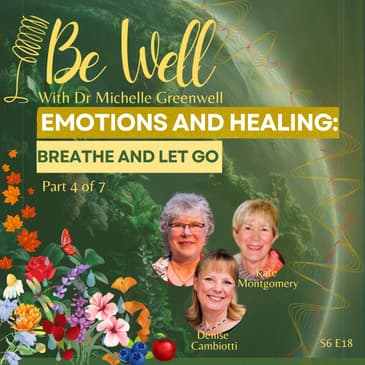
In Episode 4 of Emotions & Healing, Dr. Michelle Greenwell welcomes Kate Montgomery, HHP, ND, and Denise Cambiotti, HCD, CIH BioEW, as they explore the Metal Element through the wisdom of the Five Element Theory, Touch for Health, and the BioEnergetic Wellness Formula.
The Lung and Large Intestine meridians teach us the importance of breathing deeply, processing grief, establishing healthy boundaries, and letting go of what no longer supports our wellbeing. When the Metal Element is balanced, we experience clarity, inspiration, and the ability to move forward with greater ease. When it is challenged, we may hold onto sadness, regret, guilt, or find ourselves resisting the changes life is asking us to embrace.
Together we explore:
🌬️ The Metal Element and emotional resilience
🌿 The Lung and Large Intestine meridians
💛 The relationship between breath, grief, and emotional healing
🍂 Healthy boundaries and the art of letting go
✨ How posture, movement, and muscle balance influence emotional wellbeing
🌱 Practical Touch for Health techniques that support emotional release and renewed vitality
Tea with Intentions
Today's featured blend from the Cape Breton Tea Company is Thyme Passages, thoughtfully chosen to support the Metal Element and the journey of releasing what no longer serves us.
Featured herbs include:
🌿 Thyme – encouraging courage, clarity, purification, and trust in new beginnings.
🌿 Lemon Peel – bringing brightness, optimism, and the gentle reminder that every ending creates space for something new.
🌿 Peppermint – inviting emotional freshness, calm breathing, and renewed perspective.
Affirmation:
"With every breath, I release what no longer serves me and welcome new possibilities with an open heart."
Prepare your favourite cup of tea, take a slow, intentional breath, and join us as we discover how the wisdom of the Metal Element can help us move through grief, embrace change, and find freedom in letting go.
Continue Your Wellness Journey
🌿 Experience the Artfilled Wellness Retreat, where movement, creativity, music, nature, and BioEnergetic Wellness come together in a restorative weekend of self-discovery.
🌿 Learn Touch for Health Level 1 and discover practical muscle monitoring and meridian balancing techniques that you can use for yourself, your family, or your professional practice.
🌿 Explore the Movement Mastery Program under the Wellness Training tab at GreenwellCenter.com and learn how organized movement can support posture, emotional resilience, and lifelong wellbeing.
If this episode inspired you:
👍 Like this video
💬 Share your reflections in the comments
🔔 Subscribe for future episodes in the **Emotions & Healing** series
📤 Share this conversation with someone who is learning to breathe deeply, let go, and embrace life's next chapter.
Healing begins with awareness.
Awareness inspires intention.
Intention leads to action.
Action practiced consistently becomes resilience, balance, and a lifetime of living well.
#EmotionsAndHealing #MetalElement #FiveElementTheory #LungMeridian #LargeIntestineMeridian #TouchForHealth #BioEnergeticWellness #Breathwork #GriefHealing #LettingGo #HealthyBoundaries #TeaWithIntentions #ThymePassages #HolisticHealth #MovementMasteryProgram #ArtfilledWellnessRetreat #DrMichelleGreenwell #KateMontgomery #DeniseCambiotti
Each episode of the Be Well with Dr. Michelle Greenwell podcast includes the BioEnergetic Wellness Formula. That means that you have the opportunity to have a healing session while you listen based on the way the content is laid out and the activities we participate in. Before listening you can create a goal or an intention of where you would like to be heading with an activity or in your life, then make your cup of tea, engage in the activities and celebrate at the end.
Are you looking for more resources? The best way to find all the resources in one location is by visiting https://linktr.ee/greenwellcenter. Become a regular listener of the podcast and purchase your own tea blends to assist you in transformation while you listen. Our podcast is designed to bring balance and flow to your day, week, month, and year. Thanks for sharing us with others who could also benefit. Please send us your feedback and a review.
Dr. Michelle Greenwell, BA Psych, MSc CAM, Ph. D CIH (Complementary and Integrative Health). Striving to support the public to choose self-care and well-being options that create ease and flow in their lives, Michelle specializes in using movement to heal the body. Her BioEnergetic Formula for Success provides a means for everyone to set their intentions and create support and action for flow and ease to the goals. Learn more at www.greenwellcenter.com. Follow her YouTube channel and specialty playlists. Find her full resource list here. She highlights her Tea Company: The Cape Breton Tea Company which you can find at www.capebretontea.ca. Included is the specialty line of Tea with Intention, Harmony Blends and Coaster, and the focus on high quality organic black, green, herbal, rooibos, and honeybush tea. Including tea with your podcast listening is a unique way to explore tea, create healthy habits, and have great conversations with friends and colleagues.
[00:00:06] Hi, this is the Be Well with Dr. Michelle Greenwell podcast. Our heartwarming conversation is designed to lift you on your wellness journey. Grab your cup of tea and enjoy the podcast.
[00:00:26] Welcome everyone to another podcast, Be Well with Dr. Michelle Greenwell, and I'm thrilled to be diving into the next part of Emotions and Healing. This one we're looking at the metal element, and this has to do with the breath, boundaries, and then the power of releasing. None of us have any capacity to, you know, hold on too tight.
[00:00:50] So we're going to be looking at the lung, the large intestine, and the emotions of grief, guilt, and regret today. And to do that, I have two beautiful people to join me. Kate, welcome back. And Denise, welcome back. This series has been so much fun to bring forward and we're excited to dive into this topic today. But let me give you just a little bit of background before we get started.
[00:01:17] We're looking at emotions and healing. So how do the five elements from Chinese medicine give us information about the emotions and about the way to bring balance and harmony to the systems? So far in the previous episodes, because this is episode four, we looked at governing and central system. This helped with Koen-Shen cycles. We looked at the eyes and the brain. We looked at the ears, central nervous system, and the spine.
[00:01:45] And then we moved to the fire element. We looked at joy, love, passion, and the ability to discern and making choices. Then we go to the earth element. This is where stomach and spleen is. We've looked at digestion, empathy, immunity, and emotional nourishment. So today, the metal element. Here we're looking at breathing fully, defining our boundaries, and the opportunity to let go.
[00:02:15] The metal is going to ask us some powerful questions. What are you holding on to that no longer serves you? What needs to be released? Could it be emotionally, mentally, physically, spiritually? And how do I make space for something new? This episode will explore grief, guilt, and regret. So you can think about some of those monkey thoughts that come up repeatedly around those ideas.
[00:02:43] And then maybe we've got some great ideas that will help you to find the way to release those. I'm going to give you a little bio because this is going to be important today because Kate's all excited because she was trained first as a respiratory therapist. There we go. That was the word I was looking for. And so that was her first profession before she started to dive into the holistic health practitioner,
[00:03:11] being a certified massage therapist, sports focused, a naturopathic doctor, as well as a bioenergetic wellness professional, and an author. And so with this background, her respiratory therapy is going to provide us with some of the experience she had from that medical model perspective, as well as what she learned as she moved into the energy work.
[00:03:32] And so her ability to work with the elite athletes and performers, as well as professionals and people just in everyday lives, Kate Bridges Western Science with bioenergetic wellness. And this is going to help us with emotional resiliency, breathing efficiently, nervous system regulation and performance under pressure. So from Kate's expertise, we move over to Denise's.
[00:04:01] And Denise brings us her bioenergetic wellness educator component, what she's put into her programming at Muscle Tuners International to really highlight some of the key ways to make it really easy to transform rather than that hard manual work of the massage or physiotherapy, being able to actually make it really easy to be able to be able to be able to be able to make some really quick changes, but long lasting.
[00:04:26] She specializes in the touch for health materials, working with the five element theory, muscle monitoring, meridian balancing, using neuro lymphatic techniques. She has some amazing protocols she's built to speed through some of the slower protocols. And this gives her something very special at Muscle Tuners.
[00:04:47] She collaborates with physiotherapists, with massage therapists, having trouble with those THs today and movement professionals. She helps her clients understand how emotional stress, posture and breathing patterns do influence healing, mobility and long term well being. Okay, so with that in mind, we have our opportunity now to dive into the discussion.
[00:05:14] We want to set you up for a healing session while you listen. So whatever you have in your cup today, whether it's a water bottle, and you can put some intention into your water, you might have a cup of coffee, which we can infuse, and then you may have tea with different kinds of herbs. But I'm going to ask Kate, what did you pack into your mug today? Well, today, it's always ginger, because the weather is not so great here.
[00:05:43] I have to add ginger to everything. But I did lavender and chamomile for calming the nervous system. So that's also one of my favorites. And so I thought today was apropos for talking about grief and things. And so that helps bring us down and calms the nervous system. So that's what I did today. Perfect. Beautiful.
[00:06:12] And you're pulling those herbs out of your garden, right? Yes, I am. The lavender buds came from my garden also. The chamomile did not, but the lavender did. And neither did the ginger. But they're all organic. I buy from a good, reputable place. And but the buds did come from my bushes. Awesome. I just love that about that you've got them surrounding you. So that's great. Perfect. I'm just bringing in a little bit of nature.
[00:06:41] So while you're listening to us and what we're talking about, nature is so important. And when we bring it in and we add it to the mug, we add it to our meals. It is so beautiful to think where does all of these ingredients come from? And how are they? How are they getting us closer to nature while we're on the inside of our buildings and dealing with the weather on the outside? Denise, what did you put into your mug today?
[00:07:07] Well, did you see me grinning when Kate's reading off ginger, lavender, chamomile? Oh, no. We're on the same wavelength. On the same page here. I have it in a base of rooibos. Beautiful. Beautiful. Awesome. Okay. Well, then I might have to read all the ingredients then on the time passages package because we may have some overlaps.
[00:07:38] So I better do that. So from the Cape Breton Tea Company, I'm honoring today time passages, which is the tea for the metal element that we keep in the company. And so it's got time, eucalyptus, fennel, holy basil, cloves, cardamom, black pepper, guland flour, alfalfa, alacampain, licorice root, ginger, and cassia. So we have one ingredient that's going to be the same. All right.
[00:08:07] Let me highlight two ingredients. So what I like to bring forward is the opportunity for you to get to know the herbs a little bit more, but they come along for the conversation. So they're going to be supporting you. So you've got the ginger, you've got the lavender, the chamomile, and I'm going to highlight alfalfa.
[00:08:27] Alfalfa is for renewal and nourishment, helps support resiliency, rebuilding after loss, and gentle strengthening of the system when you have emotional depletion. And this is where metal element, if you don't have the energy coming up for you, it can really struggle. So alfalfa can be very supportive for that. Then if we look at alacampain, we have the breath and belonging.
[00:08:54] Alacampain has been long associated with lung health and emotional grounding, helping us to feel safe, safe enough to exhale fully and let go. So you know the theme we're heading down. Together, these herbs combined within the package the way they are, they invite an expansion and then a contraction, space that we need after grief. So the ability to expand and then bring that back in and then expand again.
[00:09:23] And sometimes people don't realize that's the mechanism that's happening, but that's how you're going to build energy. Okay. While we're sipping, here's the affirmation. I create an expansion of breath to clear my mind and envision new possibilities. And if it's letting go, when you're letting go, you might have that picture of the letting go part. But on the other side of that, what do you want to receive?
[00:09:48] And you might not know, you've been holding on so tight to the letting go part, it might not be evident. But as you're letting go and creating that picture, you might all of a sudden have new pictures come in. And that picture then might be a little bit clearer. So with that, cheers and ladies, thank you so much for joining me again. I love this series. This is great. We're also getting really fine tuned to our brains together.
[00:10:17] Thinking a light bulb by the T. No, I love it. Okay. All right, so where we want to head now, is we want to dive into a little bit of the background so you understand where some of the conversation is going to come from in the background that we have. So I'm just going to give you a little educational piece. So in Chinese medicine, we have different elements.
[00:10:45] And I know Denise is going to talk more to that when I ask her the first question. But the mental element helps us with autumn. So the season of autumn. Refinement, boundaries, discernment, and letting go. We know the lungs help us with breathing. But they're also part of rhythm and immunity.
[00:11:06] And it's our relationship to the inspiration that allows us to have a literal inspiration of breathing in and creating that rhythm. But also a symbolic one. And the rhythm of life and the flow through the seasons. Those kinds of things. The large intestine helps us with elimination. And it's the last part of elimination. So this is where we really get some of the nutrients that have kind of come through the system.
[00:11:35] But they still are able to come into us. So what we release, what we retain, how cleanly can we let go becomes really important. I want to bring in a couple of muscles because this is also really interesting. We have these two muscles working in the same element. And the lung has to do with anterior serratus. So all the muscles that go around the ribs that help you with breathing.
[00:12:03] And it allows the opportunity for you to lift your arms to come up over your head, put things up onto a shelf, pull things down, or to offer things over. Badminton or tennis where you're going to do something over with your hand. Anterior serratus is a part of that action. And combined with that is the deltoids. So I'm pointing at my shoulders. Sorry, deltoids slightly below that. But the arms are going to be able to pull up at the side.
[00:12:32] So for those people that are listening on the podcast, I was taking my hands up over the head for anterior serratus. And now what I'm doing is lifting my elbows up at the side so I can feel where those deltoids are going to engage. That all gives an expansion and a contraction for breathing. The large intestine goes to the lower part of the body. So we have quadratus lumborum, which is a muscle that is attached at the lower part of the spine.
[00:13:00] And it goes out kind of in a triangular shape, but then it goes around the crest of the pelvis of the bone. And so that little piece is responsible for how we twist and turn and bend down to pick things up or turn and go to reach for something. We're using that muscle all the time. It is linked up to our hamstrings as well as fascia latae, which runs down the side of the leg.
[00:13:26] Hamstrings on the back side, we know that one from stretching down to touch our toes. The hamstring allows us to do a lot of different movements. And when you combine it with fascia latae on the side of the leg, we have rotation that happens to give a conversation that goes back and forth. And then we have those muscles talking, the lower legs are talking to the upper body.
[00:13:49] So if you are playing tennis or badminton, if you are doing activities in the garden, you're constantly going back and forth between these muscles and you're creating this expansion contraction with them as well. I wanted to give you that idea because in Tai Chi, we really explore through the spiral action, these muscles in almost every movement that we do. And it is such an incredible way for us to deepen our breath.
[00:14:19] And it's a way to harmonize physically. So I wanted to give you that picture because we're going to talk about emotions and then you can see how physical might link up with emotions. Okay, let's dive in. So Denise, can you help us understand a little bit more about how the metal element fits into the five element wheel? And then how do these emotions come out of there? Ah, fabulous subject.
[00:14:48] So I'm going to just share for those of you who are listening, I'm showing a diagram. If I can find the right button. I'm showing a diagram that shows the five elements of Chinese theory, beginning with fire at the top and the energy of fire moving clockwise through the five elements brings us to earth. So we've already spoken of those two elements in previous podcasts.
[00:15:17] And now we're on metal and how the earth gives up its under pressure and as trees create earth, eventually we find metals come out of the earth. And this element is very interesting in that it is a pair of meridians of the lung and the large intestine,
[00:15:40] which if they're out of balance, if any one of those is out of balance, it will be affecting its related meridian partner in that element. And so then as we continue in our podcast, we're going to talk about water and wood.
[00:15:58] But one of the things is because we're talking about emotions in relation to all this and this series of podcasts is I'm really fascinated with the idea of the control cycle. So in addition to energies, well, let me move my hand this way for the viewers. In addition to energies flowing clockwise, they also skip an element and control the next element.
[00:16:28] And so with metal and emotions, if metal is not in balance, it is not able to control well the emotions of wood element.
[00:16:44] And almost everybody I know who knows hardly anything about emotions and elements knows that wood connects to anger, rage, frustration, resentment. So this is the importance of having a balanced metal element. It helps us with those really uncomfortable everyday human emotions as well.
[00:17:13] So that's a little bit about that and how that fits in the scheme of the five elements. And one of my personal favorites is I find a lot of people with an imbalanced metal element. Almost every North American has got some kind of a gut issue. So it could be large intestine.
[00:17:36] Also in fire, we have small intestine, but most North Americans definitely have a large intestine thing going on. And the lungs and emotions of the lungs. So the metal element has the guilt, grief, regret that you mentioned. But also those individual, the meridians in there, also have emotions like smothered. Think about that.
[00:18:04] The lung feeling smothered. It is definitely something that we can go, oh, I could see the obvious connection there. And the thing is, is when you move out of guilt, grief, and regret, those types of feelings, you're moving into cheerful. You're moving into powerful. You're moving into tolerance.
[00:18:29] And tolerance is my, besides the guilt, grief thing that most people have, a little bit of it stuck in their bodies. Tolerance is an idea that most people pay no attention to. But think about it. If you can't tolerate dust, you've got asthma, can't tolerate pollen, asthma. You can't tolerate certain foods.
[00:18:58] You'll have intestinal colic or spasms or cramps or diarrhea or constipation, all these things. It comes down to tolerance. Can your body tolerate a little bit or a lot of something? But emotionally, think about tolerance emotionally. And something that, you know, as humans, never mind the political situation, wherever it's going on,
[00:19:26] it's about everybody has a different point of view in our families, in our communities, in our provinces, our cities, our states, our countries. Tolerance is important. Because without tolerance, there you go again, it flips into anger, rage, frustration. So it's a nice little package to think about.
[00:19:54] And I just wanted to toss that extra emotion out at people because it's often unrecognized and yet it is so important. Thank you for the way that you brought that together, Denise. Because I haven't ever actually looked across to what happens to the wood element. And I'm thinking about how the fire element of passion and love and joy can feed over to the metal element.
[00:20:23] But if it's out of balance, it'll just fizzle. And so you can have all the passion you want and then that regret comes in and passion is gone. And then, you know, you wonder why in your day or in your life, you just don't have that fire that you used to have. And you might think it's part of fire element, but it's this relationship it has with metal element. That's beautiful. Thank you for that picture.
[00:20:53] Absolutely. Great. Great. That's why I love geeking out with you ladies. And we think, you know, we've played with these materials for decades and we know a lot about them. But how lovely when we, you know, the pieces that we've played with isn't always the same as the pieces other people have played with. So it's so lovely to see how we can all bring it together. Okay, so I'm going to move to you, Kate.
[00:21:19] And what I wanted to talk about, because I know we've focused on sports and musicians, which are some of the elite people that you've worked with. But for those people who have everyday jobs and sometimes very repetitive actions that they do in their jobs or mental processing that they do.
[00:21:39] In what way, based on this metal element, do you find people coping, trying to cope and struggle in those environments with a view through the metal element? Can you share some of that? Well, you know, we're talking about the lungs.
[00:22:06] Since I did this for 14 years, it's sort of ingrained in me. But one of the things, if we look at the physical side, when you go to work, maybe you don't like your job, you know. And so what do you do? You might struggle to breathe. You might struggle to hold your breath or not breathe deeply.
[00:22:28] And so that's one of the things that I used to see in my practice is that one of the first things I would check was I would ask that person to take a deep breath. Where's the breath coming from? And in most people, stress, you know, I'd ask their stress level if their stress level is like a 10. Well, okay, where's the diaphragm? Where's the lungs? And so most of the time, they couldn't breathe deep. They didn't even know the diaphragm existed, let alone.
[00:22:58] And so trying to teach somebody how to breathe again was really interesting. They're all stuck up here in the upper body. And so if they go to take a breath, you see all these muscles of the pecs and the neck muscles extend when they try to take it from the upper part.
[00:23:20] There is no smooth rhythm from the belly up through the chest, feeling the shoulders rise and the neck muscles extend. You don't see that. And sometimes you will see what I call the roller coaster breath is that it would start here but jump and it would just do one of these. And it never was smooth or rhythmic. Stress, along with every emotion that has been mentioned, is the key.
[00:23:51] Because stress separates everything from us that creates an emotion. And if I'm really stressed out, I don't take a deep breath. I don't breathe. So I used to see that. That's one of the big things. When I left respiratory and then went into massage therapy, I saw it all the time.
[00:24:19] That's all I saw was my lung thing because people didn't know how to breathe. In the 80s, meditation was coming around and people, but really wasn't there yet. And so people didn't understand deep diaphragmatic breathing, even belly breathing. I've been in meditation classes today and nobody knows how to breathe correctly.
[00:24:43] That's still one of the things I see that they don't, they're there, they're calm, they're taking a breath, but they're not really doing that full deep breath. And back then, they didn't breathe at all. So, and then you have an athlete or the musician and they have to use their lungs efficiently in order to propel them into a winning race or to create a musical note.
[00:25:11] A horn player, a saxophone player, a flute player has to be able to breathe deeply. And those are the ones you see because if they're trained correctly, are breathing with their diaphragm. But the other side of that coin is the diaphragm gets tired. It's a muscle just like anything else. And so I always taught to rub the neurolymphatic reflex point for the diaphragm, which is on the sternum,
[00:25:41] and relax it as you try to breathe the note. And I found that with my horn players, especially, the wind instruments, that when they would do some of the work that I had talked about, then they would breathe and rub, breathe, rub, and they could feel the difference. Even some of my singers were that way too. They could feel them.
[00:26:09] But I wanted to say something about large intestine too, because with that, the diaphragm separates the upper cavity to the lower cavity. One of the things is when you eat, this is one of the things too, or you take a breath, is that the esophagus runs down through the diaphragm all the way to the stomach and then out to the intestines.
[00:26:36] So if your diaphragm is not being used right and it's really tight, it blocks that diet, that food tube. And that's when you get an indigestion. You get a cramp in the side. And this is what my athletes, is if they weren't breathing correctly, the biggest complaint was a cramp, was a stitch in their side. How do we relieve this?
[00:27:02] And one of my triathletes, he said every time he got on the bike, he had a stitch in his side. Well, we taught him how to breathe. We released the diaphragm. And then a whole trip, he's doing this. He's rubbing up and down on his sternum. Yes. To make sure that he didn't get a stitch in his side. And then he could reach back here and underneath his rib cage, he'd push on the diaphragm, pull it down and rub. And those are the things that you also want to look at.
[00:27:31] The diaphragm is also responsible for your metabolic well-being. So you also have to know that it's pushing oxygen throughout your body, into the heart, into your blood vessels, through the rest of the organs. And if you're not breathing and standing up correctly and have good posture, then blood flow oxygenation isn't as efficient as it could be.
[00:27:59] Not only is it a stress buster, but it's your lifeline. Breathing is your lifeline. And so I can't say that enough about good posture. Because the quadratus lumborum, it is also not only is it a low back muscle, it's part of your core. But it's also a hip hiker.
[00:28:27] It's a long leg, short leg issue. And when I used to work with everybody, I always found that. And I always found the quadratus lumborum out of sync. Never right. And that's going to go with your lungs again. So is that person breathing? Is there paradoxical breathing? No. So you look at muscles in conjoined, like your metal meridian.
[00:28:55] These two have such a huge connection of moving nutrients throughout the system. Because you don't breathe, you don't get nutrients. When you don't stand up straight, you will totally bend over because your back hurts you. You can't breathe if you're crunching the diaphragm. So you have to really look at all this from the physical standpoint, not only as the emotional standpoint.
[00:29:23] But if I don't breathe, I'm more stressed out. I have more emotions of guilt if something or grief or anything else. And if I lose somebody who I love dearly, which I have, you know, it's really hard to take that deep breath. And we tend to... As we try to hold. And letting go is hard. It's really hard.
[00:29:52] But you have to sit down, take a deep breath, put your hands on your lower abdomen, and feel your belly go out, rise up through the chest, up through the shoulders, and get that full fullness. So what are the other things you have to understand about your lungs? Well, how big are they? Do you really know how big your lungs are?
[00:30:17] So if here's my bottom of my rib cage and here's the top of my shoulders, that's how much space they take up. They take up that much space. And so if I don't feel that breath come from my belly all the way up through the chest cavity and feel my shoulders rise and my neck muscles extend, I'm not taking a full deep breath. I'm not taking a full deep breath.
[00:30:42] So in weather like we have today, and through the last two years of very cold weather, it's real easy to get sick and not get pneumonia or have a cold or even asthma or anything else. COPD, a chronic obstructive pulmonary disease, relevant to the function of the lungs.
[00:31:07] So wherever you live, the contaminants, the air quality, whatever can affect you. And that changes how all of the internal workings of the body work. So there's a whole lot here, not just to emotions, but letting go of everything and just go and breathe, digest, get your nutrients, and live moment to moment. Take each day.
[00:31:38] You can't go backwards, but move that day, just that day. Tomorrow comes, then you start again. Just breathe. Take a full deep breath. So with that, I'm just going to draw attention to what you said about rubbing on the sternum.
[00:32:01] So for those people listening, as we've gone through the different podcast episodes, we have different tips and tools that will pop out. So I just wanted to bring that back because for people with allergies and asthma, it can be great to rub there. So we have other tools, too. But for yourself, you'll be able to really make a difference by rubbing on there. I wanted to draw attention to that.
[00:32:26] And the other would be, and I love to do this for getting a deep breath in so you can imagine then, as you were talking about, Kate, the lungs are large, but how big a capacity can our breath be? So I would invite you, as you're listening, as long as you're not driving, to take a breath in. Notice where your breath is at at the moment. And it might be deeper because even when Kate took that nice deep breath, we all kind of matched her. There's that rhythmic part.
[00:32:55] However, you know what the breath feels like. So now I'm going to invite you to tap from your shoulder. With firm pressure, you're just going to tap all the way down the arm with your hand until you get to the palm of your other hand. And we're going to do that three times. We're going to just travel down and then do it on the other side. And that's following the line for the lung meridian.
[00:33:26] So what I'd like you to do now is take your breath in again and see if the breath has changed. It's not in your head. Where did it change for you, Kate? Just feel it from lung one, which is in the corner of my shoulder right here off the chest all the way down. I feel it in my thumb because that's where it's coming down to.
[00:33:52] And then it's also connecting up with large intestine four, which is in the crease of the thumb. So those two go together. And so that's where I felt it right through there. Right down your arm. So as people are listening, she felt it beyond the capacity of her lungs. She felt the energy line of that and how it went into the tissue. So there's a change there. Denise, what did you notice?
[00:34:19] I noticed that my right rib cage was moving more. I thought it was okay at the start. But after the tapping, your advice to tune in and going, oh, there has been a change. And it's not all that subtle. Perfect. So when you were tapping on that, we have that opportunity to open the little hairs that are inside the lungs.
[00:34:49] We're going to have more oxygen coming in. But what I noticed for me, my background coming from being an asthmatic, no longer being there. But I remember trying to breathe in and it would be like I would run out of lungs. There could be so much more air that could come in, but there was no more capacity. My breath was so small. And now it's when it opens up like that, it's like I could keep breathing. It's like, oh, I could take more air in. It seems like that's the end of the breath.
[00:35:18] But there's still space. So if you've noticed a difference, you can keep that in mind. So now you know you could rub on the sternum as one option. And you can tap down from the shoulder to the palms down the energy line for lung. And that's going to give you an opportunity to make a difference right where you are.
[00:35:37] And as Kate said, in the middle of playing an instrument, business meeting where you're having trouble speaking and the air is getting smaller because of what you've got a voice, being able to rub onto the sternum can make a difference on how you're going to be able to expand that breathing back out and then be able to take in what you need to share what you want to share. Okay. So thanks for that segue, Kate. That's beautiful.
[00:36:08] So, Denise, let's move over to where we want to go next, which is the muscles and the breathing patterns. What have you observed about people that come to you to get a balance and they've got their shallow breathing going on? And after you've had a chance to bring some of the different systems into balance through that five element theory, what have you noticed for people? Okay.
[00:36:36] Lots of people cannot breathe correctly. First observation. The work that we do when we're activating acupressure points, when we're activating reflexes, you bring so much more power. And it just works quicker and better. If people can breathe while you activate whatever reflex it is, whatever acupoint it is.
[00:37:02] And when I invite people to breathe deeply and I see what Kate's talking about, it's all up here and it's tiny and it's just like, no, no, no. Okay. That was good practice. Now take a real breath. And they don't know how. And so I'll coach them to do it. But the thing is that reminds me when I was a child and I've spoken of before, my mother would say, stop slouching, sit up straight. And as long as you pay attention to it, yeah, okay, I'm sitting up straight.
[00:37:31] As soon as mom's looking away and I'm distracted, I'm back to slouching again. Because the muscles in my body were not supporting posture. It's the same thing with breathing. So the muscles that wrap around the rib cage, the anterior serratus, they can either, in a lot of muscle testing modalities, they're looking for muscles that are not functioning because they've gotten tired.
[00:38:00] They're not working well anymore. So if we were to do a muscle test, they would be found in a state called unlocked. As an observer, you go, wow, that muscle looks and feels weak. And it's not about that. It's just that the neurology is not talking to those muscles.
[00:38:20] So the thing is that muscle tuners, we're really keen on identifying when muscles are working too hard and they're really like holding their breath. Literally, it doesn't have to be a diaphragm or the lungs. But individual muscles can be basically holding their breath so that they can function. It brings, okay, I can do it, kind of an attitude.
[00:38:44] So when the diaphragm and the anterior serratus are either unlocked or locked or one is in one state, the other is in the other state, you're never going to be able to breathe properly unless you really focus on it consciously. But you cannot do all day, all night, 24-7.
[00:39:06] So what I find often is the diaphragm is often unrecognized. It is often ignored, is often not looked at, even with people that have had our kind of training. It's just we learned it like in the third level and we forget about it. However, it's so primary.
[00:39:36] And I had a friend once we were supposed to go out for a walk and she started listing pretty much every symptom for heart attack that a woman can have. Now, have I told this story yet about taking my friend to the emergency room? Was that on this podcast? No. Well, I'm going, girlfriend, we're not going on a walk. I'm not letting you go home and stay awake all night, worried that if you fall asleep, you won't wake up. And I took her to the ER. And so they did all the tests that kept her overnight. The next day they did the stress test.
[00:40:05] Everything is okay. And I'm going, good. So I'm driving her home because I'd driven her to the hospital. So I have an obligation to go pick her up. And I say, please lie down on the floor. And I released her diaphragm. And she's going, why did she do that last night? I said, well, I didn't know if you were actually showing heart attack symptoms.
[00:40:33] Like, you know, red flags here. Go get it looked at. And I knew you would never take yourself down there. So it turned out her diaphragm was spasmed. And so this leads into another story. Well, not really a story, but a perspective. I also see a lot of people come in with anxiety. It's rampant in the world today.
[00:41:02] Well, what happens if your diaphragm is basically spasmed up? It's putting pressure on your lungs and your heart. And you're getting the sensation that you're in trouble. And it has nothing to do with the heart. It's just the heart's reacting to the pressure from the diaphragm. So we need to take attention to getting the diaphragm balanced. If you have those kind of symptoms.
[00:41:32] And yes, maybe it's anxiety. And the other cool thing is the diaphragm fibers near the spine here tangle up and mix with the fibers of another muscle that is related to the meridian that controls fear, anxiety, dread, terror. Okay? So the diaphragm being freaked out can also be affecting another muscle.
[00:41:57] And sorry, the medical doctors have no understanding how interconnected we are. They absolutely don't. And when you can release the diaphragm and release this feeling of, I think I'm having a heart attack or I'm anxious, it's life-changing. Also, I've heard from a colleague in this field that he took training with somebody pretty amazing
[00:42:25] who said, if you can get the diaphragm balanced, you'll probably clear up 98% of any other muscular imbalance. Wow. So we can assess a whole bunch of things if we find the diaphragm out of balance without going into any of the theory that we've learned about, okay, this connects to that, this controls that, and this sends energy here. Just balance the diaphragm.
[00:42:53] And you'll usually find out that you've fixed a whole bunch of stuff. I want to give a public service announcement. If you find somebody on the ground unresponsive, you're supposed to rub the sternum firmly. So when I see this on TV where the doctor shows and they find somebody and they're going like this, that doesn't do nothing. That's a little mosquito.
[00:43:22] If somebody's unresponsive and you rub them on the sternum, they'll take a breath. Kate's nodding her head. A public service announcement and a really weird fact nobody knows about me. Well, some people know I had a catastrophic accident and I didn't realize I had gone unconscious for maybe seconds. I don't know. But when I came to, I could not breathe. And I've knocked the breath out of myself before. And I go, okay, just relax.
[00:43:52] The breath will come. Just relax. Oh, dear. This is not good. Come on. Relax. Come on. You're not breathing. You're still not breathing. You're still not breathing. I'm in trouble here. Like this, I'm still not breathing. And from somewhere, this arm that was laying over here came, slapped on my chest and did this.
[00:44:15] And I went, so train, like lifeguard training, any kind of training, first responder training. You do the training so that you, it's ingrained in you that you can respond. So that's a public service announcement. Please take it to hurt. You never know when that might show up for you in your life. And, yeah, okay.
[00:44:38] Now I want to talk about large intestine muscles, specifically the fasciolata. It's a muscle that's not even as big as my hand sits here on the hip. It's connected to the large intestine. And I teach my students, I says, oh, the fasciolata. Hmm. I like to call it the fasciolata because it's on the large intestine.
[00:45:07] So, you know, you got to make teaching a little bit fun once in a while. And then it goes, oh, I don't remember. So it's the large intestine related muscle. And it's not even this big. And it attaches to the iliotibial band that goes all the way down the side of your leg, down past your knee. And how many people are doing that foam rolling and the release, and they got the tools and the scrapers to get the tension out of that? Well, it's a tendon.
[00:45:35] And if the muscle's not happy, the tendon can respond. And so if you've got side of the leg pain, it might be an iliotibial band that's not happy because the fasciolata is not happy. And that's why I just love thinking about the body, not just in parts, but how it relates to everything around it.
[00:46:00] And so when you work with the diaphragm and the lungs and the lungs come on board, the large intestine sometimes doesn't have to act so strong. And I have to do everything. And it can relax. So that relationship too. When you're working with elements, what you do to support one half of the element allows the other half to come along too. It's very much like a marital relationship.
[00:46:30] You know, the neighbors know if the husband's yelling at the wife and the wife isn't showing up in the community and just showing up and shining at her best. Yeah. So when somebody brings casserole over and helps the wife and says, oh, you want to talk about it? She gets to release some of that, you know, stress. Then there becomes more harmony in the home. So there is that whole interesting approach from the Chinese five elements that are coming into these conversations
[00:47:00] that I don't normally have with any of my clients, but it is underpinning everything. So what I see often, people aren't breathing right. We've got to work with their diaphragm. A lot of people have anxiety. They have a lot of grief. They have a lot of regret. And when you work and release the muscles, when the muscles work better, the organs work better, and the emotional system becomes stabilized.
[00:47:30] And the next thing is I work on athletes. And another thing, Kate, you know about origin insertion technique. I've done Touch for Health for years. It wasn't until I ran into somebody where I went, wow, your diaphragm's really not happy, that I attempted to do origin insertion release on the diaphragm. And since then, I have found athletes, like, you know, if you've ever had a fall or something happens and you go,
[00:48:02] your fibers can get, like, hard. So there is a technique. And it's, we can't really reach the diaphragm because it's deep down, but there are triggers that attempting and thinking and having the intention to release that has been life-changing. So I've shown it to some athletes, and I'll tell you, if your diaphragm's spasmed, it's not comfortable. So I don't like to trigger discomfort in the work I do.
[00:48:29] I think it's contraindicated for having the nervous system rest and work with you because if all of a sudden you go, what are you doing? You're kind of fighting the nervous system. But in that case, for sometimes, if you have a tendency to that, I said, go find a body worker who can help you release your diaphragm. Wow. Okay. Sorry, I could lecture for a couple hours. I know.
[00:49:00] It's just, it's so lovely. But to think, you know, such a high percentage in the diaphragm. And it's what connects the top half of the body to the bottom half of the body. And when you were talking about the T-band and trying to roll the tendon, when the tendon is what has the frequency of the emotions in it,
[00:49:28] you didn't change the emotions. They're not going to let go because the body's going to protect itself. So you've got a lot of work that you're putting into tissue that doesn't want to change. And there's that letting go piece is really being able to come back to that. So, Kate, I know you're chomping. Well, I want to say something. Because if you go to anatomy physiology books, like the Grey's Anatomy, if you look, I took a picture.
[00:49:56] And if you really look at the diaphragm, look and see who it's connected to. It's connected to the psoas and the quadratus lumborum. So those are three core muscles. If your core muscles aren't working, those, you know, you have to think. What do the psoas and the quadratus do? Psoas is a hip flexor. Then you've got a hip hiker. And then you have the diaphragm who's pulling them along.
[00:50:22] But this is where you see if your diaphragm's not working, well, neither is your psoas or your quadratus. So that's kidney, large intestine, and lung. And so you have to look at, how's my core? Well, I would go through and start testing all of these core muscles first. And then you get to see.
[00:50:46] One thing I want to add to what Denise said is that in shock and traumas, like a car accident, and I had one, I remember laying in the ambulance, doing this, rubbing everything I could to get myself so I could function. And I remember just rubbing, rubbing, rubbing until I got to the ER.
[00:51:14] And then they said, well, there's nothing wrong with you. Well, let me tell you, I'm going into shock because I knew what was happening with my blood pressure, and I knew how I felt. And they didn't think anything was wrong with me, so they discharged me. I called my acupuncturist, my chiropractor, I called my massage therapist. They all came to the house, and they treated me right then and there so that I could get out of this thing as fast as possible.
[00:51:44] Because if you sit and wait, that's one of the things that you want to say to people, too, is if you're in a shock and trauma situation, which immediately the very first muscle that goes is your diaphragm. You hold your breath. What I used to do is I would stand there with my client, and I would go, boom, like this on their shoulder. And they'd go like this. What happened? They just stopped breathing. They just locked up their diaphragm.
[00:52:15] So anything, like if you fall or you're in a bicycle accident or car accident or anything, the very first muscle goes is the diaphragm. You got to get it turned right back on because it moves everything in the body. That's the big thing to really take away is understand what how important this muscle is,
[00:52:43] because it's like Denise said, it's rarely thought of. And it's true in all the classes that I've ever taught. It's like, well, we're going to start with breathing. And they look at me like, oh, OK. And none of them could breathe, you know. And that's that was always the most interesting thing. And then once you got that going, if I could get somebody to breathe and then I would muscle test again, they all came back on.
[00:53:11] All the muscles came back online really fast. So it's a combination of things. But you have to get that muscle going for light. It's a lifesaver. Just like Denise said, it's a lifesaver. Mm hmm. OK, so as everybody's listening now and they're going, what do I do? What do I do to get it to turn back on? So rubbing up and down on the sternum.
[00:53:34] I was just like, I just want to make sure people have that in their mind so that they realize you want to rub up and down on that sternum and get them going. Which is why when you got to the ER, you looked like you were fine. Right. Because you had already bypassed the place that they normally see people. And remember what you said, if somebody's just doing this, like Denise said, they're just doing like little scratchy. No. When you rub neurolymphatic reflex points, you rub firmly. You rub deeply and firmly.
[00:54:04] Not so that you bruise yourself, but you rub firmly. You're doing a deep lymphatic massage, not a little injury type thing. When you get an injury, you do light stuff like this. But no, you get in and you rub because that's what's going to make a difference. Mm-hmm. Beautiful. I would also like to add that on either side of the sternum between the ribs. Right. Just, you don't have to be precise.
[00:54:31] Just get between each of the ribs on the muscle and you get in there and you activate that for a minimum of 20 seconds each. I prefer 30 seconds, which seems like a really, really long time. When you activate those, you are just sending some love to your lungs. Oh. And it will hurt to keep breathing while you do it.
[00:54:56] But also know that when you're rubbing these points, which is right in the intercostal muscles, that's going to connect the diaphragm, the deltoid and serratus. Because if it's sore, if you have a sore point, that's telling you that the lymphatic reflex point is blocked in that particular organ and muscle. So don't be afraid to rub it. The more you rub it, it will open up and release.
[00:55:26] That's one of the things. In low back pain, where the quadratus comes down and hooks onto the sacrum and it rubs. Well, let me tell you, you go one through four, five. You go through S1, S2, S3, S4. If they're really, really sore, keep rubbing them because it will open them up and it will release. So don't be afraid of pain. Don't be afraid to rub these points because that's a signal that tells you something's wrong and you've got to rub. Mm-hmm.
[00:55:56] People have heard you say quadratus lumborum a lot. I want to show people where it is and everybody will go, oh, that muscle. Yeah. The one from the bottom of the ribs down onto your hips in there and all along the spine. That's the quadratus lumborum and everybody goes, oh, I've got this low back pain. That's the quadratus lumborum.
[00:56:24] Or you say my aching back and you put your hands back here. I haven't looked at the statistics lately, but there's always statistics on the internet that says X millions of people are missing work because of low back pain. Yeah. And so this is, we're all interconnected.
[00:56:46] And you can't just, massage is so fabulous, but you can't just go in and get massage on the lower back when it's a systemic indicator that something's off on the whole system. Mm-hmm. Mm-hmm. Something I thought that would be good to identify too for people so that they can realize, because just like you said, Kate, right? They come in, they go to meditate. They've been breathing. They think. And then you're saying you're not breathing.
[00:57:14] But one way to know is, do you have your feet turning out when you walk or when you stand? Or do your feet turn in? That's going to be an indicator that there's a challenge in the system and it's going to be linked back to diaphragm, but it's also linked to those other core muscles. And the other part would be then we were talking about the hip hiker. So do you have one hip that's higher than the other? And you think you have one leg longer than the other.
[00:57:43] And there's not very many people in the world who have that. So most often it's going to be that there's an imbalance in the way it's lined up. And then it'll show up in the shoulders as well. So just if you're looking at yourself and you go, oh, I have some of those things, then you can now start to think about in what capacity can I start to make some changes and help this diaphragm? Yeah.
[00:58:05] So real quickie is, I think I talked about this in one of the other podcasts, but you know what? A lot of older people get long legs, short legs, and they don't realize that from sitting all the time or, you know, not having good posture, but sitting will change all that.
[00:58:28] So my one story, and I know I told this, but I had a senior who had cancer who was terminal. But she had a very, very long leg, short leg, and the doctors kept putting, giving her lifts. So when she came to see me, one shoe was a lot lifted more than the other was just to try to balance her out. And her comment, and her daughter was taking her to Europe for their big mother-daughter thing.
[00:58:57] And her one dream was to have two legs even. So I said, well, let's see what we could do about this. So I started muscle testing. Well, I put my fingers into the psoas and the iliacus. And oh my God, the trigger points were amazing. So I went in and I released that muscle and dropped that leg to even.
[00:59:28] You've never seen somebody cry so much and so happy. But I worked on her quite a bit before they went to Europe. And she went and bought like 50 pairs of shoes. And that might be an exaggeration. But she says, I'm going to wear every single one of them. I'm going to have both my legs even. And so I'm saying, when you see long legs, short legs, it could be a muscle spasm. But you've got to go in and release the muscle to ease it out.
[00:59:57] And then rub the neuro-lymphatic and turn it back on and get the nervous system to start working again. You know, for whatever caused it. But those are the things you want to start looking for. Why do I have it? What have I done? How's my body posture? What have I been doing? Do I sit all the time? What did I do? Did I fall? So, you know, look at the reasons why certain things happen. Why the diaphragm starts working. You know why it stops. And do something about it.
[01:00:27] Because pretty much everything that we do is easy. I mean, you can help yourself. So understand that. That's the one big thing. Just understand. I'm thinking too about, particularly in seniors, they were taught, women were taught, sit on an angle. Right? So you put your knees together, turn a little bit to the corner, and your feet will be on the side. Yes. Well, guess what happens, right?
[01:00:54] Especially if you go to visit a friend and you're chatting on the couch and you sit that way. That's a long time. And when you're chatting about emotional things, you can be locking it in there. So looking at how do you sit and do you sit so that you're even on both bum bones? Are you sitting there so that everything's lined up and the knees are lined up straight underneath the feet?
[01:01:18] That's going to make a huge, huge difference for what sets up as imbalance in those legs. Yeah. Good point. Good point. Yeah. And I just thought of that because often I have one student that when she's talking to me and explaining how something is not working for her, she's always standing on one leg with her hip out. Oh. And that's the stance she takes when she's telling you a story.
[01:01:45] And her head will turn on a certain angle and her arms will do a particular gesture. And that's when I know she's just moved herself into that imbalanced state. And I've got a reminder, come back to balancing on your feet. Now tell me the story. It's a different story because when she goes, wow, and then she gets ready to give me the whole gossip of the story, that's one thing. But when she gets to straight, she just tells me the facts.
[01:02:12] So it's a really interesting thing about what we do with our posture, but how that's going to affect whether you're breathing and then what do you need to bring into the story? Yeah. Good point. Okay. Lots to bring in here. So I wanted to go, I just wanted to have you, Kate, you talked a little bit around the athletes and the musicians and meeting the diaphragm.
[01:02:40] But what would you support them with in preparation for some of the races in regards to the breathing? What would be some of the key things you might bring up? Well, of course, we've discussed rubbing the diaphragm, rubbing the sternum. But we always did the diaphragm release, which is in the book, in my sports touch book. But we would check that to make sure the diaphragm is released.
[01:03:05] And that was basically going, taking their finger pads up and along the edge of the rib cage, pressing in and pulling down as they breathed in and did it on an exhale. So that's what's all listed in the book of how to do it. But rubbing the diaphragm, running the lung meridian. So we would start up here in the corner and come down all the way to the thumb.
[01:03:28] So we were getting the lung meridian, the energy of the lung to get ready to go to win a race or to run it. Always rocking on your sacrum. The sacrum and the upper part. So when you were talking about their feet in, feet out. So those are also part of it.
[01:03:51] And so if you sit on the ground and just roll your legs in and out like that, that's doing cerebral spinal fluid back up into the brain. And that's also resetting the sacrum. OK, rocking it and then rubbing the diaphragm. That is taking that full deep breath, getting the spine to elongate is all part of a ritual that you can do to get ready to go. And those are the things that we would do.
[01:04:17] Large intestine four in the in the web of the of the big thumb. That's also what I call the go point because it gets energy moving through the body really fast. It gets your your digestive system going, but calming. So those are the things that you can do yourself as tools. And then, you know, calming.
[01:04:41] You can also do ESR, putting your finger pads on your forehead, you know, taking some deep breaths, getting ready to visualize your race, seeing the body breathing up and down really easy. You know, seeing the power surging in your body, blood flow, oxygenation. So it's all about visualization, but also doing the things needed to do to get the body revved and ready to go.
[01:05:09] Same goes for the executive getting ready to do a speech or a talk. You know, anything you can do to get the energy of the body up and going. Same goes for the thing. Those would be the things that you want to do. It's better than taking a pill. Let's put it that way. It gives you energy without a drug.
[01:05:38] And so those I like that. I like that. I have control. I can. I know the points to go and do. You know, Denise teaches her stuff. You do your stuff. I do mine. There are so many books out there that show us how to do all this. You can buy them and start doing your own stuff. Don't be afraid. Don't be the other thing. Don't be afraid to touch yourself.
[01:06:06] Touch is one of the best. How you feel. It's like start palpating. You know, once you find a sore spot, rub it. It's okay. Yeah, I'm going to, you know, it might hurt a little bit, but it'll get better. So the sense of touch, you know, when I went to massage school, I was 35 years old. I'd never had a massage in my whole life. Do you know how stressful respiratory therapy is?
[01:06:35] I can't even begin to tell you how stressful that career is. And I remember when I got my first massage, it was so life-changing. Oh, it set me on a path that it was amazing. And I couldn't stop talking about it, which is what I did at every race. You know, just talk about this stuff.
[01:07:01] And I will never forget at one of the races, I was part of the San Diego sports massage team. And I never stopped talking because I'm doing my 10 minutes per person. And I had a whole lineup of athletes around me just listening. And I was saying this and that, this and whatever, you know, and muscle testing and monitoring their everything. And they're going, and I'll never forget. And I'm tall and slender.
[01:07:30] And I didn't have bulky muscles, but I had toned muscles. And I'll never forget this gentleman athlete walked by and he says, oh, she's too skinny. She can't do anything. And this guy's sitting on the ground and the guy on the table says, you've got to be kidding. You aren't on the table. But you also understand that you have the power to change a human being's life just by rubbing a point.
[01:07:57] And if you can do your own stuff, I do all mine, getting going this morning, rubbing points, doing everything I needed to do, my two-minute energy balance, getting it so that I can think clear and be here and remember things. And you can do that. It's fine to go and see somebody, but cost-effectiveness, this is it. Buy a book, you know. Buy a Touch for Health book. Buy Sports Touch.
[01:08:26] Buy the Carpal Tunnel book. Buy your books at Bioenergetics. Buy Denise's stuff. They're all there for us to, we're passing on a history. All three of us are. We're passing on our experience and everything that we've ever done to you. We've got a lot of years between us. Yeah. I'm going to take one thing that you said there, Kate.
[01:08:52] And you were talking about with the athletes, once they got that breath in there and then that being able to lift up and feel. So I thought it might be good to show people also, if there's some stress in the system, how would you know? And so you were talking about that compactness. And Denise, you talked about that too. And, you know, mothers telling us, yes, stand up tall, pull everything up. But that's with stress.
[01:09:21] And we forget as soon as it's out of our mind. But if we want to know if our body's not quite there, if you pull up on your ears, your body will find where straight is. That's how you know how much stress you've got in the system, how compact that might be on the diaphragm. And now you have a lift sternum. So, you know, this is straight. So this would be normal. Anything else is going to show stress.
[01:09:49] So if that's the case, the other piece that comes out of the Tai Chi work is when the breath is filling up all the capacity. I'll say it that way. And the breath is expanding and contracting. All of a sudden, the space in the spine, it's like putting bubbles in between each bone. You're lifted. And that lifted is no effort. So, yes, you can pull here and it's going to be effort to stay here.
[01:10:18] But once you get the breath moving the way you want, you're going to be floating. It's going to pull you up like a string of pearls. And it's going to have space. And that's how you know you got to the place of no effort. And so rub those points. Add some of the tools we've given you. And then you can go back and check and see if you've made a difference. And if you found what normal is rather than what you think normal is.
[01:10:47] So I just wanted to bring that back because, boy, it feels lovely when you're sitting on a chair and you've got your spine totally lifted. You're not using the back of the chair to hold you in place. But your body is suspended equally with everything balanced. And it just feels so beautiful to be lifted. One more thing. I just thought of something that you were talking. If you're sitting, how are you sitting?
[01:11:16] So the rotation of the pelvis itself. If I'm sitting and my pelvis is rolled forward, that takes out your low back. It also takes out your diaphragm. So you end up and you end up with what we call a belly. You get a belly. If you rotate your pelvis back, rotate it back. Then you sit straight up and then take your deep breath and you will feel the whole spine elongate.
[01:11:45] So watch how you're sitting because that affects everything that goes all the way up. So that's something to look at because the hamstrings are in that. So that was one of the things that when I watched runners, when you really push hard, the psoas pulls the spine, this pelvis out of alignment. And I saw x-rays in all my clients that were runners. And you could see where the pelvis was rotated because they had their hamstrings on a stretch.
[01:12:15] And really easy to pop a hamstring that way. And so we had to always release the low back, the quadratus lumborum, the diaphragm, the psoas to bring that pelvis back down so that then they could breathe correctly also and elongate their spine and get better posture. And as you're sitting there, if you've got your knees over top of your ankles,
[01:12:43] got everything lined up straight, from that sit bone back to the tailbone, I call it the sweet spot in the middle. And that's where every joint opens in the body, if you're in the sweet spot. You can go in the sweet spot and feel the mechanics of it. But when everything, that breath is nice and deep, you just sit in that spot. And so that's another way of knowing, but also it's another way of preventing.
[01:13:11] So being able to take what Katie said and bring that forward. So, all right, we have, we dove into mechanics, posture, structure. We've been around the emotions. We have had such an incredibly in-depth conversation today. And I think probably one of our best episodes for bringing out the wisdom
[01:13:37] and the background that each of us has in bringing balance to the body. And I so appreciate for both of you, the tools that you bring are ones that are empowering people. They can do it themselves, which is so incredible. But then knowing too, that reaching out for somebody who does this kind of work to support you to find anything extra you'd like to be working on.
[01:14:02] So, Denise, do you want to talk a little bit about when people come to muscle tuners, what can they find that they could do themselves to get them started? Well, when you go to muscle tuners.ca, near the very top of the page, there's a little button that says tips. Sign up. I won't send you endless emails. You can get a selection.
[01:14:28] There's six or seven tips uploaded there right now that are all self-care, including the emotional stress release, several for the shoulders, and for general pain. And in addition to that, if you would like closer contact, I have a six-week program where people can hang out with me week by week and learn a little bit, practice it all week,
[01:14:51] come back in the group, learn the next technique and why you want to learn how to do this. And by the end of the six weeks, learning how to put it together and ask your body, okay, today I have a headache or I have this back pain or I have this emotional stress or whatever you have. What is the best technique for me right now to take care of myself so that I don't have to keep just try this, try this, try this. Oh, okay. That one finally worked.
[01:15:20] So that is the beauty of the program I'm teaching right now is body, mind, neuro tune-ups. And that might get renamed in the future, but I will always run this regularly about every six or eight weeks. And that's for self-care. And our book of one-on-one and let me know what you're doing. I'm happy to give you a suggestion just for the price of a smile and a thank you.
[01:15:51] Perfect. Thank you for that. And so working with you too can be online and in person so that people don't have to be restricted from there. I know for you, Kate, they can reach out to you, katemontgomery.me.com. Do I have that correct? I also do WhatsApp. I mean, I work with people all over the world. So I can do WhatsApp, FaceTime. I can do any of those if somebody wants to do anything like that.
[01:16:20] So just look at Kate Montgomery. Perfect. And then your email address again, because I think Michelle added a .com after the .me. So what is your actual email address? Oh, it should be katemontgomeryatme.com. There we go. Perfect. Thank you for that. And then Kate has two books. So Sports Touch and the one for Carpal Tunnel Syndrome.
[01:16:46] So those are two resources that you can get for yourself and get started on those things. Full titles for those two books. End Your Carpal Tunnel Pain Without Surgery and Sports Touch for the Serious Athlete. But remember, if you move your finger, you are an athlete. Don't think of it as just being a triathlete. You will get a lot out of the book that will help you. Breathing number one. So.
[01:17:17] Perfect. Thank you. And then from the Greenwell Center, I teach online as well. I teach group lessons for movement-based activities. I work with the neuro arts. So bringing in a lot of the arts through music, painting, photography, all to loop into movement patterns and understanding the body better. As well as special events that happen online. Or a retreat that's coming up this summer in August.
[01:17:45] I'm inviting people to Cape Breton Island to come work with some wonderful people and enjoy the beautiful atmosphere on Cape Breton Island. And the music and passion that goes behind the music and dance that we have here. So there's lots of ways that you can be involved. So we wanted you to know that because you're not alone. And if there's something that needs a change, we have a way to support you. We want you to know that. Thank you both for this opportunity today.
[01:18:15] And I look forward to where we're heading next round because we move over from the metal element to the water element. We kind of dove in a little bit because the psoas muscle is part of that. And the emotions of fear and anxiety. So it's going to be a great episode for you to look at some of the anxious ideas you may have. Or the ways that you avoid things that you might be afraid of.
[01:18:38] And as we move away from this topic, I would invite you to put your hand on your belly and your other hand up on the chest. And just take a couple deep breaths and take the opportunity to just be centered where you are at the moment. Consider how you're sitting in case you need to adjust it. And feel those breaths come in and let them go.
[01:19:06] We gave you a lot of tools today. So I hope you took some notes. And if you were driving in a car, you might have to go back and listen to the episode again. So you can write those pieces down. All right. We wish you well. And we also wish you the opportunity to do more for yourself. Take care. And we'll look forward to seeing you on the next podcast. Thanks so much.
[01:19:38] Thank you for listening to Be Well with Dr. Michelle Greenwell. There are a couple of resources I want to just point out. When you go to the website greenwellcenter.com, you'll have a pop-up window. That pop-up gives you the top eight easy stress releasers that you can use every day. That's something you can put beside your computer, the bathroom mirror, beside the bedside table. A great resource. Also, my YouTube channel.
[01:20:05] It is full of playlists with all kinds of different ways that you can activate energy and bring vitality into your day. You can find that when you go to YouTube at Michelle Greenwell. And last, if you're a Linktree person, Linktree, L-I-N-K-T-R dot E-E slash Greenwell Centre. That has all my resources in one spot.
[01:20:32] Those are for intricate little things that you can't get everywhere. And it's a wonderful way for me to be able to share all the different aspects of the kind of work I do. So thank you for listening. Be sure to drink that tea. And if you want to have the tea blend that was shared in the podcast today, then be sure to check out kbrettontea.ca. Have a wonderful day.